682
Recovery of Xylo-oligomer and Lignin Liquors from Rice Straw by Two 2-step Processes Using Aqueous Ammonia Followed by Hot-water or Sulfuric Acid
Nguyen Phuong Vi Truong, Rubee koju Shrestha and Tae Hyun Kim† Department of Environmental Engineering, Kongju National University, Cheonan 31080, Korea
(Received 9 March 2015; Received in revised form 29 March 2015; accepted 3 April 2015)
Abstract − A two-step process was investigated for pretreatment and fractionation of rice straw. The two-step frac- tionation process involves first, soaking rice straw in aqueous ammonia (SAA) in a batch reactor to recover lignin-rich hydrolysate. This is followed by a second-step treatment in a fixed-bed flow-through column reactor to recover xylo- oligomer-rich hydrolysate. The remaining glucan-rich solid cake is then subjected to an enzymatic process. In the first variant, SAA treatment in the first step dissolves lignin at moderate temperature (60 and 80oC), while in the second step, hot-water treatment is used for xylan removal at higher temperatures (150~210oC). Under optimal conditions (190oC reaction temperature, 30 min reaction time, 5.0 ml/min flow rate, and 2.3 MPa reaction pressure), the SAA-hot-water fractionation removed 79.2% of the lignin and 63.4% of the xylan. In the second variant, SAA was followed by treat- ment with dilute sulfuric acid. With this process, optimal treatment conditions for effective fractionation of xylo-oligo- mer were found to be 80oC, 12 h reaction time, solid-to-liquid ratio of 1:12 in the first step; and 5.0 ml H2SO4/min, 170oC, and 2.3 MPa in the second step. After this two-step fractionation process, 85.4% lignin removal and 78.9%
xylan removal (26.8% xylan recovery) were achieved. Use of the optimized second variant of the two-step fractionation process (SAA and H2SO4) resulted in enhanced enzymatic digestibility of the treated solid (99% glucan digestibility) with 15 FPU (filter paper unit) of CTec2 (cellulase)/g-glucan of enzyme loading, which was higher than 92% in the two- step fractionation process (SAA and hot-water).
Key words: Soaking in Aqueous Ammonia (SAA), Lignocellulosic Material, Fractionation, Ammonia, Lignin, Xylan
1. Introduction
In recent decades, economic and environmental concerns have resulted in a surge of innovative research on renewable liquid fuels to replace conventional fossil fuels [1,2]. Conversion of abundant lig- nocellulosic materials to biofuels usable in transportation provides a viable option for improving energy security and reducing greenhouse emissions [3,4]. Rice straw, an agricultural by-product, is one of the most abundant lignocellulosic materials in the world. The world annual production of rice straw is approximately 7.31×10⁸ dry ton of per year, and Asia is responsible for 90% of the annual global pro- duction. Rice straw, like other lignocellulosic materials, mainly consists of cellulose, hemicelluloses, and lignin. Both cellulose and hemicel- lulose can readily be hydrolyzed into fermentable sugars by enzymes, and then further converted to create ethanol usable as fuel. Therefore, due to its immense annual production rice straw is potential feed- stock for the production of ethanol [5-7].
Although cellulosic ethanol offers significant potential as a substi- tute for fossil fuels, the high production costs associated with the conversion technology are currently barriers to profitable commer- cialization. One approach to overcoming the high costs of utilizing
lignocellulosic materials is production of high-value-added co-prod- ucts [8]. Prior to making value-added co-products, it is necessary to separate the lignocellulosic material into its basic components (cellu- lose, hemicelluloses, and lignin). Each of these components can be utilized as intermediate in other (non-fuel) industries for the produc- tion of various valuable products. For this reason, inexpensive frac- tionation of lignocellulosic material into its components could significantly improve the overall efficiency of biomass utilization [9, 10]. This is essential to develop an economically viable biorefinery process [11-14].
The three major components of lignocellulosic materials are cellu- lose, hemicellulose and lignin. Cellulose is a linear, pure polymer of glucose (C6 or six-carbon, sugar). It is widely used as a feedstock for bio-based industries such as fuel ethanol, food, and pharmaceuticals.
Hemicellulose is a mixture of several polysaccharides (mainly C5 sugar), and has potential for use in a wide range of applications, including food additives, nutraceuticals, and pharmaceuticals [13].
The third component, lignin, constitutes a major barrier to enzyme access to cellulose, and has many uses (e.g., concrete admixture, road binder, pesticide dispersant, dye dispersant, vanillin production, and solid fuel for combustion) [16,17].
In this study, two 2-step fractionation processes were studied and compared for breaking down rice straw into its components. The spe- cific objective was production of glucan-rich solid, xylo-oligomer- rich hydrolysate, and lignin-rich hydrolysate. The processing scheme is shown in Fig. 1. The first step of both processes is lignin separa-
†To whom correspondence should be addressed.
E-mail: [email protected], [email protected]
This is an Open-Access article distributed under the terms of the Creative Com- mons Attribution Non-Commercial License (http://creativecommons.org/licenses/by- nc/3.0) which permits unrestricted non-commercial use, distribution, and reproduc- tion in any medium, provided the original work is properly cited.
tion by soaking the rice straw in aqueous ammonia (SAA). There were two variants of the second step: xylo-oligomer separation occurred in a flow-through column reactor using either hot-water (S2-hw; S2 means the second step) or sulfuric acid (S2-sa). The SAA method (first step) has been developed to improve the enzymatic digestibil- ity of lignocellulosic biomass. Kim and Lee [18,19] reported that aqueous ammonia pretreatment at moderate temperature (60~80οC) retained most of the carbohydrates (cellulose and hemicellulose) as solids, but removed significant amounts of the lignin. Therefore, the liquid stream from the SAA treatment contains mostly lignin, and the solids remaining contain glucan and xylan. It was also reported that auto-hydrolysis using hot-water or acid (170~210οC) was effective for hemicellulose hydrolysis. In order to separate xylan from the SAA-treated solids, an auto-hydrolysis reaction was applied under various reaction conditions. The effects of reaction conditions (e.g., reaction time, flow rate, and reaction temperature) in each step were explored, to determine the optimal ranges of process conditions.
Composition analysis and enzymatic digestibility tests were conducted after treatment to evaluate overall fractionation performance.
2. Materials and Methods
2-1. Materials
The rice straw was grown in Chollabukdo, Korea and harvested in October 2013. The rice straw was ground and screened to a nominal size able to pass through 10-35 mesh. The initial composition of rice straw, as determined by standard LAP (laboratory analytical proce- dure) given by NREL (National Renewable Energy Laboratory, Golden City, CO, USA) [20], was: 30.6 wt% glucan, 14.4 wt% xylan, 2.3 wt%
arabinan, 1.7 wt% galactan, 17.6 wt% acid insoluble lignin, 1.1 wt%
acid soluble lignin, 6.9 wt% ash and 18.8 wt% other extractives. The analysis procedure for compositional analysis is described in the analytical section (2-2-4).
Ammonia solution (CAS no. 1336-21-6, with a minimum assay of
28%, purchased from Junsei Chemical Co., Ltd., Tokyo, Japan; cat no.
13370-1280, lot no. 2014B7002) was used as a delignifying agent in the first step. Sulfuric acid (cat no. 7683-4100, lot no. S04240B1, from Daejung Chemical & Metals Co., Ltd, Seoul, Korea; with an assay of above 98.0%) was used as a reagent agent in one of the second steps (S2-sa) for dilute acid pretreatment. Novozymes Cellic® CTech 2 (Novozymes Inc., Bagsvaerd, Denmark, batch no. VCP10006) was used for enzymatic hydrolysis of SAA treated solids. The average activity of the enzyme, as determined by NREL-LAP [21], was 93.2 filter paper unit (FPU)/ml.
2-2. Experimental setup and operation
2-2-1. First step (SAA; soaking in aqueous ammonia)
Rice straw was treated with aqueous ammonia in a batch reactor.
Pyrex screw-capped media bottles (250 ml) were used as reactors.
The treatment was conducted using 15 wt% ammonium hydroxide at 60 and 80oC for 6~24 h. Solid-to-liquid ratios ranging from 1:2 to 1:14 were applied. After treatment, the solids were separated using a vacuum filter with filter paper (medium pore) and then washed with DI (de-ionized) water until the pH reached 7-8. Then, the solids were dried at 45oC for 48 h and subjected to one of two second-step treat- ments. All experiments were conducted in duplicate.
2-2-2. Second-step-treatment variants (hot water: S2-hw, or dilute sulfuric acid: S2-sa)
The flow-through column reactor system included a stock-solu- tion reservoir, a pump (Series II pump, Chrom Tech, Inc., MN), a temperature-programmable GC (gas chromatography) oven (Hewlett Packard 5890, HP Inc., Ontario, Canada), an SS-316 column reactor (22.9 mm internal diameter, 254.0 mm length, 104.3 mm3 internal volume), and two stainless steel sample cylinders that served as liq- uid-holding tanks (Fig. 2). The reactor was operated in flow-through mode: liquid flowed through the reactor column packed with biomass.
The reactor system was pressurized using nitrogen at 2.3 MPa to pre- Fig. 1. Overview of the 2-step fractionation process.
vent flash evaporation during reaction.
In a typical flow-through column-reaction experiment, 15 g of oven-dried biomass was packed into a reactor. The reaction was initi- ated by raising the reactor temperature in a forced-air convection oven. Approximately 15 min of heating was necessary to reach the desired temperature. When this occurred, water or sulfuric acid was pumped into the reactor by HPLC pump, for 30 min. This second- step fractionation was conducted under the following reaction condi- tions: 150~210oC reaction temperature, and 5 ml/min flow rate. All of the flow-through column experiments were performed in dupli- cate. For second-step-treatment using dilute sulfuric acid (S2-sa), 0.2 wt% dilute sulfuric acid was used.
2-2-3. Digestibility test
Tests of the enzymatic digestibility of the rice straw were deter- mined in duplicate, according to the standard NREL-LAP [21]. The test conditions for enzymatic digestibility were 15 FPU/g-glucan at 50oC, pH 4.8 (0.05 M sodium citrate buffer) and 150 rpm in a shake flask (model no. VS-8480SFN, Vision Scientific, Inc., Daejeon, Korea).
Digestibility was defined as the percentage of the theoretical glucose released after 72 h of incubation, with cellulase enzyme.
Enzyme loading was 15 FPU of Cellic® CTech 2 per 1.0 g of glucan.
The reactors were screw-capped 250 ml Erlenmeyer flasks filled with 100 ml of liquid and with solid biomass containing 1.0 g of glucan.
The mass of solids in the reactor thus varied according to the glucan content of the biomass to be treated. The total glucose concentration after 72 h of hydrolysis was used to calculate the enzymatic digest- ibility. Untreated rice straw and Avicel® PH-101 (Sigma-Aldrich, Saint
Louis, MO, USA, cat. no. 11365, lot no. BCBJ0229V) were sub- jected to the same digestibility test as a control and a reference, respectively.
2-2-4. Analytical method
The composition analysis of biomass included extractives, carbo- hydrates (sugars), lignins (AIL; acid insoluble lignin and ASL; acid soluble lignin), and ash, following standard procedure (NREL-LAP) [20]. Extractives (water-soluble and ethanol-soluble) were determined by Soxhlet extraction according to the standard NREL-LAP (i.e., water extraction for 8 h followed by ethanol extraction for 24 h). The solid biomass remaining after extraction was dried at 105oC; then analyzed for carbohydrates, lignin, and ash.
After removal of extractives, the samples were subjected to 2-step acid hydrolysis for measurement of carbohydrates and lignin. The conditions of the first step in the hydrolysis were 1:10 biomass-to-acid ratio using concentrated sulfuric acid (72% w/w) in a water bath at 30oC for 1 h. Then, each sample was diluted to a concentration of 4% sulfuric acid and hydrolyzed in an autoclave for 1 h at 121oC.
After autoclaving, the hydrolyzed samples were vacuum filtered, the solid residues dried at 105oC, and then weighed. Next, the dried samples were combusted in a furnace at 575 ± 25oC to determine the content of acid insoluble lignin and ash, and weighed again. The dif- ference between the two weights was taken as the measure of acid- insoluble lignin. The absorbance of the aliquot obtained from the vacuum filter sample was measured at 320 nm on a UV-Visible spec- trophotometer for acid-soluble lignin content. Then the carbohy- drate was determined and quantified using high performance liquid Fig. 2. Schematic diagram of the flow-through column system.
chromatography (HPLC) (LC-10A, Shimadzu Corp., Kyoto, Japan) with RI (refractive index) detector, and a Bio-Rad Animex HPX-87P (Bio-Rad Laboratories, Hercules, CA, USA) column.
3. Results and Discussion
3-1. Effects of SAA in the first step
3-1-1. Effects of reaction temperature and time on composition and enzymatic digestibility
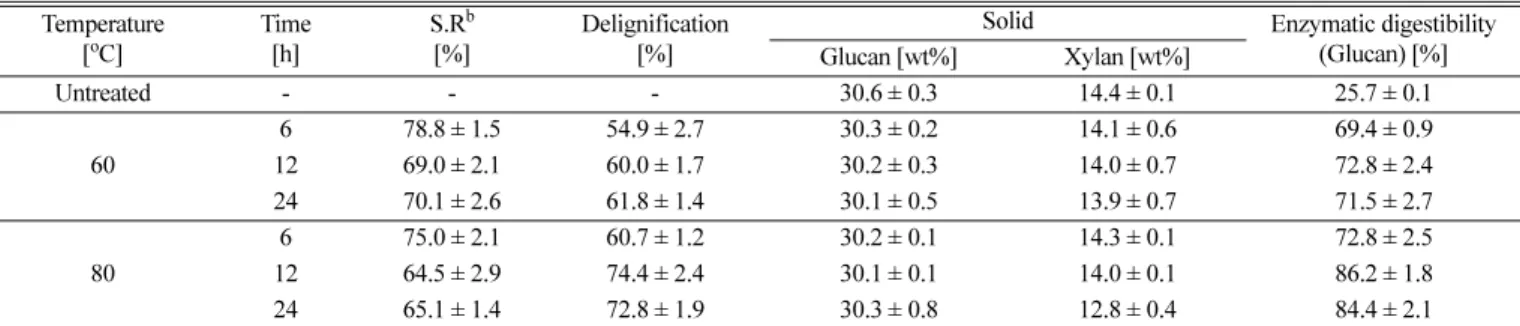
The effects of reaction time and temperature during the SAA treatment step were investigated. The changes in composition of the treated solid after the first fractionation step are summarized in Table 1. In a series of experiments, three different reaction times (6, 12, and 24 h) were tested at two different reaction temperatures (60oC and 80oC), while keeping ammonia concentration and solid-to-liquid ration at 15% and 1:10, respectively. Major differences were observed in the lignin composition of the solid samples so treated. With SAA at 60oC, as reaction time increased from 6 h to 24 h, lignin removal increased from 54.9% to 61.8%. On the other hand, SAA treatment at the higher temperature (80oC) recovered more lignin, but a differ- ent phenomenon was observed. As reaction time during SAA treat- ment increased from 6 h to 24 h, lignin removal increased from 60.7% at 6 h to 74.4% at 12 h, but then decreased to 72.8% at 24 h.
The carbohydrate content (glucan and xylan) of the treated sam- ples was preserved and intact over the entire range of treatment con- ditions. Nearly 100% of the glucan, and 99% of the xylan, remained unchanged and did not undergo solubilization during treatment (except for the sample treated at 80oC for 24 h). Therefore, it was concluded that SAA treatment at 80oC for 12 h removed lignin effectively, and these conditions were selected as optimal reaction conditions for lig- nin fractionation. This also demonstrated that SAA treatment removed significant amounts of lignin, yet retained the cellulose and hemicel- lulose fractions in the treated solids.
Enzymatic digestibility tests were also conducted to evaluate the effects of changes in chemical composition during SAA treatment on enzymatic hydrolysis of treated solids (Table 1). With SAA treat- ment at 60oC, as reaction time increased (6 h to 24 h), enzymatic digestibility improved (69.4% to 71.5%). This confirmed the find-
ing from previous studies that lignin removal has a positive impact on the enzymatic digestibility of treated solids [18,19]. However, slightly higher maximum digestibility (72.8%) was observed with SAA treatment for 12 h. A similar trend was observed for SAA treat- ment at 80oC. Enzymatic digestibility was improved (72.8% to 86.2%) as reaction time increased (6 h to 12 h), but then decreased (to 84.4%) with SAA treatment for 24 h. We did not find any correla- tion between chemical composition and enzymatic digestibility in this study.
3-1-2. Effects of solid-to-liquid ratios on composition and enzy- matic digestibility
Solid-to-liquid (S:L) ratios were varied from 1:2 to 1:14 to evalu- ate the effects on chemical composition and enzymatic digestibility of treated solids, while maintaining the reaction temperature and time, at 80oC and 12 h, respectively.
Lignin removal increased from 5.8% to 74.4% as the S:L was increased from 1:2 to 1:12. A slight decrease was observed when the S:L reached 1:14 (Fig. 3). It was also observed that the enzymatic digestibility showed the same trend as with lignin removal, regarding
Table 1. Effects of reaction temperature and reaction time on the composition and enzymatic digestibility of SAA-treated rice strawa Temperature
[oC]
Time [h]
S.Rb [%]
Delignification [%]
Solid Enzymatic digestibility
(Glucan) [%]
Glucan [wt%] Xylan [wt%]
Untreated - - - 30.6 ± 0.3 14.4 ± 0.1 25.7 ± 0.1
60
6 78.8 ± 1.5 54.9 ± 2.7 30.3 ± 0.2 14.1 ± 0.6 69.4 ± 0.9
12 69.0 ± 2.1 60.0 ± 1.7 30.2 ± 0.3 14.0 ± 0.7 72.8 ± 2.4
24 70.1 ± 2.6 61.8 ± 1.4 30.1 ± 0.5 13.9 ± 0.7 71.5 ± 2.7
80
6 75.0 ± 2.1 60.7 ± 1.2 30.2 ± 0.1 14.3 ± 0.1 72.8 ± 2.5
12 64.5 ± 2.9 74.4 ± 2.4 30.1 ± 0.1 14.0 ± 0.1 86.2 ± 1.8
24 65.1 ± 1.4 72.8 ± 1.9 30.3 ± 0.8 12.8 ± 0.4 84.4 ± 2.1
aAll sugars and lignin contents are based on the oven-dry untreated biomass weight. Values are expressed as mean and standard deviation (n=2). Pretreatment conditions (SAA: soaking in aqueous ammonia): 15 wt% ammonia, solid:liquid ratio=1:12.
bS.R.: solid remaining after reaction.
cSAA: soaking in aqueous ammonia.
Fig. 3. Effects of the solid-to-liquid ratio on SAA: Pretreatment condi- tions, SAA: 15 wt% ammonia, 80oC, 12 h and 15 g of biomass (ODW).
occurred with S:L of 1:2, and resulted in the lowest enzymatic digestibil- ity (38.4%). In contrast, lignin removal reached maximum (74.4%) at S:L of 1:12, which consequently resulted in the maximum digestibility (86.0%). Under most test conditions, both glucan and xylan content were well preserved in the treated solids. All this indicated that a S:L of 1:12 is near optimum, for high lignin recovery and improved enzymatic digestibility.
Based on these test results, optimal operating conditions for SAA (first step) treatment were found to be 80oC reaction temperature, 12 h reaction time, and S:L of 1:12.
3-2. Effects of hot-water treatment in the second step (S2-hw) Hot-water fractionation was applied to recover xylo-oligomers from the SAA-treated solids in the first variant of the second step, which was conducted using a flow-through column reactor system.
Various reaction temperatures and reaction times were tested to evaluate the pretreatment (to improve enzymatic digestibility) and fractionation effects (to recover xylo-oligosaccharide) of hot-water treatment.
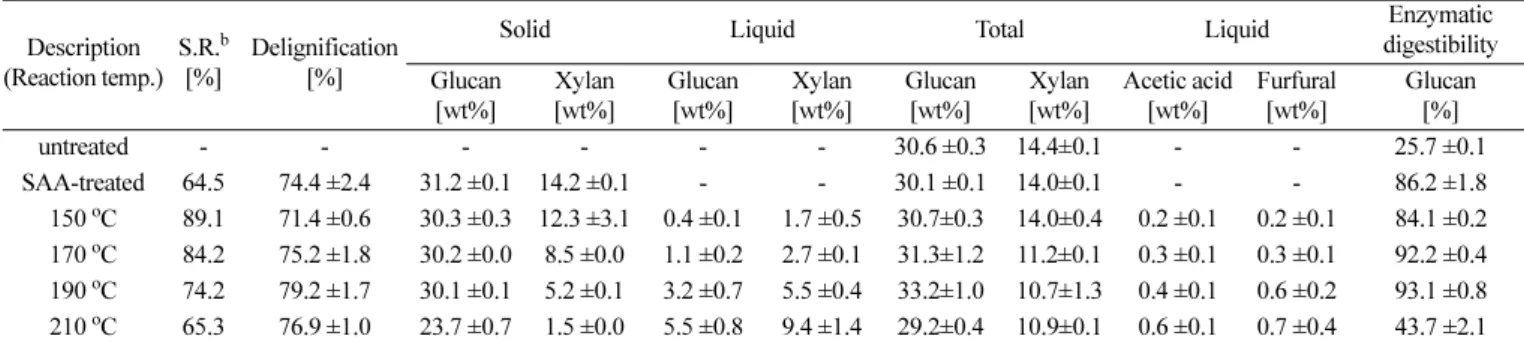
As indicated in Section 3-1-2, the treatment conditions for prepa- ration of SAA-treated solids in the first step were 15 wt% ammonia concentration, 80oC reaction temperature, 12 h reaction time, and S:L of 1:12. For effective xylan removal, four reaction temperatures (150, 170, 190 and 210oC) were attempted, while holding constant the other reaction conditions: 5.0 ml/min flow rate, 30 min reaction time, and 2.3 MPa reaction pressure. The results of lignin removal, chemical compositions of solids and liquids, and glucan digestibility are presented in Table 2.
Delignification increased from 71.4% to 79.2% as temperature increased from 150oC to 190oC (Table 2). A slight decrease in lignin removal (76.9%) was observed as temperature increased to 210oC.
More drastic change was observed in the glucan digestibility test.
Enzymatic digestibility increased from 84.1% to 93.1% as temperature increased from 150oC to 190oC. Increased temperature also effectively increased xylan removal from the SAA-treated solids: xylan content
of lignin and/or xylan, and consequent increase in surface area and porosity; however, there is no clear evidence for this notion, at this stage.
Although the elevated temperature turned out to be more effective for xylan removal, there was a substantial decrease in glucan digest- ibility: 43.7% at 210oC, compared with 93.1% at 190oC (Table 2).
Moreover, approximately 18% of the glucan was solubilized at 210oC using the S2-hw treatment. This is considered a negative factor because it means that high purity of xylo-oligomer in the hydrolysate cannot be achieved.
Formation of acetic acid and furfural in hydrolysates was determined.
Both acetic acid and furfural concentrations increased as reaction temperature increased: with the change from 150oC to 210oC, acetic acid increased from 0.2% to 0.6%, and furfural from 0.2 to 0.7%, respectively. This confirmed that hemicellulose includes some acetyl groups, and that S2-hw treatment hydrolyzed the xylan (hemicellu- lose) in the SAA-treated solids. Therefore, treatment using hot water at higher temperature cleaves more hemicellulose (xylan), which increases acetic acid formation in the liquid stream. In addition, it is also speculated that more severe treatment conditions (higher tem- perature) may decompose the released xylo-oligomers to form furfu- ral. The result in Table 2 indicates that as the solubilization of xylan increased, the production of furfural also increased. This confirms the previous finding by Kabel et al. [23] .
3-3. Effects of dilute sulfuric acid treatment in the second step (S2-sa)
The S2-hw fractionation treatment resulted in xylo-oligomer removal of only 65.3% at 210oC. Because sulfuric acid has been shown to be more effective for hemicellulose hydrolysis, fractionation of SAA- treated solid using dilute sulfuric acid (S2-sa) was also investigated.
Here, dilute sulfuric acid (0.2 wt%) at various reaction temperatures (150, 170, 190 and 210oC) were tested to evaluate the effects of S2- sa for xylo-oligomer recovery/removal and glucan digestibility of
Table 2. Compositions and enzymatic digestibility of untreated and SAA-hot-water treated solidsa
Description (Reaction temp.)
S.R.b [%]
Delignification [%]
Solid Liquid Total Liquid Enzymatic
digestibility Glucan
[wt%]
Xylan [wt%]
Glucan [wt%]
Xylan [wt%]
Glucan [wt%]
Xylan [wt%]
Acetic acid [wt%]
Furfural [wt%]
Glucan [%]
untreated - - - 30.6 ±0.3 14.4±0.1 - - 25.7 ±0.1
SAA-treated 64.5 74.4 ±2.4 31.2 ±0.1 14.2 ±0.1 - - 30.1 ±0.1 14.0±0.1 - - 86.2 ±1.8
150oC 89.1 71.4 ±0.6 30.3 ±0.3 12.3 ±3.1 0.4 ±0.1 1.7 ±0.5 30.7±0.3 14.0±0.4 0.2 ±0.1 0.2 ±0.1 84.1 ±0.2 170oC 84.2 75.2 ±1.8 30.2 ±0.0 8.5 ±0.0 1.1 ±0.2 2.7 ±0.1 31.3±1.2 11.2±0.1 0.3 ±0.1 0.3 ±0.1 92.2 ±0.4 190oC 74.2 79.2 ±1.7 30.1 ±0.1 5.2 ±0.1 3.2 ±0.7 5.5 ±0.4 33.2±1.0 10.7±1.3 0.4 ±0.1 0.6 ±0.2 93.1 ±0.8 210oC 65.3 76.9 ±1.0 23.7 ±0.7 1.5 ±0.0 5.5 ±0.8 9.4 ±1.4 29.2±0.4 10.9±0.1 0.6 ±0.1 0.7 ±0.4 43.7 ±2.1
aAll sugar and lignin contents are based on the oven-dry untreated biomass. Values are expressed as mean and standard deviation (n=2). Pretreatment conditions (2-step): SAA-H2SO4: 1st step (SAA) - 15 wt.% of ammonia concentration, 80°C of reaction temperature, 12 h of reaction time, and 1:12 of S:L ratio; 2nd step - hot-water treatment: 5.0 ml/min of flow rate, 30 min of reaction time, 2.3 MPa of pressure
bS.R.: Solid remaining after reaction.
cSAA: Soaking in aqueous ammonia
the residual solid. For effective xylan removal, four reaction tem- peratures were tested, keeping other reaction conditions constant: 5.0 ml/min flow rate, 30 min reaction time, and 2.3 MPa reaction pres- sure. The results for lignin removal, chemical compositions of the solids and liquids, and glucan digestibility are presented in Table 3.
Compared with S2-hw, the S2-sa treatment showed similar trends in terms of delignification and digestibility in relation to reaction temperature. As shown in Table 3, lignin removal increased from 79.2% to 85.4% as the temperature increased from 150oC to 170oC;
but suddenly decreased to 83.7% at 190oC; then to 75.0% at 210oC.
The enzymatic digestibility test gave similar results: the greatest digestibility (99.0%) occurred at 170oC; then it dropped to 45.1% at 210oC. It was observed that the highest delignification (85.4% at 170oC) resulted in near complete conversion of glucose (99.0%) by enzymes. On the other hand, further increase in treatment tempera- ture beyond 170oC solubilized the glucan significantly, and it was assumed, based on the mass balance in Table 3, that severe reaction temperature further decomposed the released glucose to form degra- dation products such as 5-(hydroxymethyl)furfural and organic acids, but these were not measured in this study.
The results in Table 3, also indicate that xylan removal using S2-sa (at 150-210oC)was in the range of 76.8-91.5%, a significant improve- ment over that achieved using S2-hw (13.4-89.4%). However, it was observed that xylan removal was greater (12.0-66.2%) with S2-hw than with S2-sa (21.8-50.0%) treatment. With regard to glucan con- tent in the residual solid, it seems that S2-sa treatment is more effective than S2-hw. However, overall, S2-satreatment resulted in greater lig- nin and xylan removal, and higher digestibility of residual solid, than did S2-hw treatment.
Collectively, these results indicate that the optimal operating con- ditions for a two-step fractionation process would be 80oC reaction temperature, 12 h reaction time, and S:L of 1:12 in the first step (SAA). Optimal conditions for the second step (S2-sa) would be 0.2 wt%
sulfuric acid, 170oC reaction temperature, 30 min reaction time, 5 ml/min flow rate, and 2.3 MPa of reaction pressure.
3-4. Enzymatic digestibility of 2-step-treated rice straw Enzymatic digestibility tests were conducted for the solid remain- ing after SAA (step 1) and S2-sa (step 2) treatments, using Novozyme Cellic CTech 2. Enzymatic digestibility test conditions included 15 Table 3. Compositions and enzymatic digestibility of untreated and SAA-H2SO4 treated solidsa
Description (Reaction temp.)
S.R.b [%]
Delignification [%]
Solid Liquid Total Liquid Enzymatic
digestibility Glucan
[wt%]
Xylan [wt%]
Glucan [wt%]
Xylan [wt%]
Glucan [wt%]
Xylan [wt%]
Acetic acid [wt%]
Furfural [wt%]
Glucan [%]
untreated - - - 30.6 ±0.3 14.4±0.1 - - 25.7 ±0.1
SAA-treated 64.5 74.4 ±2.4 31.2 ±0.1 14.2 ±0.1 - - 30.1 ±0.1 14.0±0.1 - - 86.2 ±1.8
150oC 57.0 79.2 ±2.8 23.1 ±0.1 3.3 ±0.6 2.0 ±0.0 3.1 ±0.0 25.1±0.1 6.4±1.2 0.2 ±0.1 0.8 ±0.0 85.1 ±2.1 170oC 49.3 85.4 ±1.3 22.5 ±0.0 3.0 ±1.4 2.2 ±0.0 3.8 ±0.0 24.7±0.4 6.8±1.1 1.0 ±0.8 1.9 ±1.2 99.0 ±0.4 190oC 34.5 83.2 ±0.2 13.4 ±0.3 2.1 ±0.4 2.9 ±0.1 5.4 ±0.1 16.3±1.1 7.5±0.4 1.2 ±0.7 2.0 ±1.0 95.0 ±2.0 210oC 32.2 75.0 ±1.7 8.1 ±0.2 1.2 ±0.2 3.5 ±0.1 7.1 ±0.1 11.6 ±0.5 8.3±0.6 1.4 ±1.0 2.4 ±1.0 45.1 ±1.3
aAll sugar and lignin contents are based on the oven-dry untreated biomass. Values are expressed as mean and standard deviation (n=2). Pretreatment conditions (2-step): SAA-H2SO4: 1st step (SAA) - 15 wt% of ammonia concentration, 80οC of reaction temperature, 12 h of reaction time, and 1:12 of S:L ratio; 2nd step - dilute sulfuric acid treatment: sulfuric acid (0.2 wt.%), 5.0 ml/min of flow rate, 30 min of reaction time, 2.3 MPa of pressure
bS.R.: Solid remaining after reaction.
cSAA: Soaking in aqueous ammonia
Fig. 4. Enzymatic digestibility of various pretreated solids: Conditions: digestibility at 72 h, enzymatic hydrolysis conditions 15 FPU/g-glucan, pH 4.8, 50oC and 150 rpm. Solid loading based on 1g-glucan basis. (a) First step-SAA (15 wt% ammonia, S:L = 1:12 for 15 g of biomass ODW), (b) Second step hot-water treatment (5.0 ml/min flow rate, 190oC, 2.3 MPa), (c) Second step dilute-sulfuric-acid treatment (0.2 wt% dilute sulfuric acid, 5.0 ml/min flow rate, 170οC, 2.3 MPa).
FPU/g-glucan, pH 4.8, 50oC, and 150 rpm. Glucose concentration profiles during enzymatic hydrolysis of untreated, SAA-treated, and SAA + S2-sa treated solids are shown in Fig. 4.
As shown in Fig. 4(a), both ‘SAA + S2-hw’ and ‘SAA + S2-hw’
treatments enhanced enzymatic results significantly. After 72 h, the digestibility of solid samples was 99% for SAA + S2-sa, 93% for SAA + S2-hw, and 86% for SAA alone. Moreover, the initial hydrolysis rates of samples treated with both SAA + S2-hw and SAA + S2-sa, were much faster than that of the SAA-only treated solids. As shown in Table 2 and Table 3, both two-step treatments were found to be effec- tive for lignin and xylan removal. It also confirmed previous finding that lignin generally hinders enzymatic reaction of cellulose [24-26].
3-5. Mass balance of two-step fractionation of rice straw The overall mass balance for this two-step fractionation process for rice straw is presented in Fig. 5. Here, it was assumed that 1000 g of rice straw is fractionated into three main components using the following two-step process. A first step involving SAA treatment would occur under the conditions: 80oC, 12 h, 15% ammonia con- centration, and S:L of 1:12. This would be followed by a second step under the conditions: 170oC, 30 min, 0.2 wt% sulfuric acid, 5.0 ml/
min flow rate, and 2.3 MPa reaction pressure.
Untreated rice straw (1000 g) contains 306 g of glucan, 144 g of xylan, and 187 g of lignin. From the mass balance, this optimized two-step fractionation process can recover 139 g of lignin and 38 g of xylo-oligomer in liquids, and 300 g of cellulose in solid cake. If this glucan-rich solid cake is then subjected to the enzymatic saccharifi- cation step, 300 g of glucose (99% digestibility) can also be obtained.
4. Conclusion
Optimized 2-step fractionation processes for rice straw, using aqueous ammonia and dilute sulfuric acid, produced two main prod- uct streams, which included glucan-rich solid and lignin-rich liquor.
After this two-step treatment (SAA + S2-sa) of the glucan-rich solid,
it was highly susceptible to enzyme action. This resulted in 99% of 72 h-glucan digestibility with 15 FPU of CTec2 commercial cellu- lase/g-glucan of enzyme loading.
It was confirmed that SAA at moderate temperature (80οC) removed 55-74% of the lignin, while it retained carbohydrates well in the solid residual (~100% for glucan and >90.1% for xylan), under all test conditions. Comparing the two variants of the second-step in frac- tionation treatment, SAA and sulfuric acid more effectively removed lignin (85.4% of delignification) and xylan (80% of removal) than did SAA and hot water. It was also found that the removal of lignin and xylan improved the accessibility of cellulosic biomass to cellu- lase enzymes.
Acknowledgement
This research was supported by “Human Resources Development program (No. 20134030200230) of the Korea Institute of Energy Technology Evaluation and Planning (KETEP) grant funded by the Korea government Ministry of Trade, Industry and Energy” and National Research Foundation of Korea (NRF Nos. 2013R1A1A2010001, 2012K1A3A1A31054765).
References
1. Wyman, C. E., Dale, B. E., Elander, R. T., Holtzapple, M., Ladisch, M. R. and Lee, Y. Y., “Coordinated Development of Leading Biomass Pretreatment Technologies,” Biores. Technol., 96(18), 1959-1966(2005).
2. Limayem, A. and Ricke, S. C., “Lignocellulosic Material for Bioethanol Production: Current perspectives, Potential Issues and Future Prospects,” Prog. Energy Combust. Sci., 38, 449-467 (2012).
3. Ko, J. K., Bak, J. S., Jung, M. W., Lee, H. J., Choi, I. G., Kim, T.
H. and Kim, K. H., “Ethanol Production from Rice Straw Using Optimized Aqueous-ammonia Soaking Pretreatment and Simul- taneous Saccharification And Fermentation Processes,” Biores.
Technol., 100, 4374-4380(2009).
Fig. 5. Mass balance of the overall process including pretreatment and enzymatic hydrolysis: (a) Rice straw was soaked in 15% (w/w) aque- ous ammonia with a solid-to-liquid ratio of 1:12 at 80oC for 12 h during initial treatment. (b)Dilute acid treatment was conducted at 5.0 ml/min of flow rate, 170oC, 2.3 MPa. (C) Two-step treated rice straw was hydrolyzed with enzyme loading of 15 FPU of cellulase/g- glucan at 50oC and 150 rpm for 72 h.
4. Kim, T. H., Chapter 6: Pretreatment of Lignocellulosic material.
Bioprocessing technologies in Biorefinery for Sustainable Produc- tion of fuels, chemicals and polymers. 1st ed., John Wiley & Sons, Inc., Hoboken, NJ, USA(2003).
5. Kim, S. and Dale, B. E., “Global Potential Bioethanol Production from Wasted Crops and Crop Residue,” Biomass Bioenerg., 26, 361-375(2004).
6. Kim, S. B., Lee, S. J., Lee, J. H., Jung, Y. R., Thapa, L. P., Kim, J.
S., Um, Y., Park, C. and Kim, S. W., “Pretreatment of Rice Straw with Combines Process Using Sulfuric Acid and Aqueous Ammo- nia,” Biotechnol. Biofuels, 6, 109(2013).
7. Binod, P., Sindhu, R., Singhania, R. R., Vikram, S., Devi, L., Naga- lakshmi, S., Kurien, N., Sukumaran, R. K. and Pandey, A., “Bioeth- anol Production from Rice Straw: An Overview,” Biores. Technol., 101, 4767-4774(2010).
8. Zheng, Y., Pan, Z. and Zhang, R., “Overview of Biomass Pretreat- ment for Cellulosic Ethanol Production,” Int. J. Agric. & Biol.
Eng., 2, 51-68(2009).
9. Won, K. Y., Um, B. H., Kim, S. W., and Oh, K. K., “Fractionation of Barley Straw with Dilute Sulfuric Acid for Improving Hemi- cellulose Recovery,” Korean J. Chem. Eng., 29(5), 614-620(2012).
10. Kim, T. H., “Sequential Hydrolysis of Hemicellulose and Lig- nin in Lignocellulosic Biomass by Two-stage Percolation Process Using Dilute Sulfuric Acid and Ammonium Hydroxide,” Korean J.
Chem. Eng., 28(11), 2156-2162(2011).
11. Koukios, E. G. and Valkanas, G. N., “Process for Chemical Separa- tion of the Three Main Components of Lignocellulosic Biomass,”
Ind. & Eng. Chem. Product Res. & Develop., 21, 309-314(1982).
12. Kim, T. H. and Lee, Y. Y., “Pretreatment of Corn Stover by Low- liquid Ammonia Recycle Percolation Process,” Appl. Biochem.
Biotechnol., 133, 41-57(2006).
13. Zhao, X. Q., Zi, L. H., Bai, F. W., Lin, H. L., Hao, X. M., Yue, G. J. and Ho, N. W. Y., “Bioethanol from Lignocellulosic Mate- rial,” Adv. Biochem. Engin/Biotechnol., 128, 25-51(2012).
14. Joshi, B., Bhatt, M., Sharma, D., Joshi, J., Malla, R. and Sreerama, L., “Lignocellulosic Ethanol Production: Current Practices and Recent Developments,” Biotechnol. Molec. Biology Rev., 6(8), 172-182(2011).
15. Harmsen, P. F. H., Huijigen, W. J. J., Lopez, L. M. B. and Bakker,
R. R. C., “Literature Review of Physical and Chemical Pretreat- ment Processes for Lignocellulosic Material,” Energy research Centre of the Netherlands, ECN-E-10-013(2010).
16. Chen, F. and Dixon, R. A., “Lignin Modification Improves Fer- mentable Sugar Yields for Biofuel Production,” Nat. Biotechnol., 25(7), 759-761(2007).
17. Kim, T. H., “Comparison of Inhibition Effects of Various Iso- lated Lignins on Enzymatic Hydrolysis of Cellulose,” Korean J.
Chem. Eng., 29(1), 82-88(2012).
18. Kim, T. H. and Lee, Y. Y., “Pretreatment of Corn Stover by Soak- ing in Aqueous Ammonia,” Appl. Biochem. Biotechnol., 124, 1119- 1132(2003).
19. Kim T. H. and Lee, Y. Y., “Pretreatment of Corn Stover by Soak- ing in Aqueous Ammonia at Moderate Temperatures,” Appl. Bio- chem. Biotechnol., 136-140, 81-92(2007).
20. NREL, “Determination of Structural Carbohydrates and Lignin in Biomass,” NREL/TP-510-42618, 2008. National Renewable Energy Laboratory, Golden, CO, USA(2008).
21. NREL, “Measurement of Cellulase Activities,” NREL/TP-510-42628, 2008. National Renewable Energy Laboratory, Golden, CO, USA (2008).
22. NREL, “Enzymatic Saccharification of Lignocellulosic Material,”
NREL/TP-510-42629, 2008. National Renewable Energy Labo- ratory, Golden, CO, USA(2008).
23. Kable, M. A., Bos, G., Zeevalking, J., Vorangen, A. G. J. and Schols, H. A., “Effects of Pretreatment Severity on Xylan Solubility and Enzymatic Breakdown of the Remaining Cellulose from Wheat Straw,” Biores. Technol., 98, 2034-2042(2007).
24. Kim, T. H. and Lee, Y. Y., “Fractionation of Corn Stover by Hot Water and Aqueous Ammonia Treatment,” Biores. Technol., 97, 224-232(2003).
25. Yoo, C. G., Lee C. W. and Kim T. H., “Two-step Fractionation of Corn Stover Using Aqueous Ammonia and Hot Water,” Appl. Biochem.
Biotechnol., 164, 729-740(2011).
26. Shrestha, R. K., Hur, O. and Kim, T. H., “Pretreatment of Corn Stover for Improved Enzymatic Saccharification using Ammonia Circulation Reactor (ACR),” Kor. Chem. Eng. Res., 51(3), 335-341 (2013).