- 835 -
폐암절제후 발생한 기엥-바레 증후군
최 형 호* 김 보 영** 오 봉 석***
서 홍 주* 임 영 혁* 김 정 중*
=Abstract=
Guillain-Barre Syndrome After Resection of Lung Cancer
Hyung-Ho Choi, M.D.
*, Bo-Young Kim, M.D.
**, Bong-Suk Oh, M.D.
***Hong-Joo Seo, M.D.
*, Young-Hyuk Lim, M.D.
*, Jeong-Jung Kim, M.D.
*A 68-year-old man with Guillain-Barre syndrome after the resection of right upper lobe for squamous cell lung cancer is presented. He developed a sudden, symmetric, extremity weakness, respiratory insufficiency, and sensory ataxia on postoperative day 6. He was intubated emergently and placed on a ventilator. Electrodiagnostic studies were performed on days 2, 20, and 40 following the onset of weakness. Motor nerve conduction abnormalities were the predominant findings. Prolonged motor distal latencies, temporal dispersion, and partial motor conduction blocks were present and formed the diagnostic features of Guillain-Barre syndrome.
With supportive care and additive use of intravenous immunoglobulin, the illness resolved 6 weeks later after the onset of weakness.
(Korean J Thorac Cardiovasc Surg 2002;35:835-8)
Key words : 1. Guillain-Barre syndrome 2. squamous cell lung cancer 3. Intravenous immunoglobulin
*
Department of Thoracic and Cardiovascular Surgery, Chosun University Hospital, Kwang-Ju, Korea
**
Department of Thoracic and Cardiovascular Surgery, Sangmoo Hospital, Kwang-Ju, Korea
***
Chonnam National University, College of Medicine: Department of Thoracic and Cardiovascular Surgery, Kwang-Ju, Korea 논문접수일 : 2001년 9월 1일 심사통과일 : 2002년 10월 5일
†이 논문은 1998년도 조선대학교 교내 학술연구비에 의하여 수행되었음.
책임저자 : Hyung-Ho Choi, Department of Thoracic and Cardiovascular Surgery, Chosun University Hospital, Dong-Gu, Seosuk-Dong 588, Kwang-Ju, Korea, (Tel) 062-220-3160, (Fax) 062-228-1444, E-mail : [email protected]
본 논문의 저작권 및 전자매체의 지적소유권은 대한흉부외과학회에 있다.
Case
A 68-year-old man with chest pain was admitted to our institute. In his forties he underwent an anterior fixation of cervical spine after traffic accident and he has a history of smoking. His chest X-ray revealed a
right upper zone opacity measuring 2 × 3cm and a subsequent Computed tomography of the thorax reported a mass on the right upper lobe consistent with lung cancer. Bronchoscopic cytology results indicated that the tumor was squamous cell lung cancer. Mediastinoscopy showed no metastatic disease. The patient underwent a
최형호 외 대흉외지
Guillain-Barre Syndrome After Resection of Lung Cancer 2002;35:835-8
- 836 -
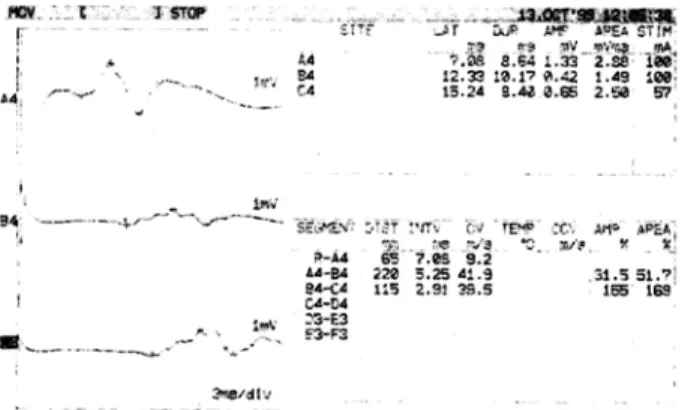
Fig. 1. The finding of electrophysiologic study performed on day 2 following the onset of weakness, showing the prolonged motor distal latencies, temporal dispersion, and partial motor conduction blocks.
NCV, Nerve conduction velocity
right upper lobe lobectomy with minithoracotomy unevenfully. Pathologic analysis disclosed a well -differentiated squamous cell carcinoma. All lymph node were negative for metastatic disease. Pathologic TNM staging was stage Ia(T1N0M0). He took a typical stable postoperative course and no sign of systemic inflamma- tion. On the evening of postoperative day 6, he noted a floating sensation bilaterally in the toes and feet on walking. Next morning, his respiratory efforts became shallow with poor chest excursion suddenly. Emergent bronchoscopy showed no abnormal findings. He was intubated, transferred to the intensive care unit and placed on a ventilator. Lumbar puncture produced clear, colorless fluid with a cerebrospinal fluid(CSF) protein of 168 mg%(normal 15
~
45 mg%), glucose of 146 mg/dl(serum 206 mg/dl), and cell counts of 3 red blood cells/mm3 and 2 white blood cells/mm3. Electro- physiologic studies were performed on days 2, 20, and 40 following the onset of weakness(Fig. 1). Motor nerve conduction abnormalities were predominant findings.Prolonged motor distal latencies, temporal dispersion, and partial motor conduction blocks were present and form the diagnostic features of GBS. His motor power was recorded as 1/5 in all four limbs with absence of tendon reflexes. Abnormalities in sensory nerve conductions and blink reflexes were also present. In histocompatibility(HLA) molecular study, HLA- DRB1*1301 allele was identified. Tracheostomy was performed 10 days later after application of ventilator.
Our patient received 0.4 mg/kg/day of intravenous
immunoglobulin (IVIg) for 5 days after confirmation of GBS and booster IVIg was administrated 3 weeks later as same dosage. He showed rapid improvement of muscular weakness after booster injection of the IVIg.
He was weaned off ventilator throughout next 5 weeks, transferred out of intensive care unit, and discharged from the hospital with walking on postoperative day 42 in good medical condition. He is well 24 months after operation.
Discussion
Guillain-Barre syndrome(GBS) is an immune mediated peripheral neuropathy characterized by acute onset of symmetric limb weakness and areflexia. Patients with typical GBS had greater leg weakness than arm weakness, with ascending progress.
Neuropathy involved with disseminated malignancy (paraneoplastic GBS) is rare and heterogeneous disor- ders. Some of paraneoplastic GBS are part of complex syndrome involving simultaneously the central and peripheral nervous system, the most frequent of which is delayed or subacute sensory neuropathy/paraneoplastic encephalomyelitis.
Sometimes the clinical differentiation between GBS and paraneoplastic GBS may be difficult. Few of neuro- pathy associated with small cell carcinoma and adeno- carcinoma of the lung is reported4), but there is none in acutely developed GBS with squamous cell lung cancer.
GBS is now recognized as a heterogenous disorder with many clinical manifestations and a diverse disorder, including both acute inflammatory demyelinating poly- neuropathy(AIDP) and acute motor axonal neuropathy (AMAN)5). The disease is of unknown etiology, although several lines of evidence suggest an immunologic pathogenesis. Approximately Two-thirds of the cases are preceded by an infection, most frequently of the respiratory or gastrointestinal tracts. Recently, the importance of host factors, associated with a certain MHC class II genes, was also suggested9).
In association with the carcinoma, depending on diagnostic criteria, up to 50% of patients with carcinoma developed peripheral neuropathy6) and Treatment toxicity, tumorous infiltration, metabolic disturbances, or terminal cachexia account for most cases7). Some of them are part of complex syndromes involving simultaneously the central and peripheral nervous system, the most frequent
대흉외지 최형호 외
2002;35:835-8 Guillain-Barre Syndrome After Resection of Lung Cancer
- 837 -
of which is subacute sensory neuropathy/ paraneoplasticencephalomyelitis8). Jean-christophe Antoine et al.
suggested that most of the neuropathies which occurred within 2.5 years with a carcinoma correspond to known inflammatory disorders suggest that despite the absence of specific antibodies or other known immunological markers, tumors have in some way induced the immunological perturbations underlying the neuro- pathies3).
Dimitri S. Monos et al. showed that the two forms of GBS, AIDP and AMAN, are characterized by independent HLA associations and each of these forms has a different HLA association than the other8). In his studies, increased number of AIDP patients has the DRB1*1301 allele, and alleles DRB1* 1301-03 and DRB1*1312 were increased in AMAN patients. Our patient has a DRB allele.
Although we could not perform the anti-onconeural antibodies because of absence of specific antibody in korea, clinical manifestation, electrophysiologic study and HLA study make the diagnosis of GBS more likely than paraneoplastic syndrome.
Treatment of GBS has evolved over the past two decades from supportive care only to the additive use of plasmapheresis and, more recently, IVIg. IVIg therapy has been shown to be an effective treatment for GBS, other inflammatory and autoimmune disorders. M. K.
Sharief et al. suggested the mechanism of action of IVIg is selective modulation of circulating proinflammatory cytokines and recommended the high dose one cycled IVIg therapy9). Our patient received 0.4 mg/kg/ day of IVIg for 5 days and one more cycle 2weeks later. He showed more rapid improvement of muscular weakness after booster injection, and completely recovered. We have experienced an effective two cycled IVIg therapy, and it has not been reported.
Respiratory failure requiring mechanical ventilation is a common complication of Guillian-Barre syndrome and up to one-occurs in 14
~
44% of patients1). Generallyearly tracheostomy was recommended to a patient applied ventilator in GBS to avoid some of the complications related to prolonged endotracheal tube placement. We performed tracheostomy at 10 day from weakness and there was no respiratory complication Although we could not find an exact cause of the illness, we have experienced an effective two cycled IVIg therapy in GBS after resection of squamous cell lung cancer and herein report.
We here report a case of GBS after resection of squamous cell lung cancer, presenting as an acute form, recovered completely with 2 cycled immunoglobulin therapy.