https://doi.org/10.9721/KJFST.2020.52.5.503
503
©The Korean Society of Food Science and Technology
Variations in total phenols, total anthocyanins, and antioxidant activity levels
in black chokeberry (Aronia melanocarpa) fruits subjected to dry
and moist heat treatments
Hekap Kim1,*and Thu Thi Hoai Mai21School of Natural Resources and Environmental Science, Kangwon National University 2Department of Environmental Science, Kangwon National University
Abstract The present study investigated the effects of dry and moist heat treatments on total phenols, total anthocyanins, and antioxidant activity levels in black chokeberry (Aronia melanocarpa) fruits. Lyophilized chokeberry powder samples were heated in a drying oven at 60, 100, 160, 180, and 200oC for 20, 40, or 60 min. Finely ground fresh chokeberry fruits were heated in water at 60, 80, and 100oC for 20 min, and bioactive compound and antioxidant activity levels were measured. The bioactive compounds and antioxidant activity decreased with increasing temperature and treatment duration. Antioxidant activity was preserved at 160oC or lower without significant loss for dry heating, whereas moist heat treatment increased both bioactive compounds and antioxidant activity with increasing temperature.
Keywords: black chokeberry, heat treatment, phenolic compounds, anthocyanins, antioxidant activity
Introduction
Black chokeberry (Aronia melanocarpa) fruits are rich in phenolic compounds, including flavonoids (e.g., flavon-3-ols), anthocyanins, and phenolic acids (e.g., chlorogenic acid and neochlorogenic acid) (Kulling and Rawel, 2008). Chokeberries have been considered as natural medicine for treating diseases in the cardiovascular and digestive systems because of their high antioxidant activity resulting from the high phenolic compound content (Kulling and Rawel, 2008). In addition, chokeberries possess blood pressure-lowering, lipid-pressure-lowering, gastroprotective, hepatoprotective, and anti-carcinogenic properties (Denev et al., 2018). Recently, chokeberry products and preparations have shown antiviral activity (Park et al., 2013), aging effects (Daskalova et al., 2015), and anti-inflammatory activity in patients with mildly elevated blood pressure (Brzóska et al., 2015). However, the astringent taste deriving from their high phenolic compound content, particularly phenolic acids and proanthocyanidins (also called condensed tannins), limits their consumption as raw fruit (Kulling and Rawel, 2008). Therefore, chokeberries are usually consumed in several preparations, such as juice, jam, jelly, syrup, bread, tea, and wine. Some of these products, including jam, bread, and tea, undergo dry or moist heat treatments while prepared that may result in the loss of bioactive compounds and, consequently, antioxidant activity.
The two most popular chokeberry products are juice and dried
powder. The unpleasant taste of chokeberry fruit juice is reduced because macromolecular tannins are less extracted into the aqueous phase during its preparation, providing that the juice is produced using the compressing method without grinding. The residue pomace is commonly used for the production of dietary supplements (pills or capsules), functional foods, snacks, or tea infusions after drying (Vattem et al., 2005; Wawer et al., 2006; Baranowski et al., 2009). The drying method also influences the bioactive compound content and antioxidant activity. Convective hot air drying of whole fruits at 50-70oC for 12-24 h usually leads to decreased antioxidant levels, and in particular, anthocyanins (Hwang and Thi, 2014; Samoticha et al., 2016; Park and Kim, 2018).
Furthermore, black chokeberry can be used as a food additive. Some types of food are heated, but the bioactive compounds in chokeberry can be degraded. There are two types of heat cooking methods for chokeberry as follows: dry and moist heat cooking. One example of dry heat cooking is bread baking, in which bread is baked with fresh fruits or dried powder at 160-210oC. Fresh fruits can also be used for preparing hot soup, pot stew, or steamed rice.
Previous studies demonstrated that the bioactive compounds and antioxidant activities of some other berries are influenced by temperature and time during either dry or moist heating. Anthocyanins are generally thermolabile, and the maximum heating temperature and duration without significant anthocyanin loss seemed to be less than approximately 100oC and 30 min, respectively (Cristea, 2016; Hwang and Ki, 2013; Khanal et al., 2010). On the contrary, Yue and Xu (2008) reported that anthocyanins in bilberry were rapidly degraded at 100oC or higher by dry heating, whereas 2,2-diphenyl-1-picrylhydrazyl (DPPH) free radical scavenging activity rather slightly increased at 100oC for 10 and 20 min and at 125oC for 10 min. However, longer heating durations resulted in decreased antioxidant activity. Moist heating of the aqueous extract of some fruits and vegetables and other types of berries showed results similar *Corresponding author: School of Natural Resources and
Environ-mental Science, Kangwon National University, Chuncheon, Gang-won 24341, Republic of Korea
Tel: 82-33-250-8577 Fax: 82-33-259-5563 E-mail: [email protected]
Received July 20, 2020; revised August 17, 2020; accepted August 20, 2020
to those for dry heating (Arancibia-Avila et al., 2012; Leong and Oey, 2012), indicating that 100oC and 20 min would be maximum moist heating temperature and duration conditions at which significant loss of biological activity is avoided.
The above-mentioned previous studies were conducted for either dry or moist heating separately for vegetables and fruits other than chokeberry. This study aimed at investigating the variations of chokeberry in total phenols, total anthocyanins, and antioxidant activity levels using both heating methods.
Materials and Methods
Reagents
Folin-Ciocalteu’s reagent (FCR), 2,2'-azino-bis(3-ethylbenzothiazoline-6-sulfonate) (ABTS), gallic acid, sodium carbonate, DPPH, and potassium persulfate were purchased from Sigma-Aldrich (St. Louis, MO, USA). High performance liquid chromatography (HPLC)-grade water, methanol, and acetonitrile were purchased from Thermo Fisher Scientific (Waltham, MA, USA), and formic acid was obtained from Daejung Chemicals & Metals (Seheung, Korea). All reagents were used without further purification.
Sample preparation
Black chokeberry (Nero cultivar) fruits that were cultivated in Chuncheon, Korea and harvested in late August of 2018 were used. The fresh fruits were stored in a freezer (−24oC) on the same
day until further use.
The heating experiments were carried out using the two following methods: dry and moist heating. For the dry heating experiments, fresh chokeberry fruits were lyophilized in a freeze-dryer (MG-VFD20; MG Ind., Gunpo, Korea) and then pulverized using a blender (HMF-3500TG; Hanil, Seoul, Korea). The dried powder (1 g) was heated in a drying oven (ThermoStable OF-155; Daihan Scientific, Wonju, Korea) at 60, 100, 160, 180, or 200oC for 20, 40, or 60 min. Each experiment was carried out in triplicate. Bioactive compounds were extracted into 10 mL of 50% ethanol in water (v/v) from each sample, and the total phenolic content (TPC) and total anthocyanin content (TAC) were measured as well as the antioxidant activity.
For the moist heating experiment, 25 g of fresh fruits were cut into small pieces in 250 mL of water using a blender (Hanil). Thereafter, 20 mL of the mixture in a 40-mL glass vial was heated in a water bath at 60, 80, or 100oC for 20 min each. The heated samples were centrifuged at 10,000 rpm (ScanSpeed 1580; LaboGene, Seoul, Korea), and the upper layer was analyzed for the aforementioned items.
Measurement of TPC
The TPC in each sample was measured using FCR and colorimetric methods as previously described by Singleton et al. (1999), with slight modifications. Here, 1 mL of FCR was added to 1 mL of the berry extract in a 15-mL centrifuge tube, and the resulting mixture was left at room temperature for 5 min. Then, 3 mL of 2% Na2CO3 was added into the vial and left at room temperature for 30 min. Absorbance values at 750 nm were measured
using a UV-9100 spectrophotometer (Human Corp., Seoul, Korea). Gallic acid was used as a standard for quantitation, and the measured concentrations were expressed as mg of gallic acid equivalent (GAE)/kg dry weight (DW) or fresh weight (FW).
Measurement of TAC
The TAC in each sample was measured using the pH differential method previously described by Giusti and Wrolstad (2001), with slight modifications. A diluted sample (0.1 mL; absorbance, 0.1-0.2 at 510 nm) was mixed with 3.9 mL of either pH 1.0 buffer solution (hydrochloric acid-potassium chloride buffer) or pH 4.5 buffer solution (acetic acid-sodium acetate buffer). The mixture was heated at 40oC for 15 min, and the absorbance at each pH was measured at 510 and 700 nm, respectively. The absorbance (A) of each sample was calculated using Eq. (1) as follows:
A=(A510 nm−A700 nm)pH 1.0−(A510 nm−A700 nm)pH 4.5 (1)
TAC was calculated for cyanidin-3-glucoside using Eq. (2) as follows:
TAC (mg/L) (2)
where A=absorbance value; MW=molecular weight of cyanidin-3-glucoside (449.2 g/mol); DF=dilution factor; ε =molar absorptivity of cyanidin-3-glucose (26,900 L/mol-cm); and d=path length (1 cm). TAC was expressed as mg cyanidin-3-glucose equivalent/ kg DW or FW.
Chromatographic comparison of anthocyanin peak areas In addition to TPC, four anthocyanins (cyanidin-3-galactoside, cyanidin-3-glucoside, cyanidin-3-arabinoside, and cyanidin-3-xyloside) in the berry extract measured using a method previously described by Kalt et al. (1999). Each sample was filtered through a 0.45-μm hydrophilic PTFE syringe filter (LabTech, Sorisole, Bergamo, Italy). Then, 10 mL of the filtrate was injected into a high-performance liquid chromatograph-photo diode array detector (Waters Co., Milford, MA, USA), and the total peak area variations of the four anthocyanins were investigated. A SkyPak C18 analytical column (250 mm×4.6 mm×5 μm; SK Chemicals, Seongnam, Korea) and ODS-A guard column (20 mm×4.0 mm×5 mm; YMC, Kyoto, Kansai, Japan). The mobile phases were composed of 5% formic acid in water (A) and methanol (B), and the flow rate was set at 0.5 mL/min. The eluent program was as follows: 0 to 10 min, 91% A; 10 to 15 min, 65% A; 15 to 20 min, 65% A; 20 to 25 min, 50% A; and 25 to 35 min, 91% A. Each anthocyanin was detected at 520 nm.
Determination of ABTS and DPPH radical scavenging activity antioxidant activities
ABTS radical scavenging activity was determined using the method previously described by Re et al. (1999). The ABTS solution was prepared by mixing 10 mL of the ABTS (7 mM) and 10 mL of K2S2O8 (2.45 mM) solutions and storing in the refrigerator for 24 h. The ABTS solution was diluted with ethanol to attain an absorbance value at 732 nm of 0.7±0.05. The diluted extract (0.05
A×MW×DF×1000 ε d× ---=
mL) was mixed with the ABTS solution (2.95 mL) and kept in the dark for 10 min. The absorbance value of the mixture was measured at 734 nm. The percentage inhibition was calculated using Eq. (3) as follows:
Percentage inhibition (%)= ×100 (3)
where Ablank=absorbance for blank; and Asample=absorbance for
sample.
DPPH radical scavenging activity was determined using the method previously described by Benvenuti et al. (2006). The diluted extract (0.05 mL) was mixed with 0.2 mM DPPH solution (2.95 mL), and the mixture was kept in the dark for 30 min. The absorbance values at 515 nm were measured against a blank, and the percentage inhibition was calculated using the same equation as that used to calculate ABTS antioxidant activity.
Statistical analysis
All data were presented as mean±standard deviation. One-way analysis of variance (ANOVA) tests were carried out to compare the mean values among data sets with a significance level (α) of 0.05 using the IBM® SPSS Statistics 24 software (SPSS Inc., Chicago, IL, USA).
Results and Discussion
Variations of TPC and TAC by dry heating
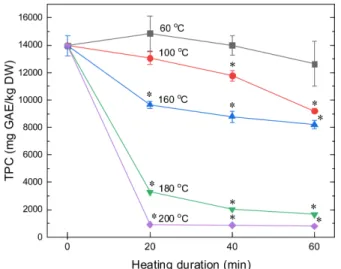
TPC variations in the lyophilized chokeberry powder by dry heating are shown in Fig. 1. The TPC reduction was dependent on both the heating temperature and duration; higher temperature and longer heating generally resulted in further TPC reduction. Temperature appeared to be a more critical parameter. The TPC was decreased by 76% at 180oC and 93% at 200oC after 20 min of heating, compared with that of the control group. Two other lower temperature options such as 100 and 160oC showed much lower
TPC reduction rates than 180oC or higher, displaying a gradual decrease over time. Furthermore, heating for 60 min at those temperatures resulted in 34 and 41% TPC reduction, respectively. On the contrary, heating at 60oC for 20 min seemed to rather increase TPC, but its average value was not significantly different from the initial values (p=0.313) at a significance level of 0.05. Heating at 60oC for 40 min did not change the TPC, but 60 min of heating showed a 14% decrease.
Anthocyanins were more thermolabile than the other phenolic compounds as indicated in Fig. 2. Exposure to the three highest temperature options (160, 180, and 200oC) for 20 min or longer led to a loss of TAC of 99% or greater. Heating at 100oC for 20 min resulted in a great reduction of TAC (46%) compared to unheated control, but no further decrease was observed for longer heating durations (47% for 40 and 60 min). Heating at 60oC showed a slow TAC reduction by 11, 34, and 43% for 20, 40, and 60 min, respectively.
Figure 3A shows the HPLC results for 20 min dry heating at 60, 100, 160, 180, and 200oC. The chromatographic retention times for galactoside, glucoside, cyanidin-3-arabinoside, and cyanidin-3-xyloside were 21.9, 22.7, 24.7, and 29.4 min, respectively. As suggested in Fig. 2, the peak area count (6.4×10⁷) for TAC at 100oC was lower than that (7.4×10⁷) at 60oC, and no peaks were identified in the chromatograms at 160oC or higher. This confirmed that high temperatures above 160oC led to almost complete anthocyanin degradation in chokeberry powder. These results show that dry heat cooking at high temperatures and for long periods of time can decrease the contents of the aforementioned bioactive compounds. Berries, including blueberry, chokeberry, raspberry, strawberry, and blackberry, are sometimes used as additives in bread baked at high temperatures ranging commonly between 160 and 220oC. For example, cakes are baked at 160-180oC for 40 min, cookies at 160-180oC for 16 min, and yeast bread at 200oC for 45 min, and the selected temperature and duration of the baking may depend on the product size, ingredients, Ablank–Asample
Ablank
---Fig. 2. Changes in total anthocyanin content (TAC) expressed as mg cyanidin-3-glucose equivalent/kg dry weight (mg CGE/kg DW) in lyophilized chokeberry powder with dry heating temperature and duration. The asterisks (*) indicate that the values are significantly different from the initial value.
Fig. 1. Changes in total phenolic content (TPC) expressed as mg gallic acid equivalent/kg dry weight (mg GAE/kg DW) in lyophilized chokeberry powder with increasing dry heating temperature and duration. The asterisks (*) indicate that the values are significantly different from the initial value.
and desired taste. Therefore, a great loss of bioactive compounds is expected during bread baking.
The bioactive compounds were found to decrease significantly even at low-temperature convective drying of berries, which is commonly carried out at 50-70oC for 12-48 h (Hwang and Thi, 2014; Park and Kim, 2018; Samoticha et al., 2016). TPC and TAC
were decreased by as much as 22-32 and 57-64%, respectively, compared with those following freeze-drying (Samoticha et al., 2016), which was recommended to be the optimal drying method for chokeberry. This indicated that prolonged convective drying also contributed to loss of bioactive compounds.
Ross et al. (2011) tested the thermal stability of polyphenolic Fig. 3. HPLC results of four anthocyanins in dry- (A) and moist-heated (B) chokeberry samples. Peaks were identified as follows: (1) cyanidin-3-galactoside (21.9 min), (2) cyanidin-3-glucoside (22.7 min), (3) cyanidin-3-arabinoside (24.7 min), and (4) cyanidin-3-xyloside (29.4 min).
compounds in grape seed flour at 120-240oC for a wide range of time durations (10-90 min), and found that temperatures of 180oC or higher and durations of 10 min or longer drastically decreased both TPC and TAC. They also observed that heating at 240oC for 10 min virtually resulted in the total loss of bioactive compounds. Several studies focused on the thermostability of anthocyanins that are frequently used as food colorants. Anthocyanin decomposition in the dry methanolic extract of bilberry fruits was drastically increased with increasing temperature (80, 100, and 125oC) and duration (10, 20, and 30 min) (Yue and Xu, 2008). For example, the average half-lives of cyanidin-3-galactose were approximately 120, 25, and 5 min for 80, 100, and 125oC, respectively, indicating that anthocyanins are very unstable at temperatures greater than 100oC. Other studies also demonstrated that heating at 60oC reduced the anthocyanin content in grape and blueberry pomace (Khanal et al., 2010) and chokeberry extract (Hwang and Ki, 2013), and approximately 40oC is a presumable marginal temperature for anthocyanin thermostability (Hwang and Ki, 2013). Our results also indicated that anthocyanins are very thermolabile compounds and need low-temperature storage or processing to minimize loss.
Variations of antioxidant activities by dry heating
The ABTS and DPPH antioxidant activities were not greatly changed (Table 1) by dry heating of chokeberry powder at 160oC or lower for 20 to 60 min. Heating at 180oC did not reduce ABTS antioxidant activity for 20 and 40 min, but decreased it for 60 min by 17%. However, heating at the same temperature (180oC) influenced DPPH antioxidant activity more than ABTS antioxidant activity, reducing it by 4.5, 19, and 26% for 20, 40, and 60 min, respectively. On another note, heating at 200oC for 60 min remarkably decreased both ABTS and DPPH antioxidant activities by 65 and 60%, respectively. Based on these two assays, dry heating at 160oC for 60 min would be the maximum temperature and heating duration conditions for processing chokeberries in order to avoid significant loss of antioxidant activities.
Antioxidant activity usually decreases with decreasing TPC and TAC. Our study results are consistent with those of previous studies. Dry heating in a convection oven at 50-70oC reduced both antioxidant activities and bioactive compounds (Hwang and Thi, 2014; Samoticha et al., 2016). Heating at 240oC for 10 min caused a complete loss of DPPH radical scavenging activity (Ross et al., 2011).
Variations of TPC, TAC, and antioxidant activity by moist heating
Moist heating of ground fresh chokeberries for 20 min did not reduce TPC and TAC at all temperatures tested, but rather increased them with temperature increase (Fig. 4). TPC at 60, 80, and 100oC increased by 22, 53, and 88%, respectively, compared with the unheated control (25oC). TAC at 60oC did not differ from the control, but increased by 55 and 42% at 80 and 100oC, respectively. Comparison of peak areas in the HPLC results (Fig. 3B) demonstrated that four anthocyanins in water are stable at all temperature ranges, with increased concentrations.
Two studies were carried out for moist heating of fruits, vegetables, and berries in water. One used the aqueous extract of lyophilized berry powder (murtilla and blueberry) (Arancibia-Avila et al., 2012), and the other used several thinly sliced fruits and vegetables in water (Leong and Oey, 2012). Their heating experiments used 100 and 98oC, respectively, and reported that the bioactive compounds were stable in the aqueous medium for 20 min or shorter. On the contrary, longer heating (40 and 60 min) resulted in the loss of both bioactive compounds by approximately 20% or more (Arancibia-Avila et al., 2012). However, it is uncommon in real cooking to heat food in water for 20 min or longer. Therefore, it can be said that TPC and TAC are stable following moist heating in regular cooking.
Our result was consistent with the aforementioned reports. Moist Fig. 4. Variations in TPC and TAC with moist heating at 60, 80, and 100oC for 20 min. The asterisks (*) indicate that the values are significantly different from the initial value.
Table 1. Variations in ABTS and DPPH radical scavenging activities with dry heating temperature and duration Temperature
(οC)
ABTS radical scavenging activities (% inhibition) DPPH radical scavenging activities (% inhibition)
0 min 20 min 40 min 60 min 0 min 20 min 40 min 60 min
60 97.6±0.7 97.4±0.7 98.4±0.3 98.2±0.3 91.3±0.4 90.9±0.1 91.4±0.4 91.6±0.1
100 97.6±07 98.2±0.5 97.9±0.7 98.2±0.3 91.3±0.4 91.9±0.3 92.1±0.1 92.2±0.1
160 97.6±0.7 99.1±0.0 *99.3±0.1* *99.5±0.1* 91.3±0.4 *92.7±0.2* *93.4±0.1* *93.5±0.0* 180 97.6±0.7 98.7±0.1 97.5±0.3 *84.2±5.6* 91.3±0.4 87.2±5.6 *73.7±7.3* *67.3±5.8* 200 97.6±0.7 *68.1±6.6* *37.9±3.0* *34.4±5.9* 91.3±0.4 *46.6±0.5* *38.9±3.6* *36.3±3.1*
heating at high temperatures led to increase in bioactive compounds, particularly anthocyanins (Fig. 4). A similar result was reported for other fruits and vegetables (apricot, cherry, nectarine, peach, plum, carrot, and pepper) (Leong and Oey, 2012). This increase could be attributed to enzyme inactivation, change in fruit surface texture, and more leaching of water-soluble compounds (e.g., polyphenols) into the water (Leong and Oey, 2012). Hence, the change in bioactive compound concentration by moist heating may be a cumulative result of the balance between extractability increase and thermal degradation (Leong and Oey, 2012). Therefore, this study suggests that chokeberry fruits can be used as food additive for moist heat cooking, such as the preparation of soups, steamed rice, and teas, without significant loss of bioactive compounds.
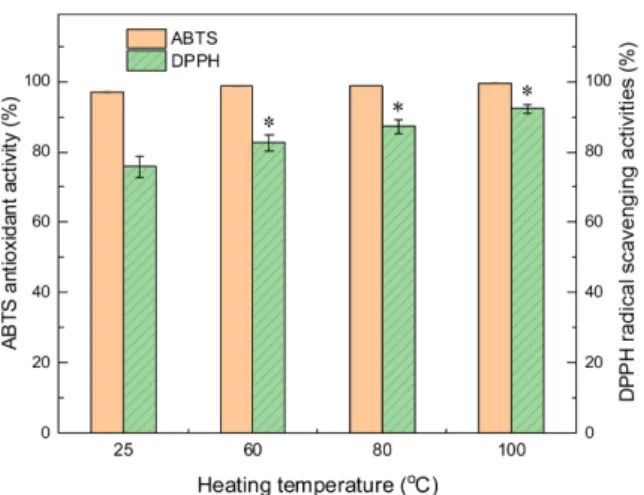
In this study, moist heating at 60, 80, and 100oC did not reduce the ABTS radical scavenging activities, but the DPPH radical scavenging activities increased with increasing temperature (Fig. 5). A one-way ANOVA test showed that the ABTS radical scavenging activities at 60, 80, and 100oC were statistically different from that at 25oC. Similarly, Crista (2016) examined 50% ethanolic extract of chokeberries for thermostability at different temperatures (40, 60, and 80oC for 15 min, and 100oC for 2 min) and found that thermal treatment at all temperatures tested did not decrease ABTS radical scavenging activities, it rather increased it at both 80 and 100oC, as observed in this study. Similar results were also reported for citrus extract and certain herbs following moist heating (Jeong et al., 2004) or steam sterilization (Kurzeja et al., 2012). Therefore, these results suggest that typical moist-heat cooking methods would not cause the loss of antioxidant activity from bioactive compounds in chokeberries.
Conclusion
This study showed that bioactive components (total phenols and anthocyanins) in aronia (black chokeberry) fruits are thermo-labile during dry heat treatment. Anthocyanins are highly sensitive to such treatment, suggesting that proper heating temperature and duration should be chosen to minimize the loss of the components,
when this method is used for cooking. On the contrary, moist heat treatment does not give rise to significant losses of bioactive compounds, or rather increases the contents of the components and their antioxidant activities at higher temperature. Therefore, if proper heating method, temperature, and heating duration are selected, aronia fruit can be used as a dietary supplement with preserved active ingredients.
Acknowledgments
This study was supported by a 2017 Research Grant from the Kangwon National University (No. 520170223). The authors would like to thank Enago (www.enago.co.kr) for the English language review.
Conflict of Interest
The authors declare that no conflict of interest exists.
References
Arancibia-Avila P, Namiesnik J, Toledo F, Werner E, Martinez-Ayala AL, Rocha-Guzmán NE, Gallegos-Infante JA, Gorinstein S. The influence of different time durations of thermal processing on berries quality. Food Control 26: 587-593 (2012)
Baranowski K, Baca E, Salamon A, Micha³owska D, Meller D, Karaœ M. Possibilities of retrieving and making a practical use of phenolic compounds from the waste products: Blackcurrant and chokeberry pomace and spent hops. Z. Nauka Technol. Jakosc/Food Sci. Technol. Qual. 16: 100-109 (2009)
Benvenuti S, Pellati F, Melegari M, Bertelli D. Polyphenols, anthocy-anins, ascorbic acid, and radical scavenging activity of Rubus, Ribes, and Aronia. J. Food Sci. 69: FCT164-FCT169 (2006) Brzóska MM, Rogalska J, Galazyn-Sidorczuk M, Jurczuk M,
Roszc-zenko A, Tomczyk M. Protective effect of Aronia melanocarpa
polyphenols against cadmium-induced disorders in bone metabo-lism: A study in a rat model of lifetime human exposure to this heavy metal. Chem.-Biol. Interact. 229: 132-146 (2015)
Cristea E. The influence of thermal treatments on the antioxidant activity and colour of chokeberry (Aronia melanocarpa) extract. Int. J. Food Stud. 5: 224-231 (2016)
Daskalova E, Delchev S, Peeva Y, Vladimirova-Kitova L, Kratcha-nova M, Kratchanov C, Denev P. Antiatherogenic and cardiopro-tective effects of black chokeberry (Aronia melanocarpa) juice in aging rats. Evid.-Based Compl. Alt. 2015: 1-10 (2015)
Denev P, Kratchanova M, Petrova I, Klisurova D, Georgiev Y,
Ogn-yanov M, Yanakieva I. Black chokeberry (Aronia melanocarpa
(Michx.) Elliot) fruits and functional drinks differ significantly in their chemical composition and antioxidant activity. J. Chem. 2018: 1-11 (2018)
Giusti MM, Wrolstad RE, Characterization and measurement of anthocyanins by UV-Visible spectroscopy. Curr. Protoc. Food Anal. Chem. F1.2.1-F1.2.13 (2001)
Hwang E-S, Thi ND. Antioxidant contents and antioxidant activities of hot-water extracts of aronia (Aronia melanocarpa) with differ-ent drying methods. Korean J. Food Sci. Technol. 46: 303-308 (2014)
Hwang E-S, Ki K-N. Stability of the anthocyanin pigment extracted from aronia (Aronia melanocarpa). Korean J. Food Sci. Technol. 45: 416-421 (2013)
Jeong M, Kim Y, Kim D-R, Jo C, Nam KC, Ahn DU, Lee S-C. Effect of heat treatment on the antioxidant activity of extracts from citrus peels. J. Agr. Food Chem. 52: 3389-3393 (2004) Kalt W, McDonald JE, Ricker RD, Lu X. Anthocyanin content and
profile within and among blueberry species. Can. J. Plant Sci. 79:
Fig. 5. Variations in ABTS and DPPH radical scavenging activities by moist heating at 60, 80, and 100oC for 20 min. The asterisks (*) indicate that the values are significantly different from the initial value.
617-623 (1999)
Khanal RC, Howard LR, Prior RL. Effect of heating on the stability of grape and blueberry pomace procyanidins and total anthocya-nins. Food Res. Int. 43: 1464-1469 (2010)
Kulling SE, Rawel HM. Chokeberry (Aronia melanocarpa)-A review
on the characteristic components and potential health effects. Planta Med. 74: 1625-1634 (2008)
Kurzeja E, Stec M, Ramos P, Pilawa B, Pawłowska-Góral K. The influence of sterilization on free-radical generation, discoloration and the antioxidant properties of certain spice herbs. Ital. J. Food Sci. 24: 254-262 (2012)
Leong SY, Oey I. Effects of processing on anthocyanins, carotenoids and vitamin C in summer fruits and vegetables. Food Chem. 133: 1577-1587 (2012)
Park M-H, Kim B. Antioxidant and anti-inflammatory activities in
freeze-dried and tot air-dried aronia (Aronia melanocarpa)
extracts. Food Eng. Prog. 22: 315-320 (2018)
Park S, Kim JI, Lee I, Lee S, Hwang M-W, Bae J-Y, Heo J, Kim D, Han S-Z, Park M-S. Aronia melanocarpa and its components demonstrate antiviral activity against influenza viruses. Biochem. Biophys. Res. Commun. 440: 14-19 (2013)
Re R, Pellegrini N, Proteggente A, Pannala A, Yang M, Rice-Evans
C. Antioxidant activity applying an improved ABTS radical cat-ion decolorizatcat-ion assay. Free Radical Bio. Med. 26: 1231-1237 (1999)
Ross CF, Hoye Jr C., Fernandez-Plotka VCF. Influence of heating on the polyphenolic content and antioxidant activity of grape seed flour. J. Food Sci. 76: C884-C890 (2011)
Samoticha J, Wojdyło A, Lech K. The influence of different drying methods on chemical composition and antioxidant activity in chokeberries. LWT-Food Sci. Technol. 66: 484-489 (2016) Singleton VR, Orthofer R, Lamuela-Raventós RM. Analysis of total
phenols and other oxidation substrates and antioxidants by means of folin-ciocalteu reagent. Method. Enzymol. 299: 152-178 (1999) Vattem DA, Ghaedian R, Shetty K, Enhancing health benefits of
ber-ries through phenolic antioxidant enrichment: focus on cranberry. Asia Pac. J. Clin. Nutr. 14: 120-130 (2005)
Wawer I, Wolniak M, Paradowska K. Solid state NMR study of dietary fiber powders from aronia, bilberry, black currant and apple. Solid State Nucl. Mag. 30: 106-113 (2006)
Yue X, Xu Z. Changes of anthocyanins, anthocyanidins, and antioxi-dant activity in bilberry extract during heating. J. Food Sci. 73: C494-C499 (2008)