D I A B E T E S & M E T A B O L I S M J O U R N A L
This is an Open Access article distributed under the terms of the Creative Commons Attribution Non-Commercial License (https://creativecommons.org/licenses/by-nc/4.0/) which permits unrestricted non-commercial use, distribution, and reproduction in any medium, provided the original work is properly cited.
Inhibition of Ceramide Accumulation in Podocytes by Myriocin Prevents Diabetic Nephropathy
Chang-Yun Woo1, Ji Yeon Baek1, Ah-Ram Kim2, Chung Hwan Hong3, Ji Eun Yoon3, Hyoun Sik Kim2, Hyun Ju Yoo3, Tae-Sik Park4, Ranjan Kc2,*, Ki-Up Lee1,2, Eun Hee Koh1,2
1Department of Internal Medicine, 2Asan Institute for Life Science, University of Ulsan College of Medicine, Seoul,
3 Department of Medical Science and Asan Medical Institute of Convergence Science and Technology, Asan Medical Center, University of Ulsan College of Medicine, Seoul,
4Department of Life Science, Gachon University, Seongnam, Korea
Background: Ceramides are associated with metabolic complications including diabetic nephropathy in patients with diabetes.
Recent studies have reported that podocytes play a pivotal role in the progression of diabetic nephropathy. Also, mitochondrial dysfunction is known to be an early event in podocyte injury. Thus, we tested the hypothesis that ceramide accumulation in podo- cytes induces mitochondrial damage through reactive oxygen species (ROS) production in patients with diabetic nephropathy.
Methods: We used Otsuka Long Evans Tokushima Fatty (OLETF) rats and high-fat diet (HFD)-fed mice. We fed the animals ei- ther a control- or a myriocin-containing diet to evaluate the effects of the ceramide. Also, we assessed the effects of ceramide on intracellular ROS generation and on podocyte autophagy in cultured podocytes.
Results: OLETF rats and HFD-fed mice showed albuminuria, histologic features of diabetic nephropathy, and podocyte injury, whereas myriocin treatment effectively treated these abnormalities. Cultured podocytes exposed to agents predicted to be risk factors (high glucose, high free fatty acid, and angiotensin II in combination [GFA]) showed an increase in ceramide accumula- tion and ROS generation in podocyte mitochondria. Pretreatment with myriocin reversed GFA-induced mitochondrial ROS generation and prevented cell death. Myriocin-pretreated cells were protected from GFA-induced disruption of mitochondrial integrity.
Conclusion: We showed that mitochondrial ceramide accumulation may result in podocyte damage through ROS production.
Therefore, this signaling pathway could become a pharmacological target to abate the development of diabetic kidney disease.
Keywords: Diabetic nephropathies; Ceramides; Mitochondria; Podocytes; Reactive oxygen species; Thermozymocidin
Corresponding author: Eun Hee Koh https://orcid.org/0000-0003-3829-0384 Department of Internal Medicine, Asan Medical Center, University of Ulsan College of Medicine, 88 Olympic-ro 43-gil, Songpa-gu, Seoul 05505, Korea
E-mail: [email protected]
*Current affiliation: Division of Orthopaedic Surgery, Department of Surgery, The
INTRODUCTION
The prevalence of diabetic nephropathy is increasing in paral- lel with the incidence of diabetes mellitus [1]. Diabetic ne- phropathy is a significant health problem worldwide and a leading cause of end-stage renal disease, accounting for ap- proximately 50% of its cases in the developed world [2]. The pathogenesis of diabetic nephropathy is complex and multifac- torial and includes a combination of hemodynamic and meta- bolic abnormalities that collectively contribute to kidney dam-
age and result in albuminuria and reductions in the glomerular filtration rate. Intrarenal hemodynamic abnormalities in asso- ciation with activation of the renin-angiotensin system and hy- perglycemia-associated generation of reactive oxygen species (ROS) are two factors leading to diabetic nephropathy [3-5].
However, because of the lack of comprehensive understanding of the pathogenesis of diabetic nephropathy, its pharmacologi- cal management remains challenging. Evidence is emerging that renal lipid metabolism may play a direct role in diabetic nephropathy progression [6,7].
https://doi.org/10.4093/dmj.2019.0063 pISSN 2233-6079 · eISSN 2233-6087
Ceramides are a family of sphingolipids that differ in their fatty acyl moiety and are intermediates in the sphingolipid synthesis pathway [8]. Evidence from various studies revealed that ceramide is an important mediator of inflammation [9], and it is associated with insulin resistance and metabolic disor- ders in various animal models as well as in humans. Further- more, it has been reported that plasma ceramides are elevated in obese patients with type 2 diabetes mellitus [10]. Most ce- ramide studies have focused on insulin resistance in the liver, muscle, and adipose tissue; only few have associated increased ceramide levels with renal injury, and most reports on diabetic nephropathy have used extrapolated data from plasma ce- ramide levels [11-13].
Ceramides can be generated by hydrolysis of sphingomyelin or can be produced by de novo synthesis [14]. Serine palmito- yltransferase (SPT) is the initial, rate-limiting enzyme of de novo ceramide synthesis. Administration of myriocin, a selec- tive SPT inhibitor, prevents homocysteine-induced ceramide formation in the renal cortex and attenuates glomerular injury [15].
Podocytes are highly specialized epithelial cells that line the outer surface of the glomerular basement membrane [16]. The glomerular podocyte density is the best predictor of albumin- uria and diabetic nephropathy progression [17]. Podocytes are characterized by a prominent nucleus, a well-developed Golgi system and endoplasmic reticulum, and large numbers of mi- tochondria. Podocyte mitochondria play a primary role in maintaining energy homeostasis [18] and mitochondrial dys- function is involved in podocyte injury [19,20]. Also, podocyte injury leads to progression of diabetic nephropathy [21].
Studies have indicated the possibility of glomerular ce- ramide and metabolites such as sphingosine accumulations contributing to the podocytopenia seen in patients with dia- betic nephropathy [12,22]. But how ceramide causes podocyte damage and whether myriocin has a protective effect in animal models of diabetic nephropathy remain unanswered questions.
Therefore, we conducted experiments in animal models of dia- betic nephropathy and immortalized mouse podocytes to test the hypothesis that mitochondrial ceramide accumulation in podocytes induces cell damage and albuminuria.
METHODS
Animals
The Institutional Animal Care and Use Committee of the Asan
Institute for Life Sciences (Seoul, Korea) approved all experi- ment protocols and animals used (2009-12-010). We pur- chased 8-week-old male C57BL/6N mice from Central Lab Animal (Seoul, Korea) and fed them a normal chow diet (12%
energy from fat) or a high-fat diet (HFD; 60% energy from fat;
Research Diets, New Brunswick, NJ, USA) for 8 weeks. We ob- tained 8-week-old male Otsuka Long Evans Tokushima Fatty (OLETF) and Long Evans Tokushima Otsuka (LETO) rats from Otsuka Pharmaceutical (Osaka, Japan).
Administration of myriocin
We treated OLETF rats for 4 weeks (starting at 18 weeks of age) and HFD-fed mice for 8 weeks (starting at 8 weeks of age) with myrio- cin (2S,3R,4R,6E)-2-amino-3,4-dihydroxy-2-(hydroxymethyl)- 14-oxo-6-eicosenoic acid (0.3 mg/kg/day; Sigma, St. Louis, MO, USA), added to powdered, standard mouse chow.
Urinary albumin excretion rate
We placed all OLETF rats at 22 weeks and C57BL/6N mice at 16 weeks of age in individual metabolic cages for 24 hours urine collections to measure urinary albumin excretion rates.
We used an enzyme-linked immunosorbent assay (ELISA; Im- munology Consultants Laboratory, Portland, OR, USA) to measure the urinary albumin excretion rates.
Electron microscopy
Kidney tissues were cut into 1 mm3 fragments. We washed kidney tissue or cultured cell samples in fresh 0.1 M phosphate buffer (pH 7.4) and fixed them in 2.5% glutaraldehyde in the same buffer for 4 hours at room temperature (RT). We then washed the tissues three times in fresh 0.1 M phosphate buffer (pH 7.4) for 10 minutes and fixed them in 1% OsO4 for 1 hour at RT and washed three times in 0.1 M phosphate buffer (10 minutes each). We embedded the samples in Epon according to standard techniques after dehydration with ethyl alcohol and propylene oxide. Ultrathin sections (60 nm) were cut from the blocks using a Reichart-Jung Ultratome E with a diamond knife. The sections were collected and stained with uranyl ace- tate followed by lead citrate, and we visualized them using a Hitachi H-7100 Transmission Electron Microscope (TEM) system (Hitachi, Tokyo, Japan).
Immunohistochemistry
Kidney specimens were fixed in Bouin’s solution. Immunos- taining was performed in paraffin-embedded sections using an
avidin-biotin immunoperoxidase technique with monoclonal antibodies against desmin (1:50; Dako, Glostrup, Denmark).
The sections were incubated overnight at 4°C with primary an- tibodies, washed with phosphate buffer saline, and then incu- bated with secondary antibodies (biotinylated anti-mouse im- munoglobulin G [IgG] and avidin-biotin-peroxidase complex;
Vector Labs, Burlingame, CA, USA) for 1 hour at RT. The reac- tion was developed using diaminobenzidine tetrahydrochlo- ride (Sigma) and counterstained with hematoxylin.
Ceramide measurements
We used both a liquid chromatography-tandem mass spectrom- etry system equipped with 1290 HPLC (Agilent, Santa Clara, CA, USA) Qtrap 5500 (AB Sciex, Framingham, MA, USA), and a reverse phase column (Pursuit 5 C18 150×2.0 mm). The sepa- ration gradient for ceramide used a mobile phase A (5 mM ammonium formate/MeOH/tetrahydrofuran; 500/200/300) and a mobile phase B (5 mM ammonium formate/MeOH/tet- rahydrofuran; 100/200/700) and proceeded at 200 µL/min and 35°C as follows: 50% of A for 0 minute, 50% of A for 5 minutes, 30% of A for 8 minutes, 30% of A for 15 minutes, 10% of A for 22 minutes, 10% of A for 25 minutes, 50% of A for 25.1 minutes, and then 50% of A for 30 minutes. The separation gradient for phosphatidylcholine (PC) used a mobile phase A (10 mM am- monium acetate in MeOH/isopropanol/H2O; 900/50/50) and a mobile phase B (10 mM ammonium acetate in MeOH/isopro- panol/H2O; 940/50/10) and proceeded at 400 µL/min and 35°C as follows: 50% of A for 0 minute, 50% of A for 5 minutes, 20%
of A for 10 minutes, 20% of A for 27 minutes, 50% of A for 27.1 minutes, and then 50% of A for 30 minutes. We used the select- ed reaction monitoring mode in positive ion mode and used the extracted ion chromatogram corresponding to the specific transition for each lipid for quantification. The calibration range for sphingolipids was 0.1 to 1,000 nM (r2≥0.99). We used the peak area ratio of each lipid/internal standard for relative comparisons among PCs.
Podocyte culture
We cultured cells in RPMI 1640 (Welgene, Daegu, Korea) sup- plemented with 10% heat-inactivated fetal bovine serum (FBS), 100 U/mL penicillin, and 100 mg/mL streptomycin in the presence of 50 U/mL recombinant murine interferon-γ (PeproTech, Rocky Hill, NJ, USA) at 33°C in 5% CO2/95% air (permissive conditions). We achieved differentiation into podocytes by culturing cells with 10% FBS in the absence of
interferon-γ at 37°C (non-permissive conditions). Cells were then maintained under non-permissive conditions for 10 to 14 days. We confirmed the differentiation of podocytes under light microscopy by detection of synaptopodin, a podocyte dif- ferentiation marker [23]. After starving differentiated podo- cytes in Dulbecco’s Modified Eagle Medium without FBS for 24 hours, we treated the cells with high glucose (25 mM), high free fatty acid (FFA) (200 μM linoleic acid), and angiotensin II (1 μM) (GFA) in combination or the same amount of mannitol for the indicated times in serum-free medium. We used podo- cytes between passages 15 and 20 in all experiments.
Cell viability assay
We harvested cells and plated them onto 96-well plates at 1×10³ cells/well maintained at 37°C in a humidified incubator.
After starving in media without FBS for 24 hours, cells were treated with GFA. At the indicated time points, we added 10 μL of cell counting kit 8 (CCK-8) solution (Dojindo Molecular Tech, Gaithersburg, MD, USA) into wells in triplicate and in- cubated them for 1 hour. We then calculated the number of vi- able cells in each well by measuring absorbance at 450 nm in a Spectramax 450PC (Molecular Devices, Sunnyvale, CA, USA).
ELISA for apoptosis
We measured the levels of cytosolic histone-bound DNA fragmen- ts using a Cell Death ELISA kit (Roche Diagnostics, Mannheim, Germany), as described by the manufacturer.
Mitochondrial ROS production measurement
We measured mitochondrial-specific ROS generation using the MitoSOX Red fluorescent dye (Molecular Probes, Eugene, OR, USA) as described by the manufacturer. We grew cells on glass coverslips (Marienfeld, Lauda-Königshafen, Germany) and loaded them with MitoSOX Red (5 μmol/L) for 30 min- utes at 37°C. We measured the cell fluorescence using confocal microscopy at 510 nm and emission at 580 nm.
Analysis of fluorescence intensity
We determined the integrated fluorescence intensity by manu- ally segmenting each cell in the image and then computing the average fluorescence intensity. We subtracted the background intensity in an area without cells and normalized the resulting data by the fluorescence of the calibration standard. We aver- aged fluorescence intensity values for 10 randomly selected cells in two different image fields to represent one sample. The
experiment was repeated five times, and the data were aver- aged [24].
Statistical analysis
All values are presented as mean±standard error of the mean.
We assessed comparisons between two groups using Mann- Whitney tests or unpaired two-tailed t-tests. We analyzed data from more than two groups using one-way or repeated mea- sure analysis of variance. We performed all statistical analyzes using the SPSS-PC15 software (SPSS Inc., Chicago, IL, USA).
Differences were considered statistically significant at P<0.05.
RESULTS
Myriocin prevented albuminuria and podocyte injury in OLETF rats
First, we examined the effect of myriocin on known animal models of diabetic nephropathy. In agreement with previous studies [25], the OLETF rats were more obese than the control LETO rats (Table 1). Plasma insulin, FFA, and glucose were also increased in OLETF rats compared with their levels in control LETO rats (Table 1). Also, OLETF rats at 22 weeks had significantly increased urinary albumin excretion and ce- ramide concentration of kidney cortex (Fig. 1A and B). Treat- ment with myriocin (0.3 mg/kg/day) from 18 to 22 weeks of age modestly reduced the increases in body weight, fasting plasma blood glucose, FFA, and insulin levels, as previously published (Table 1) [26]. These results suggest that the insulin resistance of OLETF rats was improved by myriocin. Also, treatment with myriocin significantly decreased the albumin- uria and ceramide concentration of kidney cortex in the rats as compared with the levels in untreated rats (Fig. 1A and B).
Moreover, in periodic acid-Schiff (PAS) staining, we observed diffuse mesangial thickening with glomerular basement mem- brane thickening in OLETF rats (a finding consistent with dia- betic nephropathy), and treatment with myriocin reverted these changes (Fig. 1C). Immunostaining for desmin (a mark- er for podocyte injury) was significantly increased in the
Fig. 1. Myriocin prevented albuminuria and podocyte injury in Otsuka Long Evans Tokushima Fatty (OLETF) rats. OLETF rats at 18 weeks of age were treated with myriocin for 4 weeks. (A) Twenty-four hours urinary albumin excretion. Data are presented as mean±standard error of the mean (n=7). (B) Kidney cortex ceramide concentration determined by liquid chromatography tandem mass spectrometry (LC-MS/MS) (n=5). (C) Representative images of immunostaining for periodic acid-Schiff (PAS) and desmin, a marker of podocyte injury and epithelial-mesenchymal transition. Scale bars, 50 μm (n=3). Con, control. aP<0.01 vs. Long Evans Tokushima Otsuka (LETO) rats, bP<0.05 vs. untreated OLETF rats.
50 40 30 20 10 0
30
20
10
n rinary albumin excretioU (mg/day) mide (μg/g tissue)l cerataTo 0
Con OLETF OLETF+ Con OLETF
Myriocin OLETF+
Myriocin Table 1. Effect of myriocin on body weight, fasting glucose, plasma insulin, and FFA levels in rats at 22 weeks of age
Variable Weight, g
Plasma insulin, ng/mL
Plasma glucose, mg/dL
Plasma FFA, µEq/L LETO 462.1±25.8 0.89±0.04 128.0±4.8 256.0±8.4 OLETF 590.4±21.0a 3.04±0.17a 226.4±12.7a 696.3±48.2a OLETF+Myr 438.8±31.2b 1.62±0.24b 166.8±8.6b 441.0±21.1b Values are presented as mean±standard error of the mean.
FFA, free fatty acid; LETO, Long Evans Tokushima Otsuka; OLETF, Otsuka Long Evans Tokushima Fatty; Myr, myriocin.
aP<0.05 vs. LETO rats, bP<0.05 vs. untreated OLETF rats (n=7 for each group).
A B C
LETO OLETF OLETF+Myriocin
a b a b
PAS
Desmin
OLETF rats compared with that in the LETO rats, whereas it was notably decreased in the OLETF rats treated with myrio- cin compared with the level in their untreated counterparts (Fig. 1C).
Myriocin prevented albuminuria and podocyte injury in HFD-fed mice
HFD feeding induces various systemic metabolic alterations in mice, including hyperglycemia and dyslipidemia. Moreover, these alterations are similar to those observed in patients with type 2 diabetes mellitus [27]. Renal injury induced by HFD feeding in mice is similar to diabetic nephropathy in humans [28]. So, we examined the effect of myriocin on HFD-fed mice.
HFD-fed mice showed a significant increase in body weight compared with the control group mice, and treatment with myriocin reduced the body weight difference between the
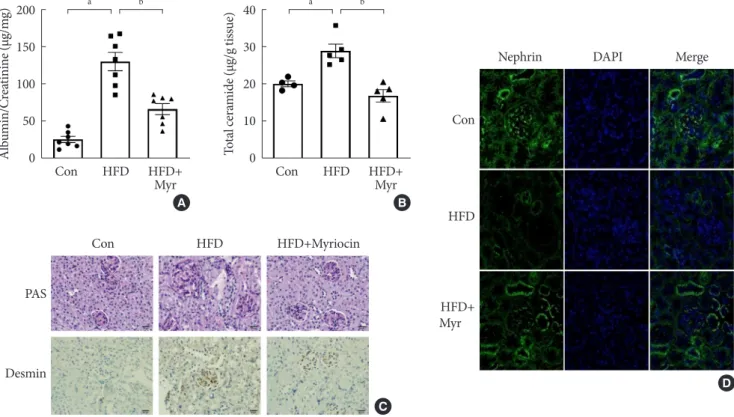
treated mice and the control mice (Table 2). Also, treatment with myriocin attenuated the metabolic complications such as the increased plasma insulin, glucose, and FFA levels in HFD-
Fig. 2. Treatment with myriocin prevented albuminuria and podocyte injury in high-fat diet (HFD)-fed mice. (A) Twenty-four hours urinary albumin excretion (n=7). Data are presented as mean±standard error of the mean. (B) Kidney cortex ceramide concentration determined by liquid chromatography tandem mass spectrometry (LC-MS/MS) (n=5). (C) Representative images of immunostaining for periodic acid-Schiff (PAS) and desmin. Scale bars, 50 μm (n=3). (D) The panels show representative im- ages of the immunofluorescence analysis of glomeruli from control, HFD diet, and HFD-fed treated myriocin (HFD+Myr) mice.
Myriocin restored the nephrin expression in HFD-fed mice. Green fluorescence denotes nephrin in the glomeruli, and blue fluo- rescence (DAPI) is indicative of the presence of a nucleus (×300). Con, control. aP<0.01 vs. control diet mice, bP<0.05 vs. un- treated HFD-fed mice.
200
150
100
50
0
40
30
20
10
Albumin/Creatinine (μg/mg) Total ceramide (μg/g tissue) 0
Con HFD HFD+ Con HFD
Myr HFD+
Myr
A B
D C
Nephrin
Con
DAPI
HFD
Merge
HFD+Myriocin
a b a b
Con
PAS
HFD
MyrHFD+
Desmin
Table 2. Effect of myriocin on body weight, fasting glucose, plasma insulin, and FFA levels in mice at 16 weeks of age
Variable Weight, g Plasma insulin, ng/mL
Plasma glucose, mg/dL
Plasma FFA, µEq/L ND 27.0±1.4 1.45±0.41 186.3±33.4 1,404.9±102.6 HFD 36.7±3.3a 5.93±0.84a 258.3±24.6a 1,442.2±100.8 HFD+Myr 23.6±0.8b 1.15±0.42b 175.2±15.0b 1,232.1±198.4 Values are presented as mean±standard error of the mean.
FFA, free fatty acid; ND, normal diet; HFD, high-fat diet; Myr, myrio- cin.
aP<0.05 vs. ND-fed mice, bP<0.05 vs. untreated HFD-fed mice (n=7 for each group).
fed mice compared with the levels in untreated mice (Table 2).
Next, HFD-fed mice exhibited an increase in urinary albumin excretion and kidney cortex ceramide levels (Fig. 2A and B).
Additionally, it showed glomerular hypertrophy and basement membrane thickening on histology (consistent with nephropa- thy) (Fig. 2C) compared with the control mice. Treatment with myriocin restored the albuminuria and ceramide concentration (Fig. 2A and B), and reverted the histological changes induced by the HFD (Fig. 2C). Nephrin is a crucial podocyte protein that functions as an adhesion molecule and a structural compo- nent of the slit diaphragm [29]. Nephrin staining is decreased in patients with diabetes mellitus, correlating with broadening of the foot process [30]. In HFD-fed mice, nephrin staining was less intense that that in control mice. Treatment with myriocin reverted these changes as compared with those in untreated mice (Fig. 2D). In all, HFD-fed mice showed podocyte damage and increased albuminuria, whereas decrease in ceramide level by myriocin prevented podocyte injury.
Combined exposure to high glucose, FFA, and angiotensin II increased the ceramide level and induced podocyte apoptosis in in vitro experiments
We mimicked a diabetic milieu in vitro and examined the ef- fects of putative pathogenic factors on cultured podocytes. Ex- posure of the cells to GFA reproducibly decreased cell viability and induced cellular apoptosis within 4 hours of culture (Fig.
3A and B). GFA treatment significantly increased ceramide generation in cultured podocytes as compared with the levels in untreated podocytes (Fig. 3C). Pretreatment with myriocin prevented GFA-induced increases in ceramide production and cell death (Fig. 3C and D).
GFA increased ceramide generation and ROS production in mitochondria of podocytes, and treatment with myriocin reverted these changes
Ceramide induces mitochondrial ROS production, which like- ly explains some of the harmful effects of ceramide accumula-
Fig. 3. Glucose, free fatty acid, and angiotensin II (GFA) treatment induced podocyte apoptosis. Myriocin pretreatment prevent- ed GFA-induced ceramide accumulation and alleviated the deleterious effects of GFA. (A) Apoptosis was determined at 4 hours using a Cell Death enzyme-linked immunosorbent assay (ELISA) kit (n=5). (B) Representative immunoblots for cleaved cas- pase-3 and caspase-9 (n=5). (C) Ceramide concentration determined by liquid chromatography tandem mass spectrometry (LC- MS/MS) (n=5). (D) Cell viability measured by the cell counting kit 8 (CCK-8) method (n=5). Data are presented as mean±standard error of the mean. Con, control; OD, optical density. aP<0.05 vs. untreated cells, bP<0.01 vs. GFA-treated cells.
400
300
200
100
0
2.0
1.5
1.0
0.5
0
120 100 80 60 40 20 0
Cleaved Caspase 3
Cleaved Caspase 9 Total Caspase 3
Total Caspase 9
Apoptosis, OD 405 nm (% control)Total ceramide (μmol/g) Cell viability (% 0 hr)
Con
Con Myriocin GFA GFA+ 1 2 3 4
Myriocin
Con
GFA A GFA
C D
B
a
a
a
b
GFAGFA+Myriocin
tion [31]. Thus, we checked the changes of ceramide accumu- lation and mitochondrial ROS production in podocytes over time. We monitored the levels of MitoSOX, an indicator of mi- tochondrial superoxide anion (O2−) production, to examine the time-dependent changes in mitochondrial ROS produc- tion. Cultured podocytes treated with GFA showed an increase in MitoSOX staining that first appeared at 60 minutes and peaked at 90 minutes to 2 hours. A time-course analysis of im- munofluorescence staining for ceramide revealed a similar pattern to that of mitochondrial ROS in these cells (Fig. 4A).
Interestingly, we observed that production of ceramide and ROS reached its peak 2 hours after treatment with GFA in podocytes, and this happened before the increase of apoptosis.
Also, treatment with GFA showed an increase in ceramide and ROS production as compared with the levels in untreated cells, and inhibition of ceramide production by myriocin inhibited the production of ROS.
TEM of podocytes revealed that, at 2 hours, GFA-treated podocytes exhibited an increased length of mitochondria with preserved cristae. At 4 hours, we observed vesicular distension of the mitochondrial cristae, indicating a progressive disrup- tion of mitochondrial integrity. Pretreatment with myriocin
prevented these morphological alterations induced by GFA (Fig. 4B).
DISCUSSION
Diabetic nephropathy is a common complication of diabetes and is the most common cause of end-stage renal disease in the world [2]. Trials of multifactorial interventions, including tightening glycemic control, blood pressure control, and the use of renin-angiotensin system blockers, have demonstrated that current treatment options slow but do not stop the pro- gression of diabetic nephropathy [32]. The reason for this clini- cal limitation is the lack of comprehensive understanding of the underlying mechanisms of diabetic nephropathy progres- sion. Therefore, identification of other determinants of diabetic nephropathy progression may lead to the development of nov- el drug candidates and better clinical outcomes.
In our study, we showed that myriocin, an inhibitor of de novo ceramide synthesis, improved albuminuria in two well- known diabetic animal models, OLETF rats, and HFD-fed mice. In both of these diabetic animal models, we identified podocyte injury, and treatment with myriocin ameliorated
Fig. 4. Myriocin decreased mitochondrial reactive oxy- gen species production through decreased ceramide ac- cumulation and prevented glucose, free fatty acid, and angiotensin II (GFA)-induced mitochondrial morpho- logical alterations. (A) Immunofluorescence corre- sponding to MitoSOX (red), ceramide (green), and nu- cleus (blue). Scale bars, 50 μm (n=3). (B) Transmission Electron Microscope (TEM) of podocyte mitochondria.
Scale bars, 1 μm. We pretreated podocytes for 24 hours with or without 1 μΜ myriocin in serum-free medium and then incubated them with GFA for 4 hours (n=4).
A
B
0 min 2 hr
90 min 60 min
2 hr
3 hr
4 hr
4 hr MitoSOX Ceramide MitoSOX Ceramide
GFA
GFA GFA+Myriocin
GFA+Myriocin
these changes. We exposed cultured podocytes to agents thought to increase the risk for diabetic nephropathy (GFA in combination) and found induced ceramide accumulation in mitochondria as well as increased cell death. Moreover, the de- creased accumulation of ceramide by myriocin prevented GFA-induced cell death.
Low ROS concentrations have important functions in regu- lating pathways such as tumor necrosis factor receptor 1 sig- naling, but high ROS concentrations ultimately lead to DNA damage and cell death [33]. There is a lot of evidence that oxi- dative stress is the common link for the major pathways in- volved in the development and progression of diabetic vascular complications including diabetic nephropathy [33]. Previous studies have reported that ceramide and oxidative stress are in- timately related to cell death induction [34]. Recently, there have been reports that the development of nonalcoholic steato- hepatitis or pancreatic β-cell dysfunction in patients with type 2 diabetes mellitus is associated with an increase in ROS by ce- ramide [35,36]. Moreover, in human myeloid leukemia U937 cells, it has been reported that ceramide elicits a direct effect on mitochondria to overproduce ROS, causing inhibition of the respiratory chain [37] and increasing permeability of the mito- chondrial membrane to form ceramide channels that increase cytochrome C release [35]. One study demonstrated the effects of ceramide on the respiratory chain by using mitochondrial respiration-deficient cells in which the ceramide-induced H2O2 production was abolished [37]. Consistent with these studies, our experiments showed that the increased ceramide of cultured podocytes produces mitochondrial ROS and causes cell damage, and we were able to prevent podocyte inju- ry by decreasing the ceramide level after treatment with myrio- cin. Next, we observed the mitochondria of podocytes by TEM to confirm that ceramide-induced apoptosis is related to mito- chondrial morphological changes. As a result, we observed the vesicular distension of mitochondrial cristae after GFA treat- ment and the protection of mitochondria from cristae disorga- nization by pretreatment with myriocin. According to the pre- vious studies, the integrity of mitochondrial cristae is impor- tant for mitochondrial function [38,39]. Additionally, ROS is considered as an important signaling molecule that can modu- late mitochondrial cristae morphology [39]. Taken together, our results suggest that the increase in mitochondrial ROS by ceramide accumulation induces mitochondrial dysfunction and podocytes apoptosis in diabetic nephropathy progression.
However, the mechanism linking ceramide and mitochondrial
ROS generation in diabetic nephropathy is still unclear, and future studies need to address this.
There are some limitations in this study. As described, myriocin attenuated features of diabetic nephropathy in ani- mal models of diabetes but decreased body weight. According to the previous studies, myriocin treatment reduces body weight [26,40]. It is not a result of any changes in food intake but rather occurs via an alternative mechanism such as an in- crease in metabolism and energy expenditure because, in a previous study, average daily intake is unchanged in myriocin- treated HFD-fed obese mice compared with controls [26]. Ad- ditional research is needed to determine the precise mecha- nism. Although weight loss itself has been reported to improve diabetic nephropathy [41], our findings suggest that there are other mechanisms improve albuminuria by myriocin. This is because the reduction of ceramide de novo synthesis by myrio- cin prevented podocyte injury in in vivo and subsequent in vi- tro experiments. To ensure this, pair-feeding experiments may be needed in the future. Another limitation of our experiment is that we did not measure plasma ceramide levels. However, according to a previous report, plasma ceramides are elevated in obese patients with diabetes [10], and we assumed that the ceramide levels of kidney cortex would have more direct effect on the deterioration of kidney function.
A variety of risk factors promotes the development and pro- gression of diabetic nephropathy, and among them, high glu- cose, high FFA, and angiotensin II are well-known risk factors, respectively. In previous studies, the administration of high glucose for 24 hours caused increase podocyte apoptosis [42], and stimulation with angiotensin II for 24 hours resulted in podocyte injury [43], and they were generally used for in vitro diabetic nephropathy models. In addition, previous studies have shown decreased insulin sensitivity and ceramide forma- tion when treated with fatty acid [44-46]. Because diabetic ne- phropathy is a result of the combined action of various patho- logic molecular pathways, we treated GFA in combination to mimic diabetic milieu. Since these risk factors were treated in combination, sufficient podocyte injuries were identified 4 hours after treatment. This was a short-term effect compared with those in the previous studies, but we considered it to be appropriate in in vitro model because it was a combination of factors involved in the pathogenesis of diabetic nephropathy.
However, it is unclear which of the three substances mainly in- creased the ceramide levels or whether a combined effect caused those.
Abnormal lipid metabolism has been reported to be associ- ated with the pathogenesis of diabetic nephropathy, and satu- rated fatty acids are known to promote ceramide accumula- tion. Also, plasma ceramide is elevated in obese patients with type 2 diabetes mellitus [10]. Thus, ceramide dysmetabolism may become an important target to manage diabetic nephrop- athy. In this study, we showed that mitochondrial ceramide ac- cumulation may result in podocyte damage through ROS pro- duction in diabetic mice models, and this signaling pathway may be used as a pharmacological target to prevent diabetic nephropathy.
CONFLICTS OF INTEREST
No potential conflict of interest relevant to this article was re- ported.
AUTHOR CONTRIBUTIONS
Conception or design: C.Y.W., K.U.L., E.H.K.
Acquisition, analysis, or interpretation of data: C.Y.W., J.Y.B., A.R.K., C.H.H., J.E.Y., H.S.K., H.J.Y., T.S.P., R.K., E.H.K.
Drafting the work or revising: C.Y.W., E.H.K.
Final approval of the manuscript: C.Y.W., E.H.K.
ORCID
Chang-Yun Woo https://orcid.org/0000-0002-8286-8481 Eun Hee Koh https://orcid.org/0000-0003-3829-0384
ACKNOWLEDGMENTS
This study was supported by grants from the National Re- search Foundation of Korea (NRF), funded by the Ministry of Education, Science, and Technology, Korea (2017R1E1A1- A01074207: Eun Hee Koh), and the Asan Institute for Life Sci- ences, Korea (2016-557).
REFERENCES
1. Harjutsalo V, Groop PH. Epidemiology and risk factors for dia- betic kidney disease. Adv Chronic Kidney Dis 2014;21:260-6.
2. Tuttle KR, Bakris GL, Bilous RW, Chiang JL, de Boer IH, Gold- stein-Fuchs J, Hirsch IB, Kalantar-Zadeh K, Narva AS, Nava- neethan SD, Neumiller JJ, Patel UD, Ratner RE, Whaley-Con-
nell AT, Molitch ME. Diabetic kidney disease: a report from an ADA Consensus Conference. Diabetes Care 2014;37:2864-83.
3. Forbes JM, Coughlan MT, Cooper ME. Oxidative stress as a major culprit in kidney disease in diabetes. Diabetes 2008;57:
1446-54.
4. Johnston CI, Fabris B, Jandeleit K. Intrarenal renin-angiotensin system in renal physiology and pathophysiology. Kidney Int Suppl 1993;42:S59-63.
5. Bhatti AB, Usman M. Drug targets for oxidative podocyte inju- ry in diabetic nephropathy. Cureus 2015;7:e393.
6. Jiang T, Wang Z, Proctor G, Moskowitz S, Liebman SE, Rogers T, Lucia MS, Li J, Levi M. Diet-induced obesity in C57BL/6J mice causes increased renal lipid accumulation and glomeru- losclerosis via a sterol regulatory element-binding protein-1c- dependent pathway. J Biol Chem 2005;280:32317-25.
7. Weinberg JM. Lipotoxicity. Kidney Int 2006;70:1560-6.
8. Adams JM 2nd, Pratipanawatr T, Berria R, Wang E, DeFronzo RA, Sullards MC, Mandarino LJ. Ceramide content is in- creased in skeletal muscle from obese insulin-resistant hu- mans. Diabetes 2004;53:25-31.
9. Kennedy A, Martinez K, Chuang CC, LaPoint K, McIntosh M.
Saturated fatty acid-mediated inflammation and insulin resis- tance in adipose tissue: mechanisms of action and implica- tions. J Nutr 2009;139:1-4.
10. Haus JM, Kashyap SR, Kasumov T, Zhang R, Kelly KR, De- fronzo RA, Kirwan JP. Plasma ceramides are elevated in obese subjects with type 2 diabetes and correlate with the severity of insulin resistance. Diabetes 2009;58:337-43.
11. Boini KM, Zhang C, Xia M, Poklis JL, Li PL. Role of sphingo- lipid mediator ceramide in obesity and renal injury in mice fed a high-fat diet. J Pharmacol Exp Ther 2010;334:839-46.
12. Merscher S, Fornoni A. Podocyte pathology and nephropathy:
sphingolipids in glomerular diseases. Front Endocrinol (Laus- anne) 2014;5:127.
13. Srivastava SP, Shi S, Koya D, Kanasaki K. Lipid mediators in di- abetic nephropathy. Fibrogenesis Tissue Repair 2014;7:12.
14. Chavez JA, Summers SA. A ceramide-centric view of insulin resistance. Cell Metab 2012;15:585-94.
15. Yi F, Zhang AY, Li N, Muh RW, Fillet M, Renert AF, Li PL. Inhi- bition of ceramide-redox signaling pathway blocks glomerular injury in hyperhomocysteinemic rats. Kidney Int 2006;70:88- 96.
16. Mundel P, Kriz W. Structure and function of podocytes: an up- date. Anat Embryol (Berl) 1995;192:385-97.
17. Reidy K, Kang HM, Hostetter T, Susztak K. Molecular mecha-
nisms of diabetic kidney disease. J Clin Invest 2014;124:2333- 40.
18. Abe Y, Sakairi T, Kajiyama H, Shrivastav S, Beeson C, Kopp JB.
Bioenergetic characterization of mouse podocytes. Am J Physiol Cell Physiol 2010;299:C464-76.
19. Zhu C, Huang S, Yuan Y, Ding G, Chen R, Liu B, Yang T, Zhang A. Mitochondrial dysfunction mediates aldosterone-induced podocyte damage: a therapeutic target of PPARγ. Am J Pathol 2011;178:2020-31.
20. Tsuruoka S, Hiwatashi A, Usui J, Yamagata K. The mitochon- drial SIRT1-PGC-1α axis in podocyte injury. Kidney Int 2012;
82:735-6.
21. Lin JS, Susztak K. Podocytes: the weakest link in diabetic kid- ney disease? Curr Diab Rep 2016;16:45.
22. Yoo TH, Pedigo CE, Guzman J, Correa-Medina M, Wei C, Vil- larreal R, Mitrofanova A, Leclercq F, Faul C, Li J, Kretzler M, Nelson RG, Lehto M, Forsblom C, Groop PH, Reiser J, Burke GW, Fornoni A, Merscher S. Sphingomyelinase-like phospho- diesterase 3b expression levels determine podocyte injury phe- notypes in glomerular disease. J Am Soc Nephrol 2015;26:133- 47.
23. Shankland SJ, Pippin JW, Reiser J, Mundel P. Podocytes in cul- ture: past, present, and future. Kidney Int 2007;72:26-36.
24. Millon SR, Ostrander JH, Yazdanfar S, Brown JQ, Bender JE, Rajeha A, Ramanujam N. Preferential accumulation of 5-ami- nolevulinic acid-induced protoporphyrin IX in breast cancer: a comprehensive study on six breast cell lines with varying phe- notypes. J Biomed Opt 2010;15:018002.
25. Fukuzawa Y, Watanabe Y, Inaguma D, Hotta N. Evaluation of glomerular lesion and abnormal urinary findings in OLETF rats resulting from a long-term diabetic state. J Lab Clin Med 1996;128:568-78.
26. Yang G, Badeanlou L, Bielawski J, Roberts AJ, Hannun YA, Sa- mad F. Central role of ceramide biosynthesis in body weight regulation, energy metabolism, and the metabolic syndrome.
Am J Physiol Endocrinol Metab 2009;297:E211-24.
27. Kitada M, Ogura Y, Koya D. Rodent models of diabetic ne- phropathy: their utility and limitations. Int J Nephrol Renovasc Dis 2016;9:279-90.
28. Deji N, Kume S, Araki S, Soumura M, Sugimoto T, Isshiki K, Chin-Kanasaki M, Sakaguchi M, Koya D, Haneda M, Kashi- wagi A, Uzu T. Structural and functional changes in the kid- neys of high-fat diet-induced obese mice. Am J Physiol Renal Physiol 2009;296:F118-26.
29. Jones N, Blasutig IM, Eremina V, Ruston JM, Bladt F, Li H,
Huang H, Larose L, Li SS, Takano T, Quaggin SE, Pawson T.
Nck adaptor proteins link nephrin to the actin cytoskeleton of kidney podocytes. Nature 2006;440:818-23.
30. Jefferson JA, Shankland SJ, Pichler RH. Proteinuria in diabetic kidney disease: a mechanistic viewpoint. Kidney Int 2008;74:
22-36.
31. Villena J, Henriquez M, Torres V, Moraga F, Diaz-Elizondo J, Arredondo C, Chiong M, Olea-Azar C, Stutzin A, Lavandero S, Quest AF. Ceramide-induced formation of ROS and ATP depletion trigger necrosis in lymphoid cells. Free Radic Biol Med 2008;44:1146-60.
32. Gaede P, Lund-Andersen H, Parving HH, Pedersen O. Effect of a multifactorial intervention on mortality in type 2 diabetes. N Engl J Med 2008;358:580-91.
33. Kashihara N, Haruna Y, Kondeti VK, Kanwar YS. Oxidative stress in diabetic nephropathy. Curr Med Chem 2010;17:4256- 69.
34. Andrieu-Abadie N, Gouaze V, Salvayre R, Levade T. Ceramide in apoptosis signaling: relationship with oxidative stress. Free Radic Biol Med 2001;31:717-28.
35. Pagadala M, Kasumov T, McCullough AJ, Zein NN, Kirwan JP.
Role of ceramides in nonalcoholic fatty liver disease. Trends Endocrinol Metab 2012;23:365-71.
36. Véret J, Bellini L, Giussani P, Ng C, Magnan C, Le Stunff H.
Roles of sphingolipid metabolism in pancreatic β cell dysfunc- tion induced by lipotoxicity. J Clin Med 2014;3:646-62.
37. Quillet-Mary A, Jaffrezou JP, Mansat V, Bordier C, Naval J, Laurent G. Implication of mitochondrial hydrogen peroxide generation in ceramide-induced apoptosis. J Biol Chem 1997;
272:21388-95.
38. Darshi M, Mendiola VL, Mackey MR, Murphy AN, Koller A, Perkins GA, Ellisman MH, Taylor SS. ChChd3, an inner mito- chondrial membrane protein, is essential for maintaining crista integrity and mitochondrial function. J Biol Chem 2011;286:
2918-32.
39. Cogliati S, Enriquez JA, Scorrano L. Mitochondrial cristae:
where beauty meets functionality. Trends Biochem Sci 2016;41:
261-73.
40. Kurek K, Piotrowska DM, Wiesiolek-Kurek P, Lukaszuk B, Chabowski A, Gorski J, Zendzian-Piotrowska M. Inhibition of ceramide de novo synthesis reduces liver lipid accumulation in rats with nonalcoholic fatty liver disease. Liver Int 2014;34:
1074-83.
41. Patil MR, Mishra A, Jain N, Gutch M, Tewari R. Weight loss for reduction of proteinuria in diabetic nephropathy: comparison
with angiotensin-converting enzyme inhibitor therapy. Indian J Nephrol 2013;23:108-13.
42. Yang H, Zhao B, Liao C, Zhang R, Meng K, Xu J, Jiao J. High glucose-induced apoptosis in cultured podocytes involves TRPC6-dependent calcium entry via the RhoA/ROCK path- way. Biochem Biophys Res Commun 2013;434:394-400.
43. Yang Y, Yang Q, Yang J, Ma Y, Ding G. Angiotensin II induces cholesterol accumulation and injury in podocytes. Sci Rep 2017;7:10672.
44. Thrush AB, Chabowski A, Heigenhauser GJ, McBride BW, Or- Rashid M, Dyck DJ. Conjugated linoleic acid increases skeletal muscle ceramide content and decreases insulin sensitivity in
overweight, non-diabetic humans. Appl Physiol Nutr Metab 2007;32:372-82.
45. Straczkowski M, Kowalska I, Nikolajuk A, Dzienis-Stracz- kowska S, Kinalska I, Baranowski M, Zendzian-Piotrowska M, Brzezinska Z, Gorski J. Relationship between insulin sensitivity and sphingomyelin signaling pathway in human skeletal mus- cle. Diabetes 2004;53:1215-21.
46. Lennon R, Pons D, Sabin MA, Wei C, Shield JP, Coward RJ, Ta- vare JM, Mathieson PW, Saleem MA, Welsh GI. Saturated fatty acids induce insulin resistance in human podocytes: implica- tions for diabetic nephropathy. Nephrol Dial Transplant 2009;
24:3288-96.