This is an Open Access article distributed under the terms of the Creative Commons Attribution Non-Commercial License (http://creativecommons.org/licenses/by-nc/4.0) which permits unrestricted non-commercial use, distribution, and reproduction in any medium, provided the original work is properly cited.
BLOOD RESEARCH
VOLUME 52ㆍNUMBER 4December 2017 ORIGINAL ARTICLE
Is long term storage of cryopreserved stem cells for hematopoietic stem cell transplantation a worthwhile exercise in developing
countries?
Santhosh Kumar Devadas
1, Minal Khairnar
2, Sumathi S Hiregoudar
2, Shashank Ojha
2, Sachin Punatar
1, Alok gupta
1, Anant Gokarn
1, Pallavi Bhole
3, Sadhana Kannan
3, Navin Khattry
11Department of Medical Oncology and Bone Marrow Transplantation, 2Department of Transfusion Medicine, 3Statistics, Tata Memorial Center, Advanced Center for Treatment, Research and Education in Cancer (ACTREC), Mumbai, India
p-ISSN 2287-979X / e-ISSN 2288-0011 https://doi.org/10.5045/br.2017.52.4.307 Blood Res 2017;52:307-10.
Received on March 26, 2017 Revised on August 6, 2017 Accepted on September 28, 2017
Background
Stem cell units (SCUs) that are cryopreserved prior to both autologous and allogeneic hematopoietic stem cell transplants (for donor lymphocyte infusion) remain unused or partially used several times, and become an increased burden to blood banks/SCU repositories. Because of the scarcity of data regarding the duration for which the storage is useful, there is no general consensus regarding disposal of SCUs.
Methods
We conducted a retrospective audit of SCU utilization in 435 patients who planned to undergo either autologous stem cell transplantation (auto-SCT) (N=239) or allogeneic stem cell transplantation (allo-SCT) (N=196) at a tertiary cancer care center between November 2007 to January 2015.
Results
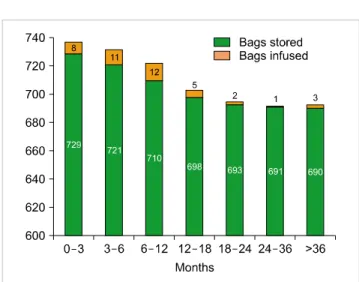
Our cohort consisted of 1,728 SCUs stored for conducting auto-SCT and 729 SCUs stored for conducting donor lymphocyte infusions (DLIs) after allo-SCT. Stem cells were not in- fused in 12.5% of patients who had planned to undergo auto-SCT, and 80% of patients who underwent allo-SCT never received DLI. Forty-one percent of SCUs intended for use in auto-SCT remained unutilized, with a second auto-SCT being performed only in 4 patients. Ninety-four percent of SCUs intended for carrying out DLIs remained unused, with only minimal usage observed one year after undergoing allo-SCT.
Conclusion
The duration of storage of unused SCUs needs to be debated upon, so that a consensus can be reached regarding the ethical disposal of SCU.
Key Words Cryopreservation, Stem cell, Long term, Developing
Correspondence to Navin Khattry, M.D.
Department of Medical Oncology, Bone Marrow Transplant Unit, ACTREC, Tata Memorial Center, Mumbai 410210, India E-mail: [email protected]
Ⓒ 2017 Korean Society of Hematology
INTRODUCTION
It is a common practice to cryopreserve the collected hem- atopoietic stem cells (HSCs) of a patient prior to an autologous stem cell transplant (auto-SCT), as stem cells are reinfused after administering high doses of chemotherapy with or with- out radiotherapy [1]. Before conducting allogeneic stem cell transplantation (allo-SCT), donor stem cells are cry- opreserved in some centers for enabling their future use in donor lymphocyte infusions (DLIs) [2]. Because a second
auto-transplant would be needed in conditions such as multi- ple myeloma, transplant centers tend to collect stem cells needed for multiple transplants in a single sitting for using them in future transplants [3]. Investigators have also advo- cated second/tandem transplants for Hodgkin’s lymphoma (HD) and neuroblastoma (NB) [4, 5]. Hence, transplant cen- ters tend to collect stem cells for more than one auto-SCT.
After conducting the first auto-SCT, the remaining cry- opreserved stem cells are stored in the transplant center for a certain duration. Except in cases where a patient has died, discarding these stored stem cells may be considered
Blood Res 2017;52:307-10. bloodresearch.or.kr
308 Santhosh Kumar Devadas, et al.
Table 1. Details of stem cell units stored for autologous stem cell transplantation.
HL NHL MM AML NB Other Total
N (%) 94 (39.3) 42 (17.5) 75 (31.3) 10 (4.1) 11 (4.6) 7 (2.9) 239
Stored SCUs 669 355 522 64 72 46 1,728
Mean SCU stored/patient 7.1 8.4 7.0 6.4 6.5 6.5 7.2
SCUs reinfused 427 249 251 22 44 31 1,024
Ratio of infused/stored SCUs 0.6 0.7 0.5 0.3 0.6 0.7 0.6
Patients receiving all SCUs (%) 35 (37.2) 20 (47.6) 4 (5.3) 2 (20.0) 4 (36.3) 3 (42.5) 68 (28.5) Patients partially receiving stored SCUs (%) 50 (53.1) 16 (38.1) 65 (86.6) 2 (20.0) 6 (54.5) 2 (28.5) 141 (58.9) Patients who never received any stored SCU (%) 9 (9.6) 6 (14.2) 6 (8.0) 6 (60.0) 1 (9.0) 2 (28.5) 30 (12.6) SCUs still stored (%) 242 (36.2) 106 (29.9) 271 (51.9) 42 (65.6) 28 (38.9) 15 (32.6) 704 (40.7) Abbreviations: AML, acute myeloid leukemia; HL, Hodgkin’s lymphoma; MM, multiple myeloma; NB, neuroblastoma; NHL, Non-Hodgkin’s lymphoma; SCU, stem cell unit; Other, other solid tumors.
unethical. The duration of storage of these cryopreserved stem cells is a matter of debate. We retrospectively analyzed the kinetics of stem cell harvest, storage, and infusion in a tertiary care hospital in India.
MATERIALS AND METHODS
This is a retrospective audit of 435 patients who planned to undergo either auto- or allo-SCT between November 2007 and January 2015; the data was analyzed in June 2016. A total of 239 patients underwent stem cell mobilization for a planned auto-SCT, out of which 30 patients eventually did not undergo auto-SCT because of disease progression prior to the planned auto-SCT. As an institutional practice, most patients (N=227) undergoing auto-SCT underwent che- mo-mobilization, while 10 patients underwent granulocyte colony stimulating factor (G-CSF) mobilization and 2 patients underwent bone marrow harvest. For allo-SCT, 185 related donors underwent G-CSF mobilization, 9 donors underwent bone marrow harvest, and cord blood grafts were obtained from 2 patients. Thirty-one patients did not have DLIs.
Because the indications and kinetics of stem cell usage are different between auto- and allo-SCT, they would be described separately. Stem cell apheresis for auto-SCT was performed in a single day or in multiple days, based on the target CD34+ cell count required and the indications regarding transplantation. In our center, 3–5×10⁶/kg of CD 34+ cells were usually collected before auto-SCT. The col- lected stem cells were divided into bags and cryopreserved with an equal volume of 8.7% dimethyl sulfoxide (DMSO), so that the final concentration of DMSO was 4.35%. Each bag contained not more than 100 ml of cryopreserved product. These bags were referred to as stem cell units (SCUs).
Between November 2007 and January 2015, a total of 239 patients underwent stem cell apheresis prior to auto-SCT;
of these, 209 underwent auto-SCT. A total of 1,728 SCUs obtained from 239 patients were cryopreserved during this period.
Similarly, out of 196 patients who underwent allo-SCT, 165 patients had cryopreserved their stem cells for receiving
DLIs. The stem cells were stored for DLIs only if the periph- eral blood stem cell harvest yielded a CD 34+ dose greater than 4×10⁶/kg. A total of 729 SCUs were stored for DLIs.
Each SCU stored for conducting a DLI contained approx- imately 1×10⁷/kg CD3+ lymphocytes.
The cost of storing the cryopreserved stem cells for each patient was calculated. The cost of 50 mL of 8.7% DMSO is approximately US $100. Therefore, for each patient, the cost of cryopreservation was calculated with the amount of 8.7% DMSO used for storing the SCU. The cost of elec- tricity, maintenance, and space required were not included.
RESULTS
The cryopreserved stem cells were included in the in- ventory during November 2007 to January 2015. At the time of analysis in June 2016, the median duration for which cryopreserved stem cells were stored was 4.1 years (range, 1.34–8.4 yr).
Autologous stem cell transplant
The median CD34+ HSCs collected per patient was 7.69×10⁶/kg. The mean number of leukapheresis sessions re- quired was 1.6. The mean number of SCUs stored per patient was 7.34. The mean number of SCUs infused was 4.89 and median CD34+ HSC dose used was 5.28×10⁶/kg. A total of 209 (87.44%) patients underwent at least 1 auto-SCT. Only 4 multiple myeloma patients underwent a second auto-SCT during this period. Details regarding the kinetics of SCU usage for each differently diagnosed subset of patients under- going auto-SCT are depicted in Table 1.
Allogeneic stem cell transplant
The median CD34+ HSCs collected per patient was 7.9×10⁶/kg. The mean number of leukapheresis sessions re- quired was 1.27. The mean number of SCUs per patient that was stored for DLIs was 4.07. A total of 33 (20%) patients underwent reinfusion with at least 1 SCU. Details regarding the kinetics of SCU usage for each subset of diagnosed patients undergoing allo-SCT (excluding 31 patients for whom SCUs
bloodresearch.or.kr Blood Res 2017;52:307-10.
Long term stem cell cryopreservation 309
Table 2. Use of SCUs stored for donor lymphocyte infusion.
ALL AML AA CML MDS HL Others Total
Patients in whom SCUs stored for DLI 37 (22.4) 71 (43.0) 16 (9.6) 20 (12.1) 10 (6.1) 3 (1.8) 8 (4.8) 165
Patients whose SCUs were not stored 9 8 7 1 4 2 0 31
Stored SCUs 169 321 61 94 42 13 29 729
Mean stored SCU/patient 4.5 4.5 3.8 4.7 4.2 4.3 3.6 4.4
SCUs reinfused (%) 9 (5.3) 25 (7.7) 3 (4.9) 0 (0.0) 1 (2.3) 2 (15.3) 2 (6.8) 42 (5.7) SCUs still stored (%) 160 (94.6) 296 (92.3) 58 (95.0) 94 (100) 41 (97.7) 11 (84.6) 27 (93.2) 687 (94.3) Abbreviations: AA, aplastic anemia; ALL, acute lymphoblastic leukemia; AML, acute myeloid leukemia; CML, chronic myeloid leukemia; DLI, donor lymphocyte infusion; HL, Hodgkin’s lymphoma; MDS, myelodysplastic syndrome; SCU, stem cell unit.
Fig. 1. Donor lymphocyte infusion after allogeneic stem cell transplan- tation.
were not stored for DLI) is depicted in Table 2.
Cost of storing unused SCU
The total cost of cryopreserving 704 unused SCUs for auto-SCT was $70,400, while the cost of cryopreserving 687 unused SCUs for DLI was $43,100.
DISCUSSION
It is a common practice to cryopreserve hematopoietic stem cells prior to auto-SCT. Stem cell centers target the harvest of around 3–5×10⁶/kg CD34+ cells per transplant prior to auto-SCT. Many centers also cryopreserve im- munocompetent donor cells for enabling DLIs to be received after allo-SCT, because it may be difficult to locate the donor and mobilize stem cells from the donor when DLI needs to be performed urgently. When a transplant center mobi- lizes, cryopreserves, and stores stem cells, three possible out- comes emerge: all the SCUs are reinfused into the patient;
a part of the stored SCUs is used; or none of the stored SCUs are used. If the SCUs remain entirely or partially un- used, an unresolved question arises regarding the duration for which the unused SCUs should be stored.
Non-Hodgkin’s lymphoma (NHL), Hodgkin’s lymphoma (HD), and multiple myeloma (MM) remain the main in- dications for auto-SCT [6]. A second autologous stem cell transplantation procedure conducted after relapse is consid- ered to be a standard practice in patients with multiple myeloma, while tandem transplants are less common at pres- ent [7-9]. A few experts also advocate a second auto SCT/tan- dem auto-SCT for relapsed/refractory HD [4, 10]. Similarly, stem cell rescue following high-dose MIBG therapy prolongs survival in patients at high risk for neuroblastoma who re- lapse after auto-SCT [5]. Because of these reasons, if SCUs remain at the transplant center after the first auto-SCT, it may be considered unethical to discard them as long as the patient is alive [11].
In our series of 239 patients, in whom stem cell apheresis was done prior to auto-SCT (Table 1), 12.5% of patients never underwent transplantation because of disease pro- gression/death during the waiting period, 28% of patients underwent auto-SCT and they received all the cryopreserved
SCUs, and 59% of patients only partially received their SCUs.
When compared with large series of patients studied in Europe, the ratio of infused to stored stem cells was lower in our series [11]. In other words, we had a higher percentage of unused SCUs. Nearly 40% of SCUs collected prior to au- to-SCT remained in our blood bank, with a second infusion being done only in 4 myeloma patients.
DLIs could be used in various settings in the post allo-SCT phase, namely preemptive, prophylactic, and therapeutic [12]. It is sometimes difficult to harvest stem cells again from donors because of societal and financial reasons in developing countries such as India when the patient requires DLI; hence as a policy our center stores excess stem cells collected as DLIs to avoid a second harvest when required [13]. With respect to SCUs stored for DLI, only 5.7% of stored SCUs were reinfused (Table 2), while 15% of the patients for whom SCUs were stored received DLI. As shown in Fig. 1, beyond 12 months, only 6 DLIs were performed, asserting the impracticality of storing these SCUs beyond 1 year. However, the FACT-JACIE standards that are fol- lowed by a majority of the European and American transplant centers advocate the continued storage of cellular products till the death of the patient or transfer of SCUs to other facilities after obtaining informed consent from the pa-
Blood Res 2017;52:307-10. bloodresearch.or.kr
310 Santhosh Kumar Devadas, et al.
tient/guardian [14].
The limited use of DLIs raises the following question:
Is the cryopreservation of SCUs for DLI cost effective and required? The storage of SCUs for long durations is laborious and escalates the cost of the transplantation process [15].
The cost of inventory management and electricity costs for freezing and freezer space etc add up to substantial costs in the long run. The cost of cryopreservation per patient in the West is between US $1,500 and US $5,000, depending on the volume of cells cryopreserved and the duration of cryopreservation [16-18]. With the mounting costs of cancer care in general and hematopoietic stem cell transplantation in particular, there is a renewed focus on cutting costs by both institutions and the government [19–21]. The cost of a stem cell transplant in India is between US $12,000 and US $17,000 [20]. In this retrospective analysis, we have looked only at the cost of cryopreservation. The cost of unused SCUs was approximately US $260 per patient, which is approximately 2% of the transplant cost.
A recently published paper by an Italian group has recom- mended certain criteria for disposal of SCUs based on a large survey on cryopreservation practices and outcomes [11, 22]. This guideline proposes that stem cells should be discarded after 10 years of storage if the patient continues to survive. Our study is the first of its kind in the developing world, which could help in building a consensus regarding the issue of stem cell disposal in developing countries.
In conclusion, the SCUs stored prior to auto-SCT and allo-SCT (for DLI) are only partially used most of the time.
Their continued storage after a certain point of time needs to be debated upon, so that a consensus could be built regard- ing the ethical disposal of such SCUs.
AuthorsÊ Disclosures of Potential Conflicts of Interest
No potential conflicts of interest relevant to this article were reported.
REFERENCES
1. Lennard AL, Jackson GH. Stem cell transplantation. BMJ 2000;
321:433-7.
2. Frey NV, Lazarus HM, Goldstein SC. Has allogeneic stem cell cryopreservation been given the ‘cold shoulder’? An analysis of the pros and cons of using frozen versus fresh stem cell products in allogeneic stem cell transplantation. Bone Marrow Transplant 2006;38:399-405.
3. Bladé J, Rosiñol L, Fernández de Larrea C. How I treat relapsed myeloma. Blood 2015;125:1532-40.
4. Ritchie DS. The role of second autografts in the treatment of Hodgkin lymphoma. Leuk Lymphoma 2007;48:847-8.
5. Kayano D, Kinuya S. Iodine-131 metaiodobenzylguanidine therapy for neuroblastoma: reports so far and future perspective.
ScientificWorldJournal 2015;2015:189135.
6. European Society for Blood and Marrow Transplantation. EBMT
Annual report 2014. Leiden, The Netherlands: EBMT, 2015.
(Accessed February 4, 2017, at https://www.ebmt.org/Contents/
Resources/Library/Annualreport/Documents/EBMT_Annual Report_2014.pdf).
7. Mohty M, Harousseau JL. Treatment of autologous stem cell transplant-eligible multiple myeloma patients: ten questions and answers. Haematologica 2014;99:408-16.
8. Attal M, Harousseau JL, Facon T, et al. Single versus double autologous stem-cell transplantation for multiple myeloma. N Engl J Med 2003;349:2495-502.
9. Singh Abbi KK, Zheng J, Devlin SM, Giralt S, Landau H. Second autologous stem cell transplant: an effective therapy for relapsed multiple myeloma. Biol Blood Marrow Transplant 2015;21:
468-72.
10. Morschhauser F, Brice P, Fermé C, et al. Risk-adapted salvage treatment with single or tandem autologous stem-cell transplantation for first relapse/refractory Hodgkin's lymphoma:
results of the prospective multicenter H96 trial by the GELA/
SFGM study group. J Clin Oncol 2008;26:5980-7.
11. Olivieri J, Pierelli L, Introna M, et al. Kinetics of the use of cryopreserved autologous stem cell grafts: a GITMO-SIDEM survey. Cytotherapy 2014;16:101-10.
12. Chang YJ, Huang XJ. Donor lymphocyte infusions for relapse after allogeneic transplantation: when, if and for whom? Blood Rev 2013;27:55-62.
13. Bakken R, van Walraven AM, Egeland T; Ethics Working Group of the World Marrow Donor Association. Donor commitment and patient needs. Bone Marrow Transplant 2004;33:225-30.
14. FACT-JACIE Hematopoietic Cellular Therapy Accreditation Manual. 6th ed. Omaha, NE: The Foundation for the Accreditation of Cellular Therapy, 2017:434-5.
15. Jaime-Perez JC, Monreal-Robles R, Colunga-Pedraza J, Mancías- Guerra C, Rodríguez-Romo L, Gómez-Almaguer D. Cord blood banking activities at a university hospital in northeast Mexico: an 8-year experience. Transfusion 2012;52:2606-13.
16. Mishra V, Andresen S, Brinch L, et al. Cost of autologous peripheral blood stem cell transplantation: the Norwegian expe- rience from a multicenter cost study. Bone Marrow Transplant 2005;35:1149-53.
17. Shaughnessy P, Islas-Ohlmayer M, Murphy J, et al. Cost and clinical analysis of autologous hematopoietic stem cell mobilization with G-CSF and plerixafor compared to G-CSF and cyclophosphamide.
Biol Blood Marrow Transplant 2011;17:729-36.
18. Cameron G, Tantiworawit A, Halpenny M, et al. Cryopreserved mobilized autologous blood progenitors stored for more than 2 years successfully support blood count recovery after high-dose chemotherapy. Cytotherapy 2011;13:856-63.
19. Khera N, Zeliadt SB, Lee SJ. Economics of hematopoietic cell transplantation. Blood 2012;120:1545-51.
20. Sharma SK, Choudhary D, Gupta N, et al. Cost of hematopoietic stem cell transplantation in India. Mediterr J Hematol Infect Dis 2014;6:e2014046.
21. Lee SJ, Klar N, Weeks JC, Antin JH. Predicting costs of stem-cell transplantation. J Clin Oncol 2000;18:64-71.
22. Perseghin P, Marchetti M, Pierelli L, et al. A policy for the disposal of autologous hematopoietic progenitor cells: report from an Italian consensus panel. Transfusion 2014;54:2353-60.