Corresponding author: Kim, Hyeon Mi
Department of Nursing, Yeungnam University, 170 hyunchoong-ro, Nam-gu, Daegu 705-703, Korea.
Tel: +82-53-650-9391, Fax: +82-53-652-4892, E-mail: [email protected] - This research was supported by Kyungpook National University Research Fund, 2013.
Received: Oct 17, 2014 | Revised: Dec 8, 2014 | Accepted: Dec 13, 2014
This is an open access article distributed under the terms of the Creative Commons Attribution Non-Commercial License (http://creativecommons.org/licenses/
by-nc/3.0), which permits unrestricted non-commercial use, distribution, and reproduction in any medium, provided the original work is properly cited.
Effect of Self-leadership Recognized by Newly-employed Nurses on Job Satisfaction: Mediating Effect of Organizational Commitment
Choi, Yeon Hee1 · Kim, Hyeon Mi2
1College of Nursing, Kyungpook National University, Daegu
2Department of Nursing, Yeungnam University, Daegu, Korea
Purpose: This study was done to provide fundamental data required to establish interventions to enhance job sat- isfaction of newly-employed nurses by understanding the relationship between self-leadership, organizational commitment, and job satisfaction, and by identifying mediating effects of organizational commitment. Methods:
Research participants were 210 nurses from four university hospitals and who had less than 12 months of work experience. Data were collected from September 27 to November 4, 2013 through self-administered ques- tionnaires and analyzed using SPSS/WIN 19.0 and AMOS 19.0. Sobel tests were conducted to determine the significance of mediation in the model. Results: Self-leadership and organizational commitment, self-leadership and job satisfaction, organizational commitment and organizational satisfaction were positively correlated.
Organizational commitment mediated the relationship between self-leadership and job satisfaction. Conclusion:
Study results indicate greater organizational commitment and job satisfaction with results in higher self-leader- ship, and better job satisfaction results in more organizational commitment. Results also reveal that self-leadership has a direct influence on increases in job satisfaction as well as, indirectly influencing job satisfaction through or- ganizational commitment as a mediator, confirming the need to develop intervention programs that enhance self-leadership and organizational commitment as a practical effort to increase job satisfaction in newly-employed nurses at their clinical practice sites.
Key Words: Nurses, Leadership, Job satisfaction, Mediating effect, Organization
INTRODUCTION
Expansion and corporatization of medical facilities, in- creased awareness towards health, and higher demands on quality medical services all led to the specialization and segmentation of hospital tasks, causing the role of nurses to be more complex. Nursing organizations are the group where most hospital employees work. In order for nursing organizations to actively respond to the change and de- mands, nurses need more than an outstanding level of knowledge or new skill sets. A new type of leadership, which can induce nurses to cultivate the sense of unity to-
wards the organization while motivating them for their ac- tive participation at work with autonomy and indepen- dence, is also required[1]. Traditional leadership is demon- strated with directions, orders, controls, compensations, and punishments, but nursing leadership required in these days includes accurate judgment, willpower, respect to- wards others, and their professional capabilities with pas- sion to help cure disease[2]. Adequate leadership in nurs- ing organizations enhances nurses’ effort on their job and influences their mental stability, improving job satisfaction by ameliorating productivity and efficiency of nursing practices. It eventually works as a key factor affecting high quality nursing service for patients[3].
Self-leadership received attention recently due to the change in leadership trends. Self-leadership is one of those concepts that attracted attention in recent years with regard to change in leadership trends. The concept was initially coined and proposed by Manz in response to the heightened awareness among people in 1980s that organizations could not achieve their goals with tra- ditional leadership because of the rapid change in envi- ronment and shift in values among members of organi- zations[4]. Self-leadership, a new form of leadership gaining attention recently, is the practice that influences thoughts, feeling and behavior intentionally to accom- plish objectives. It is a developed sense of a person’s identity, capability, direction coupled with the capability to influence an individual’s communication, emotions and behavior to achieve goals[5]. This type of leadership en- courages organization members to endeavor with pas- sion in order to act appropriately. It also puts emphases on autonomous and self-initiative attitude such as setting their own goals, self-rewarding, and self-criticizing[6].
A number of researches had been conducted on self- leadership in the field of nursing, mainly to discover cor- relations between self-leadership and job satisfaction, or- ganizational commitment, nursing job performance, or- ganizational citizenship behavior, innovative action, or nursing information competency[1]. Studies about the de- velopment of self-leadership training programs or the verification of such programs’ effectiveness were rare and could hardly be found.
Newly-employed nurses experience transition shock during their first year at work due to the discrepancy be- tween theory and practice, ideal and reality, and knowl- edge learned from school and actual practice at work.
Additionally, these nurses become incapable of effecti- vely learning skills that are necessary to do their job or role well and unable to feel the sense of accomplishment, self-confidence, or self-satisfaction due to high level of stress from 3-shift work schedule, complicated relation- ship with co-workers, and their ambiguous role and role conflict while interacting with patients or guardians, causing them to experience conflict[7].
Han et al., reported that newly-employed nurses ex- pressed frustration and dissatisfaction towards nursing practices if these nurses could not cope with transition shocks or conflicts by themselves, bringing negative im- pact on attitude towards the organization and work that would ultimately cause nurses to misadjust, experience burnout, and change their job in early days of their employment. The study pointed low organizational com- mitment as one of the most important factor that has in-
fluence on newly-employed nurses’ intention to resign[8].
Recent statistics from Hospital Nurses Association indi- cate that turnover rate of newly-employed nurses is 33.6
%, twice as that of nurses in general., portraying the se- verity of this problem[9]. Therefore, strategies and pro- grams for promotion and enhancement of their organiza- tional commitment and job satisfaction must be develop- ed in order to prevent maladjustment and resignation for another job. Prior to the development of such programs and strategies, factors affecting abovementioned varia- bles should be identified in order to use them as the fun- damental data in constructing intervention programs. A number of preceding studies undertaken to improve or- ganizational commitment and job satisfaction of nurses presented that self-leadership was one of key factors af- fecting abovementioned variables[10-13]. Nurses’ lead- ership can be one of the most-decisive factors that leads to the success of a hospital since nurses confront many situations that should be dealt with promptly when tak- ing care of patients. It is essential to escape from the con- ventional leadership where nurses work as middle man- agers and mainly rely on head nurses’ leadership and seek for a new leadership model in order to satisfy med- ical consumers’ demands towards high quality nursing services which was triggered by recent rapid develop- ment of modern medical technology and knowledge[14].
If the organizational commitment of nurses are enhan- ced by changing their attitude towards their jobs and en- couraging their passion and dedication, all of which will be achieved through programs that train nurses to dem- onstrate self-leadership by internally motivating them since their employment as newly-employed nurses, such enhancement will positively influence towards job satis- faction and contribute in preventing maladjustment and resignation for another job in the end.
Until now, researches on self-leadership, job satisfac- tion, and organizational commitment in the field of nurs- ing studies study of nursing were mainly focused on dis- covering correlations between each other, and only a few of them have been conducted to verify the structural rela- tionship or mediating effect connected to such matters[1].
Especially, researches on newly-employed nurses that es- tablished a structural model that presents comprehensive relationship between variables and verified mediating role were rare and could hardly be found.
Therefore, this study for newly-employed nurses aims to recognize the significance of self-leadership and or- ganizational commitment on job satisfaction and identify the mediating effect of organizational commitment in the relationship between self-leadership and job satisfaction,
thus ultimately providing fundamental data required in establishing intervention strategies to enhance job satis- faction of newly-employed nurses.
The purposes of this study were to identify the corre- lation between self-leadership recognized by newly-em- ployed nurses, organizational commitment, and job sat- isfaction and to verify mediating effect in a hypothetical model based on such correlation.
Specific purposes of this research are as follows:
y Discover the correlation between self-leadership, organizational commitment, and job satisfaction that newly-employed nurses recognize.
y Verify mediating effect of organizational commitment in the relationship between self-leadership and job satisfaction recognized by newly-employed nurses.
METHODS
1. Research Design
This descriptive research on newly-employed nurses with clinical experience was designed to analyze media- ting effect of organizational commitment in the relation- ship between self-leadership and job satisfaction.
2. Participants and Data Collection Procedure Research participants were selected and data were col- lected in the manner described below. First, structural equation modelling suggested 200~400 samples as an ideal sample size for verification to enhance sensitivi- ty[15], the quality which detects difference between da- ta, and the number of research subjects was set based such recommendation. Second, subjects of this research were 230 newly-employed nurses working in one of four university hospitals equipped with more than 800 beds in D city from September 27, 2013, to November 4, 2013.
All 230 subjects had been conveniently sampled and had agreed to participate in this study. Newly-employed nurses are the ones with a nurse license, graduated from a technical college or a four-year college of nursing, and had less than 12 months of work experience at a hos- pital ward since their employment as full-time nurses.
Third, considering ethical issues of the study, research- ers explained participants the purpose of this study, that nurses had participated in this research voluntarily, and that respondents had the right to withdraw consent at any time if answering questions was against their will.
Participants were also notified that their private informa- tion would be kept confidential and their anonymity
would be guaranteed before obtaining written consent.
Questionnaires were then provided to participants. The survey took approximately 10 minutes, and it was per- sonally collected by a researcher. 20 samples that pro- vided insufficient answers were excluded and 210 ques- tionnaires were used for data analysis.
Researchers received approval from institution review board of A university in D city before conducting this re- search (IRB No. 13-148).
3. Measurements 1) Self-leadership
This study used a tool based on a questionnaire devel- oped by Manz[16] and later revised, complemented by Kim[17]. The tool was composed with a total of 18 ques- tions, three questions from each of the following six fac- tors: self-expectation, rehearsal, goal setting, self-com- pensation, self-criticism, and constructive thinking. It adopted Likert’s 5-point scale where 5 is the highest score and higher score indicates more self-leadership. Cron- bach’s ⍺ was .87 at the time of development, and that of this research was .86
2) Organizational commitment
The research used OCQ (Organizational Commitment Questionnaire) that was initially developed by Mowday, Steers, and Porter[18] and later revised, complemented by Park[19] as a tool to assess organizational commit- ment of participants. The questionnaire was composed of nine questions in total, three questions each to meas- ure a sense of mission, self-esteem, and maintain inten- tion. The tool adopted Likert’s 5-point scale where high- er score implies more commitment to the organization.
Cronbach’s ⍺ was .82~83, and that of this research was .94.
3) Job satisfaction
The study adopted General Satisfaction Scale devised by Taylor and Bowers[20] and adapted by Lee[21] as a tool to measure the degree of job satisfaction. The tool consisted seven questions in total and uses Likert’s 5- point scale for measurement where higher score implies more satisfaction towards their job. Cronbach's ⍺ was .87 at the time of development, and that of this research was .91.
4. Data Analysis
The study worked with SPSS/WIN 19.0 to analyze the
Table 1. General Characteristics (N=210)
Characteristics Categories n (%)
Age (year) 23~<24 24
≥25
52 (24.8) 116 (55.2) 42 (20.0)
Gender Male
Female
6 (2.9) 204 (97.1) Religion Christianity
Buddhist Catholic None
91 (43.3) 12 (5.7) 26 (12.4) 81 (38.6) Marital status Unmarried
Married Bereaved
136 (64.8) 72 (34.3) 2 (0.9) Level of
education
Diploma Bachelor
Enrolled in graduate school
115 (54.8) 53 (25.2) 42 (20.0) Assigned
department
General ward Intensive care unit Outpatient department Others
109 (51.9) 49 (23.3) 19 (9.1) 33 (15.7)
Table 2. Correlations among Research Variables (N=210)
Variables Self-leadership Organization commitment Job satisfaction
r (p) r (p) r (p)
Self-leadership 1.00
Organization commitment .61 (<.001) 1.00
Job satisfaction .61 (<.001) .68 (<.001) 1.00
collected data as undermentioned in accordance with purposes of this research. First, the research used SPSS/
WIN 19.0 to calculate frequency and percentage from general characteristics of research subjects and Pearson’s correlation coefficients to analyze correlation of self-lea- dership, organizational commitment, and job satisfac- tion. Second, the research employed AMOS 19.0 when modeling structural equations to verify mediating effect of organizational commitment in the relationship bet- ween self-leadership and job satisfaction. Sobel test was conducted to identify the significance of mediating ef- fect. As an effort for adequate and accurate verification, Bootstrapping test to confirm confidence level was addi- tionally performed to check the validity of mediating effect. The study also adopted difference test, GFI, TLI, and RMSEA to evaluate adequacy of the model.
RESULTS
1. General Characteristics of Participants
55.2% of research participants were aged 24, while 24.8% were aged 23 to less than 24. The remaining 20.0
% were 25 or older. In terms of the gender of research subjects, vast majority of them (97.1%) were female.
43.3% of the participants believed in christianity, being the most popular religion, and 38.6% were non-belie- vers. For marital status, 64.8% marked as unmarried and 34.3% checked as married. Regarding their academic background, 54.8% graduated from a 3-year nursing col- lege, 25.2% from a 4-year nursing college, and 20.0% are graduate school students. 51.9% of newly-employed nur- ses were assigned to a general ward, followed by 23.3%
of respondents at an intensive care unit (Table 1).
2. Correlation of Self-leadership, Organizational Com- mitment, and Job Satisfaction
As described on Table 2, statistically significant posi- tive correlations were observed between self-leadership and organizational commitment (r=.61, p<.001), self-lead- ership and job satisfaction (r=.61, p <.001), and organi- zational commitment and job satisfaction (r=.68, p<.001).
3. Verification of the Mediated Model 1) Verification of mediating effect
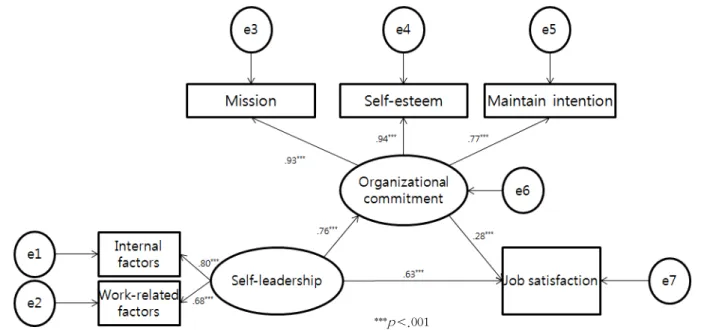
Analysis result of a model describing mediating effect of organizational commitment in the relationship bet- ween self-leadership and job satisfaction was presented in Table 3. The study conducted an analysis based on mediation model identification process suggested by Ba- ron and Kenny[22] and Kenny and Milan[23]. In the first step of identification, an independent variable was self- leadership and significantly affected organizational com- mitment, a parameter (β=0.76, p <.001). Second, self-
Table 3. Mediating Effects of Partially Mediated Model (N=210)
Path β Estimate SE CR p SMC Direct effect Indirect effect Total effect
OC ← SL .76 1.18 .14 8.68 <.001 .58 .76* .76*
JS ← SL .63 1.25 .24 5.27 <.001 .75 .63* .22* .85*
JS ← OC .28 0.36 .13 2.79 .005 .28* .28*
OC=Organizational commitment; SL=Self-leadership; JS=Job satisfaction; SE=Standard error; CR=Critical ratio; SMC=Squared multiple correlation.
*p<.05.
Figure 1. Research model: partially mediated model (standardized beta weight).
***p<.001 leadership had significant influence on job satisfaction
(β=0.63, p <.001). Finally, the study identified the influ- ence of organizational commitment on job satisfaction after controlling self-leadership, an independent vari- able. It was discovered that organizational commitment had statistically significant influence on job satisfaction (β=0.28, p =.005). Self-leadership’s influence on job sati- sfaction was also statistically significant (β=0.63, p <
.001) but lower than β value (β=0.85) at the second stage, proving that organizational commitment partially medi- ated between self-leadership and job satisfaction.
Sobel test was conducted to identify the significance of this mediating effect. According to calculation based on Sobel’s Z formula, Z value was 2.65 (p <.001), indi- cating significance of mediating effect by organization- al commitment between self-leadership and job satis- faction. The research additionally identified confidence level through Bootstrapping test to eliminate criticisms which asserted that mediating effect was not on the nor- mal distribution[23]. Bootstrapping test confirmed that value zero (0) was not observed in 95% confidence in-
terval (.51~.97) of mediating effect between self-leader- ship and job satisfaction, portraying that mediating ef- fect by organizational commitment level was signifi- cant. The model was described in Figure 1.
2) Fitness of mediation models
In an aim to evaluate fitness of this research model, the study adopted CFI and TLI, the most widely used rel- ative fit indices, and an absolute fit index called RMSEA.
As explained in Table 4, the model could be considered to be fit as the value of CFI and TLI was .95 and .94 re- spectively, exceeding the fitness standard of .90. was stricter standard than other fit indices and its value was 35.5 (p<.001). Although the value was not entirely flaw- less, such value could be regarded as acceptable since test results suggested significant difference in most cases with 200 or higher sample size[15]. A fully mediated mo- del was also considered, but its TLI value recorded .86 and its value was 82.15, which was higher than the alter- native. Thus, a partially mediated model was judged to be more adequate.
Table 4. Model Fitness Indices
Model x2 df p RMSEA GFI TLI CFI NFI
Partially mediated model (A) 35.35 7 <.001 .13 .95 .94 .97 .97
Fully mediated model (B) 82.15 8 <.001 .20 .90 .86 .93 .92
x2 Difference (A:B) Δx2=x2B-x2A=46.796* (Δdf=1)
RMSEA=Root mean square error of approximation; GFI=Goodness of fit; TLI=Tucker-Lewis index; CFI=comparative fit index; NFI=Normed fit index.
DISCUSSION
This research identified whether organizational com- mitment had mediating effects on self-leadership’s influ- ence towards job satisfaction. It first investigated to un- derstand the correlation between each variable, then dis- covered mediating effect of organizational commitment on the relationship between self-leadership and job satis- faction. The discussion below focused on such results.
First, the level of organizational commitment increas- ed with higher self-leadership as self-leadership and or- ganizational commitment were positively correlated (r=
.61, p <.001). It concurred with Park and Park’s resear- ch results[11]. Their research asserted that while actively endeavoring to provide training opportunities and in- formation for the development of nurses’ self-leadership, nursing organizational culture should also be changed to provide more autonomy to nurses. Such improvements would alleviate conflicts between departments and fur- ther enhance organizational commitment. Lim et al. [24], also suggested in their research that higher level of self- leadership, the quality that leads people to set their own goals and either compensate or criticize themselves for goal achievement, had more influence on organization- al commitment of individuals. These results supported Bligh’s research result[25], which stated that members who utilized self-leadership experienced rise in their ownership during performance of their jobs.
Second, the level of job satisfaction rose with higher self-leadership since self-leadership and job satisfaction were positively correlated (r=.61, p <.001). Seomun’s research[10] on hospital nurses also presented high pos- itive correlation between self-leadership and organiza- tional commitment, especially with constructive think- ing among self-leadership factors. Seomun’s another re- search[26] emphasized that self-leadership in the field of nursing improves nurses’ job performance, and its rela- tion with job satisfaction leads nurses to provide quality medical service in nursing patients. Kim and Hong’s study[11] indicated weak positive correlation between self-leadership and organizational commitment; the study
also reported that establishing goals by oneself and pro- viding internal reward based on performance led the person to have positive attitude towards jobs and to feel satisfaction. A research by Kang et al.,[27] also showed that aforementioned two variables were closely related;
it was also discovered that self-expectation and const- ructive thinking, both of which were components of self- leadership, had the highest impact on job satisfaction of nurses. Lim et al.[24] presented that self-leadership was highly influential to job satisfaction. Such result concur- red with Choi et al.’s work[13], implying that nurses who are confident to their capabilities and utilize self-leader- ship, the tool indicating possession of definite goals and constructive thinking, tend to feel higher job satisfaction.
Third, the level of organizational commitment became high with higher job satisfaction due to the positive cor- relation (r=.68, p <.001) between organizational com- mitment and job satisfaction. It was the same as results from Kang et al.’s paper[14] on hospital nurses that re- ported significant positive correlation between organiza- tional commitment and job satisfaction. Park and Yang [28] concluded that each of organizational commitment and job satisfaction worked as a key factor affecting each other on their study on the relationship between nurse managers’ facilitative communication and nurses’ orga- nizational commitment, job satisfaction, and empower- ment. On the other hand, Zhou et al.,[29] asserted in their research for nurses in Chinese hospitals that organ- izational commitment was one of key predictive factors that had influence in job satisfaction, and suggested that intervention programs to enhance organizational com- mitment should be provided to improve nurses’ job sa- tisfaction. Lu et al.[30] presented significant positive cor- relation between organizational commitment and job satisfaction, and reported factors like working condi- tions, organizational environment, job stress, and role conflict were related to job satisfaction of nurses.
Fourth, organizational commitment played the role of a partially mediating variable between self-leadership and job satisfaction (Z=2.65, p <.01). It presented that while self-leadership functioned as a direct factor in the
improvement of job satisfaction, the leadership also af- fected job satisfaction indirectly using organizational commitment as a mediator. Direct comparison with oth- er studies was difficult since no research had been con- ducted to discover mediating effect of organizational commitment in the relationship between self-leadership and job satisfaction. Nevertheless, results of this study indicated that albeit job satisfaction of newly-employed nurses could be improved by solely strengthening self- leadership, adoption of strategies for the improvement of organizational commitment, a variable closely con- nected to nurses’ job in a hospital, during development of programs for self-leadership enhancement was pro- ven to be more effective in improving job satisfaction in the long run.
Han et al.’s research[8] pointed organizational com- mitment as one of key factors influencing newly-employ- ed nurses’ intention to resign and asserted that members with high commitment actively participate in group ac- tivities, are not absent from work on their will, have a great desire to stay in the organization, are willing to con- tinuously contribute to achieve goals of the organiza- tion, and put more effort for the group. The study also emphasized that characteristics of an individual, a task, and an organization should all be taken into account during the assignment process and thoughtful conside- ration from department managers and colleagues to as- sist newly-employed nurses settle into the group were essential in improving organizational commitment of newly-employed nurses. It is believed, therefore, that hospital managers could contribute in preventing turn- over of newly-employed nurses by developing strategies that would improve job satisfaction by promoting or- ganizational commitment of nurses.
In conclusion, a different type of approach is required for newly-employed nurses unlike the one for experi- enced nurses. Newly-employed nurses should be en- couraged to utilize self-leadership during their work to cultivate strong sense of unity towards the organization that these nurses belong and award self-initiative, au- tonomy, and self-motivation in an aim to alleviate new- ly-employed nurses’ maladjustment and curb their turn- over rate, both of which were incurred from conflicts and stress felt by nurses themselves. It is essential for hospital organizations to thoroughly understand factors relevant to job satisfaction of newly-employed nurses and endeavor to establish adequate environment so newly-employed nurses can stay longer in the assigned nursing field, utilize better skill sets, and provide high quality of nursing services to patients. Additionally, a
various efforts should be made, including adoption of training programs to enhance self-leadership and organ- izational commitment of newly-employed nurses and expansion of nurses’ autonomy in hospital operations.
CONCLUSION
This research proved its significance since this study was conducted on self-leadership for newly-employed nurses, compared to other preceding ones performed only for experienced nurses, and identified mediating effect of organizational commitment in the relationship between self-leadership and job satisfaction. The results presented that self-leadership of newly-employed nurses, their organizational commitment, job satisfaction were positively correlated to each other. It also revealed that organizational commitment worked as a partial media- tor between self-leadership and job satisfaction. Such results indicate that newly-employed nurses’ self-leader- ship skills should be improved to lead themselves and achieve something, which would boost their job satis- faction and prevent resignation at the early days of em- ployment. The results also suggest that hospital mana- gers need to realize the importance of organizational commitment and exert effort to discover ways to enhan- ce organizational commitment.
This paper suggests clinical practitioners in psychia- tricmental health nursing to develop training programs based on findings of this research, programs that can en- hance self-leadership skills and organizational commit- ment simultaneously and conduct researches to verify its effect as a practical effort to improve job satisfaction of newly-employed nurses. Replicating this research is also necessary for confirmation purpose due to the lack of researches on self-leadership for newlyemployed nur- ses. As subjects of this research were sampled from a certain city instead of nationwide basis, stretching the interpretation of research results is difficult. Thus, follow- up researches with various regional distribution and size of medical institutions are necessary.
REFERENCES
1. Won HJ, Cho SH. A review of research on self-leadership in nurses. J Korean Acad Nurs Adm. 2013;19(3):382-93.
http://dx.doi.org/10.11111/jkana.2013.19.3.382
2. Watson L. Self-leadership: becoming an exceptional leader.
Radiol Technol. 2003;75(6):457-67.
3. Dolbier CL, Soderstrom M, Steinhardt MA. The relationships between self-leadership and enhanced psychological, health,
and work outcomes. J Psychol. 2001;135(5):469-85.
http://dx.doi.org/10.1080/00223980109603713
4. Manz CC. Self-leadership: toward an expanded theory of self- influence processes in organizations. Acad Manage Rev. 1986;
11(3):585-600.
5. Bryant A, Kazan AL. Self-leadership: how to become a more successful, efficient, and effective leader from the inside out.
New York: The McGraw-Hill Companies; 2012. 224 p.
6. Neck CP, Houghton JD. Two decades of self-leadership theo- ry in theory and research: Past developments, present trends, and future possibilities. J MP (Journal of Managerial Psycho- logy). 2006;21(4):270-95.
http://dx.doi.org/10.1108/02683940610663097
7. Sin KM, Kwon JO, Kim EY. Factors associated with new gra- duate nurses’ reality shock. J Korean Acad Nurs Adm. 2014;
20(3):292-301. http://dx.doi.org/10.11111/jkana.2014.20.3.292 8. Han SS, Sohn IS, Kim NE. New nurse turnover intention and
influencing factors. J Korean Acad Nurs. 2009;39(6):878-87.
9. Kim SH, Lee MA. Effects of emotional labor and communica- tion competence on turnover intention in nurses. J Korean Acad Nurs Adm. 2014;20(3):332-41.
http://dx.doi.org/10.11111/jkana.2014.20.3.332
10. Seomun GA. The relationship of self-leadership, job satisfac- tion, and perceived outcome in nurses. J Korean Acad Nurs.
2005;11(1):45-58.
11. Kim JY, Hong JY. Self-leadership, job stress and job satisfac- tion among clinical nurses. J Korean Acad Nurs. 2007;13(2):
184-90.
12. Park KN, Park MK. A study on nurses' self-leadership, organ- izational commitment and the nursing performance. J Korean Acad Nurs Adm. 2008;14(1):63-71.
13. Choi SH, Jang IS, Park SM, Lee HY. Effects of organizational culture, self-leadership and empowerment on job satisfaction and turnover intention in general hospital nurses. J Korean Acad Nurs Adm. 2014;20(2):206-14.
http://dx.doi.org/10.11111/jkana.2014.20.2.206
14. Kang YS, Choi YJ, Park DL, Kim IJ. A study on nurses’ self- leadership, self-esteem, and organizational effectiveness. J Korean Acad Nurs Adm. 2010;16(2):143-51.
15. Kim GS. Analysis of structural modeling with Amos 18.0. Seoul:
Hannarae Publishing Co.; 2010. 664 p.
16. Manz CC. The art of self-leadership: strategies for personal ef- fectiveness in your life and work. Englewood Cliffs, NJ: Pren- tice-Hall, 1983. 115 p.
17. Kim HS. The relationship between teachers’ self-leadership and the job satisfaction at secondary schools [master's thesis].
[Seoul]: Soongsil University; 2002. 48 p.
18. Mowdays RT, Steers RM, Porter LW. The measurement of or- ganizational commitment. J Vocat Behav. 1979;14(2):224-47.
19. Park SW. A study on the organizational commitment of regis- tered nurses and the related factors [dissertation]. [Seoul]:
Kyung Hee University; 2004. 63 p.
20. Taylor JC, Bowers DC. Survey of organization: a machine- scored standardized questionnaire instrument (group process scale). Ann Arbour: University of Michigan, Institute for Social Research; 1972.
21. Lee MH. Relationship between organizational culture types and organizational effectiveness in hospitals [dissertation].
[Daejon]: Chungnam National University; 1998. 141 p.
22. Baron RM, Kenny DA. The moderator-mediator variable dis- tinction in social psychological research: conceptual, strategic and statistical consideration. J Pers Soc Psychol. 1986;51(6):
1173-82.
23. Kenny DA, Milan S. Identification: a non-technical discussion of technical issues. New York: Guilford; 2012. pp.145-163.
(Hoyle R, editor. Handbook of structural equation modeling).
24. Lim KM, Bae SK, Kim HS. The effect of self-leadership and self-efficacy on organizational effectiveness and organiza- tional citizenship behavior in nurses. The Korean Journal of Health Service Management. 2013;7(4):259-72.
http://dx.doi.org/10.12811/kshsm.2013.7.3.259
25. Bligh MC, Pearce CL, Kohles JC. The importance of self-leader- ship in team based knowledge work. Journal of Managerial Psychology. 2006;21(4):296-318.
26. Seomun GA, Chang SO, Cho KH, Kim IA, Lee SJ. The relation between self-leadership and outcome of nursing practice. J Korean Acad Nurs Adm. 2006;12(1):151-58.
27. Kang SY, Kim SY, Doe HJ, Lee HS, Jeon SH, Jeon HS, et al.
Job-satisfaction of nurse according to the self-leadership. J Nurs Assoc Ewha Womans Univ. 2009;43:51-60.
28. Park YR, Yang S. Nurse managers’ facilitative communication and nurses’ organizational commitment, job satisfaction, and empowerment. J Korean Acad Psychiatr Ment Health Nurs.
2008;17(3):342-52.
29. Zhou WB, Ouyang YQ, Qu H. The impact of psychological empowerment and organizational commitment on Chines nurses' job satisfaction. Contemp Nurse. 2014;10:4336-67.
http://dx.doi.org/10.5172/conu.2014.4336
30. Lu H, Barriball KL, Zhang X, While AE. Job satisfaction among hospital nurses revisited: a systemic review. Int Nurs Stud.
2012;49(8):1017-38.
http://dx.doi.org/10.1016/j.ijnurstu.2011.11.009