1. Introduction
Because humans react to comfort not only physiologically but also individually, they compare climatic and geomorphic differences in
regard to their physical comfort and alway search the places that are more comfortable or have a greater comfort condition. The precipitation in Korea changes drastically. It rains a lot in summer and a little in the winter under a monsoon
A Study on Korean Pungsu as an Adaptive Strategy*
Han Suk Ock**
환경 적응 전략으로서의 풍수지리 연구*
옥한석**
Abstract:Humans have been searching for more comfortable places for centuries. The comfort concept which is related with vitality in Pungsu is closest to science. The comfort concept was introduced as being based upon measurable human physiological and psychological reactions. Two classification nomograms, the comfort index and the wind effect index were identified. The Pungsu concept can be applied in America, and one of them is North Cemetery located in the town of Hampton in northeastern Connecticut not far from Storrs campus, the University of Connecticut.
The human reaction to comfort not only physiologically but also individually is various in various climate region. It is important to search for more comfortable places or to make up for less comfortable places with Pungsu as the adaptive strategy for the comfort.
Key Words : comfort, vitality, comfort index, wind effect index, adaptive strategy.
요약:풍수지리의 기본 개념인 생기가‘연중 일정한 온도가 유지되며 상대 습도의 큰 변동 없이 통풍이 잘되고 일조량이 상당한 조건 을 갖춘 곳의 쾌적성’이라고 한다면 이는 생리적으로 comfort한 기후조건을 갖춘 곳이 된다. Terjung은 신체적으로 comfort한 기후 조건에 영향을 주는 요소로서 온도와 상대습도, 그리고 바람의 세기에 대하여 언급하고 comfort index, wind effect index를 개발하 여 인간의 체감조건에 적용하였다. 따라서 풍수지리가 추구하는‘생기가 넘치는 곳’이‘보다 편안한 장소(more comfortable place)
‘가 되면 풍수지리는 과학적인 분야로 자리매김할 수 있게 된다. 미국 코넥티컷주에서도 풍수의 기본형에 부합되는 장소로서 Hampton 시의 North Cemetry가 발견되어 한국 뿐 아니라 세계의 다른 어떤 지역에도 풍수가 적용될 수 있다. 한국이건 미국이건 풍수지리적으로 선정된 이른바 쾌적한 곳의 온도, 상대습도, 바람의 세기와 방향 등의 기후 자료가 있다면 Terjung의 견해와 더불어 특정 장소의 편안함이 밝혀질 수 있다. 이것은 같은 기후 지역 내에서 두 장소에 대한 서로 비교하는 자료가 요청되며 풍수지리는 특 정 기후 조건 아래에서 보다 comfort한 곳을 찾는 인간의 적응 전략으로 자리매김하기에 충분하다.
주요어 : 쾌적성, 생기, 쾌적지수, 바람지수, 적응 전략
* 2006년도 강원대학교 학술연구조성비로 연구하였음(This study was supported by the Research Grant from Kangwon National University).
** Professor, Department of Geography Education, Kangwon National University, [email protected]
climate. Therefore, it is very dry during the winter, and flooding is common in summertime.
It is important to live under moderate moisture and temperature but in Korea’s drastically variable weather, it is hard to live in moderate temperature.
In this sense, Koreans try to find and live in places with a greater comfort condition. This is Korean Pungsu. It seeks to find the ideal state of circulating, mild air, acceptable moisture and temperature. In other words, it tries to achieve a great comfort or vitality condition from the ideal combination of the moisture, temperature and fresh mild wind. Koreans developed Pungsu theory in housing and applied this knowledge in their living for centuries. They tried to prevent water and wind from their homes, settlements, and cities by situating themselves in the best places that showed a good combination of water and wind, related to the circulation of fresh, mild wind and presence of adequate topography.
Koreans feel comfort when they live in these places. Another terms of Pungsu is Fenfsui which is from Chinese.
This paper first reviews the concept of comfortable climatic environments based upon measurable human physiological and psychologi- cal reactions. Secondly, it discusses the new knowledge that Pungsu is more than an attempt to be comfortable by a harmony of the local climate and the topography. Finally, a place in Connecticut is introduced as an example of how Pungsu has become an adaptive environmental strategy to define the comfort condition. It was found by the field trip on August 2007.
2. The Relationship between Comfort and Vitality
What types of places can be comforting for
man physiologically or individually? The concept of human comfort and its distribution in climatology is actually not an new one. Even though man has been aware of climatic differences to pursue his physical comfort and has reacted accordingly, it is difficult to describe comfort condition uniformly. Forty years ago, the comfort concept was introduced as being based upon measurable human physiological and psychological reactions (Terjung, 1966). Two classification nomograms, the comfort index and the wind effect index were identified.
The comfort index and the wind effect index are studied to know how man reacts to his climatic environment and to what degree he feels comfortable or uncomfortable. The comfort index concept deals with an integration of dry-bulb temperature and relative humidity, whereas wind effect index addresses a combination of solar radiation and wind chill. The wind effect index is used together with the comfort index. Terjung explained how it ranges from ultra cold to extremely hot depending on the temperature and relative humidity. For example at 80°F, the comfort index is 0 (comfortable) when relative humidity is 40%, but the comfort index is +2b (oppressive) for 80°F when the relative humidity reaches 70%. The two indices can be determined with local climate conditions, which are influenced by local geomorphologic landscape.
Heat can be exchanged between a human body and the environment by the processes of conduction, convection, radiation, and liquid- vapor evaporation. Extreme temperature can not only elicit sensations of discomfort, but also may actually be harmful to the human organism. Wind chills or cold air chills can not only freeze flesh, but cause chills in the respiratory tract at lower temperatures. Under hot conditions the body attempts to dissipate heat to keep the internal body temperature from rising.
Since air temperature, relative humidity, wind,
and radiation-exchange all affected the same physical processes quantitatively, their operations are largely interchangeable. It is important to know the basic formulae in the thermodynamic processes in the heat interchange between organism and its climatic environment. The basic formulae calculating the equilibrium between body and heat produced has been devised (American Society of Heating and Air- Conditioning Engineering, 1959). There are several zones in the psychrometric chart, but in comparing the psychological data with the physiological data one notices a slight discrepancy between the two. They are dealt with cooling by wind outdoors. An attempt to integrate the psycho-physiological sensations the average person in terms of temperature and humidity was applied to world-wide (Terjung, 1968).
The concept of human comfort has been developed in Korea or China. It is Pungsu, the Korean geomancy. The nature of the geomancy theory is divided into two ideas, vitality (Senggi) and feeling vitality (Kamung). What is vitality? It means both moderate relative humidity resulting from air temperature with water vapor pressure and mild wind speed (Ock, 2005). Circulating fresh, mild wind (Jangpung method) and the presence of the moisture (Duksu method) are aimed to achieve vitality which literally means a good combination of the moisture, temperature and fresh mild wind. Feeling vitality corresponds with feeling physically comfortable. The ruling class in Korea or in China who used to live in places with vitality wanted to feel vitality. They believed that the vitality can give them power and wealth. They tried to find those places chosen by the practioners specialized in geomancy. Is it true that the vitality can provide power and wealth? If vitality gives a good health and a clear mind, it is possible. They called the places bright yard (Myungdang). The bright yard
is the place that people can feel vitality.
The vitality which literally means a good combination of the moisture, temperature and fresh, mild wind is related with the local climate (Ock, 2007). The elements including air temperature, water vapor pressure, wind speed, and solar radiation affects on man’s feeling of comfort. The vitality concept is closest to the concept of comfort. With regard to the effects of the conditions on human comfort, vitality means the feeling of men incorporating the major elements affecting them. Some ideas of comfort related to Korean geomancy, Pungsu, become one of the traditional environmental theories.
Their feelings of comfort in regard to climate is not only Pungsu’s interest, but also of climatologic and geomorphologic concern.
The harmony of mountain, water, and land is modeled in Figure 1. Figure 1 shows the typical model including the bright yard, whose local climate is not described. The bright yard on the figure is in the center. Also, the model can have various modified model, and can be symbolized as plants, animals, man, goods.
Vitality corresponding with physical comfort can give a good health and a clear mind. Physical comfort can make humans relaxed and feeble, but it stipulates a healthy body. Increased tension is an impairment to his health. Koreans believe that vitality and comfort could give them power and wealth. Pungsu was accepted in the past. If it is agreed that the comfort can make people healthy and active, we do not have to worry about it. In choosing the location of best places in different regions, we must consider mountains and waters of that region
Can we prove that living in the best place creates physical comfort? It can not make troubles, but it has some problems. Owing to feeling it on the comfortable place for long time, it requires long time observed climatologic data including air temperature, relative humidity,
wind, and radiation-exchange. Pungsu can be proven scientifically with data that observes comfort and vitality. But because of no local climate data, Korean Pungsu became pseudo- science.
3. The Idea of Korean Pungsu as an Environmental Adaptive Strategy for the Comfort
As one of the elements in the comfort index, precipitation is the most variable, and influences relative humidity. The amount of precipitation in Korea varies greatly and seasonally. Summer is the rainy season, and it is much higher than in
the winter. It also varies greatly by inter-annual timescales. Summer precipitation presents the feature of abundant rain common to the Asian monsoon region. Therefore, it is very dry during the winter, and flooding is common in summertime. Figure 2 shows seasonal precipita- tion change at several locations.
The rainy period, Changma, extends over four months allowing for only minor regional gaps. In having to consider this information of our nation’s seasonal condition, Koreans have to locate the high and low buildings, considering proximity to lakes, or the flows of rivers, in order to prevent disastrous destruction when flooding occurs. We have to be prepared for all natural phenomena, especially precipitation since it is one of the major natural phenomena in this Figure 1. Typical model for human comfort
country, due to being surrounded by the East Sea, Yellow sea and South Sea.
Also, annual temperature range is large. In summer, the average temperature is 24°C, but it is -6°C in winter. During the summertime, relative humidity is highest when summer temperatures are relatively hot. Perspiration can be intense. But relative humidity is low in winter or spring. It is hard to live under moderate moisture and mild temperature through Korea’s drastic change of weather. Even though precipitation and temperature in Korea was uncomfortable, Koreans adhered to the idea to live comfortably which meant applying this environmental adaptive strategy for the comfort. The most important physical key to determine the strategy was the topography, which consisted of hills and mountain streams.
Korea has 70% or more mountains under 2000m height. We can not know how they make places comfortable, but maybe this is from being in the rain shadow of the mountain or the influencing geomorphology of streams. Mountain streams can make water or air cooler in summer and wind more mild in winter, which can be comfort. Most Koreans live below 200m elevation, the elevation cannot control the
temperature. Perhaps mountain streams moderate the temperature and vapor of the best place (bright yard) by wind direction and speed changed in summer.
The typical model can be applied in America, and it can take many variations. One characteris- tic of Connecticut is the variable weather. The state lies in a transitional zone between humid subtropical and humid continental. Located on the eastern side of the North American continent, about halfway between the equator and the North Pole, Connecticut lies within a belt of prevailing westerly winds. Its location on the edge of a middle latitude, continental landmass means it is characterized by winter and summer temperatures and pressures that reverse seasonally (Lewis and Harmon, 1986).
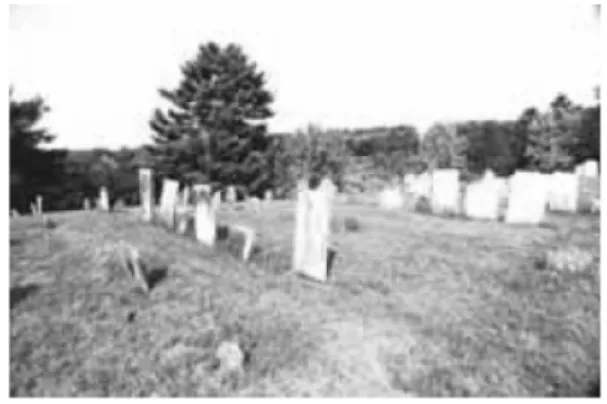
Where under this changeable condition are more comfortable places for humans in Connecticut? One of them is North Cemetery located in the town of Hampton in northeastern Connecticut not far from the Storrs Uconn campus. The Little River drains this area of Hampton area. In this area, elevations are generally between 200 feet and 500 feet, and land slopes down about 12 feet per mile to the south and southeast. It is hilly in some places around Figure 2. Seasonal precipitation change of each city in Korea (unit in %)
(The longer the scale bar, the higher the precipitation)
Hampton area. Local differences in elevation can bring about variations in weather characteristics;
in particular climate forces including temperature, relative humidity, wind, and radiation-exchange are greatly affected by topography.
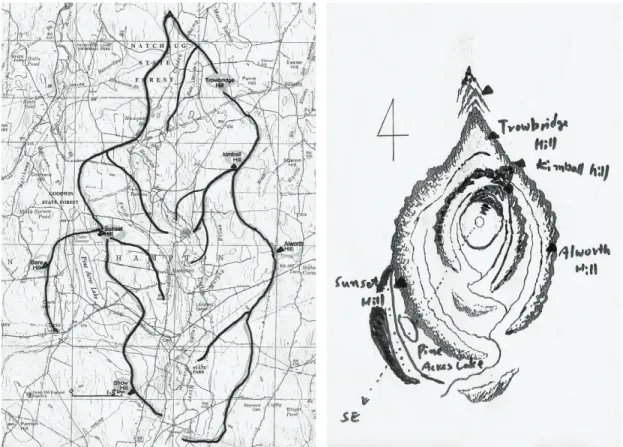
Applying the Pungsu model to this site, the locations of hills and rivers may can be given Pungsu name. Kimball Hill can be called Main Mountain, Slope of Trowbridge Hill Outer White Tiger, State Park slope Outer Azure Dragon, Sunset Hill Peace Mountain, Bare Hill Facing Mountain, Hampton Brook and Murphy Brook Inner Water Discharge, Little River Outer Water Discharge, Pine Acres Lake Water. The model can be symbolized as a snake moving from Kimball Hill to North Cemetery, where it stops to look at Sunset Hill.
The comfortable place represents the snake’s head. The head consists of three parts: eyes, nose, and mouth. The nose is the geomancy cave, and Koreans constructed a tomb on it for one dead. The nose is the most important place because the snake breathes through its nose. The benefit of this arrangement is that the ancestor’s bone will make the ancestor’s offspring prosperous. Americans can build a small house on the place, locating main room on the geomancy cave.
Pungsu practioners in Korea have investigated the most comfortable place or bright yard with the landscape of landform for centuries. The evaluation is based on five properties or criteria as semi-openness, multi-surroundedness, stability, harmony, and balance (Ock, 2003a, 2005). The
Figure 4. White Tiger Figure 3. Azure Dragon
Figure 6. Main Mountain Figure 5. Enterance Slope
results are ranked excellent, good, not bad. North Cemetery is good.
It is necessary to investigate first how the local geomorphologic element including hills and mountains can make the high relative humidity with hot temperature or the low relative humidity with cold wind chill all season on North Cemetry, and secondly how the mechanism , if so, can be proved. To solve this problem, the Pungsu Index can be proposed. It incorporates the comfort index modified by the wind effect index and the local geomorphologic index. To calculate the Pungsu index, the local data about relative humidity, wind direction and speed are needed over an entire year. If there are data comparing the most comfortable place with the common place measured by the Pungsu index, Pungsu can be a geographic science for searching for
comport place.
Pungsu, the geographic science, will be based on the adaptive strategy for finding the more comfortable places to humans which considers good relative humidity with warm and mild wind.
As Pungsu is recognized as an adaptive strategy, some ideas, the efforts of mankind to achieve the comfortable condition similar to Pungsu could be found worldwide. Investigating the Pungsu relationship as an adaptive strategy for finding the comfortable or vital places is an important research topic. Though humans do not live on the comfortable area, they can try to search for the more comfortable places or to make up for the less comfortable places with Pungsu as the adaptive strategy for the comfort. The strategy depends on the Pungsu landscape.
Figure 7. Comfort place in North Cemetery (left) and it’s modified model (right)
4. Discussion and Conclusion
Humans have been searching for more com- fortable places for centuries. Pungsu in Korea or China has a long history of development. It has very complicated concepts, but the comfort concept which is related with vitality is closest to science. The human reaction to comfort not only physiologically but also individually in the traditional society was not easy because of the lack of air conditioning, humidifier, or air circulation equipment. Nowadays, contemporary house can be equipped with them at a significant cost, but human’s effort for the equipment cannot be sustainable. It is important for us to search for more comfortable places or to make up for less comfortable places in the area with the adaptive strategy for the comfort
Reference
American Society of Heating and Air-Conditioning Engineering, 1959, Heating Ventilating Air Conditioning Guide, Waverly Press.
Lee, C. M., 1993, Pungsu (Geomancy) in Korea: theory and practice, the 60th Anniversary Book of Professor Ki Ju Hyung, 565-619.
Lewis, T. R. and Harmon, J. E., 1986, Connecticut: A Geography, Ingolf Vogeler.
Ock, H. S., 2003a, A study on the Pungsu landscape of the myungdang tomb sites in Andong area, Journal of the Korean Geographical Society,
38(1), 70-86.
Ock, H. S. and Park, W. P., 2003b, The Criteria and selection of Pungsu site of exurban housing along the Han riverside, Journal of Photo- Geography, 13(1), 59-72.
Ock, H. S., 2005, The nature of landscape geomancy and the criteria about selecting the bright yard, Journal of Korean Cultural and Historical Geography, 10, 1-15.
Ock, H. S., 2007, The evaluation of royal palaces by the landsape of Korean Pungsu by the variables of climate and geomorphology, Cultural and Historical Georaphy, 19(1), 1-10.
Ock, H. S. and Seo, T. Y., 2005, Planning the new city based on the geomancy: A case of the design of the New Multi-functional Administrative City (NMAC), Journal of the Korean Geographical Society, 40(5), 491-513.
Terjung, W. H., 1966, Physiologic climates of the conterminous United States: A bioclimatic classi- fication based on man, Annals of the Association of American Geographers, 56(1), 141-179.
Terjung, W. H., 1968, World patterns of the distribution of the monthly comfort index, International Journal of Biometeology, 12(2), 119-151.
Correspondence: Hansuk Ock, Department of Geography Education, Kangwon National University, Chunchon, Gangwon-do, 200-701, Korea(e-mail: ock@kangwon.
ac.kr, phone: 82-33-250-6694, fax: 82-33-250-6690) 교신 : 옥한석, 200-701, 강원도 춘천시 효자동 강원대학교 지
리교육과(이메일: [email protected], 전화: 033- 250-6694, 팩스: 033-250-6690)
Recieved December12, 2007 Accepted December21, 2007