ISSN: 2233-601X (Print) ISSN: 2093-6516 (Online)
− 40 −
Received: April 25, 2018, Revised: October 22, 2018, Accepted: October 22, 2018, Published online: February 5, 2019
Corresponding author: Jong Ho Cho, Department of Thoracic and Cardiovascular Surgery, Samsung Medical Center, Sungkyunkwan University School of Medicine, 81 Irwon-ro, Gangnam-gu, Seoul 06351, Korea
(Tel) 82-2-3410-2114 (Fax) 82-2-3410-6986 (E-mail) [email protected]
© The Korean Society for Thoracic and Cardiovascular Surgery. 2019. All right reserved.
This is an open access article distributed under the terms of the Creative Commons Attribution Non-Commercial License (http://creativecommons.org/
licenses/by-nc/4.0) which permits unrestricted non-commercial use, distribution, and reproduction in any medium, provided the original work is properly
cited.
A Large Epiphrenic Esophageal Diverticulum Communicating with the Left Lower Lobe
Suk Kyung Lim, M.D., Jong Ho Cho, M.D., Ph.D.
Department of Thoracic and Cardiovascular Surgery, Samsung Medical Center, Sungkyunkwan University School of Medicine
Epiphrenic diverticula are known to cause a series of complications. We report the case of a 54-year-old woman who was diagnosed with an epiphrenic diverticulum at a regular checkup in November 2006. Ten years later, she presented with massive hematemesis. Imaging studies revealed an epiphrenic diverticulum measuring 7.8 cm in diameter and a large amount of bleeding inside the diverticulum. Computed tomography showed fistula formation between the diverticulum and the left lower lobe of the lung, leading to the devel- opment of a pulmonary abscess. Diverticulectomy and 180° posterior partial fundoplication were performed transabdominally. The pulmonary abscess was treated with antibiotics alone. She was discharged 16 days af- ter the operation without any complications over 7 months of follow-up.
Key words: 1. Esophageal diverticulum 2. Esophagopulmonary fistula
Case report
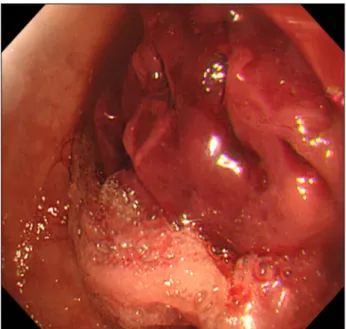
A 54-year-old woman was diagnosed with an esophageal diverticulum at a regular checkup in November 2006. No treatment was needed because the size of the diverticulum was small and she was asymptomatic. In September 2015, she presented with mild regurgitation and dysphagia. An esoph- agogastroduodenoscopic examination showed no spe- cific abnormalities, and she was treated conserva- tively. She returned to the emergency department 5 months later with massive hematemesis. An esoph- agogastroduodenoscopic examination revealed a Dieulafoy lesion within the diverticulum, in addition to a large hematoma (Fig. 1), and she underwent a clipping procedure. The esophagogram showed an epiphrenic diverticulum measuring 7.8 cm in diame- ter located 5 cm above the gastroesophageal junction (Fig. 2). Surgical treatment was indicated; however,
because of her poor nutritional condition and co- morbidities, surgery had to be put on hold. Her body mass index was 14.86 kg/m
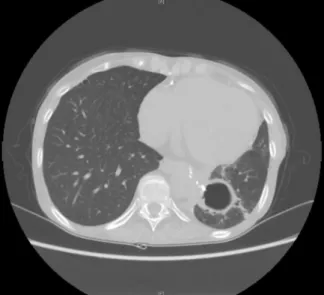
2, and her weight was 33 kg and height was 149 cm. Her Eastern Cooperative Oncology Group performance status was only 3. The forced expiratory volume in 1 second was 58% and diffusing capacity of carbon monoxide was 38% of the expected value. She performed the 6-minute walk test but could only cover 156 m. She was diagnosed with end-stage renal disease and received hemo- dialysis. She had been administered long-term ste- roids to treat rheumatoid arthritis. In March 2017, her general condition improved to the point where she could use a wheelchair for ambulation, and sur- gery was therefore planned. Preoperative computed tomography of her chest revealed a concealed rup- ture of the diverticular sac, leading to the develop- ment of a fistula between the diverticulum and the left lower lobe of the lung and a consequent pulmo-
Korean J Thorac Cardiovasc Surg 2019;52:40-43 □ CASE REPORT □
https://doi.org/10.5090/kjtcs.2019.52.1.40