Korean J Clin Pharm, Vol. 29, No. 1, 2019
9 Original Article
Official Journal of
Korean College of Clinical Pharmacy pISSN 1226-6051 eISSN 2508-786X https://doi.org/10.24304/kjcp.2019.29.1.9 Korean journal of clinical pharmacy (Online) URL: http://www.ekjcp.org
사용금기 약물에 대한 의약품안전사용서비스의 효과에 대한 체계적 문헌고찰
이희영
# ·
최혜숙# ·
지은희*
가천대학교 약학대학
(2018 년 11 월 22 일 접수 · 2019 년 3 월 7 일 수정 · 2019 년 3 월 8 일 승인 )
The Effects after Implementing a Drug Utilization Review System on Contraindicated Drug use: A Systematic Review
Heeyoung Lee # , Hyea Suk Choi # , and Eunhee Ji*
College of Pharmacy and Research Institute of Pharmaceutical Sciences, Gachon University, Incheon 21936, Republic of Korea (Received November 22, 2018 · Revised March 7, 2019 · Accepted March 8, 2019)
Introduction
The drug utilization review (DUR) system is a systematic program to determine whether patients receive, or are prescribed, appropriate medication to improve patient health status.1) As defined “an authorized, structure, and on-going review of prescribing, dispensing, and use of medication”, DUR system adopted predetermined criteria for appropriate drug therapy compared to patient’s records. Effective implementing DUR system, as supported by various reports, promised to reduce or eliminate serious preventable drug-related adverse events such as contraindicated drug use.2,3) As contraindicated drug use is life-threatening for some patients, to ensure safety while
prescribing drugs, avoiding contraindicated drug use is the most essential factor.4-6) Furthermore, contraindicated drug uses were attributed to increase expenditures by additional hospital admissions.2) Considering the risk for mortality increased by 40% with inappropriate exposure to contraindicated drugs for some vulnerable patients,6) ensuring effective implementation of DUR system is important for the clinical and economic aspects.
Nevertheless, some researchers reported current DUR system has yet to reach its full potential.7-9) These reports initially questioned about the important discrepancy between current practice and potential advantages from drug utilization review, which showed that critical drug interactions were not detected
ABSTRACT
Objective: The objective of the present study was to evaluate the effects of implementing a systematic Drug Utilization Review (DUR) system on contraindicated drug use and pharmaceutical expenditures in Korea. Methods: A literature search was conducted using search engines such as PubMed, EMBASE, NDSL, and RISS for relevant systematic studies. The database search was performed and updated in April 2018. Two independent reviewers evaluated the abstracts to find potentially eligible articles.
Results: In total, 1433 potentially eligible studies were selected, and 11 articles were eventually shortlisted for inclusion in the present review system. The outcome showed that contraindicated drug use decreased after implementation of the DUR system in Korea. The analysis also showed that the DUR system contributed to a reduction in pharmaceutical expenditures. Conclusions:
Our study showed that implementing the DUR system reduced both contraindicated drug use and pharmaceutical expenditures in Korea.
KEY WORDS: Drug utilization review system, contraindicated drugs, pharmaceutical expenditure, systematic review, Korea
#
The first two authors contributed equally to this work.
*Correspondence to: Eunhee Ji, College of Pharmacy, Gachon University, 191 Hambakmoe-ro, Yeonsu-gu, Incheon 21936, Republic of Korea Tel: +82-32-820-4939, Fax, +82-32-820-4829
E-mail: [email protected]
by DUR systems.7,8) Others described that current DUR systems fail to “promote appropriate use of medications without having to remove useful but clinically interacting agents from the market”9) with several studies suspected the efficiency of regulatory actions preventing prescription of contraindicated drugs.10,11) Besides, a systematic review and meta-analysis showed that computerized decision support systems linked to electronic health records such as DUR systems did not significantly reduce mortality and morbidity.12)
In Korea, also, the DUR system was implemented as a unique format to notify concurrent and real-time information to physicians and pharmacists. After the need for a DUR system was raised in 2003, the system was supplied nationwide in December 2010. The DUR system includes a list of medications predefined with DUR criteria including contraindications in pregnant women, drugs with drug-drug interactions, and drugs with age contraindications.3) It was managed with the Health Insurance Review and Assessment Service (HIRA) database includes nationwide information from hospitals and pharmacies on patient demographics, diagnosis, prescriptions, and healthcare providers, which is linked to the Korean National Health Insurance data that issues reimbursements.13) Despites of various research supports for the effectiveness of the DUR system in Korea, still, one- third of the users of the DUR system did not agree that the DUR alerts could identify rare adverse drug reactions.
Indicated by Goedecke et al.14) to evaluate the effects of regulatory interventions such as the DUR system, more studies should be supported with various measures and designs. To our knowledge, there was no attempt to evaluate the efficacy of implementing the DUR system in Korea through a systematic review with outcomes shown in previous literatures. Thus, in the present study, we set out to systematically investigate the effects of the DUR system on contraindicated drug use and pharmaceutical expenditures in Korea.
Methods
Literature Screening
The search was conducted in PubMed and EMBASE for previous relevant systematic studies. Also, for searching relevant articles in Korean, we performed database searches in National Digital Science Library (NDSL) and Research Information Sharing Service (RISS). Our database search was
performed and updated in April 2018. Published articles searched for were limited that they investigated the effects of the DUR systems in Korea. The literature search was restricted to full-text articles that were written in English and Korean. In addition, we manually searched the references of the collected articles and systematic reviews for additional relevant studies. Supplementary Appendix 1 details the PubMed search strategy.
Study Selection and Data Extraction
Two independent reviewers first evaluated the abstracts to find potentially eligible articles. All types of study designs were selected. We selected studies conducting analysis with HIRA data and evaluating the effects of the DUR system on contraindicated drug use and pharmaceutical expenditures in Korea. Data were classified into those of the following two periods: the “Pre-DUR” period data, collected from studies that provided data before implemented the nation-wide DUR system, and “Post-DUR” period data, collected after the implementation. In addition, we collected studies providing number of contraindicated drug uses and pharmaceutical expenditures as outcomes. No date or time restrictions were applied and all articles published before and after nation-wide DUR system implementation in Korea were analyzed. We excluded duplicates, abstracts, letters to editors, commentaries, and supplements. A contraindicated drug was defined in terms of the authors’ definition in each study that was included. The data extracted from the retrieved articles included the year of publication, study design, study setting, data source, types of database, observation period, main findings, and drug regimens prescribed. Any disagreements between two independent reviewers were solved through discussions.
Data Validity and Quality Assessment
Two investigators extracted data and assessed the validity with a qualitative evaluation system.15) For the assessment, we applied a checklist developed by Vander Stichele R. et al. for the European surveillance of antimicrobial consumption (ESAC) project.15,16) This is a qualitative evaluation tool to assess the validity of the data to confirm the cross-national comparability was applied. This system provided list recommending to check for possible bias related to population coverage, drug coverage, and other potential issues. According to the checklist for evaluating the validity of the data, problems with population coverage included issues relevant to sample or
census bias of data. In addition, problems associated with drug coverage included underdectection bias related to over-the- counter (OTC) sales, use of selected drug list, and terminology/
measurement assignment bias. Especially, underdetection bias is possible in countries with data collection systems based on reimbursement data where OTC sales are considered as part of the national consumption. Also, risks of terminology and measurement assignment bias refers to problems in terminology and measurement units’ assignment in the data set, which means errors of attribution of marketed drugs to the ATC classification. Two reviewers evaluated the risk of bias, either as high, medium, low, or unclear. Any discrepancies between two reviewers made consensus by discussions.
Results
Study Selection
We reported a systematic review according to the Preferred Reporting Items for Systematic Reviews and Meta-Analysis
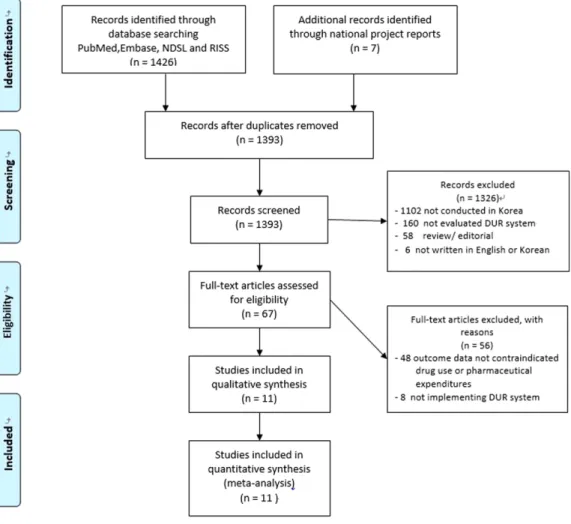
(PRISMA) statement.17) Through our comprehensive search, 1341 potentially eligible articles were selected from PubMed and EMBASE. Additionally, 92 eligible articles were chosen from NDSL and RISS. After full-text review, 67 articles were selected. Fifty-six studies were excluded, and 11 articles were included in the present systematic review (Fig. 1). We did not include any article following the manual search.
Study Description
The summary of characteristics of all the studies finally included was provided in Table 1. All included studies18-28) evaluated the effects of the DUR system implemented in Korea, and the majority of study data used in these studies were Health Insurance Review and Assessment Service (HIRA) data. SO Kim et al.21) study analyzed National Health Insurance Service (NHIS) data to evaluate the DUR system, which were directly linked with HIRA data. Except for three studies,18,20,21) others provided findings the effects of the DUR system in Korea on contraindicated drug uses. These three
Fig. 1. Flow diagram for study selection.
studies showed the effects of implementing DUR system on the trend of pharmaceutical expenditures without indicating specific types of medications they analyzed. Two studies19,22) found contraindicated use trends for drug-drug interactions after implementation of DUR system, and six studies19,23-25,27,28)
described outcomes related to age-contraindicated drug uses.
SO Lee et al.,19) JH Yang et al.,25) JH Heo et al.18) studies provided the outcomes after the DUR system implemented. JH Heo et al.’s study18) was conducted before the nationwide DUR system implemented in Korea in 2010, but it tested the same format of the nationwide system as a pilot program.
Except for these two studies, other studies compared the impact of the DUR system before and after nationwide implementation. JH Heo et al.18) and SO Kim et al.21) studies
provided the changes of pharmaceutical expenditures after implementing DUR system in Korea. MH Yi et al. study20) yielded the number of clinics showing decreased or increased pharmaceutical expenditures after applying DUR system.
Quality and Data Validity
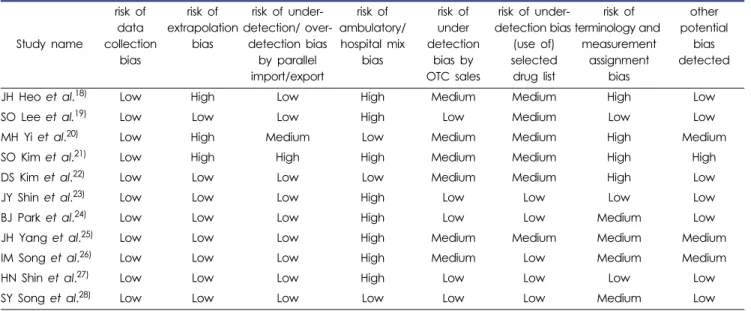
Data provided by all included studies showed low risk of bias for data collection, and were retrieved from HIRA or NHIS database (Table 2). Three studies18,20,21) analyzing data from a local area in Korea showed high risk of extrapolation bias. Three studies20,22,28) provided specific data separated from between inpatient and outpatient settings. Also, there were possibilities for OTC sales of medicines prescribed in four studies.18,20-22) Risk of under-detection bias by OTC sales
Table 1. Characteristics of included studies
Study name Publication year
Study design
Data source
Observation
period Outcomes Types of
Contraindications Drug regimen
JH Heo et al.
18)2013 Cross-sectional HIRA data
May ~ October 2009
Pharmaceutical expenditures at clinics
and pharmacies
Not available Not available
SO Lee et al.
19)2015 Descriptive HIRA
data 2011 ~ 2013
Number of alerts for contraindicated drug uses and acceptance
rate
DDIs, Age Not specified
MH Yi et al.
20)2012 Cross-sectional HIRA data
January 2010 ~ January 2011
Number of clinics according to the pharmaceutical expenditure changes
Not available Not available
SO Kim et al.
21)2014 Cross-sectional NHIS data
March 2009 ~ October 2011
Pharmaceutical
expenditures Not available Not available DS Kim et al.
22)2014 Cross-sectional HIRA
data
January 2010 ~ December 2011
Number of drugs per
prescription DDIs Contraindicated use for DDIs
JY Shin et al.
23)2014 Cross-sectional HIRA data
January 2009 ~ December 2011
Number of population prescribed for contraindicated drugs
Age (under the
age of 18) Fluoroquinolone
BJ Park et al.
24)2015 Cross-sectional HIRA data
January 2007 ~ December 2011
Number of population prescribed for contraindicated drugs
Age (under the
age of 18) Methylphenidate
JH Yang et al.
25)2015 Cross-sectional HIRA data
January 2009 ~ December 2012
Number of drugs per prescription
Age, Pregnancy
CF, LF, OF, AZ, CT, LP, DG, MG, MP IM Song et al.
26)2016 Cross-sectional HIRA
data
January 2007 ~
December 2011 Number of prescriptions Pregnancy Not specified
HN Shin et al.
27)2017 Cross-sectional HIRA data
January 2007 ~ December 2011
Number of population prescribed for contraindicated drugs
Age Not specified
SY Song et al.
28)2017 Cross-sectional HIRA
data 2007 ~ 2015 Number of prescriptions Age CF or LF
AZ, azelastine ; CT, cetirizine; CF, ciprofloxacin; DDIs, drug-drug interactions; DG, dydrogesterone; HIRA, Health Insurance Review and Assess-
ment Service; LP, loperamide; LF, levofloxacin; MG, methylergoetrine; MP, micronized progesterone NHIS; OF, ofloxacin; NHIS, National Health
Insurance Service.
Table 2. Risk of bias
Study name
risk of data collection
bias
risk of extrapolation
bias
risk of under- detection/ over-
detection bias by parallel import/export
risk of ambulatory/
hospital mix bias
risk of under detection
bias by OTC sales
risk of under- detection bias
(use of) selected
drug list
risk of terminology and
measurement assignment
bias
other potential
bias detected
JH Heo et al.
18)Low High Low High Medium Medium High Low
SO Lee et al.
19)Low Low Low High Low Medium Low Low
MH Yi et al.
20)Low High Medium Low Medium Medium High Medium
SO Kim et al.
21)Low High High High Medium Medium High High
DS Kim et al.
22)Low Low Low Low Medium Medium High Low
JY Shin et al.
23)Low Low Low High Low Low Low Low
BJ Park et al.
24)Low Low Low High Low Low Medium Low
JH Yang et al.
25)Low Low Low High Medium Medium Medium Medium
IM Song et al.
26)Low Low Low High Medium Low Medium Medium
HN Shin et al.
27)Low Low Low High Low Low Low Low
SY Song et al.
28)Low Low Low Low Low Low Medium Low
was determined to be a medium risk. Except for two studies,21,23) Anatomical Therapeutic Chemical Classification (ATC) or defined daily dose (DDD) assignments were not indicated, and thus others showed medium or high risk of bias.
Trends of Contraindicated Drug Use
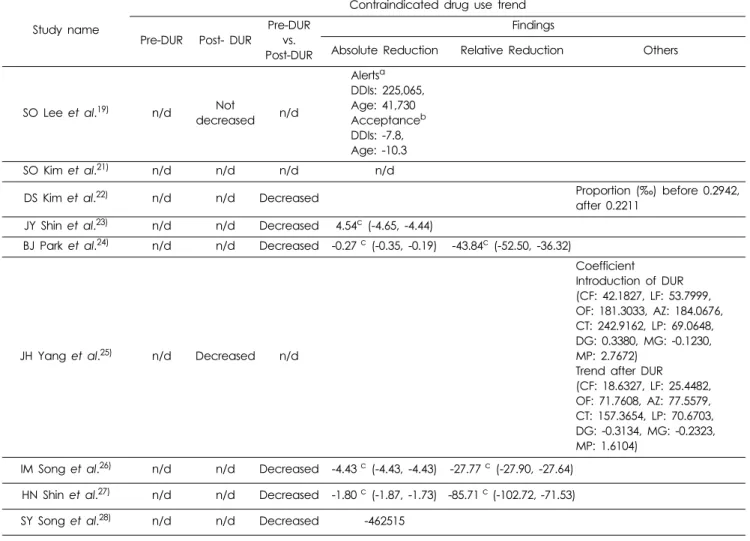
Six included studies showed comparative outcomes between pre-DUR and post-DUR periods showing trends of contraindicated drug uses (Table 3). Except for the study by SO Lee et al.,19) all others showed that the DUR system contributed to a decrease in the use of contraindicated drugs. SO Lee et al.
study19) indicated number of alerts to avoid contraindicated drug uses and rates accepted by clinicians, which showed no reductions after DUR system initiated. Included studies19,23,24,27,28)
provided the trend of prescribing age-contraindicated medications showed reduction of drug uses after implementing the DUR system. The relative reduction of contraindicated drug uses was shown from 27.77 to 94.55%, and absolute reduction was from 1.80 to 4.54%. JH Yang et al. study25) showed age- contraindicated drug use reduction compared after implementing DUR system compared to the time of introduction of DUR system. JH Yang et al. study indicated that coefficient of ciprofloxacin use was 42.1827 at the period of introduction of DUR, but, after DUR implemented, the coefficient was reduced to 18.6327. In addition, SY Song et al.’s study28) provided the number of fluoroquinolones, ciprofloxacin and levofloxacin, prescribed for pediatric patients compared between pre-DUR and post-DUR periods. Based on the sum of prescriptions of
ciprofloxacin and levofloxacin in the study, 462,515 prescriptions were less used during post-DUR period than them in pre-DUR period (Table 3). Two studies25,26) showed a decrease in drug use, which are contraindicated during pregnancy.
Trends of Pharmaceutical Expenditures
Three studies18,20,21) provided the changes of pharmaceutical expenditures after DUR system was implemented (Table 4).
Two studies18,21) showed the reduction of expenditures through the implementation of DUR system in Korea. A pilot program18) conducted with the same system as nation-wide DUR system initiated from 2010 in Korea, which also showed a reduction of pharmaceutical expenditures. In this study, after implementing DUR system in Korea, absolute reduction of clinics showed
$2126.74 and $246.14 for pharmacies. MH Yi et al. study20) found the proportion of clinics showing decreased (3.45%) expenditures was more than the ones increased (2.77%).
Discussion
We conducted a systematic review to evaluate the effects of implementing the DUR system in Korea on prescribing trends for contraindicated drug use and pharmaceutical expenditure changes. We found that contraindicated drug reduced after the DUR system was initiated in 2010. In addition, the DUR system contributed toward decreasing the burden on pharmaceutical expenditures.
In the present study, the majority of included studies presented the reduction of contraindicated drug use after the DUR
system was implemented. SO Lee’s et al. study19) did not show significant reduction for alerts to avoid contraindication uses provided by the DUR system and for the acceptance rates. Decreased acceptance rates of the warnings for
contraindicated drug use could be explained by the alert fatigue due to abrupt increase of frequencies of alarms after implementing the DUR system or caused by clinical determination of DUR system users.29,30) Nevertheless, other
Table 3. Trends of contraindicated drug use
Study name
Contraindicated drug use trend
Pre-DUR Post- DUR
Pre-DUR vs.
Post-DUR
Findings
Absolute Reduction Relative Reduction Others
SO Lee et al.
19)n/d Not
decreased n/d
Alerts
aDDIs: 225,065, Age: 41,730 Acceptance
bDDIs: -7.8, Age: -10.3
SO Kim et al.
21)n/d n/d n/d n/d
DS Kim et al.
22)n/d n/d Decreased Proportion (‰) before 0.2942,
after 0.2211 JY Shin et al.
23)n/d n/d Decreased 4.54
c(-4.65, -4.44)
BJ Park et al.
24)n/d n/d Decreased -0.27
c(-0.35, -0.19) -43.84
c(-52.50, -36.32)
JH Yang et al.
25)n/d Decreased n/d
Coefficient Introduction of DUR (CF: 42.1827, LF: 53.7999, OF: 181.3033, AZ: 184.0676, CT: 242.9162, LP: 69.0648, DG: 0.3380, MG: -0.1230, MP: 2.7672)
Trend after DUR (CF: 18.6327, LF: 25.4482, OF: 71.7608, AZ: 77.5579, CT: 157.3654, LP: 70.6703, DG: -0.3134, MG: -0.2323, MP: 1.6104)
IM Song et al.
26)n/d n/d Decreased -4.43
c(-4.43, -4.43) -27.77
c(-27.90, -27.64) HN Shin et al.
27)n/d n/d Decreased -1.80
c(-1.87, -1.73) -85.71
c(-102.72, -71.53) SY Song et al.
28)n/d n/d Decreased -462515
AR, absolute reduction; AZ, azelastine ; CT, cetirizine; CF, ciprofloxacin; DDIs, drug-drug interactions; DG, dydrogesterone; n/d, not determined;
LP, loperamide; LF, levofloxacin; MG, methylergoetrine; MP, micronized progesterone; Pre-DUR, pre-period of DUR system; Post-DUR, post-period of DUR system; Pre-DUR vs. Post-DUR, compare between pre and post period of DUR system; OF, ofloxacin; RR, relative reduction.
a: number of alert cases, b: percentage of the acceptance, c: percentage (%)
Table 4. Trends of pharmaceutical expenditures
Study name
Pharmaceutical expenditure trend
Pre-DUR Post- DUR
Pre-DUR vs.
Post-DUR
Findings
JH Heo et al.
18)n/d Decreased n/d
AR
Clinics: -$2126.74 Pharmacies: -$246.14
MH Yi et al.
20)n/d n/d Decreased Pharmaceutical expenditure decreased
a: 268 (3.45)
bPharmaceutical expenditure increased
a: 376 (2.77)
bSO Kim et al.
21)n/d n/d Decreased Coefficient -3,997 (2,615)
eAR, absolute reduction; n/d, not determined; a: percentage (%), b: standard error
included studies22-28) still showed the DUR system have played effective role to reduce contraindicated drug uses after implementation. Considering patients’ safety, appropriate precautions should be taken to prescribe drugs.4) Furthermore, inappropriate precautions were applied, prevalence of comorbidities and worsening clinical outcomes caused by contraindicated drug use was significantly increased.31,32) According to Keenan et al.32) ’s study, however, more than one contraindications to nonsteroidal anti-inflammatory drug use were identified in over 90% of the patients in three cohorts supported by the concerns that contraindicated drug uses could not be prevented from regulatory actions.10,11) Despites of such concerns, our study showed that the DUR system in Korea effectively reduced the use of contraindicated drugs. Korean DUR system notify real-time information to health care providers.3) When alert appears according to prescribing contraindicated drug, the physician may change or provide a reason to continue for the prescription. For dispensing purposes, a similar alert appears, and the pharmacist should communicate with the prescriber and confirm the prescription. For conducting DUR system in Korea, they are linked to HIRA database for review NHIS data enrolled by over 97% of citizens in Korea from 1989 for deciding reimbursement. Previously, requirement for the evolution of DUR systems to resolve drawbacks found from experiences or studies was consistent.2,33) However, as the present showed, the unique system adopted in Korea is one of the well-structured ongoing programs to detect contraindicated drug uses in clinical practice accurately and equitably.2,31)
Moreover, our study showed that implementing the DUR system contributed to a decrease in pharmaceutical expenditures.
MH Yi et al. study20) showed the distributions of clinics reported pharmaceutical costs reductions were increased, reflecting decreased pharmaceutical expenditures after implementing DUR system. In Korea, each year, growth of pharmaceutical expenditures was faster than in other nations, which could be influenced by growing number of brand name of drugs or over-utilization.34) As Mossialos et al.35) explained, added expenditures were not directly related to quality of patient care. However, still, the primary goal of health care system is determined by improving patients’ health status such as safety at the least cost.36) In terms of cost-effectiveness issues, our study showed implementing DUR systems in Korea significantly reduced the pharmaceutical expenditures by preventing drug over-utilizations.
Our study has several limitations as well. First, the findings of this present study should be applied with caution in the interpreting economic effects of DUR system to other entities such as pharmaceutical companies. Thus, future pharmacoeconomic evaluation should be conducted in future studies. Secondly, our study could not include clinical trials to conduct meta- analysis with included studies because of heterogeneity. We expected that more clinical studies evaluate the effects of DUR system for the patients’ safety and efficacy in Korea in the future. Next, the present study did not compare the magnitude of reduction between studies according to the risk of bias. According to the quality evaluation, several studies such as JY Shin et al. or JH Yang et al. studies showed medium risk of bias for underdetection by OTC sales.
However, in the present study, we did not show the discrepancies of reduction between these studies. This is because these studies did not provide same values of outcomes and conduct based on same study designs. Thus, future studies that analyzed reductions compared among studies according to risk of bias are warranted. Finally, in the current study, we did not provide clinical outcomes followed by DUR system implementation in Korea such as incidence of adverse events. However, evaluating clinical outcomes is beyond the scope of the present study, which is expected to be done in the future research.
To our knowledge, this is the first systematic review to assess the effects of implementing DUR systems for contraindicated drug use and pharmaceutical expenditures in Korea. We conclude that the DUR system was successfully implemented to provide a reduction of prescribing contraindicated drugs.
We also noted that the DUR system decreased pharmaceutical expenditures. Since the DUR system has been implemented in Korea in 2010, it has contributed to an improvement in patient safety and the economic status in Korea.
Conclusion
In conclusion, our study showed that implementing the DUR system both reduced contraindicated drug use and pharmaceutical expenditures. With regard to patient safety, the DUR system is a cost-effective regulatory action. However, there is a need to further evaluate the DUR system with various types of clinical outcomes or study designs in the future.
Funding
No funding sources for this study.
Conflict of Interest
No conflicts of interest have been declared.