212 http://e-aair.org © Copyright The Korean Academy of Asthma, Allergy and Clinical Immunology • The Korean Academy of Pediatric Allergy and Respiratory Disease
INTRODUCTION
Reactive dyes form covalent bonds with the fibers in textiles.
A reactive dye (RD) can act as a hapten1 and elicit occupational asthma (OA) in exposed workers.2 Since the first report of RD- induced OA in 1978,3 the reported prevalence of RD-induced OA in Korea has been 2.5–5.9%.4,5 RDs were among the most frequent causes of OA in Korea until the 1990s.6 Of these dyes, Black GR is the most frequent sensitizer; others include Orange 3R, Blue GG, and Green 6B.4,7,8 There has been no previous re- port of OA caused by Synozol Red-K 3BS (Red-K). Thus, we re- port the first case of OA induced by Red-K, confirmed by skin- prick testing, bronchial provocation, and immunological test- ing in a dyer in the textile industry.
CASE REPORT
The patient was a 38-year-old male non-smoker. He had no history of allergic disease. He had worked in the textile industry for 15 years and had used reactive dyes, such as Synozol Black B 150 (Black B) and Red-K. Nine years after starting his job, he experienced rhinorrhea that progressed to a cough and dyspnea 1 year ago; these were aggravated at work.
At presentation, his blood differential count, serum biochem- istry, total IgE (56 kU/L), and chest and paranasal sinus radio- graphs were normal. The sputum eosinophil count was elevat-
Occupational Asthma Induced by the Reactive Dye Synozol Red-K 3BS
Hyun Jung Jin, Joo-Hee Kim, Jeong-Eun Kim, Young-Min Ye, Hae-Sim Park*
Department of Allergy and Rheumatology, Ajou University School of Medicine, Suwon, Korea
ed to 84%, while the blood and nasal eosinophil counts were normal (220/μL, 0%). Skin prick testing was positive for mug- wort and nettle pollens. Baseline results included a FEV1 of 3.84 L (120.0%) with a FEV/FVC ratio of 90.61% and post-broncho- dilator FEV1 of 3.92 L (122.3%) without reversibility. His initial methacholine PC20 was 1.25 mg/mL.
We considered that his asthma and rhinitis symptoms may be related to his occupation, especially using RDs. Two RDs used in his factory were Black B (color index name Reactive Black 5) and Red-K. The structures of Black B and Red-K are shown in Fig. 1. Skin-prick testing was performed with extracts of these two RDs (10 mg/mL) and histamine. He had a positive result for Red-K (4 × 4/31 × 24 mm), but a negative result (0 mm) for Black B, when compared with histamine (3 × 3/35 × 29 mm).
Serum specific IgE antibodies to two RD–human serum albu- min (HSA) conjugates were measured using an enzyme-linked immunosorbent assay (ELISA), as described previously.9 The positive cut-off value for a high serum specific IgE level was de- fined as the mean absorbance value plus three standard devia-
Case Report
Allergy Asthma Immunol Res. 2011 July;3(3):212-214.
doi: 10.4168/aair.2011.3.3.212 pISSN 2092-7355 • eISSN 2092-7363
Various reactive dyes can elicit occupational asthma in exposed textile industry workers. To date, there has been no report of occupational asthma caused by the red dye Synozol Red-K 3BS (Red-K). Here, we report a 38-year-old male textile worker with occupational asthma and rhinitis induced by inhalation of Red-K. He showed positive responses to Red-K extract on skin-prick testing and serum specific IgE antibodies to Red-K-human se- rum albumin conjugate were detected using an enzyme-linked immunosorbent assay. A bronchoprovocation test with Red-K extract resulted in sig- nificant bronchoconstriction. These findings suggest that the inhalation of the reactive dye Red-K can induce IgE-mediated occupational asthma and rhinitis in exposed workers.
Key Words: Asthma; reactive dye; occupation
This is an Open Access article distributed under the terms of the Creative Commons Attribution Non-Commercial License (http://creativecommons.org/licenses/by-nc/3.0/) which permits unrestricted non-commercial use, distribution, and reproduction in any medium, provided the original work is properly cited.
Correspondence to: Hae-Sim Park, MD, PhD, Department of Allergy and Rheumatology, Ajou University School of Medicine, San-5 Wonchon-dong, Yeongtong-gu, Suwon 442-749, Korea.
Tel : +82-31-219-5196; Fax : +82-31-219-5154; E-mail: [email protected] Received: October 20, 2010; Accepted: November 22, 2010
•There are no financial or other issues that might lead to conflict of interest.
Synozol Red-K 3BS Induced Occupational Asthma
Allergy Asthma Immunol Res. 2011 July;3(3):212-214. doi: 10.4168/aair.2011.3.3.212 AAIR
213 http://e-aair.org tions for sera from 18 unexposed, non-atopic, healthy controls.
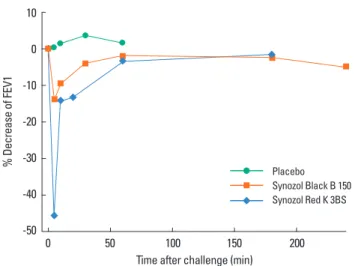
He had a high level of IgE antibody specific to the Red-K-HSA conjugate, but no specific IgE binding was noted with the Black B-HSA conjugate (Fig. 2). To confirm OA, inhalation challenge tests with the two RD extracts were performed. No significant change in FEV1 was noted after the placebo inhalation, while significant bronchoconstriction (a 45.6% fall in FEV1 from the baseline value) with dyspnea and wheezing was noted 10 min- utes after inhaling 10 mg/mL of Red-K extract; the response was negative after inhaling Black B extract up to 10 mg/mL (Fig. 3).
Based on these findings, he was diagnosed with OA and rhini- tis caused by Red K. We recommended job relocation and the
use of an inhaled corticosteroid/long acting β-2 agonist with regular follow-up.
DISCUSSION
Positive skin-prick tests to extracts of dyes and a positive radio- allergosorbent test to RD-bound paper discs suggest that RDs can act as haptens, provoking IgE-mediated hypersensitivity re- actions.10 Both skin-prick testing and the detection of specific IgE to RD-HSA conjugate in serum are useful for screening, di- agnosing, and monitoring OA resulting from exposure to RDs.11 Our patient had positive responses to Red-K extracts on skin- Fig. 1. Chemical structures of Synozol RED K 3BS (A) and Synozol Black B 150 (B).
A B
Fig. 2. Serum specific IgE levels to two reactive dye-human serum albumin conjugates by enzyme-linked immunosorbent assay: Synozol RED K 3BS (A) and Synozol Black B 150 (B). Horizontal bars indicate positive cut-off values. OD, optical density; NC, unexposed healthy controls.
Specific lgE level (OD×1,000)
Patient NC
800
600
400
200
0
Specific lgE level (OD×1,000)
Patient NC
300
200
100
0
A B
Jin et al.
Allergy Asthma Immunol Res. 2011 July;3(3):212-214. doi: 10.4168/aair.2011.3.3.212 Volume 3, Number 3, July 2011
214 http://e-aair.org
prick testing and had high serum specific IgE antibody to Red- K-HSA conjugate. The bronchoprovocation test with Red-K ex- tracts demonstrated immediate bronchoconstriction with the development of asthma symptoms. Thus, we confirmed the first case of OA caused by Red-K, not by Black B, in which an IgE-mediated response was suggested as a major pathogenic mechanism.
Reactive dyes contain a chromogen and reactive functional groups that form irreversible covalent bonds with the amino acid residues of cellulosic fibers.12 There are many RDs with dif- ferent reactive functional groups to which carrier proteins bind to induce immune responses.2,11,13 The vinyl sulfone RDs are major causes of OA and have one or two vinyl sulfone reactive groups.10,14,15 Black GR, the most frequent sensitizer, has two vi- nyl sulfone reactive groups,9 while Red-K has one. However, the allergenicity of an RD can differ according to the carrier protein and the conditions under which the hapten conjugation pro- cess occurs. The chromogen components, neoantigenic deter- minants, and reactive components all contribute to allergenici- ty.9 Our patient showed negative responses to skin-prick test- ing, ELISA, and bronchoprovocation testing for Black B, which is the most frequent sensitizer. Thus, we conclude that he was not sensitized to Black B.
He was atopic, although atopy is not a predisposing factor for RD-induced OA.7 He was a non-smoker, and smoking is a pre- disposing factor.8 Park et al.15 suggested that the duration from symptom onset to diagnosis was the only factor differentiating patients with normal and reduced lung function at diagnosis and that early diagnosis and treatment were essential for a good prognosis. Our patient’s disease duration from asthma symp- tom onset to diagnosis was 1 year. Thus, his condition may im- prove if he moves to another workplace and takes anti-asthma medications.
In conclusion, we confirmed that Red-K powder inhalation
can induce OA, and an IgE mediated response was suggested in the pathogenic mechanism.
ACKNOWLEDGMENTS
This study was supported by a grant from the Korea Science and Engineering Foundation (KOSEF), funded by the Korean government (MEST, 2009-0078646).
REFERENCES
1. Park HS, Kim YJ, Lee MK, Hong CS. Occupational asthma and IgE antibodies to reactive dyes. Yonsei Med J 1989;30:298-304.
2. Luczynska CM, Topping MD. Specific IgE antibodies to reactive dye-albumin conjugates. J Immunol Methods 1986;95:177-86.
3. Alanko K, Keskinen H, Bjorksten F, Ojanen S. Immediate-type hy- persensitivity to reactive dyes. Clin Allergy 1978;8:25-31.
4. Park HS, Kim JW, Hong CS. The prevalence of specific IgE and IgG to reactive dye-human serum albumin conjugate in workers of a dye factory and neighboring factories. J Korean Med Sci 1991;6:63-8.
5. Lee KJ, Moon YH, Roh J, Park HS, Hong CS. Health characteristics and symptom of workers in reactive dye industries. Korean J Prev Med 1990;23:338-44.
6. Koh DH, Won J, Ahn YS, Kim HR, Koh SB. Asthma mortality in male workers of the dye industry in Korea. J Occup Health 2008;50:130-5.
7. Nilsson R, Nordlinder R, Wass U, Meding B, Belin L. Asthma, rhini- tis, and dermatitis in workers exposed to reactive dyes. Br J Ind Med 1993;50:65-70.
8. Park HS, Lee MK, Kim BO, Lee KJ, Roh JH, Moon YH, Hong CS. Clin- ical and immunologic evaluations of reactive dye-exposed workers.
J Allergy Clin Immunol 1991;87:639-49.
9. Park JW, Kang DB, Choi SY, Kim CW, Kim KS, Hong CS. Heteroge- neity of IgE epitopes of vinyl sulphone reactive dye: human serum albumin that react with IgE. Clin Exp Allergy 2001;31:1779-86.
10. Docker A, Wattie JM, Topping MD, Luczynska CM, Newman Tay- lor AJ, Pickering CA, Thomas P, Gompertz D. Clinical and immu- nological investigations of respiratory disease in workers using re- active dyes. Br J Ind Med 1987;44:534-41.
11. Park JW, Kim CW, Kim KS, Choi SY, Kang DB, Ko SH, Won JU, Yang JY, Hong CS. Role of skin prick test and serological measurement of specific IgE in the diagnosis of occupational asthma resulting from exposure to vinyl sulphone reactive dyes. Occup Environ Med 2001;
58:411-6.
12. Bosshard HF, Datyner A. The use of a new reactive dye for quanti- tation of prestained proteins on polyacrylamide gels. Anal Bio- chem 1977;82:327-33.
13. Wass U, Nilsson R, Nordlinder R, Belin L. An optimized assay of specific IgE antibodies to reactive dyes and studies of immunolog- ic responses in exposed workers. J Allergy Clin Immunol 1990;85:
642-8.
14. Romano C, Sulotto F, Pavan I, Chiesa A, Scansetti G. A new case of occupational asthma from reactive dyes with severe anaphylactic response to the specific challenge. Am J Ind Med 1992;21:209-16.
15. Park HW, Kim DI, Sohn SW, Park CH, Kim SS, Chang YS, Min KU, Kim YY, Cho SH. Outcomes in occupational asthma caused by re- active dye after long-term avoidance. Clin Exp Allergy 2007;37:225- 30.
Fig. 3. Results of bronchoprovocation tests with two reactive dye extracts:
Synozol Black B 150 and Synozol RED K 3BS.
% Decrease of FEV1
10 0 -10 -20 -30 -40
-50 0 50 100 150 200
Time after challenge (min)
Placebo Synozol Black B 150 Synozol Red K 3BS