
Is the Linear No-Threshold Dose-Response Paradigm Still Necessary for the Assessment of Health Effects of Low Dose Radiation?
Inevitable human exposure to ionizing radiation from man-made sources has been increased with the proceeding of human civilization and consequently public concerns focus on the possible risk to human health. Moreover, Fukushima nuclear power plant accidents after the 2011 East-Japan earthquake and tsunami has brought the great fear and anxiety for the exposure of radiation at low levels, even much lower levels similar to natural background. Health effects of low dose radiation less than 100 mSv have been debated whether they are beneficial or detrimental because sample sizes were not large enough to allow epidemiological detection of excess effects and there was lack of consistency among the available experimental data. We have reviewed an extensive literature on the low dose radiation effects in both radiation biology and epidemiology, and highlighted some of the controversies therein. This article could provide a reasonable view of utilizing radiation for human life and responding to the public questions about radiation risk. In addition, it suggests the necessity of integrated studies of radiobiology and epidemiology at the national level in order to collect more systematic and profound information about health effects of low dose radiation.
Keywords: Low Dose Radiation; Health Effects; Radiobiology; Epidemiology; LNT Model Ki Moon Seong,* Songwon Seo,*
Dalnim Lee, Min-Jeong Kim, Seung-Sook Lee, Sunhoo Park, and Young Woo Jin
Laboratory of Radiation Exposure & Therapeutics, National Radiation Emergency Medical Center, Korea Institute of Radiological & Medical Sciences, Seoul, Korea
* Ki Moon Seong and Songwon Seo equally contributed to this work.
Received: 22 June 2015 Accepted: 17 September 2015 Address for Correspondence:
Young Woo Jin, MD
National Radiation Emergency Medical Center, Korea Institute of Radiological & Medical Sciences, 75 Nowon-ro, Nowon-gu, Seoul 01812, Korea
E-mail: [email protected]
Funding: This work was supported by the Nuclear Safety Research Program through the Korea Radiation Safety Foundation, granted financial resource from the Nuclear Safety and Security Commission (NSSC) (No. 1303028), and the Ministry of Science, ICT and Future Planning (MSIP) (No. 50586-2015), Republic of Korea.
http://dx.doi.org/10.3346/jkms.2016.31.S1.S10 • J Korean Med Sci 2016; 31: S10-23
INTRODUCTION
Since the discoveries of X-ray by Roentgen, W.C. in 1895 and radioactivity by Becquerel, H. in 1896 (1), radiation has been used in diverse fields for the improvement of human life, in- cluding medical diagnosis and treatment for diseases, industri- al application, scientific and educational uses (2). In the early days after finding radiation, it was prevalent all over the indus- trial fields without recognizing that exposure to large radiation dose could cause serious harmful effects on human health, for example, “Radiothor” (a popular and expensive radium con- taining water) and “Fluoroscope” (a shoe-fitting X-ray unit) (3).
Owing to the scientific research such as Herman J. Muller’s pio- neering works on the mutagenic X-ray and the radiation disas- ter by two atomic bombs in 1945 in Japan, the view of the public for the radiation had been changed, and finally the protection standards for exposure to radiation was constructed by several expert authorities (4).
RADIATION EXPOSURE AND BIOLOGICAL RESPONSE
Challenge to the target theory in low dose radiation response
Despite the uncertainty of the Muller’s data due to insufficient analysis and lack of overall consistent findings for low dose range, his achievement is one of the critical contributing factors consolidating linear-no-threshold (LNT) model as a standard concept for regulation of the human radiation exposure (5,6).
In the LNT model, any low dose of radiation can dose-propor- tionally cause detrimental effects such as cancer and heritable genetic mutation without a threshold dose. This model is now accepted to adopt policy for radiation protection in the world (7). However, the LNT model neglects the important facts that all living beings on the earth have been evolved and adapted to harsher natural radiation environments for billions of years.
Moreover, there is a growing body of experimental and epide- miological evidence that does not support the LNT model for
estimating cancer risks at low doses (8). In addition, the tradi- tional concept that radiation hits a defined target in cells and genes has been changed into that there are also non-targeted DNA mechanisms in low dose radiation response. They are very complex to investigate, and the prediction for their occurrence is more difficult due to the presence of several agonistic or an- tagonistic confounding factors such as pollutants, ages and life styles. Recent reports issued by international authorities of radi- ation such as the National Academy of Sciences (NAS), the Unit- ed Nations Scientific Committee on the Effects of Atomic Radi- ation (UNSCEAR), the International Commission on Radiologi- cal Protection (ICRP), the French Academy of Sciences (FAS) analyzed a great number of experimental data related to low dose radiation (9-12). They commonly announced that biologi- cal responses of low dose radiation were different from those of high dose radiation with various dose-response relationships and therefore, low dose effects cannot be concluded to be harm- ful to human health (9,12). They also recommended holistic approaches combining biological system-based methods with epidemiological data to develop more sophisticated dose-re- sponse models at low dose levels, considering a dose and dose- rate effectiveness factor (DDREF) (7).
Complexity of biological effects of radiation exposure Radiation may damage various cellular components including DNA, directly (molecule ionization) or indirectly (reactive oxy- gen species production). Irradiated cells protect themselves by many innate defense mechanisms such as removal of oxidative stress and damaged cells, and DNA repair. Remained damages of cells may cause tissue/organ dysfunction and malignant dis- eases. For radiation protection, the biological effects of radia- tion are conventionally categorized into two broad classes: sto- chastic and deterministic effects (or recently termed tissue re- actions) (13).
Stochastic effects have probability of occurrence depending on the irradiated doses without threshold. These effects can oc- cur by chance and consist primarily of cancer and genetic ef- fects such as inherited mutations. Stochastic effects often show up years after exposure. In addition, because they can occur in individuals under background radiation levels without expo- sure, it can never be determined that an occurrence of these ef- fects was due to a specific exposure (2).
Deterministic effects (or non-stochastic effects) are malfunc- tions of organs by irradiation at more than threshold. These ef- fects do not exist below their threshold doses, for example, skin burns, cataracts, cardiovascular disease, intestinal damage, and hemopoietic system and central nervous system failure (14).
Recent ICRP report referred to deterministic effects as tissue re- actions because it was recognized that these effects are not de- cided at the moment of irradiation and can be modified through various biological responses (15). This simplistic classification
is not absolute. Deterministic effects can occur as a result from the loss of normally functioning large number of critical cells caused by stochastic killing of irradiated individual cells.
RISK ASSESSMENT OF RADIATION EXPOSURE Proposed models for risk assessment of radiation exposure and ongoing debate
During the early decades of the 20th century, consensus of the public had been achieved that the most fundamental radiation dose-response relationships have a threshold (16). Protection agencies recommended dose limits for workers and the public following linear model with a threshold dose. They believed the presence of tolerance levels against radiation exposure. In this model, there is no radiation risk at less than a threshold dose.
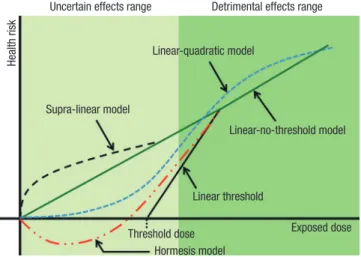
However, this concept was rapidly changed after atomic bomb disaster. The atomic bomb survivor data and several evidence from various medical exposure groups had successively re- duced the recommended dose limit over the years (13). For the protection against radiation exposure, the dose-response mod- el was finally replaced with a conservative model with the LNT hypothesis that there is no threshold to induce radiation re- sponse (17). This model was accepted for human protection of radiation exposure and published as a guideline of radiation policy by ICRP (18). The LNT hypothesis was very useful to esti- mate the risk of radiation exposure at high doses based on the solid scientific evidence, but not at low doses since the data at low doses are imprecise and often conflicting. A great deal of research has been performed to establish dose-response rela- tionships, especially, in low dose range using data including Japanese atomic bomb survivors, cancer and life-shortening in animals, chromosome aberrations in somatic cells, and then other risk assessment models has been proposed to estimate the radiation toxicity in low levels (19). Nowadays, five risk as- sessment models has been discussed (Fig. 1). These models fo- cus on primarily cancer risk. Regarding heritable risk, its nomi- nal risk coefficient in the whole population was estimated as 0.2% per Sv in ICRP 103, which was substantially reduced by a factor of 6-8 compared to the estimates from the former ICRP 60, becoming less of a concern about health risks of low dose radiation. The LNT model is a gold standard model for radia- tion safety regulation, as mentioned above. This relationship implies proportionality between dose and cancer risk. Because risk estimation at low doses is achieved by extrapolation of lin- ear dose-response relationship for high doses without definite scientific evidence, it should be carefully revaluated in the low level of radiation. Linear quadratic (LQ) model is widely view in radiotherapy and it is the best fit to leukemia data from the Life Span Study (LSS) of atomic bomb survivors (20). Some experi- mental data such as bystander effect and low-dose hypersensi- tivity were observed at low doses and should yield a supralinear
dose-response relationship (21). Low dose hypersensitivity de- creases with increasing dose and disappears at doses higher than 0.5 Gy due to the biological defense system (22). Low dose hypersensitivity could eliminate potential mutant cells at low doses, thereby reducing the carcinogenic risk. Hormesis model shows U-shaped dose-response relationships at low doses. In various experiments in vitro and in vivo, low dose radiation in- duced the activation of protective mechanisms at the cell and tissue levels, against carcinogenic factors other than ionizing radiation and even against spontaneous cancer (23-25).
Diverse observation on the biological effects of low dose radiation
Profound insight on carcinogenesis at the molecular level opens widely the ways to understand physiological responses of radiation. Progress of biological technologies also enables us to collect a great number of new experimental data related to low dose radiation. Thousands of reports indicate that LNT model is inappropriate to explain the biological responses of low dose radiation at the levels of genome, cells, tissues, and experimental animals.
Immediate defense mechanisms
Living organisms have innate defense systems, including anti- oxidant molecules against oxidative stress generated from me- tabolism, repair system to restore damaged DNA, and removal of damaged cells. These systems could be activated by low dose radiation and less effective when the irradiated dose is high.
Reactive oxygen species produced by low dose radiation are rapidly removed by anti-oxidative enzymes, and DNA damages by irradiation are also repaired by two main systems, homolo- gous recombination (HR) and non-homologous end joining (NHEJ) (26). Both are influenced by irradiated dose, dose-rate, nature of radiation, and cell state. The efficacy of repair in the
irradiated cells at low dose would be higher than at high dose (27). Therefore, the carcinogenic risk seems to be negligible at low doses and low dose-rates irradiation. The irradiation at doses less than 100 mSv did not induce the intra-chromosomal inversions and deletions in human (28). Programmed cell death (apoptosis) activated by low doses under 200 mSv could remove damaged cells (29,30). The number of eliminated cells at low dose irradiation did not affect the tissue function for or- ganism’s living.
Non-targeted effects of radiation
Irradiated cells may communicate their information to neigh- boring cells with small molecules, which is a representative non-targeted effect called “bystander effect”. Similarly, “absco- pal effects” is another non-targeted effect defined that a radia- tion effect in a non-irradiated tissue distant from the irradiated tissue. It could be explained as cases fitting supralinear dose- risk relationships. However, recent results suggest that irradiat- ed cells also protect neighboring cells, thus acting as a benefi- cial effect (31,32). Health effects at less than 100 mSv are argued whether radiation is good or bad in epidemiological approach- es which already include non-targeted effects of radiation in risk estimation.
Radiation-induced genomic instability
Genomic instability is the acquired DNA damage in cell proge- ny causing chromosomal aberrations, micronuclei, DNA frag- mentation, and aneuploidy. It can be induced through targeted and non-targeted bystander effects by irradiation. Instability can be formed by X-ray at doses about 10 mGy, which is regard- ed to be an early event in radiation carcinogenesis (33). In con- trast, some data related to radiation less than 250 mGy of X- or gamma ray showed no genomic instability (34). Moreover, there has been considerable controversy over whether genomic instability is observed in irradiated human populations (35-37).
Exposed individual showed convincing evidence of genomic instability in acute myeloid leukemia and myelo-dysplastic syndrome patients among Japanese A bomb survivors (38).
However, this data is still questioned whether the observed in- stability is caused by a consequence of the disease or non-tar- geted effects of irradiation, and whether the instability is corre- lated to the development of diseases. It remains difficult to de- termine whether radiation-induced genomic instability at low doses affects health risk.
Adaptive response
In addition to the presence of immediate defense mechanisms against radiation, a stimulation (or activation) of defenses is in- duced by low dose radiation. These adaptive responses are ob- served in cultured cells and model animals after irradiation at less than 500 mGy (39,40). Growth of human cells under re- Uncertain effects range
Supra-linear model
Detrimental effects range
Linear-quadratic model
Linear-no-threshold model
Linear threshold
Threshold dose Hormesis model
Health risk
Exposed dose
Fig. 1. Schematic diagram illustrating various dose-response models in risk assess- ments. Radiation exposed level is represented on the x-axis and overall risk for diseas- es is represented on the y-axis.
duced background radiation increased their sensitivity to acute irradiation at high dose (41). These are thought to be an evi- dence for the existence of a persistent adaptive response made by normal levels of background radiation. It could be also spe- cifically determined depending on the genetic background in lymphocytes (42). Therefore, adaptive response induced by ra- diation should be carefully analyzed with various physiological factors.
Radiation hormesis
Hormesis could be defined as the stimulating effect of small doses of substances which in larger doses are inhibitory. Up- regulation of protective mechanisms at the cell and tissue by low doses can function against spontaneous cancer other than radi- ation-induced carcinogenesis. Indeed, irradiation at 10 mGy re- duced the rate of spontaneous transformation in culture cells below background level (43). In addition, irradiated model ani- mals at low dose showed the extension of their lifespan, com- pared to non-irradiated control (44,45). Innate immunity study using irradiated fruit flies showed low dose radiation enhanced immune system through the activation of the specific signal pathway related to mammalian NF-κB (46). However, radiation protection agencies announced that radiation hormetic effects are now unwarranted and should be further investigated con- tinuously due to the experimental incoherence and uncertainty.
In addition, they strongly recommend research into the mecha- nistic understanding of hormesis that may contribute to im- proved understanding of low dose radiation-induced response.
New biological research fields to estimate radiation risk at low doses
Development of molecular and biochemical approaches to re- veal the physiological phenomena like carcinogenesis has been rapidly applied to radiobiology. Especially, reversible heritable changes on genome without a change in the DNA sequences, epigenetic changes, are an outstanding field in understanding carcinogenesis. Additional covalent modifications of chromo- somal structure, e.g. phosphorylation, methylation, acetylation and sumoylation, can be particularly affected by radiation.
Some epigenetic data using irradiated mice showed that high dose radiation altered gene expression levels through transmit- ted epigenetic modification and potentially increased the can- cer risk (47). Reactive oxygen species (ROS) in the irradiated cells is also thought to be an important factor to modulate radi- ation response. ROS state is significantly regulated by irradia- tion at low doses, which maintained for a period time accom- panying with gene expression changes (48). In the irradiated cells, anti-oxidant molecules such as Mn-SOD (manganese-su- peroxide dismutase) were regulated by the redox state-sensing transcription factor NF-κB (49). Omics is another excellent ar- senal to reveal the overall cellular signal networks rather than
one or two specific signaling, e.g. genomics, epigenomics, tran- scriptomics, proteomics, and metabolomics. Although it can provide high-throughput screening methods to find biomarkers in radiation response, the analytical tools for mass data and much regarding to validation for them remain to be incomplete (50).
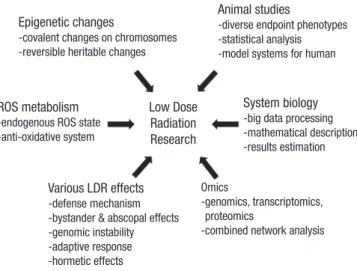
Finally, system biology is recommended to analyze and estimate the radiation response. It can deal with multi-factors affecting radiation response and elucidate the connectivity among sig- naling networks with mathematical equations produced by com- putational biology (51). In addition, mechanistic model is nec- essary for the explanation of radiation response, especially at low dose, including environmental factors. It can remove the uncertainty and inconsistency from biological specimen. For example, the transcriptional responses for specific genes in sys- tem biological approaches displayed considerable inter-indi- vidual heterogeneity when intact human skin was exposed to radiation in vivo (52). These cross-talk analytic approaches as mentioned above are required for revealing proper molecular function in the irradiated tissues and radiation-induced cancer risks in the near future (Fig. 2).
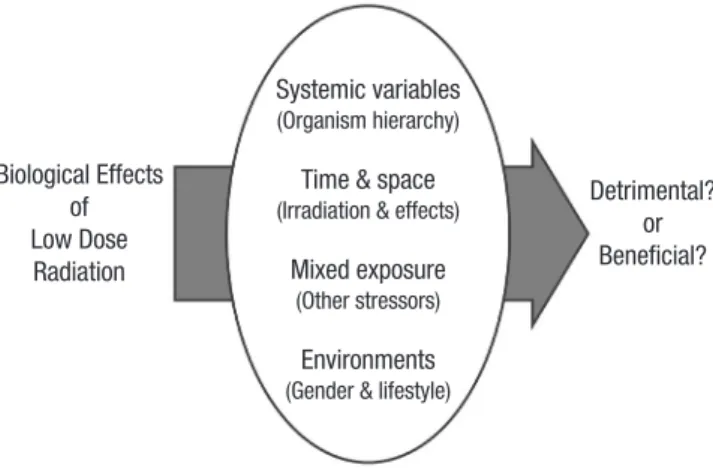
Confronting difficulties to separate the effects of low dose radiation from the complicated environmental stressors Recently, radiobiologist largely accepted theoretically that low dose radiation could facilitate the distinguished biological re- sponse from the targeted detrimental effects caused by high doses, where non-targeted effects are inhibited. However, these concepts are difficult to be proved since there are many con- founding factors to be considered in the analysis for end-point phenotypes such as cancers. First, living things are highly orga- nized in hierarchies with multiple dimensions. Some effects by low dose radiation would be beneficial or detrimental depend- ing on the hierarchical level in the organism. Cell death is often
Low Dose Radiation Research
Fig. 2. Recent biological studies on the low dose radiation effects. To increase the consistency and coherence of experimental data on low dose radiation, we should in- troduce new biological knowledge of emerging area as well as conventional con- cepts.
Epigenetic changes
-covalent changes on chromosomes -reversible heritable changes
ROS metabolism -endogenous ROS state -anti-oxidative system
System biology -big data processing -mathematical description -results estimation
Omics
- genomics, transcriptomics, proteomics
-combined network analysis Various LDR effects
-defense mechanism -bystander & abscopal effects -genomic instability -adaptive response -hormetic effects
Animal studies
-diverse endpoint phenotypes -statistical analysis -model systems for human
regarded as a bad effect, but if it removes the carcinogenic po- tentials in a tissue, it could be seen as good in the view of organ- ism’s life maintaining. Second, irradiated time to biological or- ganism is thought to be a determining factor to induce various radiation responses. We can observe that young individuals show the severe impacts due to the faster metabolic rate, higher rate of cell proliferation, and immature entity whether they are cells or organisms. However, older individuals did not always show the resistant phenotype in radiation response. We should consider the context variables in the irradiated biological sys- tem. Delayed effects and bystander effects are other examples to show the complexity of radiation responses depending on the time and space of exposure to radiation. These concepts are also discussed elsewhere (53). Third, living organisms are usu- ally exposed to many stressors including ionizing radiation. Ra- diation effects seldom occur in isolation. These stressors can induce the additive, antagonistic, or synergistic effects in com- bination with radiation, which are not predictable from indi- vidual agent dose response data. This complexity has required more attention how to interpret and manage the results from mixed exposures to the low level of stress. In order to resolve this issue, more data related to low dose exposures to multiple stressors involving radiation and chemical should be investi- gated, and new experimental system to explain this concept is necessary (Fig. 3).
EPIDEMIOLOGY OF LOW DOSE RADIATION
Epidemiological studies on the effects of low dose ionizing radiation
Scientific evidence of health risks from radiation exposure is based on biological and epidemiological studies. The major role of epidemiological studies in radiation research is to pro- vide the essential data for quantifying human health risks from
radiation exposure and for setting radiation protection stan- dards (54). A proportional relationship between cancer risk and effective dose above 200 mSv has been well documented main- ly based on Japanese atomic bomb survivor, while radiation- associated health effects at low dose still remain unclear. Effects of low dose radiation are generally considered stochastic effects of which the main risks are cancer and heritable disease. Stud- ies on accidental, occupational, environmental and medical exposures provide useful information of the effects of low doses and low dose rates of ionizing radiation. The commission of the ICRP proposed nominal probability coefficients of 5.5% per Sv for detriment-adjusted cancer and 0.2% per Sv for heritable risks for the whole population, using the LNT model with a DDREF of 2 (55). However, given that health effects of low dose are still poorly known, the application of these coefficients should be used for the purpose of radiological protection and be considered carefully in estimating risk of cancer or heritable disease of low dose radiation. Although there is emerging evi- dence from recent epidemiological studies indicating elevated risks of non-cancer diseases such as circulatory disease and cataract below doses of 1 to 2 Gy, it is still not clear whether this would extend to low dose and low dose rate exposure (56).
Atomic bomb survivors and accidental exposure
The LSS cohort of the atomic bomb survivors is the major source of epidemiological data for radiation risk assessment. The latest LSS study found that the additive radiation risk for solid cancers continues to increase with a linear dose-response relationship (57). The sex-averaged excess relative risk (ERR) for all solid can- cer was 0.42 per Gy (95% CI, 0.32-0.53) at age 70 years after ex- posure at age 30 (57). The study also reported that the estimated lowest dose range with a statistically significant ERR (0.56/Gy, 95% CI, 0.15-1.04) was 0-0.2 Gy; however due to possibilities of sociodemographic selection bias and other factors such as ad- ditional radiation sources and a large geographical distribution, further investigation considering these factors is required to in- terpret the health effects of low dose radiation appropriately (57).
There are numerous studies to investigate health effects from the Chernobyl accident. Except for the increase of thyroid can- cer in children with relatively high thyroid absorbed doses (58- 60), there was no clearly demonstrated increase in the inci- dence of other cancers or non-cancer diseases in the residents of the Chernobyl region (61). Several case-control or ecological studies suggested the increase of radiosensitive disease such as childhood leukemia and breast cancer (62-64); however, due to the nature of the study design and lack of consistency among other studies, these data have not been sufficient to provide convincing evidence for low dose effects. For the Chernobyl liquidators more heavily exposed to prolonged low to medium radiation (0-500 mSv), there exist some data indicating the in- crease in the risk of leukemia, cataracts and cardiovascular dis- Systemic variables
(Organism hierarchy) Time & space (Irradiation & effects)
Mixed exposure (Other stressors)
Environments (Gender & lifestyle) Biological Effects
of Low Dose
Radiation
Detrimental?
or Beneficial?
Fig. 3. Confounding factors in the analysis of low dose radiation effects. Biological effects of low dose radiation could be determined by several confounding factors as detrimental or beneficial. For example, systemic variables such as hierarchy, maturity, and ageing of irradiated organism, time of irradiation and phenotype emergence, and interaction with other environmental factors.
eases (65-68), but further epidemiological studies is necessary to provide more precise risk estimates and protect individuals exposed to low dose radiation (69).
Health effects following the Fukushima Daiichi nuclear acci- dent have been being extensively monitored by the Japanese government and international organizations such as WHO, UNSCEAR and ICRP. For the comparison of ultrasound screen- ing of thyroid in children between Fukushima and other three Japanese prefectures, no significance differences were ob- served (70). Until recently, any radiation-induced effects have not been reported, and lifetime health risk would be expected to be minimal based on the risk assessment model with the ex- posure level of no more than 50 mSv during the first year after the accident (71,72) and the expected lifetime dose after 2012 (73). However, further careful follow-up should be continued in consideration of long latency of radiation effects.
A number of epidemiological studies for the health effects from the Three Mile Island (TMI) nuclear power plant accident have been conducted by different investigators. Despite the low level exposure of 0.09-0.25 mSv within 5-mile area around TMI, elevated risks for non-Hodgkin’s lymphoma, lung cancer and leukemia were noted in a few studies with the first 5 year follow- up after the accident (74,75). These findings were not consistent in the later study with a longer and more comprehensive fol- low-up of 1979-1998, although dose-response relationships for all lymphatic and hematopoietic tissue (LHT) in males and breast cancer in females cannot be definitely ruled out (76).
In summary, epidemiological data for acute radiation expo- sure have not provided consistent evidence of health effects in the low dose range.
Occupational exposure (mainly focus on nuclear industrial workers and aircrew)
Radiation workers and air crew are well known occupationally exposed cohorts to assess the effects of protracted exposures to
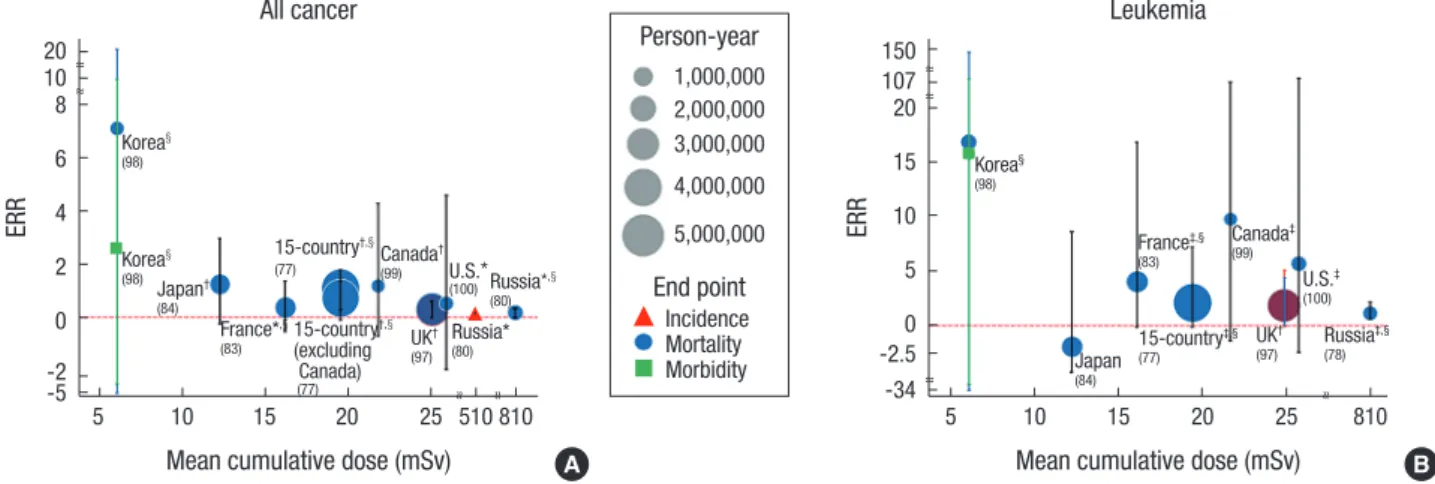
low dose radiation. The 15-country collaborative cohort study including 407,391 nuclear industry workers with 5.2 million person-years of follow-up is one of the largest occupational studies (77). From the study a significant ERR of 0.97 (95% CI, 0.27-1.8) for all cancer mortality was reported; however, the sig- nificance was not observed after excluding Canada data having uncertainties of dose measurement records (77). Another study reporting an elevated cancer risk is the Mayak nuclear complex cohort studies with the mean cumulative external dose of 810 mGy (78-80). The range of the cumulative dose of the study co- hort was broader than other nuclear industry cohorts since a substantial number of workers were exposed to relatively high dose in the first decade of the facility operation, which allows some degree of precision in a dose-response relationship with protracted exposure (80). Besides the Mayak cohort studies, el- evated risks of certain types of cancer such as leukemia exclud- ing chronic lymphocytic leukemia (CLL) (81-83), lung cancer (82) and esophageal cancer (84) were observed in nuclear in- dustry workers in some countries. However, these site-specific risks were not consistent with other study populations and sta- tistical significance was not found in most cohort studies. Since this null finding does not necessarily mean “no risk”, continued studies with long-term follow-up and sophisticated designs and analytical methods are required to draw firmer conclu- sions. ERR and standardized mortality or incidence ratios (SMR, SIR) for all cancers and leukemia were summarized ac- cording to the mean cumulative dose and study populations (Fig. 4 and 5). While cancer risk per unit dose varies across the study populations and exposure doses, possibly due to con- founding factors, population heterogeneity or statistical uncer- tainties (Fig. 4), the tendency to lower SMRs indicates healthy worker effects (Fig. 5).
Aircrew including pilots is the major occupation exposed to cosmic radiation. An average effective dose of aircrew has been estimated to be 2-5 mSv/year and 75 mSv for cumulative effec-
Fig. 4. Excess relative risk (ERR) for cancer in major cohort studies of radiation workers. (A) All cancer; (B) leukemia. The mean cumulative doses are represented on the x-axis and ERRs for cancer are represented on the y-axis. *Solid cancer only; †All cancer excluding leukemia; ‡Leukemia excluding CLL; §90% confidence interval.
ERR ERR
20 108
6 4 2 0 -2-5
150 107 20 15 10 5 0 -2.5
5 10 15 20 25 510 810 -34 5 10 15 20 25 810
Mean cumulative dose (mSv) Mean cumulative dose (mSv)
All cancer Leukemia
Korea§
(98) Korea§
(98)
Korea§
(98) Japan†
(84)
Japan
(84)
France*,§
(83)
France‡,§
(83)
UK†
(97)
UK†
(97)
Russia*
(80) Russia‡,§
(78)
15-country†,§
(excluding Canada)
(77)
15-country†,§
(77)
15-country‡,§
(77)
Canada†
(99)
Canada‡
(99)
~~ ~~
~~
~~ ~~
A B
~~ ~~~~
Person-year
End point 1,000,000 2,000,000 3,000,000 4,000,000 5,000,000
Incidence Mortality Morbidity U.S.*
(100) U.S.‡
(100)
Russia*,§
(80)
tive dose at career end (85). In consideration of that the average effective dose of radiation workers is generally less than 2 mSv/
year, epidemiological studies of the aircrew can provide funda- mental knowledge and evidence of health effects from the cos- mic radiation exposure at low dose levels. Several studies of Nordic, the US and Canada aircrews presented the increase of cancer risk for breast cancer (86-89), skin cancer (90), brain cancer (91), non-Hodgkin’s lymphoma (92), prostate cancer and acute myeloid leukemia (93), compared to the general population. However, these findings have lacked consistency among studies with no dose-response relationship, and overall cancer risks (e.g., all cancers, all solid cancer or leukemia) were not elevated in most studies. Recent results of the pooled co- hort of 93,771 air crews from 10 countries indicated a lower mortality from all cancers, radiation-related cancers and car- diovascular diseases, but a higher mortality from malignant melanoma especially in cockpit crew (94). Similar results were observed in the recent study of the US airline cockpit crew ex- cept for an increased risk of the central nervous system (CNS) (95). Due to remarkable differences from the general popula- tion in terms of occupational characteristics, lifestyles and dis- ruption of circadian rhythm may be possibly associated with health risks in air crew such as melanoma and breast cancer (96-98). Overall cancer mortality in air crew seems similar to one in radiation workers with the suggestion of increased mela- noma and breast cancer risks, but not necessarily caused by ra- diation exposure (Fig. 6).
In conclusion, radiation-associated health effects at low dose levels have not yet been clearly established in occupationally exposed studies (99-102).
High background radiation exposure
The worldwide average natural dose to human is about 2.4 mSv/year (103) with a large variation depending on location and geology. The Yangjiang in China, Karunagappally in India,
Guarapari in Brazil, and Ramsar in Iran are well known for their high background radiation areas (HBRAs) of which dose level is up to 260 mSv/year (104). A number of biological and epidemi- ological studies have been conducted to evaluate health effects in HBRAs. Increased chromosomal aberrations were observed in some studies (105,106), but there was no study reporting an increase in cancer or life-shorting in the residents of HBRAs (107-110). Increased risk of non-cancer mortality and diseases of digestive system were observed in the study of the Yangjiang area, but not likely to be attributable to radiation exposure (109). Techa River cohort and Taiwan building residents ex- posed to Co60, are often referred to as the cohort of HBRAs, but strictly speaking they are not HBRAs due to artificial (man- made) radiation sources. Significantly elevated risks of solid cancer and leukemia, which is comparable to risks shown in LSS data, were observed in the Techa River cohort (111-114) with average effective doses ranging from 35-1,700 mSv for evacuees (115). There were dose-response relationships for leukemia excluding CLL (HR, 1.19/100 mGy; 90% CI, 1.01-1.31) and breast cancer (HR, 1.12/100 mGy; 90% CI, 0.99-1.21) in the Taiwanese residents, but due to the small number of cases, the current data provides limited evidence for the effects of pro- longed low dose radiation exposure (116). Most studies of HBRAs were of ecological design due to difficulties in collecting individual data for exposure levels, health outcomes and con- founding factors, which may lead to ecological fallacy. There- fore, results from studies of HBRAs should be interpreted with caution. In short, no demonstrated health effects were ob- served in residents of HBRAs except for the Techa River cohort exposed to artificial radiation above the low dose range.
Medical exposure (diagnostic and therapeutic radiation) With the remarkable increase in public exposure to diagnostic or therapeutic radiation, numerous studies have examined the link between medical radiation exposure and health risks.
Fig. 5. Standardized mortality ratio (SMR) (or Standardized incidence ratio [SIR]) for cancer in major cohort studies of radiation workers. (A) All cancer; (B) leukemia. The mean cumulative doses are represented on the x-axis and SMRs (or SIR) for cancer are represented on the y-axis. *Solid cancer only; †All cancer excluding leukemia; ‡Leukemia ex- cluding CLL.
SMR or SIR SMR or SIR
4
3
2
1
0
4
3
2
1
0
5 10 15 20 25 30 5 10 15 20 25 30
Mean cumulative dose (mSv) Mean cumulative dose (mSv)
All cancer Leukemia
Korea
(98) Korea
(98)
UK†
(97) UK‡
15-country (97)
(77) Canada*
(99) Canada‡
(99)
A B
Person-year
End point 1,000,000 2,000,000 3,000,000 4,000,000 5,000,000
SIRSMR U.S.*
(100)
U.S.
(100)
Germany†
(102) Germany‡
(102)
Korea†
(101) Korea
(101)
Medical exposure cohorts often contain useful information on patients’ characteristics such as demographic data, medical history, smoking and alcohol consumption. Thus, epidemio- logical studies of these cohorts could provide more accurate as- sessment of the risks associated with radiation exposure after adjusting for other risk factors. Dose from the diagnostic radia- tion exposure is generally 0.1-10 mSv, which belongs to the range of low dose radiation, and repeated exposure in child- hood is a major concern. Recent retrospective cohort studies for radiation exposure from computed tomography (CT) scan in childhood suggested an increased risk of childhood cancer, especially brain cancer and leukemia (117,118). However, due to some methodological issues including the lack of a control group and potential risks in the patient population, it is difficult to draw a causal relationship between the radiation exposure and cancer risk from these studies. In addition to diagnostic ra- diation exposure in childhood, a number of studies have con- ducted to examine the risks from radiotherapy, a risk-benefit
analysis of cancer screening programs and genetic susceptibili- ty to the tumorigenic effects of radiation. Overall, it is reason- able to maintain that clinical benefits from the medical expo- sure outweigh the potential risks from radiation exposure (119- 122). There are some findings about genetic susceptibility for BRAC1/2 mutations related to the risks of radiation (123-126), but they are not consistent with other studies (127-129). Al- though the exact risk from the medical exposure has not been definitely known, given the increasing use of diagnostic and therapeutic radiation, radiation dose should be kept as low as possible and unnecessary exposure should be avoided, espe- cially for child patients.
UNCERTAINTIES IN ESTIMATING HEALTH RISKS OF LOW DOSE RADIATION
Epidemiological data are essential to investigate low dose ef- fects on human health. Although some evidence for effects of Fig. 6. SMR for cancer (all cancer, leukemia excluding chronic lymphocytic leukemia [CLL], melanoma and breast cancer) in major cohort studies of air crews and radiation workers. The names of the studies are represented on the x-axis and SMRs are represented on the y-axis.
SMR or SIR SMR
2.5
2.0 1.5 1.0 0.5
4.0 2.0
1.5 1.0 0.5
4.0
2.0 1.5 1.0 0.5
2.5 2.0
1.5 1.0 0.5
10-country 8-country UK
(94) (96) (97)
10-country 8-country UK
(94) (96) (97)
10-country 8-country UK
(94) (96) (97)
10-country 8-country UK
(94) (96) (97)
All cancer
Melanoma
Leukemia excluding CLL
Breast cancer
~~
~~
~~
Person-year 200,000
Pilot
400,000
Cabin crew (male)
600,000
Cabin crew
(female) Nuclear worker
Study population
moderate and low doses have been observed to date (null re- sults for very low dose exposure in most studies), they are sug- gestive rather than conclusive and the interpretation is chal- lenging due to the uncertainties caused by following limita- tions:
1) Under present knowledge about a dose-response relation- ship, extremely large sample size is necessary to ensure statisti- cal significance at low dose levels. Based on the US baseline cancer risk and the radiation risk model, sample sizes of 500,000 and 2,000,000 are required with lifetime follow-up for exposure levels of 20 mSv and 10 mSv, respectively (130), which would render a decent epidemiological study unfeasible.
2) Issues of confounding factors such as smoking, genetic variation and socioeconomic status are particularly important in low dose radiation studies. Given the nature of low dose radi- ation effects with low event (e.g., disease incidence) rates, even a small degree of confounding can distort the study results. It is often not possible to collect all confounding factors and this may lead to inconsistent findings in epidemiological studies.
Confounding factors may also mask other radiation-induced endpoints that may be actually present at low dose levels.
3) Uncertainties in radiation dosimetry cannot be avoidable in most epidemiological studies and they influence every as- pect of studies. In general, measurement errors related to do- simetry are more likely to mask a true effect rather than to gen- erate a spurious one (131). Continuous improvement of bioki- netic and dosimetric models is crucial for the precision of do- simetry measurements.
4) There exist inherent statistical uncertainties in selection of dose-response models, particularly great uncertainties at low dose levels.
In addition to these uncertainties, there also exist other types of uncertainties in estimating health risk through risk assess- ment models (132). Major components of the uncertainties are as follows: 1) extrapolation of a dose-response relationship through risk transfer between populations with different levels of baseline risk, 2) difference in dose-response relationships according to different types or levels of exposure (e.g., high-en- ergy gamma rays, low-energy photons, alpha particles, neu- trons, low doses, acute exposure, chronic exposure, etc), and 3) difference in risk according to parts of the body exposed to ra- diation (e.g., individual tissue, organ sites and all tumor com- bined due to whole-body exposure).
Due to these uncertainties, epidemiological studies at low doses become increasingly impractical. Recent research direc- tion is being focused on the integration of biological and epide- miological studies. For example, if we find genetic fingerprints of radiation-induced disease, uncertainties of stochastic mod- els would be largely eliminated (133). In addition, finding the specific gene(s) modulated by low dose radiation will provide more profound information for health effects of low dose radia-
tion. Thus, based on these radiobiological studies, identifica- tion of genetically sensitive subpopulation will enable an effec- tive low dose radiation research with increased statistical pow- er. Besides continued investigation of health effects of low dose radiation, social science research including risk communica- tion and education, psychometric paradigm of risk perception and public engagement is essential for risk management, since scientific uncertainties of low dose radiation often bring public concern with lack of social trust for every nuclear or radiation accident.
CONCLUSIONS
As epidemiological and biological data are accumulated indi- cating cancer and non-cancer diseases associated with pro- tracted low-dose radiation exposure, dose limits have been continuously reduced to 20 mSv/year for radiation workers and 1 mSv/year for the public since the first dose limit of about 10 rad/day (100 mSv/day) in 1902. The recent international large scale cohort study indicated strong evidence of positive associ- ations between leukemia mortality and protracted low dose ra- diation exposure (134); although the association (i.e., point es- timate of relative risk) did not diminish in dose levels less than 300 or 100 mGy, their wide confidence intervals preclude de- finitive conclusions in the low dose range. In sum, despite a va- riety of studies, understanding of health effects of low dose ra- diation, especially less than 100 mSv, is still incomplete and dif- ficult. There are emerging data such as adaptive responses and hormesis against the LNT hypothesis at low dose levels, which could provide useful information to optimize decision making for public health based on the hormetic model where there ex- ist protective effects at low doses and harmful effects at higher doses (135,136). Nevertheless, given the lack of scientific knowledge about health risk of low dose radiation, the LNT ap- proach is the most reasonable risk model at low dose levels and is likely to remain fundamental tenet in terms of radiation pro- tection and safety. On the other hand, caution is required in the interpretation of the estimated risks from the LNT model since the estimate at low doses, which is calculated theoretically based on the LNT hypothesis, does not necessarily correspond to a real risk. Different biological pathways between low and high dose effects are considered proven through sophisticated cellular and molecular studies. Moreover, there is much inter- est in the interactions between genetic susceptibility and low dose exposure. Although radiation biology cannot currently provide direct evidence of low dose effects in human health, a comprehensive understanding of radiobiological mechanism would facilitate epidemiological studies and improve the preci- sion of a dose-response relationship at low dose levels. The in- tegration of biological and epidemiological studies along with social science research will allow firmer conclusions about low
dose effects on human health on the basis of social trust.
DISCLOSURE
The authors have no potential conflicts of interest to disclose.
AUTHOR CONTRIBUTION
Conception and design: Jin YW, Seong KM, Seo S. Acquisition of data: Lee D, Seong KM, Seo S. Writing and review manu- script: Seong KM, Seo S, Kim MJ, Jin YW, Lee SS, Park S, Lee D.
Revision of manuscript: Seo S, Seong KM, Jin YW. Study super- vision: Jin YW. Manuscript approval: all authors.
ORCID
Ki Moon Seong http://orcid.org/0000-0003-3530-5587 Songwon Seo http://orcid.org/0000-0001-6200-5120 Dalnim Lee http://orcid.org/0000-0001-5008-6082 Min-Jeong Kim http://orcid.org/0000-0002-5571-513X Seung-Sook Lee http://orcid.org/0000-0001-6714-5851 Sunhoo Park http://orcid.org/0000-0002-1362-9428 Young Woo Jin http://orcid.org/0000-0002-0029-9028 REFERENCES
1. Lederman M. The early history of radiotherapy: 1895-1939. Int J Radiat Oncol Biol Phys 1981; 7: 639-48.
2. Mettler FA. Medical effects and risks of exposure to ionising radiation. J Radiol Prot 2012; 32: N9-13.
3. Duffin J, Hayter CR. Baring the sole. The rise and fall of the shoe-fitting fluoroscope. Isis 2000; 91: 260-82.
4. Preston RJ. Radiation biology: concepts for radiation protection. Health Phys 2005; 88: 545-56.
5. Calabrese EJ. Muller’s Nobel Prize Lecture: when ideology prevailed over science. Toxicol Sci 2012; 126: 1-4.
6. Calabrese EJ. Key studies used to support cancer risk assessment ques- tioned. Environ Mol Mutagen 2011; 52: 595-606.
7. Dauer LT, Brooks AL, Hoel DG, Morgan WF, Stram D, Tran P. Review and evaluation of updated research on the health effects associated with low- dose ionising radiation. Radiat Prot Dosimetry 2010; 140: 103-36.
8. Calabrese EJ, O’Connor MK. Estimating risk of low radiation doses - a critical review of the BEIR VII report and its use of the linear no-thresh- old (LNT) hypothesis. Radiat Res 2014; 182: 463-74.
9. National Research Council (US) Committee to Assess Health Risks from Exposure to Low Level of Ionizing Radiation. Health risks from exposure to low levels of ionizing radiation: BEIR VII Phase 2. Washington, D.C.:
The National Academies Press, 2006.
10. ICRP. Low-dose extrapolation of radiation-related cancer risk. ICRP Pub- lication 99. Ann ICRP 2005; 35: 1-141.
11. Tubiana M, Aurengo A, Averbeck D, Bonin A, Le Guen B, Masse R, Moni- er R, Valleron AJ, de Vathaire F. Dose-effect relationships and estimation of the carcinogenic effect of low doses of ionizing radiation. Paris: Aca-
démie des Sciences - Académie National de Médicine, 2005.
12. United Nations Scientific Committee on the Effects of Atomic Radiation.
Biological mechanisms of radiation actions at low doses: a white paper to guide the Scientific Committee’s future programme of work. New York, NY: United Nations, 2012.
13. Goodhead DT. Understanding and characterisation of the risks to hu- man health from exposure to low levels of radiation. Radiat Prot Dosim
etry 2009; 137: 109-17.
14. Kadhim M, Salomaa S, Wright E, Hildebrandt G, Belyakov OV, Prise KM, Little MP. Non-targeted effects of ionising radiation--implications for low dose risk. Mutat Res 2013; 752: 84-98.
15. ICRP. Statement on Tissue Reactions and Early and Late Effects of Radia- tion in Normal Tissues and Organs - Threshold Doses for Tissue Reac- tions in a Radiation Protection Context. ICRP Publication 118. Ann ICRP 2012; 41: 1-322.
16. Vaiserman AM. Radiation hormesis: historical perspective and implica- tions for low-dose cancer risk assessment. Dose Response 2010; 8: 172- 91.
17. ICRP. The 2007 Recommendations of the International Commission on Radiological Protection. ICRP publication 103. Ann ICRP 2007; 37: 1-332.
18. International Commission on Radiological Protection. Radiation pro- tection; recommendations. Adopted September 9, 1958. London: Per- gamon, 1959.
19. Prekeges JL. Radiation hormesis, or, could all that radiation be good for us? J Nucl Med Technol 2003; 31: 11-7.
20. Finch SC. Leukemia: lessons from the Japanese experience. Stem Cells 1997; 15 Suppl 2: 135-9.
21. Smith LG, Miller RC, Richards M, Brenner DJ, Hall EJ. Investigation of hypersensitivity to fractionated low-dose radiation exposure. Int J Radi
at Oncol Biol Phys 1999; 45: 187-91.
22. Krueger SA, Collis SJ, Joiner MC, Wilson GD, Marples B. Transition in survival from low-dose hyper-radiosensitivity to increased radioresis- tance is independent of activation of ATM Ser1981 activity. Int J Radiat Oncol Biol Phys 2007; 69: 1262-71.
23. Feinendegen LE. Evidence for beneficial low level radiation effects and radiation hormesis. Br J Radiol 2005; 78: 3-7.
24. Redpath JL. Radiation-induced neoplastic transformation in vitro: evi- dence for a protective effect at low doses of low LET radiation. Cancer Metastasis Rev 2004; 23: 333-9.
25. Azzam EI, de Toledo SM, Raaphorst GP, Mitchel RE. Low-dose ionizing radiation decreases the frequency of neoplastic transformation to a level below the spontaneous rate in C3H 10T1/2 cells. Radiat Res 1996; 146:
369-73.
26. Sancar A, Lindsey-Boltz LA, Unsal-Kaçmaz K, Linn S. Molecular mech- anisms of mammalian DNA repair and the DNA damage checkpoints.
Annu Rev Biochem 2004; 73: 39-85.
27. Dikomey E, Brammer I. Relationship between cellular radiosensitivity and non-repaired double-strand breaks studied for different growth states, dose rates and plating conditions in a normal human fibroblast line. Int J Radiat Biol 2000; 76: 773-81.
28. Zeng G, Day TK, Hooker AM, Blyth BJ, Bhat M, Tilley WD, Sykes PJ. Non- linear chromosomal inversion response in prostate after low dose X-ra- diation exposure. Mutat Res 2006; 602: 65-73.
29. Columbano A, Endoh T, Denda A, Noguchi O, Nakae D, Hasegawa K, Ledda-Columbano GM, Zedda AI, Konishi Y. Effects of cell proliferation
and cell death (apoptosis and necrosis) on the early stages of rat hepa- tocarcinogenesis. Carcinogenesis 1996; 17: 395-400.
30. Löbrich M, Rief N, Kühne M, Heckmann M, Fleckenstein J, Rübe C, Uder M. In vivo formation and repair of DNA double-strand breaks after com- puted tomography examinations. Proc Natl Acad Sci U S A 2005; 102:
8984-9.
31. Mothersill C, Seymour CB. Radiation-induced bystander effects and the DNA paradigm: an “out of field” perspective. Mutat Res 2006; 597: 5-10.
32. Schettino G, Folkard M, Michael BD, Prise KM. Low-dose binary behav- ior of bystander cell killing after microbeam irradiation of a single cell with focused c(k) x rays. Radiat Res 2005; 163: 332-6.
33. Huang L, Kim PM, Nickoloff JA, Morgan WF. Targeted and nontargeted effects of low-dose ionizing radiation on delayed genomic instability in human cells. Cancer Res 2007; 67: 1099-104.
34. Okada M, Okabe A, Uchihori Y, Kitamura H, Sekine E, Ebisawa S, Suzuki M, Okayasu R. Single extreme low dose/low dose rate irradiation causes alteration in lifespan and genome instability in primary human cells. Br J Cancer 2007; 96: 1707-10.
35. Lefèvre SH, Vogt N, Dutrillaux AM, Chauveinc L, Stoppa-Lyonnet D, Doz F, Desjardins L, Dutrillaux B, Chevillard S, Malfoy B. Genome instability in secondary solid tumors developing after radiotherapy of bilateral reti- noblastoma. Oncogene 2001; 20: 8092-9.
36. Salomaa S, Holmberg K, Lindholm C, Mustonen R, Tekkel M, Veidebaum T, Lambert B. Chromosomal instability in in vivo radiation exposed sub- jects. Int J Radiat Biol 1998; 74: 771-9.
37. Tawn EJ, Whitehouse CA, Winther JF, Curwen GB, Rees GS, Stovall M, Olsen JH, Guldberg P, Rechnitzer C, Schrøder H, et al. Chromosome anal- ysis in childhood cancer survivors and their offspring--no evidence for radiotherapy-induced persistent genomic instability. Mutat Res 2005;
583: 198-206.
38. Nakanishi M, Tanaka K, Takahashi T, Kyo T, Dohy H, Fujiwara M, Kama- da N. Microsatellite instability in acute myelocytic leukaemia developed from A-bomb survivors. Int J Radiat Biol 2001; 77: 687-94.
39. Barquinero JF, Barrios L, Caballín MR, Miró R, Ribas M, Subias A, Egozcue J. Occupational exposure to radiation induces an adaptive response in human lymphocytes. Int J Radiat Biol 1995; 67: 187-91.
40. Stoilov LM, Mullenders LH, Darroudi F, Natarajan AT. Adaptive response to DNA and chromosomal damage induced by X-rays in human blood lymphocytes. Mutagenesis 2007; 22: 117-22.
41. Carbone MC, Pinto M, Antonelli F, Amicarelli F, Balata M, Belli M, Conti Devirgiliis L, Ioannucci L, Nisi S, Sapora O, et al. The Cosmic Silence ex- periment: on the putative adaptive role of environmental ionizing radia- tion. Radiat Environ Biophys 2009; 48: 189-96.
42. Wolff S. Aspects of the adaptive response to very low doses of radiation and other agents. Mutat Res 1996; 358: 135-42.
43. Calabrese EJ. Hormesis: from marginalization to mainstream: a case for hormesis as the default dose-response model in risk assessment. Toxi
col Appl Pharmacol 2004; 197: 125-36.
44. Seong KM, Kim CS, Seo SW, Jeon HY, Lee BS, Nam SY, Yang KH, Kim JY, Kim CS, Min KJ, et al. Genome-wide analysis of low-dose irradiated male Drosophila melanogaster with extended longevity. Biogerontology 2011;
12: 93-107.
45. Calabrese EJ, Iavicoli I, Calabrese V. Hormesis: why it is important to bio- gerontologists. Biogerontology 2012; 13: 215-35.
46. Seong KM, Kim CS, Lee BS, Nam SY, Yang KH, Kim JY, Park JJ, Min KJ, Jin
YW. Low-dose radiation induces Drosophila innate immunity through Toll pathway activation. J Radiat Res (Tokyo) 2012; 53: 242-9.
47. Hatchwell E, Greally JM. The potential role of epigenomic dysregulation in complex human disease. Trends Genet 2007; 23: 588-95.
48. Rugo RE, Schiestl RH. Increases in oxidative stress in the progeny of X- irradiated cells. Radiat Res 2004; 162: 416-25.
49. de Toledo SM, Asaad N, Venkatachalam P, Li L, Howell RW, Spitz DR, Azzam EI. Adaptive responses to low-dose/low-dose-rate gamma rays in normal human fibroblasts: the role of growth architecture and oxida- tive metabolism. Radiat Res 2006; 166: 849-57.
50. Marchetti F, Coleman MA, Jones IM, Wyrobek AJ. Candidate protein bio- dosimeters of human exposure to ionizing radiation. Int J Radiat Biol 2006; 82: 605-39.
51. Amundson SA. Functional genomics in radiation biology: a gateway to cellular systems-level studies. Radiat Environ Biophys 2008; 47: 25-31.
52. Goldberg Z, Rocke DM, Schwietert C, Berglund SR, Santana A, Jones A, Lehmann J, Stern R, Lu R, Hartmann Siantar C. Human in vivo dose-re- sponse to controlled, low-dose low linear energy transfer ionizing radia- tion exposure. Clin Cancer Res 2006; 12: 3723-9.
53. Baverstock K, Rönkkö M. Epigenetic regulation of the mammalian cell.
PLoS One 2008; 3: e2290.
54. Gilbert ES. Ionising radiation and cancer risks: what have we learned from epidemiology? Int J Radiat Biol 2009; 85: 467-82.
55. ICRP. The 2007 Recommendations of the International Commission on Radiological Protection. ICRP publication 103. Ann ICRP 2007; 37: 1-332.
56. United Nations Scientific Committee on the Effects of Atomic Radiation.
Report of the United Nations Scientific Committee on the effects of atom- ic radiation: fifty-seventh session, includes scientific report, summary of low-dose radiation effects on health. New York, NY: United Nations, 2011.
57. Ozasa K, Shimizu Y, Suyama A, Kasagi F, Soda M, Grant EJ, Sakata R, Sug- iyama H, Kodama K. Studies of the mortality of atomic bomb survivors, Report 14, 1950-2003: an overview of cancer and noncancer diseases.
Radiat Res 2012; 177: 229-43.
58. Likhtarov I, Kovgan L, Vavilov S, Chepurny M, Ron E, Lubin J, Bouville A, Tronko N, Bogdanova T, Gulak L, et al. Post-Chernobyl thyroid cancers in Ukraine. Report 2: risk analysis. Radiat Res 2006; 166: 375-86.
59. Jacob P, Bogdanova TI, Buglova E, Chepurniy M, Demidchik Y, Gavrilin Y, Kenigsberg J, Meckbach R, Schotola C, Shinkarev S, et al. Thyroid cancer risk in areas of Ukraine and Belarus affected by the Chernobyl accident.
Radiat Res 2006; 165: 1-8.
60. Cardis E, Howe G, Ron E, Bebeshko V, Bogdanova T, Bouville A, Carr Z, Chumak V, Davis S, Demidchik Y, et al. Cancer consequences of the Cher- nobyl accident: 20 years on. J Radiol Prot 2006; 26: 127-40.
61. UNSCEAR. Sources and effects of ionizing radiation vol. II: effects scien- tific annex D. Health effects due to radiation from the Chernobyl acci- dent. UNSCEAR 2008 Report. New York, NY: United Nations, 2011.
62. Pukkala E, Kesminiene A, Poliakov S, Ryzhov A, Drozdovitch V, Kovgan L, Kyyrönen P, Malakhova IV, Gulak L, Cardis E. Breast cancer in Belarus and Ukraine after the Chernobyl accident. Int J Cancer 2006; 119: 651-8.
63. International Consortium for Research on the Health Effects of Radia- tion Writing Committee and Study Team; Davis S, Day RW, Kopecky KJ, Mahoney MC, McCarthy PL, Michalek AM, Moysich KB, Onstad LE, Ste- panenko VF, et al. Childhood leukaemia in Belarus, Russia, and Ukraine following the Chernobyl power station accident: results from an inter- national collaborative population-based case-control study. Int J Epide
![Fig. 5. Standardized mortality ratio (SMR) (or Standardized incidence ratio [SIR]) for cancer in major cohort studies of radiation workers](https://thumb-ap.123doks.com/thumbv2/123dokinfo/5139794.93343/7.892.85.808.105.349/standardized-mortality-standardized-incidence-cancer-studies-radiation-workers.webp)
