Introduction
Dental implants are used to replace the missing tooth, and have been used for more than 50 years1). And now, dental implant treatment has obtained gene -ral consent by most clinicians worldwide. Implant
stability and osseointegration are most important fac- tors in the success of implant treatment. The stability of an implant is determined by the mechanical pro- perties of the implant-bone interface, and the os- seointegration of the interface has been commonly evaluated by histomorphometric analysis2). Many at- tempts have been made over the past years to improve bone anchorage of dental implants. Implants placed in non compromised conditions presented similar success rate irrespective of its own system. However, the placement of implant in compromised sites need the better and the faster osseointegration. Several studies presented that occurrence of dehiscence defect or co-
The effects of Hydroxyapatite nano-coating implants on healing of surgically created circumferential gap in dogs
Gyung-Joon Chae
1, Hyun-Chang Lim
1, Jung-Yoo Choi
1, Sung-Min Chung
2, In-Seop Lee
3, Kyoo-Sung Cho
1, Chong-Kwan Kim
1, Seong-Ho Choi
1*1. Department of Periodontology, Research Institute for Periodontal Regeneration, College of Dentistry, Yonsei University 2. Dentium®
3. Institute of Physics & Applied Physics, and Atomic-scale Surface Science Research Center, Yonsei University
ABSTRACT
Purpose: The aim of this study is to compare the healing response of various Hydroxyapatite(HA) coated dental implants by Ion-Beam Assisted Deposition(IBAD) placed in the surgically created circumferential gap in dogs.
Materials and methods: In four mongrel dogs, all mandibular premolars and the first molar were extracted. After an 8weeks healing period, six submerged type implants were placed and the circumferential cylindrical 2mm coronal defects around the implants were made surgically with customized step drills. Groups were divided into six groups : anodized surface, anodized surface with 150nm HA and heat treatment, anodized surface with 300nm HA and heat treatment, anodized surface with 150nm HA and no heat treatment, and anodized surface with 150nm HA, heat treatment and bone graft, anodized surface with bone graft. The dogs were sacrificed following 12 weeks healing period. Specimens were analyzed histologically and histomorphometrically.
Results: During the healing period, healing was uneventful and implants were well maintained. Anodized surface with HA coating and 430゚C heat treatment showed an improved regenerative characteristics. Most of the gaps were filled with newly regenerated bone. The implant surface was covered with bone layer as base for intensive bone formation and remodeling. In case that graft the alloplastic material to the gaps, most of the coronal gaps were filled with newly formed bone and remaining graft particles. The bone-implant contact and bone density parameters showed similar results with the histological findings. The bone graft group presented the best bone-implant contact value which had statistical significance.
Conclusion: Within the scope of this study, nano-scale HA coated dental implants appeared to have significant effect on the development of new bone formation. And additional bone graft is an effective method in overcoming the gaps around the implants. (J Korean Acad Periodontol 2008;38:373-384)
KEY WORDS: Hydroxyapatite; dental implant; surface coating; coronal gap.
Correspondence: Dr. Seong-Ho Choi
Department of Periodontology, College of Dentistry, Yonsei University, Shinchon-dong 134, Seodaemun-gu, Seoul, 120-752, Korea.
e-mail: [email protected], Tel: 82-2-2228-8825, FAX: 82-2-392-0398
* The research was supported by a grant (code #: 08K1501-01210) from ʻCenter for Nanostructured Materials Technologyʼ under ʻ21st Century Frontier R & D Programʼ of the Ministry of Education, Science and Technology, Korea.
Received: May 26, 2008; Accepted: Jun 28, 2008
ronal defect after implant placement results in poor osseointegration and increase the risk of implant failure. Nowadays, many implant systems are available and each system uses several types of surface treat- ment, aiming for optimal bone-implant contact.
Several studies have shown that the existence of sur- face roughness increase bone-implant contact3,4). The roughness seems to favor the migration of un- differentiated mesenchymal cells, which cover the im- plant surface and maximize new bone formation5). Many types of surface treatment have been proposed for increasing implant roughness. These include acid etching of the pure titanium surface, application of titanium plasma spray, blasting with different sub- stances, oxiding the TiO2 surface, and incorporating hydroxyapatite (HA). Experimental studies using vari- ous rough surface implants demonstrated significantly higher removal torques, and a higher percentage of direct bone-implant contact3) than smooth surface ti- tanium implants.
HA coated dental implants have shown excellent bone-to-implant contact and clinical survival rate6). HA is an osteoconductive and osteoinductive ceramic and it promotes strong biological bonding between im- plants and bone tissue. HA ceramics have bio- compatibility, which induces superficial topographic irregularities. Laboratory animal studies and experi- ences with human suggested that HA coated dental implants could induce a chemical bond with bone and achieve biological fixation. Several studies have shown an increase of new bone formation in the initial stage of osseointegration with the development of osteo- phylic surface7). But controversy still persists over the long-term clinical effectiveness of HA-coated dental implants, because some reports suggest that the HA coating may separate from the substructure, undergo dissolution in tissue fluids, and contribute to rapid breakdown around the implants8-10). This failure may be due to the differences in chemical composition of
changes of the coating, which dependent on coating method. HA coating on the dental implant can be ap- plied by numerous methods. This includes electro- phoretic deposition, dip coating, hot isostatic press- ing, flame spraying, plasma spraying, and pulsed laser deposition. The most commonly used plasma spraying methods have some problems, ie, chemical non- uniformity of the coating layer and degradation in the physiologic human fluid. Also low adhesion strength between metal and HA coating still remains a pro- blem6). Recently, nano coating of HA to the currently used implants or application of growth factors such as BMP have been developed for successful and better osseointegration. Of the several coating methods, ion beam- assisted deposition (IBAD) being recently de- veloped to resolve these problems, has shown the fa- vorable result11). The aim of this study was to compare the healing response of various nano size HA coated dental implants by IBAD placed in the surgically cre- ated circumferential gap in dogs.
Materials and Methods
1. Animals
Four male Mongrel dogs, 18 to 24 months old and weighing about 30kg, were chosen. The animals had intact dentition and healthy periodontium. Animal se- lection, management, preparation and surgical proto- col followed the routine procedure approved by the Animal Care and Use Committee, Yonsei Medical Center, Seoul, Korea.
2. Experimental design
Groups were divided according to implant surface characteristics and defect treatment methods. Gap de- fect width around all implants was 2mm. The anodized surface implants without any modification were placed
with HA coating (150nm thickness of HA layer and 430 ゚C heat treatment) were placed in the Experimental group 1 and the anodized surface implants with HA coating (300nm thickness of HA layer and 430゚C heat treatment) were placed in the Experimental group 2.
The anodized surface implants with HA coating (150nm thickness of HA layer and no heat treatment) were placed in the Experimental group 3. Bone graft mate- rial was used in the Experimental group 4, 5. In the Experimental group 4, anodized surface implants were placed and bone graft material (Osteon®, Dentium, KOREA) was applied in gap defect. In the Experimental group 5, anodized surface with HA coat- ing (150nm thickness of HA layer and 430゚C heat treatment) was placed and bone graft material was applied in the gap defect.
3. Surgical procedures
Teeth were extracted under general anesthesia un- der sterile conditions in an operating room using Atropine 0.05mg/kg SQ, xylazine (Rompun®, Bayer Korea, Seoul, Korea.) 2mg/kg, and ketamine hydro- chloride (Ketalar®, Yuhan Co., Seoul, Korea) 10mg/kg IV. Dogs were placed on a heating pad, intubated, administered 2% enflurane, and monitored with an electrocardiogram. After disinfecting the surgical sites, 2% lidocane HCl with epinephrine 1:100,000 (Kwangmyung Pharm., Seoul, Korea) was administered by infiltration at the surgical sites. Crevicular in- cisions were made and all premolars (P1-P4) and the first molar (M1) were carefully extracted. Prior to ex- traction, P2-P4 and M1 were sectioned to avoid tooth fracture. Flaps were sutured with 5-0 resorbable su-
ture material (Polyglactin 910, braided absorbable su- ture, Ethicon, Johnson & Johnson Int., Edinburgh, U.K.) by the vertical mattress suture technique. On the day of the surgery, the dogs received 10mg/kg IV of the antibiotic Cefazoline (Yuhan Co., Seoul, Korea).
The implants (Implantium®, Dentium, KOREA) were placed after a healing period of 8 weeks using the same surgical conditions as those for tooth extraction.
A crestal incision was made to preserve keratinized tissue, and mucoperiosteal flaps were carefully re- flected on the buccal and lingual aspects. The edentu- lous ridge was carefully flattened with a ridge con- touring bur and irrigated with sterile saline. Three submerged type implants (3.4mm diameter, 10.0mm length) were placed on each side of the mandible.
Implant osteotomy was performed at 800rpm under chilled saline irrigation. And circumferential defects of 2.0mm gaps were created surgically with a customized paralleled step drill. Implant placement was made without tapping to obtain good initial stability. In two groups (anodized surface implant, anodized surface coated 150nm HA with 430゚C heat treatment), addi- tional bone graft (Osteon®, Dentium, KOREA) was performed around the fixtures (Fig. 1, 2). Flaps were closed with a 5-0 resorbable suture material and im- plants were submerged. Post-operative care was sim- ilar as that for tooth extraction. Sutures were re- moved after 7 to 10 days and soft diet was provided throughout the study period.
Dogs were sacrificed after 12 weeks after.
Euthanasia was performed by anesthesia drug overdose. Block sections including segments with im- plants were preserved and fixed in 10% neutral buf- fered formalin.
4. Histologic and histometric analysis
The specimens were dehydrated in ethanol, em- bedded in methacrylate, and sectioned in the me- sio-distal plane using a diamond saw (Exakt®, Apparatebau, Norderstedt, Germany). From each im- plant site, the central section was reduced to a final thickness of about 20μm by micro-grinding and pol- ishing with a cutting-grinding device (Exakt®). The sections were stained in hematoxiline-eosine.
General histological findings were observed with a stereoscope (LEICA MZFLIII, LEICA, WETZLAR, Germany) and microscope. After conventional micro- scopic examinations, computer-assisted histometric measurements were obtained using an automated im- age analysis system (Image-Pro Plus®, Media Cybernetics, Silver Spring, M.D.) coupled with a video camera mounted on a light microscope (LEICA DM-LB, LEICA, WETZLAR, Germany). The measuring parame- ters were as follows.
1) Bone to implant contact percentage(BIC%) in the coronal 5mm of the implant.
2) Newly formed bone density(%) within the threads in the coronal 5mm of the implant.
5. Statistical Analysis
The means and the standard deviation for each of the 6 groups were calculated. The significance of the difference for the groups was determined by the Kruskal-Wallis test (P<0.05).
Results
1. Clinical findings
During the postoperative period, healing was un- eventful and implants were well-maintained. There were no signs of inflammation observed in the mucosa adjacent to the implants.
2. Histologic anlysis
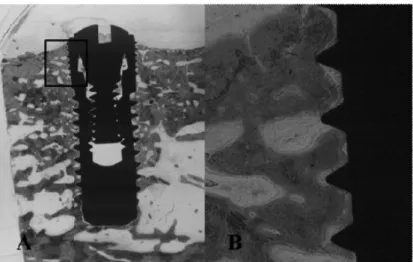
Histologic analysis of the implants demonstrated newly formed, compact, mature bone with nearby marrow space, but there were volumetric differences between groups (Fig. 1~6). In the control–anodized surface group, most of the coronal gaps were not fill -ed with bone, and minimal new bone formation was shown (Fig. 3). Coronal gaps were filled with loose connective tissues, and apical migration of epithelium was observed. The microthreads portion of the implant in the control groups did not show osseointegration.
Figure 1. Clinical photograph representing the Figure 2. Radiographic view of the experimental site.
experiment site.
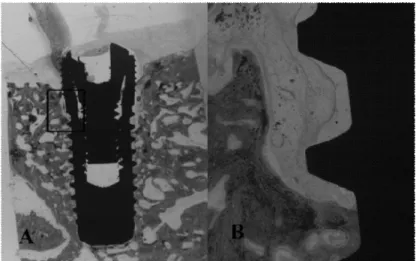
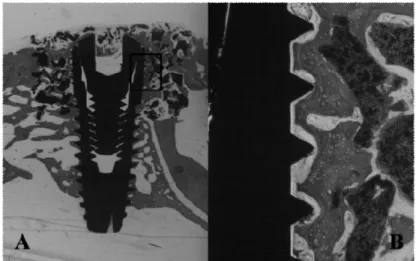
The Experimental group 1, 2 -anodized surface with HA coating and 430゚C heat treatment showed an im- proved regenerative characteristics(Fig. 4, 5). Most of the gaps were filled with newly regenerated bone. The implant surface was covered with bone layer as base for intensive bone formation and remodeling.
Osteoblasts were lined with the implant surface and showed favorable contact osteogenesis. Especially ex- perimental group 1-150nm coating and 430゚C heat treatment- showed more favorable bone formation.
Most of the newly formed bone was compact and
mature. The coronal microthread portion showed no connective tissue invagination and epithelial migration (Fig. 2). In experimental group 2-300nm coating and 430゚C heat treatment, there was also good bone filling around the implant surface, but there were some bony resorption in the coronal microthreads portion (Fig.
3). The two or three microthreads of the most coronal part did not show bone fill and osseointegration, but the other part of the implant was lined with newly formed bone just as the experimental group 1.
Figure 3. Histologic view of control group. (Anodized surface implant) A: maginification (×10), B: H-E staining (×100).
Figure 4. Histologic view of experimental group 1. (Anodized surface + HA 150nm coating +430゚C heat treatment implant) A: maginification (×10), B: H-E staining (×100).
Experimental group 3 -anodized surface with 150nm HA coating and no heat treatment-showed minimal bone fill and less osteointegration as that of the con-
In grafted case, the alloplastic material to the gaps-experimental group 4, 5-, most of the coronal gaps were filled with newly formed bone and the re- maining graft particles (Fig. 7, 8). The newly formed bone was observed above the implant top and favor- able bone to implant contact was also seen. Some
trol (Fig. 6). There was connective tissue invasion and bony resorption in the coronal microthreads.
grafted materials were remained without resorption and were surrounded by the new bone. The newly formed bone trabeculae were present, which were composed mostly of woven bone. New bone was in di- rect apposition to the HA particles and implant tita- nium surface.
Figure 5. Histologic view of experimental group 2. (Anodized surface + HA 300nm coating +430゚C heat treatment implant) A: maginification (×10), B: H-E staining (×100).
Figure 6. Histologic view of experimental group 3. (Anodized surface + HA 150nm coating no heat treatment implant) A: maginification (×10), B: H-E staining (×100).
3. Histometric anlysis
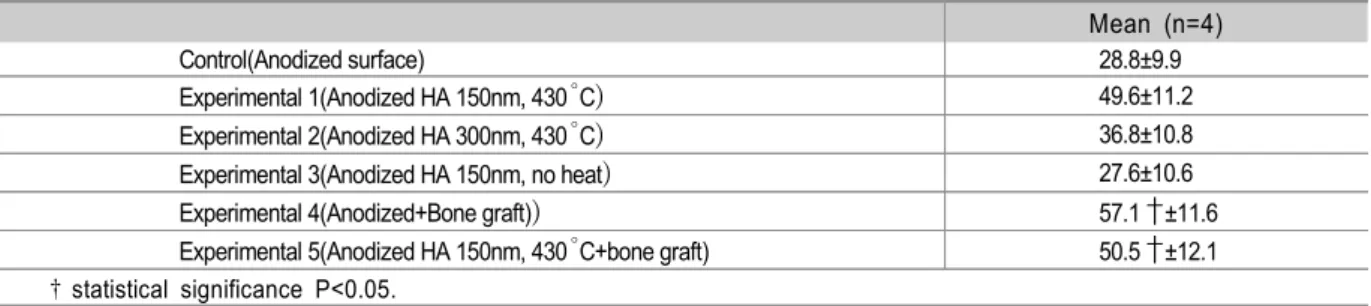
The results from the histometric analysis are pre- sented in Table 1, 2.
The BIC and bone density parameters showed sim- ilar results with the histological findings. The bone graft group presented the best BIC value which had statistical significance. Experimental group 1 pre-
sented the highest mean value in bone density, which was statistically significant. The anodized surface with HA coatings and 430℃ heat treatment showed favorable results in terms of BIC and the bone density compared to the control and no heat treatment groups. But there was no statistical significance be- tween those groups
Figure 7. Histologic view of experimental group 4. {Anodized surface implant + Bone (Osteon®: HA+
TCP) graft} A: maginification (×10), B: H-E staining (×100).
Figure 8. Histologic view of experimental group 5. {Anodized surface + HA 150nm coating +430℃
heat treatment implant + Bone(Osteon®: HA+ TCP) graft}
A: maginification (×10), B: H-E staining (×100).
Discussion
In the late 1950s, Br゚anemark predictably achieved an intimate bone-to-implant apposition that offered sufficient strength to cope with load transfer. This phenomenon is called“osseointegration”and after that a series of screw-shaped, commercially pure ti- tanium implants were inserted in the edentulous area.
Since that time, millions of patients have been treated worldwide using dental implant, and now, dental im- plant treatment has obtained general consent by most of the clinicians. A key element in the reaction of hard and soft tissues to an implant involves the im- plants surface characteristics-the chemical and phys- ical properties. It is generally believed that the rough surfaces accelerate the initial healing phase and en- hance bone formation at the implant surface4,12,13). Roughening the topography of the implant surface by applying a porous coating or surface treatments may promote osteogenesis by enhancing osteoblast meta- bolic activity and cellular adhesion, increasing surface area, and stabilizing the fibrin scaffold. Thus faster
bone apposition can be achieved with roughened sur- faces compared to machined surfaces14). The chemical nature of the implant surface can be modified by sur- face coating. Some materials, as well as various sur- face characteristics, enhance bone apposition at the implant surface in an osteoconductive manner.
Calcium phosphate, especially HA have been a popular coating material because of its resemblance to bone tissue. HA is an osteoconductive and osteoinductive ceramic and it promotes strong biological bonding be- tween implants and bone tissue. Although long-term clinical studies have presented highly successful re- sults for HA-coated implants6,7,15), some researchers have expressed concerns about the potential for dis- solution, resorption, and detachment of the coating, which may promote the loss of osseointegration8-10). Usually this may be due to the macroscopically visible surface roughness. Macroscopically rough surfaces have the tendency of progressive bone loss, suscepti- bility to the contamination of oral bacteria and lead- ing ultimately to implant loss.
In the present study, nano scaled HA coated im- Table 1. Bone to Implant Contact Percentage(BIC %) in the Coronal 5mm of the Implant
Mean (n=4)
Control(Anodized surface) 28.8±9.9
Experimental 1(Anodized HA 150nm, 430゚C) 49.6±11.2
Experimental 2(Anodized HA 300nm, 430゚C) 36.8±10.8
Experimental 3(Anodized HA 150nm, no heat) 27.6±10.6
Experimental 4(Anodized+Bone graft)) 57.1†±11.6
Experimental 5(Anodized HA 150nm, 430゚C+bone graft) 50.5†±12.1
† statistical significance P<0.05.
Table 2. Newly Formed Bone Density(%) within the Threads in the Coronal 5mm of the Implant
Mean (n=4)
Control(Anodized surface) 33.8±12.4
Experimental 1(Anodized HA 150nm, 430゚C) 59.9†±11.6
Experimental 2(Anodized HA 300nm, 430゚C) 43.1±12.9
Experimental 3(Anodized HA 150nm, no heat) 30.6±15.2
Experimental 4(Anodized+Bone graft) 53.1±11.8
Experimental 5(Anodized HA 150nm, 430゚C+bone graft) 47.5±13.5
† statistical significance P<0.05.
plants were used. Basically used implants had an ano- dized surface. This surface used titanium oxide(TiO2) layers to enhance or accelerate the bone formation. In our study, we hypothesized that combining the ano- dized surface and HA deposition would have syner- gistic effect, and used 150nm or 300nm thickness HA coated implants to evaluate the effects of HA coatings on the anodized surface of endosseous dental implants whether osseointegration of implants with such HA coating occurs earlier. In analyzing the results of the histologic and histometric analysis, HA coated dental implant showed favorable results compared to the control anodized surface implant. Anodized surface implant group showed minimal bone fill of the surgi- cally created gaps, low BIC and bone density value.
The HA coated implant groups presented almost double sized value in BIC and bone density and the gaps were almost filled with newly regenerated bone. Especially 150nm HA coated implants showed more favorable re- sults than 300nm coated implants. In bone density parameter, 150nm HA coated implant group showed statistically different value compared to 300nm coated implant group. Anodized implants have its own micro- pores on the surface and average roughness is about 0.37μm. When very thick layer of HA is coated on the anodized implant, the micropores are blocked by HA particles16). Our results may be due to these charac- teristics of oxidized implant. And HA must be re- sorbed according to the bone healing time and must be replaced with bone. However, it is unfavorable for the bone to be replaced and takes more time to resorb as the layer gets thicker.
In terms of heat treatment, we compared the same thickness HA coated implant with or without of 430゚C heat treatment. Oonishi et. al17) suggested that the amorphous phase of the coatings, which has a greater resorption in vivo than crystalline HA coating, can accelerate the early fixation of the implant with bony tissue and promote fast bone remodeling and attachment. However, it is also known that a high
concentration of amorphous phase in the coating layer can cause excessive dissolution and consequently re- duce the coating integrity of the implants. In addi- tion, in vitro and vivo research also suggested that the crystallinity of HA coatings is essential to their biocompatibility and early performance compared to machined implants18,19). In our results, anodized sur- face with HA coating, no heat treatment showed min- imal bone fill and less osseointegration as that of the control group. The reason for this being is that there is fast melting characteristic with amorphous HA layer when there is no heat treatment, in consequent, there is an unfavorable effect in terms of osseointegration and there happens to be a gap between the implant surface and the bone surface.
In this study, circumferential parallel 2mm defect was created surgically. Several studies suggested that gaps larger than 2mm resulted in a smaller amount of direct bone to implant contact20,21). Clinically many methods have been introduced to overcome the coronal gap associated with immediate implant22-24). Additionally, bone particles were grafted into the surgically created gaps for evaluating the synergistic effects of bone materials and HA surface of implants. Bone material (Osteon®) is the mixture of HA and beta-tricalcium phosphate (ß-TCP). HA provides a good scaffold for the new bone to growth, but has poor regeneration potential. ß-TCP has good bone regeneration poten- tial, but is not able to provide sufficient space for bone growth. Mixing HA and ß-TCP permits the as- sociation between the physic-chemical properties of each compound. Recent studies have suggested the stability and effectiveness of the mixture of HA and ß-TCP25,26). The present study showed the superior results in histologic and histometric analysis. Most of the gap areas were filled with newly formed bone. In some histologic view, we can see that the new bone was formed above the implant top. In BIC and bone density parameters, it also showed also favorable val- ues compared to the other groups.
The object of this study was to evaluate the effects of HA coating to the anodized surface of dental im- plant, and the synergistic effects of bone graft. As a result, the thin coating of HA to the implant surface enhanced the osseointegration even in the surgically created gaps. And additional bone graft synergistically promoted the new bone formation in HA coated dental implants.
In conclusion, even if more researches are neces- sary on the long term effects of HA coated implants, HA coated dental implants appeared to have sig- nificant effects on the development of new bone formation. And additional bone graft is an effective method in overcoming the gaps around the implants.
References
1. Albrektsson T, Jansson T, Lekholm U. Osseointegrated dental implants. Dent Clin North Am 1986;30:151-74.
2. Johansson CB, Albrektsson T. A removal torque and histo- morphometric study of commercially pure niobium and tita- nium implants in rabbit bone. Clin Oral Implants Res 1991;2:24-29.
3. Buser D, Schenk RK, Steinemann S, et al. Influence of surface characteristics on bone integration of titanium implants. A histomorphometric study in miniature pigs. J Biomed Mater Res 1991;25:889-902.
4. Buser D, Nydegger T, Hirt HP, et al. Removal torque val- ues of titanium implants in the maxilla of miniature pigs.
Int J Oral Maxillofac Implants 1998;13:611-619.
5. Cochran DL, Simpson J, Weber HP, Buser D. Attachment and growth of periodontal cells on smooth and rough tita- nium Int J Oral Maxillofac Implants 1994;9:289-297.
6. McGlumphy EA, Peterson LJ, Larsen PE, Jeffcoat MK.
Prospective study of 429 hydroxyapatite-coated cylindric omniloc implants placed in 121 patients. Int J Oral Maxillofac Implants 2003;18:82-92.
7. Thomas KA, Kay JF, Cook SD, Jarcho M. The effect of surface macrotexture and hydroxylapatite coating on the mechanical strengths and histologic profiles of titanium im- plant materials. J Biomed Mater Res 1987;21:1395-1414.
dictability of hydroxyapatite-coated endosseous dental im- plants: a review of the literature. Int J Oral Maxillofac Implants 1995;10:712-720.
9. Hanisch O, Cortella CA, Boskovic MM, et al.
Experimental peri-implant tissue breakdown around hydrox- yapatite-coated implants. J Periodontol 1997;68:59-66.
10. Liao H, Fartash B, Li J. Stability of hydroxyapatite-coat- ings on titanium oral implants (IMZ). 2 retrieved cases.
Clin Oral Implants Res 1997;8:68-72.
11. Jeffcoat MK, McGlumphy EA, Reddy MS, et al. A com- parison of hydroxyapatite (HA) -coated threaded, HA-coat- ed cylindric, and titanium threaded endosseous dental implants. Int J Oral Maxillofac Implants 2003;18:406-410.
12. Ericsson I, Johansson CB, Bystedt H, Norton MR. A histo- morphometric evaluation of bone-to-implant contact on ma- chine-prepared and roughened titanium dental implants. A pilot study in the dog. Clin Oral Implants Res 1994;5:
202-206.
13. Klokkevold PR, Nishimura RD, Adachi M, Caputo A.
Osseointegration enhanced by chemical etching of the tita- nium surface. A torque removal study in the rabbit. Clin Oral Implants Res 1997;8:442-447.
14. Wong M, Eulenberger J, Schenk R, Hunziker E. Effect of surface topology on the osseointegration of implant materials in trabecular bone. J Biomed Mater Res 1995;29:1567-1575.
15. Block MS, Gardiner D, Kent JN, et al. Hydroxyapatite- coated cylindrical implants in the posterior mandible: 10-year observations. Int J Oral Maxillofac Implants 1996;11:
626-633.
16. Sul YT, Johansson C, Wennerberg A, et al. Optimum sur- face properties of oxidized implants for reinforcement of osseointegration: surface chemistry, oxide thickness, poros- ity, roughness, and crystal structure. Int J Oral Maxillofac Implants 2005;20:349-359.
17. Oonishi H, Hench LL, Wilson J, et al. Comparative bone growth behavior in granules of bioceramic materials of var- ious sizes. J Biomed Mater Res 1999;44:31-43.
18. Ong JL, Bessho K, Cavin R, Carnes DL. Bone response to radio frequency sputtered calcium phosphate implants and titanium implants in vivo. J Biomed Mater Res 2002;59:
184-190.
19. ter Brugge PJ, Jansen JA. Initial interaction of rat bone marrow cells with non-coated and calcium phosphate coat-
20. Akimoto K, Becker W, Persson R, et al. Evaluation of tita- nium implants placed into simulated extraction sockets: a study in dogs. Int J Oral Maxillofac Implants 1999;14:
351-360.
21. Knox R, Caudill R, Meffert R. Histologic evaluation of dental endosseous implants placed in surgically created ex- traction defects. Int J Periodontics Restorative Dent 1991;
11:364-375.
22. Werbitt MJ, Goldberg PV. The immediate implant: bone preservation and bone regeneration. Int J Periodontics Restorative Dent 1992;12:206-217.
23. Becker W, Dahlin C, Becker BE, et al. The use of e-PTFE barrier membranes for bone promotion around titanium im- plants placed into extraction sockets: a prospective multi-
center study. Int J Oral Maxillofac Implants 1994;9:31-40.
24. Lang NP, Bragger U, Hammerle CH, Sutter F. Immediate transmucosal implants using the principle of guided tissue regeneration. I. Rationale, clinical procedures and 30-month results. Clin Oral Implants Res 1994;5:154-163.
25. Cornell CN, Lane JM. Current understanding of osteo- conduction in bone regeneration. Clin Orthop Relat Res 1998:S267-273.
26. Schopper C, Ziya-Ghazvini F, Goriwoda W, et al. HA/TCP compounding of a porous CaP biomaterial improves bone formation and scaffold degradation--a long-term histological study. J Biomed Mater Res B Appl Biomater 2005;74:
458-467.