ORIGINAL ARTICLE
대장 내시경 장정결제 분할 요법의 효능: 2 Liters Polyethylene Glycol with Ascorbic Acid versus Sodium Picosulfate versus Oral Sodium Phosphate Tablets
이석원, 방창석, 박태영, 석기태, 백광호, 김동준
한림대학교 의과대학 내과학교실
Split-dose Bowel Preparation for Colonoscopy: 2 Liters Polyethylene Glycol with Ascorbic Acid versus Sodium Picosulfate versus Oral Sodium Phosphate Tablets
Seok Won Lee, Chang Seok Bang, Tae Young Park, Ki Tae Suk, Gwang Ho Baik and Dong Joon Kim Department of Internal Medicine, Hallym University College of Medicine, Chuncheon, Korea
Background/Aims: Adequate bowel preparation is an essential factor affecting the visibility of colonic mucosa and safety of related therapeutic interventions. The aim of this study was to assess the efficacy, tolerability, and safety of three bowel preparation agents –2 L polyethylene glycol with ascorbic acid (PEGA), sodium picosulfate magnesium citrate (SPMC), and oral sodium phosphate tablet (NaP)– for morning colonoscopy.
Methods: Here, we analyzed the medical records of patients who had taken bowel preparation agents using the split-dose method and undergone colonoscopy in a single hospital. The efficacy of bowel preparation agents was evaluated using the Ottawa bowel prep- aration assessment tool. The safety and tolerability of the agents were assessed by measuring the renal function and electrolytes prior to and after the procedure as well as by assessing the self-reported questionnaire.
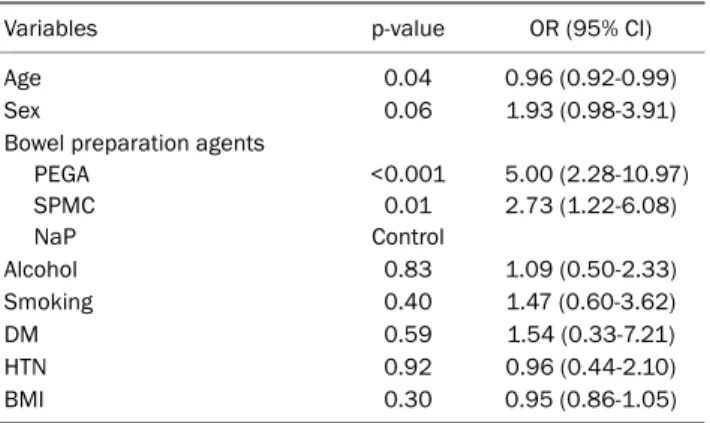
Results: Of the 365 patients (PEGA:163, SPMC: 93, NaP: 109), 98.6% ingested more than 90% of the agents. NaP showed an inferior cleansing efficacy, and serum phosphate elevation was significantly higher in the NaP group. However, the satisfaction score was lowest in the PEGA group. Age (odds ratio [OR] 0.96, 95% confidence interval [CI] 0.92-0.99, p=0.04) and preparation agents (OR of PEGA versus NaP 5.0, 95% CI 2.28-10.97, p<0.001) (OR of SPMC versus NaP 2.73, 95% CI 1.22-6.08, p=0.01) were independently associated with bowel preparation success.
Conclusions: According to our analysis, NaP showed an inferior cleansing efficacy compared with PEGA and SPMC, which may be attributed to the complex administration method and lower water intake. However, large-volume ingestion remains unsatisfactory for patients. Detailed bowel preparation instructions could enhance bowel cleansing efficacy. (Korean J Gastroenterol 2017;70:89-95) Key Words: Bowel preparation solutions; Colonoscopy; Polyethylene glycols; Picosulfate sodium; Sodium phosphate
Received January 19, 2017. Revised April 21, 2017. Accepted April 21, 2017.
CC This is an open access article distributed under the terms of the Creative Commons Attribution Non-Commercial License (http://creativecommons.org/licenses/
by-nc/4.0) which permits unrestricted non-commercial use, distribution, and reproduction in any medium, provided the original work is properly cited.
Copyright © 2017. Korean Society of Gastroenterology.
교신저자: 방창석, 24253, 춘천시 삭주로 77, 한림대학교 의과대학 춘천성심병원 소화기내과
Correspondence to: Chang Seok Bang, Division of Gastroenterology, Department of Internal Medicine, Chuncheon Sacred Heart Hospital, Hallym University College of Medicine, 77 Sakju-ro, Chuncheon 24253, Korea. Tel: +82-33-240-5000, Fax: +82-33-241-8064, E-mail: [email protected]
Financial support: None. Conflict of interest: None.
INTRODUCTION
Adequate bowel preparation is an essential factor affect- ing the visibility of colonic mucosa and safety of related ther-
apeutic interventions. It has been reported that poor bowel preparation is found in about 20-25% of colonoscopy exams.1,2 Inadequate bowel preparation not only prolongs the proce- dure as it requires an addition step of washing the poorly
cleansed colon, but it also increases the chance of missing mucosal lesions. Ideal bowel preparation agents should be easy to take with minimal effect on the water and electrolyte balance, without inducing mucosal injuries and not requiring an extended duration to finish the preparation.3
The available bowel preparation agents in Korea include polyethylene glycol (PEG), osmotic laxatives, and stimulant laxatives. PEG is the most commonly used agent and is rela- tively safe because it is not absorbed through the colonic mu- cosa and does not permit the transposition of water and electrolytes. However, despite its advantages, its disadvantage is that it is not easy to take due to the large volume of agents required (a total of 4 liters of water). PEG 2 L+ascorbic acid (PEGA) has recently been developed and widely adopted in Korea. The stimulant laxative, sodium picosulfate+magne- sium citrate (SPMC), is also available in Korea. This laxative stimulates the peristalsis of the bowel, inducing osmotic diarrhea. Another agent, a sodium phosphate (NaP) solution, has been used as an osmotic laxative. However, complica- tions, including acute phosphate nephropathy, which could potentiate chronic kidney disease requiring hemodialysis, had been reported, and as a result, the Korean Food and Drug Administration banned the use of a NaP solution for bowel cleansing in 2009.4-6 However, the oral NaP tablet was per- mitted in 2012 and is currently being used in Korea.
There have been many studies comparing the efficacy, safety, and tolerability between these bowel preparation agents. However, it remains difficult to determine which agent is most superior. Thus, the aim of this study was to com- pare the efficacy, safety, and tolerability of PEGA, SPMC, and NaP using the split-dose method in a Korean population.
SUBJECTS AND METHODS
1. Ethics statement
This study was conducted in accordance with the Declaration of Helsinki and approved by the institutional re- view board of Chuncheon Sacred Heart Hospital prior (2015-23). Patient records and information were anony- mized and de-identified prior to analysis.
2. Patient selection
The authors retrospectively analyzed, using the split-dose method, the medical records of patients who had undergone
colonoscopy (for the purpose of screening or surveillance) and taken bowel preparation agents between December 2013 and February 2014 in a single hospital in Korea (split-dose bowel preparation was started in November 2013 in Chuncheon Sacred Heart hospital). Patients with systemic illness or a past history that may have affected the bowel cleansing were excluded. The exclusion criteria were as fol- lows: patients with heart failure (New York Heart Association class>2), renal failure (glomerular filtration rate<60 mL/ min/
1.73 m2), liver cirrhosis, malignancy, intestinal obstruction, his- tory of parathyroidectomy, history of abdominal surgery, as- cites, inflammatory bowel disease, and specific medication use (nonsteroidal anti-inflammatory drugs with the exception of low-dose aspirin, diuretics, angiotensin-converting-enzyme inhibitors, or angiotensin receptor blockers). Patients who underwent colonoscopy in the afternoon were also excluded because the time interval between bowel preparation and co- lonoscopy may have biased the efficacy of the preparation agents.
3. Bowel preparation method
Three bowel preparation agents were used in this study (Coolprep®, Taejoon Pharmaceuticals Co., Ltd., Seoul, Korea;
Picolight powder®, Pharmbio Korea Co., Ltd., Chungju, Korea;
and Nexcolon tab®, Nexpharm Korea Co., Ltd., Seoul, Korea).
All enrolled patients took these preparation agents following the doctor’s instructions. All patients commenced a mini- mal-residue diet, which was refraining from eating fruits with seeds, sea algae, mixed grains, and foods with high fiber con- tents, three days prior to colonoscopy. They were also in- structed to skip their last dinner. Bowel preparation agents were selected by a prescribing doctor for each patient consid- ering patients’ taste preference, cost, and tolerability. Details of patient instruction on specific bowel preparation methods according to each regimen are as follows:
1) PEGA for morning examination
(1) The day before the exam, at 9 p.m., dissolve two sachets of PEGA in 1 L of water and drink 250 mL in each 15-minute period; afterward, drink an additional 500 mL of plain water.
(2) On the following day, at 5 a.m., repeat step (1) using the remaining two sachets.
(3) These steps should be finished at least 3 hours before the colonoscopy.
2) SPMC for morning examination
(1) The day before the exam, at 5 p.m., dissolve one sachet of SPMC in 150-200 mL of water, and drink the solution, and drink an additional 1 L of water or another clear fluid within 1-2 hours. Take the additional sachet in the same manner at 9 p.m.
(2) On the following day, at 5 a.m., repeat step 1 using the remaining sachet.
(3) These steps should be finished at least 3 hours before the colonoscopy.
3) NaP for morning examination
(1) The day before the exam, at 7 p.m., take four tablets of NaP with 240 mL of water in each 15-minute period, until 20 total tablets have been taken (4 tablets×5 times, 1.2 L of wa- ter total).
(2) On the following day, at 5 a.m., take four tablets of NaP with 240 mL water in each 15-minute period until 12 total tab- lets have been taken (4 tablets×3 times, 960 mL of water total).
(3) These steps should be finished at least 3 hours before the colonoscopy.
4. Evaluation of the efficacy of the preparation agents Bowel cleansing efficacy was assessed at the end of the co- lonoscopy by endoscopists with an experience of at least 2,000 cases. The Ottawa bowel preparation scale, a reliable and valid tool for assessing bowel cleansing, was used for the assessment. This scale uses ratings from 0-4 (no liquid=0, minimal liquid, no suctioning required=1, suction required to see mucosa=2, wash and suction=3, solid stool, not wash- able=4) for the right, middle, and rectosigmoid colon, re- spectively, as well as a score for the overall amount of fluid in the colonic lumen (minimal=0, moderate=1, large=2).
These provide a score range between 0 (excellent prepara- tion, no fluid) and 14 (inadequate in all segments with a large amount of fluid). A total score of 7 or less was defined as a successful bowel preparation.7
5. Safety and tolerability of bowel preparation agents The safety of each preparation agent was assessed by comparing the serum level of the electrolytes and creatinine with the estimated glomerular filtration rate on arrival in the endoscopy suite with the baseline (in the same clinic prior to or after booking colonoscopy within 1 month) levels. Of the
365 patients, laboratory data on 247 were available for this study (PEGA, SPMC, NaP=92, 82, 73).
The tolerability was assessed by a self-reported questionnaire.
We routinely investigated the tolerability of the bowel prepa- ration agents due to safety concerns in a customer sat- isfaction campaign. Voluntary participation was requested, and written informed consent was obtained from each partic- ipant for the use of their information.
We investigated whether each participant consumed all preparation agents prescribed and their taste; we also eval- uated the development of any side effects, including nausea, vomiting, abdominal pain, bloating, or dizziness after com- pleting the bowel preparation. The satisfaction score was as- sessed via the visual analogue scale (from 0=unsatisfactory to 10=satisfactory). We also investigated the patients' will- ingness to accept or refuse the same preparation agent in the future.
6. Statistical analysis
Continuous data are expressed as the means and stand- ard deviation, and categorical data are given as frequencies (percentages). The Student’s t test, ANOVA, and Fisher’s ex- act test were used to evaluate the baseline characteristics (post-hoc analysis using the Bonferroni method), and RM- ANOVA was used to compare the preparation scores of the three agents. A multivariable logistic regression test was used to detect the associated factors of successful bowel preparation. A p-value<0.05 was considered statistically sig- nificant for all tests. The analysis was performed using SPSS software version 18.0 (SPSS Inc., Chicago, IL, USA).
RESULTS
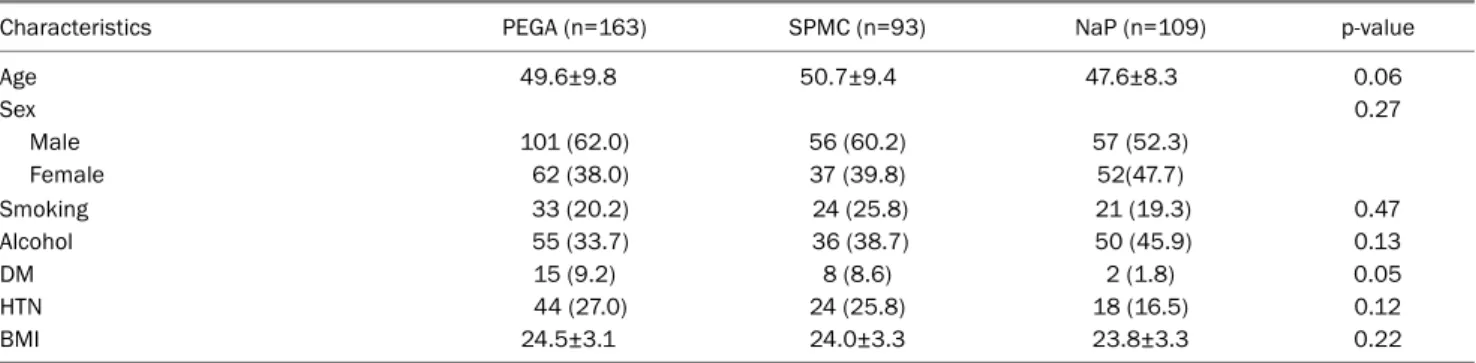
1. Population characteristics
Among the 402 colonoscopy examinations during study period, 37 cases were excluded. The detailed cause of ex- clusion is as follows: renal failure (n=2), liver cirrhosis (n=5), malignancy (n=3), history of abdomen surgery (n=3), in- flammatory bowel disease (n=2), medication users (n=20), and colonoscopy in the afternoon (n=2). Finally, a total of 365 patients (PEGA 163, SPMC 93, NaP 109) were included in this study. The detailed study flow is described in Fig. 1. The mean age of the total population was 49.3±9.3 years. Among the study population, 214 were men (58.6%) and 151 were
Table 1. Clinical Characteristics of Total Enrolled Population
Characteristics PEGA (n=163) SPMC (n=93) NaP (n=109) p-value
Age 49.6±9.8 50.7±9.4 47.6±8.3 0.06
Sex 0.27
Male 101 (62.0) 56 (60.2) 57 (52.3)
Female 62 (38.0) 37 (39.8) 52(47.7)
Smoking 33 (20.2) 24 (25.8) 21 (19.3) 0.47
Alcohol 55 (33.7) 36 (38.7) 50 (45.9) 0.13
DM 15 (9.2) 8 (8.6) 2 (1.8) 0.05
HTN 44 (27.0) 24 (25.8) 18 (16.5) 0.12
BMI 24.5±3.1 24.0±3.3 23.8±3.3 0.22
Values are presented as mean±standard deviation or n (%).
PEGA, polyethylene glycol+ascorbic acid; SPMC, sodium picosulfate magnesium citrate; NaP, sodium phosphate; DM, diabetes mellitus; HTN, hypertension; BMI, body mass index.
Table 2. Cleansing Efficacy of Bowel Preparation Agents Component of Ottawa bowel
preparation scale PEGA (n=163) SPMC (n=93) NaP (n=109) p-value
Right colon 0.93±0.69 0.97±0.84 1.51±1.07 <0.001a
Mid colon 1.01±0.56 1.05±0.81 1.34±0.93 0.005b
Rectosigmoid colon 0.56±0.64 0.69±0.88 1.04±0.99 <0.001c
Colonic fluid 1.06±0.37 1.09±0.41 1.05±0.48 0.77
Total score 3.57±1.70 3.82±2.55 4.93±2.96 <0.001d
Values are presented as mean±standard deviation.
PEGA, polyethylene glycol+ascorbic acid; SPMC, sodium picosulfate magnesium citrate; NaP, sodium phosphate.
aSignificant difference between PEGA and NaP (p<0.001), and between SPMC and NaP (p<0.001); bSignificant difference between PEGA and NaP (p=0.001), and between SPMC and NaP (p=0.02); cSignificant difference between PEGA and NaP (p<0.001), and between SPMC and NaP (p=0.008); dSignificant difference between PEGA and NaP (p<0.001), and between SPMC and NaP (p=0.003).
Fig. 1. Flow diagram of study. PEGA, polyethylene glycol+ascorbic acid; SPMC, sodium picosulfate magnesium citrate; NaP, sodium phosphate.
women (41.4%). The mean body weight and body mass index were 65.4±11.2 kg and 24.2±3.2, respectively. Twenty-five patients (6.8%) had diabetes mellitus, and 86 patients
(23.6%) had hypertension. Seventy-eight patients (21.4%) were smokers, and 141 patients (38.6%) were alcoholics. No significant differences in the baseline characteristics were detected between the three preparation groups. Detailed characteristics of the total enrolled population are listed in Table 1.
2. Efficacy of preparation agents
In the enrolled population, 360 patients (98%) ingested more than 90% of the bowel preparation agents. A total of 318 patients (88.3%) showed successful bowel preparation (Ottawa total regional score of 7 or less). Ottawa bowel prepa- ration scale scores were significantly higher in the NaP group than the other groups (PEGA and SPMC) in the right colon, mid colon, and rectosigmoid colon, as well as for the total score (PEGA, SPMC, NaP=3.57±1.70, 3.82±2.55, 4.93±2.96, respectively, p<0.001) (Table 2). However, there were no sig- nificant differences in the colonic fluid score between the groups (PEGA, SPMC, NaP=1.06±0.37, 1.09±0.41, 1.05±
0.48, respectively, p=0.77) (Table 2).
Table 3. Safety Profile of Bowel Preparation Agents
PEGA (n=92) SPMC (n=72) NaP (n=83) p-value
Na (mmol/L) 0.40 -0.33 0.81 0.91
Cl (mmol/L) 1.29 -0.80 -0.11 0.03a
P (mg/dL) -0.07 0.07 3.85 <0.001b
Ca (mg/dL) 0.07 0.14 -0.35 <0.001c
Cr (mg/dL) 0.01 0.01 0.01 0.91
eGFR (mL/min) -1.10 -0.79 -0.97 0.98
The mean difference between pre & post-bowel preparation of serum electrolyte and eGRF.
PEGA, polyethylene glycol+ascorbic acid; SPMC, sodium picosulfate magnesium citrate; NaP, sodium phosphate; eGFR, estimated glomerular filtration rate.
aSignificant difference between PEGA and SPMC (p=0.03); bSignificant difference between PEGA and NaP (p<0.001), and between SPMC and NaP (p<0.001); cSignificant difference between PEGA and NaP (p<0.001), and between SPMC and NaP (p<0.001).
Table 4. Tolerability of Bowel Preparation Agents
PEGA (n=163) SPMC (n=93) NaP (n=109) p-value
Could not intake all the preparation agents 3 (1.8) 1 (1.1) 1 (0.9) 0.86
Satisfaction score 7.29±2.00 8.25±1.71 8.12±1.60 <0.001a
Refuse to take the same preparation agent in the future 48 (29.4) 16 (17.2) 17 (15.6) 0.01 Values are presented as mean±standard deviation or n (%).
PEGA, polyethylene glycol+ascorbic acid; SPMC, sodium picosulfate magnesium citrate; NaP, sodium phosphate.
aSignificant difference between PEGA and SPMC (p<0.001), and between PEGA and NaP (p=0.001).
3. Safety of bowel preparation agents
There were no significant differences in the 3 groups re- garding the changes in the serum Na, creatinine level, or esti- mated glomerular filtration rate (p=0.91, 0.91, and 0.98, re- spectively) between the baseline and after bowel prepara- tion (Table 3). However, there were statistically significant dif- ferences between the groups regarding changes in the serum phosphate, calcium, and chloride levels. The elevation of the serum phosphate level and a reciprocal decrease in the se- rum calcium level were statistically significant in the NaP group (PEGA versus NaP: p<0.001; SPMC versus NaP:
p<0.001) (Table 3). A statistically significant serum chloride elevation was observed in the PEGA group compared with the SPMC group (p=0.03) (Table 3). Visible mucosal abnormal- ities, diagnosed as non-specific colitis, were found in 4 pa- tients (0.01%; 2 patients in the PEGA group, 1 patient in the SPMC group, and 1 patient in the NaP group).
4. Tolerability of bowel preparation agents
All the enrolled patients voluntarily participated in com- pleting the self-reported questionnaire. The proportion of pa- tients who complained of abdominal pain, nausea or vomit- ing after taking bowel preparation agents were not statisti- cally different among the 3 preparation agents (<5% in each
group). There were no significant differences in the pro- portion of patients who could not drink all preparation agents (p=0.86). However, PEGA showed a significantly lower sat- isfaction score than the other preparation agents (PEGA, SPMC, NaP=7.29±2.00, 8.25±1.71, 8.12±1.60, respectively, p<0.001), and the proportion of refusal for the same bowel preparation agent in the future was highest in the PEGA group (PEGA, SPMC, NaP=29.4, 17.2, 15.6%, respectively, p=0.012) (Table 4).
5. Multivariable analysis for the success of bowel preparation In the analysis of the detection of associated factors for successful bowel preparation, age (odds ratio [OR] 0.96, 95% confidence interval [CI] 0.92-0.99, p=0.04) and prepa- ration agents (OR of PEGA versus NaP 5.0, 95% CI 2.28- 10.97, p<0.001) (OR of SPMC versus NaP 2.73, 95% CI 1.22-6.08, p=0.01) showed a significant association with the success of bowel preparation (Ottawa total regional score of 7 or less). Detailed adjusted factors and OR are shown in Table 5.
DISCUSSION
Adequate bowel preparation is an essential factor for a suc-
Table 5. Multivariable Logistic Regression Analysis Assessing the Associated Factors of Successful Bowel Preparation (Ottawa bowel preparation scale score 7 or less)
Variables p-value OR (95% CI)
Age 0.04 0.96 (0.92-0.99)
Sex 0.06 1.93 (0.98-3.91)
Bowel preparation agents PEGA
SPMC NaP
<0.001 0.01 Control
5.00 (2.28-10.97) 2.73 (1.22-6.08)
Alcohol 0.83 1.09 (0.50-2.33)
Smoking 0.40 1.47 (0.60-3.62)
DM 0.59 1.54 (0.33-7.21)
HTN 0.92 0.96 (0.44-2.10)
BMI 0.30 0.95 (0.86-1.05)
OR, odds ratio; CI, confidence interval; PEGA, polyethylene glycol+
ascorbic acid; SPMC, sodium picosulfate magnesium citrate; NaP, sodium phosphate; DM, diabetes mellitus; HTN, hypertension; BMI, body mass index.
cessful colonoscopy. The optimum bowel preparation regi- men for a colonoscopy should provide excellent cleansing, have a high safety profile, and be well tolerated by patients.
In this study, we investigated the cleansing efficacy, safety profile, and patient tolerance of three different agents in a Korean population by using the split-dose method. Moreover, we also aimed to determine which factor was associated with successful bowel preparation.
Regarding bowel cleansing efficacy, previous studies have shown inconsistent results when comparing between avail- able agents.8-10 Moreover, comparison data on oral NaP tab- lets are scarce. In this study, oral NaP tablets showed to be inferior with respect to its efficacy compared with PEGA and SPMC; this was consistent in all bowel segments (Table 2).
This result is in agreement with a recent large-scale random- ized study in Australia.8 The complex administration method and relatively lower water intake are suspected to be the rea- sons for the low efficacy of oral Nap. Between PEGA and SPMC, efficacy was comparable; this result is in line with pre- vious randomized studies.8,11 However, there has also been conflicting reports, indicating a lower efficacy for SPMC com- pared with PEG.12,13 A recent Korean multicenter randomized study also indicated comparable efficacy between SPMC+bi- sacodyl and 4 L PEG.14 Heterogeneity between the studies in terms of dietary counseling, total water intake, administration method, and time interval between bowel preparation and colonoscopy may bias the results. It appears that there is an increasing demand by patients for a lower volume of prepara-
tion agents. This prompts the need for more studies focusing on ways to lower the volume of bowel preparation agents.
Further studies are also required to confirm the results found in this study.
Regarding the safety profile, hyperphosphatemia and hy- pocalcemia induced by NaP tablets presented statistically significant differences compared with the other two agents (Table 3). Although no patients with acute kidney injury were found, hyperphosphatemia and hypocalcemia, which are well-known adverse events, were identified at the same lev- els following the administration of NaP tablets compared with NaP solution. The long-term effects of NaP tablet in- gestion were difficult to determine, as this study only focused on the available, immediate biochemical data.
Although superior bowel cleansing efficacy was observed in PEGA compared with NaP, patient satisfaction and toler- ability of PEGA were lower. Due to the detailed instruction of the administration method in this study, the proportion of pa- tients who were unable to consume all the preparation agents as instructed was not particularly different between the three groups. However, the satisfaction score was higher in the NaP and SPMC groups than in the PEGA group (Table 4).
This highlights the difference in perspective between doctors and patients regarding the selection of bowel preparation agents. The bowel cleansing efficacy and safety profile ap- pear to be more important to doctors, while avoiding large vol- ume of consumption remains to be important to patients. To satisfy this unmet need for patients, an agent that is sat- isfactory with respect to both safety and volume is necessary.
Several factors have been reported to predict inadequate bowel preparation for colonoscopy, including old age, female sex, diabetes, constipation, history of abdominal or gyneco- logic surgery, compliance with preparation instructions, diet counseling prior to colonoscopy, and bowel preparation type.15,16 Our study also revealed that old age was associated with poor bowel preparation. Previous studies indicated that an age over 60 years was associated with poor bowel preparation.16-18 Suspected reasons are reduced colon transit time or comorbidities in elderly patients.19 A complex admin- istration method is a barrier and could be the reason for poor adherence to the instruction of taking preparation agents in elderly patients. Detailed instructions and counseling could promote successful bowel cleansing.
This study has several limitations to consider. It is a retro-
spective study from a single hospital, and a small number of patients was enrolled for statistical analysis. It is possible for selection bias to influence the study results because the pre- scribing doctor may have changed the preparation agents considering the patient's information. Another limitation was the lack of information regarding the safety profile for the en- rolled population. However, contrary to previous studies, this study included a group of those who took the oral NaP tablets.
Additionally, the entire enrolled population adhered to split-dosing, which was more effective and better tolerated than the standard 1-day bowel preparation method.20 Another strength of this study was the confirmation of compliance to bowel preparation agents. About 98.6% of the enrolled pop- ulation ingested more than 90% of the prescribed prepara- tion agents.
In brief, NaP tablets were shown to have an inferior cleans- ing efficacy compared with PEGA and SPMC in this retro- spective, single-center based analysis. A complex admin- istration method with a lower water intake could explain this lower efficacy. However, it is also worth noting that the need to ingest a large volume of preparation agents remains unsat- isfactory to patients. Detailed bowel preparation instructions could promote bowel cleansing efficacy.
ACKNOWLEDGEMENT
Authors would like to thank to Hyo Sun Kim, Jeong Ho Eom, and Eun Jin Kim for the help of collecting data.
REFERENCES
1. Harewood GC, Sharma VK, de Garmo P. Impact of colonoscopy preparation quality on detection of suspected colonic neoplasia.
Gastrointest Endosc 2003;58:76-79.
2. Rex DK, Petrini JL, Baron TH, et al. Quality indicators for colonoscopy.
Gastrointest Endosc 2006;63(4 Suppl):S16-S28.
3. Hoy SM, Scott LJ, Wagstaff AJ. Sodium picosulfate/magnesium citrate: a review of its use as a colorectal cleanser. Drugs 2009;
69:123-136.
4. Belsey J, Crosta C, Epstein O, et al. Meta-analysis: the relative effi- cacy of oral bowel preparations for colonoscopy 1985-2010.
Aliment Pharmacol Ther 2012;35:222-237.
5. Belsey J, Epstein O, Heresbach D. Systematic review: adverse event reports for oral sodium phosphate and polyethylene glycol.
Aliment Pharmacol Ther 2009;29:15-28.
6. Choi NK, Lee J, Chang Y, et al, Acute renal failure following oral
sodium phosphate bowel preparation: a nationwide case-cross- over study. Endoscopy 2014;46:465-470.
7. Rostom A, Jolicoeur E. Validation of a new scale for the assess- ment of bowel preparation quality. Gastrointest Endosc 2004;
59:482-486.
8. Lawrance IC, Willert RP, Murray K. Bowel cleansing for colono- scopy: prospective randomized assessment of efficacy and of in- duced mucosal abnormality with three preparation agents.
Endoscopy 2011;43:412-418.
9. Schmidt LM, Williams P, King D, Perera D. Picoprep-3 is a superior colonoscopy preparation to fleet: a randomized, controlled trial comparing the two bowel preparations. Dis Colon Rectum 2004;
47:238-242.
10. Tjandra JJ, Chan M, Tagkalidis PP. Oral sodium phosphate (fleet) is a superior colonoscopy preparation to picopre (sodium pico- sulfate-based preparation). Dis Colon Rectum 2006;49:616-620.
11. Worthington J, Thyssen M, Chapman G, Chapman R, Geraint M.
A randomised controlled trial of a new 2 litre polyethylene glycol solution versus sodium picosulphate + magnesium citrate sol- ution for bowel cleansing prior to colonoscopy. Curr Med Res Opin 2008;24:481-488.
12. Dakkak M, Aziz K, Bennett JR. Short report: comparison of two orally administered bowel preparations for colonoscopy--poly- ethylene glycol and sodium picosulphate. Aliment Pharmacol Ther 1992;6:513-519.
13. Saunders BP, Masaki T, Fukumoto M, Halligan S, Williams CB.
The quest for a more acceptable bowel preparation: comparison of a polyethylene glycol/electrolyte solution and a mannitol/picolax mixture for colonoscopy. Postgrad Med J 1995;71:476-479.
14. Kim HG, Huh KC, Koo HS, et al. Sodium picosulfate with magne- sium citrate (SPMC) plus laxative is a good alternative to conven- tional large volume polyethylene glycol in bowel preparation: a multicenter randomized single-blinded trial. Gut Liver 2015;9:
494-501.
15. Ness RM, Manam R, Hoen H, Chalasani N. Predictors of in- adequate bowel preparation for colonoscopy. Am J Gastroenterol 2001;96:1797-1802.
16. Chung YW, Han DS, Park KH, et al. Patient factors predictive of inadequate bowel preparation using polyethylene glycol: a pro- spective study in Korea. J Clin Gastroenterol 2009;43:448-452.
17. Chan WK, Saravanan A, Manikam J, Goh KL, Mahadeva S.
Appointment waiting times and education level influence the quality of bowel preparation in adult patients undergoing colonoscopy. BMC Gastroenterol 2011;11:86.
18. Nguyen DL, Wieland M. Risk factors predictive of poor quality preparation during average risk colonoscopy screening: the im- portance of health literacy. J Gastrointestin Liver Dis 2010;19:
369-372.
19. Romero RV, Mahadeva S. Factors influencing quality of bowel preparation for colonoscopy. World J Gastrointest Endosc 2013;
5:39-46.
20. Cohen LB. Split dosing of bowel preparations for colonoscopy: an analysis of its efficacy, safety, and tolerability. Gastrointest Endosc 2010;72:406-412.