Effects of Step Length Change on Kinetic Characteristics While Stepping Over an Obstacle From a Position of Quiet Stance
in Young and Elderly Adults: A Preliminary Study
Hyeong-dong Kim, Ph.D., P.T.
Dept. of Physical Therapy, Catholic University of Daegu
Abstract
1)The aim of the present study was to investigate age-related differences in stepping behavior in re- sponse to sensory perturbations of postural balance. The participants for this study were 2 healthy elderly adults (mean age=76.0) and 2 younger adults (mean age=25.5). Subjects were asked to step over a 10 ㎝ high obstacle at self-paced speed with the right limb to land on the primary target (normal step length) that is 10 ㎝ in diameter. However, if, during movement, the light was illuminated, then the subject had to step on the secondary target (long step length). It was planned that the onset of the light would be prior to peak Fx of swing limb, between swing peak Fx and swing toe-off, and after swing toe-off. In the younger adults these secondary visual cues were provided at mean times of 240 ㎳ (standard devia- tion (SD)=11), 402 ㎳ (SD=13), and 476 ㎳ (SD=88) following the movement onset. Corresponding mean times for the healthy elderly were 150 ㎳ (SD=67), 352 ㎳ (SD=39), and 562 ㎳ (SD=115). Results showed great changes in both group and visual cue condition in Fx ground reaction forces and temporal events following the swing toe-off. Swing limb acceleration force (Fx) and stance peak Fx1 was much greater in the young adults compared to the older adults. Both young and older adults increased stance peak Fx2 in the visual cue condition compared to normal stepping. There was no difference in stance peak Fx2 be- tween the visual cue conditions in both groups. Similarly, the time to stance peak Fx2 was much longer for the visual cue condition than for the normal stepping. It was not different between the visual cue conditions in the young adults, but in the elderly mid and late cue was much greater than early cue. In addition, time to stance peak Fx2 and swing and stance time were much longer in the older adults com- pared to the young adults for the visual cue conditions. These results suggest that unlike young adults, elderly adults did not flexibly modify their responses to unexpected changes in step length while stepping over obstacles.
Key Words: Elderly; Falls; Ground reaction forces; Sensory perturbation; Stepping.
Introduction
In order to perform daily activities an individual must be able to control balance of the body proac- tively (volitionally) or reactively. In proactive control, appropriate responses occur to avoid perturbations and allow uninterrupted locomotion. For example, while stepping over obstacles there is a need to con- tinuously monitor the obstacle's location and charac-
teristics, and modulate limb trajectory to avoid ob- stacles in a proactive manner. Subjects appear to use many different strategies to modify and adapt gait patterns when confronted with obstacles. For exam- ple, one strategy is to identify the potential obstacles and increase toe clearance and/or change the direc- tion of gait when objects cannot be cleared.
Applying the sensory perturbation during a chal- lenging stepping task may be a useful tool to meas-
Corresponding author: Hyeong-dong [email protected]
This research was supported by research grants from Catholic University of Daegu in 2006.
ure the changes of postural response between healthy people and people with balance dysfunction.
McGibbon et al (2005) showed, in fact, that in- dividuals with balance impairment have reduced abil- ity to stabilize locomotor patterns following an audi- tory sensory perturbation, compared to healthy adults, that was applied by suddenly changing the cadence of the metronome at a predetermined time.
In particular, the authors concluded that both balance impaired groups (vestibular hypofunction and cer- ebellar pathology) had more difficulty in maintaining normal stepping pattern and a slower recovery com- pared to the healthy participants when the auditory (cadence) perturbation occurred.
McFadyen et al (2006) also showed that both visu- al and vestibular perturbations in the healthy adults caused a slower gait speed with increased foot and lateral deviations in head and trunk roll angles as well as in foot and trunk displacements during ob- stacle avoidance. The authors interpreted these find- ings as suggesting that visual information is utilized in a manner of anticipatory control which is most important for lead limb clearance. However, vestibular information does not appear to be processed the same way as the visual perturbations for obstacle crossing because vestibular perturbations to foot placement and upper body roll angles did not result in increased vertical foot clearances over obstacle.
Other investigators have used perturbations induced by the presentation of a sudden virtual obstacle while walking. For example, Chen et al (1994) has studied age-related differences when the elderly and young adults step over virtual obstacles under different available response times. They found that the amount of available response time played an important role in the success of obstacle negotiation in adults of any age. Older adults, however, were more likely to con- tact the obstacle than the corresponding young adults when a virtual obstacle suddenly appeared in the gait path. Mean success rates for the old were about 16%
at 200 ㎳ available response time and 92% at a 450
㎳ available response time before the heel-strike of
swing phase leg. The corresponding mean success rates for young adults were about 21% and 97%
respectively. Thus, a reduction of available response time decreases success rate of stepping over ob- stacles more in older adults than in young adults.
Gait adjustments used to negotiate obstacles have been well studied in young healthy adults (Begg et al, 1998; Begg and Sparrow, 2000; Brunt et al, 1999;
Chou and Draganich, 1997; 1998; Patla and Rietdyk, 1993; Patla et al, 1991; 1996). Older adults appear to use a significantly more conservative strategy to avoid obstacles during walking. Older adults showed a somewhat slower approaching speed, a significantly slower crossing speed, and decrease in step length prior to obstacle crossing (Chen et al, 1991). Older adults also appear to position both the lead and trail foot relatively farther from the obstacles compared to young healthy adults (Begg and Sparrow, 2000). This risk-related non-optimal foot placement strategy on the approach to the obstacles makes less lead foot clearance and little correction time in the event of foot contact to the obstacles (Begg and Sparrow, 2000).
It has been suggested that elderly have more dif- ficulty in stepping over obstacles, as compared to young adults. This difficulty may be due to muscle weakness (Hurley et al, 1998; Wolfson et al, 1995) and the inability to develop torque quickly (Thelen et al, 1996) which may lead to instability and impaired stepping behavior. Ankle and knee strength for nurs- ing home residents who had a history of falls was significantly lower than for community living elderly (Aniansson et al, 1983; Fugl-Meyer et al, 1980;
Whipple et al, 1987). Furthermore, some investigators report an increased reaction time in elderly people (Chen et al, 1994; Horak et al, 1984; Spirduso, 1980), although others report either no change with aging or conflicting results (Gottsdanker, 1982; Inglin and Woollacott, 1988; Rogers et al, 1992; Stelmach et al, 1990; Woollacott et al, 1986). Increased reaction time in the elderly may be caused either by slowing in the voluntary control system itself or by the delayed and weaker postural muscles associated with volun-
Subject Age Gender MMSEa BFBSb FIADLc APFd
1 74 Male 29 56 50 29
2 78 Female 28 56 56 28
Mean±SD 76.0±2.8 28.5±.7 56.0±.0 53.0±4.2 28.5±.7
aMMSE: Mini Mental Status Exam.
bBFBS: Berg Functional Balance Scale.
cFIADL: Frenchay Instrumental Activities of Daily Living.
dAPF: Assessment of Physical Function.
Table 1. Elderly subject characteristics tary movement (Inglin and Woollacott, 1988).
Age-related slowing of reaction time and less effi- cient postural response may increase the muscular force required to mount an appropriate response to perturbation while stepping. However, at the same time, the strength of skeletal muscles and torque de- velopment involved in walking decline with aging.
These factors impair the effectiveness of balance control strategies in the elderly while stepping.
These previous papers have studied balance con- trol strategies in the elderly in response to sensory perturbations while stepping. Numerous papers re- ported that the problems in the lateral balance sta- bility and motion in the elderly are most frequently related with lateral falls that often follows the hip fractures (Cumming and Klineberg, 1994; Hayes et al, 1993; Robinovitch et al, 1991). Interestingly, it had been argued that lateral body stability during ob- stacle crossing is a good indicator of balance impair- ments in the elderly (Chou et al, 2003). The aim of the present study was to examine whether an un- expected change of step length would affect the abil- ity to step over obstacles from quiet stance in healthy older adults more so than young adults.
Methods Subjects
The participants for this study were 2 healthy elderly (mean age=76.0, standard deviation (SD)=2.8,
range=74~78) and 2 younger adults (mean age=25.5, SD=2.1, range=24~27) with no known neurological or orthopedic deficits. In order to qualify for this study, the elderly participants had to live in- dependently in the community and were able to complete all activities of daily living. Elderly sub- jects were also tested on the Mini Mental Status Exam (Gallo et al, 2000), Frenchay Instrumental Activities of Daily Living (Schuling et al, 1993), Assessment of Physical Function (Gallo et al, 2000), and Berg Functional Balance Scale (Berg et al, 1989; Berg et al, 1992). The first three were ques- tionnaire tests while the Berg Functional Balance Scale consisted of 14 basic mobility tasks. Inclusion criteria for the frail elderly group was a Berg Functional Balance Scale score > 50, a Frenchay Instrumental Activities of Daily Living Score > 50, and a Physical Function Score > 20. All partic- ipants scored greater than 24 on the Mini Mental Status Exam. The participant's characteristics for the elderly are shown in Table 1. The elderly had no neurological or orthopedic problem that prevented them from participation in the study. No elderly participants reported a history of falls within the previous 12 months. All participants signed an in- formed consent form prior to participation.
Equipments2)
Two force platforms1), embedded in a level walk- way (5 m in length and 1.22 m in width), measured ground reaction forces of the stance and swing limb.
1) Advanced Mechanical Technology, Inc., Newton, MASS, U.S.A.
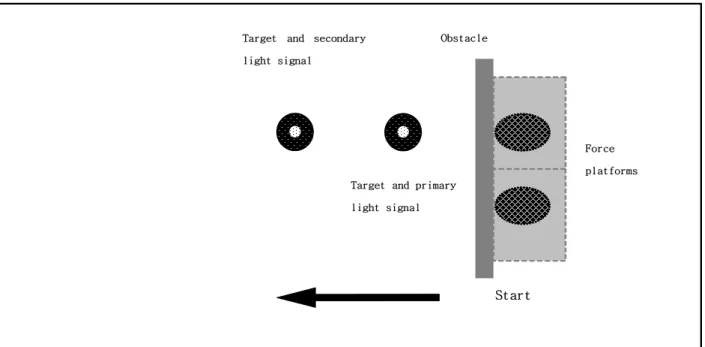
Force platforms
Start Target and primary
light signal Target and secondary
light signal
Obstacle
Figure 1. Experimental setup.
Electrical foot switches2) were placed in the shoes to measure heel-strike and toe-off of the swing limb and heel-off of the stance limb. Amplified force plat- form3) signals were sampled on-line at a rate of 1000
㎐ for 2 seconds.
Procedures3)4)
The experimental setup is shown in Figure 1. For each trial subjects stood in a predetermined position with each foot on a force platform. Subjects were asked to step over a 10 ㎝ high obstacle at self-paced speed to a visual cue. Prior to experimental trials the average position of the swing heel-strike was de- termined for each subject through videotape analysis.
For all experimental trials two targets (10 ㎝ in di- ameter) were placed on the ground to dictate the po- sition and accuracy of swing limb heel-strike. A small red light emitting diodes was set in the center of each target. These lights dictated when and where to step. The position of the secondary target was de- termined through the coordinate system. If, for exam- ple, the initial position for each subject is coordinate
(0, 0) and the step length is 'radius', the position for long step length condition is coordinate (0, 2 × radi- us). Subjects were asked to begin walking with the right limb landing on the primary target. When the light of the primary target came on, the subject step- ped over the obstacle with the right limb. However, if the light of the secondary target came on after the light of the primary target, the subject must then step towards the secondary target.
It was planned that the onset of the light would be prior to peak Fx of swing limb, between swing peak Fx and swing toe-off, and after swing toe-off.
In the younger adults these secondary visual cues were provided at mean times of 240 ㎳ (SD=11), 402
㎳ (SD=13), and 476 ㎳ (SD=88) for the long step- ping following the movement onset.
Corresponding mean times for the healthy elderly were 150 ㎳ (SD=67), 352 ㎳ (SD=39), and 562 ㎳ (SD=115). The timing of these cues was presented in random order. That is, subjects were unaware when and where to step. Subjects completed practice trials and five successful experimental trials in each of the
2) B & L Engineering, Los Angeles, CA, U.S.A.
3) BIOPAC Systems, Goleta, CA, U.S.A.
Dependent variables Stepping Long stepping
No visual cue Early visual cue Mid visual cue Late visual cue Swing peak Fx
Young adults 36.6±2.6a 32.1±1.4 33.1±1.6 35.5±6.5
Older adults 29.7±1.4 30.0±5.7 25.5±7.6 23.6±3.3
Slope to swing peak Fx
Young adults 125.2±1.4 124.1±1.3 120.2±1.2 124.4±5.6
Older adults 125.1±27.1 124.2±16.4 89.1±7.7 99.3±16.2
Time to swing peak Fx
Young adults 328.0±57.6 310.1±20.5 347.2±28.7 278.4±37.6
Older adults 240.1±28.3 263.2±5.8 252.3±54.2 228.1±30.2
Stance peak Fx1
Young adults 43.2±9.8 50.2±16.5 43.3±14.3 43.2±12.6
Older adults 34.2±19.5 44.7±10.7 25.7±1.2 24.4±11.5
Time to swing toe-off
Young adults 427.4±37.4 413.0±13.3 456.2±2.8 397.5±45.5
Young adults 422.5±75.5 342.1±99.6 438.1±41.2 454.6±68.3
aMean±SD.
Table 2. The peak (%BW) and slope (%BW/S) for force plate and temporal events (㎳) following conditions: 1) normal stepping initiated by
the primary light signal 2) step forwards upon the redirection of the secondary light signal. Some trials in which the subject missed the target were repeated.
Data Analysis
The independent variables were subject group (young adults and healthy elderly) and timing of visual cue (prior to swing peak Fx (early), between peak Fx and toe-off (mid), and after toe-off (late)). Force plat- form measures include timing, slope and amplitude measures of anterior posterior (Fx) ground reaction forces under the stance and swing limbs. Time to swing limb toe-off, swing time, and stance time were also analyzed. Timing data were referenced from the first detectable onset of force platform activity. Means and SDs were used to compare the different conditions.
Results
Mean data for the ground reaction forces is shown in Table 2 and 3. Dependent variables that occurred
prior to toe-off such as swing peak Fx, time to swing peak Fx, slope to swing peak Fx, and time to swing toe-off did not show clear changes between conditions.
However, there were group differences in the swing peak Fx. Clear changes in both group and visual cue condition were also noted for stance Fx following toe-off. Comparisons of the changes in the ground re- action force in response to three different timings of the visual cues and group difference were made.
Effect of Group and Visual Cue on the Trials Where the Target Was Missed
There was no clear group differences in the num- ber of trials missed for step length change except for mid and late visual cue conditions. Compared to the early and mid visual cues, the number of trials missed in the late visual increased (Figure 2).
Effect of Group and Visual Cue on the Intended Velocity of Stepping
As summarized in Table 2, there were no clear group differences in the variables that are related to the intended velocity of stepping except for swing
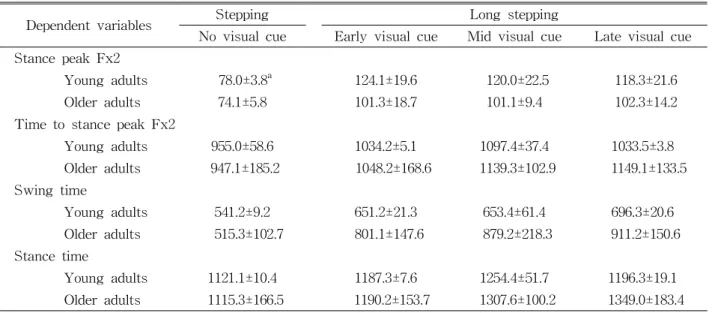
Dependent variables Stepping Long stepping
No visual cue Early visual cue Mid visual cue Late visual cue Stance peak Fx2
Young adults 78.0±3.8a 124.1±19.6 120.0±22.5 118.3±21.6
Older adults 74.1±5.8 101.3±18.7 101.1±9.4 102.3±14.2
Time to stance peak Fx2
Young adults 955.0±58.6 1034.2±5.1 1097.4±37.4 1033.5±3.8
Older adults 947.1±185.2 1048.2±168.6 1139.3±102.9 1149.1±133.5 Swing time
Young adults 541.2±9.2 651.2±21.3 653.4±61.4 696.3±20.6
Older adults 515.3±102.7 801.1±147.6 879.2±218.3 911.2±150.6
Stance time
Young adults 1121.1±10.4 1187.3±7.6 1254.4±51.7 1196.3±19.1
Older adults 1115.3±166.5 1190.2±153.7 1307.6±100.2 1349.0±183.4
aMean±SD.
Table 3. The peak (%BW) for force plate and temporal events (㎳)
peak Fx. Swing peak Fx was much greater in the young adults compared to the older adults. In con- trast, the swing limb peak Fx, time to the swing limb peak Fx, swing toe-off, and the slope to swing limb peak Fx were similar among all the conditions.
However, stance peak Fx1 was greater for the young adults. In addition, stance peak Fx1 was greater for the early visual cue compared to normal stepping, mid and late visual cue. The overall mean for early visual cue for stance peak Fx1 was 11.8
%BW greater than the overall mean for normal stepping, mid and late visual cue.
Comparisons of the Changes in Anterior-Posterior (Fx2) Ground Reaction Force Responses of the Stance Limb
Coincident with the swing heel strike was a sec- ond peak acceleration ground reaction force (Fx2) of the stance limb. Stance peak Fx2 was much greater in the visual cue than normal stepping in both young and older adults. In addition, stance peak Fx2 was not different between the visual cue conditions in both the young and the elderly. Similarly, the time to stance peak Fx2 was much longer for the visual cue conditions than for the normal stepping. It was not
much different between the visual cue conditions in the young adults, but in the elderly mid and late cue was much greater than early cue.
Swing time was similar between the groups for the normal stepping, but there were big differences between the groups for visual cue conditions. Swing time in the elderly was 196.9 ㎳ longer than in the young for visual cue conditions. As expected swing time for visual cue conditions was 237.2 ㎳ longer than the normal stepping.
Stance time for both groups was similar in normal stepping and early visual cue, but in mid and late visual cue conditions the elderly was much greater than the young. In addition, stance time for visual cue conditions was 128.7 ㎳ longer compared to the normal stepping. Table 3 shows means for peak force plate and temporal events.
Discussion
The primary goal of this experiment was to de- termine how both elderly and young subjects changed step distance while stepping over an obstacle. The unexpected onset of a light cued the
Figure 2. Mean number of trials missed on the target in both younger and older adults for long stepping.
subjects to modify their stepping characteristics.
Stepping errors were greater for the elderly. In long stepping the propulsive force required to increase step length (Fx2) was considerably less for the eld- erly, especially for the early, mid and late visual cue.
Consequently, swing and stance time greatly in- creased for the elderly subjects. Elderly subjects, therefore, could successfully increase step length, but compared to young subjects, with less acceleration force and over a longer period of time.
Previous studies (Breniere and Do, 1986; Breniere et al, 1987) have shown that the acceleration forces (Fx) of the swing limb determine the intended velocity of the gait initiation. This acceleration force increases with faster speed or decreases when subjects are con- strained by the accuracy of the swing limb heel-strike (Breniere et al, 1987; Brunt et al, 1999). Moreover, in healthy young adults slope to swing peak Fx remains constant regardless of task conditions, i.e., gait ini- tiation versus stepping over an obstacle. These results suggest that in both tasks subjects equally modulate the acceleration force of the swing limb to determine the intended velocity for each task.
In the present study, those variables that dictate the intended velocity of initiation did not change be- tween normal stepping and those trials when the vis- ual cue required change in step length. This is im- portant as it illuminates initiation velocity as a possi- ble strategy to ensure successful experimental trials.
However, swing limb acceleration force prior to toe-off was always less for the elderly group.
Although the slope to swing limb peak Fx was sim- ilar between two groups for normal and early visual cue condition, the older adults showed 27.8% BW/s less slope to swing peak Fx for mid and late visual cue conditions. These differences of the ground re- action forces of swing limb between the young and older adults indicated that the older adults were not able to produce sufficient ankle torque to generate acceleration forces equal to those of the young adults.
The acceleration force of stance Fx1 is related to the rate of swing limb toe-off. In the present study stance limb peak Fx1 was greatly less in the older adults compared to the young adults. This decrease in the peak stance peak Fx1 paralleled an increase in the time to swing limb toe-off and therefore an in- crease in time preparation for stepping and toe-clearance. However, clear difference in the swing limb toe-off between two groups was not found in the present study.
After swing toe-off the center of mass of the body moves forwards and in the late swing phase it passes beyond the stance limb. During this period, there is a greater threat to the equilibrium of the system. Step length lengthening is mainly achieved by applying a larger acceleration force. The increase in push-off during late stance facilitates hip flexion.
Step length is also regulated by controlling the knee
extension during foot placement phase. Swing limb heel-strike coincides with stance Fx2. In the present study, stance Fx2 was much lower for the older adults than that of the young adults. In addition, time to stance peak Fx2 and swing and stance time for the visual cue conditions were much longer in the older adults compared to the young adults.
Previous study (Brunt et al, 1999) has shown that stance peak Fx2 is related to the walking speed.
Thus, for fast speed stance peak Fx2 increase and time to stance peak Fx2 is reduced.
Conclusion
These results suggest that unlike young adults, elderly adults did not flexibly modify their re- sponses to unexpected changes in step length while stepping over obstacles. Furthermore, these dimin- ished abilities may partially account for high rates of falls in the elderly. Although the current study addressed stepping behavior in both younger and healthy older adults, it did not include all the ques- tions that could have been asked. Future inves- tigations will be to clarify some of the issues that current study left unresolved.
References
Aniansson A, Sperling L, Rundgren A, et al. Muscle function in 75-year-old men and women. A lon- gitudinal study. Scand J Rehabil Med Supp.
1983;9:92-102.
Begg RK, Sparrow WA, Lythgo ND. Time-domain analysis of foot-ground reaction forces in nego- tiating obstacles. Gait Posture. 1998;7(2):99-109.
Begg RK, Sparrow WA. Gait characteristics of young and older individuals negotiating a raised surface:
Implications for the prevention of falls. J Gerontol A Bio Sci Med Sci. 2000;55(3):M147-M154.
Berg KO, Maki BE, Williams JI, et al. Clinical and
laboratory measures of postural balance in an elderly population. Arch Phys Med Rehabil.
1992;73(11):1073-1080.
Berg KO, Wood-Dauphinee S, Williams JI, et al.
Measuring balance in the elderly: Preliminary development of an instrument. Physiotherapy Canada. 1989;41:304-311.
Breniere Y, Do MC. When and how does steady state gait movement induced from upright pos- ture begin? J Biomech. 1986;19(12):1035-1040.
Breniere Y, Do MC, Bouisset S. Are dynamic phe- nomena prior to stepping essential to walking? J Mot Behav. 1987;19:62-76.
Brunt D, Liu SM, Trimble M, et al. Principles under- lying the organization of movement initiation from quiet stance. Gait Posture. 1999;10(2):121-128.
Chen HC, Ashton-Miller JA, Alexander NB, et al.
Stepping over obstacles: Gait patterns of healthy young and older adults. J Gerontol.
1991;46(6):M196-M203.
Chen HC, Ashton-Miller JA, Alexander NB, et al.
Effects of age and available response time on ability to step over an obstacle. J Gerontol.
1994;49(5):M227-M233.
Chou LS, Draganich LF. Stepping over an obstacle increases the motions and moments of the joints of the trailing limb in young adults. J Biomech.
1997;30(4):331-337.
Chou LS, Draganish LF. Placing the trailing foot closer to an obstacle reduces flexion of the hip, knee, and ankle to increase the risk of tripping.
J Biomech. 1998;31(8):685-691.
Chou LS, Kaufman, KR, Hahn ME, et al. Medio-lat- eral motion of the center of mass during ob- stacle crossing distinguishes elderly individuals with imbalance. Gait Posture. 2003;18(3):125-133.
Cumming RG, Klineberg RJ. Fall frequency and characteristics and the risk of hip fractures. J Am Geriatr Soc. 1994;42(7):774-778.
Fugl-Meyer AR, Gustafsson L, Burstedt Y. Isokinetic and static plantar flexion characteristics. Eur J Appl Physiol Occup Physiol. 1980;45(2-3):221-234.
This article was received April 8, 2007, and was accepted June 21, 2007.
Gallo JJ, Fulmer T, Paveza GJ, et al. Handbook of Geriatric Assessment. 3rd ed. Maryland, Gaithersburg, Aspen publication, 2003.
Gottsdanker R. Age and simple reaction time. J Gerontol. 1982;37(3):342-348.
Hayes WC, Myers ER, Morris JN, et al. Impact near the hip dominates fracture risk in elderly nurs- ing home residents who fall. Calcif Tissue Int.
1993;52(3):192-198.
Horak FB, Esselman P, Anderson ME, et al. The ef- fects of movement velocity, mass displaced, and task certainty on associated postural adjust- ments made by normal and hemiplegic individuals. J Neurol Neurosurg Psychiatry.
1984;47(9):1020-1028.
Hurley MV, Rees J, Newham DJ. Quadriceps func- tion, proprioceptive acuity and functional per- formance in healthy young, middle-aged and elderly subjects. Age Ageing. 1998;27(1):55-62.
Inglin B, Woollacott M. Age-related changes in antici- patory postural adjustments associated with arm movements. J Gerontol. 1988;43(4):M105-M113.
McFadyen BJ, Bouyer L, Bent LR, et al. Visual-ves- tibular influences on locomotor adjustments for stepping over an obstacle. Exp Brain Res.
2007;179(2):235-243.
McGibbon CA, Krebs DE, Wagenaar R. Stepping stability: Effects of sensory perturbation. J Neuroengineering Rehabil. 2005;2:9.
Patla AE, Prentice SD, Robinson C, et al. Visual con- trol of locomotion: Strategies for changing direc- tion and for going over obstacles. J Exp Psychol Hum Percept Perform. 1991;17(3):603-634.
Patla AE, Rietdyk S. Visual control of limb tra- jectory over the obstacles during locomotion:
Effect of obstacle height and width. Gait Posture. 1993;1:45-60.
Patla AE, Rietdyk S, Martin C, et al. Locomotor pat- terns of the leading and the trailing limbs as solid and fragile obstacles are stepped over:
Some insights into the role of vision during locomotion. J Motor Behav. 1996;28(1):35-47.
Robinovitch SN, Hayes WC, McMahon TA.
Prediction of femoral impact forces in falls on the hip. J Biomech Eng. 1991;113(4):366-374.
Rogers MW, Kukulka CG, Soderberg GL. Age-re- lated changes in postural responses preceding rapid self-paced and reaction time arm movements. J Gerontol. 1992;47(5):M159-M165.
Schuling J, de Haan R, Limburg M, et al. The Frenchay Activities Index. Assessment of func- tional status in stroke patients. Stroke.
1993;24(8):1173-1177.
Spirduso WW. Physical fitness, aging and psychomotor speed: A review. J Gerontol. 1980;35(6):850-865.
Stelmach GE, Zelaznik HN, Low D. The influence of aging and attentional demands on recovery from postural instability. Aging (Milano).
1990;2(2):155-161.
Thelen DG, Schultz AB, Alexander NB, et al. Effects of age on rapid ankle torque development. J
Gerontol A Bio Sci Med Sci.
1996;51(5):M226-M232.
Whipple RH, Wolfson LI, Amerman PM. The rela- tionship of knee and ankle weakness to falls in nursing home residents: An isokinetic study. J Am Geriatr Soc. 1987;35(1):13-20.
Wolfson L, Judge J, Whipple R, et al. Strength is a major factor in balance, gait, and the occurrence of fa11s. J Gerontol A Biol Sci Med Sci.
1995;50:64-67.
Woollacott MH, Shumway-Cook A, Nashner LM.
Aging and posture control: Changes in sensory organization and muscular coordination. Int J Aging Hum Dev. 1986;23(2):97-114.