JCS
Journal of Chest SurgeryClinical Research A Risk Prediction Model for Operative Mortality after Heart
Valve Surgery in a Korean Cohort
Ho Jin Kim, M.D.1, Joon Bum Kim, M.D., Ph.D.1, Seon-Ok Kim, M.Sc.2, Sung-Cheol Yun, Ph.D.2, Sak Lee, M.D., Ph.D.3, Cheong Lim, M.D., Ph.D.4, Jae Woong Choi, M.D.5, Ho Young Hwang, M.D., Ph.D.5, Kyung Hwan Kim, M.D.5, Seung Hyun Lee, M.D., Ph.D.3, Jae Suk Yoo, M.D., Ph.D.6, Kiick Sung, M.D., Ph.D.7, Hyung Gon Je, M.D., Ph.D.8, Soon Chang Hong, M.D., Ph.D.9, Yun Jung Kim, R.N., Ph.D.10, Sung-Hyun Kim, M.S.10, Byung-Chul Chang, M.D, Ph.D., F.A.H.A.11
Departments of 1Thoracic and Cardiovascular Surgery and 2Clinical Epidemiology and Biostatistics, Asan Medical Center, University of Ulsan College of Medicine; 3Department of Thoracic and Cardiovascular Surgery, Severance Hospital, Yonsei University College of Medicine, Seoul; 4Department of Thoracic and Cardiovascular Surgery, Seoul National University Bundang Hospital, Seoul National University College of Medicine, Seongnam; 5Department of Thoracic and Cardiovascular Surgery, Seoul National University Hospital, Seoul National University College of Medicine, Seoul; 6Department of Cardiovascular Surgery, Sejong General Hospital, Bucheon; 7Department of Thoracic and Cardiovascular Surgery, Samsung Medical Center, Sungkyunkwan University School of Medicine, Seoul; 8Department of Thoracic and Cardiovascular Surgery, Pusan National University Yangsan Hospital, Yangsan; 9Department of Thoracic and Cardiovascular Surgery, Wonju Severance Christian Hospital, Wonju; 10National Evidence-based Healthcare Collaborating Agency, Seoul; 11Department of Thoracic and Cardiovascular Surgery, CHA Bundang Medical Center, CHA University School of Medicine, Seongnam, Korea
ARTICLE INFO Received July 28, 2020 Revised September 7, 2020 Accepted September 9, 2020 Corresponding author Byung-Chul Chang Tel 82-31-780-5850 Fax 82-31-780-5857 E-mail [email protected] ORCID
https://orcid.org/0000-0001-5005-8217
Background: This study aimed to develop a new risk prediction model for operative mortality in a Korean cohort undergoing heart valve surgery using the Korea Heart Valve Surgery Registry (KHVSR) database.
Methods: We analyzed data from 4,742 patients registered in the KHVSR who under- went heart valve surgery at 9 institutions between 2017 and 2018. A risk prediction model was developed for operative mortality, defined as death within 30 days after surgery or during the same hospitalization. A statistical model was generated with a scoring system by multiple logistic regression analyses. The performance of the model was evaluated by its discrimination and calibration abilities.
Results: Operative mortality occurred in 142 patients. The final regression models identi- fied 13 risk variables. The risk prediction model showed good discrimination, with a c-sta- tistic of 0.805 and calibration with Hosmer-Lemeshow goodness-of-fit p-value of 0.630.
The risk scores ranged from -1 to 15, and were associated with an increase in predicted mortality. The predicted mortality across the risk scores ranged from 0.3% to 80.6%.
Conclusion: This risk prediction model using a scoring system specific to heart valve surgery was developed from the KHVSR database. The risk prediction model showed that operative mortality could be predicted well in a Korean cohort.
Keywords: Risk prediction model, Mortality, Heart valve surgery
Copyright©The Korean Society for Thoracic and Cardiovascular Surgery. 2021. All right reserved.
This is an Open Access article distributed under the terms of the Creative Commons Attribution Non-Commercial License (http://creativecommons.org/licenses/
Introduction
Cardiovascular disease is the second most common cause of death in Korea [1], and valvular heart disease has been reported to affect approximately 9% of the Korean population [2]. Despite the recent rapid adoption of alter- nate transcatheter valve therapy [3,4], the number of heart valve operations has gradually increased owing to the growth of the aging population [5]. Approximately 14,000
cardiac surgical procedures are performed annually, and heart valve surgery has outpaced coronary artery bypass grafting (CABG) to become the most common cardiac procedure performed in Korea [6].
Risk assessment is an essential part of preoperative plan- ning, both for cardiac surgeons and for patients and their families, and may contribute to the improved safety and quality of cardiac surgery. As such, 2 risk prediction mod- els have been developed in the United States and Europe
https://doi.org/10.5090/jcs.20.102 pISSN: 2765-1606 eISSN: 2765-1614 J Chest Surg. 2021;54(2):88-98
Ho Jin Kim, et al. A Risk Model for Heart Valve Surgery
JCS
based on the nationwide or international cardiac surgery databases [7,8]. Although these risk prediction models have been widely adopted among global cardiac surgery com- munities, it has been suggested that a nation-specific risk prediction model that is developed based on a unique na- tional database may predict the risk of surgery more ade- quately than the US or European models [9,10].
The Korea Heart Valve Surgery Registry (KHVSR) was established as an official heart valve surgery database ini- tiative of the Korean Society of Thoracic and Cardiovascu- lar Surgery in 2017. Using this database, we developed the first risk prediction model for operative mortality in pa- tients who undergo heart valve surgery in Korea.
Methods
Study cohort
The clinical and operative data of patients who under- went heart valve surgery at the 13 participating institutions in Korea have been prospectively registered in the KHVSR since January 2017. From the KHVSR database, we identi- fied patients who received valve replacement/repair surgery with or without concomitant procedures between January 1, 2017 and December 31, 2018 from 9 of the 13 institutions that agreed to provide institutional data to develop the risk prediction model. This study was approved by the Institu- tional Review Board and Ethics Committee of each partic- ipating institution and the National Evidence-based Healthcare Collaborating Agency (IRB approval no., 19- 018-01). Informed consent was obtained from the patients who agreed to provide their clinical data to be registered in the KHVSR database.
Data collection
The KHVSR database contains information on each pa- tient’s preoperative risk profiles, laboratory and echocar- diographic data, intraoperative details, and postoperative mortality and complications. Data were prospectively col- lected by a data manager or an operating surgeon at each participating institution using a dedicated electronic case report form (available online at http://heartvalve.or.kr). All patients who underwent heart valve surgery between Janu- ary 1, 2017 and December 31, 2018 at the 9 institutions were registered in the KHVSR.
After the collection of data, all data were verified and queried for missing values or outliers by the first author (H.J.K.). The authors at each participating institution were
responsible for the completion of data collection: data were validated by the authors at each institution, and an exter- nal audit was also performed on-site to evaluate the consis- tency and accuracy of the data.
Statistical analyses
SAS software ver. 9.4 (SAS Institute Inc., Cary, NC, USA) and R software ver. 3.6.1 (R Foundation for Statistical Computing, Vienna, Austria; http://www.r-project.org/) were used for the statistical analyses. Categorical variables were presented as means±standard deviations, and contin- uous variables were presented as frequencies or propor- tions with percentages. Missing values were handled using the Markov chain Monte Carlo single-imputation method.
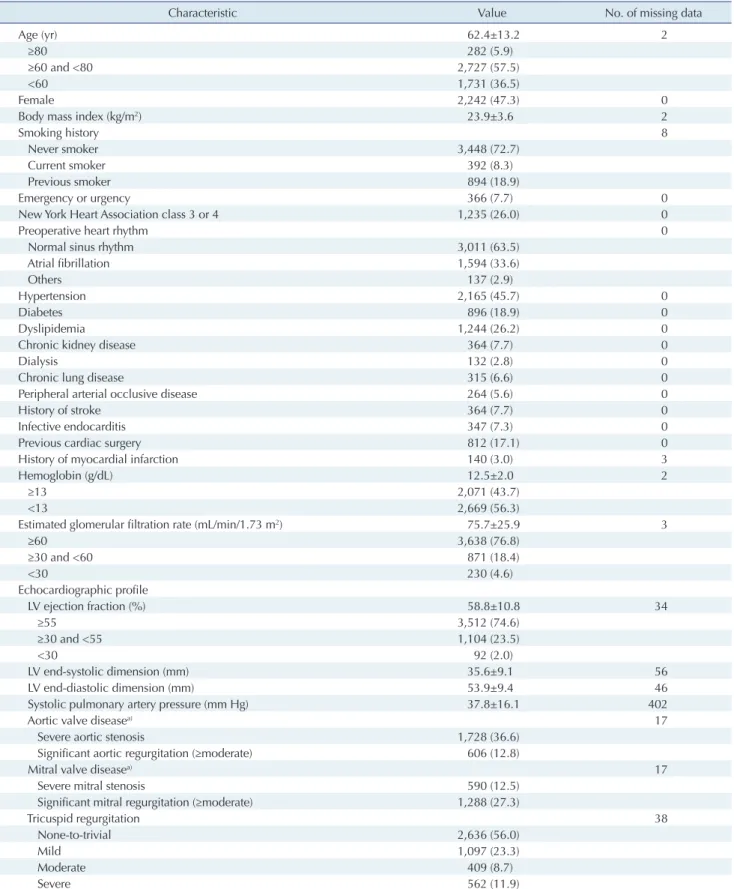
The primary endpoint for the risk prediction model was operative mortality that occurred within 30 days of surgery or during the same hospitalization period. To estimate the significant risk factors for operative mortality, multivari- able logistic regression analyses were performed. Of all data fields registered in the KHVSR, the authors a priori reviewed and selected 25 potentially relevant risk variables listed in Table 1. The number of operated valves (Table 2) and concomitant procedures (Table 3) were also primarily fitted in the univariable models.
The multivariable models were validated with a boot- strap method that generated 1,000 random samples (n=4,742) with replacement. A stepwise backward elimina- tion process was performed in every bootstrap sample to evaluate the reliability of risk variables to be retained in the final risk prediction models, and risk variables selected
≥400 times in the 1,000 bootstrap models were then re- tained in the final risk prediction model [11]. Although the extent of the procedure, which was quantified as the num- ber of operated valves (Table 2), was not retained in the fi- nal model, we assumed that the extent of the procedure may have significant clinical implications. Accordingly, we developed 2 risk prediction models depending on the fit- ting of the extent of the procedure. All reported p-values were 2-tailed, and p-values <0.05 were considered to indi- cate statistical significance.
The risk prediction models were developed using a scor- ing system based on penalized maximum likelihood esti- mates of each risk variable. The multivariable logistic re- gression β coefficient of each risk variable was transformed into an integer risk score by rounding the quotient of the β coefficient divided by a single constant. The constant was the β coefficient for a 20-year increment in age, thereby al- lowing the risk score for a 20-year increment in age to be 1
https://doi.org/10.5090/jcs.20.102
JCS
Table 1. Baseline characteristics of the study population
Characteristic Value No. of missing data
Age (yr) 62.4±13.2 2
≥80 282 (5.9)
≥60 and <80 2,727 (57.5)
<60 1,731 (36.5)
Female 2,242 (47.3) 0
Body mass index (kg/m2) 23.9±3.6 2
Smoking history 8
Never smoker 3,448 (72.7)
Current smoker 392 (8.3)
Previous smoker 894 (18.9)
Emergency or urgency 366 (7.7) 0
New York Heart Association class 3 or 4 1,235 (26.0) 0
Preoperative heart rhythm 0
Normal sinus rhythm 3,011 (63.5)
Atrial fibrillation 1,594 (33.6)
Others 137 (2.9)
Hypertension 2,165 (45.7) 0
Diabetes 896 (18.9) 0
Dyslipidemia 1,244 (26.2) 0
Chronic kidney disease 364 (7.7) 0
Dialysis 132 (2.8) 0
Chronic lung disease 315 (6.6) 0
Peripheral arterial occlusive disease 264 (5.6) 0
History of stroke 364 (7.7) 0
Infective endocarditis 347 (7.3) 0
Previous cardiac surgery 812 (17.1) 0
History of myocardial infarction 140 (3.0) 3
Hemoglobin (g/dL) 12.5±2.0 2
≥13 2,071 (43.7)
<13 2,669 (56.3)
Estimated glomerular filtration rate (mL/min/1.73 m2) 75.7±25.9 3
≥60 3,638 (76.8)
≥30 and <60 871 (18.4)
<30 230 (4.6)
Echocardiographic profile
LV ejection fraction (%) 58.8±10.8 34
≥55 3,512 (74.6)
≥30 and <55 1,104 (23.5)
<30 92 (2.0)
LV endsystolic dimension (mm) 35.6±9.1 56
LV enddiastolic dimension (mm) 53.9±9.4 46
Systolic pulmonary artery pressure (mm Hg) 37.8±16.1 402
Aortic valve diseasea) 17
Severe aortic stenosis 1,728 (36.6)
Significant aortic regurgitation (≥moderate) 606 (12.8)
Mitral valve diseasea) 17
Severe mitral stenosis 590 (12.5)
Significant mitral regurgitation (≥moderate) 1,288 (27.3)
Tricuspid regurgitation 38
Nonetotrivial 2,636 (56.0)
Mild 1,097 (23.3)
Moderate 409 (8.7)
Severe 562 (11.9)
Values are presented as mean±standard deviation or number (%), unless otherwise stated.
LV, left ventricular.
a)Included only the patients with native valve disease and excluded the patients with valve disease from infectious etiology.
Ho Jin Kim, et al. A Risk Model for Heart Valve Surgery
JCS
point. Therefore, the total risk score for each patient was calculated as the sum of the risk score for the selected vari- ables.
The discrimination and calibration abilities of the risk prediction models were assessed with the c-statistic and Hosmer-Lemeshow goodness-of-fit test. For internal vali- dation, 1,000 random bootstrap samples with replacement (n=4,742) were drawn to obtain an optimism-corrected c-statistic [12]. Additionally, the performance of the risk prediction models was also validated on external cohorts composed of patients who underwent surgery between Jan- uary 2019 and June 2019 and were then registered in the KHVSR until November 30, 2019. In the development and validation set, calibration was also assessed by plotting ac- tual versus predicted mortality rates across deciles of pre- dicted risk [13].
Results
Baseline characteristics and operative profiles
A total of 4,766 patients who underwent heart valve sur- gery at the 9 participating institutions were registered in the KHVSR during the study period. Of them, 24 patients who underwent cardiac surgery other than valve replace- ment/repair surgery were excluded. Consequently, 4,742 patients were enrolled in this study.
Table 1 summarizes the baseline characteristics of the study cohort. The mean age of the patients was 62.4±13.2 years, and 2,242 (47.3%) were women. Non-elective surgery accounted for 7.7% of the patients (n=366), and 812 pa- tients (17.1%) had a history of previous cardiac surgery.
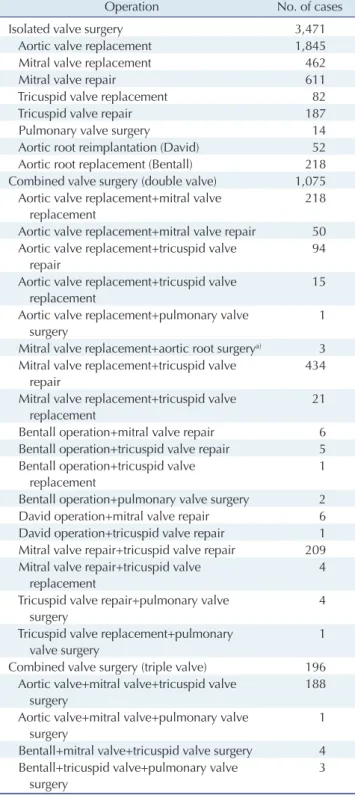
Isolated valve surgery was performed in 3,471 patients (73.2%), whereas the remaining 1,271 (26.8%) underwent combined valve surgery (Table 2, Supplementary Fig. 1).
Concomitant procedures were performed in 1,789 patients (37.7%), and 160 (3.4%) received ≥2 types of concomitant procedures (Table 3). Atrial fibrillation (AF) surgery was most frequently performed concomitantly in these patients (n=976, 20.6%), followed by aorta replacement (n=493, 10.4%) and CABG (n=346, 7.3%).
Table 2. Operative profiles and sample sizes
Operation No. of cases
Isolated valve surgery 3,471
Aortic valve replacement 1,845
Mitral valve replacement 462
Mitral valve repair 611
Tricuspid valve replacement 82
Tricuspid valve repair 187
Pulmonary valve surgery 14
Aortic root reimplantation (David) 52 Aortic root replacement (Bentall) 218 Combined valve surgery (double valve) 1,075 Aortic valve replacement+mitral valve
replacement
218 Aortic valve replacement+mitral valve repair 50 Aortic valve replacement+tricuspid valve
repair
94 Aortic valve replacement+tricuspid valve
replacement
15 Aortic valve replacement+pulmonary valve
surgery
1 Mitral valve replacement+aortic root surgerya) 3 Mitral valve replacement+tricuspid valve
repair
434 Mitral valve replacement+tricuspid valve
replacement
21 Bentall operation+mitral valve repair 6 Bentall operation+tricuspid valve repair 5 Bentall operation+tricuspid valve
replacement
1 Bentall operation+pulmonary valve surgery 2 David operation+mitral valve repair 6 David operation+tricuspid valve repair 1 Mitral valve repair+tricuspid valve repair 209 Mitral valve repair+tricuspid valve
replacement
4 Tricuspid valve repair+pulmonary valve
surgery
4 Tricuspid valve replacement+pulmonary
valve surgery
1 Combined valve surgery (triple valve) 196 Aortic valve+mitral valve+tricuspid valve
surgery
188 Aortic valve+mitral valve+pulmonary valve
surgery
1 Bentall+mitral valve+tricuspid valve surgery 4 Bentall+tricuspid valve+pulmonary valve
surgery
3
a)Included both aortic root reimplantation (David operation) and aortic root replacement (Bentall operation).
Table 3. Concomitant procedures
Concomitant procedures No. of cases (%) Coronary artery bypass grafting 346 (7.3)
Atrial fibrillation surgery 976 (20.6)
Aorta replacement 493 (10.4)
Cardiac tumor resection 6 (0.1)
Congenital correction (atrial septal defect, ventricular septal defect)
126 (2.7)
https://doi.org/10.5090/jcs.20.102
JCS
Operative outcomes
Operative mortality occurred in 142 patients (3.0%). Of these, 87 and 55 patients underwent isolated and combined valve surgery, respectively (Supplementary Table 1). The operative mortality rate according to the number of oper- ated valves was 2.5% for an isolated valve, 4.1% for a double valve, and 5.6% for a triple valve. Among patients who un- derwent concomitant CABG (n=346) and AF surgery (n=976), operative mortality occurred in 24 patients (6.9%) and 26 patients (2.7%), respectively (Supplementary Table 2).
Development of risk prediction models for operative mortality
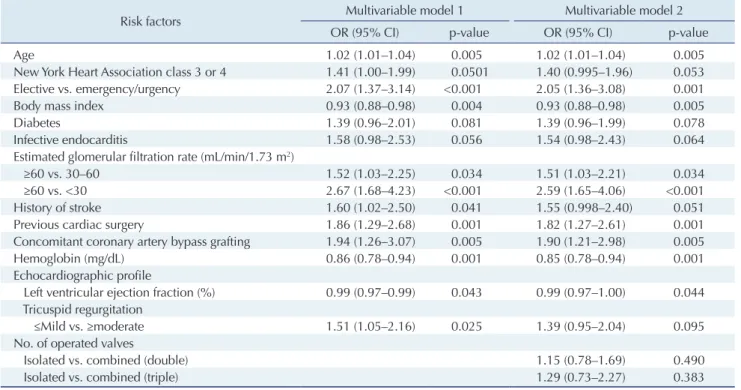
Twenty risk variables were identified as candidate vari- ables in the univariable logistic regression analyses (Sup- plementary Table 3). In the 1,000 bootstrap random sam- ples, 13 risk variables emerged as significant predictors for operative mortality with a frequency of ≥400 in the multi- variable analyses (model 1 in Table 4): age, New York Heart Association class 3 or 4, elective versus non-elective sur- gery, body mass index (BMI), diabetes, infective endocar- ditis, estimated glomerular filtration rate (eGFR), history
of stroke, previous cardiac surgery, anemia (hemoglobin
<13 g/dL) [14], concomitant CABG, left ventricular (LV) dysfunction (LV ejection fraction), and significant tricus- pid regurgitation. In model 2, the number of operated valves was also incorporated as a risk variable (Table 4).
Regarding statistical performance, models 1 and 2 achieved adequate discrimination, with c-statistics of 0.805 and 0.804, respectively; calibration ability was also acceptable, with Hosmer-Lemeshow p-values of 0.630 and 0.494, re- spectively.
Continuous variables were categorized into risk groups based on clinical implications or with reference to previous studies [7,14-16]. The β coefficient for a 20-year increment in age was 0.446 in model 1 and 0.440 in model 2. The β coefficients of risk variables in each risk prediction model were converted to risk scores (Table 5). Of note, BMI values
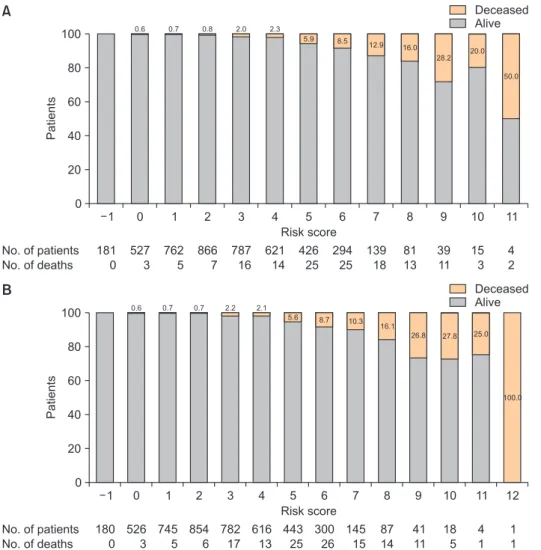
≥25 kg/m2 were found to have a negative predictive value for operative mortality in model 1 (β coefficient=-0.375) and model 2 (β coefficient=-0.360). Thus, the sum of the risk scores ranged from -1 to 15 in model 1, and from -1 to 16 in model 2. The risk scores of the study cohort ranged from -1 to 11 in model 1, and from -1 to 12 in model 2 (Fig.
1). The incidence of postoperative mortality tended to be higher in patients with higher risk scores in both model 1 (Fig. 1A) and model 2 (Fig. 1B). The mortality rate was
Table 4. Risk variables for operative mortality in the multivariable logistic regression models
Risk factors Multivariable model 1 Multivariable model 2
OR (95% CI) pvalue OR (95% CI) pvalue
Age 1.02 (1.01–1.04) 0.005 1.02 (1.01–1.04) 0.005
New York Heart Association class 3 or 4 1.41 (1.00–1.99) 0.0501 1.40 (0.995–1.96) 0.053
Elective vs. emergency/urgency 2.07 (1.37–3.14) <0.001 2.05 (1.36–3.08) 0.001
Body mass index 0.93 (0.88–0.98) 0.004 0.93 (0.88–0.98) 0.005
Diabetes 1.39 (0.96–2.01) 0.081 1.39 (0.96–1.99) 0.078
Infective endocarditis 1.58 (0.98–2.53) 0.056 1.54 (0.98–2.43) 0.064
Estimated glomerular filtration rate (mL/min/1.73 m2)
≥60 vs. 30–60 1.52 (1.03–2.25) 0.034 1.51 (1.03–2.21) 0.034
≥60 vs. <30 2.67 (1.68–4.23) <0.001 2.59 (1.65–4.06) <0.001
History of stroke 1.60 (1.02–2.50) 0.041 1.55 (0.998–2.40) 0.051
Previous cardiac surgery 1.86 (1.29–2.68) 0.001 1.82 (1.27–2.61) 0.001
Concomitant coronary artery bypass grafting 1.94 (1.26–3.07) 0.005 1.90 (1.21–2.98) 0.005
Hemoglobin (mg/dL) 0.86 (0.78–0.94) 0.001 0.85 (0.78–0.94) 0.001
Echocardiographic profile
Left ventricular ejection fraction (%) 0.99 (0.97–0.99) 0.043 0.99 (0.97–1.00) 0.044 Tricuspid regurgitation
≤Mild vs. ≥moderate 1.51 (1.05–2.16) 0.025 1.39 (0.95–2.04) 0.095
No. of operated valves
Isolated vs. combined (double) 1.15 (0.78–1.69) 0.490
Isolated vs. combined (triple) 1.29 (0.73–2.27) 0.383
OR, odds ratio; CI, confidence interval.
Ho Jin Kim, et al. A Risk Model for Heart Valve Surgery
JCS
lower in patients with scores of -1 to 4 (1.2%) than the av- erage rate (3.0%) (Supplementary Table 4). In the subgroup of patients with a risk score ≥5, the mortality rate was found to be significantly increased in patients with a score
≥7.Table 6 demonstrates the predicted probability rates for operative mortality as a function of the risk score. Based on the estimated total risk scores, the predicted risk of mortality ranged from 0.3% to 80.6% in model 1, and from 0.3% to 85.5% in model 2.
Validation of risk prediction models
Internal bootstrapping validation on 1,000 samples demonstrated an optimism-corrected c-statistic of 0.792 (95% confidence interval [CI], 0.755–0.829) in model 1, and 0.789 (95% CI, 0.753–0.826) in model 2, thereby indicating
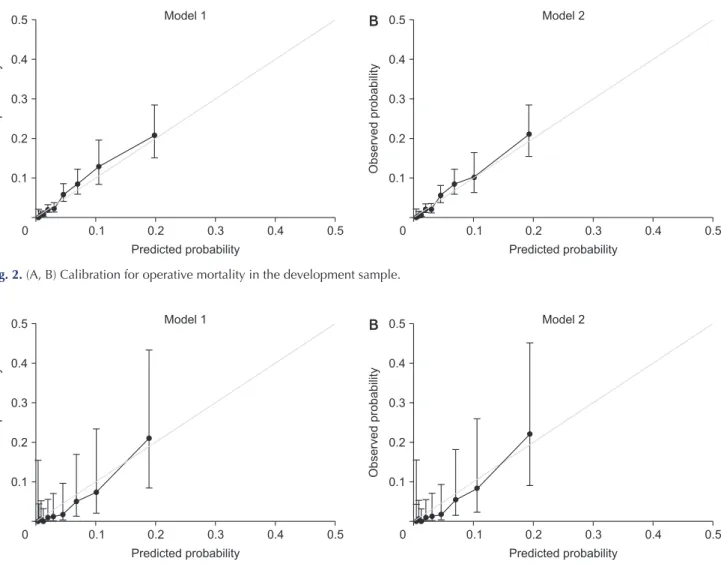
that the performance of the risk prediction model was good. These risk prediction models were also externally validated on 639 patients registered in the KHVSR who underwent surgery from January 2019 to June 2019. The c-statistic was 0.845 (95% CI, 0.719–0.972) for model 1 and 0.842 (95% CI, 0.715–0.969) for model 2. The calibration abilities assessed by the Hosmer-Lemeshow goodness-of-fit test were also acceptable in model 1 (p=0.637) and model 2 (p=0.675). Calibration graphs also demonstrated accept- able calibrations for operative mortality in the development (Fig. 2) and validation sets (Fig. 3).
Discussion
The major findings of this study relate to the develop- ment of risk prediction models for operative mortality fol- lowing heart valve surgery, using a cohort that constituted Table 5. β coefficients and risk scores for operative mortality
Risk factors Model 1 Model 2
β coefficient Risk score β coefficient Risk score Age (yr)
≥60 and <70 0.368 1 0.363 1
≥70 and <80 0.579 1 0.572 1
≥80 0.757 2 0.747 2
New York Heart Association class
Class 1 or 2 vs. 3 or 4 0.344 1 0.334 1
Elective vs. emergency/urgency 0.727 2 0.717 2
Body mass index (kg/m2)
<20 0.319 1 0.306 1
≥25 0.375 1 0.360 1
Diabetes 0.329 1 0.326 1
Infective endocarditis 0.458 1 0.432 1
Estimated glomerular filtration rate (mL/min/1.73 m2)
<30 0.981 2 0.951 2
≥30 and <60 0.422 1 0.413 1
History of stroke 0.468 1 0.437 1
Hemoglobin (mg/dL)
<13 vs. ≥13 0.500 1 0.510 1
Left ventricular ejection fraction (%)
<30 0.574 1 0.569 1
≥30 and <55 0.258 1 0.255 1
Tricuspid regurgitation
≤Mild vs. ≥moderate 0.410 1 0.327 1
Previous cardiac surgery 0.618 1 0.598 1
Concomitant coronary artery bypass grafting 0.663 1 0.640 1
No. of operated valves
Isolated vs. double valve NA NA 0.137 0
Isolated vs. triple valve NA NA 0.252 1
Total score 15 16
NA, not applicable.
https://doi.org/10.5090/jcs.20.102
JCS
a majority of the recent clinical outcomes of patients in Korea. The KHVSR was established in 2017 by the Korean Society of Thoracic and Cardiovascular Surgery as a na- tionwide collaborative effort to improve the quality of heart valve surgery and to enhance research activities. By generating a risk prediction model from the KHVSR data- base, this study presents an up-to-date multi-institutional analysis of operative mortality after heart valve surgery across medium- to high-volume hospitals in Korea. The risk prediction model was generated based on a readily cal- culable scoring system and was shown to perform well in a contemporary heart valve surgery cohort in Korea. This study, to our knowledge, represents the largest and most current analysis of nationwide operative outcomes, partic- ularly dedicated to the wide spectrum of heart valve sur- gery with or without concomitant procedures. Therefore, we speculated that these risk prediction models may sup- port cardiac surgeons and healthcare providers in obtain- ing more accurate assessments of operative mortality, as
well as in counseling patients and families who are consid- ering heart valve surgery in Korea.
The US- and Europe-derived risk prediction models have been most commonly used to assess the risk of cardiac sur- gery in Korea [7,8]. However, the performance of these risk prediction models has been frequently challenged for a specific regional population, subgroups of a particular dis- ease [17], or specific types of cardiac procedure [18,19]. The European System for Cardiac Operative Risk Evaluation (EuroSCORE) II model was generated to assess the mortal- ity risk of all types of cardiac procedures [7]. However, it has been suggested that the EuroSCORE II risk prediction model may not perform well for patients undergoing heart valve surgery with or without combined procedures [20], or those in endemic areas of rheumatic heart disease [21].
The Society of Thoracic Surgeons (STS) risk prediction models are procedure-specific and only evaluate sin- gle-valve surgery, such as aortic/mitral valve replacement or mitral valve repair [8]; therefore, they are not applicable
100 80 60 40 20
1
Patients
Risk score 0
Deceased Alive
No. of patients No. of deaths
0 1 2 3 4 5 6 7 8 9 10 11
181 0
527 3
762 5
866 7
787 16
621 14
426 25
294 25
139 18
81 13
39 11
15 3
4 2
0.6 0.7 0.8 2.0 2.3
5.9 8.5 12.9 16.0
28.2 20.0 50.0
A
B
100 80 60 40 20
1
Patients
Risk score 0
Deceased Alive
No. of patients No. of deaths
0 1 2 3 4 5 6 7 8 9 10 11
180 0
526 3
745 5
854 6
782 17
616 13
443 25
300 26
145 15
87 14
41 11
18 5
4 1
0.6 0.7 2.2 2.1
5.6 8.7 10.3
16.1
26.8 27.8
100.0
1 1 12
0.7
25.0
Fig. 1. Risk scores and the rate of operative mortality in model 1 (A) and model 2 (B) after heart valve surgery.
Ho Jin Kim, et al. A Risk Model for Heart Valve Surgery
JCS
to the 26.8% of patients who underwent multi-valve sur- gery (n=1,271) in our cohort.
Compared to other developed countries, Korea has unique demographic features: specifically, the aging popu- lation is growing faster than that in any other region in the world [5,22], and there is still a high prevalence of rheu- matic heart disease, which is known to be generally preva- lent in developing countries [23]. Moreover, coronary by- pass surgery is less frequently performed than in other countries, as demonstrated by the reported ratio of percu- taneous coronary interventions to CABG of 19.12 in Korea, compared to the average ratio of 5.92 in the Organization for Economic Cooperation and Development member countries [6,24]. Accordingly, heart valve surgery has be- come the most common cardiac procedure in Korea, and the necessity of developing a risk prediction model specific to Korea following heart valve surgery has been pointed out.
Using the KHVSR database, we identified 13 readily available risk factors for operative mortality that were in- corporated into the risk prediction models. Of these, ad- vanced age (≥80 years), an emergent or urgent operation, and severe renal dysfunction with an eGFR <30 mL/
min/1.73 m2 were found to be most strongly associated with an increased risk of operative mortality, which was scored as 2 points in our risk prediction models. These re-
sults imply that timely surgery may reduce the risk of op- erative mortality before patients become too old or suffer from circulatory collapse due to a delayed surgical referral.
Renal dysfunction was also proven to be related to an in- creased risk of operative mortality after heart valve surgery in our cohort. This may be attributed to the higher preva- lence of comorbidities leading to increased operative com- plications and higher calcific burdens in the valvular leaf- lets and annular structures, making surgical procedures more technically challenging [25]. It is also noteworthy that a consistent trend was found in our study for operative mortality and morbidity to be lower in obese patients after cardiac surgery, which appeared to be paradoxical and was reflected in the risk prediction model (-1 for patients with a BMI ≥25 kg/m2) [15].
In designing the risk prediction model, we initially in- tended to evaluate the procedural burden on the risk of mortality by analyzing the extent of heart valve surgery (isolated versus combined or aortic root procedure) and the performance of concomitant procedures (Table 3). Al- though the mortality risk was numerically higher in pa- tients with combined valve surgery (Supplementary Table 1), the extent of the procedure was not associated with an increased risk of mortality in the final multivariable risk analysis, and model 2 (incorporating the extent of the pro- cedure) did not show better discrimination and calibration abilities than model 1. As for concomitant procedures, the addition of the 2 most common procedures (AF surgery and aorta replacement), did not increase the risk of opera- tive mortality, which is consistent with a recent study [26]
and guidelines [27,28]. However, concomitant CABG was shown to be significantly associated with an increased risk of mortality during heart valve surgery, which agrees with the STS risk prediction models that evaluate combined val- vular and coronary bypass surgery as separate procedural entities [8].
Our risk prediction models are limited by the small number of participating institutions (n=9), which included mainly high- and medium-volume centers. As small-vol- ume centers constitute most of the Korean institutions that perform open heart surgery, whether our risk prediction model can be applied to patients receiving cardiac surgery at such centers warrants further validation. It should also be noted that the number of patients in our study cohort was relatively small (n=4,742) compared to the number of patients enrolled to generate other nation-specific risk pre- diction models [9,10], as well as the US and European models [7,8]. According to annual reports from the Korea Heart Foundation (www.heart.or.kr), the nationwide vol- Table 6. Predicted risk of operative mortality by the risk score in
models 1 and 2
Risk score Predicted risk of operative mortality (%)
Model 1 Model 2
1 0.3 0.3
0 0.5 0.5
1 0.8 0.8
2 1.2 1.2
3 1.9 1.9
4 3.0 2.9
5 4.6 4.4
6 6.9 6.7
7 10.5 10.1
8 15.4 14.8
9 22.2 21.3
10 30.8 29.6
11 41.0 39.5
12 52.1 50.3
13 62.9 61.2
14 72.6 71.0
15 80.6 79.2
16 NA 85.5
NA, not applicable.
https://doi.org/10.5090/jcs.20.102
JCS
ume of heart valve surgery was 3,930 cases from 71 institu- tions in 2017 and 4,141 cases from 73 institutions in 2018, with a mortality rate of 3.9% and 3.2% in 2017 and 2018, respectively [29]. Given these nationwide volumes, we esti- mate that approximately 59% of the patients undergoing heart valve surgery in Korea between 2017 and 2018 were incorporated into the risk prediction model, and mortality occurred in 144 patients (4.3%) at the institutions that did not participate in the KHVSR, which is significantly higher than the rate at institutions that did participate in the KH- VSR (3.0%) (p<0.001). Therefore, the risk prediction model in this study should be interpreted with caution because of selection bias, and future efforts to register a larger num- ber of patients in the KHVSR across low- to high-volume centers are warranted to obtain a more adequately repre- sentative cohort of patients undergoing heart valve surgery in Korea. Thereby, we believe that the current risk predic- tion model will be more refined in the next version, with a
larger national cohort of patients undergoing heart valve surgery using a more sophisticated KHVSR dataset to dis- criminate the risk of procedural extent between isolated and combined valve surgery and analyze the impact of currently unavailable risk variables such as critical status (e.g., preoperative extracorporeal membrane oxygenation) or frailty.
In conclusion, we developed a risk prediction model ded- icated to heart valve surgery with a scoring system using preoperative patient data from the KHVSR. The operative mortality after heart valve surgery can be predicted well with this risk prediction model in a Korean cohort. More- over, the results of the present analyses highlight the sig- nificance of collaborative nationwide efforts to collect pa- tient data after cardiac surgery. This risk prediction model may also provide an important foundation for the identifi- cation of high-risk patients, thereby supporting cardiac surgeons and healthcare providers in providing optimal
0.5
0.4
0.3
0.2
0.1
0.5
Observedprobability
Predicted probability
0 0.1 0.2 0.3 0.4
A Model 1 B 0.5
0.4
0.3
0.2
0.1
0.5
Observedprobability
Predicted probability
0 0.1 0.2 0.3 0.4
Model 2
Fig. 3. (A, B) Calibration for operative mortality in the validation sample.
0.5
0.4
0.3
0.2
0.1
0.5
Observedprobability
Predicted probability
0 0.1 0.2 0.3 0.4
A Model 1 B 0.5
0.4
0.3
0.2
0.1
0.5
Observedprobability
Predicted probability
0 0.1 0.2 0.3 0.4
Model 2
Fig. 2. (A, B) Calibration for operative mortality in the development sample.
Ho Jin Kim, et al. A Risk Model for Heart Valve Surgery
JCS
therapies to patients with valvular heart disease in Korea.
Conflict of interest
No potential conflict of interest relevant to this article was reported.
Acknowledgments
The authors are thankful to the following research coor- dinators and data managers for the efforts in collecting the KHVSR data: Young Ok Yoo, Jin Kyoung Kim, Hye Won Jo, Se Un Kim, and An You Jung (Asan Medical Center);
Sang Eun Lee (Sejong General Hospital); Ji Hye Lee (Pusan National University Yangsan Hospital); Hyun Jung Han (Seoul National University Bundang Hospital); Hi Jae Lee (Severance Hospital); Ji Yeon Choi, Joomin Hwang, and Ji- yoon Shin (Samsung Medical Center).
Funding
This work was supported by the National Evidence-based Healthcare Collaborating Agency (NA19-006), Republic of Korea
ORCID
Ho Jin Kim: https://orcid.org/0000-0002-0809-2240 Joon Bum Kim: https://orcid.org/0000-0001-5801-2395 Seon-Ok Kim: https://orcid.org/0000-0001-9010-5460 Sung-Cheol Yun: https://orcid.org/0000-0001-8503-109X Sak Lee: https://orcid.org/0000-0001-6130-2342
Cheong Lim: https://orcid.org/0000-0003-0913-7014 Jae Woong Choi: https://orcid.org/0000-0002-0921-756X Ho Young Hwang: https://orcid.org/0000-0002-8935-8118 Kyung Hwan Kim: https://orcid.org/0000-0002-2718-8758 Seung Hyun Lee: https://orcid.org/0000-0002-0311-6565 Jae Suk Yoo: https://orcid.org/0000-0002-7008-054X Kiick Sung: https://orcid.org/0000-0003-0768-9587 Hyung Gon Je: https://orcid.org/0000-0003-4713-2898 Soon Chang Hong: https://orcid.org/0000-0001-6415-8243 Yun Jung Kim: https://orcid.org/0000-0002-0449-1279 Sung-Hyun Kim: https://orcid.org/0000-0001-9587-674X Byung-Chul Chang: https://orcid.org/0000-0001-5005-8217
Supplementary materials
Supplementary materials can be found via https://doi.
org/10.5090/kjtcs.20.102. Supplementary Table 1. Opera-
tive mortality according to the number of operated valves.
Supplementary Table 2. Operative mortality according to the performance of concomitant procedures. Supplemen- tary Table 3. Risk variables for operative mortality in the univariable logistic regression models. Supplementary Ta- ble 4. Mortality rate according to the risk score groups.
Supplementary Fig. 1. The rate of isolated and multi-valve surgery at each participating institution.
References
1. Statistics Korea. Cause of death in 2018 [Internet]. Daejeon: Statis- tics Korea; 2018 [cited 2020 Jul 13] Available from: http://kostat.
go.kr/wnsearch/search.jsp.
2. Kim MS, Cho SJ, Park SJ, et al. Frequency and clinical associating factors of valvular heart disease in asymptomatic Korean adults. Sci Rep 2019;9:16741.
3. Mack MJ, Leon MB, Thourani VH, et al. Transcatheter aortic-valve replacement with a balloon-expandable valve in low-risk patients. N Engl J Med 2019;380:1695-705.
4. Popma JJ, Deeb GM, Yakubov SJ, et al. Transcatheter aortic-valve replacement with a self-expanding valve in low-risk patients. N Engl J Med 2019;380:1706-15.
5. Kim DH, Kang DH. Early surgery in valvular heart disease. Korean Circ J 2018;48:964-73.
6. Park SJ, Kim DJ, Kim JB, Park KH, Lee JW. Cardiothoracic surgery training in South Korea: challenges and new hopes. J Thorac Cardiovasc Surg 2019;159:205-14.
7. Nashef SA, Roques F, Sharples LD, et al. EuroSCORE II. Eur J Car- diothorac Surg 2012;41:734-44.
8. D’Agostino RS, Jacobs JP, Badhwar V, et al. The Society of Thoracic Surgeons Adult Cardiac Surgery Database: 2018 update on outcomes and quality. Ann Thorac Surg 2018;105:15-23.
9. Miyata H, Tomotaki A, Motomura N, Takamoto S. Operative mortal- ity and complication risk model for all major cardiovascular opera- tions in Japan. Ann Thorac Surg 2015;99:130-9.
10. Billah B, Reid CM, Shardey GC, Smith JA. A preoperative risk pre- diction model for 30-day mortality following cardiac surgery in an Australian cohort. Eur J Cardiothorac Surg 2010;37:1086-92.
11. Heinze G, Wallisch C, Dunkler D. Variable selection: a review and recommendations for the practicing statistician. Biom J 2018;60:431- 49.
12. Moons KG, Kengne AP, Woodward M, et al. Risk prediction models:
I. development, internal validation, and assessing the incremental value of a new (bio)marker. Heart 2012;98:683-90.
13. Moons KG, Kengne AP, Grobbee DE, et al. Risk prediction models:
II. external validation, model updating, and impact assessment. Heart 2012;98:691-8.
14. Loor G, Koch CG, Sabik JF 3rd, Li L, Blackstone EH. Implications
https://doi.org/10.5090/jcs.20.102
JCS
and management of anemia in cardiac surgery: current state of knowledge. J Thorac Cardiovasc Surg 2012;144:538-46.
15. Mariscalco G, Wozniak MJ, Dawson AG, et al. Body mass index and mortality among adults undergoing cardiac surgery: a nationwide study with a systematic review and meta-analysis. Circulation 2017;135:850-63.
16. Eckardt KU, Berns JS, Rocco MV, Kasiske BL. Definition and clas- sification of CKD: the debate should be about patient prognosis: a position statement from KDOQI and KDIGO. Am J Kidney Dis 2009;53:915-20.
17. Patrat-Delon S, Rouxel A, Gacouin A, et al. EuroSCORE II underes- timates mortality after cardiac surgery for infective endocarditis. Eur J Cardiothorac Surg 2016;49:944-51.
18. LaPar DJ, Likosky DS, Zhang M, et al. Development of a risk pre- diction model and clinical risk score for isolated tricuspid valve sur- gery. Ann Thorac Surg 2018;106:129-36.
19. Grant SW, Hickey GL, Dimarakis I, et al. How does EuroSCORE II perform in UK cardiac surgery: an analysis of 23 740 patients from the Society for Cardiothoracic Surgery in Great Britain and Ireland National Database. Heart 2012;98:1568-72.
20. Singh N, Gimpel D, Parkinson G, et al. Assessment of the Euro- SCORE II in a New Zealand tertiary centre. Heart Lung Circ 2019;28:1670-6.
21. Casalino R, Tarasoutchi F, Spina G, et al. EuroSCORE models in a cohort of patients with valvular heart disease and a high prevalence of rheumatic fever submitted to surgical procedures. PLoS One
2015;10:e0118357.
22. Kang DH, Park SJ, Lee SA, et al. Early surgery or conservative care for asymptomatic aortic stenosis. N Engl J Med 2020;382:111-9.
23. Kim WK, Kim HJ, Kim JB, et al. Clinical outcomes in 1731 patients undergoing mitral valve surgery for rheumatic valve disease. Heart 2018;104:841-8.
24. Lee H, Lee KS, Sim SB, Jeong HS, Ahn HM, Chee HK. Trends in percutaneous coronary intervention and coronary artery bypass sur- gery in Korea. Korean J Thorac Cardiovasc Surg 2016;49(Suppl 1):S60-7.
25. Marwick TH, Amann K, Bangalore S, et al. Chronic kidney disease and valvular heart disease: conclusions from a Kidney Disease: Im- proving Global Outcomes (KDIGO) Controversies Conference. Kid- ney Int 2019;96:836-49.
26. Idrees JJ, Roselli EE, Blackstone EH, et al. Risk of adding prophy- lactic aorta replacement to a cardiac operation. J Thorac Cardiovasc Surg 2020;159:1669-78.
27. Ad N, Damiano RJ Jr, Badhwar V, et al. Expert consensus guidelines:
examining surgical ablation for atrial fibrillation. J Thorac Cardio- vasc Surg 2017;153:1330-54.
28. Badhwar V, Rankin JS, Damiano RJ Jr, et al. The Society of Thoracic Surgeons 2017 clinical practice guidelines for the surgical treatment of atrial fibrillation. Ann Thorac Surg 2017;103:329-41.
29. The Korea Heart Foundation. Cardiac surgery annual report [Inter- net]. Seoul: The Korea Heart Foundation; 2018-2019 [cited 2020 Sep 6] Available from: https://www.heart.or.kr/Home/reference.