R E S E A R C H A R T I C L E Open Access
Association between air pollution in the 2015 winter in South Korea and population size, car emissions, industrial activity, and fossil-fuel power plants: an ecological study
Hyeran Choi and Jun-Pyo Myong*
Abstract
Background: Compared to 10 years ago, the ambient particulate matter 10 (PM10) and carbon monoxide (CO) levels in South Korea have decreased. However, compared to many other OECD countries, these levels are still too high. Concentration of air pollutants such as PM10is especially higher during winter than during summer. The first step to rationally solving the air pollution problem in Korea is to identify the key air pollution sources during each season. This ecological study was performed to assess the association between the number of days the accepted PM10and CO thresholds were exceeded and the concentration of potential emission sources in winter season 2015.
Methods: An emission inventory of the PM10and CO emissions in the 232 administrative South Korean districts in January, 2015, and February, 2015 and December, 2015, and the population density, number of car registrations, number of car accidents, industrial power usage, and presence of a fossil-fuel power plant in each district was established on the basis of official web-page data from the government. For all emission source variables except power plants, the administrative districts were grouped into quartiles. Districts were also divided according to whether a power plant was present or not. Negative binomial regression was performed to assess the associations between the PM10and CO air pollution (defined as≥100 g/m3and≥ 9 ppm, respectively) and the concentration of each emission source.
Results: Compared to the districts with the lowest population density, the districts with the third highest population density associated most strongly with air pollution. This was also observed for industrial power usage.
Car accident number and car registration numbers showed a linear relationship with air pollution. Districts with power plants were significantly more likely to have air pollution than districts that lacked a plant.
Conclusions: Greater car numbers, industrial activity, and population density, and the presence of fossil-fuel plants associated with air pollution in the 2015 winter in South Korea. These data highlight the contaminant sources that could be targeted by interventions that aim to reduce air pollution, decrease the incidence of exposure, and limit the impact of pollution on human health.
Keywords: PM10, CO, Population density, Number of car registration, Car accident count, Industrial power usage, Fossil-fuel power plant
* Correspondence:[email protected]
Department of Occupational & Environmental Medicine, Seoul St. Mary’s Hospital, College of Medicine, The Catholic University of Korea, Seoul, Republic of Korea
© The Author(s). 2018 Open Access This article is distributed under the terms of the Creative Commons Attribution 4.0 International License (http://creativecommons.org/licenses/by/4.0/), which permits unrestricted use, distribution, and reproduction in any medium, provided you give appropriate credit to the original author(s) and the source, provide a link to the Creative Commons license, and indicate if changes were made. The Creative Commons Public Domain Dedication waiver (http://creativecommons.org/publicdomain/zero/1.0/) applies to the data made available in this article, unless otherwise stated.
Background
Environmental white papers published in 2017 by the Min- istry of Environment of South Korea state that while the at- mospheric concentrations of nitrogen oxide (NO2) and ozone (O3) have not changed in the past 10 years, the levels of sulfur oxides (SO2) and particulate matter 10 (PM10) have dropped. In particular, the PM10 concentration has de- creased markedly. However, it is still relatively high com- pared to the levels in many of the other OECD countries [1]. This is significant because many recent studies show that high particulate matter concentrations are a major pub- lic health issue [2–11]. These findings have intensified ef- forts to identify the sources of particulate matter in South Korea and other countries.
Particulate matter can be divided into two types: one is emitted by directly from a source while the other is the re- sult of a chemical reaction. The primary particulate matter is mainly emitted by diesel cars and factory chimneys while the secondary particulate matter is the result of chemical re- actions with the SO2and NO2that is emitted by automo- biles or plants [12]. Several studies in Germany, South Korea, India, and China show that PM10is mostly due to secondary sulfate reactions, secondary nitrogen reactions, and diesel and gasoline cars. Other common sources are construction, road dust, soil, other combustion reactions, in- cineration, and industry-related activity [13–16].
According to a recent report on seasonal variation of air pollution level in Poland, the concentrations of PM10, carbon monoxide (CO), NO2, and SO2rise in winter be- cause of the increase in heat consumption. In particular, the PM10 concentrations are highest in winter, followed by autumn, spring, and summer. O3concentrations tend to increase during the summer because of increased fre- quencies of the photochemical reaction [17]. A study on the long-term trends of particulate matter in the air in a Seoul urban area from 2004 to 2013 showed that the average concentration of PM2.5 was highest in the win- ter, while PM10 was also higher in winter than during summer. Both PM10 and PM2.5 had the lowest concen- tration during summer [18]. This seasonal variation and increased PM in winter might be attributed to strong fuel consumption and temperature inversion associated with the winter season [19,20]. The PM10levels correl- ate with various air pollution sources such as industrial activities, on road, and off road. However, a detailed as- sociation between air pollution sources and PM10as well as the nationwide results were not shown.
The first step to solve the air pollution problem in Korea is to identify the key sources of pollutants.
The purpose of this ecological study was to estimate the association between the number of days the PM10 and CO levels exceeded the exposure limits in the winter of 2015 and the concentration of several potential pollution sources.
Methods
Generation of an emission inventory for South Korea in the winter of 2015
South Korea has 232 administrative districts that are termed Si-goon-gu. The total air pollutants that were emitted in each Si-goon-gu from several potential pollu- tant sources in the 2015 winter (January, 2015, February, 2015 and December, 2015) were estimated, as follows.
Population density
The population density per unit area (persons/km2) in each Si-goon-gu in December 2015 was calculated on the basis of data provided by the Ministry of Land, Infrastructure, and Transport [21] [22]. To assess the association between population density and air pollution, the 232 Si-goon-gu were divided into quartile groups on the basis of the popu- lation densities: in first quartile (Q1), secondary quartile (Q2), third quartile (Q3), and fourth quartile (Q4), the population density was < 98.27, 98.27–459.19, 459.19–
6329.12, and≥ 6329.12 persons/km2, respectively.
Number of car registrations
The total number of registered motor vehicles in 2015 in each administrative district was obtained from the Ministry of Land, Infrastructure, and Transport [23]. Since commercial trucks may not actually be located in the area of registration, we excluded vans, trucks, and other car types that are likely to have variable locations; only the car registration data were used. The data were expressed as number of car registra- tions/1000. The 232 Si-goon-gu were divided into quartile groups on the basis of the car registrations/1000: in Q1, Q2, Q3, and Q4, the number of car registrations/1000 was
< 16.43, 16.43–48.90, 48.90–98.36, and ≥ 98.36, respectively.
Number of car accidents
Park found that the number of automobile accidents in- creases in proportion to the traffic density [24]. There- fore, the number of car accidents is a valuable surrogate marker of mobile sources of air pollution. The number of car accidents in the winter of 2015 was obtained from the Road Traffic Authority [25]. The number of car acci- dents in each administrative district was expressed sim- ply as counts (i.e., not in relation to unit area). The 232 Si-goon-gu were divided into quartile groups on the basis of the car accident counts: in Q1, Q2, Q3, and Q4, the number of car accidents were < 213, 213–728, 729–1520, and ≥ 1521, respectively.
Industrial power usage
The Korea Electric Power Corporation (KEPCO) is the exclusive provider of electricity power to the na- tion [26]. Data from the KEPCO were used to esti- mate the industrial power usage in each district. The data from each administrative district were expressed
as kilowatt-hour (kwh)/km2. The 232 Si-goon-gu were divided into quartile groups on the basis of their industrial power usage: in Q1, Q2, Q3, and Q4, the industrial power usage was < 300,926.7, 300,926.7–1,588,265.6, 300,926.7–
8,306,667.3, and≥ 8,306,667.4 kwh/km2, respectively.
Generation of electricity
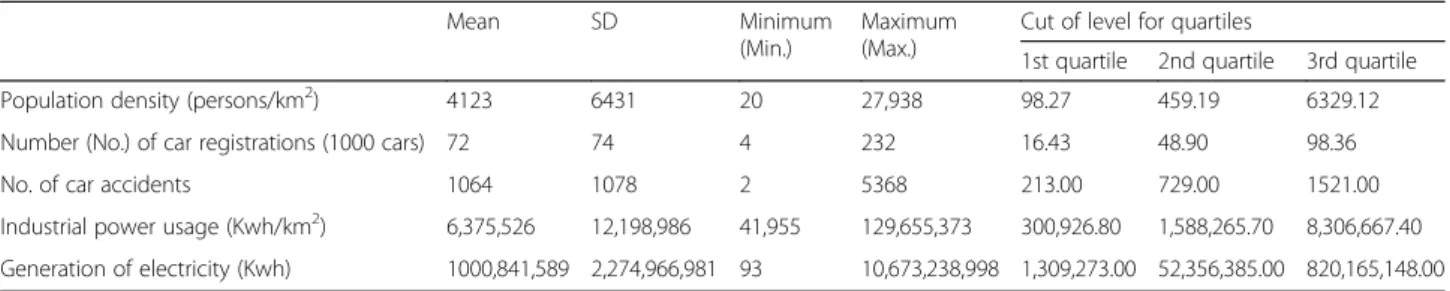
The amount of power that was generated from fossil fuels was estimated on the basis of detailed statistics on the power plants from the KEPCO and nationwide sta- tistics reported by the Korean government on the“public Table 1 Descriptive statistics of the emission inventories of South Korea in the winter of 2015
Mean SD Minimum
(Min.)
Maximum (Max.)
Cut of level for quartiles
1st quartile 2nd quartile 3rd quartile
Population density (persons/km2) 4123 6431 20 27,938 98.27 459.19 6329.12
Number (No.) of car registrations (1000 cars) 72 74 4 232 16.43 48.90 98.36
No. of car accidents 1064 1078 2 5368 213.00 729.00 1521.00
Industrial power usage (Kwh/km2) 6,375,526 12,198,986 41,955 129,655,373 300,926.80 1,588,265.70 8,306,667.40 Generation of electricity (Kwh) 1000,841,589 2,274,966,981 93 10,673,238,998 1,309,273.00 52,356,385.00 820,165,148.00
Table 2 Number of days the particulate matter 10 (PM10) and carbon monoxide (CO) levels in the winter of 2015 exceeded government thresholds
CO (days) PM10(days)
Mean ± SD Min. Max. Mean ± SD Min. Max.
Population density (persons/km2)a
Q1 (lowest) 8.3 ± 14.3 0 54 1.4 ± 1.2 0 4
Q2 28.4 ± 24.4 1 81 4.1 ± 4.7 0 23
Q3 41.8 ± 19.0 0 79 5.4 ± 5.3 0 21
Q4 (highest) 30.5 ± 21.1 0 66 2.2 ± 2.9 0 12 No. of car registrationsb
Q1 (lowest) 7.5 ± 13.9 0 54 2.0 ± 2.6 0 10
Q2 26.5 ± 24.1 0 77 3.0 ± 3.7 0 16
Q3 29.0 ± 19.3 0 72 2.9 ± 4.0 0 23
Q4 (highest) 43.2 ± 20.0 0 81 5.0 ± 5.2 0 21 No. of car accidentc
Q1 (lowest) 9.9 ± 14.6 0 54 2.1 ± 2.6 0 10
Q2 21.9 ± 23.0 0 77 2.1 ± 2.6 0 12
Q3 31.2 ± 19.6 0 72 3.6 ± 4.4 0 23
Q4 (highest) 43.0 ± 20.4 0 81 4.8 ± 5.2 0 21 Industrial power usage (Kwh/km2)d
Q1 (lowest) 9.8 ± 13.8 0 46 1.6 ± 1.5 0 4
Q2 28.2 ± 26.5 0 81 4.2 ± 4.9 0 23
Q3 38.4 ± 18.6 1 78 5.0 ± 5.1 0 21
Q4 (highest) 33.8 ± 22.2 0 79 2.6 ± 3.7 0 16 Generation of electricity (Kwh)
No 27.0 ± 22.8 0 77 2.3 ± 2.8 0 14
Yes 37.1 ± 21.2 0 81 5.1 ± 5.4 0 23
apopulation density(persons/km2): Q1 < 98.87, 98.87≤ Q2 < 459.19, 459.19≤ Q3 < 6329.12, 6329.12 ≤ Q4
bNo. of car registrations(1000 cars): Q1 < 16.43, 16.43≤ Q2 < 48.90, 48.90≤ Q3 < 98.36, 98.36 ≤ Q4
cNo. of car accident: Q1 < 213.00, 213.00≤ Q2 < 729.00, 729.00≤ Q3 < 1521.00, 1521.00 ≤ Q4
dIndustrial power usage (Kwh/km2): Q1 < 300,926.80, 300,926.80≤ Q2
< 1,588,265.70, 1,588,265.70≤ Q3 < 8,306,667.40, 8,306,667.40 ≤ Q4
Table 3 Association between the number of days of excessive particulate matter 10 (PM10) and carbon monoxide (CO) in the winter of 2015 and concentration of putative contaminant sources
CO PM10
exp(β) 95% CI exp(β) 95% CI
Population density (person/km2)a
Q1(lowest) 1.00 1.00
Q2 3.44 1.96–6.04 3.00 1.46–6.17
Q3 5.07 3.00–8.58 3.89 1.97–7.68
Q4(highest) 3.70 2.19–6.26 1.59* 0.79–3.18
No. of car registrationsb
Q1(lowest) 1.00 1.00
Q2 3.53 1.96–6.38 1.50 0.70–3.21
Q3 3.86 2.22–6.72 1.45* 0.71–2.95
Q4(highest) 5.75 3.32–9.99 2.49 1.23–5.04
No. of car accidentc
Q1(lowest) 1.00 1.00
Q2 2.20 1.23–3.93 1.00 0.47–2.13
Q3 3.14 1.84–5.36 1.67* 0.84–3.32
Q4(highest) 4.33 2.54–7.38 2.23 1.13–4.40
Industrial power usage (Kwh/ km2)d
Q1(lowest) 1.00 1.00
Q2 2.88 1.64–5.07 2.69 1.31–5.52
Q3 3.93 2.37–6.51 3.19 1.66–6.12
Q4(highest) 3.46 2.09–5.71 1.70* 0.88–3.27
Generation of electricity (Kwh)
No 1.00 1.00
Yes 1.37 1.01–1.86 2.27 1.60–3.21
apopulation density(persons/km2): Q1 < 98.87, 98.87≤ Q2 < 459.19, 459.19≤ Q3 < 6329.12, 6329.12 ≤ Q4
bNo. of car registrations(car/1000): Q1 < 16.43, 16.43≤ Q2 < 48.90, 48.90≤ Q3 < 98.36, 98.36 ≤ Q4
cNo. of car accident: Q1 < 213.00, 213.00≤ Q2 < 729.00, 729.00≤ Q3 < 1521.00, 1521.00 ≤ Q4
dIndustrial power usage (Kwh/km2): Q1 < 300,926.80, 300,926.80≤ Q2
< 1,588,265.70, 1,588,265.70≤ Q3 < 8,306,667.40, 8,306,667.40 ≤ Q4
data portal” web-page (http://epsis.kpx.or.kr/epsisnew/
selectEkfaFclDtlChart.do?menuId=020104) [27]. The KEPCO also provided, on request, data on how much electricity was generated by each power plant. These data were used to determine how much power (kwh) was used in the 2015 winter and the location of each plant. Since only 90 out of 232 administrative districts had a power plant, the generation of electricity was expressed as a di- chotomous variable (Yes/No).
Assessment of CO and PM10pollution exposure in each Si-goon-gu in the 2015 winter
The National Institute of Environmental Research (NIER) measures the amount of air pollution per hour at 320 moni- toring stations across the nation. The NIER CO and PM10
data from the winter of 2015 were extracted [28]. The data from the 38 monitoring stations that were located next to roads with heavy traffic (i.e., the road network monitoring stations) were excluded as these data are outliers. According to the address of each monitoring station, the remaining 282 monitoring stations were distributed variably across the 232 Si-goon-gu: 44 Si-goon-gu did not have monitoring sta- tions and in some cases one Si-goon-gu had multiple moni- toring stations. If there were multiple monitoring stations in a Si-goon-gu, the maximum moving average values were taken and the rest were deleted. To control for the impact of pollution from China, the data from the days when yellow dust was observed were excluded. The CO data in the data- set were expressed as the moving average of 8 hours while the PM10 data were expressed as the moving average of 24 h. Korean law stipulates that beyond the respective CO and PM10thresholds of 9 ppm and 100 g/m3, the air quality is considered to be poor [29]. 73 Si-goon-gu were excluded in analysis because there are no monitoring station or miss- ing value. Each Si-goon-gu has a number of days exceed PM10and CO criteria. It assumed that the higher the number of days of baseline excess, the more severe the air pollution.
Statistical analyses
Each item of the emission inventory, excluding the generation of electricity, was expressed as quartiles. Binomial negative analysis was performed to determine the dose-response rela- tionship between the number of days in winter where the PM10and CO levels were excessive and the population dens- ity, the number of car registrations/1000, the number of car accidents, the kwh of industrial power usage/km2, and whether electricity was generated locally or not. SAS software (version 9.4, SAS Institute Inc., Cary, NC, USA) was used for database management and the statistical analyses. Statistical significance was defined asp < .05.
Results
Table1summarizes the descriptive statistics of each emis- sion source. Statistics on each emission source and average
number of winter days with excessive CO and PM10levels by Si-Do scales are shown in Additional file 1 and in Additional file 2, respectively. Table 2 shows the average number of winter days with excessive CO and PM10levels in the Si-goon-gu with low (Q1), moderate (Q2), high (Q3), and very high (Q4) population densities, numbers of car registrations, number of car accidents, and industrial power usage/km2. The average number of days the CO and PM10
levels exceeded the thresholds in the 90 and 142 Si-goon-gu that, respectively, did and did not generate electricity from fossil fuel power plants is also shown in Table2.
The number of days of excessive CO and PM10 in- creased steadily as the population density, and the indus- trial power usage/km2 increased. However, the peak number of days were observed in the 3Q, not 4Q. The number of days of excessive CO and PM10 increased steadily as the number of car accidents and the number of car registrations increased: the peak number of days were observed in the 4Q. The Si-goon-gu that did have power plants had more days of excessive CO and PM10
than the Si-goon-gu that did not.
Table 3 shows the results of the negative binomial re- gression analyses. Compared to the lowest population density (Q1), all three higher population densities associ- ated significantly with higher CO and PM10pollution. The association for both pollutants grew increasingly stronger as the population density rose from Q2 to Q3; thereafter (Q4), the association dropped somewhat. The same was observed for the industrial power usage: The numbers marked with an asterisk did not associate significantly with PM10pollution compared to Q1. All of these findings are consistent with the trends shown in Table2.
Compared to the lowest car accident counts (Q1), higher car accident counts associated significantly with higher CO and PM10 pollution (the only exception was the association between PM10 pollution and the Q3 car accident counts, which did not achieve statistical signifi- cance). There was a linear relationship between pollu- tion and car mobile pollutants since the association steadily strengthened as the car accident counts and number of car registration rose. These findings are con- sistent with the trends shown in Table2.
The Si-goon-gu that had power plants were signifi- cantly more likely to exceed both air pollution thresh- olds than the Si-goon-gu that lacked power plants.
Discussion
Particulate matter and air pollution continue to be a problem during winter. There is a growing need to establish the cause in order to come up with coun- termeasures. The purpose of this study was also to identify the relationship between different variables, using official measurement data and other data pro- vided by the country.
A key finding of this study was that there was a linear relationship between increasing mobile pollutant counts and increasing number of days of excessive CO and PM10
levels in Korea during the winter season of 2015. This is consistent with the fact that car emissions are a classic source of air pollutants such as CO, NOx, SOx,and PM10. Indeed, a South Korean government report [1] showed that in 2013, car exhaust was responsible for 58.7% of all CO emissions and 10% of all PM10emissions.
The present study found a consistent linear relationship between the number of car registrations and the days of excessive air pollution with CO and PM10: while the asso- ciation did increase up to the 3Q, the association weak- ened in the 4Q. This is not consistent with a previous report that showed that air pollutant levels correlated sig- nificantly with several car-related statistics (major-road density, all-traffic density, and heavy-traffic density) [30].
Data from monitoring station where located roadside were excluded because the roadside’s outcome couldn’t repre- sent all the area. Thus, our outcomes might underesti- mated the effect of motor vehicles.
We observed that the population density also showed a linear dose–response with air pollution until the 3Q: the highest population density associated less strongly with pollution than the smaller population densities. This is not consistent with a report from the United States of America that found a significant positive correlation be- tween population density and air pollution [31]. However, the study conducted in the U.S only include major metro- politan areas where their population over one-million.
Moreover, air pollution from population activities is not easy to explain. The results of each correlation analysis on population density and the number of car registration, number of car accidents, and industrial power usage were r = 0.31, 0.41 and 0.63 respectively. (Not presented as a separate table) Population density showed a weak correl- ation with mobile pollutants and a rather strong correl- ation with industrial power usage. Population density exhibited the same pattern as the negative regression ana- lysis of industrial power usage. In other words, the 3Q group showed the greatest degree of contamination while the 4Q group showed a slight decrease in pollution. This suggests that while larger population translates to more industrial power usage, the content of industrial activity is deeply related to air pollution.
When we used industrial power usage as a measure of industrial activity, we found the same relationship with air pollution as population density: there was a linear dose–
response relationship between industrial power usage and air pollution until the 3Q: the highest levels of industrial power usage associated less strongly with pollution than the 3rd levels of industrial power usage. We speculated that this may reflect differences in the specific type of in- dustries that used industrial power. To address this, we
assessed the types of industries in the Si-goon-gu that were in the 3Q and 4Q. Indeed, the industries in the 4Q were mainly service and healthcare businesses, which are unlikely to be air polluters. By contrast, the main indus- tries in the 3Q manufactured electronic video and audio equipment, chemical products, and motor vehicles.
Additional file3 and Additional file4show the key indus- tries in the third and 4Q of industrial power usage and how much industrial electricity they used in 2015 winter. Data from the KEPCO on the electricity usage by various indus- tries in January, 2016, were used to compile this table [32].
Thus, the 3Q, but not 4Q of population density, and in- dustrial power usage associated most strongly with air pol- lution. An analysis of the third and fourth Si-goon-gu showed that industrial electricity consumption was most concentrated in the downtown areas of Seoul and Busan, followed by the periphery of these metropolitan areas (Additional file5). Additional file6showed that distribution of the Korea industrial complexes in 2015. Approximately 40% of the 3Q of industrial electricity consumption were concentrated in industrial complexes. These findings par- tially support the notion that PM10and CO may be more affected by industrial complex activities than by population density.
Since there are relatively few fossil fuel power plants around the country, the Si-goon-gu with and without these plants were compared. The districts with these plants were significantly more likely to have air pollution than the districts that did not. This is consistent with a previous study [33].
The present study has several limitations. Since it had an ecological design, it was not possible to demonstrate a cause and effect relationship between the putative con- taminant sources and air pollution. Moreover, all data used in the study were secondary data from the South Korean government. Third, while monitoring stations have been established all over the country to monitor air pollution levels, the stations are concentrated in metro- politan areas and around large cities. This shortcoming is difficult to overcome. While many studies use simu- lated pollution data, these data are merely estimates, and the purpose of this study was to examine the relation- ship between real air pollution data and putative sources.
Another limitation is that due to substantial difficulties in estimating how much contaminants are produced by putative sources, we used surrogate variables to repre- sent these sources. This limitation is partly overcome by the fact that we measured the population density, auto- mobile density, and industrial activities in each district.
Air pollution levels in a given country can be signifi- cantly affected by pollutants from surrounding countries.
In South Korea, the air is often affected by pollution from China. However, we did not correct the measured air pollution levels for the direction of air flow, although
we did exclude the data from the days when yellow dust was observed (19 days). Despite these efforts, external factors were not sufficiently excluded. Meanwhile, CO is a gaseous substance, so it is understood that the expos- ure in neighboring areas is a more appropriate material for explanation. Analyzing between pollutant and CO, not necessary to consider the effect from China. Finally, humidity, temperature and wind direction all influence air pollution, and the non-correction of these factors pose limitations in this study.
The present study showed the impact of major air- borne sources on air pollution in South Korea in winter. Significantly, our study design allowed us to investigate whether all but one of the putative sources showed a positive dose–relationship with CO and PM10 pollution: all did. The remaining variable, power generation, which was expressed as a dichot- omous variable, also associated with air pollution. In addition, we examined the contribution of motor ve- hicles to air pollution by not only assessing vehicle registration data but also the number of car acci- dents. In addition, we analyzed the effect of the type of industry in specific areas to explain why the third, not the fourth, highest industrial power usage associ- ated most strongly with air pollution. Finally, the re- sults are likely to be a good representation of the real situation because all data were from various parts of the government: this assures public confi- dence in the data.
Conclusions
Air pollution is increasingly being seen as an important public health issue. To reduce air pollution, the incidence of exposure, and the impact on human health, it is import- ant to identify the most significant sources of pollutants.
This study showed that cars, industrial activity, fossil fuel plants, and population density associated significantly with CO and PM10air pollution in South Korea in winter. It also showed that polluting industrial activity occurs on the per- iphery of large cities. Well-designed research studies that verify these findings are warranted.
Additional files
Additional file 1:Descriptive statistics of the emission inventories of South Korea in the winter of 2015 by Si-Do. (DOCX 32 kb)
Additional file 2:Number of days the particulate matter 10 (PM10) and carbon monoxide (CO) levels in the winter of 2015 exceeded
government thresholds by Si-Do. (DOCX 15 kb)
Additional file 3:Main types of industries in the districts that fell into the 3Q and 4Q of industrial power usage. (DOCX 15 kb)
Additional file 4:Mean amount of power sold by type of industries.
(DOCX 15 kb)
Additional file 5: Distribution of the industrial power usage in South Korea in 2015 winter. The maps were generated by QGIS 2.18.6, which was provided as an open-source. (JPEG 711 kb)
Additional file 6: Distribution of the industrial complexes in South Korea [34]. (JPEG 586 kb)
Acknowledgements
The Authors wishes to acknowledge the financial support of the Catholic Medical Center Research Foundation made in the program year of 2017.
Availability of data and materials
The datasets generated and analyzed during the current study are available in the references.
Authors’ contributions
CHR and MJP designed the research. CHR and MJP interpreted the data and CHR collected data and drafted the manuscript. MJP devised and supervised the entire process. All authors read and approved the final manuscript.
Ethics approval and consent to participate
This manuscript is ecological study Thus, it is not applicable.
Consent for publication Not applicable.
Competing interests
The authors declare that they have no competing interests.
Publisher’s Note
Springer Nature remains neutral with regard to jurisdictional claims in published maps and institutional affiliations.
Received: 19 March 2018 Accepted: 28 September 2018
References
1. Ministry of Environment. 2017 white paper of environment. Sejongsi:
Ministry of Environment; 2017.
2. Cai Y, Hansell AL, Blangiardo M, Burton PR, BioShaRe, de Hoogh K, et al.
Long-term exposure to road traffic noise, ambient air pollution, and cardiovascular risk factors in the HUNT and lifelines cohorts. Eur Heart J.
2017;38:2290–6.
3. Cascio WE. Proposed pathophysiologic framework to explain some excess cardiovascular death associated with ambient air particle pollution: insights for public health translation. Biochim Biophys Acta. 2016;1860:2869–79.
4. DeFranco E, Moravec W, Xu F, Hall E, Hossain M, Haynes EN, et al. Exposure to airborne particulate matter during pregnancy is associated with preterm birth: a population-based cohort study. Environ Health. 2016;15:6.
5. Furuyama A, Kanno S, Kobayashi T, Hirano S. Extrapulmonary translocation of intratracheally instilled fine and ultrafine particles via direct and alveolar macrophage-associated routes. Arch Toxicol. 2009;83:429–37.
6. Gauderman WJ, Urman R, Avol E, Berhane K, McConnell R, Rappaport E, et al. Association of improved air quality with lung development in children. N Engl J Med. 2015;372:905–13.
7. Goldberg MS, Labreche F, Weichenthal S, Lavigne E, Valois MF, Hatzopoulou M, et al. The association between the incidence of postmenopausal breast cancer and concentrations at street-level of nitrogen dioxide and ultrafine particles. Environ Res. 2017;158:7–15.
8. Int Panis L, Provost EB, Cox B, Louwies T, Laeremans M, Standaert A, et al.
Short-term air pollution exposure decreases lung function: a repeated measures study in healthy adults. Environ Health. 2017;16:60.
9. Oberdorster G, Sharp Z, Atudorei V, Elder A, Gelein R, Kreyling W, et al. Translocation of inhaled ultrafine particles to the brain. Inhal Toxicol. 2004;16:437–45.
10. Raaschou-Nielsen O, Pedersen M, Stafoggia M, Weinmayr G, Andersen ZJ, Galassi C, et al. Outdoor air pollution and risk for kidney parenchyma cancer in 14 European cohorts. Int J Cancer. 2017;140:1528–37.
11. Talbott EO, Arena VC, Rager JR, Clougherty JE, Michanowicz DR, Sharma RK, et al. Fine particulate matter and the risk of autism spectrum disorder.
Environ Res. 2015;140:414–20.
12. National Institute of Environment Research. KORUS-AQ rapid science synthesis report. Incheon: National Institute of Environmental Research; 2017.
13. Ehrlich C, Noll G, Kalkoff W, Baumbach G, Dreiseidler A. PM10, PM2.5and PM1.0—emissions from industrial plants—results from measurement programmes in Germany. Atmos Environ. 2007;41:6236–54.
14. Li KC, Hwang I. Characteristics of PM2.5in Gyeongsan using statistical analysis. J Korean Soc Atmos Environ. 2015;31:520–9.
15. Srimuruganandam B, Shiva Nagendra SM. Source characterization of PM10
and PM2.5mass using a chemical mass balance model at urban roadside.
Sci Total Environ. 2012;433:8–19.
16. Wu D, Wang Z, Chen J, Kong S, Fu X, Deng H, et al. Polycyclic aromatic hydrocarbons (PAHs) in atmospheric PM2.5and PM10at a coal-based industrial city: implication for PAH control at industrial agglomeration regions, China. Atmos Res. 2014;149:217–29.
17. Cichowicz R, Wielgosinski G, Fetter W. Dispersion of atmospheric air pollution in summer and winter season. Environ Monit Assess. 2017;189:605.
18. Ahmed E, Kim KH, Shon ZH, Song SK. Long-term trend of airborne particulate matter in Seoul, Korea from 2004 to 2013. Atmos Environ. 2015;101:125–33.
19. Kim H, Zhang Q, Bae G-N, Kim JY, Lee SB. Sources and atmospheric processing of winter aerosols in Seoul, Korea: insights from real-time measurements using a high-resolution aerosol mass spectrometer. Atmos Chem Phys. 2017;17:2009–33.
20. Kim HS, Huh JB, Hopke PK, Holsen TM, Yi SM. Characteristics of the major chemical constituents of PM2.5and smog events in Seoul, Korea in 2003 and 2004. Atmos Environ. 2007;41:6762–70.
21. Ministry of the Interior and Safety. Population by administrative region.
2016.http://kosis.kr/statHtml/statHtml.do?orgId=101&tblId=DT_1IN1509&
conn_path=I2. Accessed 15 Aug 2018.
22. Ministry of Land Infrastructure and Transport. Administrative Area. 2016.http://
kosis.kr/statHtml/statHtml.do?orgId=116&tblId=DT_MLTM_2300&conn_path=I2.
Accessed 15 Aug 2018.
23. Ministry of Land Infrastructure and Transport. Total Registered Moter Vehicles in 2015. 2016.http://stat.molit.go.kr/portal/cate/statFileView.do?hRsId=58&hFormId=
1244&hSelectId=1244&hPoint=00&hAppr=1&hDivEng=&oFileName=&rFileName
=&midpath=&month_yn=N&sFormId=1244&sStart=2017&sEnd=2017&sStyleNum
=562&sDivEng=N&EXPORT. Accessed 15 Aug 2018.
24. Park B. Predicting the traffic accident and volume using simultaneous equations. J Institute Constr Technology. 2014;33(1):1–6 In Korean.
25. Road Traffic Authority. Car accident count in 2015 by administrative distriction. 2016.http://taas.koroad.or.kr/sta/acs/exs/typical.do?menuId=WEB _KMP_STA_UAS_UDS. Accessed 15 Aug 2018.
26. Korea Electric Power Corportation. Electric power sales by an administrative distriction in 2015. 2016.http://home.kepco.co.kr/kepco/KO/ntcob/ntcob View.do?pageIndex=1&boardSeq=21015198&boardCd=BRD_000283&menu Cd=FN05030105&parnScrpSeq=0&searchCondition=total&searchKeyword.
Accessed 15 Aug 2016.
27. Ministry of the Interior and Safety. Public data portal. 2016.http://www.data.
go.kr. Accessed 15 Aug 2018.
28. National Institute of Environmental Reaserach. Measurement data for air pollution by time zone in 2015. 2016.https://www.airkorea.or.kr/last_amb_
hour_data. Accessed 15 Aug 2018.
29. Ministry of Environment. Enforcement ordinance of the Framework Act on Environmental Policy. 2016.http://www.law.go.kr/LSW/lsBylInfoPLinkR.do?
lsiSeq=193560&lsNm=%ED%99%98%EA%B2%BD%EC%A0%95%EC%B1%85%
EA%B8%B0%EB%B3%B8%EB%B2%95+%EC%8B%9C%ED%96%89%EB%A0%
B9&bylNo=0000&bylBrNo=. Accessed 15 Aug 2018.
30. Liu SV, Chen FL, Xue J. Evaluation of traffic density parameters as an Indicator of vehicle emission-related near-road air pollution: a case study with NEXUS measurement data on black carbon. Int J Environ Res Public Health. 2017;14:12.
31. Environmental Proctctions Agency. Population density traffic density and nox emission air pollution density in major metropolitan areas of the United States. 2010.
32. Korea Electric Power Corporation. Electric Power Sales. 2017.https://www.
data.go.kr/dataset/3069444/fileData.do. Accessed 15 Aug 2018.
33. Commission for Environmental Cooperation. North American power plant air emissions. Montreal(Quebec) Commission for environmental cooperation; 2011.
34. Korea Industrial Complex Corporation. A Study on the present condition of the Industrial Complex in the 4th quarter of 2015. 2016.http://www.kicox.
or.kr/user/bbs/BD_selectBbs.do?q_bbsCode=1036&q_bbscttSn=373&q_order
=&q_clCode=2. Accessed 15 Aug 2018.