Korean J. Pl. Taxon. 48(3): 195 − 200 (2018) https://doi.org/10.11110/kjpt.2018.48.3.195 RESEARCH ARTICLE
pISSN 1225-8318 eISSN 2466-1546 Korean Journal of Plant Taxonomy
Isolation and characterization of EST-SSR markers for
Astilboides tabularis (Saxifragaceae), endangered species in Korea
Eui-Kwon JUNG, Dae-Hyun KANG
1, Ki-Oug YOO
2, Myounghai KWAK
3, Young-Dong KIM and Bo-Yun KIM
1*
Department of Life Science, Hallym University, Chuncheon 24252, Korea
1
Multidisciplinary Genome Institute, Hallym University, Chuncheon 24252, Korea
2
Department of Biological Sciences, Kangwon National University, Chuncheon 24341, Korea
3
Plant Resources Division, National Institute of Biological Resources, Incheon 22689, Korea (Received 4 September 2017; Revised 17 September 2018; Accepted 28 September 2018)
ABSTRACT:
Genetic assessments of rare and endangered species are among the first steps necessary to establish the proper management of natural populations. Transcriptome-derived single-sequence repeat markers were developed for the Korean endangered species Astilboides tabularis (Saxifragaceae) to assess its genetic diver- sity. A total of 96 candidate microsatellite loci were isolated based on transcriptome data using Illumina pair end sequencing. Of these, 26 were polymorphic, with one to five alleles per locus in 60 individuals from three pop- ulations of A. tabularis. The observed and expected heterozygosity per locus ranged from 0.000 to 0.950 and from 0.000 to 0.741, respectively. These polymorphic transcriptome-derived simple sequence repeat markers would be invaluable for future studies of population genetics and for ecological conservation of the endangered species A. tabularis.
Keywords:
Astilboides tabularis, endangered species, EST-SSR markers, next-generation sequencing, conservation
Astilboides tabularis (Hemsl.) Engler is the only species in Astilboides (Saxifragaceae) known to be distributed in a cluster in the forests of river valleys of northeastern Korea and China (Jintang and Cullen, 2001; The Angiosperm Phylogeny Group et al., 2016). This species is a protected wild plant classified as endangered wildlife grade II by the Ministry of the Environment due to the possibility of the extinction of the population and/or reduction in the number of individuals by climate change (Ministry of the Environment of Korea, 2014). A. tabularis is a potential horticultural plant as an ornamental species given its large leaves (approximately 1 m in diameter) and beautiful panicles (Belyaeva and Butenkova, 2016; Choi et al., 2016). It also has a long history of usage as a medicinal plant for diabetes (Liu et al., 2016). Due to biological conservation efforts and given the ecological importance of A. tabularis, genetic diversity analysis studies have been conducted using AFLP and isozymes (Ku et al., 2006; Lee, 2008).
To the best of our knowledge, no microsatellite markers have been developed thus far for A. tabularis for population studies.
Population genetics research provides insight into conservation and management plans for rare and threatened species (Ottewell et al., 2016). To assess the genetic diversity of A.
tabularis, we developed expressed sequence tag–simple sequence repeat (EST-SSR) markers. These have been used as a powerful molecular tool for genetic diversity studies of many plant species (Yan et al., 2016; Wang et al., 2017).
Materials and Methods
For the construction of the RNA library, the total RNA was extracted from leaves of individuals representing A. tabularis from three populations (Voucher No. NIBRVP0000655607) (Table 1). RNA was extracted using RNeasy kits, version 2.2 (Illumina, San Diego, CA, USA) following the manufacturer’s
*Author for correspondence: [email protected]
http://e-kjpt.org, © 2018 the Korean Society of Plant Taxonomists. This is an open-access article distributed under the terms of the Creative Commons Attribution Non-Commercial License (http://creativecommons.org/licenses/by-nc/4.0) which permits unrestricted non-commercial use, distribution, and reproduction in any medium, provided the original work is properly cited.
instructions, and was subsequently used for TruSeq cDNA library preparation and high-throughput Illumina HiSeq 100 bp paired-end de novo transcriptome sequencing. The analysis results reads were obtained and assembled into 102,884 unigenes with 7,476,378,742 read numbers. The de novo transcriptome assembly of these reads was performed using the short read assembling program Trinity r20140717 (Haas et al., 2013) with the default parameters. Microsatellites were detected using MIcroSAtellite (MISA) version 1.0.0 (Thiel et al., 2003) with thresholds of ten repeat units for dinucleotide and five repeat units for tri-, tetra-, penta-, and hexanucleotides.
MISA identified 38,598 simple sequence repeats (SSRs), of which 96 loci were selected depending on (1) the number of SSR repeats, (2) a PCR product size of 150–500 bp, (3) an annealing temperature range of 55–60
oC, and (4) a minimum GC content of 50% for further testing of A. tabularis. The primer sets were designed to flank the microsatellite-rich regions with a minimum of eight repeats using the Primer3 program (Rozen and Skaletsky, 1999).
We sampled 60 A. tabularis individuals from three wild populations (Table 1). All samples included in this study were collected in accordance with the requirements of permission and support from relevant authorities. To avoid collecting clones, we specified a distance of at least 2 m among individuals within each population. The voucher specimens were deposited in the National Institute of Biological Resources Herbarium (KB) and in the Herbarium of Hallym University (HHU) in Korea (Table 1). The locations of the sites have been withheld to prevent illegal collection. The utility of the 96 microsatellite markers was confirmed by PCR from each population of A. tabularis in a total volume 25 µL, containing 2.5 µL of 10× Ex Taq buffer (TaKaRa Bio Inc., Otsu, Japan), 2 µL of 2.5 mM dNTPs, 0.01 µM each of a forward and reverse primer, 0.1 µL of TaKaRa Ex Taq DNA polymerase (5 units/
µL) (TaKaRa Bio Inc.), and 5–10 ng of template DNA. All PCRs were performed in a GeneAmp PCR System 9700 thermocycler (Applied Biosystems, Carlsbad, CA, USA) using the following program: initial denaturation at 98
oC for 5 min
followed by 30 cycles of denaturation at 95
oC for 1 min, annealing at annealing at 59
oC for 1 min with an extension at 72
oC for 1.5 min, and a final extension step at 72
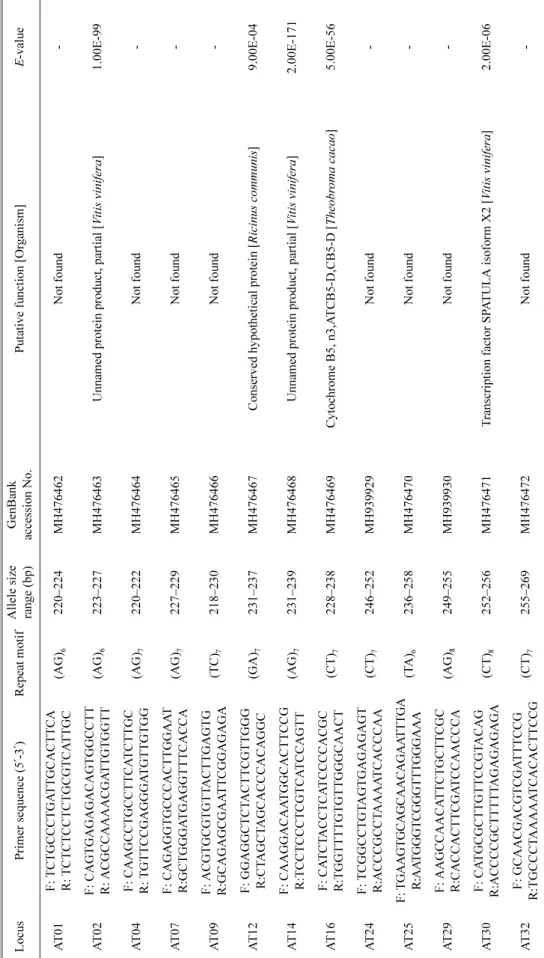
oC for 10 min. Fluorescently labeled (HEX, FAM) PCR products were analyzed by an automated sequencer (ABI 3730XL) with the GeneScan 500 LIZ Size Standard (Applied Biosystems). Genotyping was performed using GeneMapper 3.7 (Applied Biosystems), and peaks were scored manually by visual inspections. Finally, we identified 26 polymorphic markers based on genotyping data, and functional annotations for these markers were performed on a subset of ESTs with BLASTX scores (E-value < 1 × 10
-10) using the gene ontology database (Table 2). The genetic parameters of polymorphic loci were assessed by calculating the number of alleles (A), the observed heterozygosity (H
o), and the expected heterozygosity (H
e) using GenAlEx 6.5 (Peakall and Smouse, 2012). Degrees of deviation from the Hardy-Weinberg equilibrium (HWE) were estimated with ARLEQUIN 3.5 (Excoffier and Lischer, 2010).
Results and Discussion
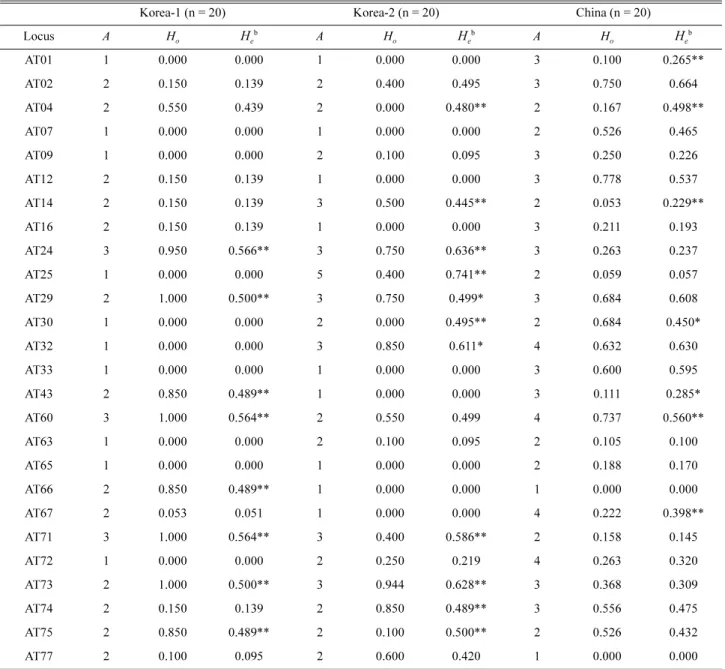
The results of the genetic diversity of 26 polymorphic markers are shown in Table 3. Overall, the 26 microsatellite loci were polymorphic, with the number of alleles per locus ranging from one to five (average 2.218). The H
oand H
evalues ranged from 0.000 to 0.950 and from 0.000 to 0.741, respectively (Table 3). Some polymorphic loci significantly deviated from HWE, though this was not consistent across populations.
This study describes the first assembly and characterization of the leaf transcriptome of A. tabularis using the Illumina paired-end sequencing method. Twenty-six polymorphic markers were successfully amplified, revealing polymorphisms in A. tabularis. This work can serve as a basis for further studies on the genetic diversity and structure of A. tabularis and can provide essential information for devising effective conservation strategies.
National Institute of Biological Resources (KB) and in the Herbarium of Hallym University (HHU), Republic of Korea. To prevent illegal collection, we did not disclose the exact locations of the sites.
Population Locality No. Voucher No. (Herbarium)
Korea-1 Bonghwachi, Jeongseon 20 NIBRVP0000655607 (KB)
Korea-2 Geomyongso, Taebaek 20 KBY2017273 (HHU)
China Fusong Xian, Jilin Sheng 20 NIBRVP0000655609 (KB)
No., number of individuals sampled.
EST-SSR markers for Astilboides tabularis 197
Table 2. Characteristics of the 26 polymorphic microsatellite loci developed from Astilboides tabularis. LocusPrimer sequence (5ʹ-3ʹ)Repeat motifAllele size range (bp)GenBank accession No.Putative function [Organism]E-value AT01F: TCTGCCCTGATTGCACTTCA R: TCTCTCCTCTGCGTCATTGC(AG)6220–224MH476462Not found- AT02F: CAGTGAGAGACAGTGGCCTT R: ACGCCAAAACGATTGTGGTT(AG)6223–227MH476463Unnamed protein product, partial [Vitis vinifera]1.00E-99 AT04F: CAAGCCTGCCTTCATCTTGC R: TGTTCCGAGGGATGTTGTGG(AG)7220–222MH476464Not found- AT07F: CAGAGGTGCCCACTTGGAAT R:GCTGGGATGAGGTTTCACCA(AG)7227–229MH476465Not found- AT09F: ACGTGCGTGTTACTTGAGTG R:GCAGAGCGAATTCGGAGAGA(TC)7 218–230MH476466Not found- AT12F: GGAGGCTCTACTTCGTTGGG R:CTAGCTAGCACCCACAGGC(GA)7231–237MH476467Conserved hypothetical protein [Ricinus communis]9.00E-04 AT14F: CAAGGACAATGGCACTTCCG R:TCCTCCCTCGTCATCCAGTT(AG)7231–239MH476468Unnamed protein product, partial [Vitis vinifera]2.00E-171 AT16F: CATCTACCTCATCCCCACGC R:TGGTTTTGTGTTGGGCAACT(CT)7228–238MH476469Cytochrome B5, n3,ATCB5-D,CB5-D [Theobroma cacao]5.00E-56 AT24F: TCGGCCTGTAGTGAGAGAGT R:ACCCGCCTAAAATCACCCAA(CT)7 246–252MH939929Not found- AT25F: TGAAGTGCAGCAACAGAATTTGA R:AATGGGTCGGGTTTGGGAAA(TA)6 236–258MH476470Not found- AT29F: AAGCCAACATTCTGCTTCGC R:CACCACTTCGATCCAACCCA(AG)8 249–255MH939930Not found- AT30F: CATGCGCTTGTTCCGTACAG R:ACCCCGCTTTTTAGAGAGAGA(CT)8252–256MH476471Transcription factor SPATULA isoform X2 [Vitis vinifera]2.00E-06 AT32F: GCAACGACGTCGATTTCCG R:TGCCCTAAAAATCACACTTCCG(CT)7 255–269MH476472Not found-
Table 2. Continued. LocusPrimer sequence (5?-3?)Repeat motifAllele size range (bp)GenBank accession No.Putative function [Organism]E-value AT33F: GGCGTCTGGTCTTCGATCTT R:CGTCGTGTGTAAGCAAGCAG(TC)7255–259MH476473Unnamed protein product, partial [Vitis vinifera]0 AT43F: AAACCATCTGAGCCCCTCAC R:GATTGTAACGCGCCGAAGAC(CT)8262–276MH939931Uncharacterized protein TCM_015808 [Theobroma cacao]1.00E-65 AT60F: GAAGGTGTTGCTGATGAGCC R:ATTGCAACAACTGACACCGC(GCT)6 217–235MH939932Not found- AT63F: CCATCTCACCATTCTCGCGA R:TCCATGGTTGCATTTGGGGA(CGC)7235–244MH476474RING-H2 finger protein ATL3 [Vitis vinifera]9.00E-80 AT65F: GTGTTTCGGGTCGTGAGTCT R:GTTGAGGGACCTGACTGCAA(GAT)5 231–240MH476475Not found- AT66F: TATCTCGCTAGGCCGGAGAT R:CGAGGAAGATTCGAGGCCAA(TGA)6240–243MH939933Hypothetical protein PRUPE_2G009100 [Prunus persica]2.00E-51 AT67F: AATGAAGAGTCGTCGTCCCC R:TCCCATGCTGCCCATTACTT(CAC)6239–251MH476476MLO-like protein 6 [Vitis vinifera]5.00E-105 AT71F: AGCCCTAACCGCCTTAATCG R:CGCCCCAGAGAAGATCGAAA(GCG)7247–256MH939934Hypothetical protein B456_001G263100 [Gossypium raimondii]5.00E-53 AT72F: CGCGTCTCAAAATCGTCACC R:CGGAAGTTTTACGGCCACAG(GTT)6242–254MH476477Uncharacterized protein LOC100257948 [Vitis vinifera]8.00E-19 AT73F: CTTCAGGGGAGTACGGAAGC R:CTGGCTCAAGCTTTCGGAAC(ACA)6240–252MH476478Ethylene-responsive transcription factor 4-like [Nelumbo nucifera]1.00E-28 AT74F: GGCGTAGGGAGTACCACTTG R:CCCCCTCCTCTCCTCTTCAT(GAG)5250–256MH476479Trihelix transcription factor ASIL2 [Cucumis melo]2.00E-53 AT75F: CGGCGAGGATTCAATGGAGA R:TCAAAAGCCGACGATCGTCT(TCC)6251–254MH939935Hypothetical protein CICLE_v10032167mg [Citrus clementina]4.00E-62 AT77F: AGTGCACCTGGTGGAATGAG R:AGCGGAGGCATTGTTCTGAA(ACA)6252–255MH476480Uncharacterized protein LOC100249661 [Vitis vinifera]1.00E-144
EST-SSR markers for Astilboides tabularis 199
Acknowledgments
This research was supported by Grant No. NIBR201703201 from the National Institute of Biological Resources under the Ministry of Environment, Republic of Korea.
Conflict of Interest
The authors declare that there are no conflicts of interest.
Literature Cited
Belyaeva, T. N. and A. N. Butenkova. 2016. Seed productivity and leaf anatomy of Astilboides tabularis (Hemsl.) Engl. Interna- tional Journal of Pharma and Bio Sciences 7: 511–516.
Choi, J. S., J. H. Jeong and C. H. Lee. 2016. The effects of envi- ronmental conditions and chemical treatments on seed germi- nation in Astilboides tabularis (Hemsl.) Engl. Korean Journal of Horticultural Science and Technology 34: 363–371.
Table 3. Genetic diversity in three Astilboides tabularis populationsa based on the 26 newly developed polymorphic microsatellite markers (loci).
Korea-1 (n = 20) Korea-2 (n = 20) China (n = 20)
Locus A Ho
H
eb A HoH
eb A HoH
ebAT01 1 0.000 0.000 1 0.000 0.000 3 0.100 0.265**
AT02 2 0.150 0.139 2 0.400 0.495 3 0.750 0.664
AT04 2 0.550 0.439 2 0.000 0.480** 2 0.167 0.498**
AT07 1 0.000 0.000 1 0.000 0.000 2 0.526 0.465
AT09 1 0.000 0.000 2 0.100 0.095 3 0.250 0.226
AT12 2 0.150 0.139 1 0.000 0.000 3 0.778 0.537
AT14 2 0.150 0.139 3 0.500 0.445** 2 0.053 0.229**
AT16 2 0.150 0.139 1 0.000 0.000 3 0.211 0.193
AT24 3 0.950 0.566** 3 0.750 0.636** 3 0.263 0.237
AT25 1 0.000 0.000 5 0.400 0.741** 2 0.059 0.057
AT29 2 1.000 0.500** 3 0.750 0.499* 3 0.684 0.608
AT30 1 0.000 0.000 2 0.000 0.495** 2 0.684 0.450*
AT32 1 0.000 0.000 3 0.850 0.611* 4 0.632 0.630
AT33 1 0.000 0.000 1 0.000 0.000 3 0.600 0.595
AT43 2 0.850 0.489** 1 0.000 0.000 3 0.111 0.285*
AT60 3 1.000 0.564** 2 0.550 0.499 4 0.737 0.560**
AT63 1 0.000 0.000 2 0.100 0.095 2 0.105 0.100
AT65 1 0.000 0.000 1 0.000 0.000 2 0.188 0.170
AT66 2 0.850 0.489** 1 0.000 0.000 1 0.000 0.000
AT67 2 0.053 0.051 1 0.000 0.000 4 0.222 0.398**
AT71 3 1.000 0.564** 3 0.400 0.586** 2 0.158 0.145
AT72 1 0.000 0.000 2 0.250 0.219 4 0.263 0.320
AT73 2 1.000 0.500** 3 0.944 0.628** 3 0.368 0.309
AT74 2 0.150 0.139 2 0.850 0.489** 3 0.556 0.475
AT75 2 0.850 0.489** 2 0.100 0.500** 2 0.526 0.432
AT77 2 0.100 0.095 2 0.600 0.420 1 0.000 0.000
n, number of individuals; A, number of alleles; Ho, observed heterozygosity; He, expected heterozygosity.
aLocality and voucher information are provided in Table 1. bSignificant deviation from HWE after correction for multiple tests (*p < 0.05 and
**p < 0.01).
![Table 2. Continued. LocusPrimer sequence (5?-3?)Repeat motifAllele size range (bp)GenBankaccession No.Putative function [Organism]E-value AT33F: GGCGTCTGGTCTTCGATCTT R:CGTCGTGTGTAAGCAAGCAG(TC)7255–259MH476473Unnamed protein product, partial [Vitis vinifera](https://thumb-ap.123doks.com/thumbv2/123dokinfo/5378218.409487/4.892.178.731.166.1137/continued-locusprimer-motifallele-genbankaccession-putative-organism-ggcgtctggtcttcgatctt-cgtcgtgtgtaagcaagcag.webp)