• 검색 결과가 없습니다.

Redefining Lingua Franca Core for Korean Learners of English

N/A
N/A
Protected

Academic year: 2021

Share "Redefining Lingua Franca Core for Korean Learners of English"

Copied!
6
0
0

로드 중.... (전체 텍스트 보기)

전체 글

(1)

말소리와 음성과학 제2권 제4호 (2010) pp. 129~134

Redefining Lingua Franca Core for Korean Learners of English

Chung, Hyunsong 1)

ABSTRACT

Jenkins (2000, 2007) suggested lingua franca core (LFC) of English as an international language (EIL) context. According to her, intelligibility of English pronunciation of L2 English speakers and English learners is more important than pronunciation accuracy in English communication. Her suggestion has been widely accepted in Korean classroom situations, so the systematic teaching of English pronunciation has been rarely emphasized. In this paper it is argued that the LFC of English is widely misinterpreted in Korea while some of her suggestions themselves are also misleading. This paper tries to redefine Jenkins' LFC and provide suggestions for teaching LFC in Korea.

Keywords: lingua franca core (LFC), convergence, accommodation, pronunciation teaching, English as a lingua franca (ELF)

1. Ownership of English

According to Crystal (2003), English is used as a first language or a second language in 75 countries. Among them 329 million speak English as their first language while 430 million as their second language. Speakers who are exposed to these English speakers within the same territory reach 2,237 million out of 6,908 million of the world population as of 2010. In reference to territory, English is used in almost one-third of the world’s continents as depicted in the following figure.

Figure 1. Countries where English is used as a first or a second language

1) Korea National University of Education, [email protected] This work was supported by the 2009 research fund of Korea National University of Education (2009-0124).

Received: December 5, 2010

Revision received: December 13, 2010 Accepted: December 15, 2010

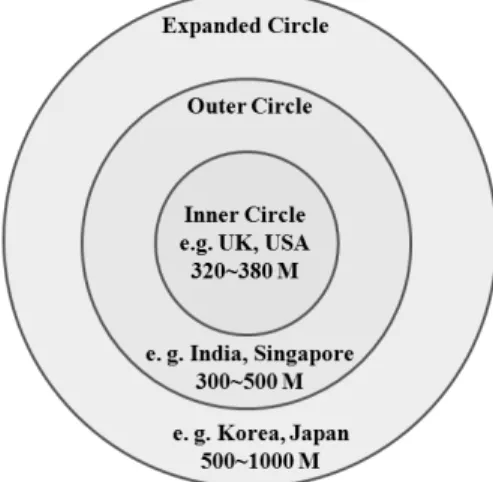
Moving away from the simple native vs. non-native distinction of English speakers, Kachru (1986) and Crystal (2003) classified the speakers into three circles as in the following figure.

Figure 2. Three circles model of English (Adapted from Crystal, 2003: 61)

Inner circle English speakers refer to residents of the UK,

Ireland, the USA, Australia, Canada, New Zealand, the Caribbean,

and South Africa where English is learned as their first language

or mother tongue due to the migration of native speakers from

the British Isles (Walker, 2010). The English speakers in the

outer circle use English as their second language, such as India,

Pakistan, Malaysia, Kenya, Tanzania, and Nigeria, due to

(2)

historical colonization by Britain or America. In the expanding circle countries, English is not used as their first, second, or official language. However, English is learned and educated among a significant amount of people for international business and communication. Korea, Japan, and China are examples to be included in this circle. Consequently, it can be said that English is acting as a lingua franca, a common language used among those speakers who have different language backgrounds.

Furthermore, many non-native speakers of English (NNSs) are moving into English speaking countries, and since European countries became united under the European Union, such citizens around the area have immigrated to different countries to seek a better life. For example, in the United Kingdom, it is unlikely that you would talk to native English speakers (NS) when you order coffee or a meal in coffee shops or restaurants. When native speakers encounter these situations when ordering, they try to accommodate their own pronunciation so that they are understood more easily by NNSs. Martin Dewey, one of the proponents of English as a lingua franca at Kings College London, told this author in a personal communication that he usually tries to change his English to achieve successful communication with NNSs who are working in London. Unlike NSs, Korean speakers might have difficulty in coping with these situations successfully because this type of conversational interface circumstance is quite different from what they have learned and experienced in English language classrooms. Students are dominantly exposed to North American or British accents without being exposed to other varieties of English accents;

furthermore, they rarely have sufficient opportunities to learn English pronunciation explicitly in classrooms. This situation more often than not leads to communication breakdown when they are in scenarios where they must communicate with NNSs.

Based on these situations, Howatt with Widdowson (2004) suggested that TESOL should be known as “Teaching English FOR Speakers of Other Languages” not of “Teaching English TO Speakers of Other Languages.” Jenkins went one step further to argue that TESOL should refer to “Teaching English OF Speakers of Other Languages.” Her main argument is that the ownership of English belongs to L2 speakers or English learners, not to native or inner-circle English speakers any more. She also suggests that NSs must try hard to understand non-native or outer- or expanding-circle speakers' English pronunciation. Quoting from the works of various researchers, Murata & Jenkins (2009) summarize that the English language has been given various nomenclatures, such as global Englishes, global language, world

English(es) (WE), English as an international language (EIL), or English as a lingua franca (ELF).

Even though these names seem to be used in the same fashion, there are big conceptual differences among them. When English is called a global language, the ownership still belongs to NSs of English and the norm of the language is mainly focused on the native or native-like proficiency. This is why David Crystal, a proponent of English as a global language, says,

“Although we need to accept non-native pronunciation norms in terms of listening comprehension, we still need to adhere to standard English pronunciation model in teaching production,” via a personal communication with the author. Conversely, when English is called an international language, the ownership does not belong to NSs. In this case, the norm of the language is mainly focused on NNSs' speech. Thus, intelligibility is usually much more emphasized in the English as an international language paradigm than in the English as a global language paradigm.

2. Issues in the Lingua Franca Core

Apart from the issue on the ownership of English, there have been many controversies over the roles of segmental and suprasegmental features in the intelligibility of English pronunciation. According to Anderson-Hsieh, Johnson & Koehler (1992) and Derwing & Munro (1997), suprasegmental features had much more crucial effect on the intelligibility of English learners' speech. That is, the more accurate the suprasegmental features are than the segmental features, the more intelligible the speech is. The post-test results after pronunciation training in these experiments showed that subjects who had more instruction of suprasegmental features showed much more improvement in the intelligibility than those who had more instruction of segmental features (Derwing & Rossiter, 2003). However, Jenkins claims that their experiments were carried out using native English listeners rather than non-native English listeners and that their results were not suitable in EIL context. After observing the communication for almost 4 years among NNSs who had different language backgrounds, she devised the lingua franca core (LFC), which is, essentially, a list of pronunciation features that must be learned in order to guarantee the intelligibility in communication among NNSs (Jenkins, 2000).

According to Jenkins’ LFC, the intelligibility between NNSs

has more priority over that between NNS and NS; therefore, she

puts more emphasis on the intelligibility than the accuracy and

(3)

accentedness. Furthermore, she notes that most segmental features are very important in LFC, but she disregarded the importance of suprasegmental features except for nuclear stress in LFC. Jenkins argued that regional accents of English learners due to suprasegmental features must be allowed because the errors of suprasegmental features do not hinder the intelligibility of international communication. These features are usually difficult to teach and learn in order to enhance the communication among NNSs, she argues. She even insists that certain features of English as a Native Language (ENL) pronunciation are detrimental to intelligibility in ELF communication. Typical examples of these detrimental elements are the use of weak forms and other features of connected speech, such as deletion and assimilation, which are usually connected with the stress timing property of the English language. This leads to the conclusion that the nuclear stress within an intonational phrase (IP) is the only important suprasegmental element in ELF communication.

In the LFC, except for a couple of phonetic features such as the replacement of [Ɵ] and [ð] with [s] and [d] and the velarization of /l/ at the syllable coda position, most of the other consonant features are important in intelligibility. For example, [Ɵɪŋ] and [ðeɪ] can be replaced by [sɪŋ] and [zeɪ] and the dark-/l/ in [mɪɫk] is not recommendable. Between the British and American accents, LFC encourages pronunciation through a word’s spelling rather than rely on a specific variety. For example, the rhotic vowel is preferred in the pronunciation of the vowel in the word, “bird” while unflapped [t] is preferred in the pronunciation of /t/ in the word, “water.” The deletion of consonants within clusters could lead to a intelligibility problem while the addition of vowels within the clusters rarely causes any problem. This could be noted, when the word “product” is pronounced as [pɒdʌk] in a Taiwanese speaker's utterance (Jenkins, 2000), it leads to an intelligibility problem while [pəɾɔdʌkʊtɔ] by a Japanese speaker rarely matters.

In terms of the vowel production, once the distinction between the vowel length is consistent, the vowel quality difference which is essential in NS communication does not cause the problem in ELF communication. It means that NNSs do not care much about the vowel quality difference, but they are sensitive to the vowel length which is the partial property of the vowel quality difference.

She also suggested accommodation skills and phonological convergence in interlanguage talk (ILT). According to this model, in ILT where learners of English with different language backgrounds engage in communication, the interlocutors try to

accommodate their pronunciation in accordance with the other interlocutors’ pronunciation where phonological convergence will take place to enhance intelligibility and communication.

Conversely, in the same-L1 talk, though phonological convergence happens in order to improve the communicative efficiency and solidarity, the speakers do not need to change their own phonological system because they are familiar with their own accent. Even within their own phonological system, they would not have any problem in communicating with each other, thus pronunciation is further fossilized.

Walker (2010) explores some of the concerns that surround the adoption of ELF and gave a number of potential benefits of an ELF approach to pronunciation. According to him, the LFC could provide the learners with a lighter workload and increased levels of achievability which in turn leads to increased learner motivation. It also helps learners hold on to their first-language identity when they speak in English. He also suggests various techniques and materials for teaching LFC.

Even though the LFC is a very attractive approach in teaching pronunciation in that it focuses more on the intelligibility than accuracy and that it pursues learnability, teachability, learner motivation and identity, the application of the LFC to a Korean context has practical problems, thus it may be prudent to redefine the LFC and its teaching techniques.

3. LFC in Korea

Some features of the LFC are quite misleading. Jenkins, for example, deliberately excluded English NSs from ELF interlocutors, and it is the same with the Vienna-Oxford International Corpus of English (VOICE, 2010). Because English NSs number more than 300 million (Crystal, 2003; Kachru, 1986), they are still important participants in English communication as NS/NNS interaction still likely transpires. Even though there are more NNSs than NSs, Korean learners of English, specifically, are more likely to have communications with NSs than with NNSs outside their L1. Even though Jenkins argues that NSs must try hard to understand the LFC of NNSs, not vice versa, the fact cannot be denied that the pronunciation of NSs has priority over that of NNSs in certain areas. Therefore, the LFC for communication only among NNSs could lead to serious communication breakdown when NS-NNS communication happens.

Jenkins’ argument that once the vowel length difference is

maintained, the vowel quality difference does not matter much

(4)

could also be a misleading concept. Specifically for Korean learners of English, the difficulty of vowel pronunciation is not just the matter of vowel length difference. For example, even though the phonetic vowel length difference before voiced/voiceless consonants can be handled by Korean learners of English, the differences between the vowels in words “leave, live”

and “seat, sit” are not only about the phonemic vowel length.

Furthermore, the difference between the vowels in words “sat, set” can not be handled by vowel length difference only. Other than vowel length differences, we can think about the constant distance between vowels in the vowel quadrant. However, Korean speakers usually overlap the distance between vowels, so unless accuracy-based pronunciation teaching is enforced, it might be difficult to acquire intelligible pronunciation.

Jenkins further implies that reduced vowels, phonological changes in connected speech, stress-based English rhythm, and word stress might not be important phonological features for NNSs, but who rather should rely more on spelling pronunciation.

It was argued by Jenkins that word stress should be removed from LFC because it is difficult to teach and learn. However, too much deviation of such prosodic features would make it difficult for NSs or even NNSs to understand NNSs' pronunciation (Munro

& Derwing, 2000). For example, misplaced stress on “normally (norMALLy)” may be misheard as “no money”; misplaced stress on “written (wriTTEN)” may be misheard as “retain”; and misplaced stress on “secondary (seCONdary)” may be misheard as

“country” (Benrabah, 1997). This happens because when a stress moves to another syllable it involves vowel quality change as well as a stress shift. Another significant anecdote is that a Korean linguist once asked a question to a NS speaker in an international linguistics conference. The Korean linguist had to repeat the same word three times and change the stress position of the word before he was understood by the NS speaker. This shows how much importance word stress has in order to avoid possible communication breakdown in English.

Jenkins’ disregard of suprasegmental features in LFC was also criticized by Dauer (2005). Dauer argued that just several English stress rules could explain the stress patterns of more than 85% of multi-syllabic English words. In addition, aspiration, vowel lengthening, and nuclear stress which are included in LFC cannot be explained without referring to word stress. He also suggested that reduced vowels and phonological changes in connected speech are important because they contribute to easing speakers’

effort and enhancing ‘non-native’ speakers’ fluency. Improving

‘non-native’ speakers’ pronunciation of suprasegmental features

led to the improved intelligibility by ‘native’ listeners (Munro &

Derwing, 2000).

An additional problem relating to Jenkins’ LFC is the misinterpretation of LFC and ILT by English teachers in Korea.

Because most English instruction takes place in a homogeneous context in Korea, rather than in multi-lingual context, it is very difficult to apply ILT model to Korean classrooms. So although communication activities among homogeneous learners might be excellent techniques in English learning, they would result in very negative effects in learners' English pronunciation due to fossilization. In Korea, Jenkins’ LFC and ILT is misinterpreted that once intelligible communication is guaranteed among

‘non-native’ homogeneous interlocutors, pronunciation is not so

significant. Therefore, while more communication activities and

tasks have been emphasized in Korean classrooms, systematic

pronunciation instruction has rarely been emphasized in Korean

secondary schools (Chung & Chung, 2008). However, this could

be a fatal flaw in English learning. The communicative activities

in Korea are only between Korean learners, not with those of

different language background, and thus what is intelligible

pronunciation between Korean learners might not be quite

understood by other NNSs or NSs. For example, word order and

the meaning of an utterance could be rebuilt once the utterance is

perceived. However, if the utterance itself is not perceived at all,

there is no way to rebuild the structure or meaning of the

utterance. Some researchers could argue that even without the

emphasis on English pronunciation, most English pronunciation by

Korean secondary school students is well understood, thus there is

cause for concern. The Korean accent of English learners is

mistakenly, but predominantly, allowed in English classrooms in

Korea because it is believed to not hinder communication and

intelligibility. However, because communication usually takes

place in the same-L1 talk in Korean classrooms, the phonological

convergence is likely to lead to the phonological fossilization than

to the LFC. Additionally, the intelligibility of Korean accent in

international communication has rarely been tested, and is paucity,

at best, of empirical and thorough studies about how much of

Korean secondary school students' English pronunciation is

intelligible. Should any intelligible pronunciation be found among

them, it would most likely be attributable to private English

instruction where systematic pronunciation instruction has been

given to students. The precondition of Jenkins’ ILT model is that

of the multi-lingual setting and thus the accommodation skills and

phonological convergence suggested by Jenkins do not mean

maintaining Korean accent but rather learning a new phonological

(5)

system which would be much closer to native English pronunciation than to Korean accented English. The target pronunciation in ILT, then, is native or native-like pronunciation, not the regional accent. Since it is difficult to apply the ILT model to Korean situation, a different effort to find alternative pronunciation instruction model is needed.

One of the solutions to teach the LFC to monolingual groups is via student recording as suggested by Walker (2010). In the recording, students can record a text and give feedback to their classmates focusing their attention on a small number of pronunciation points from the LFC and then practicing these in other activities. He also suggests an exposure to a range of ELF accents using multi-media resources. The critical problem of these approaches is that there is no interaction with non-native speakers. Peer feedback and multi-media resources do not provide the students with the ILT environment. It only possibly improves the learners’ receptive skills than productive skills.

Another misconception by Korean teachers about LFC is that most vowels and consonants in LFC are more ‘native’ or

‘native-like’ pronunciation than are understood by many teachers.

Except for a few consonantal features including dental fricatives and velarized lateral liquid, the other consonantal features are very important in ELF communication. The tense and lax vowel distinction is also very important in LFC, which is the most difficult vowel feature among Korean learners of English.

Therefore, at least in regards to segmental features, the LFC is not much different from “native” English pronunciation. Even though it is not necessary to acquire Received Pronunciation (RP) or General American (GA), learners must strive towards native-like pronunciation anyway even in the ELF context.

Finally, we cannot simply ignore socio-linguistic aspect of English pronunciation. Intelligible pronunciation is not necessarily what learners of English want to learn. Learners of English usually try to acquire standard or native-like English pronunciation. This is the same with English teachers in Korea, and is ironic in that they do not teach their pupils standard or native-like pronunciation in classrooms. This paradox came from their standpoint that the norm of English does not need to be native or native-like, but the reference model must be that of a native speaker's. Teachers need to be a native-like reference model, which is usually not possible in Korean classrooms. There are many occasions in the job market that biased preference goes toward less regionally-accented English speakers. Even in Jenkins’

(2007) survey about the descriptions of the Korean English accent by expanding-circle and native English speakers, the Korean

English accent was described as one of the most noticeable variants. The negative comments were a lot higher than the positive comments compared to other accents. It was described as

‘difficult to understand, strange, harsh, nasal, and quarrel like.’ So the accentedness as well as intelligibility are very important factors in learning English pronunciation. English learners’

accented pronunciation usually has more correlations with suprasegmental features such as intonation and speaking rate than with segmental features (Munro & Derwing, 2000; Munro &

Derwing, 2001). Therefore, improving the comprehensibility and accentedness of Korean EFL learners' pronunciation is important in international communication, which calls for more emphasis on suprasegmental features.

4. Conclusion

Jenkins' LFC should be modified and appropriately interpreted in the Korean context. Contrary to her intention, her suggestion of the LFC is much closer to “native” English speakers' pronunciation than to the Korean accent of English at least in segmental features. Suprasegmental features in English, which were disregarded by her, are also as important as segmental features to improve intelligibility. As suggested by Dauer (2006), many suprasegmental features are learnable and teachable.

Socio-linguistically, native or native-like accented English pronunciation is still generally preferred to accented English pronunciation, and thus in this paper it is concluded that English pronunciation syllabi in Korea still need to provide English learners with native-like pronunciation including suprasegmental features as a reference model.

The LFC could be allowed as long as it does not hinder

communication, and that intelligible pronunciation having a

priority over accuracy. However, intelligibility and accuracy are

not exclusive to each other as they may be addressed

simultaneously. In terms of listening, it is necessary to develop

materials which contain non-native norms. The materials should

be more authentic than before so that Korean learners of English

may successfully cope with inter-language talk. However, in terms

of production, it still needs to adhere to a native-like model

based on the argument given above. In English classrooms in

Korea, the pronunciation teaching is carried out contrary to this

concept. A native-like model and norm is given to the students in

order to improve their listening ability while fossilization is

allowed in production. Regarding L2 learners’ learning of English

rhythm, Crystal (1996) suggests that L2 learners, who have

(6)

syllable-based rhythm, would become competent in both syllable-based and stress-based speech, continuing to use syllable-based speech for local communication, as a signal of national identity, and switching to stress-based speech for international communication, as a means of ensuring intelligibility.

His suggestion could be applied to teaching other pronunciation features. Even though learners rarely reach the native-like pronunciation proficiency and the norm of English pronunciation would be LFC, the reference model or input to English learners in classrooms must move toward the native or native-like pronunciation to guarantee the intelligibility in international communication in any context, so that learners can switch between native-like norm and LFC norm when either norm is required.

References

Anderson-Hsieh, J., Johnson, J. R. & Koehler, K. (1992). “The relationship between native speaker judgments of nonnative pronunciation and deviance in segmentals, prosody, and syllable structure”, Language Learning, Vol. 42, No. 4, pp. 529-55.

Benrabah, M. (1997) “Word-stress―A source of unintelligibility in English”, International Review of Applied Linguistics, Vol. 35, No. 3, pp. 157-165.

Chung, H. & Chung, S.-H. (2008). “A needs analysis of Korean English teachers’ English pronunciation instruction”, The Journal of Modern British & American Language & Literature, Vol. 26, No. 3, pp. 129-164.

Crystal, D. (1996). “The past, present and future of English rhythm”, In M. Vaughan-Rees, Changes in pronunciation, Special Issue of Speak Out!, pp. 8-13.

Crystal, D. (1997, 2003). English as a global language. Cambridge:

Cambridge University Press.

Dauer, R. M. (2005). “The lingua franca core: A new model for pronunciation instruction?”, TESOL Quarterly, Vol. 39, No. 3, pp. 543-550.

Derwing, T. M. & Munro, M. J. (1997). “Accent, comprehensibility and intelligibility: Evidence from four L1s”, Studies in Second Language Acquisition, Vol. 19, pp. 1-16.

Derwing, T. M. & Munro, M. J. (2005). “Second language accent and pronunciation teaching: A research-based approach”, TESOL Quarterly, Vol. 39, No. 3, pp. 379-398.

Derwing, T.M. & Rossiter, M. J. (2003). “The effects of pronunciation instruction on the accuracy, fluency and

complexity of L2 accented speech”, Applied Language Learning, Vol. 13, pp. 1-18.

Howatt, A. P. R. with Widdowson, H. G. (2004). A history of English language teaching (2

nd

edition), Oxford: Oxford University Press.

Jenkins, J. (2000). The phonology of English as an international language. Oxford: Oxford University Press.

Jenkins, J. (2002). “A sociolinguistically based, empirically researched pronunciation syllabus for English as an International Language”, Applied Linguistics, Vol. 23, No. 1, 83-103.

Jenkins, J. (2007). English as a lingua franca: Attitude and identity.

Oxford: Oxford University Press.

Kachru, B. B. (1986). The sacred cows of English, English Today, Vol. 16, pp. 3-8.

Munro, M. J. & Derwing, T. M. (2000). “Foreign accent, comprehensibility, and intelligibility in the speech of second language learners”, Language Learning, Vol. 45, No. 1, pp.

73-97.

Munro, M. J. & Derwing, T. M. (2001). “Modeling perceptions of the accentedness and comprehensibility of L2 speech The role of speaking rate”, Studies on Second Language Acquisition, Vol. 23, pp. 451-468.

Murata, K. & Jenkins, J. (2009). “Introduction: Global Englishes from global perspectives”, In Murata, K. & Jenkins, J. (eds.), Global Englishes in Asian contexts: Current and future debates, pp. 1-13, London: Palgrave Macmillan.

Vienna-Oxford International Corpus of English. (2010). Retrieved from http://www.univie.ac.at/voice/.

Walker, R. (2010). Teaching the pronunciation of English as a lingua franca, Oxford: Oxford University Press.

∙Chung, Hyunsong

Department of English Education Korea National University of Education San 7, Darakri, Gangnaemyeon, Cheongwongun Chungbuk 363-791

Tel: 043-230-3554 Fax: 043-236-3554 Email: [email protected]

Research interests: Experimental phonetics, ELF 2005~present Associate Professor

PhD in Experimental Phonetics, UCL (Univ. College London)

수치

Figure 1. Countries where English is used as a first  or a second language

참조

관련 문서

Therefore, A lot of native English-speaking teachers have come to Korea to teach English.. The purpose of this study is to assess the job satisfaction of

The research for the participants shows that the animated English fairy tales did not contribute to the elementary learners' interest in English learning,

proficiency level, they enjoyed English flipped learning. Based on the study findings teaching implications in order to improve English flipped instruction for middle

Therefore, this paper is to recognize the common mistakes English learners make while using English articles and to provide helpful tips for those who teach

The difference in writing ability according to English proficiency (upper and lower) was that for students with upper English proficiency, grammar learning

The aim of this study is to explain difficulties of Korean high school students' use of English relative pronouns by the error analysis and then provide English teachers

Participants in one group (20’s) started to learn English before school and they have high proficiency of English.. The other group had participants who

This study looks at the types of learning activities preferred by native English teachers for English speaking classes, criteria that are considered important