Optimized Processing Condition of Production of Nannochloropsis oculata under Light-emitting Diode (LED) Condition
Nam Kyu Lee*
Department of Marine industry Reliability Center, Busan Techno-Park, Busan 46048, Korea Received April 25, 2017 /Revised July 17, 2017 /Accepted July 17, 2017
The 100 l culture system was made on the basis of LED light, and Nannochloropsis oculata was cultured in f/2 medium at light intensity (100 μmol/m2/s), culture temperature (20℃±1℃) and LD cycle (12 hr). As a result, the maximum biomass of 1.07 g/l was cultured as a result of 100 l mass culture at 100 μmol/m2/s and 24 mg/l nitrate concentration in LED blue (475 nm). The extraction was carried out using sonicator, homogenizer and chemical method 0.5M HCl shredding method. The contents of chlorophyll a, chlorophyll b and carotenoid were 1.6, 0.5 and 0.3 mg/g cell. When using homogenizer, it was measured at 1.0, 0.6 and 0.2 mg/g cell. The chemical breakdown method of 0.5M HCl, chlor- ophyll a, b, and carotenoid contents were measured as 0.9, 0.8, 0 mg/g cell. The highest amount of biomass during the distruption time was measured at 3.6 mg/g cell at 15 min disintegration and ace- tone, 3.6 mg/g cell of acetone, methanol, and ethanol were measured as effective solvents. Concentration was measured by using microfilter, disk type continuous centrifuge and tubular type continuous cen- trifuge were 16.0, 1.1 and 0.5 g/l, respectively. Four kinds of equipment such as hot air dryer, vacuum dryer, spray dryer and freeze dryer were tested to optimize the drying process. As a result, the recov- ery rates of spray dryer and freeze dryer were 80% and 60%.
Key words : Distruption time, freeze dryer, light intensity, microfilter, Nannochloropsis oculata
*Corresponding author
*Tel : +82-51-720-8902, Fax : +82-51-723-3320
*E-mail : [email protected]
This is an Open-Access article distributed under the terms of the Creative Commons Attribution Non-Commercial License (http://creativecommons.org/licenses/by-nc/3.0) which permits unrestricted non-commercial use, distribution, and reproduction in any medium, provided the original work is properly cited.
Journal of Life Science 2017 Vol. 27. No. 7. 754~759 DOI : https://doi.org/10.5352/JLS.2017.27.7.754
서 론
화석연료 사용의 증가는 대기중 CO2 농도가 증가해 지구온 난화 현상이 심해지는 원인으로 대두되고 에너지 자원의 고갈 로 인한 대체에너지 자원의 필요성이 증가하고 있다[11]. 산업 이 고도화 되면서 온실가스(이산화탄소, 메탄, 아산화질소, 프 레온가스) 발생량이 증가하고 이는 전 세계적으로 심각한 문 제를 야기하고 있다. 특히 2009년 환경부 발표에 따르면 CO2
는 전체 온실가스 중에서 83%(미국, 2008), 89%(한국, 2006)을 차지하고 있다. 미세조류는 빛과 CO2를 이용해 성장함으로서 이를 해결하기 위한 대안으로 부각되었고 성장속도가 빠르며 유용물질의 체내 축적하고 좁은 면적에서도 대량배양이 가능 하다[6, 9]. 전략소모량이 낮고 미세조류가 원하는 파장만을 선택적으로 사용 가능한 발광다이오드를 이용해 효과적이고 경제적인 미세조류의 대량배양이 개발되어지고 있다.
대량으로 배양된 미세조류는 바이오연료 및 다양한 산업소 재와 의약품 등 고부가가치 물질의 생산에 이용될 수 있다.
상대적으로 빠르게 산업화가 가능한 화장품, 의약품 및 사료 등으로 사용가능하며 산업화를 통해 시장에서 판매되고 있다.
본 연구에서는 사용된 Nannochloropsis oculata는 지방산 및 생리활성물질 함량이높아 바이오디젤 및 화장품 원료 등으로 이용될 수 있다[3, 7]. 이를 실제 산업용으로 이용하기 위한 저비용 고효율의 생산공정 개발이 필요하며 대량배양에서 추 출, 농축 및 건조공정 연구를 통해 경제성을 확보한 대량생산 공정의 확립에 관한 연구가 필요하다.
재료 및 방법
대량배양
100 l scale 미세조류 배양 시스템은 LED 광을 기반으로 자체 제작하였으며 Nannochloropsis oculata 배양에 사용된 배 지는 f/2 배지이며 배양온도는 20℃±1℃였다. 이때 사용된 광 도는 100 μmol/m2/s이며 반응기내 광 조사주기는 12 hr : 12 hr (light : dark)으로 명반응시 LED 광원이 사용되었다[4, 12].
추출공정
미세조류내 영양물질 추출은 물리적인 방법인 sonicator, homogenizer를 이용한 파쇄법과 화학적인 방법인 0.5M HCl 파쇄법을 이용하였다. 추출용매는 일반적으로 사용되는 ace- tone을 사용하여 영양물질을 추출 하였으며, 파쇄시간은 5 min, 추출시간은 24 hr, 추출온도는 -20℃의 조건에서 3 종류 의 추출용매(acetone, methanol and ethanol)를 활용하여 확인
Fig 1. Cell growth of N. oculata under LED wavelength 450 nm in light intensity of 100 μmol/m2/s.
Fig 2. Comparison of cell distruption method such as sonicator, homogenizer and HCl (pH2.0).
하였다.
영양물질 성분 및 함량분석
영양물질의 성분 및 함량분석은 acetone (pure solvent) 추 출 후 chlorophyll a, chlorophyll b, carotenoid 및 색소(pig- ments)의 함량을 UV-Vis spectroscopy를 이용하여 측정하였 으며, Lichtenthaler (1987)의 공식에 의거하여 산출하였다.
Lichtenthaler (1987)의 공식에 따른 함량 산출방식 Chlorophyll a (μg/ml) = 11.24× Absorbance (661.6 nm) -
2.04× Absorbance (644.8 nm)
Chlorophyll b (μg/ml) = 20.13× Absorbance (644.8 nm) - 4.19× Absorbance (661.6 nm)
Total carotenoids (μg/ml) = [1,000× Absorbance (470 nm) - 1.90× Chl. a (μg/ml) - 63.14× Chl. b (μg/ml)] / 214
농축 및 건조공정
농축은 4종류의 생산장비를 이용하였으며 tubular 및 disk type 연속원심분리기의 운전조건은 7,500 및 11,000 rpm에서 유속은 2.5, 34 l/min의 조건에서 농축하였다. 마이크로필터 및 필터프레스의 막크기는 0.45 μm를 이용해 시간당 회수율을 산출하였다. 건조공정은 4종류의 생산장비별 회수율을 축정 하였고 분무건조기는 1 hr, 열풍건조기와 진공건조기는 24 hr, 동결건조기는 48 hr 건조 후 측정하였다.
결과 및 고찰
대량배양
미세조류 대량배양 기술을 확립하기 위하여 미세조류 배양 의 다방면을 고려한 배양수조를 제작하였다. 대량배양 시 가 장 크게 고려할 점으로 미세조류에게 광 전달의 적절성 여부 를 고려해 사방면 LED 장착형으로 제작하였으며, 광 분포를 고려한 교반장치, 외부와의 오염을 차단하기 위한 에어필터 장착형 100 l 대량배양 수조를 제작하여 N. oculata의 100 l 대량배양을 실시하였다[4].
100 l 대량배양 수조에서 N. oculata 배양한 결과는 Fig. 1이 다. 배양기간 5일에 log phase에 진입하였으며 배양 16일 sta- tionary phase에 진입하였다. 앞서의 연구[10]에서 의한 최적 화 요소를 반영하여 LED blue (475nm)에서 100 μmol/m2/s의 광도와 24 mg/l의 nitrate 농도에서 100 l 대량 배양하였을 때 1.07 g/l의 최고의 생산을 보였다.
파쇄공정 최적화
미세조류는 광합성을 하는 식물플랑크톤으로서 600개 이상 의 광합성 색소를 함유하고 유용물질인 광합성 색소는 대부분 지용성 물질로 chlorophyll과 보조색소인 carotenoid 색소가
있다. 색소 물질들은 미세조류 내 엽록체 안에 존재하기 때문 에 세포파쇄공정에 대한 최적화를 하였다[2].
Nannochlopsis oculata를 Fig. 2과 같이 3가지 파쇄법을 이용 해 영양물질을 추출하여 분광광도계로 측정된 함량분석 결과 그래프이다. chlorophyll a, chlorophyll b, carotenoid 함량은 물리적인 파쇄법인 sonicator를 이용시 1.6, 0.5, 0.3 mg/g cell, homogenizer 이용시 1.0, 0.6, 0.2 mg/g cell로 측정되었다.
0.5M HCl의 화학적 파쇄법 이용시 chlorophyll a, chlorophyll b 함량은 0.9, 0.8 mg/g cell로 측정되었다.
결과적으로 sonicator파쇄법이 homogenizer파쇄법 보다 효과적인 결과를 얻었으며, 0.5M HCl 파쇄법은 carotenoid 색 소가 측정되지 않았다. 미세조류는 세포벽이 존재하기 때문에 일반적인 파쇄법의 경우 파쇄시간이 증가한다. 세포벽 파쇄는 sonicator 파쇄법이 homogenizer 파쇄법 보다 시간당 파쇄효 율이 더 효과적이다.
Sonicator 파쇄법이 cavitation 현상을 동반하는데 cav-
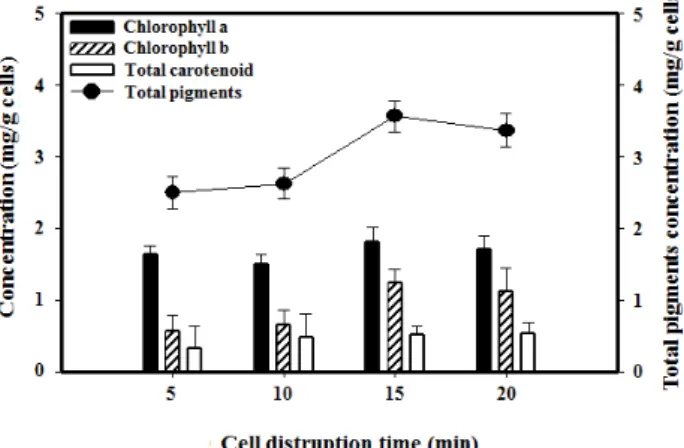
Fig 3. Comparison of cell distruption time under sonicating with 5, 10, 15 and 20 min.
Fig 4. Comparison of extraction solvent such as acetone, meth- anol and ethanol.
itation현상이란 공동현상이라는 뜻으로 높은 온도와 압력 및 자유라디칼을 형성되어 단시간에 세포파쇄가 효과적이다.
Carotenoid 색소는 낮은 pH로 인하여 측정되지 않았으며 이 는 0.5M HCl을 이용한 화학적 파쇄법이 적절하지 않았다. 그 러므로 carotenoid 색소 및 전체 색소함량이 가장 높은 soni- cator 파쇄법이 최적 파쇄법이었다.
세포 파쇄시간 최적화를 위해 Fig. 3와 같이 파쇄시간(5, 10, 15, 20 min)에 따라 추출되는 유용물질 함량을 분광광도계로 측정한 결과이다.
Sonicator 5 min 파쇄 시 chlorophyll a, chlorophyll b, car- otenoid 함량은 1.6, 0.6, 0.3 mg/g cell이며, 10 min 파쇄는 1.5, 0.6, 0.5 mg/g cell, 15 min 파쇄는 1.8, 1.2, 0.5 mg/g cell, 20 min 파쇄는 1.7, 1.1, 0.5 mg/g cell로 측정되었다. 파쇄시간 에 따른 전체 영양물질 함량은 각각 0.3, 2.6, 3.6, 3.4 mg/g cell로 측정되었다. 파쇄시간당 추출되는 영양물질이 가장 높 은 시간은 15 min 파쇄인 3.6 mg/g cell로 측정되었고, 20 min 파쇄와 유의적인 차이가 없었다.
추출공정 최적화
추출용매의 최적화를 위해 Fig. 4와 같이 미세조류 내 유용 물질인 광합성 색소의 추출용매로서 acetone, methanol, etha- nol의 3가지 용매에 대한 추출효율 비교 결과이다.
Chlorophyll의 추출함량은 acetone 용매에서 1.8 mg/g cell, methanol과 ethanol은 1.0 mg/g cell이 측정되었다. car- otenoid 함량은 acetone에서 0.6 mg/g cell, methanol과 etha- nol은 0.4 mg/g cell로 측정되었다. 영양물질들은 solubility parameter에 의해서 용매의 용해도가 달라진다. Solubility parameter는 액체 간 혼합의 척도가 되는 액체의 특성으로 δ값이 가까운 액체가 친화력이 강하다. Acetone의 δ값은 19.7, methanol은 29.7, ethanol은 26.2이며 영양물질의 δ값은 18~20 으로 acetone과 친화력이 크며 3.6 mg/g cell로 acetone 용매 가 최적 추출 용매이다.
영양성분분석 결과
Nannochloropsis oculata는 영양물질 중 색소로서 astax- anthin, cantaxanthin함량이 높고 타 종에 비해 chlorophyll a 함량이 높다고 보고되어 있다[1]. 먹이생물로 유명한 N. ocula- ta는 C14~C22의 지방산이 풍부하여 biodiesel로서 이용되고 있으며 EPA 및 DHA등 omega-3 함량이 높아 먹이생물로서도 이용될 수 있는 유용한 미세조류이다. 미세조류는 최적조건 하에서는 영양물질이 적고 성장이 빠르나 성장저해조건에서 는 성장이 저해되지만 영양물질이 강화된다. 본 연구에서는 최적 추출 공정법 과정을 거쳐 HPLC를 이용해 LED 조건과 성장저해조건에서 N. oculata의 영양물질 성분 및 함량(색소, omega-3 지방산)을 측정하였다[5].
미세조류 N. oculata는 강화된 영양물질 측정을 위해 광 성 장저해조건인 blue (450nm)파장에서 2일간 배양후 측정되었 으며[8], Table 1은 GC를 이용하여 영양물질(Omega-3) 지방 산 성분 및 함량을 분석한 결과이다. 전체 omega-3 지방산 함량은 1.97 mg/g cell로 측정되었으며 EPA 및 DHA 함량은 큰 차이가 없었다. 미세조류 N. oculata의 영양물질을 강화시키 기 위해 blue (475 nm) 파장을 이용한 광 성장저해조건을 주어 2일 배양 후 강화된 영양물질을 측정하였다[8].
Table 2의 결과에 따르면 green (520 nm)를 이용한 광 성장 저해조건 하에서 2일간 배양하였을 때 cantaxanthin과 chlor- ophyll a는 blue (475 nm)보다 4.4, 32.4 mg/g cell로 측정되었 고 총 함량 또한 42.5 mg/g cell로 약 52% 농도가 증가하였음 을 확인 하였다. 또한 omega-3 지방산인 Eicosapentaenoic acid (EPA), Docosahexaenoic acid (DHA)함량은 green (520 nm) 2일간 배양 하였을 때 EPA 및 DHA 함량이 다량 증가하 였으며, 총 함량 4.72 mg/g cell로 42% 증가함을 확인할 수 있었다. LED 광 성장저해조건 하에서 색소물질의 특이점은 astaxanthin 함량이 증가하지 않은 점이다. Astaxanthin의 색 소는 blue-green 파장을 흡수하여 성장에너지로 사용된다. 그 러므로 green (520 nm) 2일간 배양하였을 때 astaxanthin 색소
Table 1. Pigment and Omega-3 contents of N. oculata under LED blue 475 nm
Species Pigments and Omega-3 Contents
(mg/g cell)
Total contents (mg/g cell)
N. oculata
Pigments
Astaxanthin Cantaxanthin Chlorophyll a Chlorophyll b
0.3±0.1 2.2±0.1 17.1±0.2 2.7±0.1
22.3±0.5
Omega-3 Eicosapentaenoic acid (EPA)
Docosahexaenoic acid (DHA)
0.95±0.01
1.02±0.01 1.97±0.02
Table 2. Pigment and Omega-3 contents of N. oculata under LED green 520 nm
Species Pigments and Omega-3 Contents
(mg/g cell)
Total contents (mg/g cell)
N. oculata
Pigments
Astaxanthin Cantaxanthin Chlorophyll a Chlorophyll b
0.3±0.1 4.4±0.1 32.4±0.1 5.4±0.1
42.5±0.4
Omega-3 Eicosapentaenoic acid (EPA)
Docosahexaenoic acid (DHA)
1.52±0.01
3.20±0.01 4.72±0.02
Table 3. Yield of concentration equipment under continuous centrifuge, microfilter and filterpress
Equipment Volume
(kg)
Time (hr)
Yield (g/l) Tubular type continuous
centrifuge 0.5 6.5 0.5
Disk type continuous
centrifuge 1.1 1 1.1
Microfilter 0.8 1.5 16.0
Filetpress 0.5 -
는 여전히 빛을 흡수하고 있으며 이 파장영역을 흡수하지 못 하는 cantaxanthin과 chlorophyll a가 증가 한 것으로 보이며, astaxanthin의 흡수영역 반대 파장인 red (600~700 nm)에서 파장을 비춘다면 cantaxanthin, chlorophyll a 함량보다 astax- anthin 함량이 더 강화될 것이다.
농축공정 최적화
앞선 연구[13]에서 현재 가장 최적화된 산업적인 분리건조 공정은 연속원심분리법을 대량 수확 방법으로 주로 사용하고 있으며, 100 l LED 배양수조를 이용해 미세조류 대량배양 및 생물전환 유도 후 유용물질의 농축 및 회수 단계에서의 생산 성과 경제성을 검토를 위해 산업용으로 널리 이용되며 대량으 로 대량처리가 가능한 2종류의 연속원심분리장비(tubular type, disk type), 마이크로필터, 필터프레스를 이용하여 각 장 비별 최적 공정을 확립을 위해 미세조류 3 ton을 배양하여 시 간당 회수율을 산출하여 산업화단계에서 편이성과 작성시간, 유지비용, 작업난이도 등을 종합적으로 고려하였다. 구매비용 및 유지가동 측면에선 disk type 연속원심분리가 가장 고가이 며, tubular type 연속원심분리기가 가장 저렴하였다. 마이크 로필터 유지가동 및 작업난이도는 낮았으나 구매비용은 중간 수준이었으며 필터프레스는 모든면에서 중간수준의 장단점 을 가지고 있었다.
4종의 장비를 이용하여 시험한 결과 마이크로필터, disk type 연속원심분리기, Tubular type 연속원심분리기의 경우 16.0, 1.1, 0.5 g/l 의 순으로 시간당 수율을 확인하였으며 산업 화 측면을 구매비용을 제외하면 유지보수 및 가동비용이 저렴
하고 작업난이도가 낮은 편으로 최적의 조건으로 확인되었다.
Tubular type 및 disk type 연속원심분리기는 각각 11,000, 7,500의 rpm에서 2.5, 3.4 l/min의 유속으로 1 ton을 운전하였 고 microfilter와 필터프레스는 0.45 µm 필터로 0.05 ton 운전 하였으며, 이때 microfilter의 유속은 0.04 l/min, 압력은 1.5 bar에서 진행하였다.
Table 3과 같이 Tubular type 연속원심분리기는 소요시간 6.5 hr, 수율 0.5 g/l로 가장 낮았고 disk type 연속원심분리기 는 소요시간 1 hr, 수율 1.1 g/l로 확인되었으나 비용면에서 고가이며, Microfilter는 1.5 hr의 소요시간에 16.0 g/l 의 수율 로 가장 높게 측정되었으며 구매비용을 제외한 유지보수 및 가동 비용이 저렴하고 작업난이도가 낮아 가장 효율적인 장비 이며 필터프레스는 소요시간이 0.5 hr로 가장 단 시간에 회수 가 가능하나 샘플 소실 과다였다.
Table 4. Comparison of yield under drying equipment (hot air dryer, vacuum dryer, spray dryer and freeze dryer) for dry time (24 hr)
Equipment Sample volume
(kg)
Dextrine (kg)
Dry time (hr)
Volume (kg)
Recovery rate (%)
Hot air dryer 0.5 - 24 0.1 20
Vacuum dryer 0.5 - 24 0.08 16
Spray dryer 0.5
0 0.3 0.5
1 1 1
0.04 0.05 0.4
8 10 80
Freeze dryer 0.5 - 48 0.3 60
Table 5. Comparison of yield under temperature (set value : -40~40℃) condition in freeze dryer
Temp. SV1
(℃)
SV2 (℃)
SV3 (℃)
SV4 (℃)
SV5 (℃)
SV6 (℃)
SV7 (℃)
SV8 (℃)
SV9 (℃)
Yield (%) 1
2 3 4
40 -10 -40 -40
40 0 -30 -30
40 10 -20 -20
-10 20 -10 -10
0 30 0 0
10 40 10 10
20 40 20 20
30 40 25 30
40 40 25 40
46 48 50 60 SV = Set Value (set temp.)
건조공정 최적화
Table 4와 같이 건조공정 최적화를 위하여 4종(열풍건조기, 진공건조기, 분무건조기, 동결건조기) 시생산설비를 이용해 각 장비별 운전조건을 설정하고, 동일한 배양액을 이용하여 장비가동 후 미세조류의 시간당 회수율을 산출하여 비교하였 으며 농축 및 회수공정과 동일하게 구매비용, 유지 및 가동비 용, 작업난이도를 고려하였다.
각 장비 별 건조시간을 측정한 결과 분무건조기 1 hr, 열풍 건조기와 진공건조기는 24 hr, 동결건조기는 48 hr으로 측정하 였으며 각 장비 별 동일한 샘플양에서 회수량 및 회수율을 측정하였을 때 분무건조기는 Dextrin 0.5 kg이 첨가되면 회수 율이 80% 이지만 순도가 떨어지므로 최적장비로는 부적합하 였으며 동결건조기 회수율은 60%로 측정되었다.
Table 5와 같이 가장 우수한 건조 회수율을 보였던 동결건 조 온도 설정 4가지 방법에 따라 샘플 0.5 kg으로 설정하여 최종 회수율 측정결과에 따라 최적온도(-40~40℃)을 최적화 하였다.
References
1. Aflalo, C., Meshulam, Y., Zarka, A. and Boussiba, S. 2007.
On the relative efficiency of two-versus one-stage pro- duction of astaxanthin by the green alga Haematococcus pluvialis. Biotechnol. Bioeng. 98, 300-305.
2. Chojnacka, K. and Noworyta, A. 2004. Evaluation of Spirulina sp. growth in photoautotrophic, heterotrophic and mixotrophic cultures. Enzym. Microb. Technol. 34, 461-465.
3. Chiu, S. Y., Kao, C. Y., Tsai, M. T., Ong, S. C., Chen, C.
H. and Lin, C. S. 2009. Lipid accumulation and CO2 uti- lization of Nannochloropsis oculata in response to CO2
aeration. Bioresour. Technol. 100, 833-838.
4. Converti, A., Casazza, A. A., Ortiz, E. Y., Perego, P. and Del, B. M. Effect of temperature and nitrogen concentration on the growth and lipid content of Nannochloropsis oculata and Chlorella vulgaris for biodiesel production. Chem. Eng.
Process. 48, 1146- 1151.
5. Calvalho, A. P., Silva, S. O., Baptista, J. M. and Malcata, X. F. 2011. Light requirements in microalgal photo- bioreactor: an overview of biophotonic aspects. Appl.
Microbiol. Biotechnol. 89, 1275-1288.
6. Go, S. G., Lee, S. J., Jeong, G. T. and Kim, S. K. 2012. Factors affecting the growth and the oil accumulation of marine mi- croalgae, Tetraselmissuecica. Bioprocess. Biosyst. Eng. 35, 145- 150.
7. Huang, G. H., Chen, F., Wei, D., Zhang, X. W. and Chen, G. 2010. Biodiesel production by microalgal biotechnology.
Appl. Energy 87, 38-46.
8. Korbee, N., Figureroa, F. L. and Aguilera, J. 2005. Effect of light quality on the accumulation of photosynthetic pig- ments, proteins and mycosporine-like aminoacids in the red alga Porphyra leucosticte (Bangilales, Rodophyta). J. Photo- chem. Photobiol. B. Biol. 80, 71-78.
9. Malcata, F. X. 2011. Micro algae and biofuels: a promising partnership. Trands Biotechnol. 29, 1-8.
10. Pal, D., Goldberg, I., Cohen, Z. and Boussiba, S. 2011. The effect of light, salinity, and nitrogen availability on lipid pro- duction by Nannochloropsis sp. Appl. Microbiol. Biotechnol. 90, 1429-1441.
11. Shafiee, S. and Topal, E. 2010. A long-term view of world- wide fossil fuel prices. Appl. Energy 87, 988-1000.
초록:LED배양조건에서 미세조류 Nannochloropsis oculata의 생산 효율성을 높이는 공정 최적화
이남규*
((재)부산테크노파크 해양산업신뢰성센터)
100 l scale 미세조류 배양 시스템은 LED 광을 기반으로 자체 제작하였으며 Nannochloropsis oculata를 f/2 me- dium에서 광도(100 μmol/m2/s), 배양온도(20℃±1℃), LD cycle (12 hr)으로 배양하였다. 그 결과 LED blue (475 nm)에서 100 μmol/m2/s의 광도, 24 mg/l의 nitrate 농도에서 100 l 대량배양 결과 최대 biomass인 1.07 g/l를 배양하였다. 이렇게 배양된 미세조류에서 유용물질을 추출의 위한 추출방법을 확보하고 나아가 산물의 추출, 농축 및 건조공정 기술을 최적화하고자 하였다. 추출은 물리적인 방법인 sonicator, homogenizer를 이용한 파쇄법과 화학적인 방법인 0.5M HCl 파쇄법을 이용한 결과 chlorophyll a, chlorophyll b, carotenoid 함량은 물리적인 파쇄 법인 sonicator를 이용 시 1.6, 0.5, 0.3 mg/g cell, homogenizer 이용 시 1.0, 0.6, 0.2 mg/g cell로 측정되었다. 0.5M HCl의 화학적 파쇄법 이용 시 chlorophyll a, chlorophyll b 함량은 0.9, 0.8 mg/g cell으로 측정되었다. 파쇄시간당 추출되는 영양물질이 가장 높은 시간은 15 min 파쇄 시 3.6 mg/g cell로 측정되었으며 acetone, methanol, ethanol 의 3가지 용매 중 acetone이 3.6 mg/g cell로 효과적이 용매로 측정되었다. 농축은 2종류의 연속원심분리장비 (tubular type, disk type), 마이크로필터, 필터프레스 4종 장비를 이용하여 시험한 결과 마이크로필터, disk type 연속원심분리기, Tubular type 연속원심분리기의 경우 16.0, 1.1, 0.5 g/l의 순으로 시간당 수율을 확인하였다. 건조 공정 최적화를 위하여 열풍건조기, 진공건조기, 분무건조기, 동결건조기 등의 4종 시생산설비를 이용해 미세조류 의 시간당 회수율 분무건조기는 Dextrin 0.5 kg이 첨가되면 회수율이 80%이지만 순도가 떨어졌고 동결건조기 회 수율은 60%로 측정되었다.
12. Palanichamy, S. and Rani, V. 2004. Observations on the long term preservation and culture of the marine microalga, Nannochloropsis oculata, J. Mar. Biol. Ass. India 46, 98-103.
13. Kang, D. H., Heo, S. J., Oh, C. H., Ju, S. J., Jeon, S. M., Choi,
H. W., Noh, J. H., Park, S. H. and Kim, T. Y. 2012. A review on major factors for miciroalgae biofuel commercialization.
Ocean Polar Res. 34, 365-384.