• 검색 결과가 없습니다.

Production of Tween 80-inducing Esterase by Acinetobacter sp. B1 Using Response Surface Methodology

N/A
N/A
Protected

Academic year: 2021

Share "Production of Tween 80-inducing Esterase by Acinetobacter sp. B1 Using Response Surface Methodology"

Copied!
9
0
0

로드 중.... (전체 텍스트 보기)

전체 글

(1)

Production of Tween 80-inducing Esterase by Acinetobacter sp. B1 Using Response Surface Methodology

Peiyu Ma

1

, Yuqi Li

1#

, Chensi Miao

1

, Yunpeng Sun

1

, Chunhui Liu

2

, and Huijuan Li

1

*

1

Department of Bioengineering, College of Chemical and Environmental Engineering, Shandong University of Science and Technology, Qingdao 266590, P.R. China

2

Key Laboratory of Chemical Biology (Ministry of Education), Institute of Biochemical and Biotechnological Drugs, School of Pharmaceutical Sciences, Shandong University, Jinan 250012, P.R. China

Received: August 27, 2018 / Revised: October 16, 2018 / Accepted: October 18, 2018

Introduction

Esterase (EC 3.1.1.1) catalyzes the cleavage and for- mation of ester bonds with short-chain monoesters (C ≤ 10), including esterification, interesterification and transesterification [1]. Esterase exhibits higher specific- ity of substrate, region and chirality, which are widely applied in formulation of detergents, resolution of racemic mixtures, synthesis of food ingredients [2, 3].

Esterase is widely distributed in animals, plants and microorganisms. Microbial enzymes are superior to enzymes from plant and animal because microorgan-

isms are easy to scale-up culture and genetic manipula- tion [4]. However, higher production cost is the main obstacle limiting the industrial application of enzyme.

Although enzyme production is mainly related to the inherent properties of microorganism or strain, approxi- mately 30 −40% of the production cost is related to the medium composition (carbon and nitrogen source, pH and inducer) and culture condition (temperature, agita- tion, inoculum age and size) [5]. Traditional one-vari- able-at-a-time is time-consuming and tedious, can lead to misinterpretation of results [6, 7]. In order to over- come these shortages, statistical experimental designs are widely applied for the optimization fermentation and process. The Plackett-Burman (PB) design and response surface methodology (RSM) are the most popular experi- ment design. The PB design screens the significant fac- Esterase produced by Acinetobacter sp. B1 (strain B1) was optimized by means of one-variable-at-a-time and response surface methodologies. Results of the one-variable-at-a-time experiment showed that Tween 80 significantly increased esterase production of strain B1. The addition of Tween 80 to the culture medium increased the biomass and esterase activity of strain B1, stimulated content of total extracellular protein, and enhanced the oleic acid (C18:1) composition in the cell membrane of strain B1. The influence of eight culture variables on esterase production was evaluated by Plackett-Burman design. Results showed that Tween 80, pH, and K

2

HPO

4

significantly affected the esterase production of strain B1. Tween 80, pH, and K

2

HPO

4

were further optimized by central composite design. Under the optimized conditions (w/v, soluble starch 2.5%, tryptone 1.5%, Tween 80 0.8%, K

2

HPO

4

0.5%, NaCl 0.5%, pH 8.0, inoculum size 1%, and inoculum age 24 h), the maximum esterase activity of strain B1 was 152.13 U/ml, which was 10-fold higher than that of non-optimization after 36 h cultivation.

Keywords: Acinetobacter, esterase, Tween 80, response surface methodology

*Corresponding author Tel: +86-532-86057813

E-mail: [email protected] / [email protected]

© 2019, The Korean Society for Microbiology and Biotechnology

(2)

tors from a large number of variables. RSM is a collection of statistical techniques that is useful for designing experiments, building models, evaluating the effects of different factors and searching for optimal con- ditions of selected factors for desirable responses [8].

The addition of chemical inducer into the medium is a more effective strategy for improving the production of enzymes or secondary metabolites [9 −11]. Inducers include vegetable seed oil, fatty acid, organic solvent and surfactants [11]. Among surfactants, Tween 80 (a non- ionic surfactant, polyethylene glycol sorbitan monooleate) exhibits a remarkable stimulating effect on enzymes or exopolysaccharides (EPS) [9, 12 −16]. The addition of Tween 80 in cultures of Thermomyces lanuginosus improved the α-amylase activity with a 2.7-fold [12].

Tween 80 could increase the activity of amylase, car- boxymethyl cellulose enzyme (CMCase) and xylanase of Penicillium simplicissimum isolated from compost [9].

EPS production in Cordyceps sinensis Cs-HK1 was markedly increased two-fold at 1.5% (w/v) Tween 80, which was probably related to the stimulation of EPS biosynthesis by Tween 80 [15]. It was reported that the EPS increase brought by Tween 80 was highly attributed to glucosyltransferase activity and fatty acid composition [14, 16]. However, a little information is available about effect of Tween 80 on esterase produc- tion.

In this study, one-variable-at-a-time and RSM experi- ments were conducted to enhance the esterase produc- tion of strain B1. The results of inducers showed that Tween 80 has a significant increase on esterase activity.

Effect of Tween 80 on esterase was explored by measur- ing esterase activity, biomass, the content of extracellu- lar protein and fatty acid composition. Based on the results of one-variable-at-a-time, PB design and CCD was further conducted to screen the significant factors and determine the optimal level of screened significant factors in order to enhance the esterase production of strain B1.

Materials and Methods

Microorganism and medium

The strain B1 (Acinetobacter sp. B1) was isolated from oil-polluted sea-water samples and stored in our labo- ratory. The basal fermentation medium was as follows

(w/v): 0.5% glucose, 1.0% peptone, 0.5% NaCl, 0.1%

K

2

HPO

4

.

Esterase assay

Esterase assay was determined by using spectrophoto- metric assay as described by Zhang et al. [17] with minor modification. The reaction mixture contained 1 ml of 50 mM Tris-HCl buffer (pH8.0), 30 μl of 10 mM p-nitrophe- nyl butyrate (substrate) and 0.3 ml of cell-free superna- tant with appropriate concentration. After reaction mixture was incubated for 10 min at 40 ℃, the reaction was terminated by the addition of 150 μl 20% (w/v) sodium dodecyl sulfate (SDS). The amount of released p- nitrophenol was measured by its absorbance at 405 nm.

One unit of enzyme was defined as the amount of enzyme that releases 1 μmol p-nitrophenol per minute.

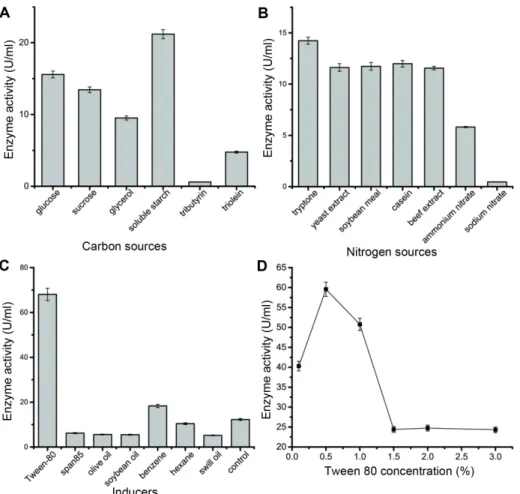
Screening of factors effecting esterase production In the present study, esterase production by strain B1 was optimized with different nutrients (carbon and nitrogen sources, inducers, the concentration of the suit- able inducer). Various carbon sources including glucose, sucrose, glycerol, soluble starch, tributyrin and triolein (w/v, 0.5%) replaced glucose of the basal fermentation medium to determine their influence on esterase produc- tion. Correspondingly, the screened nitrogen sources were tryptone, yeast extract, soybean meal, casein, beef extract, NH

4

NO

3

and NaNO

3

. The medium of suitable carbon and nitrogen source was supplemented with var- ious inducers (Tween 80, span 85, olive oil, soybean oil, benzene, hexane and swill oil (w/v, 1%)). The optimal concentration of the suitable inducer was investigated from 0.1% to 3.0% (w/v). The cell-free supernatants of strain B1 were measured for esterase activity after strain B1 was cultivated for 48 h at 170 rpm and 30 ℃.

Influence of Tween 80 on biomass, esterase production, protein content and specific activity of strain B1

To assess whether Tween 80 acts as a carbon source,

strain B1 was inoculated in the basal fermentation

medium with glucose and Tween 80, respectively. The

fermentation broth was sampled every 12 h and centrif-

ugated to measure the biomass and esterase production

of strain B1. The cell pellets was washed twice with dis-

tilled water and dried at 80 ℃ to a constant weight for

the determination of biomass. The cell-free supernatants

(3)

were used for measuring esterase activity as described above.

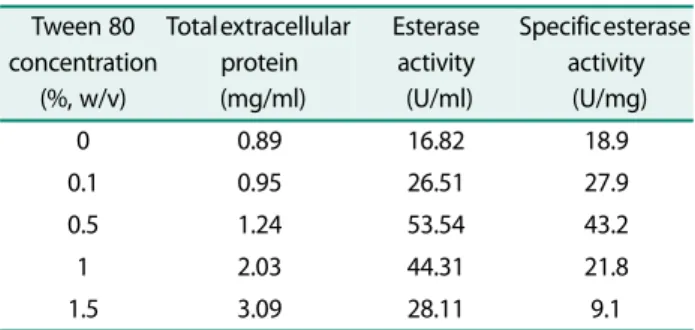
Strain B1 was inoculated in the basal fermentation medium containing different concentrations of Tween 80 (w/v, 0.1, 0.5, 1.0, 1.5%), without the addition of Tween 80 as control. After strain B1 was cultivated for 48 h at 170 rpm and 30 ℃, the protein content of cell-free super- natants was determined by the Bradford method with bovine serum albumin as standard. The cell-free super- natant of strain B1 was measured by esterase activity as described above.

Effect Tween 80 on fatty acid composition

The strain B1 was inoculated into the basal fermenta- tion medium with and without Tween 80, respectively.

After strain B1 was cultivated for 36 h at 30 ℃ and 170 rpm, cell pellets washed twice with distilled water were freeze-dried and sent to Shanghai Public Health Clinical Center of Fudan university to analyze the fatty acids.

Screening of significant factors using Plackett-Burman design

The Plackett-Burman (PB) design is an efficient way to screen the most significant variables affecting the enzyme production among a large number of process variables. Eight variables (soluble starch, tryptone, Tween 80, pH, NaCl, K

2

HPO

4

, inoculum size and inocu- lum age) were chosen to screen the main factors. Every variable was tested at two concentrations, the high level (+1) and the low level (-1). PB design allows the investi- gation of N variables in at least N+1 experiments [6].

Based on the PB design matrix, twelve experiments were conducted (Table S1). The esterase activity were measured in the withdrawn samples and acted as the responses, which were subjected to compatible analysis and regression coefficients. PB design is based on the first order model, Y = β

0

+ Σ β

i

χ

i

(where Y is the response (esterase activity), β

0

is the model intercept and β

i

is the linear coefficient and χ

i

is the level of the independent variable). The model is used to screen and evaluate the significant factors that influence the response [18].

According to the regression analysis of variables, the sig- nificant factors (p < 0.05) for esterase activity were fur- ther optimized by the central composite design (CCD).

Optimization by central composite design

Based on the results of PB design, the factors (Tween 80, pH and K

2

HPO

4

) exhibited the highest regression coefficients, indicating that these factors significantly influenced on esterase production. The optimal level of the significant variables (Tween 80, pH and K

2

HPO

4

) was determined by CCD in order to enhance the ester- ase production of strain B1. Each variable was tested in five different levels: lowest (-1.68), low (-1), middle (0), high (+1) and highest (+1.68). Table S2 represented the design matrix of a 20-trials experiment. The esterase production was analyzed using a second-order polyno- mial equation and the data were fitted into the equation by multiple regression procedure. The model equation used for the analysis is given below, Y = β

0

+ Σ β

i

X

i

+

Σ β

ii

X

i2

+ Σ β

ij

X

i

X

j

(In this equation, Y being the response (esterase activity), X

i

and X

j

representing the indepen- dent coded variables, β

0

representing the intercept term, β

i

representing the linear coefficient, β

ii

representing the squared coefficient, and β

ij

representing the interaction coefficient). The quality of fit of the second-order model equation was expressed by the coefficient R

2

and its sta- tistical significance.

Statistical analysis

The Design-Expert Software (Version 8.0.6.1) was used for the regression analysis of obtained data and plotting the response surface graphs. Statistical analysis of the model was performed to evaluate the analysis of variance (ANOVA).

Results and Discussion

Evaluation of the factors affecting esterase activity

Different strain has its own specific culture conditions

for maximum enzyme production. Carbon and nitrogen

sources of fermentation medium play a significant role

in enzyme production. The effects of various carbon and

nitrogen sources on esterase activity were tested. Higher

esterase activity was observed in different sugars (soluble

starch (21.19 U/ml), glucose (15.58 U/ml) and sucrose

(13.44 U/ml)) (Fig. 1A). In earlier reports, glucose [19],

fructose [20], sucrose [6], lactose [1] and soluble starch

[7] were the suitable sugar for the lipase/esterase pro-

duction. In the present study, tributyrin supplemented

(4)

in the LB agar medium was conducted to screen ester- ase-producing strain according to the transparent zone of clone. However, the lowest esterase production (0.56 U/ml) was observed in the medium supplied tribu- tyrin (Fig. 1A), which indicated that tributyrin inhibited esterase activity of strain B1. This result was accorded with the results of Esakkiraj et al. [20]. However, tribu- tylin improved the esterase activity of Lactobacillus casei CL96 by 2.5-fold, compared to the control [1].

Among the added nitrogen sources, the highest ester- ase activity of strain B1 was the medium containing tryptone (14.23 U/ml), followed by yeast extract (11.62 U/ml), soybean meal (11.73 U/ml), casein (11.99 U/ml) and beef extract (11.56 U/ml) (Fig. 1B). A similar result was reported that yeast extract [7], peptone and soy bean flour [6] stimulated the esterase/lipase production.

Kudanga et al. reported that casein was a good source

for esterase production by Aureobasidium pullulans [21]. Corn steep liquor (waste product of corn processing) was reported to increase recombinant esterase produc- tion [22]. The organic nitrogen source composition is complex and contains trace elements for the growth and metabolism of microorganisms, which benefits for the enzyme production [7]. However, weak esterase produc- tion was observed in the presence of inorganic nitrogen source, sodium nitrate (5.81 U/ml) and ammonium nitrate (0.46 U/ml).

A total of 7 stimulatory agents in 3 chemical categories were added into the culture medium. They include (1) oils (olive oil, soybean oil and swill oil), (2) organic sol- vents (benzene, hexane), (3) surfactants (span 85, Tween 80). Compared with the control, the addition of these agents (olive oil, soybean oil, swill oil, span85 and hex- ane) into the culture medium inhibited the esterase

Fig. 1. Evaluation of the factors affecting esterase activity of Acinetobacter sp. B1 (strain B1). (A) Effect of different carbon

sources, (B) Effect of different nitrogen sources, (C) Effect of different inducers, (D) Optimal concentration of Tween 80. The cell-free

supernatants were used for measuring the esterase activity after strain B1 was cultivated in the culture medium for 48 h at 170 rpm

and 30 ℃. All the data are given mean ± SD, n = 3.

(5)

activity (<10 U/ml) (Fig. 1C). The esterase activity was 18.32 U/ml in the medium containing 1% benzene, being slightly higher than that of the control (12.28 U/ml), which indicated that strain B1 could endure benzene.

However, Tween 80 showed an obvious stimulating effect on esterase activity (Fig. 1C). Esterase activity of strain B1 increased by 5.5 fold (59.57 U/ml) than that of control when 0.5% Tween 80 was added to the fermenta- tion medium (Fig. 1D). However, higher Tween 80 con- centration didn’t improve the esterase activity, which was accorded with the results of Byreddy et al. [23]. It was reported that Tween 80 as inducer increased the enzyme activity and EPS [9 −13]. Except Tween 80, tributylin [1] and glycerol [19] were applied for lipase/

esterase inducer.

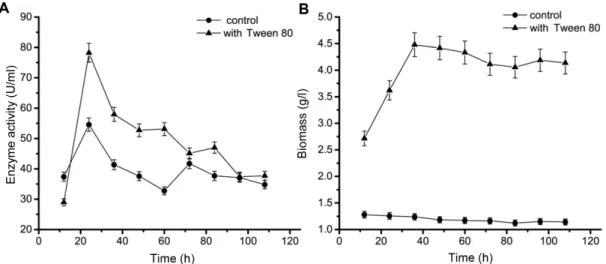
Effect of Tween 80 on esterase production by strain B1 To evaluate effect of Tween 80 on the growth and esterase activity of strain B1, glucose of the basal fer- mentation medium was replaced by Tween 80. The bio- mass and esterase of strain B1 cultivated in the medium containing Tween 80 were higher 1.43-fold (4.48 g/l) and 3.61-fold (78.24 U/ml) than that of control (glucose as carbon source) after 36 h-fermentation, respectively (Fig.

2). These data are coincided with observations reported by Zeng et al. [9] and Byreddy et al. [23]. The addition of Tween 80 in the medium increased activities of extracel-

lular enzymes (amylase, carboxymethyl cellulose and xylanase) and biomass of Penicillium simplicissimum [9], lipase production and biomass of Schizochytrium S31 [23]. Increase of biomass indicated that Tween 80 might be served as extra carbon source, which was accorded with the results of Sidhu et al. [24]. However, Sheng et al. [14] reported that Tween 80 increased pullulan production and glucosyltransferase activity, but had no effect on biomass of Aureobasidium pullu- lans, which indicated that Tween 80 wasn’t degraded to act as extra carbon source. Therefore, the function of Tween 80 was diverse.

Table 1 showed the effect of Tween 80 on extracellular protein and esterase activity of strain B1. Different con- centrations of Tween 80 were added into the basal fer- mentation medium. The amount of total extracellular protein was obviously elevated with the increase of Tween 80 concentration. Compared to the control, a 3.49-fold increase of extracellular protein was observed at 1.5% (w/v) Tween 80 supplied the medium (Table 1), which indicated Tween 80 stimulated the total protein secretion of strain B1. Compared with other concentra- tions of Tween 80, the addition of 0.5% Tween 80 in the medium significantly enhanced the esterase activity (59.57 U/ml) (Fig. 1D) and specific esterase activity (43.2 U/mg) (Table 1). These data indicated that effect of Tween 80 not only stimulated the secretion of total pro-

Fig. 2. Effect of Tween 80 on the esterase activity (A) and biomass (B) of Acinetobacter sp. B1 (strain B1) cultivated the basal

medium.

The experimental group (carbon source being 0.5% Tween 80).

The control group (carbon source being 0.5% glu-

cose). The strain B1 were cultivated in the corresponding medium at 170 rpm and 30 ℃, and sampled every 12 h. The cell-free super-

natants were used for measuring the esterase activity. The cell pellets was washed twice with distilled water and dried at 80 ℃ to

a constant weight for the determination of biomass. All the data are given mean ± SD, n = 3.

(6)

tein, but also enhance the enzyme activity in this study.

A similar finding was observed by Arnesen et al. [12], which reported that the addition of Tween 80 stimulated the secretion of total extracellular protein (6-fold) and increased the α-amylase (2.7-fold) of Thermomyces lanuginosus.

The major fatty acid components of strain B1 were investigated in the fermented medium supplemented Tween 80 or without. Table S3 showed that the major fatty acids included palmitic acid (C16:0), palmitoleic acid (C16:1), stearic acid (C18:0) and oleic acid (C18:1).

The ratios of palmitic acid (C16:0) and stearic acid (C18:0) weren’t obviously different when strain B1 was cultured in the medium with or without Tween 80. How- ever, the ratio of oleic acid (C18:1) and unsaturated/satu- rated fatty acids in the cell lipid was significantly increased in the presence of Tween 80 (Table S3). The increase in the unsaturated degrees was mainly due to the increase of oleic acid (C18:1), which indicated that the oleic acid (C18:1) contained in Tween 80 might be incorporated into the cell membrane. A similar pattern

was observed in Schizochytrium S31 [23]. The above results suggested that Tween 80 could affect the cell membrane composition and increase the permeability of the lipid bilayer membrane of the cell, which enhanced the secretion of extracellular protein and enzyme activ- ity [10, 14]. In addition, Tween 80 in the media could also increase the homogeneity of the medium and facili- tate the transfer of the nutrient to the cell [10, 16].

Selection of significant factors for esterase production using Plackett-Burman design

A total of eight factors (soluble starch, tryptone, Tween 80, pH, NaCl, K

2

HPO

4

, inoculum size and inocu- lum age) were evaluated to determine their effects on esterase production based on PB design. The experimen- tal design matrix together with the corresponding response (esterase activity) is given in Table S1. Varia- tion of esterase ranged from 8.72 U/ml to 86.72 U/ml, which indicated the importance of medium composition and other conditions to enhance esterase activity. The polynomial model describing the correlation between eight factors and the esterase activity could be written as, Y = 47.30 + 0.94X

2

− 15.88X

3

+ 12.19X

5

− 3.00X

6

− 1.31X

7

− 4.45X

9

+ 5.63X

10

+ 4.32X

11

(Where Y is ester- ase activity; X

2

, X

3

, X

5

, X

6

, X

7

, X

9

and X

10

represent tryp- tone, Tween 80, pH, inoculum size, inoculum age, NaCl and K

2

HPO

4

, respectively). Statistical analysis of the responses were represented in Table 2. It was reported that factors (above a 95% confidence) were considered to have a significant effect on the enzyme production [18].

Based on the ANOVA analysis of Table 2, Tween 80, pH and K

2

HPO

4

were the most significant variables. pH and K

2

HPO

4

exerted a positive effect, while Tween 80 Table 1. Effect of Tween 80 on total extracellular protein,

esterase activity and specific esterase activity by Acineto- bacter sp. B1.

Tween 80 concentration

(%, w/v)

Total extracellular protein (mg/ml)

Esterase activity (U/ml)

Specific esterase activity (U/mg)

0 0.89 16.82 18.9

0.1 0.95 26.51 27.9

0.5 1.24 53.54 43.2

1 2.03 44.31 21.8

1.5 3.09 28.11 9.1

Table 2. Analysis of variance (ANOVA) for the regression model representing esterase production by Acinetobacter sp. B1 based on Plackett-Burman design matrix.

Source Sum of squares d.f. F value P value (Prob > F) Ranking

Model 5786.92 8 20.36 0.015*

X

2

-Tryptone (%) 10.53 1 0.30 0.624 7

X

3

-Tween 80 (%) 3024.57 1 85.14 0.003** 1

X

5

-pH 1781.89 1 50.16 0.006** 2

X

6

-Incubation size (%) 107.71 1 3.03 0.180 5

X

7

-Inoculum age (h) 20.54 1 0.058 0.502 6

X

9

-NaCl (%) 237.56 1 6.69 0.081 4

X

10

-K

2

PO

4

(%) 380.16 1 10.70 0.047* 3

**Extremely significant level, p < 0.01, *Significant level, p < 0.05.

(7)

showed a negative effect on esterase activity. This was accorded with the results of Fig. 1D, which showed that higher Tween 80 concentration inhibited the esterase activity of strain B1. A similar finding was observed the lipase activity of Schizochytrium S31 [23]. The optimal levels of the three selected factors (Tween 80, pH and K

2

HPO

4

) and their interactions were determined by a central composition design (CCD). Others factors kept at middle level.

Optimization of significant factors using central composi- tion design

Experimental matrix design along with the corre- sponding response (esterase activity) was conducted according to a CCD (Table S2), esterase activity varying from 33.52 U/ml to 162.84 U/ml in 20-trails. On regres- sion analysis of experimental data, a second-order poly- nomial equation showing the relation between esterase activity and selected factors (Tween 80 (X

1

), pH (X

2

) and K

2

HPO

4

(X

3

)) was expressed as follows,

Y = 129.90 + 7.03X

1

+ 34.56X

2

− 4.53X

3

− 2.54X

1

X

2

− 4.02X

1

X

3

+ 2.08X

2

X

3

+ 2.54X

12

− 15.67X

22

+ 1.27X

32

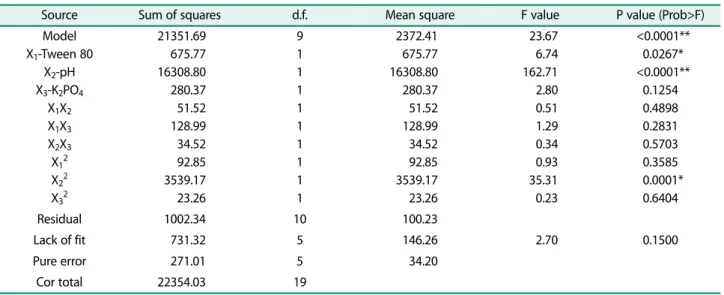
The coefficient values of the regression model are listed in Table 3. The statistical analysis of Table 3 showed that the linear coefficients of Tween 80, pH and quadratic coefficients of pH had a significant effect on

esterase production (p < 0.05), but the interaction terms of three variables were not significant, which indicated that there wasn’t mutual interaction between any two variables. The model F-value is 23.67. High F-value implies the model is significant [25]. The model P-value (<0.0001) and the lack of fit (0.1500) also suggested that the obtained experimental data agree well with the model. The fit of the model was also expressed by the determination of coefficient R

2

and adjusted R

2

. For a good statistical model, the R

2

value should be close to 1.0 and all of the factors should be positive and close to each other [8]. The high R

2

value (0.9552) (Table 3) indicated that 95.52% of total variations could be explained by activity model, which indicated that the polynomial model is accurate and good. The adj R

2

value (0.9148) was also higher, further advocating the good consistency between the experimental results and the theoretical values predicted by the model. A lower value of CV (8.22) indicates that the experiments conducted were accurate and reliable.

By using the response surface plot, it is easy to under- stand and determine the interaction of the medium com- positions and the optimum concentration of each composition for the esterase production. Fig. 3A showed that an increase in the Tween 80 improved the esterase activity at high pH level; with the maximum esterase activity being 159.50 U/ml. Fig. 3B showed that the response varied little as a function of K

2

HPO

4

and

Table 3. Significance of regression coefficients for esterase activity by Acinetobacter sp. B1 using central composite design.

Source Sum of squares d.f. Mean square F value P value (Prob>F)

Model X

1

-Tween 80

X

2

-pH X

3

-K

2

PO

4

X

1

X

2

X

1

X

3

X

2

X

3

X

12

X

22

X

32

21351.69 675.77 16308.80 280.37 51.52 128.99 34.52 92.85 3539.17 23.26

9 1 1 1 1 1 1 1 1 1

2372.41 675.77 16308.80 280.37 51.52 128.99 34.52 92.85 3539.17 23.26

23.67 6.74 162.71 2.80 0.51 1.29 0.34 0.93 35.31 0.23

<0.0001**

0.0267*

<0.0001**

0.1254 0.4898 0.2831 0.5703 0.3585 0.0001*

0.6404

Residual 1002.34 10 100.23

Lack of fit 731.32 5 146.26 2.70 0.1500

Pure error 271.01 5 34.20

Cor total 22354.03 19

R

2

= 0.9552; Adj R

2

= 0.9148; CV% = 8.22.

**Extremely significant level, p < 0.0001; *significant level, p < 0.001.

(8)

Tween 80. Low K

2

HPO

4

level (0.5%) and high Tween 80 level (0.8%) resulted in the maximum enzyme activity.

Fig. 3C depicted the interaction between K

2

HPO

4

and pH when Tween 80 concentration was stayed at 0.8%.

Verification of model

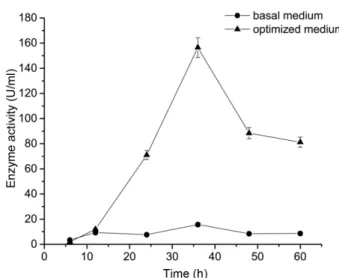
The extracellular esterase activity of strain B1 grown on the basal fermentation medium and optimized medium was sampled and measured as described above every 12 h (Fig. 4). According to the results of the statis- tical design, the optimized medium and condition were as follows (w/v): 0.8% Tween 80, 0. 5% K

2

HPO

4

, 2.5%

soluble starch, 1.5% tryptone, pH 8.0, inoculum size 1%, inoculum age 24 h and the culture temperature was 30 ℃.

Under the above optimized condition, the maximum esterase activity was 152.13 U/ml after 36 h-cultivation,

higher 10-fold than that of the non-optimized (Fig. 4).

The maximum esterase activity of 163.60 U/ml was pre- dicted by the model. The excellent correlation between measured and predicted values certifies the authenticity of model.

In this study, one-variable-at-a-time, Plackett-Bur- man design and central composite design (CCD) were used for optimizing the medium composition and culture conditions for esterase production by strain B1. Tween 80 significantly enhanced the esterase production, due to Tween 80 acting as carbon source, increasing the per- meability of cell membrane and stimulating the secre- tion of total protein. Based on the results of PB design and CCD, the maximum esterase activity under opti- mized culture conditions was 152.13 U/ml, which was close to the predicted of maximum esterase activity (163.60 U/ml).

Acknowledgments

This work was supported by the National Nature Science Founda- tion of China (No.21372146) and Shandong Provincial Science and Technology Major Project (No.2015ZDJS04002). We thank Dr. Zhaoqin Zhu (from Shanghai Public Health Clinical Center, Fudan University) for measuring the fatty acid composition.

Conflict of Interest

The authors have no financial conflicts of interest to declare.

Fig. 3. Three dimensional response surface curves of esterase activity from strain B1 showing interactions of two variables.

(A) pH and Tween 80, (B) K

2

HPO

4

and Tween 80, (C) K

2

HPO

4

and pH.

Fig. 4. Time profile of esterase activity in the basal medium

and optimized medium.

(9)

References

1. Choi JY, Lee BH. 2001. Culture conditions for the production of esterase from Lactobacillus casei CL 96. Bioprocess Biosyst. Eng.

24: 59-63.

2. Panda T, Gowrishankar BS. 2005. Production and applications of esterases. Appl. Microbiol. Biotechnol. 67: 160-169.

3. Zhang T, Chen H, Ni Z, Tian R, Jia J, Chen Z, et al. 2015. Expression and characterization of a new thermostable esterase from Clos- tridium thermocellum. Appl. Biochem. Biotechnol. 177: 1437-1446.

4. Klibanov AM. 2001. Improving enzymes by using them in organic solvents. Nature 409: 241-246.

5. Kirk O, Borchert TV, Fuglsang CC. 2002. Industrial enzyme appli- cations. Curr. Opin. Biotechnol. 13: 345-351.

6. Abdel-Fattah YR, Solimam NA, Yousef SM, EI-Helow ER. 2012.

Application of experimental designs to optimize medium com- position for production of thermostable lipase/esterase by Geo- bacillus thermodenitrificans AZ1. J. Genet. Eng. Biotechnol. 10: 193- 200.

7. Prabha MS, Divakar K, Priya JDA, Selvam GP. 2015. Statistical anal- ysis of production of protease and esterase by a newly isolated Lysinibacillus fusiformis AU01: purification and application of pro- tease in sub-culturing cell lines. Ann. Microbiol. 65: 33-46.

8. Haddar A, Fakhfakh-Zouari N, Hmidet N, Frikah F, Nasri M, Kamoun AS. 2010. Low-cost fermentation medium for alkaline protease production by Bacillus mojavensis A21 using hulled grain of wheat and sardinella peptone. J. Biosci. Bioeng. 110: 288- 294.

9. Zeng GM, Shi JG, Yuan XZ, Liu J, Zhang Z, Huang G, et al. 2006.

Effects of Tween 80 and rhamnolipid on the extracellular enzymes of Penicillium simplicissimum isolated from compost.

Enzyme Microb. Technol. 39: 1451-1456.

10. Zhang BB, Cheung PC. 2011. A mechanistic study of the enhanc- ing effect of Tween 80 on the mycelial growth and exopolysac- charide production by Pleurotus tuber-regium. Bioresour. Technol.

102: 8323-8326.

11. Zhang BB, Cheung PC. 2011. Use of stimulatory agents to enhance the production of bioactive exopolysaccharide from Pleurotus tuber-regium by submerged fermentation. J. Agric. Food Chem. 59: 1210-1216.

12. Arnesen S, Eriksen SH, Olsen J, Jensen B. 1998. Increased produc- tion of α-amylase from Thermomyces lanuginosus by the addition of Tween 80. Enzyme Microb. Technol. 23: 249-252.

13. Liu J, Yuan X, Zeng G, Shi J, Chen S. 2006. Effect of biosurfactant on cellulase and xylanase production by Trichoderma viride in solid substrate fermentation. Process Biochem. 41: 2347-2351.

14. Sheng L, Zhu G, Tong Q. 2013. Mechanism study of Tween 80 enhancing the pullulan production by Aureobasidium pullulans.

Carbohydr. Polym. 97: 121-123.

15. Liu YS, Wu JY. 2012. Effects of Tween 80 and pH on mycelial pel- lets and exopolysaccharide production in liquid culture of a medicinal fungus. J. Ind. Microbiol. Biotechnol. 39: 623-628.

16. Xia Z. 2013. Effect of Tween 80 on the production of curdlan by Alcaligenes faecalis ATCC 31749. Carbohydr. Polym. 98: 178-180.

17. Zhang Y, Hao J, Zhang YQ, Chen XL, Xie BB, Shi M, et al. 2017.

Identification and characterization of a novel salt-tolerant ester- ase from the deep-sea sediment of the South China Sea. Front Microbiol. 8: 441.

18. Mukherjee AK, Rai SK. 2011. A statistical approach for the enhanced production of alkaline protease showing fibrinolytic activity from a newly isolated gram-negative Bacillus sp. strain AS-S20-I. N. Biotechnol. 28: 182-189.

19. Sifour M, Zaghloul TI, Saeed HM, Berekaa MM, Abdel-Fattah YR.

2010. Enhanced production of lipase by the thermophilic Geoba- cillus stearothermophilus strain-5 using statistical experimental designs. N. Biotechnol. 27: 330-336.

20. Esakkiraj P, Usha R, Palavesam A, Immanuel G. 2012. Solid-state production of esterase using fish processing wastes by Bacillus altitudinis AP-MSU. Food Bioprod. Process 90: 370-376.

21. Kudanga T, Mwenje E, Mandivenga F, Read JS. 2007. Esterases and putative lipases from tropical isolates of Aureobasidium pul- lulans. J. Basic Microbiol. 47: 138-147.

22. Ren X, Yu D, Han S, Feng Y. 2006. Optimization of recombinant hyperthermophilic esterase production from agricultural waste using response surface methodology. Bioresour. Technol. 97:

2345-2349.

23. Byreddy AR, Rao NM, Barrow CJ, Puri M. 2017. Tween 80 influ- ences the production of intracellular lipase by Schizochytrium S31 in a stirred tank reactor. Process Biochem. 53: 30-35.

24. Sidhu P, Sharma R, Soni SK, Gupta JK. 1998. Production of extra- cellular alkaline lipase by a new thermophilic Bacillus sp. Folia Microbiol. 43: 51-54.

25. Oskouis SFG, Tabandeh F, Yakhchali B, Eftekhar F. 2008. Response

surface optimization of medium composition for alkaline prote-

ase production by Bacillus clausii. Biochem. Eng. J. 39: 37-42.

수치

Fig. 1. Evaluation of the factors affecting esterase activity of  Acinetobacter sp. B1 (strain B1)
Table 1 showed the effect of Tween 80 on extracellular protein and esterase activity of strain B1
Table 2. Analysis of variance (ANOVA) for the regression model representing esterase production by  Acinetobacter sp
Table 3. Significance of regression coefficients for esterase activity by  Acinetobacter sp
+2

참조

관련 문서

• 이명의 치료에 대한 매커니즘과 디지털 음향 기술에 대한 상업적으로의 급속한 발전으로 인해 치료 옵션은 증가했 지만, 선택 가이드 라인은 거의 없음.. •

Current Tokyo is rich in green compared to other metro cities. In some parts, the greenery has been contributed by the many inherited gardens from the Edo era to today which

In a statement to Kuwait News Agency (KUNA) on the sidelines of a meeting of the Arab Parliament's Foreign Affairs Political and National Security

The meeting was attended by Assistant Foreign Minister for GCC Affairs, Ambassador, Nasser Al-Muzayyen, and Deputy Assistant Foreign Minister for the Office of the

“ Sheikh Nasser has a written message from HH the Amir, Sheikh Sabah Al-Ahmad Al-Jaber Al-Sabah to the Chinese President, Chi Gen Beng related to enhancing mutual

On his part, CEO of Express Roads Authority, Saud Al-Naqqi said that the heavy rains of the previous day led to clogging parts of the express

Kuwait will celebrate on Sunday the fourth anniversary of the UN honoring and proclamation of His Highness the Amir, Sheikh Sabah Al-Ahmad Al-Jaber Al-Sabah as

The Joseon government designed and promulgated the Taegeukgi as a national flag for diplomatic and political purposes, but it was the independence movement that made it