Nitrous Oxide Emission from Livestock Compost applied Arable Land in Gangwon-do
Youngho Seo*, Sewon Kim, Seungchul Choi, Byeongchan Jeong, and Yeong-Sang Jung1
Gangwon Agricultural Research & Extension Services, Chuncheon 200-150, Korea
1Kangwon National University. Chuncheon 200-701, Korea
Agriculture activities account for 58% of total anthropogenic emissions of nitrous oxide (N2O) with global warming potential of 298 times as compared to carbon dioxide (CO2) on molecule to molecule basis.
Quantifying N2O from managed soil is essential to develop national inventories of greenhouse gas (GHG) emissions. The objective of the study was to compare N2O emission from livestock compost applied arable land with that for fertilizer treatment. The study was conducted for two years by cultivating Chinese cabbage (Brassica campestris L.) in Chuncheon, Gangwon-do. Accumulated N2O emission during cultivation of Chinese cabbage after applying livestock compost was slightly greater than that for chemical fertilizer.
Slightly greater N2O emission factor for livestock compost was observed than that for chemical fertilizer possibly due to lump application of livestock compost before crop cultivation compared with split application of chemical fertilizers and enhanced denitrification activity through increased carbon availability by organic matter in livestock compost.
Key words: Nitrous oxide, Livestock compost, Chinese cabbage, Gangwon-do, Fertilizer
Received : January 18. 2012 Accepted : February 1. 2012
*Corresponding author : Phone: +82332486096 E-mail: [email protected]
Introduction
Nitrous oxide (N2O) is a potential greenhouse gas and a catalyst destructing ozone layer in the strato- sphere that emitted from agricultural land after applying compost and/or chemical fertilizer through nitrification and denitrification (Singh and Tyagi, 2009). The global warming potential of N2O is 298 times greater than CO2 based on a 100 yr time horizon (IPCC, 2007).
Agricultural activity is one of the biggest anthropogenic sources of N2O emission, 2.8 Tg N yr-1 out of total 6.7 Tg N yr-1 (Singh and Tyagi, 2009). Atmospheric N2O is increasing at a rate of 0.2~0.3% per year probably due to anthropogenic emissions (Saggar et al., 2009).
Nitrous oxide is produced in soil as a by-product of nitrification and intermediate of denitrification by the microbial activity (Freney, 1997; Singh and Tyagi, 2009). Ammonia produced from chemical fertilizer or compost could be oxidized to nitrate through nitrifi-
cation. Under anaerobic condition, nitrate could be reduced to nitrous oxide in the course of denitrifi- cation. The default value for N2O emission factor has been changed from 0.0125 to 0.01 (IPCC, 2006) of N applied to the agricultural fields.
Organic farming has rapidly increased in response to consumer’s preference to safe food, farmer’s desire to live in a clean environment, and government’s policy to reduce fertilizers use. In Korea, certified number of farms, area, and products for organic farming increased from 442, 450 ha, and 10,672 Mg in 2001 to 9,403, 13,343 ha, and 108,810 Mg in 2009, respectively (National Agricultural Products Quality Management Service, 2010). In Gangwon province, the number of farms, area, and products increased from 62, 66 ha, and 1,391 Mg in 2001 to 851, 1,281 ha, and 14,551 Mg in 2009, respectively (National Agricultural Products Quality Management Service, 2010).
Livestock compost has been used to supply nutrients to crops instead of chemical fertilizers in organic farming (Lee et al., 2006). Therefore, the objective of this study was to compare N2O emission from livestock compost applied upland field with that for chemical fertilizer, urea by cultivating Chinese cabbage
Table 1. Selected physico-chemical characteristics of the field used in the study.
pH Electrical
conductivity
Organic
matter Avail. P2O5
Exch. Cation Particle size distribution
Ca K Mg Sand Silt Clay
(H2O, 1:5) dS m-1 g kg-1 mg kg-1 --- cmolc kg-1 --- --- % ---
6.0 0.33 22 470 3.5 0.63 0.87 54 18 28
Table 2. Chemical composition of the livestock compost used in the study.
Organic matter T-N P2O5 K2O CaO MgO
--- g kg-1 ---
268 15 16 2.7 23 5.1
Fig. 1. Mean air temperature during the study period compared with normal data (1970~2000).
Fig. 2. Precipitation during the study period compared with normal data (1970~2000).
(Brassica campestris L.) in spring and autumn for two years.
Materials and Methods
The study was conducted at the Gangwon Agricultural Research & Extension Services field in Chuncheon (N 37°57′15.9″ E 127°46′26.6″), Gangwon-do from 2009 to 2010. The soil in the field is classified to Yonggye series (fine loamy, mixed, mesic Typic Dystrudepts) and the selected physic-chemical properties of the soil are shown in Table 1. Chinese cabbage was cultivated twice a year, spring and autumn with application of livestock compost or nitrogen fertilizer, urea. Chemical composition of the compost on wet weight basis is shown in Table 2.
The application rate of the livestock compost was determined by standard nitrogen fertilization rate for Chinese cabbage, 320 kg ha-1 and nitrogen content of the compost, 15 g kg-1. All the amount of the livestock compost was applied before transplanting while urea was split applied before transplanting and during the cultivation. To examine the effect of over-fertilization on N2O emissions, twice amount of the livestock
compost or urea was also incorporated into the soil of the field. Lee et al. (2006) reported that some organic farmers applied greater amounts of livestock compost than recommended level. Nitrous oxide emissions from livestock compost were compared with those from conventional chemical fertilizer, urea.
Nitrous oxide was collected using static chambers, the most commonly used tools worldwide (Kim et al., 2006; Kim et al., 2008; Saggar et al., 2009; Kim et al., 2010), and determined by a gas chromatograph (Varian GC 450) with ECD. Gas samples were taken twice a week. Parkin (2008) reported that sampling at 1~4 d intervals resulted in cumulative N2O emissions with a precision of ±10% compared with ±14% for 3~7 d intervals. Flux of N2O was calculated using the following equation (Shin et al., 2003; Kim et al., 2008; Kim et al., 2010):
F = ρ・V・A-1・Δc・Δt-1・273・T-1
where F is N2O flux (mg m-2 h-1), ρ is the gas density of N2O (1.96 mg m-3), V is the volume of the chamber (m3), A is the area of the chamber (m2), Δc・Δt-1 is the average increase of gas concentration in the chamber, and T is mean temperature in the
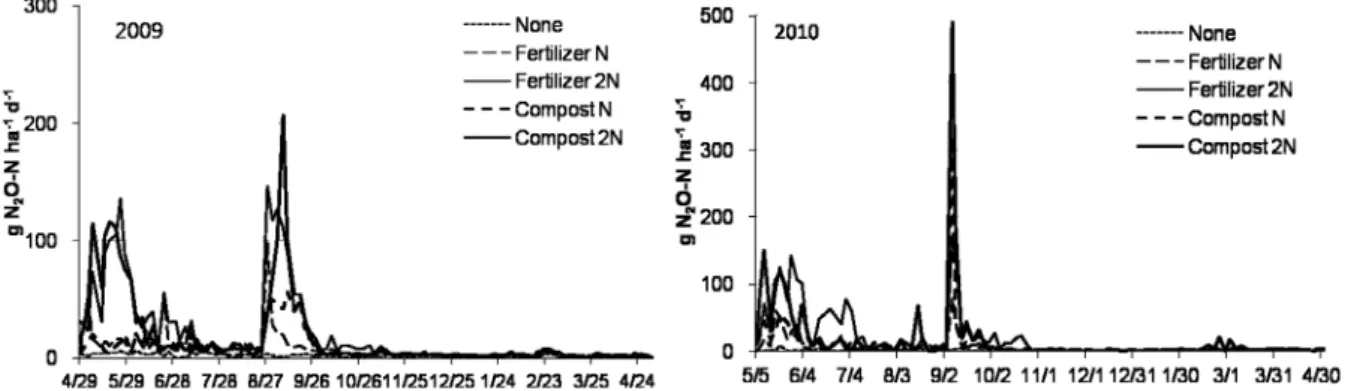
Fig. 3. N2O emission flux of Chinese cabbage cultivated in spring and autumn in 2009 (left) and 2010 (right).
Fertilizer and compost denote chemical fertilizer, urea and livestock compost, respectively. N and 2N denote standard nitrogen fertilization and two-fold nitrogen fertilization, respectively.
Fig. 4. N2O emission for Chinese cabbage cultivated in spring (left) and autumn (right) in 2009. Fertilizer and compost denote chemical fertilizer, urea and livestock compost, respectively. N and 2N denote standard nitrogen fertilization and two-fold nitrogen fertilization, respectively.
chamber (℃) plus 273.
Mean air temperature and precipitation during the study period are shown in Fig. 1 and Fig. 2, respe- ctively. The mean air temperature was 10.3℃, which is 0.6℃ below the normal data (1970~2000). The annual precipitation in 2009 and 2010 was 1,781 mm and 1,634 mm, respectively, about 500 mm higher than normal data, 1,266 mm.
Results and Discussion
Nitrous oxide emission pattern from the experi- mental site in 2009 and 2010 is shown in Fig. 3.
Emission flux of N2O for livestock compost showed greater emission in the early growth stage of Chinese cabbage compared with chemical fertilizer treatment.
In the autumn, N2O emission sharply increased just after applying compost or fertilizer compared with the pattern in spring because of higher temperature and humid soil moisture. The N2O emission, thereafter,
dramatically decreased and even reach almost zero in late autumn and winter possibly due to low temperature at that time. Greater N2O emission was observed for livestock compost than chemical fertilizer treatment at the early growth stage of Chinese cabbage possibly due to the application of total amount of compost once while split application for chemical fertilizer.
Accumulated N2O emission from Chinese cabbage cultivated field for livestock compost, 1.1 kg N2O-N ha-1 in spring and 1.8 kg N2O-N ha-1 in autumn, was comparable to chemical fertilizer treatment, 1.5 kg N2O-N ha-1 in spring and 1.2 kg N2O-N ha-1 in autumn in 2009 (Fig. 4). As a result, N2O emission factors for livestock compost treatment were 0.0029 in spring and 0.0058 in autumn compared with 0.0040 in spring and 0.0030 in autumn for chemical fertilizer application (Table 3). Application of greater amount of chemical fertilizer or livestock compost resulted in higher N2O emission; 1.1~1.5 kg N2O-N ha-1 for standard fertilization vs 3.7~4.0 kg N2O-N ha-1 for twice fertilization in spring (Fig. 4).
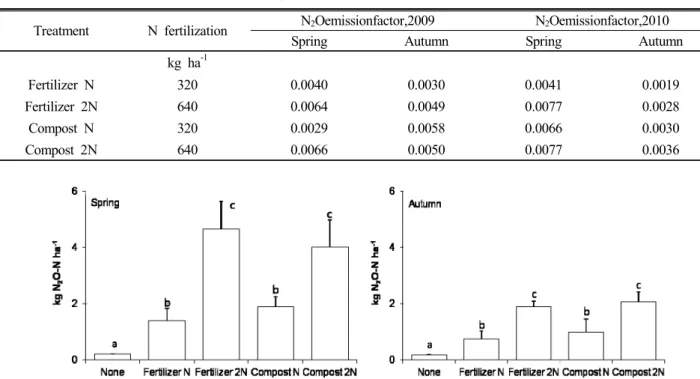
Table 3. N2O emission factor for livestock compost and chemical fertilizer in 2009 and 2010.
Treatment N fertilization N2Oemissionfactor,2009 N2Oemissionfactor,2010
Spring Autumn Spring Autumn
kg ha-1
Fertilizer N 320 0.0040 0.0030 0.0041 0.0019
Fertilizer 2N 640 0.0064 0.0049 0.0077 0.0028
Compost N 320 0.0029 0.0058 0.0066 0.0030
Compost 2N 640 0.0066 0.0050 0.0077 0.0036
Fig. 5. N2O emission for Chinese cabbage cultivated in spring (left) and autumn (right) in 2010. Fertilizer and compost denote chemical fertilizer, urea and livestock compost, respectively. N and 2N denote standard nitrogen fertilization and two-fold nitrogen fertilization, respectively.
In 2010, the N2O emission pattern was similar to the pattern observed in 2009; sharply increased N2O emission just after fertilizer/compost application in autumn. Accumulated N2O emission for livestock compost, 1.9 kg N2O-N ha-1 in spring and 1.0 in autumn, was slightly greater than that for chemical fertilizer, 1.4 kg N2O-N ha-1 in spring and 0.8 kg N2O-N ha-1 in autumn (Fig. 5). As a result, N2O emission factor for livestock compost, 0.0030 for autumn and 0.0066 for spring, was also slightly greater than that of chemical fertilizer, 0.0019 for autumn and 0.0041 for spring (Table 3). Slightly greater N2O emission factor for livestock compost than that for chemical fertilizer is possibly due to lump application of livestock compost before crop cultivation compared with split application of chemical fertilizers and enhanced denitrification activity through increased carbon availability by organic matter in livestock compost. Kim et al. (2008) showed that mineral nitrogen level in soil greatly affected N2O emission from pepper cultivated soils. Barton and Schipper (2001) reported that increased carbon availability by organic matter in livestock compost can attribute to enhanced denitrification activity. A laboratory study showed 100~300 g N2O-N ha-1 during 16 days after applying pig slurry at a rate of 50 Mg
ha-1 (Sommer et al., 1996).
Conclusion
Accumulated N2O emission during cultivation of Chinese cabbage for livestock compost amendment (1.0~1.9 kg N2O-N ha-1) was slightly greater than that for chemical fertilizer treatment (0.8-1.5 kg N2O- N ha-1). As a result, N2O emission factors for livestock compost application (0.0029~0.0066) were slightly greater than those for chemical fertilizer treatment (0.0019-0.0041). Since environment factors including temperature and precipitation greatly affect greenhouse gas emissions from soils, N2O emission data should be collected more than three years to develop N2O emission factor.
Acknowledgement
This study was carried out with the support of
“Cooperative Research Program for Agricultural Science
& Technology Development (Project No. PJ006783 052011)”, Rural Development Administration, Republic of Korea.
References
Barton, L. and L.A. Schipper. 2001. Regulation of nitrous oxide emissions from soils irrigated with dairy farm effluent. J.
Environ. Qual. 30:1881-1887.
Freney, J.R. 1997. Emission of nitrous oxide form soils used for agriculture. Nutrient Cycling Agroecosystem. 49:1-6.
Intergovernmental Panel on Climate Change (IPCC). 2006. 2006 IPCC guidelines for national greenhouse gas inventories. Vol.
4. Agriculture, forestry and other land use. Eggleston H. S., Buendia L., Miwa K., Ngara T., Tanabe K. (eds.) Hayama, Japan, 682p.
IPCC. 2007. Climate change 2007. Mitigation of climate change:
Contribution of working group III to the fourth assessment report of the Intergovernmental Panel on Climate Change.
Metz B., Davidson O., Bosch P., Dave R., Meyer L. (eds) Cambridge University Press, New York, 851p.
Kim, G.Y., B.H. Song, B.K. Hyun, K.M. Shim, J.T. Lee, J.S.
Lee, W.I. Kim, and J.D. Shin. 2006. Predicting N2O emission from upland cultivated with pepper through related soil parameters. Korean J. Soil Sci. Fert. 39:253-258.
Kim, G.Y., B.H. Song, K.A. Roh, S.Y. Hong, B.G. Ko, K.M.
Shim, and K.H. So. 2008. Evaluation of greenhouse gases emissions according to changes of soil water content, soil temperature and mineral N with different soil texture in pepper cultivation. Korean J. Soil Sci. Fert. 41:399-407.
Kim, G.Y., K.H. So, H.C. Jeong, K.M. Shim, S.B. Lee, and D.B.
Lee. 2010. Assessment of greenhouse gases emissions using global warming potential in upland soil during pepper cultivation.
Korean J. Soil Sci. Fert. 43:886-891.
Lee, Y.H., S.G. Lee, S.H. Kim, J.H. Shin, D.H. Choi, Y.J. Lee, and H.M. Kim. 2006. Investigation of the utilization of organic materials and the chemical properties of soil in the organic farms in Korea. Korean J. Organic Agric. 14:55-67.
National Agricultural Products Quality Management Service.
2010. Certified Agricultural Products Statistics, http://www.
enviagro.go.kr/portal/info/Info_statistic_cond.jsp.
Parkin, T.B. 2008. Effect of sampling frequency on estimates of cumulative nitrous oxide emissions. J. Environ. Qual. 37:
1390-1395.
Saggar, S., J. Luo, D.L. Giltrap, and M. Maddena. 2009. Nitrous oxide emissions from temperate grasslands: Processes, measurements, modelling and mitigation. In Sheldon A. I., Barnhart E. P. (eds.): Nitrous oxide emissions research progress. Nova Science Publishers, Inc., New York, p. 1-66.
Shin, Y.K., J.W. Ahn, M.H. Koh, and J.C. Shim. 2003.
Emissions of greenhouse gases from upland rice and soybean.
Korean J. Soil Sci. Fert. 36:256-262.
Singh, S.N. and L. Tyagi. 2009. Nitrous oxide: Sources, sinks and mitigation strategies. In Sheldon A. I., Barnhart E. P.
(eds.): Nitrous oxide emissions research progress. Nova Science Publishers, Inc., New York, p. 127-150.
Sommer, S.G., R.R. Sherlock, and R.Z. Khan. 1996. Nitrous oxide and methane emissions from pig slurry amended soils.
Soil Biol. Biochem. 28:1541-1544.