JDCS Vol. 18, No. 8, pp. 1641-1648, Dec. 2017
컬러 이미지 변환을 이용한 노이즈 제거 방법 및 성능 비교
김 태 호1 · 김 학 란2*
1
청나 달튼 스쿨, 11학년
2
미시시피 주립대학교 계산공학과
Performance comparison of Image De-nosing Techniques based on Color Model Transformation
Taeho Kim
1· Hakran Kim
2*1
11th Grade, Cheongna Dalton School, 344 Cheomdandong-ro, Incheon, 22742, South Korea
2
*Department of Computational Engineering, Mississippi State University, Mississippi State, Mississippi, 39762, USA
[요 약]
본 논문의 주요 목적은 컬러 이미지에서의 노이즈 제거를 위한 다양한 필터들의 성능 분석 비교이다. 기존의 노이즈 제거 필터
들에 대한 분석에서 한 발 더 나아가 RGB에서 HSV나 YC
BC
R로 컬러 모델변환을 하여 노이즈를 제거하는 방법을 제안하였다. 논
문에서 사용된 예인 Median, Wiener, Mean 등의 노이즈 제거필터들의 성능 개선에 도움을 주기위해 고안했으며 현재까지는 컬러 이미지를 위한 필터들의 성능분석이나 컬러모델 변환을 이용한 개선 방법들이 제안된 바가 없다. 이에 영감을 받아서, 고안된 새 로운 방법을 테스트 하였다. 실행해 본 결과 , 현재 사용되고 있는 필터들 중에서 몇몇 필터들의 성능을 향상시켜서 컬러 이미지에 서의 노이즈 제거에 큰 도움을 주는 것으로 나타났다.
[Abstract]
The main purpose of this paper is to compare the performances of various filters with color images to remove the noise.
Furthermore, we suggest a modified de-noising process by the transformation of color model from RGB to another color models, such as HSV and YC
BC
R,to improve the quality of de-noising methods encompassing Median, Wiener, and Mean filters. Neither the performance comparison of the de-noising filters with color images nor the converting the color model for better de-noise on the degraded images haven't been performed before. Inspired to make improvements, we conduct experiments with new de-noising process on color images. The result of the experiments is shown that it could assist on certain filters being more reliable techniques.
색인어 :
컬러이미지에서의 노이즈 제거, Mean 필터, Median 필터, 위너 필터
Key word : De-noising with various color model images, Mean filter, Median filter, Wiener filter
http://dx.doi.org/10.9728/dcs.2017.18.8.1641
This is an Open Access article distributed under the terms of the Creative Commons Attribution Non-CommercialLicense(http://creativecommons .org/licenses/by-nc/3.0/) which permits unrestricted non-commercial use, distribution, and reproduction in any medium, provided the original work is properly cited.
Received 31 October 2017; Revised 07 November 2017 Accepted 25 December 2017
*Corresponding Author; Hakran Kim Tel: +1-662-617-2897
E-mail: [email protected]
Ⅰ. Introduction
The importance of digital image processing in the numerous field, such as computer vision, medicine, photograph, remote sensing satellite, and control of manufacturing and automation is becoming one of the major problems in computer relevant systems. However, when images are acquired through media or systems, noise on images is an unavoidable result. Noises in images are affected by random electron devices as data is acquisited, data transmission, image quantization, and so on.
Hence, de-noising is an imperative preprocessing in image processing in a vast area, such as segmentation, edge detection, feature extraction, image data analysis, and interpolation discussed in [1][2][3][4][5].
Abundant de-nosing methods proposing have improved corrupted images by image restoration and noise reduction algorithms. Many advanced de-noising algorithms and traditional methods have been working greatly on noised image, nonetheless, de-noising still remains as challenges due to noise, such as artifacts or blurs, being crucial problems that discern important features from images.
Surveys, reviews, and performance comparison researches of de-nosing algorithms have been performed to validate which method works better on which type of noise. However, commonly the experimental comparisons have done with gray scale images.
Many works, [6][7][8][9][10] have been published in this area over the recent years. In paper [6], as the title says authors used two filters to conduct performance comparison and although six different filters were tested in [7], five modified Median filters were included. Median Filter, Adaptive Median Filter, Mean Filter, Gaussian Filter and Adaptive Wiener filter were chosen for [8]. In paper [9] and [10] adaptive wiener filter and fuzzy filter in wavelet domain and mean filter were examined, respectively.
Gaussian noise, Salt & Pepper noise, Poisson noise, or Speckle noise were encompassed for their experiment in all papers referred in our paper. None of those papers examined color images except paper [7]. By inspired from that, we select the most common three filters encompassing Median, Wiener, and Mean filters for de-noising and two type of noises Salt-and-pepper and Gaussian noise for our proposal.
In addition, we suggest that the new modified process for de-noising. The method uses the transformation from the chromatic color represented by red, green, and blue(RGB) to another color models having different chromatic intensities.
This paper presents a brief overview of types of noises, de-noising filters, and color models in section II through IV. Then we evaluate the performance of existing noise reduction
algorithms- a nonlinear filter and two linear filters and the comparison is performed between de-noising on corrupted RGB images itself and de-noising by color model transformation to test how effective our new method is.
Ⅱ. Image Noise
Noise deteriorates an image quality by representing unwanted information. In this chapter, we review two most typical types of noises: Salt-and-Pepper and Gaussian in which we used to test.
Noise can be modeled an acquisitive process (n) by a histogram or a probability density function(PDF).
(1)
I(i,j) represents an acquired image, O(i,j) represents the initial signal, where the coordinate(i, j) in an n X m pixel image.
2-1 Gaussian Noise
Gaussian noise is caused by the discrete nature of radiation and the conversion of the optical signal into electrical signal amplification and has a Gaussian probability density function(i.e, the normal distribution) shown as below.
(2) where g = gray level, μ = mean, and σ = standard deviation Spatial filters including Median filter, Mean filter, and Gaussian filter are known as effective method to remove Gaussian noise, therefore, we performed how effective it is against different filters on this type of noise for grayscale images and color images.
2-2 Salt-and-Pepper Noise(Impulse Noise)
In general, this type of noise is caused by malfunctioning of camera's sensor cells, memory cell failure, or synchronization errors in digitization or transmission and has only two values possible. "dead pixels" appear mostly dark due to defective sensor , meanwhile, "hot pixels" appear overly bright owing to charge leakages in long exposures. On the other hand, the corrupted pixel is either set to the maximum value or has a bit flipped over. The PDF in an 8 bit/pixel image for this noise model is written as:
an d f or ≃
f or ≃ (3)
Ⅲ.
Image De-noising Filters
So many de-noising filters have been developing to suppress various noises on the tainted image. Although related researches are delving wider and deeper, we, however, tested the most common filters- Median, Wiener, and Mean.
3-1 Median Filter
Median filter, one of the nonlinear filters, can reduce noises while preserving edges and small details precisely because it is less sensitive to outliers than a mean value and has been shown particularly effective results for the salt-and-pepper noise[11] and the speckle noise. Hence it is widely used in digital image processing.
It replaces each pixels with median values of its neighbors called as a window. Each median(middle) values are calculated by sorting neighboring pixels in numerical order first, and then considering a median value as a replacing pixel value. The window size of 2D median filer can be a square, a cross, a rectangle, or any central symmetric shapes. Generally, a window is assumed having length 2n + 1 where n is any positive number.
Often Median filter works better than Mean filter, but it takes longer to compute.
Following two expressions are for nonlinear property and median filter y(k), defined as kth middle value from a window w.
≠
(4)
3-2 Wiener Filter
Wiener filter is done by comparing the received signal with an estimation of a desired noiseless signal and assumes inputs to be a stationary[12]. As well as it is assumed that a user knows a spectral property such as power functions of the original signal and noise. The goal of this filter is minimizing the differences between the original signal and the new signal as less as possible. Hence it aims removing noises on a degraded image based on the statistical approach.
Given a degraded image x(n,m) in the frequency domain, one takes the Discrete Fourier Transform(DFT) to obtain X(u,v). The original image spectrum is estimated by following equation[13][14].
∙ , (5)
where G(u, v) is the Wiener filter.
Then the inverse DFT is used to obtain the image estimate from its spectrum. The filter is defined regarding these spectra.
(6)
where H(u,v) is DFT of the point-spread function, P
a(u,v) is Power spectrum of the signal process obtained by taking the DFT of the signal autocorrelation, and P
u(u,v) is Power spectrum of the noise process obtained by taking DFT of the noise autocorrelation.
This filter is not able to reconstruct frequency components degraded by noise. Neither undo blurring caused by bandlimiting, which occurs in any real world imaging system, of H(u,v)[8].
3-3 Mean Filter
By reducing the amount of intensity variation between one pixel and the next, Mean filter smooths images in an easy and simple manner. The mean value of its neighboring including itself is used as the replacement value for each pixel. In this filter, a kernel which represents the shape and size of the neighborhood to be sampled when calculating the mean is used[15]. Even though a 3X3 kernel is used often and able to be applied several times to produce effects for more smoothing in the similar way what larger size of kernels do, note that, however, it is not identical as a single pass with a larger kernel.
Sometimes this filter doesn't show significant improvement in reducing noise; it even gives us a blurred image in such cases: a single pixel with an unrepresentative value can affect mean value of its neighborhood or when the filter neighborhood is an edge, the filter replaces new values for pixels on the edge and so blurs that edge[16].
×
(7)
Ⅳ. Color Model
We briefly describe two chromatic color models used to
conduct our experiment in this section.
The Hue, Saturation, and Value(HSV) color model describes colors similarly to how the human eye tends to perceive color. Hue value is a color type, ranges 0-255 with a zero being red, the color vibration can be represented by Saturation, also ranges 0-255.
Lower the value, more gray it gets, causing color to fade. Value represents the brightness of the color with 0-255 ranges. A zero value is fully dark, and 255 appears completely bright. The Value dominates black and white, where as Hue and Saturation values do not make differences as they are at maximum or minimum intensity value. Conversion formula from RGB to HSV are as follows.
′
′
′
m ax max
′
′
′
m i n min
′
′
′
∆
m ax
m i n(8)
With the above results, Hue, Saturation, and Value can be calculated , respectively.
∆
× ∆
′
′
m ax
′
× ∆
′
′
m ax
′
× ∆
′
′
m ax
′
m ax
m ax∆
m ax≠
m ax(9)
Another color model YC
BC
Rcame from the same sense of HSV, i.e. human eye has different sensitivities to brightness and color. The Luminance is represented as Y and similar to the gray level. Chrominance-Blue(C
B) is strong on blue in parts of image, while Chrominance-Red(C
R) is strong on radish color. Both C
Band C
Rhave weak properties in places of green. To take an advantage of lower resolution ability of the human eye for color with respect to luminosity, YC
BC
Rcolor model which represents the weighted RGB is widely used in image processing[17].
The formula from RGB to YC
BC
Rare given below[17].
(10)
Ⅴ. Performance Comparison
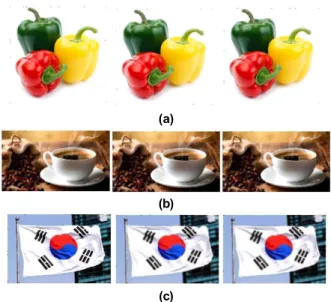
We conducted our experiments with three color images including bell pepper, coffee, and flag as shown in figure 2.
Performance comparison of de-noising techniques is measured by PSNR(Peak Signal-to-Noise Ratio) and visual qualities. PSNR is the most common method to measure an image quality in digital image processing and usually calculates the ratio between the original and the corrupted(noisy) image or the noisy image and the image de-noised by an algorithm. A higher signal, expressed in the logarithmic decibel scale, indicates a better quality.
For the given m rows by n columns noised image I and its de-noised image K, Mean Squared Error(MSE) is computed below in equation(11) and PSNR is defined by MSE as follows[18].
∙log
(11)
where MAX
Iis the maximum pixel value in the input image.
In order to evaluate the performance, all implementation are done by MATLAB R2013a. The 3 X 3 size of neighborhood is used to estimate both of local images' median and mean, and 10% of noises are added to make salt-and-pepper noise images.
Median filter is set up by zero mean value and 0.05 standard deviation.
To make more reliable and effective filters on degraded color images, we propose the color transformation method for various filters to purge noise. Our method is summarized as follow:
If the given original RGB image is O and let C as a
corrupted image, color transformation should come first before
de-noise filters are applied on TC that is converted from C to
another color models such as HSV or YC
BC
Rto restore C. The
reverse transformation has to be performed after filtering.
Fig. 1. Overall process
Fig. 2. Original RGB Images: Bell Pepper, Coffee, and Flag
Fig. 3. HSV Images converted from RGB: Bell Pepper, Coffee, and Flag
Fig. 4. YC
BC
RImages converted from RGB: Bell Pepper,
Coffee, and Flag
Fig. 5. RGB Images with Salt-and-pepper noise(density = 0.1)
The following figures represent the result of three filters applied on RGB, HSV, and YC
BC
Rimages degraded by salt-and-pepper noise after simulation.
(a)
(b)
(c)
Fig. 6. Result of Median filter for RGB, HSV, and YC
BC
Rcolor model images with salt-and-pepper noise,
respectively - (a) bell pepper, (b) coffee, and (c)
flag
(a)
(b)
(c)
Fig. 7. Result of Wiener filter for RGB, HSV, and YC
BC
Rcolor model images with salt-and-pepper noise, respectively - (a) bell pepper, (b) coffee, and (c) flag
(a)
(b)
(c)
Fig. 8. Result of Mean filter for RGB, HSV, and YC
BC
Rcolor model images with salt-and-pepper noise, respectively - (a) bell pepper, (b) coffee, and (c) flag
Figure 9 shows RGB images degraded by Gaussian noise and following figures after figure 9 are the results of each filters applied on the corrupted RGB, HSV, and YC
BC
R.
Fig. 9. RGB Images with Gaussian noise(zero mean noise with 0.1 variance)
(a)
(b)
(c)
Fig. 10. Result of Median filter for RGB, HSV, and YC
BC
Rcolor model images with Gaussian noise,
respectively - (a) bell pepper, (b) coffee, and (c)
flag
(a)
(b)
(c)
Fig. 11. Result of Wiener filter for RGB, HSV, and YC
BC
Rcolor model images with Gaussian noise,
respectively - (a) bell pepper, (b) coffee, and (c) flag
(a)
(b)
(c)
Fig. 12. Result of Mean filter for RGB, HSV, and YC
BC
Rcolor model images with Gaussian noise,
respectively - (a) bell pepper, (b) coffee, and (c) flag
Table 1. PSNR for salt-and-pepper noise
Image Filter RGB HSV YC
BC
RBell Pepper
Median 32.7424 33.6990 33.6433
Wiener 20.9429 16.7032 19.7619
Mean 20.7770 15.8622 18.3363
coffee
Median 25.3911 26.1916 25.9886
Wiener 21.0734 21.9241 20.5168
Mean 19.7827 19.9891 18.7493
flag
Median 25.9925 25.8117 26.4187
Wiener 19.9686 18.0632 19.0176
Mean 17.5201 15.6219 16.3643
Table 2. PSNR for Gaussian noise
Image Filter RGB HSV YC
BC
RBell Pepper
Median 23.1469 23.3330 27.1207
Wiener 19.6045 16.0763 20.8491
Mean 19.2660 15.0165 18.6010
coffee
Median 21.3148 21.4526 22.0938
Wiener 19.0796 19.5900 18.9660
Mean 18.0383 18.3681 17.4031
flag
Median 21.3796 21.3326 22.3296
Wiener 18.6960 17.3168 18.9710
Mean 16.6020 15.0757 16.0010
Performance comparison of color images to identify the most effective filter on two different noises have been analyzed with three color models.
Table 1 shows that Median filter works the best among three filters with all three images and three color models for removing salt-and-pepper noise. As RGB converted to HSV, or YC
BC
R,noised images are restored with even better qualities (It is possible to observe some improvements in PSNR.) rather than de-noising is simulated on the tainted RGB image itself.
However, the color transformation method does not seem to be working with Wiener and Mean filter.
In table 2, our testing results with Gaussian noise present that Median filter works the best, along with salt-and-pepper noise. Particularly, when the noised RGB color model is changed to YC
BC
R ,it develops a huge improvement in PSNR for Bell Pepper image.
In term of color composition, images with higher saturation like a bell pepper is seen an impressive betterment in PSNR value for both noises with the Median filter.
The coffee image which has low saturation shows slightly higher quality for both noises as color conversion is performed from RGB to HSV and the Wiener filter is applied. But others tend to still fall behind in quality while using the Wiener filter and the Mean filter.
VI. Conclusion
In this paper, we discussed three filters, two noises and three color models to provide an idea for considering the most effective de-noising filters to fit in the degraded color images. From our testing, no de-noising filter compensates the Median filter for salt-and-pepper and Gaussian noises. Especially, the proposed method well performs with Median filter for both noises. Color transformation to YC
BC
Rhas been found to have a prominent role in decreasing noises.
We would like to compare more filters, noises, and color
models in the future to give more insight to find the desirable filters for de-noising.
References