Preparation and Characterization of White Phosphorescence Polymer Light Emitting Diodes Using PFO:Ir(ppy)
3:MDMO-PPV Emission Layer
Byung Min Park
1and Ho Jung Chang
1,†1Department of Electronics Engineering, Dankook University, Cheonan-si, Chungnam 330-714, Korea (Received December 15, 2011: Corrected December 26, 2011: Accepted December 28, 2011)
Abstract: White phosphorescence polymer light emitting diodes (WPhPLEDs) with a glass/ITO/PEDOT:PSS/
PFO:Ir(ppy)3:MDMO-PPV/TPBI/LiF/Al structure were fabricated to investigate the effects of Ir(ppy)3 doping concentrations on the optical and electrical properties of the devices. PFO, Ir(ppy)3 and MDMO-PPV conjugated polymers as host and guest materials in the emission layer were spin coated at various concentrations of Ir(ppy)3 ranging from 0.0 to 20.0 vol.%. As the concentration of Ir(ppy)3 increased from 5.0 to 20.0 vol.%, the luminance and current efficiency values of the devices decreased clearly, which are attributable to the quenching effect at a high doping concentration.
The maximum luminance and current density were 2850 cd/m2 and 741 mA/cm2, respectively for a WPhPLED with an Ir(ppy)3 concentration of 5.0 vol.%. The CIE color coordinates were about x=0.33 and y=0.34 at 11V, showing a good white color.
Keywords: white polymer light emitting diode, phosphorescence, PFO, Ir(ppy)3, MDMO-PPV
1. Introduction
Polymer light emitting devices (PLEDs) have drawn much attention because of their promising applications in next-generation display devices. Recently, white PLEDs (WPLEDs) have drawn considerable interest because of their potential applications to large and flexible lighting sources. In addition, WPLEDs have attracted increasing attention due to their advantages of allowing inexpensive solution processing technologies, such as spin coating, ink- jet printing, and spray coating.
1-5)For the applications of new WPLEDs, it is desirable to improve the light quantum efficiency through the optimization of the electron and hole recombination process by introducing phosphorescent organic materials into the emission layer.
6)The phosphorescent materials emit light from both singlet and triplet excitons. Their internal quantum efficiencies can theoretically reach 100% in white phosphorescence polymer LEDs (WPhPLEDs), in comparison with fluorescence PLEDs which can reach 25% only by emissions from singlet excitons.
7)Therefore, it is necessary to produce and collect as many excitons as possible in the emission layer without decay processing. The single host blended system in PLEDs shows lower efficiency and brightness compared with the host and guest system.
8)The light emission and energy transfer can take place from both the host and the guest materials, the combined effect of which results in high
light efficiency. The performance of a WPhPLED is mainly controlled by the optimization of its organic materials and device structure. In the case of WPhPLEDs, one of the common methods is to blend blue and red fluorescencent materials with a green phosphorescent material to form a single layer white emission device.
9,10)In this report, we focus on the case of phosphorescent guest (Ir(ppy)
3) role and investigate the effects of doping concentrations of this guest material for the optimization of an organic host and guest material system.
For this study, we prepared phosphorescence:fluorescence blended WPhPLEDs with glass/indium tin oxide/poly(3,4- ethylenedioxythiophene):poly(styrenesulfonate)]/poly (9,9- dioctylfluorenyl-2,7-diyl:[tris(2-phenylpyridine) iridium(III)]:poly[2-methoxy-5-3(3,7-dimethyloctyloxy)-1-4- phenylenevinylene]/2,2',2''(1,3,5benzinetriyl)-tris(1-phenyl -1- H-benzimidazole)/lithium fluoride/aluminum (glass/ITO/
PEDOT:PSS/PFO:Ir(ppy)
3:MDMO-PPV/TPBI/LiF/Al) structures, and evaluated the optical and electrical properties of the devices according to the Ir(ppy)
3doping concentrations in the PFO:Ir(ppy)
3:MDMO-PPV emission layer.
2. Experiments
Patterned ITO/glass substrates of the size 1×1 inch square were used as substrates to prepare WPhPLEDs with glass/
ITO/PEDOT:PSS/PFO:Ir(ppy)
3:MDMO-PPV/TPBI/LiF/Al
†Corresponding author E-mail: [email protected]
structure. The substrates were cleaned ultrasonically with acetone, isopropyl alcohol (IPA), and deionized water. The remaining solvent was removed by soft baking for 10 min at 100
oC. A heat treatment for the ITO/glass substrate was carried out at 130
oC for 10 min in a vacuum oven. The PEDOT:PSS was used for the hole transport layer.
11)The PFO, and MDMO-PPV conjugated polymer were used as the host and guest materials in the white emission layer. The emission layer of the WPhPLED was fabricated by blending various concentrations of Ir(ppy)
3green phosphorescent guest material into the fixed fluorescence blue and red materials with concentrations of PFO : MDMO-PPV = 100 : 20 vol.%. The starting PFO and Ir(ppy)
3polymer materials were dissolved with 0.5 vol.% monochlorobenzene and MDMO-PPV was dissolved with 0.1 vol.% with monochlorobenzene, separately for the precursor solutions.
Following this, the prepared solution of PFO and MDMO- PPV materials were mixed with the Ir(ppy)
3guest materials in various concentrations ranging from 0.0 to 20.0 vol.%.
The PFO, Ir(ppy)
3and MDMO-PPV mixed solution was spin coated onto the PEDOT:PSS/ITO/glass substrate at a rotation speed of 5000 rpm for 30 seconds. To improve the quantum efficiency through effective hole blocking from the emission layer, the TPBI was thermally evaporated onto the emission layer. LiF was used as an electron injection layer and an aluminum cathode electrode (LiF/Al) was deposited by thermal evaporation in a vacuum chamber with a base pressure of 5×10
8Torr.
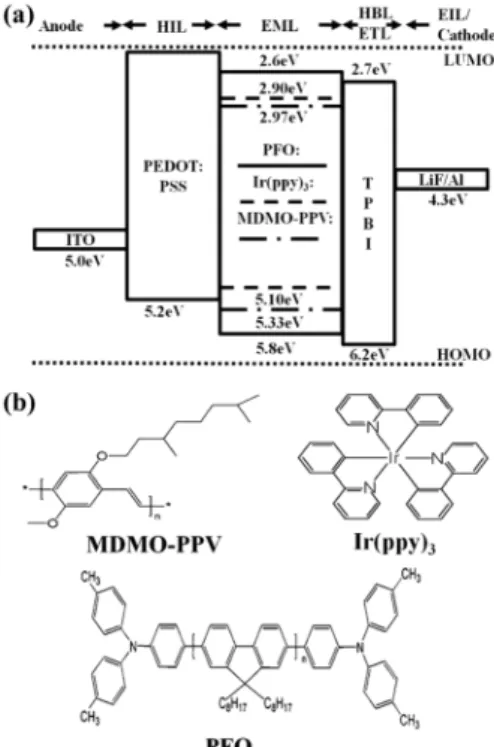
Fig. 1 shows (a) the energy band diagram of the prepared WPhPLED devices and (b) the chemical structures of consisting emission materials. The electrical properties of the devices were investigated using a POLARONIX M6100 I-L- V test system. The absorption spectra of the host and guest materials were measured by UV-visible and a photoluminescence (PL) spectrometer. For the measurements of the optical properties such as luminance, emission spectrum, and Commission Internationale de I'Eclairage (CIE) color chart were evaluated using a CS-1000 spectro- radiometer in a dark room.
3. Results and Discussion
As shown in the energy band diagram of Fig. 1 (a), the S1 and T1 energy states in PFO are expected to be higher than those of phosphorescent Ir(ppy)
3and fluorescence MDMO- PPV guests, which emits green and red color emission by the energy transition from the excited lowest unoccupied molecular orbital (LUMO) state to the highest occupied molecular orbital (HOMO) state. In order to ensure high
efficient energy transfer from the host to the guest material, it is desirable to broaden the spectra overlap between the host and guest materials in the UV-visible and PL spectrum measurement. To confirm the spectral overlap of the host and guest materials, the absorption and emission spectra of the consisting emission materials were investigated.
12)Fig. 2 shows the normalized photoluminescence (PL) spectrum of the PFO host, the UV-visual absorption and PL emission spectra of the Ir(ppy)
3and MDMO-PPV guest materials. The absorption spectrum of Ir(ppy)
3showed excellent overlap with the emission PL of the PFO at a wavelength of around 420 nm, suggesting highly effective energy transfer from PFO host to the Ir(ppy)
3and MDMO- PPV guest materials. Therefore, the luminance and light efficiency of the WPhPLEDs with the PFO, Ir(ppy)
3and MDMO-PPV system can be increased by effective energy transfer in the emission film layer. Moreover, the efficiency of energy transfer from host to guest polymer materials can be explained by Dexter energy transfer theory.
13,14)As a consequence, in order to increase the k
H*->Gvalue, it is desirable to increase the intensities of the PL emission of the host and the absorption of the guest material as well as to spectral overlap between the host and the guest materials.
In this experiment, it may be concluded that a wide overlap between the PL emission spectrum of PFO and absorption spectrum of Ir(ppy)
3contributes to the large k
H*->Gvalue.
Fig. 3 shows the UV-visible absorption spectra of the
Fig. 1. (a) the energy band diagram and (b) the chemical structuresof consisting polymer materials for the WPhPLEDs.
PFO:Ir(ppy)
3:MDMO-PPV emission films coated on PEDOT:PSS/ITO/glass substrates as a function of wavelengths at different Ir(ppy)
3concentrations. The maximum intensity of the absorption peaks of Ir(ppy)
3are shown at around 383 nm.
In addition, the absorption intensities of the Ir(ppy)
3decreased with the Ir(ppy)
3concentration increased from 5.0 to 20.0 vol.%, indicating that the maximum intensity occurs for the sample with a 5.0 vol.% of Ir(ppy)
3concentration. At high concentration, the organic materials may change their absorption and emission spectrum or, in some cases, exhibit a new emission due to the formation of aggregations and excimers.
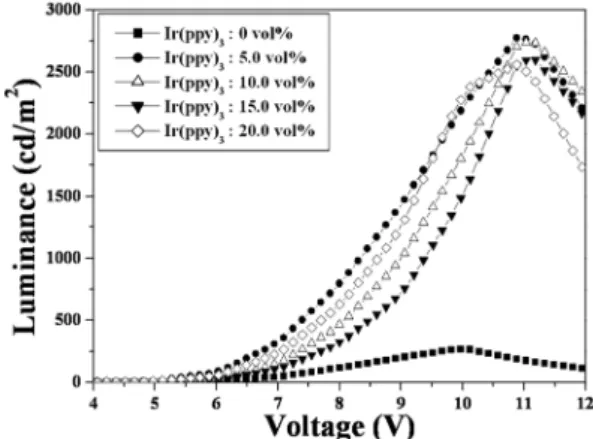
15)Fig. 4 represents the luminance versus voltage (L-V) curves for the WPhPLEDs at different Ir(ppy)
3doping concentrations. It was observed clearly that the PhPLEDs without Ir(ppy)
3phosphorescent material showed very low luminance value of 280 cd/m
2, and the luminance increased
greatly up to 2850 cd/m
2by introducing the Ir(ppy)
3phosphorescent guest material with 5.0 vol.% in concentration. The increased luminance for the devices with the phosphorescence guest material is originated from the singlet-triplet intersystem-crossing among the PFO, Ir(ppy)
3and the MDMO-PPV emission materials. The singlet-triplet intersystem-crossing is very efficient due to strong spin-orbit coupling by the heavy atom effects of Ir.
16)However, the luminance was decreased slightly from 2850 to 2590 cd/m
2when the Ir(ppy)
3doping concentration increased up to 20.0 vol.%. The drop in the luminance can be attributed to increasing self quenching at higher phosphorescent doping concentration.
17)The current efficiency, η, can be calculated by the equation η = L/J if the current density-voltage and the luminance–
voltage relationships are known, where L (cd/m
2) is the luminance intensity, and J (mA/m
2) is the current density. The current efficiencies of the devices obtained from various
Fig. 2. Normalized photoluminescence (PL) spectrum of the PFOhost, the UV-visual absorption and PL emission spectra of the Ir(ppy)3 and MDMO-PPV guest materials.
Fig. 3. UV-vis absorption spectra of PFO: Ir(ppy)3:MDMO-PPV emission films coated on PEDOT:PSS/ITO/glass substrates as a function of wavelengths at various Ir(ppy)3 concentrations.
Fig. 4. Luminance versus voltage (L-V) curves for the WPhPLEDs at various Ir(ppy)3 doping concentrations.
Fig. 5. Current efficiency versus voltage (η-V) curves for the WPhPLEDs at various concentrations of Ir(ppy)3 guest material.
Ir(ppy)
3doping concentrations are shown in Fig. 5. The current efficiency increased greatly by introducing the Ir(ppy)
3phosphorescent polymers. This result is caused by the formation of excitons required to emit light. The maximum current efficiency was found to be about 1.31 cd/A at a current density of about 741 mA/cm
2for the WPhPLED with 5.0 vol.% of Ir(ppy)
3concentration. However, in the case of the sample with Ir(ppy)
3concentration of above 15.0 vol.%, the current efficiency was decreased sharply, which is attributable to a decay quenching effect as described previously. The CIE color coordinates for the WPhPLED with the concentration of 5.0 vol.% Ir(ppy)
3were about x=0.33, y=0.34 at 11V, showing a pure white color. The current density, luminance and maximum current efficiency as a function of Ir(ppy)
3concentrations for the WPhPLEDs are summarized in Table 1.
4. Conclusions
The PFO, Ir(ppy)
3and MDMO-PPV as host and guest emission materials were spin coated onto PEDOT:PSS/ITO/
glass substrates for the fabrication of white phosphorescence polymer light emitting diodes (WPhPLEDs). We investigat- ed the effects of Ir(ppy)
3doping concentrations into PFO and MDMO-PPV host materials on the optical and electrical properties of the devices. Ir(ppy)
3phosphorescent guest material was doped with ranging from 5.0 to 20.0 vol.% into fixed fluorescent host materials with the concentration of PFO : MDMO-PPV = 100 : 20 vol.%. The luminance of the WPhPLEDs without Ir(ppy)
3green phosphorescent materials was very low of 280 cd/m
2, and the luminance increased greatly up to 2850 cd/m
2by introducing the Ir(ppy)
3phosphorescent guest material with the concentration of 5.0 vol.%. This result can be explained by wide spectral overlap between the PFO emission and Ir(ppy)
3absorption spectra, suggesting highly effective energy transfer from the host to the guest materials. The
maximum current efficiency of the device with 5.0 vol.% of Ir(ppy)
3concentration in the PFO:Ir(ppy)
3:MDMO-PPV emission layer was found to be 1.31 cd/A.
Acknowledgements
This work was supported by a Korea Research Foundation Grant funded by the Korean Government (KRF-2008-521- D00261)
References
1. S. B. Shin, S. C. Gong, H. K. Lee, J. G. Jang, M. S. Gong, S. O. Ryu, J. Y. Lee, Y. C. Chang and H. J. Chang, “Improv- ing Light Efficiency of White Polymer Light Emitting Diodes by Introducing the TPBi Exciton Protection Layer”, Thin Solid Films, 517, 4143 (2009).
2. F. Villani, P. Vacca, G. Nenna, O. Valentino, G. Burrasca, T.
Fasolino, C. Minarini and D. D. Sala, “Inkjet Printed Polymer Layer on Flexible Substrate for OLED Applications”, J. Phys.
Chem. C., 113, 13398 (2009).
3. Y. W. Park, Y. M. Kim, J. H. Choi, T. H. Park, J. W. Jeong, M. J. Cho, D. H. Choi and B. K. Ju, “Electroluminescence Property of Highly Soluble Ir(III) Complex Utilized by Var- ious Hole Blocking Layers in Polymer Light Emitting Diodes”, J. Nanosci. Nanotechnol., 10, 3250 (2010).
4. S. C. Gong and H. J. Chang, “The Properties of Polymer Light Emitting Diodes with ITO/PEDOT:PSS/MEH-PPV/Al Structure”, J. Microelectron. Packag. Soc., 12(3), 213 (2005).
5. J. H. Yoo and H. J. Chang, “Preparation of Polymer Light Emitting Diodes with PFO-poss Organic Emission Layer on ITO/Glass Substrates”, J. Microelectron. Packag. Soc., 13(4), 51 (2006).
6. C. H. Ku, C. H. Kuo, M. K. Leung and K. H. Hsieh, “Car- bazole-oxadiazole Containing Polyurethanes as Phosphores- cent Host for Organic Light Emitting Diodes”, Eur. Polym.
J., 45, 1545 (2009).
7. W. Zhu, W. Mo, M. Yuan, W. Yang and Y. Cao, “Highly Effi- cient Electrophosphorescent Devices Based on Conjugated Polymers Doped with Iridium Complexes”, Appl. Phys. Lett., 80, 2045 (2002).
8. C. Adachi, M. A. Baldo, M. E. Thompson and S. R. Forrest,
“Nearly 100% Internal Phosphorescence Efficiency in an Organic Light Emitting Device”, J. Appl. Physics, 90, 5048 (2001).
9. J. H. Lee, H. Y. Chu, J. I. Lee, K. I. Song and S. J. Lee,
“Improvements of Phosphorescent White OLEDs Perfor- mance for Lighting Application”, J. Nanosci. Nanotechnol., 8, 5185 (2008).
10. J. Li, T. Sano, Y. Hirayama and K. Shibata, “White Polymer Light Emitting Diodes with Multi-layer Device Structure”, Synthetic Met., 159, 36 (2009).
11. S. J. Martin, R. A. L. Jones, M. Geoghegan, A. M. Higgins, I. Grizzi, J. J. M. Halls, S. Kirchmeyer and R. M. Dalgliesh,
“Current-induced Chain Migration in Semiconductor Polymer Blends”, Phys. Rev. B., 71, 081308(R) (2005).
12. J. Wang, J. Yu, L. Li, X. Tang and Y. Jiang, “Efficient White Organic Light-emitting Devices Using a Thin 4,4’-bis(2,2’- Table 1. The characteristics of the WPhPLEDs at various Ir(ppy)3
concentrations.
Ir(ppy)3 Concentration
(vol.%)
Current Density at 11V (mA/cm2)
Luminance (cd/m2)
Max. Current Efficiency
(cd/A)
0.0 1051 280 0.04
5.0 741 2850 1.31
10.0 708 2830 1.25
15.0 575 2700 0.49
20.0 664 2590 0.42
diphenylvinyl)-1,1’-diphenyl Layer”, J. Phys. D: Appl. Phys., 41, 045104 (2008).
13. S. Tokito, C. Adachi and H. Murata, Organic Electrolumines- cence Display (in Japan), pp.85-86, Ohmsha, Tokyo (2004).
14. H. M. Lee, H. H. Park, H. Jeon, Y. C. Chang and H. J. Chang,
“Preparation and Characterization of Phosphorescence Organic Light-emitting Diodes Using Poly-vinylcarbazole:
Tris(2-phenylpyridine) Iridium(III) Emission Layer”, Opt.
Eng., 48(10), 104001 (2009).
15. S. Miyata and H. S. Nalwa, Organic Electroluminescent
Materials and Devices, pp.237-239, Gordon and Breach Sci- ence Publishers, Amsterdam (1997).
16. D. Beljonne, J. Cornil, R. H. Friend, R. A. Janssen and J. L.
Brédas, “Influence of Chain Length and Derivatization on the Lowest Singlet and Triplet States and Intersystem Crossing in Oligothiophenes”, J. Am. Chem. Soc., 118, 6453 (1996).
17. S. Lamansky, R. C. Kwong, M. Nugent, P. I. Djurovich and M.
E. Thompson, “Molecularly Doped Polymer Light Emitting Diodes Utilizing Phosphorescent Pt(II) and Ir(III) Dopants”, Org.
Electron., 2, 53 (2001).