∙ Received: June 28, 2011. Accepted: July 5, 2011.
∙ Corresponding author: Seung Jae Lee
Department of Nuclear Medicine, Severance Hospital, Yonsei University Health System 250 Seongsanno, Seodaemun-gu, Seoul, 120-752, Korea
Tel: +82-2-2228-6065, Fax: +82-2-312-0578 E-mail: [email protected]
Original Article
방사선 작업 종사자의 작업화 및 작업복의 방사선오염 분석
연세의료원 세브란스병원 핵의학과
1, 연세대학교 방사선안전관리센터
2, 강동경희대학교병원
3이승재1⋅정 석1⋅서수현2⋅박용성3⋅박훈희1⋅오신현1⋅임한상1⋅김재삼1⋅이창호1
Radiation Exposure of Hands and Feet from 18 F-FDG in Radio-technologists
Seung Jae Lee1, Jeong Seok1, Soo-Hyun Seo2, Yong Sung Park3, Hoon-Hee Park1, Shin Hyun Oh1, Han Sang Lim1, Jae Sam Kim1, Chang Ho Lee1
1
Department of Nuclear Medicine in Yonsei University Health System,
2Yonsei University Radiation Safety Center,
3
Kyung Hee University Hospital at Gangdong, Seoul, Korea
Purpose: The radiation exposure from radioisotope at the hands and foots of radiation workers who works in PET/CT part at the department of nuclear medicine was investigated in this study. Materials and Methods: From 4th August 2010 to 14th January 2011, 6 radio-technologists' radiation on hands and feet were measured. All radio-technologist have been examined around 8; morning, 12; afternoon, and 16 o'clock; evening, respectively.
SPSS version 17 was used for statistical analysis. Results: The statistical significances were calculated in several ways. The radiation from both hands and feet in the Morning was lower than Afternoon and Evening. In some cases, the detected radiation showed extremely high values in data. In order to find the effect of the γ-ray on the hand, the estimated doses were presumably calculated, however, the exposure dose on feet were unmeasured.
Conclusion: Even if the radiation exposure from the radioisotope at the hands and feet were under the limitations, it is definitely needs to prevent the radiation-contamination. Therefore, the radio-technologists need to have a proper radiation-dealing-procedure of their own, and must try to prevent a radiation exposure by themselves. (Korean J Nucl Med Technol 2011;15(2):94-98)
Key Words : Radiation exposure, Radiation contamination, Extremity contamination,
18F-FDG
Introduction
Over the last decade the number of PET procedures in diagnostic nuclear medicine has risen, especially with the introduction of PET/CT. Many new Radiopharmaceuticals have been introduced in diagnostic PET but they are only used on occasional basis. This makes F-18 FDG still the most commonly used radiopharmaceutical in PET. Despite the
lowered injected activity due to the improved scanner
technology, the radiation exposure of staff can still be substantial
as high quality images can be obtained in a shorter time and
consequently more patients can be scanned in a day.
1)Many
studies
2-5)have reported the increasing whole-body and
extremity dose of nuclear medicine staff as a result of the
increasing number of procedures. Whole-body exposure is
generally spread over the entire procedure whereas extremity
doses are mainly received during steps where localized sources
are manipulated, i.e. during dispensing of individual patient
doses and injection of the patient. These latter manipulations
contribute to the problem of extremity doses since they can
result in skin doses to fingertips of more than 500 mSv / year
Fig. 1. FHT 65 LLX ; Size (in operation): Approx. 1400 H x 380 W x 750 D mm (55" H x 15" W x 29.5" D),
Weight: 35 kg (77.2 lbs), Ambient temperature: +5 °C to +50 °C (41 °F to 122 °F), Relative air humidity: 10 % to 90 % (non-condensing), Protection system: IP30, Voltage: 85 to 285 VAC (47 to 63 Hz), Power requirements:< 10 W, Display ranges: 0.01 to 1000 s-1 (0.01 to 1000 Bq/cm2).
Fig. 2. The 'Dose Preparation' and 'Dose Injection' are the main cause of radiation contamination on hands
among the Patients Preparations; Patients on Bed, Dose Preparation, Dose Injection, Resting, Voiding, Scanning Room.even with the use of heavy-weighted syringe shields. In Yonsei University Health System, the exact radiation exposures on fingertips were monitored and speculated the prevention.
Materials and Methods
FHT 65 LLX model from Thermo Company was used as a
radiation monitoring system for both hands and feet. There were two main possibilities, which are 'Dose Preparation' in Cleanroom and 'Dose Injection', of radiation contamination on hands among the process of Patients Preparations; Patients on Bed, Dose Preparation, Dose Injection, Resting, Voiding, Scanning Room.
F-18 FDG was used as a radiopharmaceutical. Six of
Table 1. The statistical significances of Radiation of hands and feet in the Morning, Afternoon, and Evening
Variable Diff. p<0.05 Variable Diff. p<0.05
(1) Hand / Morning (2),(3) (1) Feet / Morning (2),(3)
(2) Hand / Afternoon (1),(3) (2) Feet / Afternoon (1),(3)
(3) Hand / Evening (1),(2) (3) Feet / Evening (1),(2)
Minimum required difference of mean rank : 0.1425 Minimum required difference of mean rank : 0.1564 Multiple comparisons
Table 2. The statistical significances of the radiation between both hands and both feet
Extremity Parts
Hand Feet
number of positive differences 101 86
Number of Negative differences 54 57
Large sample test statistic Z -4.448326 -2.236858
Two-tailed probability p<0.0001 p=0.0253
Wilcoxon test(Paired samples)
Table 3. The statistical significances of the radiation between both hands and feet on each technologist
R-L hand R-L foot R-L hand R-L foot R-L hand R-L foot R-L hand R-L foot R-L hand R-L foot R-L hand R-L foot
p-value .709 .010 .294 .502 .071 .093 .031 .656 .030 .977 .014 .986
C D E F
A B
radiotechnologists were participated in as subjects. From 4
thAugust 2010 to 14
thJanuary 2011, the radiation from their both hands and feet were measured on 8 o'clock; Morning, 12 o'clock;
Afternoon, 16 o'clock; Evening. 8 o'clock is the time before the injection of radiopharmaceuticals, which could confirm the background exposure and unexpected contamination for each subject. 12 o'clock is in the middle of the day which means 'busy and hurry time'. Therefore, the radiotechnologists might have more possibilities of making mistakes in radiopharmaceutical compounding hood, in Cleanroom, or in the any other procedure. The injections were administrated to about 2~3 patients on each worker until 12 o'clock. The injections were administrated to about 4~5 patients on each worker until 16 o'clock. Friedman test, Two-tailed test, and Wilcox (paired samples) test have used for a statistical analysis.
Results
Four statistical analyses were performed. Six technologists’
hands and feet's differences in the morning, afternoon, and evening were analyzed. The second and fourth columns show the statistical significance from one to others. (1), (2), and (3) represents Morning, Afternoon, and Evening, respectively
(Table 1.). Those (2) and (3) have a statistical significance with (1) in multiple comparisons of hand morning, which means data from hand morning is different from hand afternoon and hand evening. Likewise, the rests of all rows have statistical significances. Therefore, the radiation from hands and feet could be differently distinguished in morning, afternoon, and evening.
The differences of a radiation between both hands and both feet were evaluated. Both hands and feet had statistical significances. The number of positive differences of hands was 101, feet was 86. There might be the possibility that the more radiation could be detected on left or right hand because we mainly use one hand when we prepare the radiopharmaceutical in Cleanroom. Interestingly, the results show the differences on both feet. Even though, the p value was 0.0253 which is closer to 0.05 than hands, it could be assumed that one of both feet was contaminated then another.
Through a Two-tailed test, the statistical significances were calculated on both hands and feet of each technologist. ‘A’ had 0.709 as its p-value on both hands, 0.010 on both feet. They mean the 'A' had not differences on their both hands, but on feet. 'B' and 'C' had not differences on their both hands and feet.
However, ‘D’, ‘E’, and ‘F’ had differences only on their hands.
The statistical significances of each technologists both hands
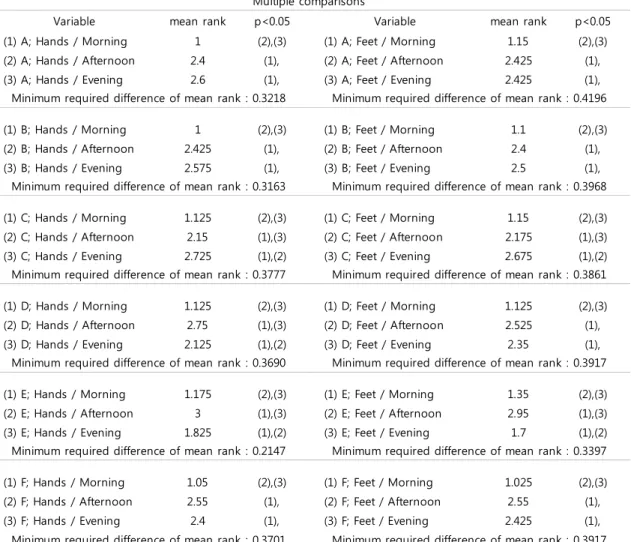
Table 4. The statistical significances of each technologists’ both hands and feet in the morning, afternoon, and evening
Variable mean rank p<0.05 Variable mean rank p<0.05
(1) A; Hands / Morning 1 (2),(3) (1) A; Feet / Morning 1.15 (2),(3)
(2) A; Hands / Afternoon 2.4 (1), (2) A; Feet / Afternoon 2.425 (1),
(3) A; Hands / Evening 2.6 (1), (3) A; Feet / Evening 2.425 (1),
(1) B; Hands / Morning 1 (2),(3) (1) B; Feet / Morning 1.1 (2),(3)
(2) B; Hands / Afternoon 2.425 (1), (2) B; Feet / Afternoon 2.4 (1),
(3) B; Hands / Evening 2.575 (1), (3) B; Feet / Evening 2.5 (1),
(1) C; Hands / Morning 1.125 (2),(3) (1) C; Feet / Morning 1.15 (2),(3)
(2) C; Hands / Afternoon 2.15 (1),(3) (2) C; Feet / Afternoon 2.175 (1),(3) (3) C; Hands / Evening 2.725 (1),(2) (3) C; Feet / Evening 2.675 (1),(2)
(1) D; Hands / Morning 1.125 (2),(3) (1) D; Feet / Morning 1.125 (2),(3) (2) D; Hands / Afternoon 2.75 (1),(3) (2) D; Feet / Afternoon 2.525 (1),
(3) D; Hands / Evening 2.125 (1),(2) (3) D; Feet / Evening 2.35 (1),
(1) E; Hands / Morning 1.175 (2),(3) (1) E; Feet / Morning 1.35 (2),(3)
(2) E; Hands / Afternoon 3 (1),(3) (2) E; Feet / Afternoon 2.95 (1),(3)
(3) E; Hands / Evening 1.825 (1),(2) (3) E; Feet / Evening 1.7 (1),(2)
(1) F; Hands / Morning 1.05 (2),(3) (1) F; Feet / Morning 1.025 (2),(3)
(2) F; Hands / Afternoon 2.55 (1), (2) F; Feet / Afternoon 2.55 (1),
(3) F; Hands / Evening 2.4 (1), (3) F; Feet / Evening 2.425 (1),
Minimum required difference of mean rank : 0.2147 Minimum required difference of mean rank : 0.3397
Minimum required difference of mean rank : 0.3701 Minimum required difference of mean rank : 0.3917 Minimum required difference of mean rank : 0.3690 Minimum required difference of mean rank : 0.3917 Minimum required difference of mean rank : 0.3163 Minimum required difference of mean rank : 0.3968
Minimum required difference of mean rank : 0.3777 Minimum required difference of mean rank : 0.3861 Minimum required difference of mean rank : 0.3218 Minimum required difference of mean rank : 0.4196
Multiple comparisons
and feet during the morning, afternoon, and evening were calculated. The hands morning; (1) and feet morning; (1) of all radiologists had statistical significances with hands morning and evening, and feet morning and evening which represent (2) and (3). We presumed the results, it is because the radiologists did not deal with radio-pharmaceuticals at that hour, in the morning.
Other columns show various. It is hard to find a tendency on radiation contamination from these individual data. Because where, when, and how did the operator get contaminated.
요 약
방사선 작업 종사자들의 손 및 작업화의 방사선 오염 정도 를 분석하여 외부 방사선 오염과 피폭의 위험도를 예상해 보 고, 방사선 작업 종사자들의 점차적인 수적 증가와 장기근무
화 되고 있는 것을 고려하여, 손 및 작업복으로 인한 방사선 오염 방지를 위한 대책을 강구 하기 위하여 본 연구를 실시 하였다. 2010년 8월 4일부터 2011년 1월 14일까지 세브란스 병원 핵의학과 PET/CT 검사실에 근무하는 방사선사 6명의 손 및 작업화의 방사선 오염 선량을 8시(아침), 12시(점심), 16시(저녁)에 각각 측정하였다. 통계적 분석은 SPSS 17을 이 용하여 프리드만 검정, 양측꼬리검정, 윌콕슨 (표본비교) 검 정을 실시하였다. 8시에 측정한 손과 작업화의 오염 선량은 다른 시간대의 선량과 비교하여 통계학적 유의성이 있었다.
특정한 경우, 측정된 선량값이 다른 시간대인 12시 16시의 선량보다 훨씬 높게 나타났다. 손에 대한 감마선의 영향을 알아보기 위해 오염되기 전의 선량을 예상하였으나 작업화 의 선량은 예상이 쉽지 않아서 시행되지 않았다.
방사선 작업 종사자의 수적 증가와 장기 근무화 현상을 고
려할 때 작은 양의 방사능 오염도 피폭의 축적을 가져옴으로
개인 피폭 , 오염 관리에 신경 써야 할 것이다. 비록 손과 작업 화의 오염 선량이 관련된 권고안 보다 낮게 나타났음에도 불
구하고 , 방사능 오염을 방지하기 위한 작업은 반드시 필요하
다 . 따라서 방사선사들은 방사능 오염을 방지하기 위하여, 보
다 방사능 피폭 관련 모니터링을 정기적 , 주기적으로 실시하
는 등의 적절한 피폭 방지 대책을 강구하여야 한다.
Conclusion
We guessed the most accurate test would be SMEAR METHOD so that we could figure out the place that operator get contaminated of their feet, and we are planning to do this test soon. The almost all of measured radiation exposure were under the exposure limitation which is 4 Bq/cm square minus. If the radiation exposure value were revealed much higher than the limits, it was brought to the 'radiation cleaning sink' and washed until the radiation was under the limits. However, what if we didn't do the radiation check?
Like “ALARA; As Low As Reasonably Achievable", It is definitely needs to prevent the radiation-contaminations.
Especially, for radiotechnologists who work with unsealed radioisotope need to prevent radiation contamination. Therefore, the radiotechnologists need a proper radiation-dealing-
procedure of their own, and must try to prevent a radiation exposure by themselves. Such as performing more frequent radiation survey in Radiopharmaceutical Compounding Hood, Cleanroom, and Radiation zone will help investigating the radiation contamination.
REFERENCE
1. P. Covens1, D. Berus, F. Vanhavere and V. Caveliers The introduction of automated dispensing and injection during PET procedures: A step in the optimization of extremity doses and whole-body doses of nuclear medicine staff. Radiation Protection
Dosimetry 2010;Vol.140,No.3:250-258, Advance Access publication
23 March 20102. Guillet, B., Quentin, P., Waultier, S., Bourrelly, M., Pisano, P. and Mundler, O. Technologist radiation exposure in routine clinical practice with 18F-FDG PET. J Nucl Med Technol 2005;33: 175-179.
3. Dalianisa, K., Malamitsia, J., Gogoua, L., Pagoua, M., Efthimiadoua, R., Andreoua, J., Louizı, A. and Georgioub, E. Dosimetric Evaluation of the staff working in a PET/CT department. Nucl Instr
Meth Phys Res 2006;A569:548-550.
4. Biran, T., Weininger, J., Malchi, S., Marciano, R. and Chisin, R.
Measurements of occupational exposure for a technologist performing 18F FDG PET scans. Health Phys 2004;87(5),539-544.
5. Benatar, N., Cronin, B. and O’Doherty, M. Radiation dose rates from patients undergoing PET: implications for technologists and waiting areas. Eur J Nucl Med 2000;27:583-589.