Print ISSN: 2288-4637 / Online ISSN 2288-4645 doi:10.13106/jafeb.2020.vol7.no11.1087
Influence of Components of Internal Control on the Effectiveness of Internal Control: Evidence from Transport
Construction Enterprises in Vietnam*
Tich Trong VU
1, Le Hong Thi HOANG
2, Huyen Thi DO
3, Duong Thuy PHAN
4, Thuan Thi NGUYEN
5Received: August 01, 2020 Revised: October 05, 2020 Accepted: October 15, 2020
Abstract
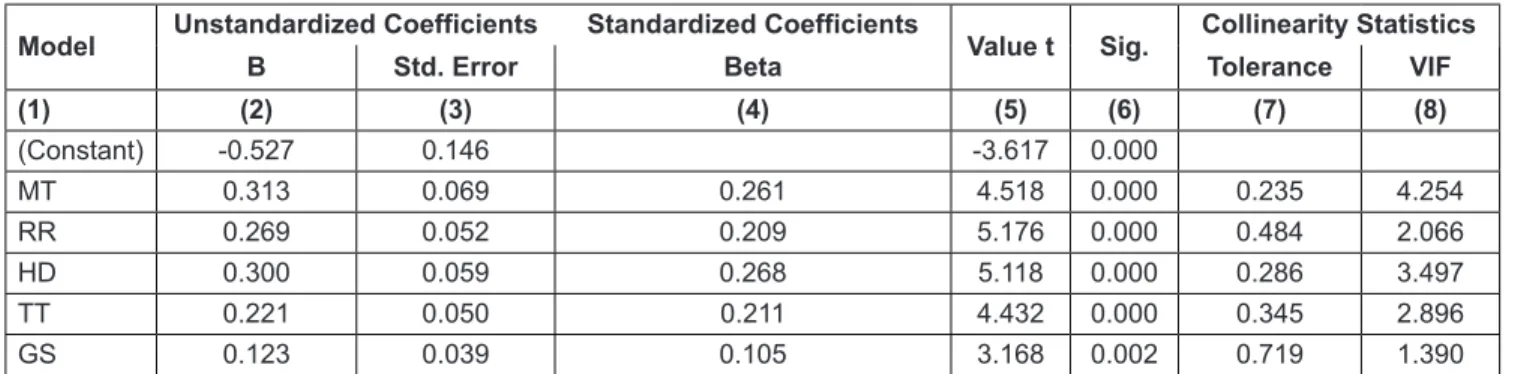
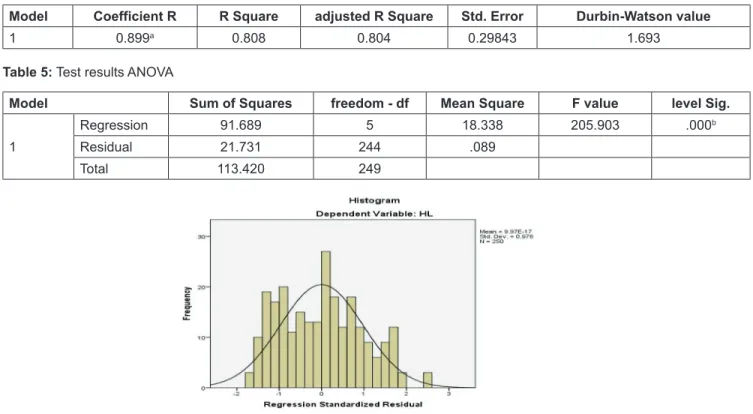
The research purpose of the article is to evaluate the effects of the internal control components on the effectiveness of internal control of transport construction enterprises in Vietnam, on the basis of which we made recommendations to contribute to improving the effectiveness of internal control. Sample was collected from Vietnamese medium and large transport construction enterprises, the total number of sample questionnaires sent was 400, 330 filled-up questionnaires was collected and 250 was used for the study purpose. Quantitative research method was used for the study with the help of the SPSS software. The variables in the model are as follows: the dependent variable is the effectiveness of internal control, 5 independent variables are: control environment, risk assessment, control activities, communication, and monitoring. The results of the analysis explain 80.4% variation as a result of the effect of internal control on the Vietnamese transport construction enterprise. All five components positively affect the effectiveness of internal controls in the order of influence, which are:
control activities, control environment, communication, risk assessment and monitoring. This study contributes in providing more empirical evidence about the effects of internal control components on the effectiveness of internal control of transport construction enterprises in Vietnam. The study has proposed a number of recommendations to help transport construction enterprises improve control activities and contribute towards improving the effectiveness of internal control.
Keywords: Components of Internal Control, Internal Control, Transport Construction Enterprises JEL Classification Code: G30, M40, M41
1. Introduction
The topic of internal control and effectiveness of internal control has received attention from researchers, there have been many studies on this issue being done domestically as well as abroad. Generally, internal control is a process consisting of activities, processes, policies and control points designed and applied by an enterprise; Internal control consists of 5 components: control environment, risk assessment, control activities, communication and monitoring. In order for internal control to operate smoothly and to achieve business goals, including performance, reporting and compliance objectives, the full presence and coherence of five components mentioned above is required.
While researching related to internal control components and internal control effectiveness, the authors found that: in the world there are many studies on the influence of control components. Effect of internal control has been studied in
*Acknowledgements:
The authors are thankful to University of Transport and Communications and University of Transport Technology for funding this research. We would like to thank the anonymous referees for their helpful comments and suggestions.
1
First Author. Dean, Faculty of Transport Economics, University of Transport and Communications, Vietnam. Email: [email protected]
2
Dean, Faculty of Transport Economics, University of Transport Technology, Vietnam. Email: [email protected]
3
Lecturer, Faculty of Transport Economics, University of Transport Technology, Vietnam. Email: [email protected]
4
Corresponding Author. Lecturer, Faculty of Transport Economics, University of Transport Technology, Vietnam [Postal Address: 54 Trieu Khuc Road, Thanh Xuan District, Hanoi, 120418, Vietnam]
Email: [email protected]
5
Lecturer, Faculty of Transport Economics, University of Transport Technology, Vietnam. Email: [email protected]
© Copyright: The Author(s)
This is an Open Access article distributed under the terms of the Creative Commons Attribution Non-Commercial License (https://creativecommons.org/licenses/by-nc/4.0/) which permits unrestricted non-commercial use, distribution, and reproduction in any medium, provided the original work is properly cited.