중생 고품질 내병 내도복 다수성 벼 ‘다보(多寶)’
박노봉1* ・ 여운상2・ 김정일2・ 이지윤2・ 권오덕1・ 박동수2・ 장재기1・ 이종희3・ 조준현2・ 송유천2・ 오성환2・ 김우재1・ 박성태1・ 손영보2・ 신문식1・ 남민희2・ 이종기3
1국립식량과학원, 2국립식량과학원 기능성작물부, 3농촌진흥청
A High Qualilty Rice Variety with Lodging Tolerance, ‘Dabo’
No-Bong Park
1*, Un-Sang Yeo
2, Jeong-Il Kim
2, Ji-Yoon Lee
2, Oh-Deog Kwon
1, Dong-Soo Park
2, Jae-Ki Chang
1, Jong-Hee Lee
3, Jun-Hyun Cho
2, You-Cheon Song
2, Seong-Hwan Oh
2, Woo-Jae Kim
1,
Seong-Tae Park
1, Young-Bo Son
2, Mun-Sik Shin
1, Min-Hee Nam
2, and Jong-Ki Lee
31
National InstituteofCropScience,RDA,441-100,Suwon,Korea
2
Deapartment of Functional Crop, NICS, RDA, 627-803, Milyang, Korea
3
Rural Development Administration(RDA), 441-100, Suwon, Korea
Abstract : A rice variety ‘Dabo‘ is a japonica rice (Oryza sativa L.) with good eating quality, lodging tolerance, and resistance to rice stripe virus (RSV) and blight bacterial disease(BB). It is developed by the rice breeding team of Yeongdeog Substation, National Institute Crop Science, RDA in 2012. This variety derived from a cross between ‘Yeongdeog31’ with good plant type and ‘Milyang165’ with good eating quality conducted in 2001/2002 winter season. A promising line, YR23160-31-2-1-5-B-3, selected by pedigree breeding method was designated as the name of ‘Yeongdeog53’ in 2009. After the local adaptability test was carried out at seven locations from 2010 to 2012, ‘Yeongdeog53’ was released as the name of ‘Dabo’ in 2012. ‘Dabo’ is short culm length as 69 cm and medium-growth duration. This variety is resistant to races, K1, K2, and K3 of bacterial blight and stripe virus and moderately resistant to leaf blast disease. ‘Dabo’ has translucent and clear milled rice kernel without white core and belly rice, and good eating quality as a result of panel test. The yield potential of ‘Dabo’ in milled rice is about 5.90 MT/ha at ordinary fertilizer level of local adaptability test. This cultivar would be adaptable to south plain, east-south costal area, and south mid-mountainous area.
Keywords : Rice, Dabo, Yeongdeog53, Medium-maturing, Eating quality
*Corresponding author (E-mail: [email protected], Tel: +82-54- 732-0385, Fax: +82-54-733-9584)
(Received on December 5, 2014. Revised on March 24, 2015.
Accepted on March 24, 2015.)
140
http://dx.doi.org/10.9787/KJBS.2015.47.2.140 Print ISSN: 0250-3360
Copyright ⓒ 2015 by the Korean Society of Breeding Science
This is an Open-Access article distributed under the terms of the Creative Commons Attribution Non-Commercial License (http://creativecommons.org/licenses/by-nc/3.0) which permits unrestricted non-commercial use, distribution, and reproduction in any medium, provided the original work is properly cited.
서 언
우리나라에서 고품질 벼 품종개발의 역사는 오래 되었고 지금까지 많은 고품질 벼 품종이 육성되었으나 최근 벼 품종 별 재배면적에서 중생종 품종이 차지하는 비율이 4% 정도로 적고 농가에서 선택 할 수 있는 벼 품종도 제한적으로 우수한 고품질 중생종 품종육성의 필요성이 항상 대두 되어 왔다.
기존 육성된 품종의 수량이 높지 않고 출수기가 중만생종
에 품종이 대부분으로, 동해안 지역의 한랭 과습풍과 태백산 맥을 넘어오는 고온 건조풍으로 인한 각종 기상재해의 피해 를 비롯한 바이러스 등 각종 병해충에 강한 복합 내재해 품종 의 개발이 필요한 실정이다. 국립식량과학원 영덕출장소에서 는 이러한 문제해결과 다양한 지역에 적응하는 다수성이며 내병성을 갖춘 최고품질 안전 다수성 벼 품종 육성에 주력하 여 왔으며 2012년 쌀 모양이 단원형이면서 밥맛이 양호한 내 도복성이며 줄무늬잎마름병과 흰잎마름병 K1, K2, K3에 저항 성이 있는 다수성 중생종 ‘다보’를 육성하여 이에 대한 육성 경위와 주요특성을 보고하고자 한다(농촌진흥청, 2010-2012).
Year ’01/’02 ’02 ’03 ’04 ’05 ’06 ’07 ’08 ’09 ’10 ’11 ’12 Generation Cross F1 F2 F3 F4 F5 F6 F7 F8 F9 F10 F11
Yeongdeog31
× Milang165
1
35
→
1,300 1
→
47
→
1
1
②→
3 3
①→ 1
⑤→Bulk
→
1
③→
YR23160-31-2-1-5- B-3
Dabo
↓
No. of breeding lines
(individuals) (35)
32
Families 47 49 24 18 15 1 1 1 1
Remarks F1
Bulk method
Pedigree method
OYT PYT Pedigree method
RYR
LAT
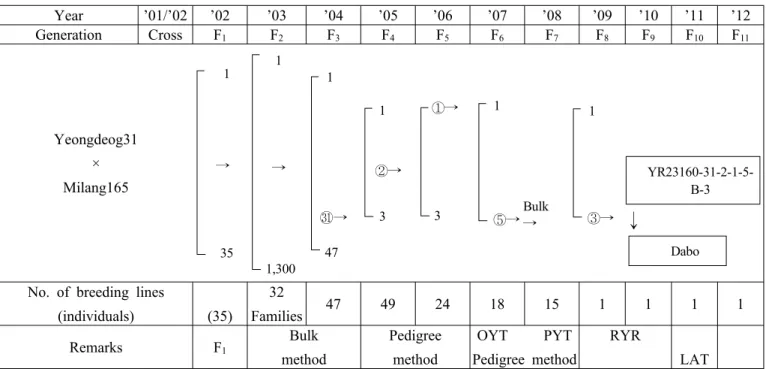
zOYT : Observational yield trial, PYT : Preliminary yield trial, RYT : Replicated yield trial, LAT : Local adaptablity tes Fig. 1. Pedigree diagram of the rice variety ‘Dabo’.
Kyehwa8 Kyehwa8
Shanghaehyan ghealna
Hwayeongbyeo
Ilpumbyeo
Yeongdeog31
Milyang165
Dabo Iri389
Cheomabyeo Odaegbyeo Suweon296-SV3
Innabawase Chukei830
YR4811 Acp8
Akis Dung269
Iri412
Milyang123 Milyang101
Sangjubyeo
Fig. 2. Genealogical diagram of the rice variety ‘Dabo’.
재료 및 방법
‘다보’는 국립식량과학원 영덕출장소에서 2001/2002년 동 계온실에서 동해안 및 영남지역에서 출수기가 중생이면서 안 정성이 높은 최고품질 벼 품종을 육성할 목적으로 밥맛이 좋
은 ‘영덕31호’를 모본으로 다수성인 ‘밀양165호’를 부본으로 인공교배를 실시하고, 2002년 하계에 35개체의 F1 식물체를 양성하여 YR23160의 교배번호를 부여하였다. 2003년 하계 에 F2 집단을 선발하여 2004년 F3세대 47계통을 육성하고, 이후 F4∼F8세대를 계통육종법으로 전개, 예비선발 시험 후
1
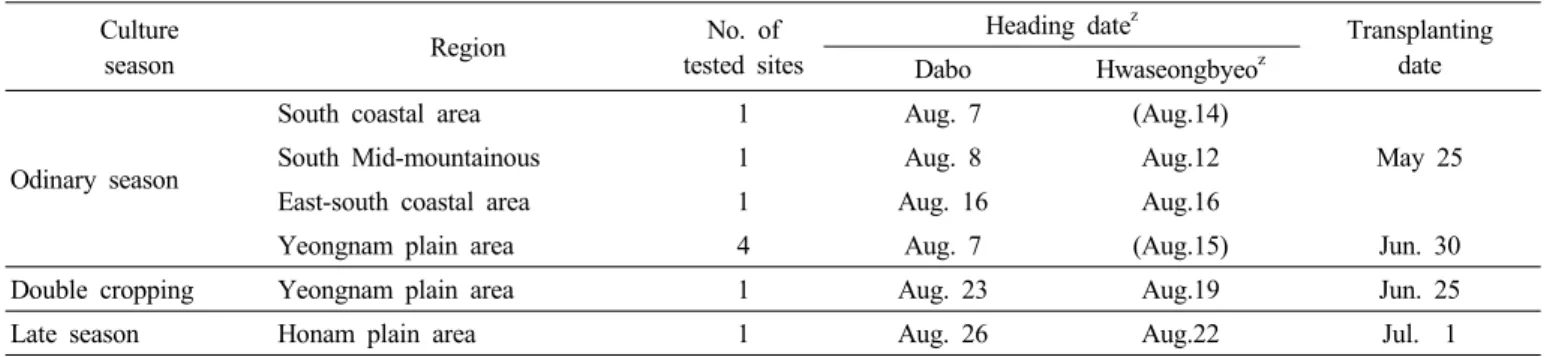
Table 1. Heading date of ‘Dabo’. (LAT : ’10-’12) Culture
season Region No. of
tested sites
Heading datez Transplanting Dabo Hwaseongbyeoz date
Odinary season
South coastal area 1 Aug. 7 (Aug.14)
May 25
South Mid-mountainous 1 Aug. 8 Aug.12
East-south coastal area 1 Aug. 16 Aug.16
Yeongnam plain area 4 Aug. 7 (Aug.15) Jun. 30
Double cropping Yeongnam plain area 1 Aug. 23 Aug.19 Jun. 25
Late season Honam plain area 1 Aug. 26 Aug.22 Jul. 1
z( ) Nampyeongbyeo
Table 2. Leaf and culm characteristics of ‘Dabo’. (NICS, Yeongdeog : ’10-’12)
Variety Flag leaf Culm
Color Length Width Erectness Length (cm) Thickness Stiffness
Dabo Green Medium Medium Erect 69* Medium-High Medium-High
Hwaseongbyeo Green Medium Medium Semi-Erect 80 Medium Medium
*5% level by DMRT
Table 3. Characteristics of grain and panicle of ‘Dabo’. (NICS, Yeongdeog : ’10-’12)
Variety Panicle length (cm) Spikelets density Shattering Panicle exertion Awn Spikelets color
Dabo 20ns Intermediate-high Hard Good None, Few Yellowish white
Hwaseongbyeo 21 Intermediate Hard Good Few Yellowish white
nsNot significantly different at 1, 5% level by DMRT
2008년 생산력검정예비시험 2009년 생산력검정본시험 을 거 쳐 YR23160-31-2-1-5-B-3을 선발하여 ‘영덕53호’로 명명하 였다(영남농업연구소, 2004-2007) (작물과학원, 2008-2010).
2010년~2012년까지 3년간 지역적응시험을 실시한 결과 중 생종이면서 쌀 품위가 좋고 밥맛이 양호하며 내도복과 내병 성에 양호한 것으로 평가되어 2012년 12월 농작물 직무육성 신품종 선정위원회에서 국가품종목록으로 등재 할 것을 결정 하고 ‘다보’로 명명하여 적응지역인 동남부해안지, 남부중산간 지 및 영남평야지에 보급하게 되었다(농촌진흥청, 2010-2012).
결과 및 고찰
주요특성 출수기
보통기 보비재배 출수기는 남부해안지 및 영남평야지에서
‘남평벼’보다 7∼8일 빨랐고, 남부중산간지, 동남부해안지는
평균 8월 12일로 ‘화성벼’에 비해 2일 빠르고, 이모작과 만식 재배에서는 ‘화성벼’에 비해 4일 늦은 중생종이다(Table 1).
잎과 줄기
‘다보’의 잎은 Table 2에서 보는 바와 같이 녹색이며 잎의 길이와 너비는 ‘화성벼’와 비슷하고 직립성으로 초형이 양호 하다. 줄기는 ‘화성벼’보다 굵으며 강도는 중강이고 간장은 69 cm로 ‘화성벼’보다 11 cm 짧은 단간 품종이다. ‘다보’의 이삭 길이는 20 cm로 ‘화성벼’와 비슷하며 착립밀도는 약간 조밀하다. 벼 알은 까락이 거의 없으며 탈립은 잘 되지않는 편이고 영색은 황백색이고 숙색은 양호하다(Table 3).
수량구성요소
‘다보’의 주당수수는 ‘화성벼’와 유사한 수준이며 수당립수 는 13개 많으며, 등숙비율은 ‘화성벼’와 비슷한 수준이며, 현 미천립중은 ‘화성벼’보다 0.1g 가벼운 중립종이다(Table 4).
Table 4. Yield components of ‘Dabo’. (NICS, Yeongdeog : ’10-’12)
Variety No. of panicle/hill No. of spikelet/panicle
Ratio ripened grain (%)
Brown rice (g)
lℓ weight 1000 grains
Dabo 13ns 104ns 88.6ns 873ns 22.6ns
Hwaseongbyeo 13 91 88.0 867 22.7
nsNot significantly different at 1, 5% level by DMRT
Table 5. Milling property and grain quality of ‘Dabo’. (LAT : ’10-’12)
Variety
Brown/
rough rice ratio (%)
Milled/
brown rice ratio (%)
Milling recovery (%)
Head rice grain ratio
(%)
Brown rice Length
(mm)
Width (mm)
Thickness (mm)
Ratio L/W
Translucency (1-9)
WC/WB (0-9)
Dabo 83.8 90.5 75.8 92.9 4.92ns 2.78ns 1.89* 1.77ns 1 0/1
Hwaseongbyeo 84.0 90.6 76.1 87.0 4.98 2.79 1.99 1.79 1 2/0
nsNot significantly different at 1, 5% level by DMRT
*5% level by DMRT
Table 6. Physicochemical properties related to eating quality of ‘Dabo’. (LAT ’10-’12) Variety Amylose content (%) Alkali digestion value (1-7) Protein content (%) Palatability of cooked rice
(-3~+3)
Dabo 19.7ns 6.4 5.7* 0.02
Hwaseongbyeo 20.5 6.5 6.9 0.15
zChucheongbyeo(Suweon) 0.06
nsNot significantly different at 1, 5% level by DMRT
*5% level by DMRT
Table 7. Reaction to the environmental and physiological stress. (LAT ’10-’12)
Variety
Premature heading in 50days old seedling (%)
Appearance of wilting
Adult leaf senes cence
Premature germination of
panicle (%)
Wind tolerance
Cold tolerancez Leaf
senescence (1-9)
Heading delay (days)
Grain fertility
(%)
Dabo 0ns Resistant Slow 14.7ns Middle-Resistant 3 13ns 28.0ns
Hwaseongbyeo 0 Resistant Slow 17.1 Middle 4 11 54.0
zCold tolerance was evaluated at Chuncheon Substation, a cold-water irrigated nursery.
nsNot significantly different at 1, 5% level by DMRT 품질특성
‘다보’의 입형은 현미장폭비가 1.77로 단원형이며 심복백 (WC/WB)은 거의 없고 ‘다보’는 ‘화성벼’보다 맑고 투명하 며, 제현율, 현백률, 도정률은 ‘화성벼’와 비슷하고 백미완전 미율은 높다(Table 5). 아밀로스함량과 단백질함량은 ‘화성 벼’보다 낮고, 밥맛은 ‘화성벼’와 같이 양호하다(Table 6).
생리장해 견딜성
‘다보’는 못자리일수 50 일묘 이앙시에 불시출수가 되지 않았으며 위조에는 강한 편이고 성숙기의 엽노화가 느린 편 이다. 내냉성 검정 결과 출수지연, 임실율은 ‘화성벼’보다 떨 어져 내냉성은 중약정도이며, 내풍성저항성 정도는 백수율이
‘화성벼’보다 적었으며, 수발아는 ‘화성벼’보다 조금 더 강하 다(Table 7).
Table 8. Lodging tolerance and its related characteristics. (LAT : ’12)
Variety Plant length (cm)
3th Culm length
(cm)
Fresh weight of aerial part
(g)
Breaking weight of 3rd internode
(g)
Momentz
(g.cm) Lodging index
Field lodging (1-9) broadcasting in flooded paddy field
Dabo 99 11 11.9 708 1,172 166 1
Hwaseongbyeo 104 12 10.7 623 1,115 179 1
z(Culm length + Panicle length) × Total fresh weight of plant/hill
Table 9. Reaction to blast disease. (LAT : ’10~’12)
Variety
Leaf blast nursery (N : 24kg/10a)
Neck blast field nursery (N:22kg/10a) No. of tested site (14)
R (0~3)
M (4~6)
Sz
(7~9) Ave. Diseased panical (%) (22kg/10a)
Jecheon Icheon Iksan Milyang Yaesan Jinju
Dabo 8 5 1 3.9 0.23ns 0.0* 0.27ns 0.35ns 0.0ns 1.14ns
Hwaseongbyeo 0 12 2 5.8 4.89 4.9 4.56 0.0 0.0 0.0
zR-Resistant M-Medium, S-Susceptible
nsNot significantly different at 1, 5% level by DMRT
*5% level by DMRT
Table 10. Reaction of durable resistance to leaf blast disease. (LAT : ’12)
Variety Percentage of infection region on series planting No. of
virulence isolate (30)
Durable resistance index (0-7)
1st 2nd 3rd 4th 5th 6th 7th
Dabo 35.0 45.0 45.0 50.0 40.0 11.0 0.05 9 6
Hwaseongbyeo 85.0 75.0 75.0 45.0 55.0 45.0 45.0 19 7
Table 11. Reaction to major diseases. (LAT : ’10~’12)
Variety
Bacterial leaf blight Virus disease
K1 K2 K3 K3a Stripe Dwarf Black streaked
dwarf
Dabo R R R Sz R S S
Hwaseongbyeo S S S S R S S
zR-Resistant S-Susceptible 내도복성
‘다보’는 벼키(간장+수장)와 3절간장이 짧아 중심고는 ‘화 성벼’ 보다 낮고, ‘화성벼’에 비해 도복지수가 낮아 포장도복 은 되지 않았다(Table 8).
병해충 저항성
’10~’12년 전국 14개소에서 실시한 잎도열병 밭못자리
검정에서 ‘화성벼’에 비해 더 강한 반응을 보였고, 이삭도열 병 포장검정 6개 지역에서 0~1.14%발병을 보여 ‘화성벼’에 비해 강한 편이었다(Table 9). 도열병 내구저항성 검정에서 잎도열병 병반면적율이 ‘화성벼’보다 적었고, 친화성균주수는
‘화성벼’ 보다 적은 내구성반응을 보였다(Table 10). ‘다보’는 줄무늬잎마름병과 흰잎마름병(K1~K3)에 저항성이나(Table 11) 벼멸구와 애멸구에는 저항성이 없었다(Table 12).
Table 12. Resistance to major insects. (LAT : ’10~’12)
Variety Brown planthopper Small brown planthopper
Dabo S Sz
Hwaseongbyeo S S
zS-Susceptible
Table 13. Yield performance at replicated yield trial. (NICS Yeongdeog : ’09~’10)
Variety Milled rice (MT/ha)
’09 ’10 Mean Index
Dabo 6.54 5.07 5.81* 115
Hwaseongbyeo 5.45 4.62 5.04 100
*5% level by DMRT
Table 14. Summarized results of local adaptability test. (LAT : ’10~’12)
Culture season Region
No. of tested
sites
Milled rice of
‘Hwaseong byeo’
(MT/ha)
Milled rice of ‘Dabo’(MT/ha)
’10 ’11 ’12 Mean Index Range
Ordinary
planting South coastal area 1 (5.20) 5.79 6.46 5.34 5.87 113 5.34~6.46
South Mid-mountainous 1 5.90 5.97 6.62 6.03 6.21 105 5.97~6.62
East-south coastal area 1 4.86 5.64 5.60 5.97 5.74 118 5.60~5.97
Yeongnam plain area 4 (5.44) 5.89 6.05 5.69 5.87 108 5.47~6.46
Mean 7 5.39 5.85 6.12 5.73 5.90** 110 -
Double
cropping Yeongnam plain area 1 4.45 - 5.60 5.13 5.37 121 -
Late planting Honam plain area 1 3.95 - 4.70 4.79 4.75 120 -
zAverage of (Nampyeongbyeo)
**1% level by DMRT
수량성
생산력검정시험
‘다보’는 ’09~’10 보통기 보비재배에서 평균 쌀수량이 5.81 MT/ha으로 ‘화성벼’ 보다 15% 증수 되었다(Table 13).
지역적응시험
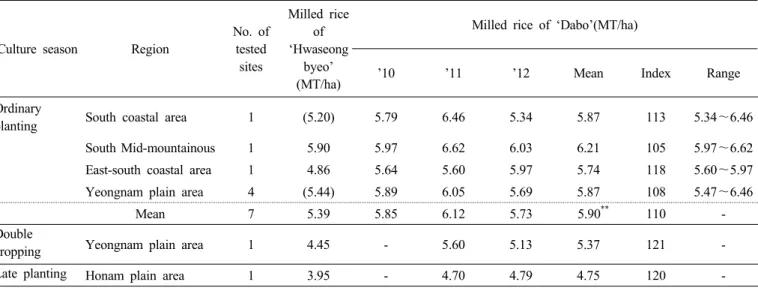
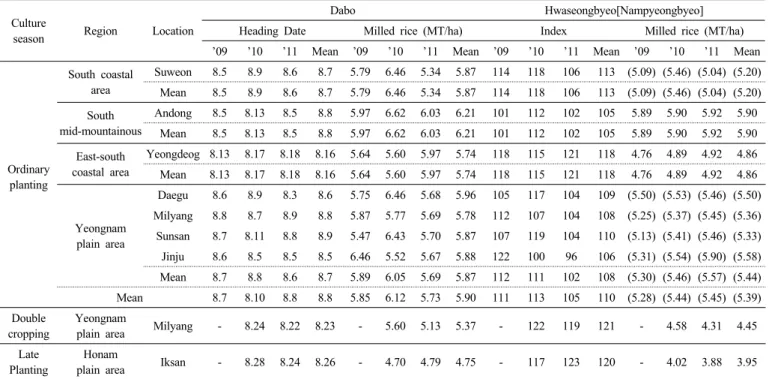
‘다보’의 수량성은 ’10~’12년 3년간 남부해안지, 남부중 산간지, 동남부해안지 및 영남평야지에서의 지역적응시험 보 통기재배 7개소에서 5.90 MT/ha로 ‘화성벼’보다 10% 증수 되었으며, 이모작재배에서는 5.37 MT/ha로 ‘화성벼’ 대비
21%, 만식재배에서는 4.75 MT/ha로 ‘화성벼’ 대비 20% 증 수하여 이모작 및 만식적응성이 높았다(Table 14, 15).
재배상의 유의점
‘다보’는 남부 및 동해안 냉조풍지, 영남평야지 및 남부중 산간지에 적응하는 중생종 품종이다. 단간이지만 질소질 비료 과다시 미질저하, 병해충 발생 및 도복이 우려되므로 적정균 형 시비하여야 하며, 묘대기와 이앙시에 애멸구와 끝동매미충 방제를 철저히하여 오갈병과 검은줄오갈병 발생을 미리 예방 하여야 하고 흰잎마름병 K3a에는 약하므로 적기에 기본방제
Table 15. Results of local adaptability test. (LAT : ’09-’11)
Culture
season Region Location
Dabo Hwaseongbyeo[Nampyeongbyeo]
Heading Date Milled rice (MT/ha) Index Milled rice (MT/ha)
’09 ’10 ’11 Mean ’09 ’10 ’11 Mean ’09 ’10 ’11 Mean ’09 ’10 ’11 Mean
Ordinary planting
South coastal area
Suweon 8.5 8.9 8.6 8.7 5.79 6.46 5.34 5.87 114 118 106 113 (5.09) (5.46) (5.04) (5.20) Mean 8.5 8.9 8.6 8.7 5.79 6.46 5.34 5.87 114 118 106 113 (5.09) (5.46) (5.04) (5.20) South
mid-mountainous
Andong 8.5 8.13 8.5 8.8 5.97 6.62 6.03 6.21 101 112 102 105 5.89 5.90 5.92 5.90 Mean 8.5 8.13 8.5 8.8 5.97 6.62 6.03 6.21 101 112 102 105 5.89 5.90 5.92 5.90 East-south
coastal area
Yeongdeog 8.13 8.17 8.18 8.16 5.64 5.60 5.97 5.74 118 115 121 118 4.76 4.89 4.92 4.86 Mean 8.13 8.17 8.18 8.16 5.64 5.60 5.97 5.74 118 115 121 118 4.76 4.89 4.92 4.86
Yeongnam plain area
Daegu 8.6 8.9 8.3 8.6 5.75 6.46 5.68 5.96 105 117 104 109 (5.50) (5.53) (5.46) (5.50) Milyang 8.8 8.7 8.9 8.8 5.87 5.77 5.69 5.78 112 107 104 108 (5.25) (5.37) (5.45) (5.36) Sunsan 8.7 8.11 8.8 8.9 5.47 6.43 5.70 5.87 107 119 104 110 (5.13) (5.41) (5.46) (5.33) Jinju 8.6 8.5 8.5 8.5 6.46 5.52 5.67 5.88 122 100 96 106 (5.31) (5.54) (5.90) (5.58) Mean 8.7 8.8 8.6 8.7 5.89 6.05 5.69 5.87 112 111 102 108 (5.30) (5.46) (5.57) (5.44) Mean 8.7 8.10 8.8 8.8 5.85 6.12 5.73 5.90 111 113 105 110 (5.28) (5.44) (5.45) (5.39) Double
cropping
Yeongnam
plain area Milyang - 8.24 8.22 8.23 - 5.60 5.13 5.37 - 122 119 121 - 4.58 4.31 4.45
Late Planting
Honam
plain area Iksan - 8.28 8.24 8.26 - 4.70 4.79 4.75 - 117 123 120 - 4.02 3.88 3.95
를 실시하고 이모작 및 만식재배 적응성은 있지만 냉수용출 답이나 극만식재배는 피하는 것이 좋다.
적 요
‘다보’는 국립식량과학원 영덕출장소에서 중생이면서 밥맛 이 좋고 재배안정성인 최고품질 품종을 육성할 목적으로 ‘영 덕31호‘와 ‘밀양165호’를 인공교배 후 YR23160의 교배번호 를 부여하였다. 2003년 하계에 F2 집단을 선발하여 2004년 F3계통을 육성하고, 이후 F4~F8세대를 계통육종법으로 전개 하면서 예비선발시험, 생산력검정예비시험, 생산력검정본시 험을 거쳐 YR23160-31-2-1-5-B-3을 선발하여 ‘영덕53호’로 명명하였다.
2010년~2012년까지 3년간 지역적응시험을 거쳐 2012년 12월 농작물 직무육성 신품종 선정위원회에서 국가품종목록 으로 등재할 것을 결정하고 ‘다보’로 명명 하였다.
출수기는 평균 8월 8일로 ‘화성벼’보다 6일 빠른 중생종이 고, 직립 초형이면 탈립은 잘되지 않고 까락이 거의 없다. 수 당립수는 ‘화성벼’보다 많으며 현미천립중은 22.6 g정도이고, 도정특성은 ‘화성벼’와 비슷하며 쌀알이 단원형이며 맑고 투 명하여 밥맛은 ‘화성벼’와 같이 양호하다. 잎도열병은 중정도 이고 줄무늬잎마름병과 흰잎마름병(K1, K2, K3)에는 강하나
오갈병 및 검은줄오갈병에 약하고 벼멸구 등 충해에는 감수 성이다. 쌀수량성은 ’10~’12년 3년간의 지역적응시험 보통 기에서 5.90 MT/ha로 ‘화성벼’보다 10% 증수되었고, 이모작 에서는 5.37 MT/ha로 ‘화성벼’ 대비 21%, 만식에서는 4.75 MT/ha로 ‘화성벼’대비 20% 증수하여 이모작 및 만식적응성 은 높았다. 적응지역은 동해안냉조풍지 및 남부해안지, 영남 평야지, 남부중산간지이다.
사 사
본 품종은 농촌진흥청 연구사업(세부과제명: 동해안 냉조 풍지 적응 고품질 벼 품종 개발, 세부과제번호: PJ90693110 2014)의 지원에 의해 이루어진 것이며, 본 품종을 육성하기까 지 협력하여 주신 국립식량과학원과 소속 연구소의 벼 육종 연구진, 농촌진흥청 연구정책국, 농촌지원국, 농업과학기술원 및 각도 농업기술원 관계관 여러분께 깊은 감사를 드리는 바 이다.
REFERENCES