Gas Chromatograph-Ion Mobility Spectrometer 전자코를 이용한 워시드 가공 커피와 내추럴 가공 커피의 향기 특성에 대한 연구
문상윤․김미리 충남대학교 식품영양학과
A Study on Fragrance Characteristics of Washed Processed Coffee and Natural Processed Coffee Using GC-IMS (Gas Chromatograph-Ion
Mobility Spectrometer) Electronic Nose
Sang-Yoon Moon and Mee-Ree Kim
Department of Food & Nutrition, Chungnam National University
ABSTRACT This study examined the characteristics of the aroma components of washed-processed and natural-proc- essed coffee. A GC-IMS electronic nose was used to compare the aroma content of three processed and three natural processed coffees produced in the same country. An analysis of the main components of the aroma components detected by GC-IMS electronic nose and the aroma pattern of the washed and natural processed coffee were distinguished.
Four common ingredients were detected because it was produced in the same country. On the other hand, methox- ybenzene was detected in the washed coffee, whereas methyl isobutyl ketone and butanal were detected in the natural processed coffee. The results revealed a difference in the characteristics of coffee aroma depending on the processing method, even if it is coffee from the same country of origin. The coffee from the washed processing method and the natural processing method can be checked even with roasted coffee beans.
Key words: washed processing coffee, natural processing coffee, aroma, GC-IMS
Received 27 April 2020; Accepted 6 July 2020
Corresponding author: Mee Ree Kim, Department of Food and Nutrition, Chungnam National University, Daejeon 34134, Korea E-mail: [email protected], Phone: +82-42-821-6837
Author information: Sang-Yoon Moon (Instructor), Mee-Ree Kim (Professor)
서 론
커피는 독특한 향기를 지니고 있어 세계적으로 생산과 소 비가 증가하고 있다(Hameed 등, 2018). 커피 소비의 증가 에 따라 커피시장이 확대되고 소비자들의 니즈가 다양화되 면서 다양한 향기를 지닌 고품질의 커피 수요가 크게 증가하 였다(Linton, 2008; Suh와 Yu, 2001). 미국은 1980년대부 터 개성적인 향기 특성을 지닌 커피에 대한 소비시장이 형성 되었고 이와 관련된 연구가 진행되었다(Bacon, 2005). 이 러한 커피시장의 변화에 따라 국내 커피시장에서도 개성적 인 향기를 지닌 고품질 커피생두의 수입량이 늘어나고, 수입 되는 커피생두의 품종과 가공방식 또한 다양해지고 있다 (Kang과 Na, 2004; Kim과 Choi, 2011).
커피의 향기는 커피의 특성을 나타내는 핵심적인 요소로 써 품질을 평가하고 소비자의 선택에 많은 영향을 준다(Silva 등, 2005). 커피 향기는 생장환경 외에도 품종이나 로스팅
방법에 의해서도 각기 다르게 생성되고(Moon과 Cho, 1999), 수확 후 가공이나 저장 방식에도 영향을 받는다(Sunarha- rum 등, 2014). 커피 향기에 영향을 주는 생산 요소 중 가공 방식의 경우 동일한 품종의 커피라 할지라도 수확 후 가공 공정을 통해 커피 향기를 변화시킬 수 있어 독특한 개성을 지닌 스페셜티 커피를 생산하는 커피 농가들의 경우 대부분 가공을 통해 개성적인 향기를 지닌 커피를 생산하고 있다 (Taguchi, 2011).
커피생두의 대표적인 가공방식은 워시드 가공법과 내추 럴 가공법으로 워시드 방식으로 가공한 커피는 파치먼트에 붙어 있는 점액질을 제거하는 미생물 발효 공정에 의해 깔끔 한 향기들이 만들어진다는 연구가 있고(Gonzalez-Rios 등, 2007), 내추럴 방식으로 가공한 커피는 건조 시 과육에 있는 미생물에 의해 발효가 이루어지게 되어 다양한 향이 만들어 질 수 있다는 연구(Schwan과 Fleet, 2015)가 있다. Wen- delboe(2012)는 내추럴 방식은 과육에 있는 당분과 고형성 분들이 생두에 흡수 및 건조되면서 단 향, 과일류의 향미를 만들어 낸다고 보고하였다. 워시드 방식과 내추럴 방식 모두 발효 과정을 통해 향기 성분들이 만들어지며, 워시드 방식은 꽃향기와 과일 향이 생성되고, 내추럴 방식은 워시드보다 강한 향기가 생성된다(Tanbe, 2016).
본 연구에서는 워시드 가공 커피와 내추럴 가공 커피의
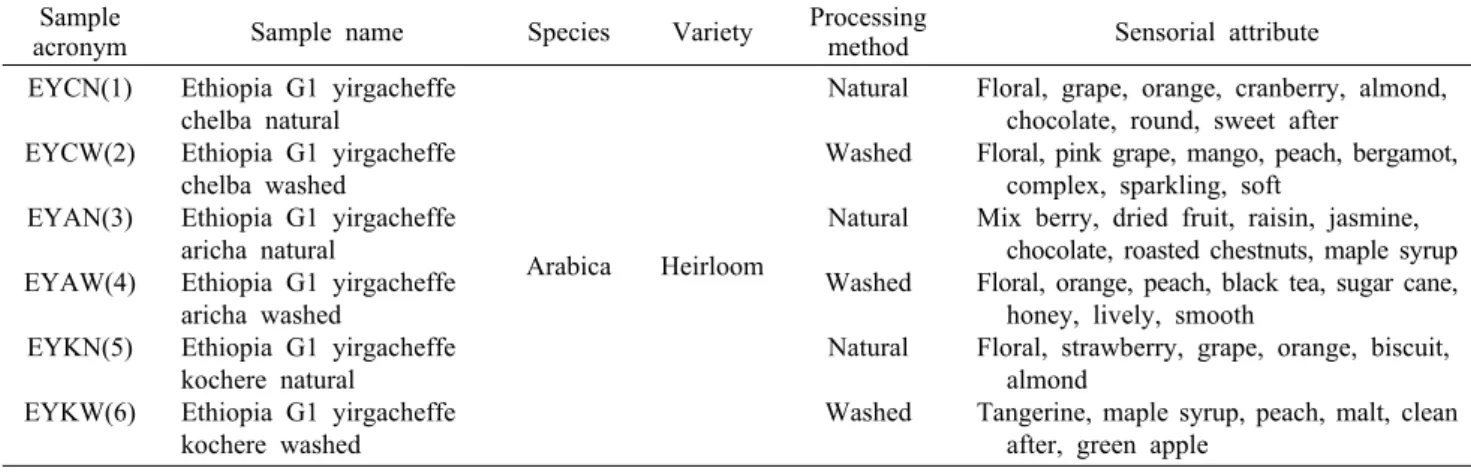
Table 1. List and characteristics of the coffee samples used in this study
Sampleacronym Sample name Species Variety Processing
method Sensorial attribute EYCN(1)
EYCW(2) EYAN(3) EYAW(4) EYKN(5) EYKW(6)
Ethiopia G1 yirgacheffe chelba natural
Ethiopia G1 yirgacheffe chelba washed
Ethiopia G1 yirgacheffe aricha natural
Ethiopia G1 yirgacheffe aricha washed
Ethiopia G1 yirgacheffe kochere natural
Ethiopia G1 yirgacheffe kochere washed
Arabica Heirloom
Natural Washed Natural Washed Natural Washed
Floral, grape, orange, cranberry, almond, chocolate, round, sweet after
Floral, pink grape, mango, peach, bergamot, complex, sparkling, soft
Mix berry, dried fruit, raisin, jasmine, chocolate, roasted chestnuts, maple syrup Floral, orange, peach, black tea, sugar cane,
honey, lively, smooth
Floral, strawberry, grape, orange, biscuit, almond
Tangerine, maple syrup, peach, malt, clean after, green apple
향기 성분 차이를 확인하고 두 가공방식 간의 특성을 파악하 여 커피 생산자들의 가공방식별 커피 선택에 도움을 주고자 한다. 또한, 가공방식에 따른 향기 성분 분석 방법을 제시하 여 한국 커피산업 발전에 적용하기 위한 기초자료로 활용하 고자 한다.
재료 및 방법
실험재료
본 연구에서 사용한 커피는 Ethiopia G1 Yirgacheffe Chelba 워시드 가공과 내추럴 가공, Ethiopia G1 Yirga- cheffe Aricha 워시드 가공과 내추럴 가공, Ethiopia G1 Yirgacheffe Kochere 워시드 가공과 내추럴 가공 커피로 총 6개의 에티오피아산 커피를 사용하였으며 커피 정보는 Table 1과 같다. 커피 구입은 서울 소재의 GSC Internation- al Co., Ltd.(Seoul, Korea)에서 2017년 9월에 구입하였다.
재료의 처리
본 연구에 사용된 커피 시료는 동일 조건에서 총 3회 로스 팅하여 사용하였다. 로스팅은 반 열풍방식 로스터인 R-101 (FUJI ROYAL Co., Ltd., Osaka, Japan)을 사용하였으며, 200°C의 온도에서 500 g씩 투입하여 1차 크랙 이후 1분간 휴지기를 거친 다음 210°C에서 배출하여 냉각하였다. 로스 팅에 소요된 총 시간은 9분 30초였다. 커피는 산화를 억제하 기 위해 One-way valve 봉투(Softpack Co., Ltd., Seong- nam, Korea)에 100 g씩 포장하였으며, 흡습제를 넣은 밀폐 박스에 넣어 15~20°C로 보관하였다. 시료의 분쇄는 커피 그라인더 R300(FUJI ROYAL Co., Ltd.)을 사용하였다.
GC-IMS에 의한 향기 분석 방법
본 실험의 향기 분석은 신속한 향기 성분 추출이 가능하여 향기 성분 변화를 최소화할 수 있는 headspace법을 이용하 였다. Gas Chromatograph-Ion Mobility Spectrometer (FlavourSpec®, GAS Co., Ltd., Dortmund, Germany)를 이용하여 휘발성 유기화합물(VOCS)을 분석하였다. 재현성
을 위해 자동화 sampler unit(CTC-PAL, CTC Analytics AG, Zwingen, Switzerland)을 함께 사용하였다.
시료는 약 0.3 g을 20 mL headspace vial에 넣고 mag- neticcaps로 밀봉하여 70°C에서 20분간 conditioning을 실 시한 후 headspace autosampler heated injector syringe (80°C)를 이용하여 100 μL를 GC-IMS에 주입하였다.
이후 carrier gas(N2)를 무극성 OV-5 MCC(Multiple capillary column)에 의해 분리가 잘되도록 30°C로 가열된 MCC(Multiple capillary column, 20 cm length)관으로 통 과시켰다. 분석은 IMS로 먼저 검출된 이온을 등온선법으로 분리를 하였다. 분자량에 대한 이온은 3H(Tritium, 100 MBq)로 만들어졌으며, 이온 물질들이 shutter 막을 통해 이온지역으로 들어오면 drift region에서 faraday plate로 이동되어 각 성분에 대한 신호의 크기를 감지하고 측정하였 다. Drift tube의 길이는 6 cm이고 60°C의 온도와 350 Vcm-1의 정전압을 공급하여 monomer, dimer 등으로 분리 하였다. 데이터는 장비에 연결된 컴퓨터를 통해 양이온을 얻었다. 각각의 스펙트럼은 평균 32개의 scan들로 구성되 어 있으며 grid pulse width 100 μs, repetition rate 21 ms, sampling frequency 150 kHz이다(Table 2).
분석 결과값은 library search software(GC×IMS library search software, GAS Co., Ltd.)를 사용하여 성분을 확인 하였다.
통계처리
향기 성분은 IMS에 의해 감지된 피크를 IMS software LAV(version 2.2.1, GAS Co., Ltd.)를 통해 분석하고, 재현 성을 위해 시료별로 반복 측정한 후 기기에 내장된 통계프로 그램인 statistical software(Dynamic PCA 1.0.7, GAS Co., Ltd.)를 사용하여 주성분 분석을 하였다.
결과와 고찰
워시드 가공 커피와 내추럴 가공 커피의 GC-IMS 전자코
스펙트럼 정성 분석 결과
Table 2. Experimental conditions for coffee aroma analysis by GC-IMS
Conditions
GC autosampler
Headspace vial Incubation time Sample amount Incubation temperature Injector temperature Syringe temperature Sample amount Agitation speed
20 mL 20 min 0.3 g 70°C 80°C 80°C 100 μL 400 rpm
GC column
Capillary column Length of column ID of column Column temperature Runtime
non-polar column constituted by 94% methyl, 5% phenyl, 1% vinyl silicone 15 m
0.32 mm 80°C 30 min
IMS
Ionization source Voltage
Carrier gas flow (N2 gas) Drift gas flow (N2 gas) Drift tube temperature
Tritium 100 MBq Positive drift
1 mL/min, 2 min> 20 mL/min, 15 min> 20 mL/min, 20 min> 1 mL/min, 22 min> 11 mL/min, 30 min
150 mL/min 45°C
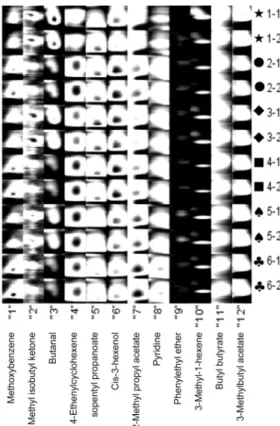
Fig. 1. Cross-sectional topographic plot of three dimensional
GC-IMS spectra obtained with non-polar column for roasted coffee. ★ 1-1, 1-2: EYCN, ● 2-1, 2-2: EYCW, ◆3-1, 3-2: EYAN,■ 4-1, 4-2: EYAW, ♠ 5-1, 5-2: EYKN, ♣ 6-1, 6-2: EYKW.
워시드 가공 커피와 내추럴 가공 커피의 향기 성분을 GC- IMS 전자코를 이용하여 분석한 결과는 Fig. 1과 같다. GC- IMS에서 검출된 커피 시료 향기의 3차원의 스펙트럼을 단
면으로 잘라 2차원으로 표현하였다. 워시드 커피와 내추럴 커피별로 나타난 peak들이 spot으로 표현되었으며, 각각의 성분들의 감지 세기가 다르게 나타났다. 커피 시료는 오른쪽 (y축)에 표시하였고, IMS에서 감지된 area spots은 아래쪽 (x축)에 성분명으로 표시하였다. 모든 시료에서 phenylethyl ether, 3-methyl-1-hexene 성분은 거의 감지되지 않았고, cis-3-hexenol 성분은 모든 시료에서 높게 감지되었다. 워 시드 가공 커피의 경우 methoxybenzene 성분이 내추럴 가 공 커피보다 높게 감지되었고, methyl isobutyl ketone, butanal 성분은 내추럴 가공 커피에서 높게 감지되어 동일 한 Heirloom 품종의 커피임에도 가공방식에 따라 향기 성분 에 차이가 나타나는 것을 확인하였다. 다만, 같은 내추럴 가 공임에도 불구하고 spot에서는 약간의 차이를 나타내어 EYCN이 다른 두 개의 내추럴 가공 커피인 EYAN, EYKN보 다 methyl isobutyl ketone, butanal 성분이 강하게 감지됨 을 확인하였다. 특히, EYCN은 3-methylbutyl acetate 성 분이 다른 커피보다 높게 감지되었다.
따라서 동일한 품종의 커피일지라도 가공방식에 따라 IMS 스펙트럼으로 구별되고 spot의 종류와 강도에서도 차 이를 나타내 워시드 가공 커피와 내추럴 가공 커피의 향에 차이가 존재하는 것을 암시해 주었다.
주성분 분석으로 확인한 워시드 가공 커피와 내추럴 가공 커피의 특징적인 향기 성분
GC-IMS에서 분석한 커피 향기 성분의 데이터를 주성분 분석하여 Fig. 2로 제시하였고, 워시드 가공 커피와 내추럴 가공 커피의 향기 성분 특성을 확인하여 가공방식별 판별의 기준으로 활용할 수 있는 가능성을 검토하고자 하였다.
전자코를 이용하여 얻어진 커피 시료 6종에 대한 주성분
Table 3. Cumulative variance of PC with eigenvalues for the principal component analysis of coffee by country of origins
Component Mean Variance Cumulative variance Eigen value
1 2 3 4 5 6 7 8 9 10 11 12
46,737.21 54,149.09 30,467.22 60,660.98 68,074.76 66,134.26 55,490.39 38,267.54 19,618.06 36,630.04 28,697.04 32,801.42
56.990450 20.916460 14.109030 4.432468 1.766560 0.749627 0.553390 0.350721 0.136352 0.074050 0.015731 0.005066
56.99 77.90 92.01 96.34 98.11 98.86 99.41 99.76 99.90 99.97 99.99 100.00
764,043.10000 280,418.10000 189,152.90000 58,083.28000 23,683.41000 10,049.88000 7,419.02800 4,701.94300 1,828.00700 992.75340 210.89410 67.92281
[9] [2] [12]
[10]
[11]
[8]
[5]
[3]
[6]
[4][7]
[1]
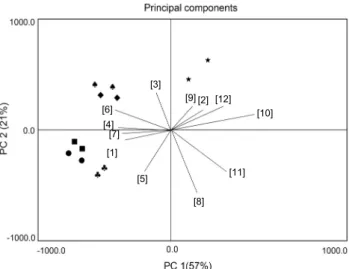
Fig. 2. Clusters obtained for 6 roasted coffee by PCA strategy.
Kind of coffee sample: ★ 1-1, 1-2: EYCN, ● 2-1, 2-2: EYCW,
◆3-1, 3-2: EYAN, ■ 4-1, 4-2: EYAW, ♠ 5-1, 5-2: EYKN, ♣ 6-1, 6-2: EYKW (EYCN: Ethiopia G1 yirgacheffe chelba natural, EYCW: Ethiopia G1 yirgacheffe chelba washed, EYAN: Ethio- pia G1 yirgacheffe aricha natural, EYAW: Ethiopia G1 yirga- cheffe aricha washed, EYKN: Ethiopia G1 yirgacheffe kochere natural, EYKW: Ethiopia G1 yirgacheffe kochere washed).
Volatile compounds: [1] Methoxybenzene, [2] Methyl isobutyl ketone, [3] Butanal, [4] 4-Ethenylcyclohexene, [5] Isopentyl propanoate, [6] Cis-3-hexenol, [7] 2-Methyl propyl acetate, [8]
Pyridine, [9] Phenylethyl ether, [10] 3-Methyl-1-hexene, [11]
Butyl butyrate, [12] 3-Methylbutyl acetate.
분석 결과는 Table 3과 같다. PC 1의 기여율은 56.99%였고 PC 2의 기여율은 20.91%였으며, PC 3의 기여율은 14.11%
였다. 6종의 커피는 PC 1과 PC 2 값만으로도 향기 패턴 구분에 필요한 정보를 얻을 수 있었다. 내추럴 가공 커피인 EYCN은 PC 1으로 구분되었고, 다른 5종의 커피도 PC 1과 PC 2를 통해 구분되었다. EYCN과 EYCW는 같은 에티오피 아 커피임에도 서로 멀리 위치하여 가공방식에 따라 향기 패턴에 차이가 남을 확인하였다. 또한, 동일한 내추럴 가공 커피인 EYCN, EYAN, EYKN은 중앙을 중심으로 위쪽에 위치했으며, 워시드 가공 커피인 EYCW, EYAW, EYKW는 왼쪽 아래에 위치하는 경향을 나타내어 동일한 생산지 커피
임에도 가공방식에 따라 향기 성분 패턴이 달라지는 것을 확인하였다. 이상의 결과로 GC-IMS 전자코를 이용한 향기 패턴 인식 정보는 PCA를 활용하여 워시드 가공 커피와 내추 럴 가공 커피의 향기 특성을 신속하게 판별이 가능함을 확인 하였다.
Kim 등(2014)의 원두 종류에 따른 커피의 향기 패턴 분석 연구 결과에서 미약하지만 가공에 따라 향기 패턴이 달라지 는 결과를 보고하여 본 연구 결과와 일치하였고, Dong 등 (2019)의 HS-SPME-GC-MS를 이용한 로스팅 커피의 품 질 특성과 내추럴 가공방식 효과에 대한 연구에서 가공을 통해 향기 특성이 달라진다는 결과와도 본 연구의 결과가 일치하였다. 이와 같은 결과로 전자코를 커피 향기 분석에 이용하게 되면 가공방식에 따른 커피 향기 특성에 대한 효율 적인 구분이 가능할 것으로 전망된다.
워시드 가공 커피와 내추럴 가공 커피의 휘발성 향기 성분 동정
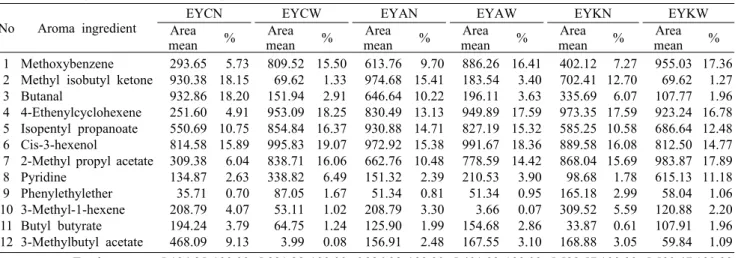
워시드 가공 커피와 내추럴 가공 커피의 특징적인 향기 성분에 대한 정보를 얻기 위해 시료별로 GC-IMS 크로마토 그램에 나타난 peak들을 선택하여 library search soft- ware를 사용하여 워시드 가공 커피와 내추럴 가공 커피의 향기 성분에 대한 상대적인 양(면적비)을 계산하여 Table 4에 나타내었다. 시료별 향기 성분의 양은 Table 4와 같이 워시드 가공 커피와 내추럴 가공 커피 간에 향기 성분의 양 이 상대적인 차이를 나타냈다. GC-IMS 전자코 분석 결과 내추럴 커피에서 높게 감지되었던 methyl isobutyl ketone 성분은 내추럴 가공 커피인 EYCN이 18.15%, EYAN이 15.41%, EYKN이 12.70%로 나타났고, 워시드 가공 커피인 EYCW는 1.33%, EYAW는 3.40%, EYKW는 1.27%로 나타 났다. 또한 butanal 성분도 내추럴 가공 커피인 EYCN이 18.20%, EYAN이 10.22%, EYKN이 6.70%로 나타났고, 워 시드 가공 커피인 EYCW는 2.91%, EYAW는 3.63%, EYKW 는 1.96%로 향의 양(면적비)에 대한 차이를 나타내 가공방 식에 따라 향기 구성에 차이가 보임을 확인하였다.
6종의 커피시료에서 총 12종의 향기 성분이 검출되었으
Table 4. Average area of volatile compounds identified with GC-IMS of roasted coffee
No Aroma ingredient EYCN EYCW EYAN EYAW EYKN EYKW
Area
mean % Area
mean % Area
mean % Area
mean % Area
mean % Area mean % 1
2 3 4 5 6 7 8 9 10 11 12
Methoxybenzene Methyl isobutyl ketone Butanal
4-Ethenylcyclohexene Isopentyl propanoate Cis-3-hexenol
2-Methyl propyl acetate Pyridine
Phenylethylether 3-Methyl-1-hexene Butyl butyrate 3-Methylbutyl acetate
293.65 930.38 932.86 251.60 550.69 814.58 309.38 134.87 35.71 208.79 194.24 468.09
5.73 18.15 18.20 4.91 10.75 15.89 6.04 2.63 0.70 4.07 3.79 9.13
809.52 69.62 151.94 953.09 854.84 995.83 838.71 338.82 87.05 53.11 64.75 3.99
15.50 1.33 2.91 18.25 16.37 19.07 16.06 6.49 1.67 1.02 1.24 0.08
613.76 974.68 646.64 830.49 930.88 972.92 662.76 151.32 51.34 208.79 125.90 156.91
9.70 15.41 10.22 13.13 14.71 15.38 10.48 2.39 0.81 3.30 1.99 2.48
886.26 183.54 196.11 949.89 827.19 991.67 778.59 210.53 51.34 3.66 154.68 167.55
16.41 3.40 3.63 17.59 15.32 18.36 14.42 3.90 0.95 0.07 2.86 3.10
402.12 702.41 335.69 973.35 585.25 889.58 868.04 98.68 165.18 309.52 33.87 168.88
7.27 12.70 6.07 17.59 10.58 16.08 15.69 1.78 2.99 5.59 0.61 3.05
955.03 69.62 107.77 923.24 686.64 812.50 983.87 615.13 58.04 120.88 107.91 59.84
17.36 1.27 1.96 16.78 12.48 14.77 17.89 11.18 1.06 2.20 1.96 1.09 Total 5,124.85 100.00 5,221.28 100.00 6,326.38 100.00 5,401.02 100.00 5,532.57 100.00 5,500.47 100.00
Table 5. Volatile compounds identified with GC-IMS of roasted coffee
No Compound RT (s)1) DT (ms)2) Sensory descriptor Reference 1
2 3 4 5 6 7 8 9 10 11 12
Methoxybenzene Methyl isobutyl ketone Butanal
4-Ethenylcyclohexene Isopentyl propanoate Cis-3-hexenol
2-Methyl propyl acetate Pyridine
Phenylethyl ether 3-Methyl-1-hexene Butyl butyrate 3-Methylbutyl acetate
286.9350 166.7320 120.2020 224.8950 334.4340 240.4050 191.9360 177.3960 366.4240 129.8960 373.2090 244.2820
1.4446 1.4050 1.2955 1.3700 1.3594 1.2163 1.3046 1.3259 1.2574 1.4142 1.4203 1.3122
Phenolic gasoline ethereal anise Herbal, fruity, dairy nuances
Fruity, ethereal, cocoa, green, grainy, aldehydic Sweet ethereal
Sweet, estry, fruity apple, banana with a fresh green slightly tropical nuance
Green, grassy, melon rind-like with a pungent freshness Sweet, fruity, etherial with an apple banana nuance Sour, putrid, fishy, amine, bitter, roasted
Fresh, sweet, almond hyacinth Solvent-like
Sweet, fruity, fresh, diffusive and ripe Sweet, banana, fruity with a ripe estry nuance
TGSC, 2019 TGSC, 2019 TGSC, 2019
Reese and Stevens, 1960 TGSC, 2019
TGSC, 2019 TGSC, 1990 TGSC, 2019 TGSC, 2019 Urbach, 1997 TGSC, 2019 TGSC, 2019 1.1.1.1. 1)RT: Retention time. 2)DT: Drift time.
며 검출된 각각 성분의 화합물명과 향의 특성을 Table 5에 나타내었다. 검출된 향기 성분들은 티올, 알데하이드, 에탄 올, 메틸, 케톤류로 워시드 가공 커피와 내추럴 가공 커피는 Fig. 1과 같이 향의 세기에 차이를 나타냈다.
본 실험에서 사용한 에티오피아산 3개 지역 Yirgacheffe Chelba, Yirgacheffe Aricha, Yirgacheffe Kochere 커피에 서 공통으로 강하게 감지된 성분은 은은한 단 향의 향기 특성 을 갖는 4-ethylcyclohexene, 달콤함, 사과향기, 바나나와 같은 열대과일 향기 특성을 갖는 isopentyl propanoate, 갓 베어낸 풀 향기 특성을 갖는 cis-3-hexenol, 달콤한 사과와 바나나 같은 향기 특성을 갖는 2-methyl propyl acetate였 다. 이와 같은 에티오피아 커피가 달콤한 향을 공통으로 나타 낸다는 결과는 브라질, 콜롬비아, 에티오피아, 과테말라 커 피를 gas chromatography로 향기를 분석한 Pua 등(2020) 의 연구 결과와도 일치함을 확인하였다. 한편, 워시드 가공 커피에서 내추럴 가공 커피에 비해 상대적으로 높은 감도를 보인 휘발성 성분은 phenolic gasoline ethereal anise 향기 특성을 갖는 methoxybenzene 성분이었다. 내추럴 가공 커
피에서 워시드 가공 커피에 비해 상대적으로 높은 감도를 보인 휘발성 성분은 herbal, fruity, dairy nuances 향기 특 성을 갖는 methyl isobutyl ketone과 cocoa, green, grai- ny, fermented 향기 특성을 갖는 butanal 성분이었다. 따라 서 가공방식에 따라 향기 특성이 달라진다는 사실을 확인하 였고, 이러한 결과는 Buratti 등(2015)의 근적외선 분광법 과 전자코・전자혀를 이용한 워시드 가공 커피와 네추럴 가 공 커피의 분석연구 결과와도 일치함을 나타냈다.
이상의 결과로부터 커피의 휘발성 성분 중 GC-IMS 전자 코에서 높은 감도로 검출된 성분들의 구성을 보았을 때, 동 일한 품종의 커피일지라도 가공방식에 따라 휘발성 성분의 차이가 있다는 것을 확인하였다.
요 약
본 연구에서는 가공방식에 따라 커피 향기 특성의 차이가 있는지를 확인하기 위해 GC-IMS 전자코를 이용하여 국내 에서 워시드 가공 커피와 내추럴 가공 커피로 동시에 많이
유통되고 있는 아라비카종의 에티오피아산 3개 지역의 커피 를 사용하여 향기 특성을 비교・분석하였다. GC-IMS 전자 코에 의해 검출된 향기 성분의 주성분을 분석한 결과 워시드 가공 커피와 내추럴 가공 커피의 향기 패턴은 뚜렷이 구분되 었다. 에티오피아산 커피에서 가장 강하게 감지된 성분은 4-ethenylcyclohexene, isopentyl propanoate, cis-3- hexenol, 2-methyl propyl acetate였다. 또한, methox- ybenzene 성분은 워시드 가공 커피에서 뚜렷이 감지되었 고, methyl isobutyl ketone, butanal 성분은 내추럴 가공 커피에서 뚜렷이 감지되었다. 이를 통해 워시드 가공방식과 내추럴 가공방식의 커피를 로스팅된 커피원두 상태로도 확 인이 가능함을 확인하였고, 커피 로스터가 부각하고자 하는 향을 위한 커피 생두를 선택할 때 참고자료로 활용할 수 있 을 것으로 사료된다.
감사의 글
본 연구에 기기 사용을 비롯한 많은 도움을 주신 (주)유로사 이언스와 시료인 커피를 제공해주신 한국커피문화협회에 감사를 드립니다.
REFERENCES
Bacon C. Confronting the coffee crisis: Can fair trade, organic, and specialty coffees reduce small-scale farmer vulnerability in Northern Nicaragua?. World Development. 2005. 33:497- 511.
Buratti S, Sinelli N, Casiraghi E, Bertone E, Venturello A, Geo- baldo F. Discrimination between washed Arabica, natural Arabica and Robusta coffees by using near infrared spectro- scopy, electronic nose and electronic tongue analysis. J Sci Food Agric. 2015. 95:2192-2200.
Dong W, Hu R, Long Y, Li H, Zhang Y, Zhu K, et al. Compar- ative evaluation of the volatile profiles and taste properties of roasted coffee beans as affected by drying method and de- tected by electronic nose, electronic tongue, and HS-SPME- GC-MS. Food Chem. 2019. 272:723-731.
Gonzalez-Rios O, Suarez-Quiroz ML, Boulanger R, Barel M, Guyot B, Guiraud JP, et al. Impact of “ecological” post-har- vest processing on the volatile fraction of coffee beans: I.
Green coffee. J Food Compos Anal. 2007. 20:289-296.
Hameed A, Hussain SA, Ijaz MU, Ullah S, Pasha I, Suleria HAR.
Farm to consumer: Factors affecting the organoleptic charac- teristics of coffee. Ⅱ: Postharvest processing factors. Compr Rev Food Sci Food Saf. 2018. 17:1184-1237.
Kang SU, Na YS. The analysis toward consumption state, import and export in the world coffee market -The case of Korea, U.S.A., Japan market-. Culi Sci & Hos Res. 2004. 10:65-82.
Kim JS, Choi SH. A study on the effects of brand individuality of specialty coffee shops on brand loyalty. Culi Sci & Hos Res. 2011. 17:125-142.
Kim KH, Kim AH, Lee JK, Chun MS, Noh BS. Analysis of flavor pattern of various coffee beans using electronic nose.
Korean J Food Sci Technol. 2014. 46:1-6.
Linton A. A Niche for sustainability? Fair labor and environ- mentally sound practices in the specialty coffee industry.
Globalizations. 2008 5:231-245.
Moon JW, Cho JS. Changes in flavor characteristics and shelf- life of roasted coffee in different packaging conditions during storage. Korean J Food Sci Technol. 1999. 31:441-447.
Pua A, Lau H, Liu SQ, Tan LP, Goh RMV, Lassabliere B, et al. Improved detection of key odourants in Arabica coffee using gas chromatography-olfactometry in combination with low energy electron ionisation gas chromatography-quadru- pole time-of-flight mass spectrometry. Food Chem. 2020.
302:125370. https://doi.org/10.1016/j.foodchem.2019.125370 Reese TS, Stevens SS. Subjective intensity of coffee odor. Am
J Psychol. 1960. 73:424-428.
Schenker S, Heinemann C, Huber M, Pompizzi R, Perren R, Escher R. Impact of roasting conditions on the formation of aroma compounds in coffee beans. J Food Sci. 2002. 67:60- 66.
Schwan RF, Fleet GH. Cocoa and coffee fermentations. 1st ed.
Taylor & Francis Group, LLC, New York, NY, USA. 2015.
p 432-461.
Silva AF, Minim VPR, Ribeiro MM. Sensory evaluation of dif- ferents comercial marks of the organic coffee (Coffea arabica L.). Cienc Agrotecnol. 2005. 29:1224-1230.
Suh JW, Yu JS. Application of porters competitive strategy in Korean foodservice market-Focused on launching of US based specialty coffee shop. Culi Sci & Hos Res. 2001. 7:69- 84.
Sunarharum WB, Williams DJ, Smyth HE. Complexity of coffee flavor: A compositional and sensory perspective. Food Res Int. 2014. 62:315-325.
Taguchi M. No specialty coffee taizen by mamoru. NHK Pub- lishing, Inc., Tokyo, Japan. 2011. p 34-47.
Tanbe Y. Coffee no Kagaku. Kodansha Ltd., Tokyo, Japan.
2016. p 21-54.
TGSC (The Good Scents Company). TGSC Information System
‘2-methyl propyl acetate’. 1990 [cited 2019 Jul 3] Available from: http://www.thegoodscentscompany.com/data/rw1013631.
html
TGSC (The Good Scents Company). TGSC Information System
‘3-methylbutyl acetate’. 1991 [cited 2019 Jul 3] Available from: http://www.thegoodscentscompany.com/data/rw1006711.
html
TGSC (The Good Scents Company). TGSC Information System
‘butanal’. 1999 [cited 2019 Jul 3] Available from: http://
www.thegoodscentscompany.com/data/rw1007681.html TGSC (The Good Scents Company). TGSC Information System
‘butyl butyrate’. 1992 [cited 2019 Jul 3] Available from:
http://www.thegoodscentscompany.com/data/rw1014091.html TGSC (The Good Scents Company). TGSC Information System
‘cis-3-hexenol’. 1993 [cited 2019 Jul 3] Available from: http://
www.thegoodscentscompany.com/data/rw1005931.html TGSC (The Good Scents Company). TGSC Information System
‘isobutyl methyl ketone’. 1996 [cited 2019 Jul 3] Available from: http://www.thegoodscentscompany.com/data/rw1032841.
html
TGSC (The Good Scents Company). TGSC Information System
‘isopentyl propanoate’. 1999 [cited 2019 Jul 3] Available from: http://www.thegoodscentscompany.com/data/rw1021091.
html
TGSC (The Good Scents Company). TGSC Information System
‘methoxybenzene’. 1987 [cited 2019 Jul 3] Available from:
http://www.thegoodscentscompany.com/data/rw1031451.html TGSC (The Good Scents Company). TGSC Information System
‘phenylethyl ether’. 2011 [cited 2019 Jul 3] Available from:
http://www.thegoodscentscompany.com/data/rw1038811.html TGSC (The Good Scents Company). TGSC Information System
‘pyridine’. 2011 [cited 2019 Jul 3] Available from: http://
www.thegoodscentscompany.com/data/rw1009251.html Urbach G. The flavor of milk and dairy products: Ⅱ. Cheese:
contribution of volatile compounds. Int J Dairy Technol. 1997.
50:79-89.
Wendelboe T. Coffee with Tim Wendelboe. Giesen Korea, Sungnam, Korea. 2012. p 20-31.