The comparison of SeaWiFS and MODIS/Terra in the Japan/East Sea
Hyun-cheol Kim
Korea Ocean Research and Development Institute
& Seoul National University [email protected]
Sinjae Yoo
Korea Ocean Research and Development Institute [email protected]
Im Sang Oh Seoul National University
[email protected]
Abstract: This study is a comparative analysis of chlorophyll a retrievals in the JES from SeaWiFS and MODIS/Terra.
SeaWiFS and MODIS/Terra data over period from 2000 through 2003 were compared. The chlorophyll concentration from the SeaWiFS was generally higher than that from MODIS during the period. There are some possible causes for such discrepancy: differences in the sensor sensitivity, chlorophyll algorithms, and atmospheric correction algorithms. We checked some of these possibilities. We also compared the data from other regions. The deviation between the two data sets was highly correlated with chlorophyll concentrations Atmospheric corrections seem the major cause of the discrepancy.
1. Introduction
Ocean color data have become an essential component of oceanographic research and monitoring and play an important role in the study of climate change because they can cover vast spatiotemporal variation.
Similar ocean color sensors, such as SeaWi FS (since August of 1997) and MODIS (on Terra since December 1999) are in operation to obtain a consistent long-term time series of ocean properties. Using such sensors appropriately, we can improve the understanding of long- term climate changes or other oceanic variations. For such purpose, it is important, first of all, to make sure the data from different sensors are comparable. In this study we aim to compare high chlorophyll values in Japan/East
Sea (JES), where atmospheric correction still seems problematic. We try to explain possible causes for the differences between the two data sets.
2. Material and Methods
In this study, Level-2 and -3 data from both sensors are used (SeaWiFS, reprocessing 4; MODIS/Terra, reprocessing 4 and 4.1 [2]). The spatial resolution of Level-2 and -3 data is 9.2km for SeaWiFS and 4.6km for MODIS /Terra. Level-2 normalized water leaving (nLw) data and total radiances are used for this study. The OC4 algorithm was used for SeaWiFS and the OC3 for MODIS /Terra. To match the spatial resolution, we first have the MODIS/Terra data resized to 9.2 km.
For the comparison, first, we analyzed the data of the whole Japan/East Sea over period from 2000 to 2003 using Level-3 eight-day chlorophyll
aconcentration data.
Then we analyzed some possible causes for the discrepancy as follows: we checked the total radiances at visible bands for the differences in the sensor sensitivity, and for the atmospheric correction algorithms we checked the total radiances and nLws at NIR bands.
Additionally, we also check other regions for possible
local effects, like Asian Dust.
3. Results
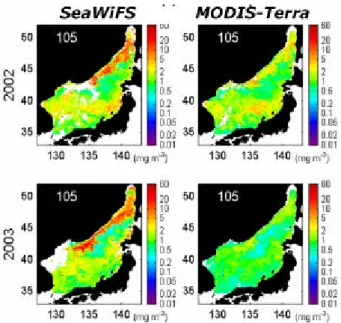
From the analysis of data of the whole JES and the time series data in central JES, we find there are significant discrepancies between the two data sets in the JES from 2000 to 2003, in the amount and in the year-to- year variation in chlorophyll
aconcentration (Figure 1.).
The chlorophyll
aconcentration from SeaWiFS was generally higher than that from MODIS/Terra during the period. SeaWiFS Level-3 eight-day mean chlorophyll was about two times higher in spring and fall seasons during the period.
Fig. 1. There are discrepancies between the data in Japan/East Sea over the period from 2000 to 2003. This figure shows that SeaWiFS chlorophyll concentration is higher than MODIS/Terra in spring season.
Using the Level-2 daily we checked possible causes in detail. Especially, we used the data from the 111
thJulian day of 2003 when there were matching data from the two sensors and there were greater range in the chlorophyll concentration. For this comparison, we sub- sampled total radiances and nLws from one horizontal line which is indicated in figure 2.
Fig. 2. The line near the Primorye used for detailed comparison.
Along this line, we can define two regions according to chlorophyll concentration. One is near the Primorye coast where chlorophyll values are high (here after we call HCR). The other is off the coast region where chlorophylls are low (here after we call LCR). In these level-2 daily data, SeaWiFS chlorophylls are about eight times higher than MODIS/Terra chlorophylls in HCR.
To check the differences in the sensor sensitivity we compared total radiance and nLws between both data.
The total radiance deviations are less than about 0.4%.
In atmospheric correction algorithms, MODIS/Terra have more sophisticated aerosol model than SeaWiFS.
Aerosol models use 765 nm and 865nm. We can infer the deviation of atmospheric correction algorithm of both data sets from the total radiances of NIR at 765nm and 865nm. The deviations are 12% at 765nm and 18% at 865nm in HCR. Compared with nLws, these deviation s are large.
4. Discussion and Conclusions
There is significant difference between SeaWiFS
and MODIS/Terra. SeaWiFS chlorophyll
aconcentration
is higher than MODIS/Terra in JES, especially after 2002,
such as Primorye and sub-polar front. In other regions
also showed chlorophyll amount difference between both
sensors, such as the Okhotsk Sea and Gulf of Main.
To understand the nature of this discrepancy, we postulate sources of errors as follows: differences 1) in the sensor sensitivity, 2) in the Chlorophyll algorithm, and 3) in the Atmospheric correction algorithms.
1) The differences in sensor sensitivities could not explain this discrepancy because the total radiances are similar. 2) According to Carder
et.al.(2003) differences from using different algorithms are not significant. 3) the atmospheric corrections seem the major cause of the discrepancy, as mentioned earlier, the deviation between two data is 12 % at 765nm and 18% at 865nm
In conclusion, the difference in atmospheric signal estimation results in difference nLw, which in turn gave rise to discrepancy in the chlorophyll a values.
References
[1] Carder, K., F. Chen, J. Cannizzaro, and J. Campell. (2003) Performance of MODIS semianalytic ocean color algorithms: chlorophyll a, absorption coefficients, and absorbed radiation by phytoplankton (ARP). MODIS ocean products workshop, university of New Hampshire, Durham, NH, February3-4, 2003
[2] Esaias, W. E. (2003) MODIS Terra 041 reprocessing recommendations. Presentation to NASA headquarters on Terra/MODIS ocean reprocessing, Greenbelt, MD, September23, 2003