S 3 xU v o ? J ! 5N f 5 375~379 (2005)
藥學舍확
매생이 추출물의 멜라닌생성 억제효과
문연자 • 유현주 ■이경은* • 김진희* ■표 형 배* . 우원홍# 원광대학교 한의학전문대학원, *한불화장품 기술연구소
(Received May 12, 2005; Revised July 8, 2005)
I n h ib it o r y E f f e c t o n t h e M e la n o g e n e s is o f
C a p s o s ip h o n fu lv e s c e n s
Yeun-Ja Mun, Hyun-Ju Yoo, Kyung-Eun Lee*, Jin-Hui Kim *, Hyeong-Bae Pyo* and Won-Hong Woo#
Department of Herbal Resources, Professional Graduated School, Wonkwang University, Iksan 570-749, Korea
^R&D Center, H anbul Cosmetics Co., Umsungkun 369-830,Korea
Abstract — The green marine algae,
Capsosiphon fulvescens
is one of the important economic seaweeds cultured in Korea.In this study, we investigated the effects of
Capsosiphon fulvescens
on melanogenesis using B16 cells. Our results showed thatCapsosiphon fulvescens
significantly inhibits melanin synthesis and it reduces the activity of tyrosinase, the rate-limiting melanogenic enzyme. Western Blot analysis using anti-tyrosinase antibody revealed thatCapsosiphon fulvescens
(10—40 )^g/ml)
decreased tyrosinase protein levels. Cell proliferation was dose-dependently inhibited by 10,20 and 40Cap
sosiphon fulvescens,
without cytotoxicity and morphological change. These results suggest that the depigmenting effect ofCapsosiphon fulvescens
is correlated with the suppression of tyrosinase activity and protein level, which are key enzymes for melanogenesis.Keywords □ melanin, tyrosinase,
Capsosiphon fulvescens,
cytotoxicity해양생물은득유의 다ᅵ사양入!윽시니고 있어 육상 자원식묵과
는 다른 새로운 생물활성 물질이 기대되며, 식용,의약자원 등으
로도이용되어 왔다. 근래 해조, 연체 및원색동^로부터 많은 신 규화합-:운이분리되어 항암제, 항。d승제 등의 의약품으로 개발되 어지고 있0ᅵ녀. 해조류에서 신규 친연물의 탐색과 개발에 대한
관심이 증가되는추에에 있어 이에 대한 연구가활성화 되어져
야할 것이다. ^
피부의멜라닌(melanin)은: 멜라닌세포의멜리닌소체(melanosome) 에서 L-tyrosine으로부터 °rl련의 반응 단계를 거쳐 생성되어,4_8)
세포질 돌기를 통하여 표피의 기저충과 가시충의 각질화세포
(keratinocyte):.! 운반되는데,9'11” 자외선에 의한 피부의 광노화 또는 일광각화승을 억제 및보호하는 긍정7'1인 기능이 있는 반
면, 멜라닌의 전구물질이 세포 사멸을촉진하거나 과다한 색소
침착등에 의한부정적인 기능도가지고 있다.11’121 그러므로 이
러한멜라닌 생합성 과정에서 나타나는부정적인 기능유 제어할
#본 논문에 관한 문의는 저자에게로 (전화) 063-850-6845 (팩스) 063-820-5195 (E-mail) [email protected]
수 있는 연구,즉 과색소증의 원인과 기전의 규명 및이를 방지
할수 있는 약품 또는 미백 화장품의 개발 연구가 활발하게 진
행되고 있다.
매생이 (Ca^sos神ow
fulvescence)
는 녹조이물문(Chlorophyta)갈파랫과에 속하는바닷말로 전세계에 분포하며 한국에서는 남
해안 지역에 서식하고, 수분, 단백질,탄수화물, 회분을 많이 함 유하고 있으며 식용하고 있다.13ᅵ151 그러나 매생이에 대한 종의 분류학적 기재 및 번이, 생태 및생활사,분포,형태 및 분뮤 등 에 관한 기초적인 연구가 있으나 박등 16〕이 bromobenzen으로
간독성윽 유발한 흰쥐에서 지질과신:화생성을 억제한다고 보고
하였을 뿐 생리활성 능에 대한연구는 미미한 실정이다.13ᄁ1 따
라서 본 연구에서는매생이가B16 세포의 멜라닌 합성과정에 미
치는 영향ft 조사하여 멘라VI 생성^ 이제하는유의한결과S 얻
었기에 보고하는바이다.
실험재료 및 방법
시 료
본 실험에시용한매생이(Ga/)sos당/ww
fulvescence)\
:선라남도장흥, 내저마을에서 채취하였고, 증류수로수회 세척하여 염분을 제거 하였다. 염분을 제거한 매생이 2 kg에 95% EtOH 10/를 첨가하여 3일동안침지추출하였고, 추출액을여과한후여액을 감압농축한다음동결 건조하여 매생이 EtOH 추출물 590 g(수 득률 : 29.5%)을얻었다. •는 10 mg/m/ 농도로 E thanol: 1,3- buthyleneglycol(4 : 1) 용매에녹인후실험에시용하였다.
B16 세포주 배양
한국세포주은행에서 분양받은 B16 세포의 배양은 C 02 배 양기 (370C,5%)에서 10% FBS가포함된 DM EM 배지를이용하 였고, Im M glutamine, 500U penicillin과 20|ig/m/ streptomycin 을 첨가하여 사용하였으며, 약 48시간주기로배양액을교체하 여 주었다. 세포의 형태는 배양완료 후 Inverted Microscope (phase contrast, Leica, Germany)를이용하여 관찰하였다.
세포생존율(Cell viability) 측정
세포생존율측정은 Mosmann의방법17'에의하여 실시하였다. 24 well plate에 B16 세포를 1X10⁴ cell 분주하여 24시간배양 한후매생이추출물을 5,10, 20, 40 농도로처리하고 3 일또는 5일간배양하였다. 배양완료후 0.1% MTT 용액 50 [d 를 넣어 3시간, 37°C에서 배양한 다음 상층액을 제거하고 formazan 침전물에 lm Z의 DMSO를가하여 15분•간실온에서방 치한후 540 nm의파장에서 ELISA reader로흡광도를측정하 여세포생존율을 계산하였다.
멜라닌정량(M elanin content assay)
멜라닌정량은 Hosoi 등18의방법을변형히여사용-하였다. B16 세포를 10cm 세포 배양 접시에 lx lO 5 cells/dish로분주하고 24시간 배양하여 세포를부착시킨후 매생이추출물을 10, 20, 40|ig/m/ 농도로 처리하고 5일동안 배양하였다. 배양세포를 phosphate buffered saline(PBS)으로 2회세척하고세포를분리 하여 각군당동일한수의세포를수집하였다. 세포짐전물에 1 m/
의증류수를넣어 현탁하고,초음파로분쇄한다음, 원심분리하 여침전물을얻었다. 10%의 D M S O } 첨가된 1 N NaOH 300 \d 를 넣어 80oC에서 1시간동안 처리하고 475nM에서흡광도를 측정하였다.
멜라닌색소침착의육안적관찰
B16 세포를 10 cm 세포배양접시에 ix 105 cells/dish로분주 하고 24시간배양하여 세포를부착시킨후 매생이추출물을 10, 20, 40 [ig/ml 농도로처리하고 5일동안 배양하였다. 멜라닌세 포의 멜라닌화를자극하는것으로 알려진 a-MSH 10nM을처 리하여 양성 대조군으로 하였다.19,20) 배양이 완료된 세포는 trypsin/EDTA로분리하여 세척하고, 각군당 5X10⁶ 세포를수
집한후에육안으로세포 침전물의 색변화를관찰하였다.
Tyrosinase 활성측정
Tyrosinase 활성은 Martinez-Esparza 둥21〉의방법에의하여즉 정하였다. B16 세포에 5일동안매생이추출물을 10, 20, 40 ^g/
ml
농도로처리한후세포를분리하였다. 200\d
세포용해액(lysisbuffer; 1% Triton X-100, 10 mM sodium phosphate, pH 7.0, 0.1 mM PMSF)을 넣고 40C 얼음에서 30분간때때로흔들어주
면서 세포를 파괴하였다. 이를 원심분리하고 50 너의상층액에 100 mM sodium phosphate(pH 6.8) 100 (j/를넣고 30°C 물중탕 기에서 5분간보온한후 100 mM catechol 50 |i/를넣어온도조 절장치가있는분광광도계로 370C, 405nM에서흡광도의 변화 를 1시간관찰하였다.
Western blotting assay
세포를 PBS로 세척하고, 40C 에서 30분 동안 lysis buffer (phosphate buffer, pH 6.8, 100 IU Aprotinin, 1% AEBSF) 에 용해하여 20,000g로 30분 동안 원심분리 시킨 후, 상층액은 Amicon system을이용하여 단백질을농축시켰다. 농축된 단백 질은 Bradford assay로정량하고, 단백질(30 ng)을 10%의 SDS- PAGE상에서 전기영동하여 분리하였다. 분리된 단백질은 Nitrocelluose membrane에 옮긴 후 실온에서 2시간 동안 blocking buffer(5% skimmilk in TBST)에서 incubation시켰다. Tyrosinase, Tyrosinase-related protein 1 & 2 antibody(Santa Cruz Biotechnology, Inc.)는각각 1: 500으로희석하여 2시간동 안반응시킨후 TBST에 3회세척하고 1 : 1,000으로희석시킨 secondary peroxidase-conjugated anti-mouse antibody(Sigma) 에반응된단백질을 Amersham ECL system으로확인하였다.
통계학적분석
실험 결과는 one-way ANOVA test를이용하였으며, P 값이 0.05 이하인 경우유의성을인정하였다.
실험결고ᅡ 및 고찰
세포증식억제효과
B16 세포에매생이추출물을 5 ng/m/에서 40 ng/m/까지다양 한농도로처리하고, 3일과 5일동안배양한후 MTT 측정방법 으로세포의생존율을관칠하였다. 3일군의경우 5,10, 20, 40 [ig/
ml 농도에서세포생존율은각각대조군의 93.5%, 91.7%, 64.4%, 49.8%였으며,5일군에서는각각 87.6%, 89.2%, 61.8%, 36%로 감소하였다 (Fig. 1).
이러한생존율의 감소현상이단순한세포의사멸이나손상에 의한것인지조사하기 위하여 매생이 추출물을각농도별로처
J. Pharm. Soc. Korea
매생이 추출물의 멜라닌생성 억제 377
Control 10 20 40
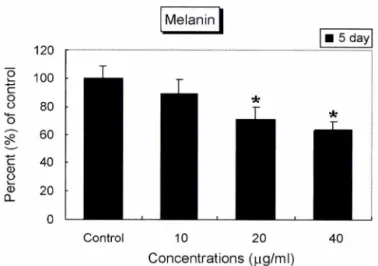
Concentrations (ng/ml)
F ig .
3 - Inhibitory effect of the ethanol extract ofCapsosiphon fulvescens
on the melanin synthesis in B16 cells. * p<0.05.C 10 20 4 0 M
F ig . 4
- Effect of the ethanol extract ofCapsosiphon fulvescens
oncell pigmentation. C: Control, 10:
Capsosiphon fulvescens
10 p.g/m/, 20: Capsosiphon fulvescens 20 |xg/m/, 40:
Capsosiphon fulvescens
40[Lg/ml,
M: a-MSH (100 nM).멜라닌합성억제효과
매생이 추출물을 여러 가지 농도로 B16 세포에 처리하고 5일 동안 배양한후 각군당 1 <106개의 세포를수집하여 멜라닌의 양을 측정한 결과, 10, 20, 40|^g/m/ 농도에서 대조군(100%)에 비하여 각각 89.4%, 71.1%,63.6%로 감소하였다(Fig. 3). 또한 멜라닌 합성 억제효과를육안으로 확인하기 위하여 각군당 5ᄊ 106개의 세포를수집하여 관찰하였다. 매생이 처리군은 연한 회
색으로대조군보다 멜라닌 색소가감소하였고, 특히 농
도에서 현저히 감소하였다. 대 조 군 로 서 멜라닌 생성을 촉진시 키는호르몬인 oc-MSH19’20)를 처리한 세포군은 검정색으로 멜라 닌이 증가되었음을 확인하였다(Fig. 4).
지금까지 알려진 멜라닌 생성 억제 물질로는 kojic acid, arbutin, hydroquinone 등이 있으며, hydroquinone은효능이 탁
월하지만 세포독성이 강하여 잠재적인 돌연변이원이 될 수 있
다고 보고8’22)되고 있어,천연물에서 세포독성이 적으면서 멜라
닌 합성을감소시키는 부작용이 적은물질을 찾는 방향으로 연
구가 진행되고 있다. 따라서 본 실험 결과 매생이 추출물은 세
포독성이 없이 매우 인-정적로 멜라닌생성을 억제하는 것으로
사료된다.
Control 5 10 20 40
Concentrations (ng/ml)
F ig . 1
- Cell viability on B16 cells after treatment with the ethanol extract ofCapsosiphon fulvescens.
Fig. 2 - Light micrographical observation of B16 cells after treat
ment with the ethanol extract of
Capsosiphon fulvescens.
A: Control, B:
Capsosiphon fulvescens
(10[ig/ml),
C:Capsosiphon fulvescens
(20 p.g/m/), D:Capsosiphon fu l
vescens
(40 Jig/m/).리하고 5일후 세포의상태를 관찰한 결과, 매생이 lOng/mi와
농도에서 세포의 형태적 특성이 대조군과동일하였다
(Fig. 2B & C). 매생이 40|ig/m/ 농도에서는 세포의 수가 감소 하였으나 세포질 내의 공포(cytoplasmic vacuoles), 핵 응죽 (nucleus shrinkage)과같은세포고사(apoptosis)나괴사(necrosis)
현상은 관찰되지 않았으며,세포의 형태적 특성 또한 대조군과
동일하였다(Fig. 2D).
이상의 결과매생이 추출물의 처리농도가증가함에 따라 세포
의증식이 억제되었으나 세포내에 공포와 핵응축등의 세포독
성은나타나지 않았다(Fig. 1 & 2).
5 day
Cell Viability~|o
ᄋo o
ᄋ0 8 6 4 2
OJ CO O M
(% — ᄋ ) C
89J Q_
ᄋ
o o
ᄋᄋ
c
0 8 6 4 2
o l
-b u o M o — o
( 0 / 0 )
C 8 0 J
Q.
C ontrol 10 20 40 (
나g/ml)
Fig. 6 - Effect of the ethanol extract ofCapsosiphon fulvescens
ontyrosinase protein in B16 cells. Lane 1: Control, Lane 2:
Capsosiphon fulvescens
10 fig/m/, Lane 3:Capsosiphon fulvescens
20[ig/ml,
Lane 4:Capsosiphon fulvescens
40 나g/ml.
한다고보고하였다.
본 실힘 결과에서는매생이 추출물은 B16 세포의 tyrosinase 활성과 protein level을 억제함으로써 견과적으로 멜라닌의 생성 을감소시킨 것으로사료되며, 보다 정확한멜라닌 생성조절 기
전을조사함 필요가있다고 사료된다.
결 론
매생이가멜라닌 생성에 미치는 영향을조사하기 위하여 세포
증식, 멜라닌, tyrosinase 활성과단백질 발현음조사한 결과, 매 생이추출물은 B16 세포의 증식을 억제하였으나, 세포내의 공 포(cytoplasmic vacuoles)나핵응 체nucleus shrinkage) 둥의 세 포독성은 나타내지 않았다. 또한 매생이 추출물은 B16 세포의 멜라VI 합성을억제하였고, 세포내 tyrosinase 활성과 tyrosinase
단백질 발현음 억제하였다. 이상의 결과 매생이 추출물은세포
독성이 없이 세포의 증식과 tyrosinase 활성을 억제함으로서 결 괴사1으로 멜라닌의 생성을 감소시킨 것으로판단된다. 따라서 매
생이는 피부부작용이 없는화장품의 미백물질로서 개발가능성
이높으며,더욱 정확한 작용기전의 규명과 활성성분의 분리 및
정제, 응용법 등의 연구가필요할 것으로 사료된다. o
Fig.
Tyrosinase Activity |
「 ■ 5 day|
幽 — -
■ iii
Control 10 20 40
Concentrations (pig/ml)
5 - Inhibitory effect of the ethanol extract of
Capsosiphon fulvescens
on the tyrosinase activity in B16 cells. * p<0.05,** p<0.01.
120 100
0 80
충 ' 60
1 각。
fe 20
Tyrosinase 활성 억제효과
멜라닌은 tyrosine을 기질로 tyrosinase, tyrosinase-related protein 1 (TRP-1) 및 tyrosinase-related protein 2(TRP-2) 등일 련의 효소반응을거쳐 합성된다.23’24) 이들효소 중 tyrosinase는 tyrosine을 3,4-础y(toxyphenylalanine(DOP^^ DOPA를 dopaqinone으로,그리고 5,6-dihydroxyindole을: indole-quinone으 로 전화시키는세단계의 반응을촉매하는속도조절효소(rate- limiting enzyme)로서 피부의 색소생성을 조절하는 많은 연구 의 대부분이 tyrosinase의효소적 조절에 초점이 맞주어져 왔 다.22-25) 따라서 매생이 추출물을 5일동안농도별로 처리하고 tyrosinase 활성을 즉정한 결과, 10 |^g/m/ 농도에서 84.4%, 20 (ig/m/ 농도에서 70.3%,40 j-ig/m/ 농도에서 53.5%로 감소하 였다(Fig. 5).
Western blotting을이용한 tyrosinase의단백질 발현에 미치 는영향을 조사한결과에서도매생이 농도의증가에 따라세포 내 tyrosinase 단백질발현이 감소하였다(Fig. 6A & B).
인체 피부에서 멜라닌세포의 tyrosinase 발현을조시*한연구 결과를 보면흑인의 경우 tyrosinase 활성이 백인보다 6〜8배가 높지만 tyrosinase mRNA와 protein level은 동일하였다.26) Fuller 등27〉은 yohimbine이멜라닌세포의 tyrosinase 활성을효 과적으로 억제하였지만,tyrosinase proein과 mRNA 발현에는 변화가 없으며, Franchi 등28〉은 calcium D-pantetheine-S- sulfonate가 tyrosinase와 TRP-1 활성을 억제하였는데,이는 이 효소들의 glycosylation pattern 변화와같은 post-transcriptional
조절에 의한것이라고보고하였다.
한편, 이등29〉은반하
(Pinellia temata
B.) 물추출물이 B16 세포의 tyrosinase 활성억제작용은없으나 tyrosinase mRNA 전 사조절을통하여 미백효과를나타내며,Ando 등30)은 lactic acid 가 tyrosinase 효소의 전사과정을억제함으로써효소활성을억제
(A)
Tyrosinase — ^
Actin —— ► 성 활 u p p
(B)
Tyrosinase
I
o l
ra J ) u o ls co a ld x
LU
J. Pharm. Soc. Korea
매생이 추출물의 멜라닌생성 억제
379문 헌
1) Shimizu, H. : Chemical and biological perspectives.
In Marine Natural Products
Academic Press, New York, p. 1 (1978).2) Kobayashi, J. and Ishibashi, M. : Bioactive metabolites of symbiotic marine microorganism.
Chem. Rev.
93,1753 (1993).3) 박영현 : 해양생물독의혈소판응집작용에관한연구. 해양식품위 생안정성학회지 10, 73 (1995).
4) Kobayashi, T.,Urabe, K., Winder, A., Jimenez-Cervantes C.’
Imokawa, G.,Brewington, T., Solano, E, Garcia-Borron, J. C.
and Hearing, V J. : Tyrosinase related protein (TRP-1) functions as a DHICA oxidase activity in melanin biosynthesis.
EMBO J.
13,5818 (1994).5) Curto, E. V,Kwong, C.,Hermersdorfer, H.,Glatt, H.,Santis, C.,Virador, V,Hearing, V J. and Dooley, R : Inhibitors of mamalian melanocytes tyrosinase:
In vitro
comparisons of alkyl esters of gentisic acid with other putative inhibitors.Biochemical Pharmacology
57,663 (1999).6) No, J. K., Soung, D. Y•’ Kim, Y. J., Shim, K. H., Jun, Y. S., Rhee, S. H., Yokizawa, T. and Chung, H. Y. : Inhibition of tyrosinase by green tea components.
Life Science
65, 241 (1999).7) Prota, G .: Recent advances in the chemistry of melanogenesis in mammals.
J. Invest Dermatol.
75, 31 (1990).8) Lee, S. H., Park, J. S., Kim, S. Y., Kim, J. J. and Chung, S. R. : Isolation of inhibitory components oa tyrosinase activity from the bark of Paeonia moutan.
Yakhak Hoeji
42,353 (1998).9) 박경아 외,조직학,고려의학, 서울,p. 405 (1999).
10) Bloom, W. and Fawcett, D. W .: A
Textbook of Histology
11th ed., W.B. Saunders Company, USA, p. 543 (1986).11) De Leeuw, S. M., Smit, N. R, Van Veldhoven, M .,Pennings, E.
M.’ Pavel, S., Simons, J. W. and Schothorst, A. A. : Melanin content of cultured human melanocytes and UV-induced cytoyoxicity.
J, Photochem. Photobiol. B.
61,106 (2001).12) Sugai, T.: Clinical effects of arbutin in patients with chlosma in Japanease.
H ifu. Skin Res.
34,522 (1992).13) Bliding, C. J. : A critical survey of european taxa in Ulvales, Part I, Capsosiphon, Percursaria, Blidingia, Enterromorpha.
Opera Botanica
8,1 (1963).14) 김도기, 서명배, 박돈희 : 녹조식물 매생이(대办싸상/zwz
jul- vescens
)의인공채묘기술개발. 한국생물공학회,2001년도춘계학술발표대회 논문집,p. 239 (2001).
15) Hwang, E. K.,Yi, Y. H., Shin, W. J. and Sohn, C. H. : Growth and maturation of a green alga,
Capsosiphon fulvescens,
as a new candidate for seaweed cultivation in Korea. International Seaweed Association,Proceedings of the 17th International Seaweed Symposium,
p. 59 (2003).16) 박종철,최재수,송상호,최명탁,김광용,최종원 : 해조류추출물 과페놀성화합물의
in vitro
및in vivo
간보호활성. 생약학회지28,239 (1997).
17) Mosmann, T. : Rapid colorimetric assay for the cellular growth and survival; application to proliferation and cytotoxic assay.
J.
Immun. Methods
65,55 (1983).18) Hosoi, J. E., Suda, T. and Kuroki, T. : Regulation of melanin synthesis of B16 mouse melanoma cells by la ,25 - dehydro- xyvitamin D3 and retinoic acid.
Cancer Res.
45,1474 (1985).19) Hunt, G.,Todd, C.,Cresswell, J. E. and Thody, A. J. : Alpha- melanocyte stimulating hormone and its analogue Nle4DPhe7 alpha-MSH affect morphology, tyrosinase activity and melano
genesis in cultured human melanocytes.
J. Cell Sci.
107,205 (1994).20) Hill, S. E., Buffey, J., Thody, A. J., Oliver, I., Bleehen, S. S. and Mac Neil, S. : Investigation of the regulation of pigmentation in alpha- melanocyte stimulating hormone responsive and unresponsive cultured B16 melanoma cells.
Pigment Cell Res.
2,161 (1989).21) Martinez-Eparza, M., Jimenez-Cervantes, C.,Solano, F., Lozano, J. A. and Garcia-Borron, J. C .: Mechanism of melano
genesis inhibition by tumor necrosis factor - alpha in B16/F10 mouse melanoma cells.
Eur. J
,Biochem.
255, 139 (1998).22) Chakraborty, A. K., Funasaka, Y.,Komoto, M. and Ichihashi, M. : Effect of arbutin on melanogenic proteins in human melanocytes.
Pigment Cell Res.
11,206 (1998).23) Hearing, V J. and Jimenez, M. : Mammalian tyrosinase-the critical regulatory control point in melanocyte pigmentation.
Int.
/.Biochem.
19,1141 (1987).24) Kameyama, K.,Takemura, T., Hamada, Y.,Sakai, C.,Kondoh, S., Nishiyama, S., Urabe, K. and Hearing, V J. : Pigment production in murine melanoma cells is regulated by tyrosinase, tyrosinase-related protein 1 (TRP1), DOPAchrome tautomerase (TRP2), and a melanogenic inhibitor.
J. Invest.
Dermatol.
100,126 (1993).25) Wakamatsu, K. and Ito, S. : Advanced chemical methods in melanin determination.
Pigment Cell Res.
15, 174 (2002).26) Naeyaert, J. M., Eller, M .,Gordon, R R.,Park, H. Y. and Gilchrest, B. A. : Pigment content of cultured human melanocytes does not correlate with tyrosinase message level.
Br. J. Dermatol
125, 297 (1991).27) Fuller, B. B.,Drake, M. A., Spaulding, D. T. and Chaydhry, F. : Downregulation of tyrosinase activity in human melanocyte cell cultures by yohimbine./.
Invest Dermatol.
114,268 (2000).28) Franchi, J., Coutadeur, M. C.,Marteau, C., Mersel, M. and Kupferberg, A .: Depigmenting effects of calcium D-pantetheine-S- sulfonate on human melanocytes.
Pigment Cell Res.
13,165 (2000).29) 이상화, 김진준,김호정, 이종태,강세훈 : 반하추출물이 B-16 마 우스흑색종세포의 멜라닌생성과타이로시네이즈 mRNA 양에 미치는 영향. 대한화장품학회지 23,23 (1997).
30) Ando, S., Ando, O.,Suemoto, Y. and Mishima, Y. : Tyrosinase gene transcription and its control by melanogenic inhibitors.