ABSTRACT
Background and Objectives: Wrist-worn wearable devices provide heart rate (HR) monitoring function via photoplethysmography technology. Recently, these devices have been used by patients to measure the HR when palpitation occurs, but few validation studies of these
instruments have been conducted. We assessed the accuracy of these devices for measuring a HR.
Methods: This study enrolled 51 consecutive patients with a history of paroxysmal supraventricular tachyarrhythmia (SVT) or paroxysmal palpitations who were scheduled to undergo an electrophysiological study (EPS). Three devices were assessed: Apple Watch Series 2 (Apple), Samsung Galaxy Gear S3 (Galaxy), and Fitbit Charge 2 (Fitbit). Patients were randomly assigned to wear 2 different devices. The HR at baseline and induced SVT were measured during the EPS. After successful ablation of SVT, HR measurements was also done during atrial and ventricular pacing study.
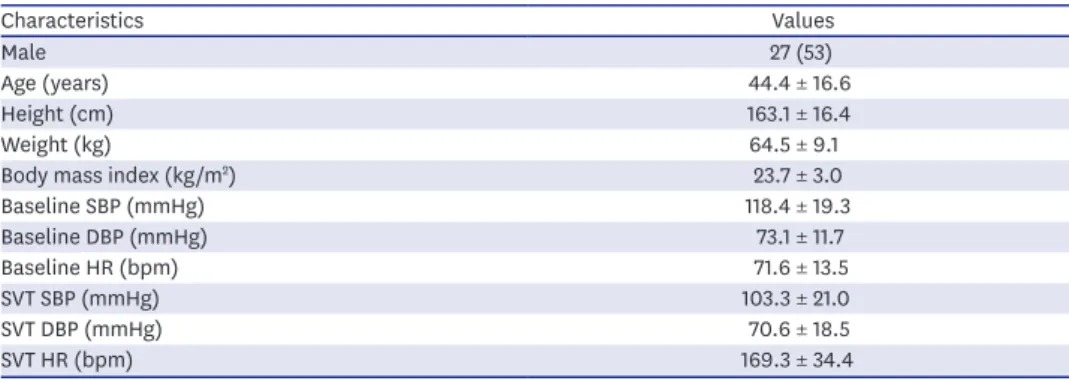
Results: The mean patient age was 44.4±16.6 years and 27 patients were male (53%). The accuracy (within ±5 beats per minute [bpm] of an electrocardiogram [ECG] measurement) of the baseline HR measurements was 100%, 100%, and 94%, for Apple, Galaxy, and Fitbit, respectively. The HR during induced SVT ranged from 108 bpm to 228 bpm and the accuracy (within ±10 bpm of an ECG) was 100%, 90%, and 87% for the Apple, Galaxy, and Fitbit, respectively. During pacing study, accuracy of these devices was also acceptable but tended to decrease as the HR increased, and showed differences between the devices.
Conclusions: Wrist-worn wearable devices accurately measure baseline and induced SVT HR.
Trial Registration: Clinical Research Information Service Identifier: KCT0002282 Keywords: Heart rate; Photoplethysmography; Tachyarrhythmia
INTRODUCTION
The wrist-worn wearable devices including so-called smart-watches and activity trackers are now very popular and offer heart rate (HR) monitoring technology via photoplethysmography (PPG) technique.
1)By measuring the pulsatile signal, each pulse ‘peak’ can be interpreted as
Original Article
Received: Sep 17, 2018 Revised: Dec 3, 2018 Accepted: Jan 4, 2019 Correspondence to Jun Kim, MD, PhD
Division of Cardiology, Department of Internal Medicine, Asan Medical Center, University of Ulsan College of Medicine, 88, Olympic-ro 43-gil, Songpa-gu, Seoul 05505, Korea.
E-mail: [email protected] Copyright © 2019. The Korean Society of Cardiology
This is an Open Access article distributed under the terms of the Creative Commons Attribution Non-Commercial License (https://
creativecommons.org/licenses/by-nc/4.0) which permits unrestricted noncommercial use, distribution, and reproduction in any medium, provided the original work is properly cited.
ORCID iDs Jongmin Hwang
https://orcid.org/0000-0001-9710-0945 Jun Kim
https://orcid.org/0000-0002-3573-638X Kee-Joon Choi
https://orcid.org/0000-0002-9055-049X Min Soo Cho
https://orcid.org/0000-0001-9867-4991 Gi-Byoung Nam
https://orcid.org/0000-0003-4391-5406 You-Ho Kim
https://orcid.org/0000-0003-0063-6300 Trial Registration
Clinical Research Information Service Identifier: KCT0002282
Jongmin Hwang , MD, PhD 1,2 , Jun Kim , MD, PhD 1 , Kee-Joon Choi , MD, PhD 1 , Min Soo Cho , MD, PhD 1 , Gi-Byoung Nam , MD, PhD 1 , and You-Ho Kim , MD, PhD 1
1
Division of Cardiology, Department of Internal Medicine, Asan Medical Center, University of Ulsan College of Medicine, Seoul, Korea
2