• 검색 결과가 없습니다.

Utility of a Three-Dimensional Interactive Augmented Reality Program for Balance and Mobility Rehabilitation in the Elderly: A Feasibility Study

N/A
N/A
Protected

Academic year: 2021

Share "Utility of a Three-Dimensional Interactive Augmented Reality Program for Balance and Mobility Rehabilitation in the Elderly: A Feasibility Study"

Copied!
11
0
0

로드 중.... (전체 텍스트 보기)

전체 글

(1)

Annals of Rehabilitation Medicine

Ann Rehabil Med 2015;39(3):462-472 pISSN: 2234-0645 • eISSN: 2234-0653 http://dx.doi.org/10.5535/arm.2015.39.3.462

Received July 24, 2014; Accepted October 16, 2014 Corresponding author: Youn Joo Kang

Department of Rehabilitation Medicine, Eulji Hospital, Eulji University School of Medicine, 68 Hangeulbiseong-ro, Nowon-gu, Seoul 139-711, Korea Tel: +82-2-970-8315, Fax: +82-2-979-8268, E-mail: [email protected]

This is an open-access article distributed under the terms of the Creative Commons Attribution Non-Commercial License (http://creativecommons.org/

licenses/by-nc/4.0) which permits unrestricted noncommercial use, distribution, and reproduction in any medium, provided the original work is properly cited.

Copyright © 2015 by Korean Academy of Rehabilitation Medicine

Utility of a Three-Dimensional Interactive Augmented Reality Program for Balance and

Mobility Rehabilitation in the Elderly:

A Feasibility Study

Dal Jae Im, MD

1

, Jeunghun Ku, PhD

2

, Yeun Joon Kim, MD

3

, Sangwoo Cho, PhD

4

, Yun Kyung Cho, PhD

5

, Teo Lim, PT

6

, Hye Sun Lee, MS

7

, Hyun Jung Kim, MD

1

, Youn Joo Kang, MD

1

1

Department of Rehabilitation, Eulji Hospital, Eulji University School of Medicine, Seoul;

2

Department of Biomedical Engineering, Keimyung University, Daegu;

3

Department of Rehabilitation, Daehan Hospital, Seoul;

4

Graduate School of Technology and Innovation Management, Hanyang University, Seoul;

5

Department of Occupational Therapy, Eulji Hospital, Seoul;

6

Department

of Physical therapy, Eulji Hospital, Seoul;

7

Department of Biostatistics, Yonsei University of College of Medicine, Seoul, Korea

Objective To improve lower extremity function and balance in elderly persons, we developed a novel, three- dimensional interactive augmented reality system (3D ARS). In this feasibility study, we assessed clinical and kinematic improvements, user participation, and the side effects of our system.

Methods Eighteen participants (age, 56–76 years) capable of walking independently and standing on one leg were recruited. The participants received 3D ARS training during 10 sessions (30-minute duration each) for 4 weeks.

Berg Balance Scale (BBS) and the Timed Up and Go (TUG) scores were obtained before and after the exercises.

Outcome performance variables, including response time and success rate, and kinematic variables, such as hip and knee joint angle, were evaluated after each session.

Results Participants exhibited significant clinical improvements in lower extremity balance and mobility following the intervention, as shown by improved BBS and TUG scores (p<0.001). Consistent kinematic improvements in the maximum joint angles of the hip and knee were observed across sessions. Outcome performance variables, such as success rate and response time, improved gradually across sessions, for each exercise. The level of participant interest also increased across sessions (p<0.001). All participants completed the program without experiencing any adverse effects.

Conclusion Substantial clinical and kinematic improvements were observed after applying a novel 3D ARS training program, suggesting that this system can enhance lower extremity function and facilitate assessments of lower extremity kinematic capacity.

Keywords Balance, Aged, Exercise, Virtual reality, Augmented reality

(2)

INTRODUCTION

Falls and fall-related injuries are common and serious medical problems among elderly people. Impaired motor performance in older adults is frequently characterized by motor retardation and decreased muscular power and balance. These deficits are primarily responsible for falls.

More than 33% of community-dwelling individuals aged

>65 years fall at least once per year; 50% of such individu- als will experience recurrent falls [1]. The frequency of falling increases up to 60% with age; three-quarters of all deaths caused by falls in the United States occur in those

≥65 years [1,2].

Many factors are involved in falls and fall-related inju- ries but a balance disorder is the most important factor in older adults. The most effective method for ameliorat- ing fall risk is physical exercise targeting lower extremity strength, balance, and proprioception [3]. Additionally, good cognitive function and attention are necessary to maintain proper balance and gait [4]. Specific exercises to improve balance include novel gaming systems using interactive computer-generated feedback environments and goal-directed tasks [5,6].

Virtual reality (VR) applications are relatively novel and potentially useful rehabilitation techniques. Moreover, rapid advances in interface and augmented reality (AR) technologies and various sensorimotor feedback tech- niques are being made [7]. Virtual and augmented envi- ronments are effective for rehabilitation training, as they apply motor learning principles [8]. Virtual environments immerse the user within an entirely simulated space, whereas augmented environments provide an interactive experience anchored in physical reality, thereby allowing knowledge gained in the therapeutic setting to be used in daily life [9].

In addition, high-resolution motion capture can pro- vide clinically valuable kinematic information concern- ing participant performance. A computational kinematic evaluation helps supplement data from existing clinical scales by providing reliable and repeatable quantitative measures of movement. This type of analysis allows for continuous measurement of many aspects of movement (e.g., velocity and joint angles). Linking motion-sensing with visual and audio feedback creates an immersive in- teractive experience that provides detailed information about performance and facilitates active engagement and sensorimotor learning [10].

Cognition function, proprioceptive input during ex- ercise, and learning ability decrease gradually with in- creasing age; thus, an AR-based exercise program could be useful for older adults. Such a system would provide intuitive external feedback on movement, thereby aug- menting proprioception arising from intrinsic sensory organs whose function may have been compromised by aging, while simultaneously encouraging sensory-motor integration [11]. Feedback also offers guidance, motiva- tion, and encouragement and may improve movement quality and confidence. Lower extremity exercises using an ARS demonstrably enhance balance in elderly per- sons; however, the majority of studies have targeted pa- tients with neurological deficits [8,12]. The utility of this novel system for balance rehabilitation in older adults has not been evaluated. Therefore, there is a lack of evi- dence regarding its efficacy compared with conventional balance exercises or that of commercial devices using AR interactive videogames to improve lower extremity func- tion.

We developed a three-dimensional interactive aug- mented reality system (3D ARS) to improve lower extrem- ity function and balance in elderly persons. The 3D ARS integrates traditional rehabilitation and motor learning theories with high-resolution motion capture and sens- ing technologies, ‘smart’ physical objects, and interactive computer graphics and sound. The system allows for ki- nematic measurements, derived from motion capture, to help assess the individual components of movement. We hypothesized that this system will enhance lower extrem- ity function. In this feasibility study, we evaluated the adverse effects and documented any user issues.

MATERIALS AND METHODS Participants

Eighteen community-dwelling older adults were re- cruited. All participants provided informed consent and were cognizant of the tasks before the study commenced.

The inclusion criteria were as follows: 1) age 55–80 years;

2) Mini-Mental State Examination (MMSE) score ≥25 [13];

3) ability to understand the nature of the study and pro-

vide informed consent; and 4) capable of independent in

ambulatory functions, with or without an assistive device

(cane or walker), and the ability to stand on one leg. Ex-

clusion criteria were any medical condition or disability

that prevented participation in an exercise program, cur-

(3)

rent treatment for a medical disease, recent fracture, un- controlled diabetes or seizures, cardiovascular problems prohibiting exercise, and neurological disorders. This study protocol was approved by the local Institutional Review Board at Eulji Hospital.

Development of the 3D ARS

The 3D ARS was developed by clinicians, physical and occupational therapists, and biomedical and software engineers. The software (Metasio Asia Inc., Korea) oper- ates in a Windows 7 environment, employs an AR setting, and motion-tracking kinetic sensor.

Setup and hardware

The 3D ARS utilized a Kinect Xbox 360 (Microsoft Inc., Redmond, WA, USA) to detect and track subject body movements and interactions with virtual objects. The Ki-

nect sensor generates a 3D depth map, such that objects in front of the sensor can be detected in 3D space. Indi- viduals positioned in front of the sensor are detectable as 3D objects; the position and angle of the joints in 3D space can be assessed using a skeleton image extrapo- lated from the user’s depth image. Joint angles are subse- quently accounted for during game-playing sessions.

The augmented environment was generated by su- perimposing video of real objects onto images of virtual objects rendered by a personal computer. Subjects inter- acted with virtual objects displayed on a screen in front of them and were able to see their appearance (i.e., gait and posture, etc.) in real time.

Task types

Three tasks were designed to elicit specific motions with specific joints: the ‘balloon game’, the ‘cave game’,

A B

C D

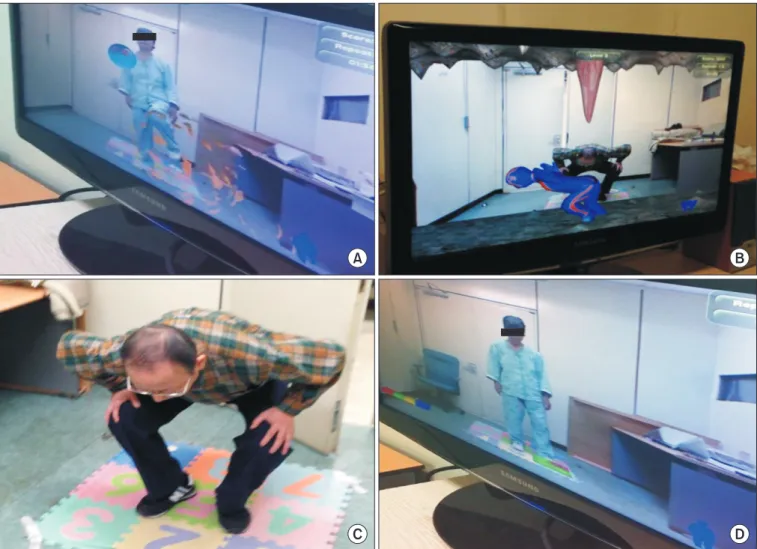
Fig. 1. Participants engaged with a three-dimensional, interactive, augmented reality rehabilitation system, comprised

of the balloon game (A), the cave game (B, C), and the rhythm game (D).

(4)

and the ‘rhythm game’ (Fig. 1). Each game focused on a specific exercise. For example, the balloon game encour- aged hip flexion and internal and external hip rotation to touch a falling balloon; the cave game encouraged flexion and extension of the knees to avoid obstacles in a cave;

and the rhythm game was designed to enhance the abil- ity to stand on one leg by stepping on specific locations appearing on the floor.

Balloon game: The balloon game was designed to train the hip joint. Balloons fall from the top to the bottom of the screen, and patients touch and burst the balloons with their foot by performing flexion, extension, and ex- ternal and internal rotation of the hip joint. The balloons fell in random positions (five levels in total). The balloons fell more rapidly and frequently as the level of difficulty increased, thereby necessitating more rapid but balanced movements. The interval between balloon appearances during the experiment was adjusted to each individual’s ability; the average interval was 3 seconds. Falling speed varied from 3.5 to 7 seconds to reach the floor; speed was assigned randomly but evenly distributed among pos- sible speeds. The subjects could burst approximately 200 balloons during the 10-minute trial.

Cave game: The objective of the cave game is to avoid

collisions with stalactites emanating from the ceiling of a cave by flexing the knee. A cave image moves from right to left, such that users feel as if they are proceeding through a cave. As difficulty level increases, the stalactites become longer, and the cave moves more quickly. In the present experiment, the stalactites appeared for 5 sec- onds, and a new one was generated 1 second after each passed. Thus, subjects encountered approximately 100 stalactites during the 10-minute trial.

Rhythm game: The rhythm game involves eight vir- tual plates situated around the player. Patients touch the plates by moving their feet. The plates appear in seven locations: front-left, front, front-right, left, right, back- left, and back-right. By encouraging users to move their feet, the game enhances standing stability. As difficulty level increases, the interval between and the duration of the plate’s appearance shortens. For example, a subject would need to move their feet within 3 seconds after a plate appeared, and the next plate would appear 1.5 sec- onds after the subject stepped on the first plate, which was visible for 3 seconds. Thus, a subject would step on approximately 200 plates during the 10-minute trial.

0 0

90 Front

Back Back Front

Hip extension

Hip flexion

0 50

0

50

0 45 75

0

75

0

A B

C D

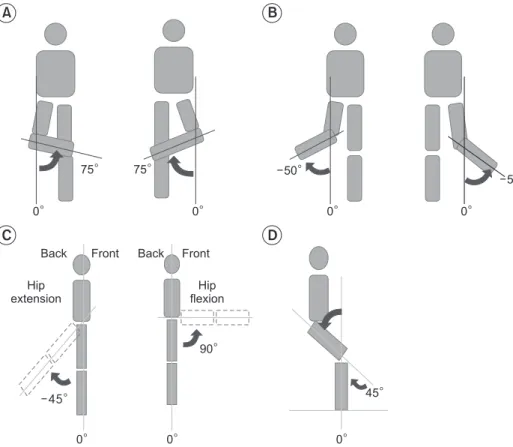
Fig. 2. The angle of each joint

(curved arrow) was calculated

based on joint position using the

3D kinetic sensor. (A) External hip

rotation angle, (B) internal hip

rotation angle (angle of a vector

from the knee to the ankle, with

a vertical reference vector in the

coronal plane), (C) hip extension

and flexion angle, and (D) knee

flexion angle (angle of a vector

from the hip to the knee, with a

vertical reference vector in the

sagittal plane).

(5)

Exercise dynamics

Each game highlighted different aspects of user perfor- mance. Response time (s) and success rate were outcome measures used for all three games. Response time (s) re- fers to the time taken to complete a task in a given game session; success rate refers to the percentage (%) of tasks successfully completed during each game session. Mean response time and success rate values were analyzed of- fline after completing the intervention.

Several movement parameters for the joint of interest in each game were also recorded during the exercises: the angle of hip flexion and external and internal hip rotation during the balloon game, and the knee flexion angle in the cave and rhythm games (Fig. 2).

Training and clinical evaluation

Participants received 10 sessions of 3D ARS training (30 min/session) over the course of 4 weeks, and the training level was adjusted to each individual’s motor abilities. All participants were subject to a clinical evaluation prior to and following the intervention, using the Berg Balance Scale (BBS) and the Timed Up and Go (TUG) test. A phys- ical therapist, with 10 years of experience, administered

the tests. Participants were briefed about the nature of the intervention prior to the evaluation. The BBS is wide- ly used to assess static and dynamic balance capabilities [14]: scores range between 0 and 56, with higher scores indicating superior balance. The TUG measures the time required to perform the following actions: stand up from a chair; walk 3 m at a normal pace; and turn around, walk backwards, and sit down [15]. The TUG is commonly used to examine functional mobility and balance [16].

Evaluation of side effects and use issues during 3D ARS training

The Pittsburgh Rehabilitation Participation Scale (PRPS) was used to evaluate the interest and motivation of participants following each 3D ARS session [17]. PRPS scores range from 1 to 6, as follows: 1, patient refused to participate in any exercises; 2, patient did not participate in at least half of the exercises; 3, patient participated in most or all of the exercises, but did not exhibit maximal effort or complete the majority of the exercises, or re- quired significant encouragement to complete the exer- cises; 4, patient participated in all exercises, exhibited a high degree of effort, and completed most but not all ex-

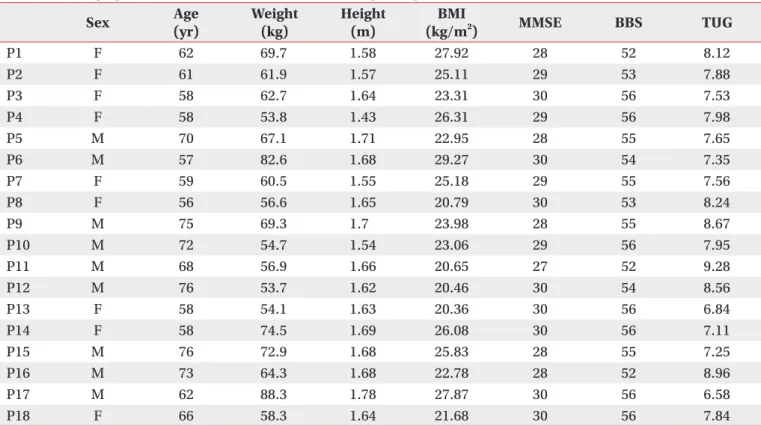
Table 1. Demographic and baseline characteristics of the participants

Sex Age

(yr) Weight

(kg) Height

(m) BMI

(kg/m

2

) MMSE BBS TUG

P1 F 62 69.7 1.58 27.92 28 52 8.12

P2 F 61 61.9 1.57 25.11 29 53 7.88

P3 F 58 62.7 1.64 23.31 30 56 7.53

P4 F 58 53.8 1.43 26.31 29 56 7.98

P5 M 70 67.1 1.71 22.95 28 55 7.65

P6 M 57 82.6 1.68 29.27 30 54 7.35

P7 F 59 60.5 1.55 25.18 29 55 7.56

P8 F 56 56.6 1.65 20.79 30 53 8.24

P9 M 75 69.3 1.7 23.98 28 55 8.67

P10 M 72 54.7 1.54 23.06 29 56 7.95

P11 M 68 56.9 1.66 20.65 27 52 9.28

P12 M 76 53.7 1.62 20.46 30 54 8.56

P13 F 58 54.1 1.63 20.36 30 56 6.84

P14 F 58 74.5 1.69 26.08 30 56 7.11

P15 M 76 72.9 1.68 25.83 28 55 7.25

P16 M 73 64.3 1.68 22.78 28 52 8.96

P17 M 62 88.3 1.78 27.87 30 56 6.58

P18 F 66 58.3 1.64 21.68 30 56 7.84

BMI, body mass index; MMSE, Mini-Mental State Examination; BBS, Berg Balance Scale; TUG, Timed Up and Go test.

(6)

ercises and passively followed directions; 5, patient par- ticipated in and completed all exercises, demonstrated maximal effort, but passively followed directions; 6, pa- tient participated in and completed all exercises, demon- strated maximal effort, and took an active interest in the exercises. Additionally, we assessed any side effects, such as dizziness, headache, falling, and joint pain, which might be related to participation in the 3D ARS training.

Statistical analysis

Data are presented as mean±standard deviation (SD), median, or range. The normality of the continuous

variables was assessed using the Kolmogorov-Smirnov test. Normally distributed variables are presented as mean±SD. We used the paired t-test to assess changes in clinical values before and after sessions. Changes in the performance scale and kinematic values for each session were assessed using linear regression analysis; rate of change is presented as regression coefficients (B) and the standard error (SE). p<0.05 was considered significant;

p<0.2 was considered indicative of a trend [18]. All data were analyzed using SPSS ver. 18 software (SPSS Inc., Chicago, IL, USA).

3.5

3.0

2.5

2.0

Response time (s)

Session

10

1 2 3 4 5 6 7 8 9

85

80

75

70

65

60

Success rate (%)

Session

10 Y=1.14X+68.696

p<0.001

1 2 3 4 5 6 7 8 9

100

95

90

85

Success rate (%)

Session

1 2 3 4 5 6 7 8 9 10 99

98

97

96

Success rate (%)

Session

1 2 3 4 5 6 7 8 9 10 Y=0.083X+97.314

p=0.059

Y=1.155X+89.224 p=0.001

6.5

6.0

5.5

5.0

4.5

4.0

Response time (s)

Session

10 Y= 0.138X+5.795

p=0.002

1 2 3 4 5 6 7 8 9

1.5

1.3

1.1

0.9

Response time (s)

Session

10

1 2 3 4 5 6 7 8 9

Y= X+2.819

p=0.011

Y= X+1.349

p=0.003

A B C

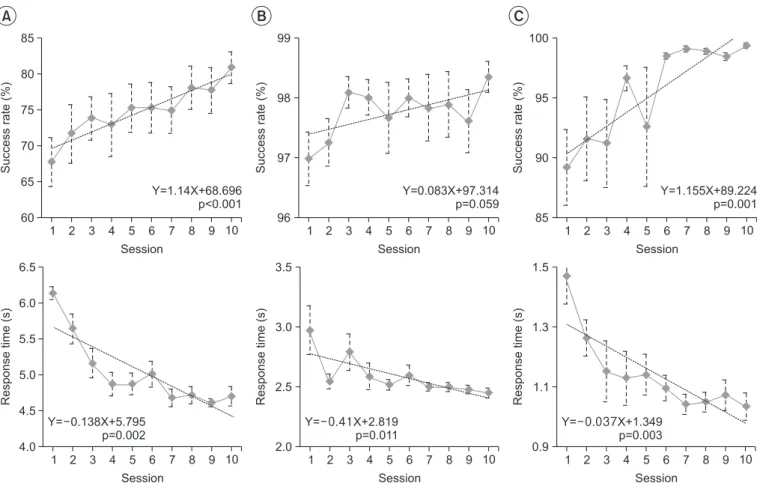
Fig. 3. Mean success rate (%) and response time (s) to stimuli for each trial in each game improved as sessions pro- gressed: (A) ball game, (B) cave game, and (C) rhythm game. Error bars indicate standard error.

Table 2. Changes in balance and gait parameters before and after 3D ARS training

Before After Diff (after-before) p-value

BBS 54.556±1.542 55.500±0.924 0.944±0.998 <0.001

TUG (s) 7.853±0.716 7.348±0.667 -0.504±0.216 <0.001

Values are presented as mean±standard deviation.

3D ARS, three-dimensional interactive augmented reality system; BBS, Berg Balance Scale; TUG, Timed Up and Go

test.

(7)

RESULTS

Participant characteristics

The characteristics of the 18 participants were: age, 64.70±7.27 years (range, 56–76 years); height, 1.64±0.08 m; body mass index, 24.09±2.77 kg/m

2

; MMSE score, 29.06±1.00; BBS score, 54.56±1.54; and TUG score, 7.85±0.72 (Table 1).

Clinical improvement following 3D ARS training

Participants exhibited improved balance and mobility following 4 weeks of 3D ARS training, as indicated by sig- nificantly higher BBS score (baseline, 54.56±1.54; post- intervention, 55.50±0.92; p<0.001) and TUG score (base- line, 7.85±0.72; post-intervention, 7.35±0.67, p<0.001) (Table 2).

Improved performance during 3D ARS training

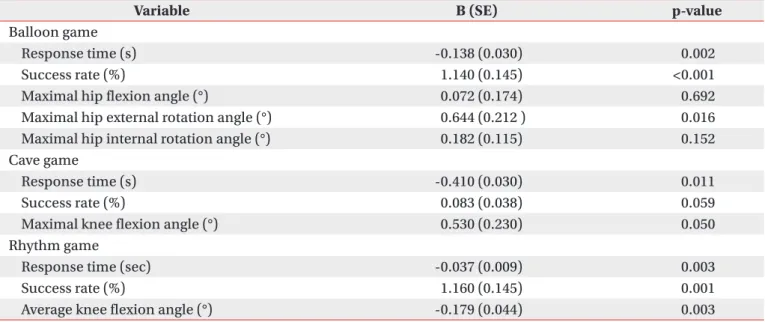
Mean response time decreased significantly across sessions during the balloon game (B=-0.138, SE=0.030, p=0.002), cave game (B=-0.410, SE=0.120, p=0.011), and the rhythm game (B=-0.037, SE=0.009, p=0.003). The success rate for the balloon game increased significantly across training sessions (B=1.140, SE=0.145, p<0.001).

A trend toward an increased success rate (B=0.083, SE=0.038, p=0.059) was observed during the cave game.

Success rate increased significantly across sessions of the

rhythm game (B=0.155, SE=0.213, p=0.001) (Fig. 3).

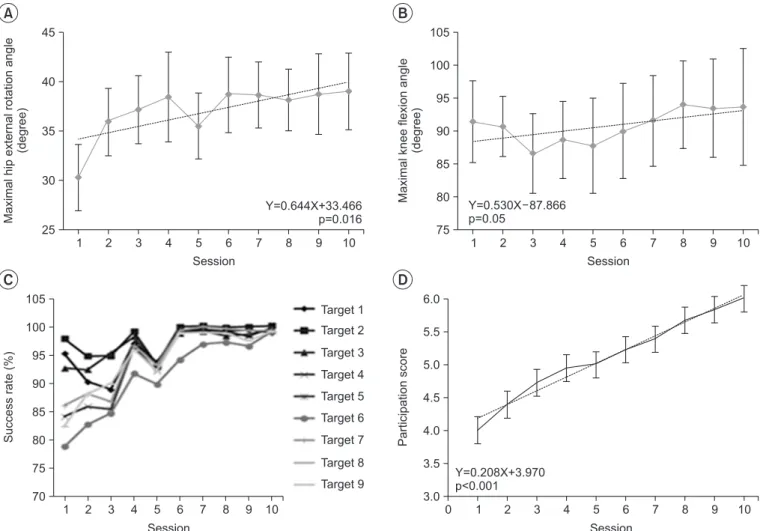
Kinematic improvements during 3D ARS training The hip flexion task used during the balloon game was associated with the highest rate of success, fol- lowed by the external rotation and internal rotation tasks (79.35%±14.95%, 78.51%±18.92%, and 64.82%±26.34%, respectively). The average degree of hip flexion across all sessions was 26.07°±10.82°; for external rotation 24.66°±10.23° and for internal rotation 25.04°±10.33°. In the linear regression analysis, maximum hip external rotation improved significantly across sessions (B=0.644, SE=0.212, p=0.016). A trend toward improved maximum knee flexion angle was observed during the cave game (B=0.530, SE=0.230, p=0.050) (Fig. 3, Table 3). The mean knee flexion angle decreased significantly during the rhythm game (B=-0.179, SE=0.044, p=0.003).

Evaluation of use issues and side effects

All 18 participants completed 10 3D ARS sessions without experiencing any adverse effects, although one subject exited the trial for private reasons. PRPS scores increased significantly during training across sessions (B=0.208, SE=0.520, p<0.001) (Fig. 4). By the end of the intervention, all participants scored 6 on the PRPS, i.e., they participated in and completed all exercises, and demonstrated maximum effort and an active interest.

Table 3. Changes in kinematic and performance outcome variables during 3D ARS sessions: regression analysis

Variable B (SE) p-value

Balloon game

Response time (s) -0.138 (0.030) 0.002

Success rate (%) 1.140 (0.145) <0.001

Maximal hip flexion angle (°) 0.072 (0.174) 0.692

Maximal hip external rotation angle (°) 0.644 (0.212 ) 0.016

Maximal hip internal rotation angle (°) 0.182 (0.115) 0.152

Cave game

Response time (s) -0.410 (0.030) 0.011

Success rate (%) 0.083 (0.038) 0.059

Maximal knee flexion angle (°) 0.530 (0.230) 0.050

Rhythm game

Response time (sec) -0.037 (0.009) 0.003

Success rate (%) 1.160 (0.145) 0.001

Average knee flexion angle (°) -0.179 (0.044) 0.003

3D ARS, three-dimensional interactive augmented reality system; B, regression coefficient; SE, standard error.

(8)

DISCUSSION

Ten sessions of 3D ARS training delivered across 4 weeks was associated with significant improvements in lower extremity function and balance in an elderly co- hort, as indicated by improvements in the BBS and TUG scores, as well as kinematics (e.g., maximum joint angle of the hip and knee). Furthermore, performance outcome variables, such as success rate and response time of each exercise, improved steadily across sessions. Furthermore, participants exhibited interest in and completed all of the exercises without experiencing adverse effects.

We analyzed maximum joint angles across sessions because they could reflect improvement in performance during the game. Maximum external hip rotation and knee flexion angles increased significantly or showed a

trend toward improvement across sessions. However, improvements in maximum flexion and internal rota- tion of the hip were not significant. The mean hip flexion angle had the highest score, and the success rate was the highest among the tasks, so we assumed that there was no improvement in maximum hip flexion angle across sessions. In contrast, the mean degree of hip internal ro- tation and success rate were the lowest among the tasks;

thus, we conclude that there was no significant improve- ment in this domain during these relatively short exercise sessions. Mean knee flexion angle decreased significant- ly, as reflected by improved ability to stand on one leg during the rhythm game.

Only group- and home-based exercise programs have been associated with a reduced risk of falling [19]. In- dividualized progressive resistance strength training,

45

40

35

30

Maximal hip external rotation angle (degree) 25

A

1 2 3 4 5 6 7 8 9 10

105

100

95

90

85

80

75 Maximal knee flexion angle (degree)

B

1 2 3 4 5 6 7 8 9 10

105 100 95 90 85 80 75 70

Success rate (%)

C

1 2 3 4 5 6 7

6.0

5.5

5.0

4.5

4.0

3.5

3.0

Participation score

D

1 2 3 4 5 6 7 8 9 10

0

Session Session

Y=0.644X+33.466 p=0.016

8 9 10

Target 1 Target 2 Target 3 Target 4 Target 5 Target 6 Target 7 Target 8 Target 9

Session Session

Y=0.208X+3.970 p<0.001

Y=0.530X 87.866 p=0.05

Fig. 4. Maximum hip external rotation during the balloon game (A) and maximum knee flexion angle during the cave

game (B), increased following training. Mean success rate (%) per target in the rhythm game (C) increased as sessions

progressed. (D) The Pittsburgh Rehabilitation Participation Scale (PRPS) scores after every session also increased. Er-

ror bars indicate standard errors.

(9)

dual-task motoric balance training, visual biofeedback training, and dynamic balance exercise training, under- taken on fixed and compliant sponge surfaces, improve balance and gait in older adults [6,20-22]. In addition, 10 weeks of commercial VR program training, using videogame software (PlayStation 2; Sony, Tokyo, Japan) improves balance, strength, gait, and fall rates in elderly adults with diabetes [23]. Similarly, healthy elderly par- ticipants engaged with a 30-minute exercise session using the ‘Wii Fit’ software package (Nintendo, Kyoto, Ja- pan) three times a week for 8 weeks, exhibited improved balance [24]. However, there is limited evidence that specific training (i.e., for gait, balance and coordination, strengthening, and 3D and multiple-exercise regimes) effectively improves balance in older people compared with conventional exercise [25].

Applications of VR technology to balance rehabilita- tion have attracted attention in the field of neurological rehabilitation [26]. VR involves computer-generated in- teractive environments, in which participants experience imaginary objects and scenarios as real [27]. Neurologi- cally impaired subjects have reported that activities un- dertaken in these virtual environments, such as walking and manipulating objects, feel authentic [28]. There is increasing evidence that VR training may benefit mobility and balance of individuals with neurological disorders, thereby reducing the risk of falling, but limited evidence suggests that VR improves balance to a greater extent than conventional physiotherapy [29].

However, VR applications have significant potential for balance rehabilitation because interfaces, AR technolo- gies, and sensorimotor feedback techniques are improv- ing rapidly [30]. In the present study, we employed soft- ware operating in conjunction with a motion-tracking kinetic sensor. In contrast to the Nintendo Wii and Sony PlayStation systems, which generate complete synthetic environments navigable by an avatar, ARS enhance the non-synthetic environment by introducing synthetic ele- ments to the user’s perception. VR replaces the existing physical environment with a virtual one, whereas AR uses virtual elements to augment the existing environment [31]. In contrast to VR, participants ‘maintain a sense of presence’ in the non-synthetic world because in AR they do not ‘depart’ the physical space that they occupy [32].

The feeling of ‘being there’ underpins the potential of AR for rehabilitation; several studies have reported that only

actions completed in a non-synthetic environment acti- vate the visuospatial network of the brain [33,34].

AR may also improve performance in older, neurologi- cally impaired patients. The AR-based ‘Otago Exercise’ is associated with significant improvements in BBS scores and gait and a reduced risk of fall [35]. ARS training in- volving a first-person view of virtual lower limbs improves balance and strength in patients with an incomplete spi- nal cord injury [36]. Use of VR or AR exercise systems has several advantages. Interactive virtual environments can augment postural control in older adults by stimulating the sensory processes responsible for maintaining bal- ance and orientation. Virtual augmented environments also can specifically target motor learning by selectively activating the motor areas of the brain [37].

Furthermore, the high-resolution motion capture tech- nology of our 3D ARS provides valuable kinematic infor- mation on patient performance and creates a motivating, interactive experience that facilitates active engagement and sensorimotor learning by linking motion-sensing with visual and audio feedback. [38], The Kinect sensor does not require attachment of any other device to the user’s body to track objects in 3D space, and the sensor recognizes motion effectively. In the present study, the maximum hip and knee joint angles increased steadily across each session, suggesting that the sensor system was reliable. However, there is also a limitation associ- ated with use of Kinect, namely that objects must be lo- cated within a specific range to be detectable by the sen- sor. Kinect recognizes users standing at distances of 0.8–4 m, but a range of 1.2–3.5 m is optimal, to allow for exten- sion and use of the arms. The Kinect sensor can also be affected by environmental lighting conditions because it uses an infrared camera. Concurrent use of several Kinect sensors or a specific lens to widen its range could counter the limitations.

In the present study, improvements in balance were

small and did not meet the criterion of clinical signifi-

cance achieved in previous studies reporting significant

differences based on large SD values across patients

[39,40]. The healthy aged population in our study showed

relatively high clinical balance scores and small SD val-

ues, so the small change in clinical values reported here

may be meaningful. Furthermore, our training period

was relatively short, and the sample size was small. Fur-

ther trials that examine the usefulness of the 3D ARS in a

(10)

large study are required to compare this approach with conventional balance exercise programs in a long-term training program.

The present feasibility study demonstrated that inten- sive 3D ARS training across 10 discrete sessions (30 min/

session) over a 4-week period is a safe, well-tolerated, and efficacious method of improving balance and mobil- ity in healthy elderly people, principally by enhancing lower extremity function. Moreover, the system allows for a detailed kinematic assessment. A future randomized controlled study is needed.

CONFLICT OF INTEREST

No potential conflict of interest relevant to this article was reported.

ACKNOWLEDGMENTS

This study was supported by the Basic Science Re- search Program through the National Research Founda- tion of Korea (NRF) funded by the Ministry of Education (2013R1A1A2060973).

REFERENCES

1. Rubenstein LZ. Falls in older people: epidemiology, risk factors and strategies for prevention. Age Ageing 2006;35 Suppl 2:ii37-ii41.

2. Moylan KC, Binder EF. Falls in older adults: risk as- sessment, management and prevention. Am J Med 2007;120:493.e1-6.

3. Gschwind YJ, Kressig RW, Lacroix A, Muehlbauer T, Pfenninger B, Granacher U. A best practice fall prevention exercise program to improve balance, strength/power, and psychosocial health in older adults: study protocol for a randomized controlled trial. BMC Geriatr 2013;13:105.

4. Hausdorff JM, Yogev G. Cognitive function may be important for fall injury prevention trials. J Am Geriatr Soc 2006;54:865-6.

5. Mirelman A, Rochester L, Reelick M, Nieuwhof F, Pe- losin E, Abbruzzese G, et al. V-TIME: a treadmill train- ing program augmented by virtual reality to decrease fall risk in older adults: study design of a randomized controlled trial. BMC Neurol 2013;13:15.

6. Szturm T, Betker AL, Moussavi Z, Desai A, Goodman

V. Effects of an interactive computer game exercise regimen on balance impairment in frail community- dwelling older adults: a randomized controlled trial.

Phys Ther 2011;91:1449-62.

7. Sveistrup H. Motor rehabilitation using virtual reality.

J Neuroeng Rehabil 2004;1:10.

8. Lehrer N, Attygalle S, Wolf SL, Rikakis T. Exploring the bases for a mixed reality stroke rehabilitation system, part I: a unified approach for representing action, quantitative evaluation, and interactive feedback. J Neuroeng Rehabil 2011;8:51.

9. Duff M, Chen Y, Attygalle S, Sundaram H, Rikakis T.

Mixed reality rehabilitation for stroke survivors pro- motes generalized motor improvements. Conf Proc IEEE Eng Med Biol Soc 2010;2010:5899-902.

10. Lehrer N, Chen Y, Duff M, L Wolf S, Rikakis T. Explor- ing the bases for a mixed reality stroke rehabilitation system, Part II: design of interactive feedback for up- per limb rehabilitation. J Neuroeng Rehabil 2011;8:54.

11. Merians AS, Jack D, Boian R, Tremaine M, Burdea GC, Adamovich SV, et al. Virtual reality-augmented rehabilitation for patients following stroke. Phys Ther 2002;82:898-915.

12. Duff M, Chen Y, Cheng L, Liu SM, Blake P, Wolf SL, et al. Adaptive mixed reality rehabilitation improves quality of reaching movements more than traditional reaching therapy following stroke. Neurorehabil Neu- ral Repair 2013;27:306-15.

13. Folstein MF, Folstein SE, McHugh PR. “Mini-mental state”, a practical method for grading the cognitive state of patients for the clinician. J Psychiatr Res 1975;12:189-98.

14. Berg K, Wood-Dauphinee S, Williams JI. The Balance Scale: reliability assessment with elderly residents and patients with an acute stroke. Scand J Rehabil Med 1995;27:27-36.

15. Shumway-Cook A, Brauer S, Woollacott M. Predict- ing the probability for falls in community-dwelling older adults using the Timed Up & Go Test. Phys Ther 2000;80:896-903.

16. Podsiadlo D, Richardson S. The timed “Up & Go”: a test of basic functional mobility for frail elderly per- sons. J Am Geriatr Soc 1991;39:142-8.

17. Lenze EJ, Munin MC, Quear T, Dew MA, Rogers JC,

Begley AE, et al. The Pittsburgh Rehabilitation Par-

ticipation Scale: reliability and validity of a clinician-

rated measure of participation in acute rehabilitation.

(11)

Arch Phys Med Rehabil 2004;85:380-4.

18. Altman DG, Bland JM. Absence of evidence is not evi- dence of absence. Aust Vet J 1996;74:311.

19. Gillespie LD, Robertson MC, Gillespie WJ, Sherrington C, Gates S, Clemson LM, et al. Interventions for pre- venting falls in older people living in the community.

Cochrane Database Syst Rev 2012;9:CD007146.

20. Joshua AM, D’Souza V, Unnikrishnan B, Mithra P, Kamath A, Acharya V, et al. Effectiveness of progres- sive resistance strength training versus traditional balance exercise in improving balance among the el- derly: a randomised controlled trial. J Clin Diagn Res 2014;8:98-102.

21. Shin SS, An DH. The effect of motor dual-task balance training on balance and gait of elderly women. J Phys Ther Sci 2014;26:359-61.

22. Kang KY. Effects of visual biofeedback training for fall prevention in the elderly. J Phys Ther Sci 2013;25:1393-5.

23. Lee S, Shin S. Effectiveness of virtual reality using vid- eo gaming technology in elderly adults with diabetes mellitus. Diabetes Technol Ther 2013;15:489-96.

24. Cho GH, Hwangbo G, Shin HS. The effects of virtual reality-based balance training on balance of the el- derly. J Phys Ther Sci 2014;26:615-7.

25. Howe TE, Rochester L, Neil F, Skelton DA, Ballinger C.

Exercise for improving balance in older people. Co- chrane Database Syst Rev 2011;(11):CD004963.

26. Cikajlo I, Rudolf M, Goljar N, Burger H, Matjacic Z.

Telerehabilitation using virtual reality task can im- prove balance in patients with stroke. Disabil Rehabil 2012;34:13-8.

27. Weiss PL, Katz N. The potential of virtual reality for rehabilitation. J Rehabil Res Dev 2004;41:vii-x.

28. Jack D, Boian R, Merians AS, Tremaine M, Burdea GC, Adamovich SV, et al. Virtual reality-enhanced stroke rehabilitation. IEEE Trans Neural Syst Rehabil Eng 2001;9:308-18.

29. Booth V, Masud T, Connell L, Bath-Hextall F. The ef- fectiveness of virtual reality interventions in improv- ing balance in adults with impaired balance com- pared with standard or no treatment: a systematic review and meta-analysis. Clin Rehabil 2014;28:419- 31.

30. de Bruin ED, Schoene D, Pichierri G, Smith ST. Use of virtual reality technique for the training of motor con-

trol in the elderly: some theoretical considerations. Z Gerontol Geriatr 2010;43:229-34.

31. Baus O, Bouchard S. Moving from virtual reality exposure-based therapy to augmented reality expo- sure-based therapy: a review. Front Hum Neurosci 2014;8:112.

32. Botella CM, Juan MC, Banos RM, Alcaniz M, Guillen V, Rey B. Mixing realities? An application of augmented reality for the treatment of cockroach phobia. Cyber- psychol Behav 2005;8:162-71.

33. Perani D, Fazio F, Borghese NA, Tettamanti M, Fer- rari S, Decety J, et al. Different brain correlates for watching real and virtual hand actions. Neuroimage 2001;14:749-58.

34. Tai YF, Scherfler C, Brooks DJ, Sawamoto N, Castiello U. The human premotor cortex is ‘mirror’ only for biological actions. Curr Biol 2004;14:117-20.

35. Yoo HN, Chung E, Lee BH. The effects of augmented reality-based Otago exercise on balance, gait, and falls efficacy of elderly women. J Phys Ther Sci 2013;25:797- 801.

36. Villiger M, Bohli D, Kiper D, Pyk P, Spillmann J, Mei- lick B, et al. Virtual reality-augmented neurorehabili- tation improves motor function and reduces neuro- pathic pain in patients with incomplete spinal cord injury. Neurorehabil Neural Repair 2013;27:675-83.

37. Prochnow D, Bermudez i Badia S, Schmidt J, Duff A, Brunheim S, Kleiser R, et al. A functional magnetic resonance imaging study of visuomotor processing in a virtual reality-based paradigm: rehabilitation gam- ing system. Eur J Neurosci 2013;37:1441-7.

38. Webster D, Celik O. Systematic review of Kinect ap- plications in elderly care and stroke rehabilitation. J Neuroeng Rehabil 2014;11:108.

39. Hiengkaew V, Jitaree K, Chaiyawat P. Minimal detect- able changes of the Berg Balance Scale, Fugl-Meyer Assessment Scale, Timed “Up & Go” Test, gait speeds, and 2-minute walk test in individuals with chronic stroke with different degrees of ankle plantarflexor tone. Arch Phys Med Rehabil 2012;93:1201-8.

40. Donoghue D; Physiotherapy Research and Older

People (PROP) group, Stokes EK. How much change is

true change? The minimum detectable change of the

Berg Balance Scale in elderly people. J Rehabil Med

2009;41:343-6.

수치

Fig. 1. Participants engaged with a three-dimensional, interactive, augmented reality rehabilitation system, comprised  of the balloon game (A), the cave game (B, C), and the rhythm game (D)
Fig. 2. The angle of each joint  (curved arrow) was calculated  based on joint position using the  3D kinetic sensor
Table 1. Demographic and baseline characteristics of the participants
Table 2. Changes in balance and gait parameters before and after 3D ARS training
+3

참조

관련 문서

The purpose of this study was to investigate how the Da Vinci body board exercise program affects the body balance and physical stress of women with body imbalance.. For

Third, for the change in balance ability according to core training and plyometric training, the core group showed a significant difference in travel area

The ability to visualize simulated construction operations in 3D augmented reality can be of significant help in alleviating model engineering problems that

The purpose of this study is a comprehensive analysis for curriculum training excellent teachers, by comparing and analyzing the training program for

In conclusion, it was confirmed that the winter training program is an effective exercise program by inducing positive changes in the physical fitness and

The purpose of this study was to examine the effects of a swimming program for 12 weeks on health-related physical fitness and growth hormone in

In the lower extremity balance, the change in left unilateral clerk showed a statistically significant difference as the exercise group increased post-test

The aim of this study was to develop a training program for swallowing and to test its effect on swallowing capacity and nutritional status in stroke