Positive Association of Obesity with Single Nucleotide Polymorphisms of Syndecan 3 in the Korean Population
Eunyoung Ha,* Mi-Ja Kim,* Bong-Keun Choi, Jung-Jae Rho, Dong-Jae Oh, Tae-Hoon Rho,
Kyu-Hyun Kim, Hee Jae Lee, Dong-Hoon Shin, Sung Vin Yim, Hyung Hwan Baik, Joo-Ho Chung, and Jong Woo Kim
Departments of Biochemistry (E.H., H.H.B.) and Neuropsychiatry (J.W.K.) and Kohwang Medical Research Institute (B.-K.C., S.V.Y., J.-H.C.), College of Medicine, Kyung Hee University, Seoul 130-701, Republic of Korea; Department of Obesity Management (M.-J.K.), Graduate School of Obesity Science, Dongduk Women’s University, Seoul 136-714, Republic of Korea; Imagine Obesity Research Institute (J.-J.R., D.-J.O., T.-H.R., K.-H.K.), Seoul 138-170, Republic of Korea; Medical Science Institute (H.J.L.), Kangwon National University, Chunchon 200-170, Republic of Korea; and Department of Preventive Medicine (D.-H.S.), School of Medicine and Institute for Medical Science, Keimyung University, Daegu 704-701, Republic of Korea
Context: Very recently the unforeseen role of syndecan 3 (SDC3), a family of membrane-bound heparin sulfate proteoglycans, in the reg- ulation of energy balance has been discovered in the Sdc3 null female mice.
Objective: The objective of the study was to test the hypothesis that single nucleotide polymorphisms (SNPs) in SDC3 are associated with obesity in the Korean population.
Design/Setting/Subjects: We conducted a population-based cohort study consisting of 229 control and 245 study subjects and a second independent study consisting of 192 control and 115 study subjects.
Main Outcome Measurement: Body mass index (BMI) was measured.
Results: First, Sdc3 mRNA expression in the brain of ob/ob mice was profoundly increased, compared with control mice. Next, all three
nonsynonymous SNPs [T271I (rs2282440, C⬎T), D245N (rs4949184, C⬎T), and V150I (rs2491132, C⬎T)] in the SDC3 gene in control female subjects (BMI⬍ 23, n ⫽ 229) and obese female subjects (BMI ⬎ 30, n⫽ 245) were genotyped. We demonstrated the presence of clear ethnic differences in three nonsynonymous SDC3 SNPs among Af- rican-Americans, Chinese, Europeans, and Koreans. Of three SNPs in SDC3, rs4949184 was not associated with obesity and the other two SNPs (rs2282440 and rs2491132) were strongly associated with obe- sity (P⬍ 0.0001), and the results were confirmed in the second in- dependent study group. Haplotype analysis also revealed strong as- sociation with obesity (2⫽ 76.92, P ⬍ 0.000001).
Conclusions: There are ethnic differences in the SDC3 polymor- phisms, and the polymorphisms are strongly associated with obesity.
(J Clin Endocrinol Metab 91: 5095–5099, 2006)
N OBODY CAN DENY that obesity is an ever increasing worldwide major health problem that is strongly as- sociated with metabolic syndrome, or insulin resistance (1, 2). Our understanding of obesity, especially of its patho- physiology, has increased enormously over the past decade (3–5). Evidence has accumulated that the underlying cause of fat deposition in peripheral tissues is, at least in part, from the central nervous system (6 –10). Whereas most of the pro- teins that have been implicated as molecules to sense and/or signal the peripheral fuel status and transmit the signal to the central nervous system are neurotransmitters, receptors, or intracellular signaling molecules (11), recent reports present evidence for the involvement of syndecan (SDC), one of cell surface heparin sulfate proteoglycans, in the control of en- ergy balance (12, 13).
SDC is a family of four-transmembrane heparin sulfate
proteoglycans (14). The functions of SDCs are diverse, ranging from involvement in cell adhesion to regulation of the signaling of heparan sulfate binding growth factors and even to organization of cell matrix adhesion and sig- naling (15, 16). Evidence that SDC3 is involved in the regulation of energy balance comes from the report that Sdc3 null mice respond to food deprivation with reduced reflex hyperphagia (12). Sdc3 null mice on a high-fat diet also exhibit resistance to high-fat diet-induced obesity, compared with wild-type mice, and accumulated less ad- ipose mass presenting better glucose tolerance than wild- type controls (13). Increased plasma leptin, insulin, and glucose levels were shown in transgenic mice expressing Sdc1 in multiple somatic tissues and specific regions of the brain in which it is not normally expressed. Overexpres- sion of Sdc1 has demonstrated hyperphagia and maturity- onset obesity. Sdc3 is expressed in hypothalamic feeding centers. The protein expression level of Sdc3 in the hypo- thalamus is increased by deprivation of food. It has been hypothesized that SDC3 may facilitate the antagonistic actions of agouti-related protein (12). However, the de- tailed mechanism of SCD3 in relation to energy balance remains to be elucidated.
First Published Online October 3, 2006
* E.H. and M.-J.K. contributed equally to this work.
Abbreviations: BMI, Body mass index; OR, odds ratio; SDC, synde- can; SNP, single nucleotide polymorphism.
JCEM is published monthly by The Endocrine Society (http://www.
endo-society.org), the foremost professional society serving the en- docrine community.
doi: 10.1210/jc.2005-2086
5095
Given the evidence that SDC3 is involved in the regulation of energy balance, we hypothesized that SDC3 polymor- phism may be associated with obesity. Because few genetic studies concerning the syndecan 3 single nucleotide poly- morphisms (SNPs), the SNPs were chosen based on the pos- sibilities that the chosen SNP may influence the function of SDC3. Thus, we chose and investigated the nonsynonymous SNPs located in the coding region of extracellular domain and set out the study to test the hypothesis that polymor- phisms in SDC3 are associated with obesity.
Subjects and Methods Study subjects
Two hundred forty-five obese female subjects with body mass index (BMI) greater than 30 (aged 32⫾ 5 yr) and 229 control female subjects with BMI less than 23 (aged 31 ⫾ 6 yr) were selected according to classification of Korean Society for the Study of Obesity (underweight, BMIⱕ 18.5; normal, BMI 18.5 to ⱕ 23; moderately obese, BMI 23 to ⱕ 25; obesity I, BMI 25.0 toⱕ 30; obesity II, BMI ⬎ 30). Subjects with BMI between 23 and 30 were excluded in this study to eliminate ambiguous genetic effects of SDC3. Another independent study group that com- prised of 115 obese female subjects with BMI greater than 30 (aged 35⫾ 8 yr), and 192 control female subjects with BMI less than 23 (aged 32⫾ 7 yr) were also recruited from Dongsan Medical Center, Keimyung University. All studies were carried out according to the Declaration of Helsinki guidelines. Written informed consent was also obtained from each subject. This study was approved by the Ethics Review Committee of the Medical Research Institute, College of Medicine, Kyung Hee University.
Animals and RT-PCR
Young (3–5 months) C57BL genetically obese mice (ob/ob; body weight 45.7⫾ 2.1 g, n ⫽ 10) and their wild-type counterparts (body weight 21.0⫾ 0.8 g, n ⫽ 10) were housed at room temperature with free access to standard food pellets and water. Also 2-month C57BL (body weight 15.5⫾ 0.9, n ⫽ 20) mice were fed with either standard diet (n ⫽ 10) or 60% high-fat diet (n⫽ 10) for 6 wk. Mice were killed by rapid neck disarticulation, and the brains were homogenized. All procedures were performed in accordance with institutional guidelines with approval from the Animal Care Committee of Kyung Hee University. Total RNA of brain was isolated by RNA isolation kit from Zymo Research (Orange, CA). RT-PCR for Sdc3 (sense, 5⬘-ggagttctacgcttagcagagccac-3⬘, anti- sense, 5⬘-atctgggtgattttgaattggaggg-3⬘) was performed. PCRs were elec- trophoresed through a 1.5% agarose gel and the 443-bp PCR product was visualized by ethidium bromide staining and UV irradiation. The mRNA quantification was performed by measuring the band density in triplicate using densitometer (Frog2000; Corebiosystem, Seoul, Korea).
Genotyping
Restriction fragment length polymorphism based method was used in this study. Peripheral blood samples for DNA extraction from all subjects were collected in an EDTA tube. Genomic DNA was extracted from the white blood cells with the use of a DNA isolation kit for mammalian blood (Macherey-Nagel GmbH & Co., Du¨ren, Germany).
Three SNPs in the coding region of the SDC3 gene were studied for association with obesity. The third nucleotide from 3⬘ end of sense primer for rs2282440 was mutated from G to A to create the restriction enzyme HpyCH4III recognition site (5⬘-acnvgt-3⬘) (sense, 5⬘-ccgcagc- ccctcccacagctaccacctcattgact-3⬘, antisense, 5⬘-atgctctgagctgacttcctgctct- 3⬘, artificially mutated primer sequence is shown in bold). A 338-bp fragment surrounding the T271I (rs2282440) was amplified and the PCR fragment was digested with the restriction enzyme HpyCH4III (T: 264⫹ 74 and C: 229⫹ 74 ⫹ 35 bp). The D245N (rs4949184) SNP was genotyped using BcnI restriction enzyme (sense, 5⬘-cccaggtggagatgatgccttggcc-3⬘, antisense, 5⬘-cttcctgctctgtaaactgggggca-3⬘, T: 347 and C: 208 ⫹ 139 bp).
C and T allele of the V150I (rs2491132) SNP was identified with the use of RsaI (sense, 5⬘-tctcaacaccctcacctgagccacc-3⬘, antisense, 5⬘-ctccactaccat-
ggctaccactgct-3⬘, C: 205 and T: 142 ⫹ 63 bp). To validate the restriction fragment length polymorphism method, random duplication of the PCR procedures (about half of all PCR performed) were performed and PCR products of each polymorphism were validated by sequencing methods (ABI Prism 377, Applied Biosystems, Foster City, CA).
Anthropometric measurements
Body weight and height of all subjects were measured. BMI was defined as weight in kilograms divided by the square of height in meters.
Statistical analysis
All SNPs conformed to Hardy-Weinberg expectations before further analysis. Differences in allele frequencies of three SDC3 SNPs for pa- tients and control subjects were compared using the2test. The odds ratio (OR) and 95% confidence interval were calculated to quantify the association between SDC3 and obesity at the 5% level of significance. The EH program was used for the investigation of the relative risks asso- ciated with haplotype and linkage disequilibrium (17). The SAS Statis- tical Software Package (release 8.02; SAS Institute Inc., Cary, NC) was used.
Results
In the present study, we investigated the possibility that SDC3 is associated with obesity by first determining the expression level of Sdc3 mRNA in control, ob/ob, and high-fat diet-induced obese mice. As shown in Fig. 1, the expression level of Sdc3 in the brain of ob/ob mouse was increased 1.6 ⫾ 0.08-fold (P ⬍ 0.05), compared with that in control mouse.
Also, the expression level of Sdc3 in the brain of high-fat diet-induced obese mice was increased 1.5 ⫾ 0.14-fold (P ⬍ 0.05). This result may confirm the previously reported find- ing that SDC3 is involved in the regulation of energy balance (18).
Next, we investigated all three nonsynonymous SNPs in SDC3. The three SNPs [T271I (rs2282440) in exon 3, D245N (rs4949184) in exon 3, and V150I (rs2491132) in exon 2] in the SDC3 gene were genotyped for 229 age- and gender-matched control (BMI ⬍ 23) and 245 obese subjects (BMI ⬎ 30). The genotype and allele frequencies, OR, and P values are shown in Table 1. Genotype distributions of three SNPs were all in Hardy-Weinberg equilibrium. T271I (rs2282440) and V150I (rs2491132) showed strong associations with the obesity. The frequency of the CC homozygote of T271I (rs2282440) poly- morphism in the control was more than 2-fold of that in the obesity (21.0% in the control vs. 9.8% in the obesity), which
FIG. 1. Expression levels of Sdc3 in control, ob/ob, and high-fat diet- induced obese mice. A, Representative RT-PCR of Sdc3 in total RNA from control and ob/ob mice. B, Representative RT-PCR of Sdc3 in total RNA from control and high-fat diet-induced mice. Amount of RNA loaded was normalized against the amount of Actb (-actin) and measured in triplicate. Con, Control, Ob, ob/ob mice, DIO, high-fat diet-induced obese mice.
suggests the possibility that CC genotype in T271I (rs2282440) polymorphism may be resistant to obesity in the Korean population. The frequency of C allele in T271I (rs2282440) in controls was 12.3% higher than that in obese subjects (45.6 vs. 33.3%, P ⬍ 0.0001). The frequency of the TT homozygote of V150I (rs2491132) polymorphism in the con- trols was more than 5 times higher than that in the obesity subjects (6.6 vs. 1.2%), and that of CT heterozygote in the controls was more 2 times higher than that in the obesity subjects (43.7 vs. 20.8%). The T allele of V150I (rs2491132) in the controls was about 2.5 times more frequent that in the obese subjects (28.4 vs. 11.6%, P ⬍ 0.0001). The ORs of T271I (rs2282440) and V150I (rs2491132) polymorphisms were 1.68 and 3.01, respectively. As shown in Table 1, of three poly- morphisms studied, the D245N (rs4949184) polymorphism was not significantly associated with obesity (P ⫽ 0.65).
In addition, we assessed the possibility that clinical parameters such as fasting blood glucose sugar, blood pressure, total choles- terol, triglyceride, high-density lipoprotein, and hemoglobin A1c were associated with SDC3 SNPs in control individuals and obese subjects of the independent study group. We observed significant difference (P ⫽ 0.04) only between diastolic blood pressure in obese subjects and V150I (rs2491132) polymorphism.
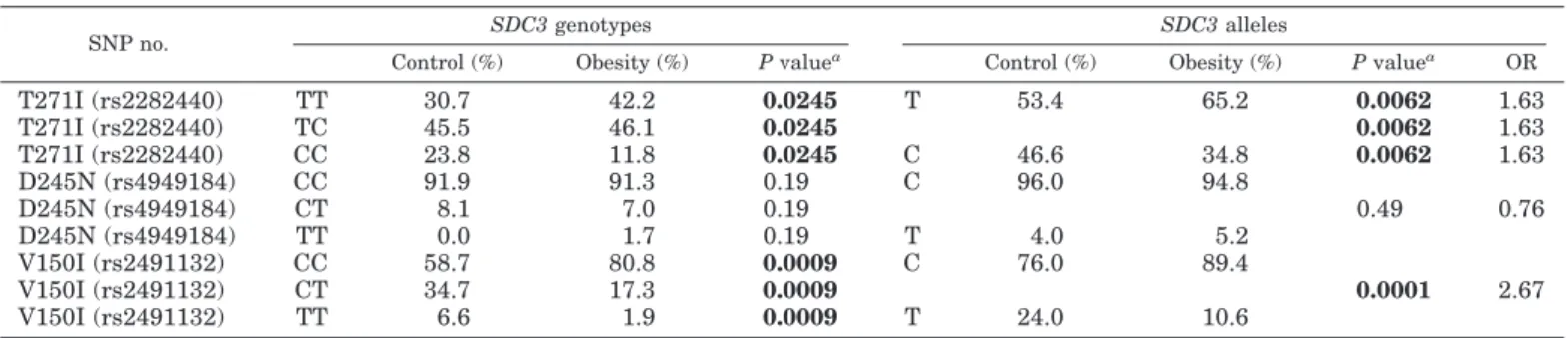
To confirm the association of SDC3 SNPs with obesity, we recruited a second independent study group and investigated three SDC3 SNPs (Table 2). As shown in Table 2, we found that the results from the second independent study replicated the re- sults in Table 1, showing that T271I (rs2282440) and V150I (rs2491132) are significantly associated with obesity. Genotype and allele frequencies of SDC3 polymorphisms in the second inde- pendent study were similar to those in Table 1, which may confirm the association of SDC3 SNPs with obesity.
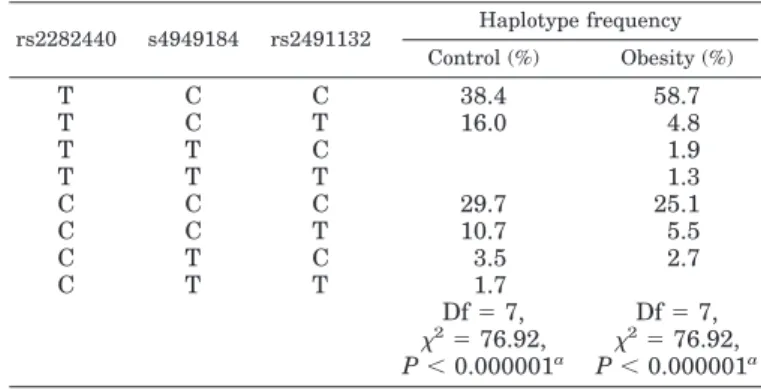
Haplotype analysis was performed on the three SNPs to estimate haplotype frequencies and haplotypes associated with obesity (Table 3). Of the eight haplotypes, the frequency of the most common haplotype (TCC) in obese subjects was 20.3%
higher than that in control subjects (58.7 vs. 38.4%). The fre- quencies of the second most common haplotype CCC were not significantly different between obese and control subjects (25.1 vs. 29.7%). The haplotype frequency of TCT in obese was almost 4 times lower than that in control subjects (4.8 vs. 16.0%), and the frequency of CCT haplotype in obese subjects was almost 2 times lower than that in control subjects (5.5 vs. 10.7%).
Whereas TTC and TTT haplotypes were not found in control subjects, 1.9 and 1.3% of TTC and TTT were observed in obese subjects. Statistical analysis revealed that significant association in haplotype frequency is present between control and obese subjects (
2⫽ 76.92, P ⬍ 0.000001). In consideration of the absence of association between the D245N (rs4949184) and obe- sity, we evaluated haplotypes formed by T271I (rs2282440) and V150I (rs2491132) and observed stronger association (P ⬍ 0.0000000001 vs. P ⬍ 0.000001). We next evaluated the linkage disequilibrium, as quantified by the metrics D ⬘ and r
2(Table 4).
SNPs T271I (rs2282440) and D245N (rs4949184) exhibited strong linkage disequilibrium (D ⬘ ⫽ 1.00). D⬘ and r
2of T271I (rs2282440) and V150I (rs2491132) were 0.03 and 0.0003, respec- tively, and those of D245N (rs4949184) and V150I (rs2491132) were 0.06 and 0.0005, respectively. P values were all ⬍ 0.0001.
Discussion
Although evidence of SDC3 in the regulation of energy balance has been published, no genetic study concerning the association between SDC3 and obesity has yet been reported.
TABLE 1. Genotype and allele frequencies of SDC3 polymorphisms in control and obesity subjects
SNP no. SDC3 genotypes SDC3 alleles
Control (%) Obesity (%) P valuea Control (%) Obesity (%) P valuea OR (95% CI)
T271I (rs2282440) TT 29.7 43.3 0.0004 T 54.4 66.7 <0.0001 1.68 (1.29 –2.19)
T271I (rs2282440) TC 49.3 46.9 0.0004 <0.0001 1.68 (1.29 –2.19)
T271I (rs2282440) CC 21.0 9.8 0.0004 C 45.6 33.3 <0.0001 1.68 (1.29 –2.19)
D245N (rs4949184) CC 90.4 90.6 0.32 C 94.8 94.1
D245N (rs4949184) CT 8.7 6.9 0.32 0.65 0.88 (0.50 –1.53)
D245N (rs4949184) TT 0.9 2.4 0.32 T 5.2 5.9
V150I (rs2491132) CC 49.8 78.0 <0.0001 C 71.6 88.4
V150I (rs2491132) CT 43.7 20.8 <0.0001 <0.0001 3.01 (2.14 – 4.24)
V150I (rs2491132) TT 6.6 1.2 <0.0001 T 28.4 11.6
CI, Confidence interval.
aP values are computed with2test using 3⫻ 2 or 2 ⫻ 2 contingency tables. P ⬍ 0.05 is shown in bold.
TABLE 2. Genotype and allele frequencies of SDC3 polymorphisms in control and obesity of the independent study
SNP no. SDC3 genotypes SDC3 alleles
Control (%) Obesity (%) P valuea Control (%) Obesity (%) P valuea OR
T271I (rs2282440) TT 30.7 42.2 0.0245 T 53.4 65.2 0.0062 1.63
T271I (rs2282440) TC 45.5 46.1 0.0245 0.0062 1.63
T271I (rs2282440) CC 23.8 11.8 0.0245 C 46.6 34.8 0.0062 1.63
D245N (rs4949184) CC 91.9 91.3 0.19 C 96.0 94.8
D245N (rs4949184) CT 8.1 7.0 0.19 0.49 0.76
D245N (rs4949184) TT 0.0 1.7 0.19 T 4.0 5.2
V150I (rs2491132) CC 58.7 80.8 0.0009 C 76.0 89.4
V150I (rs2491132) CT 34.7 17.3 0.0009 0.0001 2.67
V150I (rs2491132) TT 6.6 1.9 0.0009 T 24.0 10.6
aP values are computed with2test using 3⫻ 2 or 2 ⫻ 2 contingency tables. P ⬍ 0.05 is shown in bold.
In the present study, we showed that SDC3 is significantly associated with obesity in Koreans.
The C and T allele frequencies of T271I (rs2282440) SNP are reported to be 0.312 and 0.688 in Chinese, 0.432 and 0.568 in Japanese, and 0.977 and 0.023 in African-Americans, respec- tively (http://www.ensembl.org/). No variation is reported in Europeans (C allele frequency: 1.000). Clear ethnic differ- ence is present. The C and T allele frequencies in the Korean population were 0.456 and 0.544, which are similar to those in the Japanese (Table 1). Ethnic difference is also found in D245N (rs4949184) SNP. The C and T allele frequencies are reported to be 1.000 and 0.000 in Chinese, 0.636 and 0.364 in African-Americans, and 0.771 and 0.229 in Europeans, re- spectively (http://www.ensembl.org/). The C and T allele frequencies in the Korean population (0.948 and 0.052) are close to those in the Chinese (Table 1). The ethnic difference in the C and T alleles of V150I (rs2491132) SNP is intriguing.
The C and T allele frequencies of Koreans (0.716 and 0.284) are most closely related to those of Europeans (0.826 and 0.174), rather than to Chinese (1.000 and 0.000) (http://www.
ensembl.org/). Moreover, the C and T allele frequencies of Koreans with BMI greater than 30 (0.884 and 0.116) are even closer to those of Europeans (Table 1).
SDC3 contains a large extracellular domain, followed by a glycine-rich transmembrane domain and a very short cyto- plasmic tail (19). SDC3 consists of 384 amino acids and the molecular mass of SDC3 is 39,636 Da. Amino acids from 1 to 326 comprise extracellular, 327 to 351 transmembrane, 352 to
384 cytoplasmic domains, and 56 to 244 Ser/Thr-rich (mucin- like) region (UniProt, http://www.ebi.uniprot.org/;
SwissProt, http://au.expasy.org/). Because SDCs differ in their extracellular domains and function as mediators of cell-cell and cell-matrix interactions (20), genetic variations in the extracellular domain in SDCs, very highly likely, may influence the functions of SDCs. As expected, all three non- synonymous SNPs investigated herein are located in the extracellular domain of SDC3. Haplotype analysis of three SDC3 SNPs was found to be strongly associated with obesity in Koreans (Table 3). The V150I (rs2491132) SNP especially lies in both Ser/Thr-rich (mucin-like) and low-complexity regions (146 –180). V150I (rs2491132) was found to be most strongly associated, among three SNPs investigated in this study, with obesity in Koreans (Table 1).
In summary, we provided evidence of ethnic differences in three nonsynonymous SDC3 polymorphisms [T271I (rs2282440), D245N (rs4949184), and V150I (rs2491132)] in the Korean population. Our data in the present study that suggest that variations in SDC3 are significantly associated with obesity also provide strong support that SDC3 is in- volved in the regulation of energy balance. To our knowl- edge, this is the first report to demonstrate the ethnic dif- ferences in three SNPs of SDC3 and the strong association among three SNPs of SDC3 and obesity in the Korean pop- ulation. Because no other association studies concerning the SDC3 have yet been reported, more studies to elucidate the possible role of SDC3 in the development of obesity will be needed.
Acknowledgments
Received September 19, 2005. Accepted September 25, 2006.
Address all correspondence and requests for reprints to: Jong Woo Kim, M.D., Ph.D., Faculty of the Department of Neuropsychiatry, Kyung Hee Medical Center, Kyung Hee University, Hoigi-dong, Dongdaemun- gu, Seoul 130-701, Republic of Korea. E-mail: [email protected];
This work was supported by the Korea Health 21 R&D Project, Min- istry of Health and Welfare, Republic of Korea (A040042).
Disclosure statement: The authors have nothing to disclose.
References
1. Zimmet P, Alberti KG, Shaw J 2001 Global and societal implications of the diabetes epidemic. Nature 414:782–787
2. Carr DB, Utzschneider KM, Hull RL, Kodama K, Retzlaff BM, Brunzell JD, Shofer JB, Fish BE, Knopp RH, Kahn SE2004 Intra-abdominal fat is a major determinant of the National Cholesterol Education Program Adult Treatment Panel III criteria for the metabolic syndrome. Diabetes 53:2087–2094 3. Boden G 1997 Role of fatty acids in the pathogenesis of insulin resistance and
NIDDM. Diabetes 46:3–10
4. Seppa¨la¨-Lindroos A, Vehkavaara S, Ha¨kkinen AM, Goto T, Westerbacka J, Sovija¨rvi A, Halavaara J, Yki-Ja¨rvinen H2002 Fat accumulation in the liver is associated with defects in insulin suppression of glucose production and serum free fatty acids independent of obesity in normal men. J Clin Endocrinol Metab 87:3023–3028
5. Bajaj M, Suraamornkul S, Pratipanawatr T, Hardies LJ, Pratipanawatr W, Glass L, Cersosimo E, Miyazaki Y, DeFronzo RA2003 Pioglitazone reduces hepatic fat content and augments splanchnic glucose uptake in patients with type 2 diabetes. Diabetes 52:1364 –1370
6. Friedman JM, Halaas JL 1998 Leptin and the regulation of body weight in mammals. Nature 395:763–770
7. Elmquist JK, Elias CF, Saper CB 1999 From lesions to leptin: hypothalamic control of food intake and body weight. Neuron 22:221–232
8. Kalra SP, Dube MG, Pu S, Xu B, Horvath TL, Kalra PS 1999 Interacting appetite-regulating pathways in the hypothalamic regulation of body weight.
Endocr Rev 20:68 –100 TABLE 3. SDC3 haplotype frequencies in control and obesity
subjects
rs2282440 s4949184 rs2491132 Haplotype frequency Control (%) Obesity (%)
T C C 38.4 58.7
T C T 16.0 4.8
T T C 1.9
T T T 1.3
C C C 29.7 25.1
C C T 10.7 5.5
C T C 3.5 2.7
C T T 1.7
Df⫽ 7,
2⫽ 76.92, P⬍ 0.000001a
Df⫽ 7,
2⫽ 76.92, P⬍ 0.000001a Haplotype frequencies for the three SNPs in SDC3 were estimated with the EH program.
aP values for overall difference in haplotype distribution between control with BMI less than 23 and obese subjects (BMI⬎ 30).
Df, Degree of freedom.
TABLE 4. Pairwise linkage disequilibrium for three SNPs in SDC3
T271I (rs2282440)
D245N (rs4949184)
V150I (rs2491132)
T271I (rs2282440) 1.00 0.03
(0.07) (0.0003)
D245N (rs4949184) ⬍0.0001 0.06
(0.0005) V150I (rs2491132) ⬍0.0001 ⬍0.0001
Bold type, D⬘ (r2); italic type, P value. Pairwise linkage disequi- librium was calculated with the EH program.
9. Schwartz MW, Woods SC, Porte Jr D, Seeley RJ, Baskin DG 2000 Central nervous system control of food intake. Nature 404:661– 671
10. Spiegelman BM, Flier JS 2001 Obesity and the regulation of energy balance.
Cell 104:531–534
11. Wynne K, Stanley S, McGowan B, Bloom S 2005 Appetite control. J Endo- crinol 184:291–318
12. Reizes O, Lincecum J, Wang Z, Goldberger O, Huang L, Kaksonen M, Ahima R, Hinkes MT, Barsh GS, Rauvala H, Bernfield M2001 Transgenic expression of syndecan-1 uncovers a physiological control of feeding behavior by syn- decan-3. Cell 106:105–116
13. Strader AD, Reizes O, Woods SC, Benoit SC, Seeley RJ 2004 Mice lacking the syndecan-3 gene are resistant to diet-induced obesity. J Clin Invest 114:1354–1360 14. Bernfield M, Go¨tte M, Park PW, Reizes O, Fitzgerald ML, Lincecum J, Zako
M1999 Functions of cell surface heparin sulfate proteoglycans. Annu Rev Biochem 68:729 –777
15. Rapraeger AC, Ott VL 1998 Molecular interactions of the syndecan core proteins. Curr Opin Cell Biol 10:620 – 628
16. Woods A, Couchman JR 1998 Syndecan synergistic activators of cell adhesion.
Trends Cell Biol 8:189 –192
17. Terwilliger JD, Ott J 1994 Linkage disequilibrium between alleles at marker loci. In: Handbook of human genetic linkage. 1st ed. Baltimore: Johns Hopkins University; 188 –198
18. Reizes O, Benoit SC, Strader AD, Clegg DJ, Akunuru S, Seeley RJ 2003 Syndecan-3 modulates food intake by interaction with the melanocortin/AgRP pathway. Ann NY Acad Sci 994:66 –73
19. Berndt C, Casaroli-Marano RP, Vilaro´ S, Reina M 2001 Cloning and char- acterization of human syndecan-3. J Cell Biol 82:246 –259
20. Carey DJ 1997 Syndecans: multifunctional cell-surface coreceptors. Biochem J 327:1–16
JCEM is published monthly by The Endocrine Society (http://www.endo-society.org), the foremost professional society serving the endocrine community.