• 검색 결과가 없습니다.

A Study on Receptivity to Sharing Living Space in Communal Shared Housing of the Elderly Living in Rural Areas depending on Personal Traits

N/A
N/A
Protected

Academic year: 2021

Share "A Study on Receptivity to Sharing Living Space in Communal Shared Housing of the Elderly Living in Rural Areas depending on Personal Traits"

Copied!
16
0
0

로드 중.... (전체 텍스트 보기)

전체 글

(1)

1. Introduction

1.1. Background and Necessity of Study

The aging population of our country is proceeding at a faster rate unprecedented in the world due to the average life span extension with the development of medical technology and of the decrease of birth rate, and with this, phenomenon socially emerging even more greatly is the reduction of the elderly household constitution. As well as children decrease consciousness living together for support elderly parents (Hong, 2001a), elderly parents prefer to spend life after retirement independently from their children(Jung, 2012), so recently, there is an increasing elderly living alone household consisting of a senior person. In particular, this phenomenon is more noticeable in rural areas the younger drained due to the unbalanced development among regions (Kang et al., 2014) 1) .

pISSN 2288-968X, eISSN 2288-9698 http://dx.doi.org/10.12813/kieae.2016.16.4.005

* This research was supported by a grant(16AUDP-B068892-04#) from Residential Environment Research Program funded by Ministry of Land, Infrastructure and Transport of Korean government.

1) According to the Population and Housing Census results each year of Korea National Statistical Office, the proportion of elderly population in urban areas amounted to 5.5% in 2000 to 9.2% in 2010, on the other hand, rural areas

Increasing elderly single households living in rural areas is exposed to a variety of social issues like depression, social and psychological alienation and loneliness, etc. due to loss of social role as well as poverty due to the loss of economic capacity (Kim et al., 2011). Given the current situation that elderly living alone household who live in rural areas who receive little support from their families (Jung et al., 2014b), in order to solve a number of complex social problems which they are experiencing, we should prepare a planning in the social welfare aspect not in a family aspect (Choi et al., 2006). In particular, as most of the daily life of the elderly increasingly tend to be made around the house in accordance with the action radius shrink due to aging in their old age, because residential environment is the important factor determining the quality of their lives (Yeo, 2011), it is essential to approach in a residential welfare aspects (Choi et al., 2006).

Recent housing welfare policies for the elderly grow out of large-scale facilities protection type to be converted into local

amounted to 14.7 percent to reach the aging society in 2000, and amounted to 20.9% in 2010 to enter the super ageing society. In addition, according to 2014 agriculture and forestry fishery survey, the proportion of elderly living alone household who live in rural areas appeared as 16.6% in 2014, which increased 15.9% compared to 2013, on the other hand, elderly households consisting of two or more all showed a decreasing trend.

KIEAE Journal

Korea Institute of Ecological Architecture and Environment 80

A Study on Receptivity to Sharing Living Space in Communal Shared Housing of the Elderly Living in Rural Areas depending on Personal Traits

Kim, Hyun-Jung

*

⋅Lee, Yeun-Sook

**

⋅An, So-Mi

***

* Main author, Dept. of Interior Architecture & Built Environment, Yonsei Univ., South Korea ([email protected])

** Corresponding author, Dept. of Interior Architecture & Built Environment, Yonsei Univ., South Korea ([email protected])

*** Coauthor, Div. of Design and Imaging, Baekseok Univ., South Korea

A B S T R A C T K E Y W O R D

Purpose: The objective of this study is to divide personal traits of the elderly living in a rural area into extraversion, agreeableness, openness, conscientiousness, neuroticism, and loneliness and to identify the relationship between personal traits and receptivitiy to sharing living space in communal shared housing.

Method: Subjects of this study are the elderly of ages greater than 55 living in Yeongwol-gun, Gangwon-do.

Depending on how often elderly welfare facility was used, places where the elderly gathered were divided into a senior citizen center, senior welfare center, and other places where they often gathered. The researchers visited each of the places directly and conducted a survey with face-to-face interviews. Result: The collected data consisting of 124 respondents were analyzed through SPSS statistical program. It showed that 5 personal traits, except for agreeableness, had statistically significant difference. Extrovert and low lonely elderly people had high receptivity. The relationship between personal traits and acceptable shared space revealed differently depending on the function of space. Especially, shared resting space was related to low emotion-oriented trait, such as neuroticism and loneliness, while shared hobby and sanitary space were related to strong management-oriented trait of conscientiousness. These findings demonstrate the importance of understanding personal traits in predicting receptivitiy to sharing living space. Also, it is necessary to compare the degree of receptivity to sharing living space based on personal traits and to plan shared space in several levels, such as full sharing, partial sharing, and individual use, to develop and supply communal shared housing successfully.

1)

ⓒ 2016 KIEAE Journal

Personal Trait

Five-factor Model of Personality (Big Five)

Communal Shared Housing Receptivity to Sharing Living Space

A C C E P TA N C E I N F O
Received January 29, 2016

Final revision received August 16, 2016

Accepted August 21, 2016

(2)

social protection type, based on staying at home (Lee, 2010; Lee, 2015). In other words, by supporting that the peer elderly living in the community can form a community. and provide emotional and instrumental support which was the traditional family functions to each other (Lee, 2013; Lee, 2010; Jo & Shin, 2009), the way to ultimately reduce the social burden as well as to be able to live sustainable lives without social exclusion by enhancing their mental health is getting attention. In this regard, government and local governments are continually spreading the communal shared housing based on social sustainability in rural areas with relatively high proportion of elderly population (Ministry of Health and Welfare, 2012).

However, case studies of developed countries introducing communal shared housing ahead of Korea pointed out that these housing types revealed the advantages such as security of companion to chat with, psychological stability, human resources exchange, etc. but conflict and confrontation problem arising from personality difference, inappropriate work sharing problem due to household chores, etc. and in fact, due to this disadvantage, nearly half of the residents stop the share living within a very short period of time (Prtichard, 1983; Schreter, 1986; Kwon, 1993, re-quote;.

Pynoos et al, 1990; Oh, 2008, re-quote). Even in Korea, it revealed some problems like disagreements and conflicts between residents, etc. due to the lack of a sense of community during the operation of the shared housing (Lee, 2015; Nam, 2015).

Therefore for the elderly to not be socially excluded and sustain healthy life with emotional support within the community, spreading shared housing simply based on community life is likely to cause several problems. In order to create a successful residential environment by activating the community life between residents and enhancing their communication and harmony, it is required to more detailed approach to adjust the conflict factors which may be caused by the future community life. In other words, before spreading communal shared housing, it is required preferentially to grasp the receptivity on how to extent recognize the use of space shared with neighbor residing together with elderly households.

However, though elderly households have the same social demographic characteristics, gender, income, etc. it shows a wide variety of differences depending on the internal tendencies within the group rather than a single group. In order to grasp the receptivity of community life of the elderly, it is necessary to understand the temperamental tendency of the individual in addition to external factors of the individual.

In the field of environmental personology it is said that personal traits and physical environment are closely related (Gifford, 1987).

In particular, the tendency of individuals can be planed an appropriate environment which meets the characteristics of the persons, and in addition to a differentiated plan to meet the needs of

each group by identifying and comparing the difference between those who have particular tendencies, it has been used as a very useful tool to plan the environment because it can predict what environmental behavior individuals show and with what environment they are satisfied to some extent (Craik, 1976; Lee, 1998, re-quote). This study on the basis of this need is focused on the individual tendencies of the elderly that are predicted as future conflict factors and want to understand receptivity to sharing living space in communal shared housing of the elderly

1.2. Objective and Significance of Study

The communal shared housing utilized in this study was planned based on the social sustainability of elderly living alone households who live in rural areas, which is the housing type of the elderly sharing a lot of space required for everyday life and living with neighbors. The objective of this study is to understand the relationship between the personal traits and receptivity to sharing living space in communal shared housing at the object of the elderly living in rural areas. Study questions for this are as follows.

Study Question 1. What are personal traits of the elderly living in rural areas.

Study Question 2. What is overall receptivity to sharing living space of the elderly living in rural areas.

Study Question 3. What is the relationship between personal traits of the elderly living in rural areas and their receptivity to sharing living space.

2. Brief Review of Literature

2.1. Personal Traits of the Elderly

In order to identify personal traits correctly, we need to divide into two sides of trait and state and to understand considering all of these (Kim, 2011).

1) Personal Trait of Trait Side

The traits of trait side, as continuous personal traits, are referred to as the factors that appear a consistent behavior trait though situation and time has changed (Kim, 2011). In other words, trait of side of trait the elderly of is related to the basic character.

When we describe the character of a friend, it is often used stable qualities or characteristics associated with that person like ‘gentle’,

‘nice’, ‘lazy’, etc. (Yoo et al., 1997). In characteristical viewpoint, among psychologists defined individual character, Cattell (1946, 1965) defined character as the thing that individual will tell you what to do in any given environment. He said that if we know the personal trait we can predict how he behave in certain situations.

Cattell confirmed 16 source traits as basic factors of personality

(3)

through factor analysis; there are social-shy, low intelligent-high intelligent, emotional instable-emotional stable, submissive- dominant, serious-optimistic, convenient-conscientious, timid- adventurous, stubborn-gentle, trustful-doubtful, practical-imaginary, candid-quick witted, self confident-worried, conservative- experimental, self sufficient-group dependent, impulsive-controlled, relaxed-tense. By reanalyzing 16 factors of Cattell, Fiske (1949) first argued that it is more appropriate to explain character in five factors of social adaptability, conformity, achievement will, emotional control, and intellectual pursuit. Tupes and Christal (1961) presented five-factor model, including extroversion, friendly property, integrity, emotional stability/psychosis, and culture. Since Norman formally proposed five-factor model of character to the academics in 1963, many psychologists made consensus that character basically can be divided into 5 factors (Noh & Kang, 2003; Yoo et al., 1997; Korea Psychological Association, 2014). As the five-factor model of character, in the studies performed in a non-English-speaking (the Netherlands, Germany, Italy, China, Japan, India, the Philippines, etc.) its feasibility has been verified several times (Saum-Aldehoff, 2010), it has taken a position as the most comprehensive and stable structure that describes individual differences of character (Kim et al., 2011).

In 1981, as the results of review other previous studies as well as his study, Goldberg confirmed five character factors appearing consistently in many studies and named ‘Big Five’. The five factors of Big Five are Extraversion, Agreeableness, Openness, Conscientiousness, and Neuroticism (Noh & Kang, 2003; Korea Psychological Association, 2014). Their properties are as follows.

People with high Extraversion are talkative, passionate, strong assertive, and sociable. People with high Agreeableness are helpful to others, sympathetic, friendly, considerate, cooperative. People with high Openness are creative, imaginative and curious. And they like contemplation, have a talent of invention and consider artistic experience as important. People with high Conscientiousness are tightly reliable, hard working, goal- oriented, efficient and planning excellent. People with high Neuroticism are anxious, easily agitated, depressed, worried, and gloomy (Gosling, 2010).

2) Personal Traits of State Side

The traits of state side means factors affected and changed easily as situation and time change (Kim, 2011). That is, the traits of state side of the elderly can be interpreted as psychological condition caused by various environmental changes experienced as the elderly. The four difficulties often commonly experienced in old age are called ‘4 hardships(苦) of the elderly’ and among these, what is related to the psychological state is the loneliness that

comes by being alienated from family and people around (Kim et al., 2013).

Loneliness is a feeling that anyone feels throughout the whole life if he is human. Loneliness suffering in old age is referred to a negative psychological state that is experienced through the loss of relationship caused by changes of around environment and state (Won, 1994). Unlike other life cycle, loneliness experienced in old age is very deep, strong, and chronic (Ryu, 2001; Yang & Hong, 2003). The severity of this loneliness has emerged as a social problem to deal with importantly with the recent sharp increase of the elderly living alone households. Unlike the elderly households living with couple or their children/grandchildren, the elderly households living alone have no choice but to be more vulnerable to the negative psychological states such as loneliness, and has further increased the risk of considering suicide (Kwon et al., 2012;

Park & Song, 2014; Rim et al., 2013) because they are economically poor (Jung et al., 2014a) and do not receive social support of family or relatives (Jung et al., 2014b).

In particular, the elderly living in rural areas recognize the loneliness relatively higher than those living in urban areas (Do, 1999; Ryu, 2001). That is why as children move into the city due to the unbalanced development among regions, it is not easy to contact or come and go by physically away distance between them and community life frequent among rural elderly is gradually shrinking due to modernization (Do, 1999). In particular, the elderly living alone household living in rural areas experience the loneliness stronger unlike the elderly couple household who living rural areas or the household living with family (Do, 1999; Ryu, 2001; Yang & Hong, 2003), and it shows that the elderly women living alone are more serious in degree (Oh & Lee, 2012). Given that social support (Park & Song, 2014) and local community consciousness (Oh & Lee, 2012) contribute to help alleviate the negative emotions of the elderly household living alone who live in rural areas, when providing an alternative for solving social problems such as their sense of loneliness, solitude death, etc. we need to consider these two influence factors.

2.2. Relationship between Personal Traits and Environmental Preference

The study to identify personal trait and physical environment preference trait has been conducted a lot, and it is largely divided into outdoor environment preference, like building types, buildings shape, etc. and indoor environment preference like color, furniture, finishing material, etc.

First, in the study of relationship between personal trait and

outdoor environment preference, Cappon (1970), as the results

examined housing form according to the type of personal character,

(4)

said that extrovert enjoys the natural environment through the two big pair of casement windows, while introvert prefers yard without windows. In addition, sociable person prefer plane surface for enabling interaction through huge open space, wide stairway, etc.

while non-sociable person with reclusive trait wants soundproofing and complex internal arrangement which is blocked from the outside (Lee, 1998, re-quote). Gifford (1980), said that this type of building the person prefer is influenced by personal trait through 10 different daily photos of building. On the other hand, according to the study of Oh (2014) who analysed the demand for domestic share house at the subject of 20s and 30s, it shows that more extroverts want to live in the share house. That is, it can be seen that personal trait affects the preference for type and form of building itself.

According to study on relationship between personal trait and indoor environments preferences of Lee and Ko (2011) and Lee and Park (2013), there are difference of preferred type of interior design style, depending on the MBTI personality type. Lee and Jung (1997) divided personal personality into activity, stability, dominance, thoughtfulness, sociability, autonomy, achievement and based on this, as a results identified the impact of preference for indoor environments trait of traditional-modern, mal-female, simplicity-complexity, higher dominance appears oriental traditional trait, and higher autonomy appears relatively higher traditional trait. Lee et al. (1998) and Lee (2003) analyzed the relationship between these three indoor environment trait MBTI (Myers-Briggs Type Indicator) personality type. On the other hand, the study of Kim and Lee (2005a, 2005b) revealed that there was significant difference in the housing remodeling preference, depending on the MBTI personality type, and defined extraversion as environmental information pursuing type, introversion as universal inner pursuing type, sensing as sense reality pursuing type, intuitive as function future pursuing type, thinking as actual conservative pursuing type, feeling as relationship personality pursuing type, judging as life culture pursuing type, perceiving as open fashion pursuing type. According to study of Kim et al.

(2005c), there are differences of the characteristics of preferred furniture arrangement by couple bedroom, living room the elderly room, and children room, depending on the MBTI personality type.

For example, extraversion prefer distributed arrangement focused on dialogue and space, while introversion prefer organized interior space by arranging the furniture intensively focused on bed space.

Kim et al. (2009), who analyzed the living space the preferred color depending on the MBTI personality type, said that sensing prefers mainly generally preferred colors, while intuitive prefers various colors other than that.

These studies primarily used MBTI measure developed by Myers and Briggs (1990), based on the psychological type theory

of psychologist Jung. On the other hand, Big Five personality traits model based on the quality theory regards individual personality as single hierarchy, and as measured by the structure of five kinds of universal quality group (eg: extrovert-introvert) and the various concrete qualities (eg: chattering, sociability) included in this (Gosling et al, 2003), explains individual personality traits more comprehensively and helps to predict the behavior of unique individual (McAdams, 1992; Kim et al., 2011, re-quote). In addition, most of the personality psychologists say that Big Five personality traits model found through the experience study of more than 40 years is the most persuasive as a model that separates the individual personality (Digman, 1990; Goldberg, 1981; Choi, 1999, re-quote). Thus this study measured personal trait of trait side using Big Five personality traits model. Seo (2013) divided personality types based on Big Five personality traits model as with this study and analyzed awareness of five cardinal colors and preference of colors in the living space, within walls, ceilings, and curtains.

The study of individual trait and environmental preference generally covered a residential space and it was dealing with mainly indoor environmental quality of residential space like colors, finishing material, etc. but it has not yet presented concrete findings which examined the relation to preferred particular space type. In addition, the study classified personality types based on Big Five personality traits model has been very insufficient, and there were no study cases dealt with trait of the elderly particularly loneliness.

2.3. Communal Shared Housing for the Elderly

1) Concept and Advantages of Communal Shared Housing Communal Shared Housing is one of the residential type, not the facility and a term associated with it is The Elderly Community Life Housing (Kim & Hong, 2005; Seo & Hong, 2005a; Seo &

Hong, 2005b; You & Hong, 2005a; You & Hong, 2005b; You &

Hong, 2006; Lee, 2015; Hong & Oh, 2005; Hong, 2001a; Hong, 2001b; Hong & You, 2003; Hong & Jee, 2004a; Hong & Jee, 2004b), The Elderly Community Use Housing (Lee & Lee, 2015), Community Life Home (Park et al., 2014), and the like. Thus despite a little difference in its name, shared housing for the elderly based on the shared lives contains the main feature of all the three elements of personal space, common space, and combination of housing and services (Lee et al., 2014).

Communal shared housing for the elderly covered in this study

is referred to housing type that there are independent private spaces

that can keep a person's private life enough and separately common

spaces that can be used together with other residents while several

elderly people live together under one roof. As the specific

(5)

features, first, composition of private space includes from simply form with only the bedroom to form with a variety of functions necessary for daily life such as a living room, kitchen and dining room, bathroom. etc. Second, the shared space, according to its position and the user, may be divided into ‘internal type’ that can be used with small resident group adjacent to the private space and

‘external type’ that can be used with all residents to aggregate each floor or single floor not adjacent to personal space 2) . These space may provide with a variety of services to support the independent life of the elderly. Third, shared space of internal type can be changed enough into the type according to the personal demand and preference, so it can be flexible space planning tailored to the situation of residents (Lee & Lee, 2015; Research Group of Housing Welfare System, 2015).

Communal shared housing enables to alleviate the cost of housing and living, relieve psychological stress, fulfill social and emotional support due to the increase of sense of community, etc.

in the personal aspect and solves the problem of low-income the elderly through the low cost of housing and helps increase the stability of the community in the regional and social aspect (Day-Lower, 1983; Oh, 2008, re-quote). Also, because of this, it improves the sustainability of individuals and communities and ultimately reduces the economic costs the government should bear for the elderly housing welfare (Research Group of Housing Welfare System, 2015).

2) Prior Studies on Communal Shared Housing for the Elderly The discussion on housing model similar to communal shared housing for the elderly was raised starting with the study of Hong (1999) introducing the concept as an alternative to integrated community elderly housing and seeking institutional support plans. Later You and Hong (2005b) and Hong (2001b) investigated foreign situation cases of UK, US, Japan, etc. which has continued to develop shared housing ahead of Korea, and identifying its strengths and weaknesses, proposed the development direction of the shared housing which suits for domestic situation based on this.

in the meantime, Hong (2001a), pointed out the problem for literally introduction of foreign shared housing model, and maintained that there is need to develop various models by identifying a variety of attitudes and preference for the elderly in

2) Research Group of Housing Welfare System (2015) divided combination way of personal space and shared space based on the several plane cases of shared housing into a total of six division; ⓛ consisting of personal space, ② consisting of a personal space and shared space, ③ consisting of personal space, shared space by group, and whole shared space, ④ consisting of personal space on each floor, shared space concentrated on the ground floor, ⑤ consisting of personal space, and shared space distributed on each floor, and shared space on a separate floor,

⑥ consisting of personal space and shared space on each floor, and shared space on the ground floor. In other words, the shared space, according to its position and the user, may be divided into 'internal shared space' that can be used with small resident group adjacent to the private space and 'external shared space' that can be used with all residents to aggregate each floor or single floor not adjacent to personal space.

Korea.

In this respect, Kim and Hong (2005) and Seo and Hong (2005) divided into personal developer type and joint developer type according to preference of shared housing development type and they identified the specific characteristics of each group. Seo and Hong (2004) and You and Hong (2005a) compared characteristics between positive group and negative group targeting potential demand group according to residence intention of shared housing for the elderly. In addition, there were attempts to identify the attitude and preference of the shared housing in the object of the elderly households living in rural (Cho & Kim, 2011; Choi et al, 2006) and the elderly households living in urban (You & Hong, 2006; Choi, 2007; Hong & Oh, 2005), and to provide more differentiated space plan tailored to the characteristics of the elderly comparing what difference these preference tend has according to residential area (Hong & Jee, 2004a), socio-economic status (Hong & Jee, 2004b), the attitude for work and leisure in old age (Hong & You, 2003).

As residential type similar to communal shared housing increasingly spread in many regions across the country, the study was conducted to identify the present status and operating status (Kim & Son, 2011; Moon & Shin, 2015; Park et al., 2014), and to analyzes further satisfaction (Lee, 2015; Jeong et al., 2012) and the life status (Yu et al., 2013) of the elderly living actually and explore the improvement.

The majority of previous studies related to communal shared housing for the elderly mainly dealt with the subject of this attitudes and preferences trend, development direction, improvement direction, surveys, etc. but studies intensively only covered shared life and shared space which can be the most essential element of communal shared housing was extremely insignificant.

3. Study Method

3.1. Survey Subject and Survey Area

The survey subject of this study was only the elderly 55 years old and over (based on elderly employment law) who live in Yeongwol-gun, Gangwon-do. In consideration of the potential demand group of communal shared housing, it included single elderly households, elderly couple households, and elderly households with children /grandchildren.

In survey area, Yeongwol-gun, Gangwon-do, the number of

elderly population of the total population was 8,333 people since

entering the super-aged society by over 20.6% in 2008, by 21.5% in

2010, 22.7% in 2013 (Yeongwol County Office, 2014), 23.9% in

2014 the ratio has been steadily increasing each year, which was

(6)

much higher compared to 16.6%, the aging rate of overall Gangwon-do (Lee, 2015). In addition, based on the 2010, the number of single elderly households in Yeongwol was about 1800 people, which accounted for 21.7% of the total elderly (Kim, 2010) and this was continuously increasing 2,198 people in 2014 (Oh, 2015). To prepare for this surge in size of single elderly households, Yeongwol-gun has been working to prepare comprehensive measures to support single elderly households since 2010 (Kim, 2010). As personal trait, independent variable of this study, is influenced by other environmental factors, including area, in order to identify the relationship between the variables more precisely, from the viewpoint that it is desirable to deal with only one heterogeneous group, only Yeongwol-gun, Gangwon-do focused on severity of the elderly, especially single elderly households surged was studied.

3.2. Data Collection Method

This study carried out stratified cluster sampling taking into account the extent of elderly welfare facilities use, in order to prevent biased to particular personal trait. It was because among independent variables personal traits, loneliness was greatly affected by quantitative size like friends, neighbors, social networks, etc. (Oh & Lee, 2012). Elderly welfare facilities, socially exposed a lot as place where a lot of seniors gather, can be objective criteria that can be useful to distinguish whether the size of the social network is the big place or not. Therefore, elderly welfare facilities depending on the degree of use were divided into three groups, and each group selected the most crowded place based on the actual condition survey of the elderly in 2014 <Table 1>.

Division Data Collection Place Sample Size Degree of

Using Elderly Welfare Facility

High

a

Senior Citizen Center 42

Moderate

b

Senior Welfare Center 45 Low

Other Places Where the Seniors often Gather except for Elderly Welfare Facilities

37

Total 124

a 54.3% of the elderly living in rural areas use the senior citizen center b 8.9% of the elderly living in rural areas use the senior welfare center Table 1. Data Collection Place and Sample Size

The first group is one with a high degree of using elderly welfare facilities, the elderly using Senior Citizen Center. The second group is one with a moderate degree of using elderly welfare facilities, the elderly using Senior Welfare Center. The third group is one with a low degree of using elderly welfare facilities, the elderly using other places where the seniors often gather except for elderly welfare facilities. Specifically, there are summerhouses, flat benches, chairs, etc. located within apartment complex.

As for survey method. researchers visited each place directly and conducted interview survey of face-to-face form accompanied

by structural questionnaires. Because communal shared housing term may be confused with elderly welfare facilities as well as unfamiliar yet to seniors in Korea, survey was conducted in a way that researchers helped the subjects understand communal shared housing with a full explanation in survey progress and explained questionnaire directly and completed the response to obtain the reliable response. The research period was conducted for about a month, from October 12, until November 20, 2015 and a total of 124 questionnaires were collected and by group 42 questionnaires of the elderly using Senior Citizen Center, 45 questionnaires of the elderly using Senior Welfare Center, 37 questionnaires of the elderly not using elderly welfare facilities, were utilized in the analysis.

3.3. Survey Tools and Measurement Methods

Survey tool of this study is structured questionnaire and greatly consists of general characteristics, personal trait, receptivity to sharing living space in communal shared housing of subjects

<Table 3>. The purpose of this study is to identify relationship between personal trait and receptivity to sharing living space in communal shared housing. and measurement methods by each variable are as follows:

Division Contents Tool

General Characteristic

Socio-demographic Characteristic, Residential Environmental

Characteristic

General Survey Items

Personal Trait

Side of Trait

Extraversion, Agreeableness, Openness, Conscientiousness,

Neuroticism

BFI-K (Kim et al.,

2010) Side of

State Loneliness

R-UCLA Reduced Version (Won, 1994) Receptivity to

Sharing Living Space in Communal Shared

Housing

Whether being Willing to Live, Type of Acceptable Shared Space, Top Rank of Acceptable Shared Space, Number of Acceptable Shared Spaces

Developed based on Precedent Research Table 2. Contents of Survey and Measurement Tool

1) Personal Traits

In side of trait, personal trait was measured Big Five personality traits, that is ‘extraversion’, ‘agreeableness’, ‘openness’,

‘conscientiousness’, ‘neuroticism’ using Big Five Inventory Korean version (BFI-K) of seven researchers including Kim Seon-yeong (2010), standardized to fit the domestic situation based on Big Five Inventory (BFI; John & Srivastava, 1999) measure developed in order to measure this. It consists of a total of 44 items, measured on a 5-point scale from ‘not at all’ (1 point) to ‘Yes, always’ (5 points).

In side of state, personal trait, ‘Loneliness’ was measured using Won Hyung-joog (1994) adapted R-UCLA (Revised-UCLA;.

Russel et al, 1980) developed abroad and briefed in the 10

questions to measure this. This is measured by a four-point scale

developed by the R-UCLA from ‘not at all’ (1 point), to ‘Yes,

(7)

often’ (4 points).

2) Receptivity to Sharing Living Space

In this study, receptivity to sharing living space was defined as possibility for whether being willing to live with neighbors several common areas other than the personal space when living in communal shared housing. For more accurate measurements, The factors that can greatly affect the living conditions Based on a number of previous studies was controlled.

First, the composition of household to reside in communal shared housing was limited to single elderly households 3) . On the other hand, elderly households with spouse or children /grandchildren was made to respond to receptivity to sharing living space assuming later in case they became alone. Second, it controlled the components of personal space when living in communal shared housing. In other words, in this study, the receptivity to sharing living space was measured under the assumption that bedroom & living room, toilet, shower room, kitchenette are provided for personal space 4) . Third, shared space was limited to ‘internal shared space’ adjacent to personal space that small residents group can be used together. Specifically, there are shared entrance, shared living room, shared kitchen and dining room, shared laundry/utility room, shared veranda/balcony, shared storage, shared working room, shared toilet, shared bathroom/shower room. On the other hand, in case of toilet and bath room/shower room, because even provided to private space, whether they can be used with other residents if there are shared space was measured. The explanation and visualization data 5) were provided at the same time in survey progress so that these various conditions and assumptions can be passed sufficiently to the subjects.

Survey of receptivity to sharing living space is classified into four. The first is ‘whether being willing to live’. If willing to live means that there is a general receptivity to sharing living space.

The second is ‘type of acceptable shared space’. Using the ending of ‘can use - space with neighbors to live with’ it was measured with ‘Yes (1)’ and ‘No (0)’, and the space of a response ‘yes’ means that there is a receptivity. The third is the ‘top rank of acceptable shared space’. With a response ‘Yes (1)’ in ‘type of acceptable

3) Resident intention in the communal shared housing is high if left alone due to the bereavement of spouse (Spear & Meyer, 1988; Kim, 2004, re-quote; Lee & Lee, 2015; Choi, 2007) and if there are no children (You & Hong, 2005a) and also there are the elderly who wish to select resident by classifying elderly single households and elderly couple households (Hong, 2001a).

4) Taken together foreign and domestic previous studies on shared housing personal space composition, it was provided generally independent personal space with all the features necessary for everyday life like bedroom, kitchen, toilets, showers, etc.

(Oldman, 1990; Regnier, 1994; You & Hong, 2006, re-quote; You & Hong, 2005b; Hong, 2001a)) In fact, it was found that the elderly also prefer complete-type personal space as this self-sufficient as possible (Lee, 2014; Hong, 2001a).

5) Visualization data on receptivity to sharing living space in communal shared housing was applied to some selected to conform to the contents of the study of the draft drawings developed in the 'Research Group of Housing Welfare System' as part of the Ministry of Transportation R & D projects.

shared space’, sharing living space with neighbors who live with was to be listed as priority and the selected area as the first priority means the highest receptivity. The fourth is ‘number of acceptable shared spaces’. It is granted score again plus the number of items to the response that can be used jointly in ‘type of acceptable shared space’ above, and more numbers means that the degree of receptivity to sharing living space is high.

3.4. Analysis Method

The collected data were analyzed using the SPSS statistical program. First, descriptive statistics and frequency analysis were conducted to identify general characteristics, personal trait distribution, and overall receptivity to sharing living space of the subjects. At this time, compared the loneliness according to the degree of using elderly welfare facilities, its validity in data collection methods was verified. Second, relationship between personal traits and receptivity to sharing living space was conducted Cross analysis, t-test, ANOVA, Duncan's multiple range test, depending on the four kinds of research content to measure the receptivity to sharing living space. The only statistically significant result was discussed at a time in the comprehensive discussion.

4. Result and Analysis 4.1. General Characteristics

1) Socio-demographic Characteristics

The result of frequency analysis to understand the socio-demographic characteristics of subjects was shown in <Table 3>. The ratio of elderly women of A total of 124 subjects was as high as 81.5%, which was about four times higher than men. The average age was 73.49 in the 70s elderly the most, then 25.8% in the 80s or more, 12.1% in the 60s, 11.3% in the 50s in order. For household composition, elderly single households accounted for the highest percentage with 47.6%.

Division f %

Gender

Male 23 18.5

Female 101 81.5

Total 124 100.0

Age

50s 14 11.3

60s 15 12.1

70s 63 50.8

Over 80s 32 25.8

Total 124 100.0

Household Composition

Single Elderly Households 59 47.6 Elderly Couple Households 41 33.1

Elderly Households with

Children/Grandchildren 24 19.4

Total 124 100.0

Monthly Less than KRW 0.6 Million 64 51.6

Table 3. Socio-demographic Characteristics

(8)

The average monthly income of about 50% of subjects indicated less than the minimum cost of living ₩ 600,000, so their economic situation was very fragile. Next 18.5 percent ₩ 900,000- 1,500,000, and 17.7%, ₩ 1,500,000 or more in order, the relative income levels showed a polarization trend. Even the average monthly cost of living appeared similarly, and consuming less than

₩ 600,000 was the highest by 50.8 percent, next ₩ 900,000-1,500,000, by 19.4 percent, ₩ 1,500,000 or more by 12.1% in order.

For income source and disease type, the results of multiple response questions were as following <Table 4>. Examining the relative weight of source of income of a total of 166 cases, accounting for assistance by government/public organization 50.0%, self-burden 30.8 %, supported by children 18.7%, it shows that the ratio of dependent source amounts to 68.7% and economic independence is somewhat low.

For the state of health of elderly households living in rural area, 98%, 121 of a total of 124 subjects responded to having more than one disease, and it shows that their physical health status very fragile. The results of multiple response questions about the disease type were confirmed a total of 289 cases of 9 diseases types.

Examining the ratio of the total cases of disease types, muscular skeletal diseases accounted for the highest proportion by 29.4%, then adult vessel diseases by 29.1%, neuropsychiatric disorders by 15.9%, eye diseases by 11.4%, in order.

Division f f/n

a

f/N

Income Source

Self-burden 51 41.1 30.7

Supported by Children 31 25.0 18.7 Assistance by Government/

Public Organization 83 66.9 50.0

Disease Type

Others 1 0.8 0.6

Total(N) 166 133.9 100.0

Musculoskeletal Diseases 85 70.2 29.4 Adult Vessel Diseases 84 69.4 29.1 Neuropsychiatric Disorders 46 38.0 15.9

Eye Diseases 33 27.3 11.4

Digestive Diseases 18 14.9 6.2

Respiratory Diseases 12 9.9 4.2

Heart Disease 5 4.1 1.7

Skin Disorders 4 3.3 1.4

Others 2 1.7 0.7

Total(N) 289 238.8 100.0

a f/n refers to case %

Table 4. Socio-demographic Characteristics (Multiple Answers)

2) Residential Environmental Characteristics

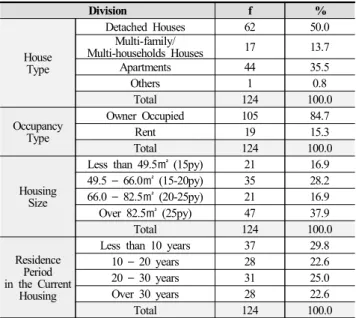
To identify residential environmental characteristic of subjects, the results of frequency analysis were following <Table 5>. 50.0%

of subjects were residing in detached house, next 35.5%, in apartment, 13.7% in multi-family/multi-households houses in order. The proportion living in others’s house Rent and charters, etc. was 15.3%. and appeared very low compared to 84.7% of owner occupied, so residential stability of subjects can be considered somewhat better.

Examining the housing size, the ratio living in the over 25 pyeong was higher by 37.9%, next in 15-20 pyeong by 28.2%, and in less than 15 pyeong and 20-25 by 16.9% in order. The residence period in the current housing was less than 10 years by 29.8%, 20-30 years by 25.0%, 10-20 years and over 30 years by 22.6% in order. In other words, 70.2% of all subjects were residing for a long period of over 10 years in the current housing.

Division f %

House Type

Detached Houses 62 50.0

Multi-family/

Multi-households Houses 17 13.7

Apartments 44 35.5

Others 1 0.8

Total 124 100.0

Occupancy Type

Owner Occupied 105 84.7

Rent 19 15.3

Total 124 100.0

Housing Size

Less than 49.5㎡ (15py) 21 16.9

49.5 – 66.0㎡ (15-20py) 35 28.2

66.0 – 82.5㎡ (20-25py) 21 16.9

Over 82.5㎡ (25py) 47 37.9

Total 124 100.0

Residence Period in the Current

Housing

Less than 10 years 37 29.8

10 – 20 years 28 22.6

20 – 30 years 31 25.0

Over 30 years 28 22.6

Total 124 100.0

Table 5. Residential Environmental Characteristics

4.2. Distribution Characteristics of Personal Traits

The Average (standard deviation) of personal trait of subjects, the elderly living in rural areas, amounted to extraversion 3.16(0.61), agreeableness 3.91(0.66), openness 3.11(0.56), conscientiousness, 3.94(0.60), neuroticism 2.55(0.63), and loneliness 1.79 (0.56). As a whole, agreeableness trait and extraversion trait were very high, while neuroticism trait and loneliness were very low <Table 6>.

Division M S.D. MAX MIN

Extraversion

a

3.16 0.61 4.71 1.86

Agreeableness

a

3.91 0.66 5.00 2.11

Openness

a

3.11 0.56 4.50 1.90

Conscientiousness

a

3.94 0.60 5.00 2.11

Neuroticism

a

2.55 0.63 4.13 1.00

Loneliness

b

1.79 0.56 3.20 1.00

a 1 point(I strongly disagree)-5 point(I strongly agree) b 1 point(I never feel this way)-4 point(I often feel this way) Table 6. Distribution Characteristics of Personal Traits Average

Income

KRW 0.6 - 0.75 Million 10 8.1

KRW 0.75 - 0.9 Million 5 4.0

KRW 0.9 - 1.5 Million 23 18.5

Over KRW 1.5 Million 22 17.7

Total 124 100.0

Average KRW 0.96 Million

Monthly Average Living Expenses

Less than KRW 0.6 Million 63 50.8 KRW 0.6 - 0.75 Million 16 12.9

KRW 0.75 - 0.9 Million 6 4.8

KRW 0.9 - 1.5 Million 24 19.4

Over KRW 1.5 Million 15 12.1

Total 124 100.0

Average KRW 0.88 Million

a 50s in this study refer to ages between 55 and 59

(9)

On the other hand, there were differences of loneliness depending on three data collection places, classified based on the extent of use of the elderly welfare facilities, and its validity was proved. Duncan's multiple range test result for it, unlike the expected, was that loneliness of the elderly using senior centers was high compared to the elderly using welfare centers, but there was no difference between them. But compared to these, the elderly to promote the fellowship not using welfare facilities but using resting places like residential complexes, etc. appeared to be aware of even higher loneliness, and the difference between the two groups was clearly identified. This can be interpreted as the difference between the group experiencing real sharing living in senior centers and welfare centers and the group without experiencing sharing living <Table 7>.

Division f M S.D. F(p) Duncan

The Elderly Using Senior Centers 42 1.74 0.50 3.523 (.033)

A The Elderly Using Welfare Centers 45 1.67 0.57 A

The Elderly

Not Using Welfare Facilities 37 1.98 0.57 B Table 7. Loneliness depending on the Degree of Using Elderly Welfare Facility

4.3. Overall Receptivity to Sharing Living Space

1) Whether being Willing to Live in Communal Shared Housing

As the result of frequency analysis as to whether being willing to live in communal shared housing if having future opportunity, the ratio of response ‘want’ was 43.5%, ‘not want’ 42.8%, and ‘don’t know’ 13.7%. In other words, 56.5% of subjects had somewhat negative attitude toward residential type of communal shared housing <Table 8>.

Division f %

Whether being Willing

to Live

Want 54 43.5

Not Want 53 42.8

Don’t Know 17 13.7

Total 124 100.0

Table 8. Whether being Willing to Live in Communal Shared Housing

2) Type and Number of Acceptable Shared Spaces

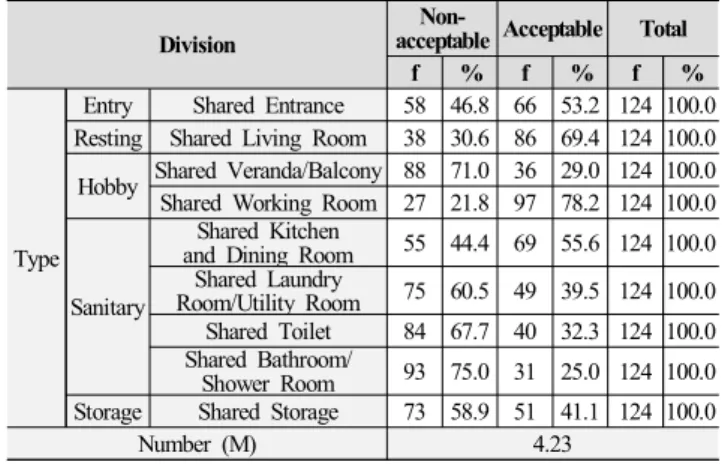
The type and number of acceptable shared spaces with neighbors living in communal shared housing are the following

<Table 9>. First, among type of acceptable shared space, shared working room was highest by 78.2%, next shared living room by 53.2%. shared kitchen and dining room by 55.6%, shared entrance by 53.2% in order.

On the other hand, the receptivity to shared veranda/balcony, shared laundry room/utility room, shared toilet, shared

bathroom/shower room, shared storage appeared very low, and it can be seen that these spaces were preferred to use individually.

Especially, the receptivity to remaining sanitary spaces except for the shared kitchen and dining room appeared very low. The reason for the remarkably low receptivity to shared toilet and shared bathroom/shower room is that the elderly may prefer to see independent use of these spaces, but it may also be interpreted as the result assumed that the toilet and shower available individually are already equipped in private space while living in communal shared housing.

Next, of total 9 shared spaces, the average number of acceptable shared spaces is 4.23 and usual level.

Division

Non-

acceptable Acceptable Total

f % f % f %

Type

Entry Shared Entrance 58 46.8 66 53.2 124 100.0 Resting Shared Living Room 38 30.6 86 69.4 124 100.0 Hobby Shared Veranda/Balcony 88 71.0 36 29.0 124 100.0 Shared Working Room 27 21.8 97 78.2 124 100.0

Sanitary

Shared Kitchen

and Dining Room 55 44.4 69 55.6 124 100.0 Shared Laundry

Room/Utility Room 75 60.5 49 39.5 124 100.0 Shared Toilet 84 67.7 40 32.3 124 100.0 Shared Bathroom/

Shower Room 93 75.0 31 25.0 124 100.0 Storage Shared Storage 73 58.9 51 41.1 124 100.0

Number (M) 4.23

Table 9. Type and Number of Acceptable Shared Spaces

3) Rank of Acceptable Shared Space

The graph of cumulative frequency for each rank of acceptable shared space with neighbors living in communal shared housing represents in <Figure 1>. Like the type of acceptable shared space above, the receptivity to shared working room and shared living room was high, while the receptivity to shared bathroom, shared bathroom/shower room was very low.

Fig. 1. Rank of acceptable shared space

(10)

4.4. Relationship between Personal Traits and Receptivity to Sharing Living Space

1) Whether being Willing to Live in Communal Shared Housing depending on Personal Traits

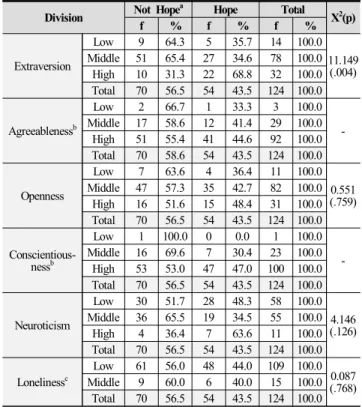
Personal traits were divided into three groups 6) depending on the degree and the X

2

test through Cross analysis was carried out to understand whether being willing to live in communal shared housing <Table 10>.

The result showed that there was significant difference in extraversion. The proportion of those who want to reside of the group of highly extroverted trait was higher than otherwise group.

It can be seen that more sociable and outgoing seniors who like to hang out with others showed a positive attitude toward communal shared housing.

Division Not Hope

a

Hope Total

X

2

(p)

f % f % f %

Extraversion

Low 9 64.3 5 35.7 14 100.0

11.149 (.004)

Middle 51 65.4 27 34.6 78 100.0

High 10 31.3 22 68.8 32 100.0

Total 70 56.5 54 43.5 124 100.0

Agreeableness

b

Low 2 66.7 1 33.3 3 100.0

Middle 17 58.6 12 41.4 29 100.0 -

High 51 55.4 41 44.6 92 100.0

Total 70 58.6 54 43.5 124 100.0

Openness

Low 7 63.6 4 36.4 11 100.0

0.551 (.759)

Middle 47 57.3 35 42.7 82 100.0

High 16 51.6 15 48.4 31 100.0

Total 70 56.5 54 43.5 124 100.0

Conscientious- ness

b

Low 1 100.0 0 0.0 1 100.0

Middle 16 69.6 7 30.4 23 100.0 -

High 53 53.0 47 47.0 100 100.0

Total 70 56.5 54 43.5 124 100.0

Neuroticism

Low 30 51.7 28 48.3 58 100.0

4.146 (.126)

Middle 36 65.5 19 34.5 55 100.0

High 4 36.4 7 63.6 11 100.0

Total 70 56.5 54 43.5 124 100.0

Loneliness

c

Low 61 56.0 48 44.0 109 100.0

0.087 (.768)

Middle 9 60.0 6 40.0 15 100.0

Total 70 56.5 54 43.5 124 100.0

a Not Hope: Not Want, Don’t Know

b It was impossible to conduct cross-tabulation analysis because more than 20% of cell had expected counts less than five

c There was no group that loneliness was high

Table 10. Whether being Willing to Live in Communal Shared Housing depending on Personal Traits

2) Type of Acceptable Shared Space depending on Personal Traits t-test was conducted to compare the personal trait, depending on

6) Because not only the personal traits of subjects is overall densely distributed for particular scores, but also scale to measure trait in the side of state and the side of trait is different respectively, some of the survey contents of acceptability to sharing living was judged reasonable to interpret to classify personal traits with groups.

Therefore, personality factors as measured by the 5-point scale, which were classified into low (1.00 to 2.44), middle (2.45 to 3.44), high (3.45 to 5.00) groups, and loneliness as measured by the 4-point scale, which were classified into low (1.00 to 2.44), middle (2.45 to 3.44), high (3.45 to 4.00) group. Meanwhile, there was no high group of the loneliness, which was excluded from the final analysis.

whether or not (Yes / No) being acceptable shared space with neighbors living in communal shared housing. As a result, a total of seven shared spaces like shared entrance, shared living room, shared kitchen and dining room, shared storage, shared working room, shared toilet, appeared statistically significant results, and acceptability to particular shared spaces appeared to be associated with particular personal trait <Table 11>.

Division E

a

A O C N L

M M M M M M

Shared Entrance

No 2.99 3.97 3.00 3.97 2.49 1.81 Yes 3.31 3.85 3.21 3.91 2.61 1.77

t (p)

-2.982 (.003)

0.994 (.322)

-2.062 (.041)

0.588 (.557)

-1.050 (.296)

0.418 (.677) Shared

Living Room

No 3.00 3.79 2.97 3.84 2.71 2.01 Yes 3.23 3.96 3.17 3.98 2.48 1.69

t (p)

-1.984 (.050)

-1.345 (.181)

-1.869 (.064)

-1.210 (.229)

1.901 (.060)

2.691 (.009) Shared

Veranda/

Balcony

No 3.12 3.98 3.10 4.01 2.47 1.75 Yes 3.27 3.74 3.13 3.77 2.74 1.87

t (p)

-1.250 (.214)

1.869 (.064)

-0.255 (.799)

2.024 (.050)

-2.212 (.052)

-1.075 (.284) Shared

Working Room

No 2.95 3.75 3.06 3.70 2.75 2.03 Yes 3.22 3.95 3.12 4.00 2.49 1.72

t (p)

-2.091 (.039)

-1.256 (.217)

-0.499 (.619)

-2.365 (.020)

1.926 (.056)

2.248 (.031) Shared

Kitchen and Dining

Room

No 3.00 3.87 2.98 3.87 2.67 1.94 Yes 3.29 3.94 3.21 3.99 2.46 1.67

t (p)

-2.654 (.009)

-0.632 (.528)

-2.300 (.023)

-1.102 (.273)

1.937 (.055)

2.708 (.008) Shared

Laundry Room/

Utility Room

No 3.14 3.97 3.05 3.95 2.52 1.81 Yes 3.20 3.81 3.21 3.92 2.60 1.76

t (p)

-0.481 (.631)

1.360 (.176)

-1.586 (.115)

0.300 (.765)

-0.773 (.441)

0.461 (.646) Shared

Toilet

No 3.06 3.93 3.13 3.91 2.60 1.81 Yes 3.39 3.87 3.08 4.00 2.44 1.73

t (p)

-2.879 (.005)

0.424 (.673)

0.487 (.627)

-0.765 (.446)

1.305 (.194)

0.846 (.400) Shared

Bathroom/

Shower Room

No 3.10 3.94 3.12 3.91 2.59 1.82 Yes 3.35 3.81 3.10 4.03 2.42 1.69

t (p)

-1.942 (.054)

0.928 (.355)

0.157 (.875)

-0.977 (.330)

1.342 (.182)

1.124 (.263) Shared

Storage

No 3.07 3.96 3.04 3.98 2.54 1.75 Yes 3.30 3.84 3.21 3.87 2.56 1.84

t (p)

-2.113 (.037)

0.988 (.325)

-1.635 (.105)

0.985 (.327)

-0.124 (.902)

-0.788 (.432) a E(Extraversion), A(Agreeableness), O(Openness), C(Conscientiousness), N(Neuroticism), L(Loneliness)

Table 11. Type of Acceptable Shared Space depending on Personal Traits

In the group with receptivity to shared entrance, extraversion

and openness were relatively high. In the group with receptivity of

shared living room, loneliness was relatively low. In the group with

responses that could be used shared working room, extraversion

and conscientiousness appeared relatively high while loneliness

was low. In the group with receptivity to shared kitchen and dining

room of shared sanitary spaces, extraversion and openness were

relatively high while loneliness was low. In the group with

(11)

responses that could be used shared toilet, extraversion showed relatively high. Like shared toilet, in the group with receptivity to shared storage, extraversion was relatively high.

Overall, as extraversion, openness, and conscientiousness of personal traits of trait side are relatively higher, and loneliness of personal traits of state side is relatively lower, it is likely to be acceptable to share particular spaces with neighbors living in communal shared housing.

Comparing degree of psychological receptivity to sharing living space depending on personal traits based on the results was the following <Table 12>. The highest receptivity to sharing living space and the lowest receptivity to sharing living space are shown in dark color and light color each, and the middle degree receptivity to shared space between the two is shown in middle color. The space of relatively strong receptivity as a ‘full sharing’ is possible to give priority to the shared space, and the space of normal receptivity as ‘partial sharing’ is necessary to be considerate so that residents can access it flexibly depending on the situation. On the other hand, the space of very low receptivity as ‘individual use’ is desirable to plan so that residents can use it independently.

E

a

A

O

C

N

L

a E(Extraversion), A(Agreeableness), O(Openness), C(Conscientiousness), N(Neuroticism), L(Loneliness)

Table 12. Degree of Receptivity to Sharing Living Space in Communal Shared Housing depending on Personal Traits

3) Top Rank of Acceptable Shared Space depending on Personal traits

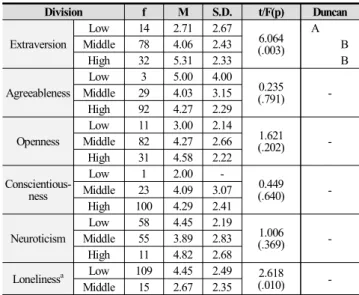
Among shared spaces responding that they can share with others when living in communal shared housing, shared space with the highest degree was selected. A total of 9 shared spaces was classified into 5 types 7) depending on each characteristics, and to compare the personal trait of the highest receptivity by shared space, F- verification was conducted. In this case, only if statistically significant results come out, the difference between

7) Shared Entering Space(Shared Entrance), Shared Resting Space(Shared Living Room), Shared Hobby Space(Shared Veranda/Balcony, Shared Working Room), Shared Sanitary Space(Shared Kitchen and Dining Room, Shared Laundry Room/Utility Room, Shared Toilet, Shared Bathroom/Shower Room), Shared Storage Space(Shared Storage)

groups was analyzed using Duncan's multiple range test <Table 13>.

Division f M S.D. F(p) Duncan

Extraversion

Shared Entering Space 35 3.14 3.14 1.073

(.374) -

Shared Resting Space 36 3.17 3.17 Shared Hobby Space 22 3.33 3.33 Shared Sanitary Space 7 3.55 3.55 Shared Storage Space 11 3.27 3.27

Agreeableness

Shared Entering Space 35 3.69 3.69 1.835

(.127) -

Shared Resting Space 36 4.05 4.05 Shared Hobby Space 22 4.07 4.07 Shared Sanitary Space 7 3.98 3.98 Shared Storage Space 11 3.98 3.98

Openness

Shared Entering Space 35 3.06 3.06 0.550

(.700) -

Shared Resting Space 36 3.18 3.18 Shared Hobby Space 22 3.10 3.10 Shared Sanitary Space 7 3.39 3.39 Shared Storage Space 11 3.10 3.10

Conscientious- ness

Shared Entering Space 35 3.67 3.67 3.843 (.006)

A Shared Resting Space 36 4.08 4.08 A B

Shared Hobby Space 22 4.16 4.16 B

Shared Sanitary Space 7 4.19 4.19 B Shared Storage Space 11 3.94 3.94 A B

Neuroticism

Shared Entering Space 35 2.83 2.83 4.624 (.002)

B Shared Resting Space 36 2.22 2.22 A

Shared Hobby Space 22 2.57 2.57 A B Shared Sanitary Space 7 2.41 2.41 A B Shared Storage Space 11 2.64 2.64 A B

Loneliness

Shared Entering Space 35 1.96 1.96 2.797

(.030) -

Shared Resting Space 36 1.58 1.58 Shared Hobby Space 22 1.72 1.72 Shared Sanitary Space 7 1.57 1.57 Shared Storage Space 11 1.74 1.74

Table 13. Top Rank of Acceptable Shared Space depending on Personal Traits

As the result, conscientiousness and neuroticism of personal traits of the elderly in the side of trait showed clear difference from receptivity to sharing living space.

In case of conscientiousness, as the receptivity to shared hobby space and shared sanitary space was the highest, conscientiousness was low at 3 point, and in the group of the highest receptivity to shared resting space, shared hobby space and shared sanitary space, conscientiousness was relatively high at 4 point. As the result of Duncan's multiple range test for it, the group of the highest receptivity to shared hobby space and shared sanitary space appeared very high in conscientiousness, compared to the group of the highest receptivity to shared entry space, so it showed clear difference between the two groups.

In case of neuroticism, it was very low overall at 2 point,

regardless of the type of shared space. As the result of Duncan's

multiple range test for it, the group of the highest receptivity to

shared entering space appeared very high in neuroticism, compared

to the group of the highest receptivity to shared resting space, so

수치

Table  5.  Residential  Environmental  Characteristics
Table  8.  Whether  being  Willing  to  Live  in  Communal  Shared  Housing
Table  11.  Type  of  Acceptable  Shared  Space  depending  on  Personal  Traits
Table  12.  Degree  of  Receptivity  to  Sharing  Living  Space  in  Communal  Shared  Housing  depending  on  Personal  Traits
+2

참조

관련 문서

In this group of high-risk patients with severe COVID-19 pneumonia, treatment with lenzilumab was associated with a significantly shorter time to clinical improvement compared

Four circular bone defects with a diameter of 8mm were formed on each of the calvaria of rabbits. Each defect in the calvarium was allocated to 1) control group,.. 2)

The Effect of Shared Leadership on Voice and Knowledge Sharing Behavior: Creative Self-Efficacy and Change.. Self-Efficacy

Puspose: Puspose: Puspose: Puspose: This study is to identify relations between activity of daily living, social support and loneliness of facilities for

Sixth, the analysis of differences in living satisfaction according to the frequency of exercise of participants through living sports showed that there

Interest in sustainability and improving the quality of living has brought changes in the measurement and judgement for the quality of living.

à Transactions scanning the relation acquire a shared lock in the data item. à Transactions scanning the relation acquire a shared lock in

However syn elimination does occur in rigid molecules when the living group and the hydrogen are held in an when the living group and the hydrogen are held in an