만성적 저용량 아스피린 사용의 잠재적 간독성 평가
이옥상·정선회·이혜숙*·고명숙**·이창호***·김상건****·임성실*****,#
충북대학교 약학대학, *서울대학교병원 약제부, **한양대학교 약학대학, ***한양대학교 의과대학
****서울대학교 약학대학, *****가톨릭대학교 약학대학
(Received August 20, 2013; Revised October 26, 2013; Accepted October 30, 2013)
Assessment of Potential Hepatotoxicity of Low Dose Aspirin in Chronic Use
Ok Sang Lee, Sun Hoi Jung, Hye-Suk Lee*, Myong-Suk Ko**, Chang Ho Lee***, Sang Geon Kim**** and Sung Cil Lim*****,#
College of Pharmacy, Chungbuk National University, Cheongju 361-763, Korea
*Department of Pharmacy, Seoul National University Hospital, Seoul 110-744, Korea
**College of Pharmacy, Hanyang University, Ansan 426-791, Korea
***College of Medicine, Hanyang University, Seoul 133-791, Korea
****College of Pharmacy, Seoul National University, Seoul 151-742, Korea
*****College of Pharmacy, The Catholic University of Korea, Bucheon 420-743, Korea
Abstract — Aspirin is widely used for treatment or prophylaxis of many diseases. Although aspirin is used chronically for preventing cardiovascular diseases especially, liver function is rarely monitored because of unpredictable and uncommon hepatotoxicity induced by aspirin. We evaluated changes in liver function indicators and compared to acetaminophen and NSAIDs. We retrospectively analyzed EMR data (n=28788) of patients who took study drugs and had liver function tests (LFT) during study period from 2009.7.1 to 2010.6.30 at a tertiary hospital and evaluated the above information. Patients not having LFT results at these three standard points of time (baseline, during medication, and after finishing medication) were excluded. During medication, mean changes of Alanine transaminase (ALT), Aspartate transaminase (AST), Total Bilirubin (TB) were increased and that of serum albumin (Alb) was decreased, with the largest effect from aspirin (n=461;
16.8, 14.9, 0.28, -0.24) and the smallest from celecoxib (n=127; 3.4, 5.2, 0.11, -0.16). In addition, aspirin caused more changes of blood liver function indicators in patient group with liver disease (n=128, 27.4, 26.9, 0.53, -0.3) than those in patient group without liver disease (n=357, 12.5, 13.1, 0.23, -0.24). Taking low dose aspirin for prophylaxis purpose with long-term medication may be associated with liver injury. Our study is just a signal regarding the possibility of hepatotoxicity among patients taking low dose aspirin in a hospital setting, and thus it needs to be further investigated.
Keywords □ NSAIDs, aspirin, hepatotoxicity, ADR, chronic disease, EMR database
Today, aspirin (acetyl salicylic acid) is commonly used for treatment or prophylaxis of many diseases. According to recent reports, approximately 50 million people, take low-dose aspirin regularly for preventing cardiovascular diseases.1,2) Original aspirin is used for analgesic, antipyretic and anti-inflammatory.
However, low-dose aspirin is also used widely for cardiovascu- lar disease (CVD) protection. The mechanism of action is that aspirin inhibits cyclooxygenase (COX), which is the rate-limit-
ing enzyme blocking converting arachidonic acid to prostaglan- din and thromboxanes.3) In addition, low-dose aspirin use irreversibly blocks the formation of thromboxane A2 in plate- lets, producing an inhibitory effect on platelet aggregation.
This antiplatelet property makes aspirin useful for reducing the risk of heart attacks.4) However, aspirin has both pharmacolog- ical action and adverse drug reactions, like all of drugs, because aspirin controls prostaglandins and thromboxanes which are located in most tissues and organs as different types of prostaglandins-PGI2, PGE2, PGF2. They are mediators and have strong physiological effects such as bronchodilation or bronchoconstriction, inhibiting platelet aggregation, pyrogenic,
#본 논문에 관한 문의는 저자에게로 (전화) 02-2164-6595 (팩스) 02-2164-4059 (E-mail) [email protected]
종설
decreasing gastric acid secretion and increasing gastric mucus secretion.5) Adverse drug reactions include gastrointestinal ulceration (6~31%) and bleeding, edema, hyperkalemia, ane- mia, tinnitus, renal failure, asthma, water and sodium reten- tion, disturbance of platelet function and hypersensitivity as well as therapeutic effects.6,7)
Many problems are associated with taking low-dose aspirin daily, even for long term. The most studied risks are gas- trointestinal intolerance, bleeding and hemorrhagic stroke.1) In addition, use of daily low-dose aspirin is associated with hyper- sensitivity reaction and hemostatic defects, decreased urinary excretion of creatinin and uric acid, ringing in the ears, hear- ing loss, allergic reactions, vomiting, diarrhea, vertigo, and hal- lucinations.8) Aspirin-induced hepatotoxicity is dose-related and associated with its metabolite, salicylic acid. The clinical presentation of liver toxicity is increased transaminase levels correlating with serum salicylate levels (>25 mg/100 ml).6) Likewise, although aspirin-induced hepatotoxicity is dose- dependent and presented as warning on label, it tends to be ignored for many people because of its low incidence and reversibility. Hence hepatotoxicity of low dose aspirin has been less investigated. However, in spite of low dose, chronic use of aspirin with purpose of prophylaxis for cardiovascular disease may damage liver due to its long duration of use.
Therefore, we investigated its risk of hepatotoxicity com- pared to general use of NSAIDs because of their pharmaco-
logical similarity.
Our study drugs include aspirin, acetaminophen and NSAIDs. We collected information from Electronic Medical Records (EMR) database in a tertiary hospital setting where there are many chronic and severe patients. EMR database is used for clinical research to evaluate objective data such as lab results.9) We investigated the transition of liver function indica- tors along taking medicine (aspirin, acetaminophen, non-selec- tive COX inhibitors, selective COX inhibitors) to examine the effect on liver injury induced by them. Therefore, we aim to realize effective and safe pharmacotherapy by evaluating the changes of liver function parameters based on a medication schedule in a tertiary hospital setting where there are several confounding factors such as underlying disease and age.
Method
This study was a retrospective analysis of EMR data col- lected from the Seoul National University Hospital (SNUH) in Korea from July 1 2009 through June 302010. Institutional Review Board approval was obtained (IRB#H-1012-046-644).
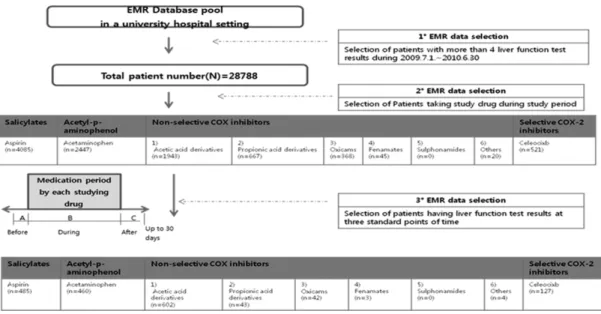
SNUH is a tertiary hospital, which has a 1650-bed medical center in Korea. The process of extracting information from EMR database base to evaluate the hepatotoxicity by studying drugs was following (Fig. 1). Because the evaluation of liver function tests (LFTs) is usually based on ALT, AST, TB and
Fig. 1− Method of Selection from EMR database.
A: Time points for "Before starting medication". B: Time points for "During medication"- Maximum (TB, ALT, AST) or Minimum (Alb) results among several results. C: Time points for "After finishing each medication up to 30 days".
Alb, we selected patients taking drugs (aspirin, acetami- nophen, selective/non-selective NSAID) among those who measured 4 LFT results (ALT, AST, TB, Alb) during study period from total EMR database pool. We excluded patients not having LFT results (more than three times during study period) to review the change of them. The database used in this study included information on unidentifiable codes repre- senting patient, patient’s age and disease code, 4 LFT results, dates of the laboratory test measurement, and drug prescrip- tion(generic/brand name, prescription date and duration). LFT indicators used and normal limits are TB (≤1.2 mg/dl), ALT (≤40 IU), AST (≤40 IU), Alb (≥3.3 g/dl) referred by SNUH ref- erence range.
We analyzed patients’ number, age and underlying diseases per each drug. We also analyzed dose and duration of our study drugs. Doses were based on general dose for indica- tions in SNUH and duration is the period from date of starting taking medication to date of finishing medication.
According to our study design, we analyzed LFT results at three standard times of points (before, during and after medi- cation) (Fig. 1). Baseline result (A) is result just before start- ing of taking drugs. Among results during medication, (B) is maximum (TB, ALT, AST)/minimum (Alb) during period of taking drugs. Results (C) after finishing medication are mini- mum (TB, ALT, AST)/maximum (alb) results up to 30 days after finishing of taking drugs. In addition, our criteria of evalu- ating LFT were ALT (Normal; 0~40 IU/l, Abnormal; >40 IU/l, Severe abnormal: ≥120 IU/l), AST (Normal; 0~40 IU/l, Abnor-
mal; >40 IU/l, Severe abnormal: ≥120 IU/l), TB (Normal: 0.2~
1.2 mg/dl, Abnormal: >1.2 mg/dl, Severe abnormal: ≥2.4 mg/
dl), Alb (Normal: ≥3.3 g/dl, Abnormal: <3.3 g/dl, Severe abnor- mal: <2 g/dl) according to The FDA.10) The FDA have adopted guidelines that ALT and AST of more than three times the upper limit of normal and a TB of more than twice the upper limit be used to define significant abnormalities on liver tests.
Also, severe hypoalbuminemia is less than 2 g/l. We calculated the distribution of patients % and the average (±standard devi- ation) of each change degree at the time point of worst LFT during medication (B). We also analyzed Damage degree ((B)- (A)) and Recovery degree ((B)-(C)) to assess the transition of liver function indicators.
We also compared between underlying liver disease group and non-liver disease group to investigate susceptibility of hepato- toxicity. Average differences were obtained by paired t-test. Null hypotheses of no difference were rejected if p-values were less than .05. Data was analyzed by SPSS (Ver. 12.0) (SPSS V12.0K, SPSS Inc., Chicago, Illinois, USA) and Microsoft Excel (Ver. 2007).
Results
EMR database (N=28788) was used for this study to over- come difficulties induced by confounding factors such as age, disease, other organ dysfunction in clinical settings and ana- lyze systemically. NSAIDs evaluated in this study were 8 groups (17 drugs) from the formulary commonly prescribed in this hospital. We broadly classified 17 drugs to 4 or 5 groups
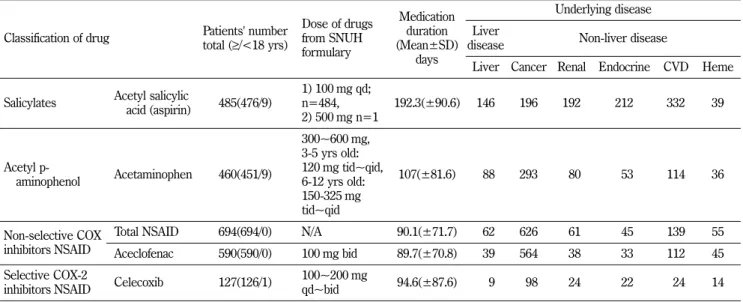
Table I− Patients’ characteristics
Classification of drug Patients' number total (≥/<18 yrs)
Dose of drugs from SNUH formulary
Medication duration (Mean±SD)
days
Underlying disease Liver
disease Non-liver disease
Liver Cancer Renal Endocrine CVD Heme
Salicylates Acetyl salicylic
acid (aspirin) 485(476/9)
1) 100 mg qd;
n=484, 2) 500 mg n=1
192.3(±90.6) 146 196 192 212 332 39
Acetyl p-
aminophenol Acetaminophen 460(451/9)
300~600 mg, 3-5 yrs old:
120 mg tid~qid, 6-12 yrs old:
150-325 mg tid~qid
107(±81.6) 088 293 080 053 114 36
Non-selective COX inhibitors NSAID
Total NSAID 694(694/0) N/A 90.1(±71.7) 062 626 061 045 139 55
Aceclofenac 590(590/0) 100 mg bid 89.7(±70.8) 039 564 038 033 112 45 Selective COX-2
inhibitors NSAID Celecoxib 127(126/1) 100~200 mg
qd~bid 94.6(±87.6) 009 098 024 022 024 14
(aspirin, acetaminophen, non-selective NSAID (aceclofenac), selective COX-2 inhibitors (celecoxib) and compared them.
When we evaluated EMR data, we only evaluated LFT dur- ing medication without consideration of any limitations (con- founding factors) such as age or underlying disease (Table I).
We analyzed aspirin, acetaminophen (APAP), non-selective NSAIDs (14) and selective NSAIDs (1). Among non-selective COX inhibitor NSAIDs, aceclofenac was the most frequent of non-selective NSAIDs. In case of selective COX-2 inhibitor, only celecoxib was available. Among them, aceclofenac of non- selective COX inhibitors were the largest group (n=590), fol- lowed by aspirin (n=485), APAP (n=460). Patients taking cele- coxib, selective COX-2 inhibitor, was 127 (Table I).
98% of patients were above 18 years old. Although we did not limit age, acetic acid derivatives including aceclofenac are contraindicated at less than 16 years of age. Therefore, there were few pediatric patients in our study (Table I).
All diseases were categorized by 6 groups; Liver (17%), non-liver [83%; cancer, cardiovascular disease, renal disease, endocrine disease, hematogenesis disease]. Types of liver dis- ease were acute/chronic viral hepatitis, alcoholic liver disease, liver cirrhosis, liver abscess, non-alcoholic fatty acids, hepatic vein/biliary obstruction and hepatocyte/biliary malignant neo- plasm. Patients have more than 1.8 underlying diseases on the average. In the aspirin taking group, cardiovascular diseases
was the most underlying disease. However, acetaminophen, non-selective COX inhibitor NSAID and selective COX-2 inhib- itor taking group were highest in cancer disease (Table I).
Aspirin for analgesics was 500 mg (n=1) and for prophy- laxis was 100 mg (n=484). APAP for analgesics, antipyretics was 300~600 mg three~four times per day (n=460). Non- selective NSAIDs were also indicated for analgesic/anti-inflam- matory doses (n=694) and aceclofenac of them was 100 mg twice per day (n=590). Selective NSAIDs, celecoxib, for anal- gesic/anti-inflammatory doses was 100~200 mg once~twice per day (n=127). Average duration of total medication was 124.1 days. During the study period, the longest duration is 358 days for aspirin 100mg daily and the shortest duration is 3 days for APAP (Table I).
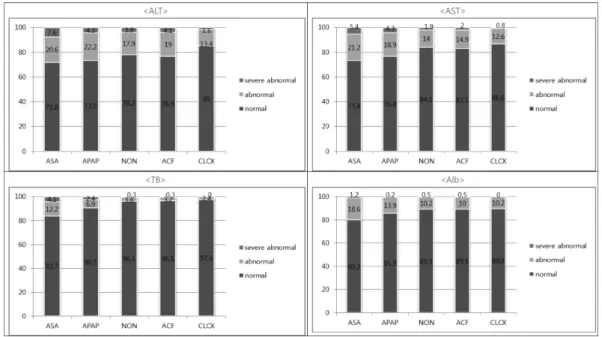
Distribution of patients % at the point of worst LFT during medication (B)
We analyzed the proportion of patients based on LFT results at the point of worst LFT during medication (B) which was abnormal during the medication according to our criteria of evaluating LFT; normal, abnormal, severe abnormal. Aspirin showed the worst profiles in these abnormal and severe abnor- mal results (ALT (28.2/7.6%), AST (26.8/5.4%), TB (16.3/
4.1%), Alb (19.8/1.2%)). APAP, non-selective NSAID including aceclofeanc, celecoxib followed in order.
Fig. 2− Distribution of Patients % at the point of worst LFT during medication (B) (X: each medication, Y: Frequencies (%)).
ALT; Alanine Transaminase, AST; Aspartate Transaminase, TB; Total Bilirubin, Alb; Serum Albumin, ASA; aspirin (N=485), APAP;
acetaminophen (N=461), NON; non-selective COX inhibitors (N=694), ACF; aceclofenac (N=590), CLCX; celecoxib (N=127).
Average LFT values at the point of worst LFT during medication (B)
All drugs caused hepatotoxicity. Aspirin was worst in hepato- toxicity (ALT (46.3 IU/l), AST (42.0 IU/l), TB (1.02 IU/l), Alb (3.7 IU/l)) and followed by APAP, non-selective NSAIDs includ-
Fig. 4− Damage degree (B-A) of LFT in total, Liver, Non-liver disease.
Dz: diseases, ALT; Alanine Transaminase, AST; Aspartate Transaminase, TB; Total Bilirubin, Alb; Serum Albumin, APAP; acetaminophen (N=461), ASA; aspirin (N=485), NON; non-selective COX inhibitors (N=694), ACF; aceclofenac (N=590), CLCX; celecoxib (N=127).
Fig. 3− Average LFT values at the points of worst LFT during medication (B).
Mean (±SD), ALT; Alanine Transaminase, AST; Aspartate Transaminase, TB; Total Bilirubin, Alb; Serum Albumin, APAP;
acetaminophen (N=461), ASA; aspirin (N=485), NON; non-selective COX inhibitors (N=694), ACF; aceclofenac (N=590), CLCX;
celecoxib (N=127), *: p<0.05.
ing aceclofenac, selective COX-2 inhibitors (celecoxib) in order.
Damage degree (B-A) of LFT in total, Liver, Non-liver disease
Regardless underlying liver disease, in aspirin, the damage
degree of ALT, AST and TB were highest. But, in alb, non- selective NSAIDs including aceclofenac were lowest. Cele- coxib has smallest change degree in all indicators except TB.
In liver disease, in case of aspirin, the damage degree of ALT, AST and TB were highest in liver underlying disease group except Alb. In alb, but, non-selective NSAIDs including ace- clofenac were lowest damage degree same as total group. In non-liver disease, in case of aspirin, TB was highest in non liver underlying disease group. In the damage degree of LFT, ALT and AST were highest in APAP. In alb, non-selective NSAIDs including aceclofenac were lowest damage degree same as total group.
Recovery degree (B-C) of LFT in total, Liver, Non- liver disease
Regardless of underlying disease, in case of aspirin, the recovery degree of ALT, AST and alb were highest in total group. But APAP was highest in TB. The recovery degree of celecoxib was smallest in all indicators. In liver disease, in case of aspirin, the recovery degree of ALT and AST were highest in liver disease group. In TB, APAP was highest but ace- clofenac was highest in Alb. The recovery degree of celecoxib was smallest in ALT, AST and Alb. In TB, non-selective COX inhibitors were smallest. In non-liver disease, in case of aspi-
rin, the recovery of Alb was highest in non-liver disease group.
The recovery degree of ALT, AST and TB were highest in APAP. The recovery degree of celecoxib was smallest in all LFT parameters.
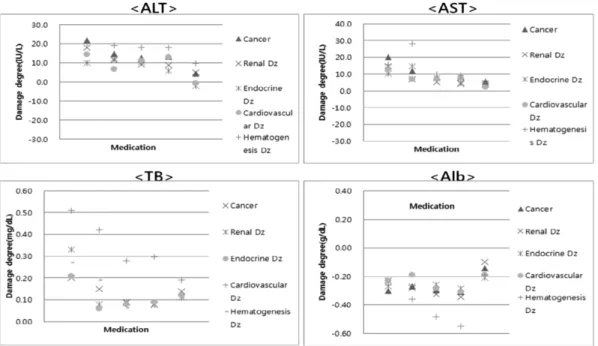
Damage degree (B-A) of LFT among non-liver dis- ease; Cancer, Renal, Endocrinology, Cardiovascular, Hematogenesis diseases
Aspirin showed highest damage degree of ALT in non-liver disease groups except endocrine disease. In endocrinology dis- ease, APAP was highest. Aspirin showed highest damage degree of AST in the non-liver disease group except endo- crine and hematogenesis disease. In endocrinology and hematogenesis disease, APAP was highest. Aspirin showed highest damage degree of TB in the non-liver disease group.Aspirin showed various damage degree of Alb depend- ing on each non-liver disease group. Aceclofenac showed high- est damage degree of Alb in all non-liver disease.
Recovery degree (B-C) of LFT among non liver dis- eases; Cancer, Renal disease, Endocrine disease, Cardio- vascular disease,Hematogenesis disease
Aspirin showed highest damage degree of ALT in the non- liver disease group except hematogenesis disease. In hemato-
Fig. 5− Damage degree (B-A) of LFT by each liver disease group.
Dz: diseases, ALT; Alanine Transaminase, AST; Aspartate Transaminase, TB; Total Bilirubin, Alb; Serum Albumin, APAP;
acetaminophen (N=461), ASA; aspirin (N=485), NON; non-selective COX inhibitors (N=694), ACF; aceclofenac (N=590), CLCX;
celecoxib (N=127).
genesis disease, APAP was highest. Aspirin showed highest damage degree of AST with all non-liver disease groups except endocrine and hematogenesis disease. In endocrinology and hematogenesis disease, APAP was highest. In TB and Alb, recovery degree of LFT was various results depending on
drug. Aspirin showed highest damage degree of TB in endocri- nology and cardiovascular disease. In cancer, renal and hemato- genesisdisease, APAP was highest. Aspirin showed highest damage degree of Alb in the non-liver disease group except endocrine and hematogenesis disease APAP was highest in Fig. 7− Recovery degree (B-C) of LFT by each Non liver disease group.
Dz: diseases, ALT; Alanine Transaminase, AST; Aspartate Transaminase, TB; Total Bilirubin, Alb; Serum Albumin, APAP;
acetaminophen (N=461), ASA; aspirin (N=485), NON; non-selective COX inhibitors (N=694), ACF; aceclofenac (N=590), CLCX;
celecoxib (N=127).
Fig. 6− Recovery degree (B-C) of LFT in total, Liver, Non-liver disease.
Dz: diseases, ALT; Alanine Transaminase, AST; Aspartate Transaminase, TB; Total Bilirubin, Alb; Serum Albumin, APAP;
acetaminophen (N=461), ASA; aspirin (N=485), NON; non-selective COX inhibitors (N=694), ACF; aceclofenac (N=590), CLCX;
celecoxib (N=127).
endocrine disease and aceclofenac was highest in hematogene- sis disease. The degree of damage (B-A) aspirin is highest except TB, but approximately returned to baseline levels. In APAP, all indicators returned to baseline levels after finishing medication. Because APAP-induced hepatotoxicity is dose- dependent, it can recover after finishing medication. Ace- clofenac is opposite to aspirin in that no indicators except TB returned to baseline levels.
Discussion
Aspirin has been widely used with inattentive liver monitor- ing but long-term use in chronic patients can cause liver injury.
Therefore, we investigated LFT results with aspirin medica- tion from EMR database in tertiary hospital setting. In our study, the indicators of hepatotoxicity evaluated were ALT, AST, TB, Alb. The transition of LFT indicators was that ALT, AST, TB was generally elevated and Alb were decreased after starting medication and they were recovered after cessation of treatment. ALT and AST are used to assess hepatocellular injury. Because the half-lives of ALT and AST are respectively 47 hours and 17 hours and they are both very sensitive and may be elevated even with minor levels of hepatocyte dam- age, it is related to active and acute hepatocyte damage.11,12) ALT is more localized to the liver but AST is not solely located in hepatocytes but in cardiac muscle, skeletal muscle, kidneys, brain, lungs, intestines, erythrocytes11,12) TB is used as markers of biliary function and cholestasis and is sum of direct bilirubin (water-soluble, conjugation to glucuronic acid) and indirect bilirubin (water-insoluble, unconjugated biliru- bin).11,12) Elevated bilirubin may be related to cholestatic liver disease.11,12) In acute liver disease, bilirubin is usually increased in relation to the severity of the acute disease. In chronic liver disease, bilirubin is usually normal until a signifi- cant amount of liver damage has occurred and cirrhosis is present. Serum albumin reflects liver synthetic function and serum albumin levels are often normal in acute viral hepatitis or drug-related hepatotoxicity because of albumin’s long half- life (20 days).11,12) Alternatively, albumin is commonly reduced in patients with chronic protein synthetic dysfunction due to cirrhosis.11,12)
In drug-induced acute cholestatic and mixed lesions are less severe in the short-term outcome than the hepatocellular type, but the resolution of cholestatic and mixed lesions are gener-
ally slower, with a higher likelihood towards chronicity.13-20) In our study, over 4000 (14.2%) patients were taking aspirin among 28788 from the EMR database and only 485 patients of them had at least three LFT results at baseline(A), during(B), and after medication(C) within study period. In addition, their average medication duration was 192.3 days. It means that aspirin was commonly and chronically used, thus misuse and risk regarding aspirin should be evaluated. 99.8% patients took low-dose aspirin for prophylaxis of cardiovascular disease.
When analyzing the distribution of underlying diseases in aspirin taking group, cardiovascular disease (68.5%) including hypertension and endocrinology disease (43.7%) including dia- betes, which is associated with cardiovascular risk were more frequent. In our study, aspirin had the worst profile in hepato- toxicity comparing to other studying drugs and its risk was even more severe than APAP which is known as hepatotoxicity.
According to a review article comparing reported risk of hepatotoxicity from non-narcotic analgesics, aspirin was 6.9%, lower than APAP (45.7%).21-24) However, in our study, abnor- mal/severe abnormal proportions of aspirin were larger and their average worst LFT results during medication was also higher than those of APAP.
Aspirin also had largest damage degree during medication, which was more severe in the presence of underlying liver dis- ease. In addition, organ dysfunction disease such as cancer and renal disease was more susceptible with the hepatotoxicity of aspirin. According to each non-liver diseases, aspirin showed highest damage degree of ALT in the non-liver disease group except endocrine disease. Aspirin showed highest damage degree of AST in the non-liver disease group except endo- crine and hematogenesis disease. In endocrinology and hematogenesis disease, APAP was highest. Aspirin showed highest damage degree of TB in the non-liver disease group.
Aspirin showed various damage degree of Alb depending on each non-liver disease group. But it tended to recover after medication because it was reported that aspirin-inducedhepato- toxicity was dose-dependent and resolved shortly after discon- tinuation.25-27) Without considering underlying disease, aspirin had the highest recovery degree of ALT, AST and alb.In liver disease, aspirin (30.1%) had the highest recovery degree of ALT and AST. In nonliver disease, aspirin (69.9%) had the highest recovery of Alb. According to each non-liver diseases, aspirin showed highest damage degree of ALT in the non-liver disease group except hematogenesis disease. Aspirin showed
highest damage degree of AST in the non-liverdisease group except endocrine and hematogenesis disease. Aspirin showed highest damage degree of TB in endocrinology and cardiovas- cular disease. In cancer, renal and hematogenesis disease, APAP was highest. Aspirin showed highest damage degree of Alb inthe non-liver disease group except endocrine and hematogenesis disease APAP was highest inendocrine disease and aceclofenac was highest in hematogenesis disease. How- ever, it is important that low-dose aspirin is used with pur- pose of prevention cardiovascular disease by continuous medication and thus it requires regular LFT check-up.
APAP-induced hepatotoxicity was known to be caused by over-dose. Metabolism to N-acetyl-p-benzoquinone imine (NAPQI) by cytochrome P450 enzymes was necessary for APAP-induced hepatotoxicity correlating with depletion of glu- tathione (GSH).28,29) Liver injury with therapeutic APAP dos- ing may occur but few reports contain sufficient data to support the probable causal relationship.28,29) Although APAP is well-known as its hepatotoxicity, APAP was not the worst pro- file in hepatotoxicity in our study. In results of abnormal pro- portion and average LFT values at the points of worst LFT during medication, APAP was lower than aspirin. In addition, liver damage degree without underlying liver disease group was more severe than one of group with underlying liver dis- ease. The reason is supposed that it is more carefully used in group with liver disease group. It is important that damage degree in liver disease group was lower than that in non- liver disease group in spite of APAP possible hepatotoxicity.
That is, it showed the significance of monitoring during medi- cation.
In our study, non-selective NSAIDs included acetic acid derivatives (aceclofenac, diclofenac, etodolac, ketorolac), propi- onic acid derivatives (dexibuprofen, fenoprofen, ibuprofen, ketoprofen, naproxen, zaltoprofen), oxicams (meloxicam, piroxi- cam), morniflumate, nabumetone, which were classified by their chemical structure. According to review article comparing incidence of hepatotoxicity between non-analgesics, NSAIDs were various; diclofenac (19.5%), ibuprofen (8.4%), sulindac (7.1%), aspirin (6.9%), naproxen (6.4%), piroxicam (5.4%), nimesulide (3.3%). Other NSAIDs were only 0.1%.21-24)
In our study, patients taking non-selective NSAIDs with at least three LFT results at baseline, during and after finishing medication were 694 and 590 (85%) of them were taking ace- clofenac, so results between non-selective NSAIDs and ace-
clofenac were same patterns. Aceclofenac is progressively hydrolyzed to diclofenac in the circulation. Therefore, ace- clofenac is largely associated with diclofenac-induced hepato- toxicity. In a review report which presented hepatotoxicity incidence rate of NSAIDs, diclofenac (19.5%) had relatively higher incidence. In our study, aceclofenac showed great change degree, especially in serum albumin.
Among propionic acid derivatives, ibuprofen and naproxen were known to be safe and low liver toxicity risk, but benox- aprofen was withdrawn from the market due to hepatotoxicity.
Fenoprofen was thought to cause mild hepatotoxicity in a patient who also had had a cross-hepatotoxic reaction with naproxen.21-24) There were few reports in hepatotoxicity of zal- toprofen or dexibuprofen. 21-24)
The mechanism of oxicams-induced hepatotoxicity appears to be idiosyncratic and dose independent.21-24) In a review report, incidence rate of hepatotoxicity among NSAIDS, meloxicam was less than 0.1% and piroxicam was 5.4%. Niflu- mic acid, metabolites of morniflumate, rarely causes liver dam- age, generally as transient and reversible increases in ALT, AST, TB, and alkaline phosphate but as fatal acute hepatitis in one case.30-36)
Celecoxib is a specific inhibitor of COX-2, being 375-fold selective for COX-2 based on human recombinant enzyme assays. Celecoxib has a low potential for liver injury. In a review of 14 controlled trials, the frequency of hepatic dysfunc- tion (0.8%) was not significantly different from that in placebo- treated patients (0.8%), and they appeared to be lower than that observed with other NSAIDs.17,26,37-40) In our study, cele- coxib had the least risk of hepatotoxicity comparing to other studying drugs. In our study, the damage degree (B-A) of cele- coxib were also lowest in ALT, AST and Alb. These scales were also low in liver disease group. Therefore, celecoxib has shown to be a low potential for liver injury. However, the num- ber of patients taking celecoxib is less than other drug, so it needs to be further investigated that it can be useful for anti- inflammatory purpose in liver disease group.
This study was retrospective, using only the EMR database and analyzed the transition of liver function indicators by each medication. We did not identify the damage of the hepatocyte through biopsy.Because we just analyzed the transition of liver function indicators in spite of various confounding factors in a tertiary hospital setting, further investigation regarding predis- posing factors are required.
Conclusion
Aspirin use is widespread and is often indicated for its anti- platelet activity as well as for its analgesic effect chronically.
Incidence, pattern, and mechanism of liver injury by aspirin have been known in some reports but specific change pattern of liver function indicators (TB, ALT, AST and Alb) in lots of patients taking aspirin chronically has been rarely investi- gated. In our study, we analyzed LFT results to evaluate hepa- totoxicity by chronic use of NSAIDs through EMR database (patients’ number=28788) for one year.
The result was that after starting medication, ALT, AST and TB were mostly increased and Alb were decreased, but increased ALT, AST, TB and Alb overall tend to be recovered within 30 days after finishing medication. During medication, changes of ALT, AST, TB and alb were aspirin (16.8, 14.9, 0.28, -0.24), APAP (11.7, 9.6, 0.17, -0.24), non-selective COX inhibi- tors (12.5, 7.9, 0.07, -0.30), and celecoxib (3.4, 5.2, 0.11, -0.16).
Proportions of clinically meaningful elevations in ALT were aspirin (7.6%), APAP (4.3%), non-selective COX inhibitors (4.3%), celecoxib (1.6%). With liver disease, aspirin damaged more on liver comparing to group without liver disease in aspect of changes in ALT (27.4, 12.5), AST (26.9, 13.1), TB (0.53, 0.23), and Alb (-0.30, -0.24). In our study, it was demon- strated that taking 100 mg aspirin daily for prophylaxis pur- pose may cause negative effect on liver combined with long- term medication. In the patient group taking aspirin, change degree of liver function indicators during medication were greater. In addition, proportions of abnormal results were higher. Therefore, low-dose aspirin needs to be used cau- tiously with regular liver function monitoring.
Acknowledgement
“This study was supported by the Research Fund, 2013 of The Catholic University of Korea.”
References
1) Campbell, C. L., Smyth, S., Montalescot, G. and Steinhubl, S. R. : Aspirin dose for the prevention of cardiovascular disease. JAMA 297, 2018 (2007).
2) Bartolucci, A. A., Tendera, M. and Howard, G. : Meta-analysis of multiple primary prevention trials of cardiovascular events
using aspirin. Am. J. Cardiol. 107, 1796 (2011).
3) Vane, J. R. and Botting, R. M. : Mechanism of action of nonsteroidal anti-inflammatory drugs. The American Journal of Medicine 104, 2S (1998).
4) Imaeda, A. B., Watanabe, A., Sohail, M. A., Mahmood, S., Mohamadnejad, M., Sutterwala, F. S., Flavell, R. A. and Mehal, W. Z. : Acetaminophen-induced hepatotoxicity in mice is dependent on Tlr9 and the Nalp3 inflammasome. J. Clin.
Invest. 119, 305 (2009).
5) Glaser, K. B. : Cyclooxygenase selectivity and NSAIDs:
cyclooxygeanse-2 selectivity of etodolac. Inflamopharmacology 3, 335 (1995).
6) Teoh, N. C. and Farrell, G. C. : Hepatotoxicity associated with non-steroidal anti-inflammtory drugs. Clin Liver Dis. 7, 401 (2003).
7) Vane, J. R. and Botting, R. M. : Mechanism of action of anti- inflammatory drugs. Scand J. Rheumatology 102, 9 (1996).
8) Charles, F. L., Lora, L. A., Morton, P. G. and Leonard, L. L. : Drug information handbook. 19th ed. Ohio: Lexi-CompInc.
(2010).
9) Marmura, M. J., Hopkins, M., Andrel, J., Young, W. B., Biondi, D. M., Rupnow, M. F. and Armstrong, R. B. : Electronic medical records as a research tool: Evaluating topiramate use at a headache center. Headache 50, 769 (2010).
10) Elizabeth, H. H. : Elevated liver function tests in type 2 diabetes. Clinical Diabetes 23, 115 (2005).
11) Koda-kimble, M. A., Young, L. Y., Alldredge, B. K., Corelli, R. B., Guglielmo, B. J., Kradjan, W. A. and Williams, B. R. : Applied therapeutics-The clinical use of drugs (9th Ed). Baltimore, Philadelphia: Lippincott Williams&Wilkins (2009).
12) Mary, L. : Basic skills in interpreting laboratory test, 4th ed.
(2009).
13) Banichou, C., Dana, G. and Flahault, A. : Causality assessment of adverse reactions to drug-II. An original model for validation of drug causality assessment methods: case reports with positiverechallenge. J. Clin. Epidemol. 4, 1331 (1993).
14) Dana, G. and Benichou, C. : Causality assessment of adverse reactions to drugs- I.A novel method based on the conclusions of international consensus meetings:application to drug- induced liver injuries. J. Clin. Epidemol. 46, 1323 (1993).
15) Liss, G., Rattan, S. and Lewis, J. H. : Predicting and preventing actue drug-induced liver injury; what's new in 2010? Expert.
Opin. Drug Metab. Toxicol. 6, 1047 (2010).
16) Stine, J. G. and Lewis, J. H. : Drug-induced liver injury: a summary of recent advances. Expert. Opin. Drug Metab.
Toxicol. 7, 875 (2011).
17) Nachimuthu, S., Volfinzon, L. and Gopal, L. : Acute hepatocellular and cholestatic injury in a patient taking celecoxib. Postgrad Med. J. 7, 548 (2001).
18) Watkins, P. B. : Biomarkers for the diagnosis and management of drug-induced liver injury. Semin Liver Dis. 24, 393 (2009).
19) Treeprasertsuk, S., Huntrakul, J., Ridtitid, W., Kullavanijata, P.
and Bjornsson, E. : The predictors of complications in patients with drug-induced liver injury caused by antimicrobial agents.
Alimentary Pharmacol. Ther. 31, 1200 (2010).
20) Zimmerman, H. J. : The spectrum of hepatootxicity.
PerspectBiol. Med. 12, 135 (1968).
21) O'Connor, N., Dargan, P. I. and Jones, A. L. : Hepatocellular damage from non-steroidal anti-inflammatory drugs. QJM 96, 787 (2003).
22) Bessone, F. : Non-steroidal anti-inflammatory drugs: what is the actual risk of liver damage. WJG 16, 5651 (2010).
23) Agúndez, J. A., Lucena, M. I., Martínez, C., Andrade, R. J., Blanca, M., Ayuso, P. and García-Martín, E. : Assessment of nonsteroidal anti-inflammatory drug-indcued hepatotoxicity.
Expert. Opin. Drug Metab. Toxicol. 7, 817 (2011).
24) Tolman, K. G. : Hepatotoxicity of Non-Narcotic Anagesics. Am.
J. Med. 105, 13S (1998).
25) Elzouki, A. N. and Lindgren, S. : Granulomatous hepatitis induced by aspirin-kodein analgesics. J. Intern. Med. 239, 279 (1996).
26) Laine, L., White, W. B., Rostom, A. and Hochberg, M. : COX- 2 selective inhibitors in the treatment of osteoarthritis. Semin Arthritis Rheum 38, 165 (2008).
27) Travers, F. L. and Hughes, G. R. : Salicylate hepatotoxicity in systemic lupus erythematosus: a common occurrence? Br.
Med. J. 2, 1532 (1978).
28) Kuffner, E. K., Dart, R. C., Bogdan, G. M., Hill, R. E., Casper, E. and Darton, L. : Effect of maximal daily doses of acetaminophen on the liver of alcohol patients. Arch. Intern.
Med. 161, 2245 (2001).
29) Haviv, Y. S. : Low-dose paracetamol probably associated with hepatic injury in a patients with chronic renal failure. Clin.
Drug. Invest. 19, 389 (2000).
30) Boelsterli, U. A. : Mechanisms of NSAID-induced hepatotoxicity:
focus on nimesulide. Drug. Saf. 25, 633 (2002).
31) Ackerman, Z., Flugelman, M. Y., Wax, Y., Shouval, D. and Levy,
M. : Hepatitis during measles in young adults: possible role of antipyretic drugs? Hepatology 10, 203 (1989).
32) Alam, I., Ferrell, L. D. and Bass, N. M. : Vanishing bile duct syndrome temporally associated with ibuprofen use. Am. J.
Gastroenterol. 91, 1626 (1996).
33) Benson, G. D. : Hepatotoxicity following the therapeutic use of antipyretic analgesics. Am. J. Med. 75, 85 (1983).
34) Goldkind, L. and Laine, L. : A systematic review of NSAIDs withdrawn from the market due to hepatotoxicity: lessons learned from the bromfenac experience. Pharmacoepidemiol.
Drug. Saf. 15, 213 (2006).
35) Prescott, L. F. : Effects of non-narcotic analgesics on the liver.
Drugs 32, 129 (1986).
36) Masubuchi, Y., Saito, H. and Horie, T. : Sturctural Requirements for the Hepatotoxicity of Nonsteroidal Anti- inflammatory Drugs in isolated rat hepatocytes. J. Pharmacol.
Exp. Ther. 287, 208 (1998).
37) Mukherjee, D., Nissen, S. E and Topol, E. J. : Risk of Cardiovascular events associated with selective COX-2 inhibitors. JAMA 286, 954 (2001).
38) Paik, Y. H., Kim, J. K., Lee, J. I., Kang, S. H., Kim, D. Y., An, S. H., Lee, S. J., Lee, D. K., Han, K. H., Chon, C. Y., Lee, S. I., Lee, K. S. and Benner, D. A. : Celecoxib induces hepatic stellate cell apoptosis through inhibition of Akt activation and suppresses hepatic fibrosis in rats. Gut 58, 1517 (2009).
39) Silverstein, F. E., Faich, G., Goldstein, J. L., Simon, L. S., Pincus, T., Whelton, A., Makuch, R., Eisen, G., Agrawal, N. M., Stenson, W. F., Burr, A. M., Kent, J. D., Lefkowith, J. B., Verburg, K. M. and Geis, G. S. : Gastrointestinal toxicity with celecoxibvsnonsteroidal anti-inflammatory drugs for osteoarthritis and rheumatoid arthritis: the CLASS study: A randomized controlled trial. Celecoxib long-term arthritis safety study.
JAMA 284, 1247 (2000).
40) Matsumura, T., Suzuki, T., Aizawa, K., Sawaki, D., Munemasa, Y., Ishida, J. and Nagai, R. : Regulation of transforming growh factor-b-dependent cyclooxygenase-2 expression in fibroblasts.
Journal of Biological Chemistry 284, 35861 (2009).