- 1656 -
비선형 외란 관측기를 이용한 모델 불확실성을 고려한 유도전동기의 회전자 저항 추종
아리프아르살란, 박기광, 이선영, 양해원 한양대
Rotor Resistance Estimation Of Induction Motor With Model uncertainty Using NonLinear Disturbance Observer
Arif Arsalan. Ki Kwang Park, Sun Young Lee, Hai Won Yang Hanyang University
Abstract - This paper presents a new method for estimating rotor resistance of induction motor. The rotor resistance changes dramatically with temperature and frequency. Speed is controlled by PID as it is simplest and most intuitive control method. The change in rotor resistance has a great influence on the performance of IM. In this paper rotor resistance is estimated using Non Linear Disturbance Observer. The model uncertainty and system non linearity are treated as disturbance in this method. Using NDO it does not require an accurate dynamic model to achieve high precision motor control.
Controller with NDO has more superior tracking performance.
Simulation results are presented to show the validity of the proposed controller.
1. INTRODUCTION
Induction motors are widely used for industrial application because of their reliability, low cost and ruggedness to environment as compared to other motors used in same area. They require practically low maintenance .Consequently much attention has been given to induction motor control.
The main objective of this paper is the speed control by using PID controller and rotor resistance estimation using Non-Linear Disturbance Observer. Speed is controlled by PID.
Two strategies have been proposed in [3]. (a) Improvement of rotor speed tracking performance by robust speed control using NDO, and (b) minimization of electric power loss of induction motor by Efficiency Flux Control EFC.
MRAS is a fast converging adaptive technique. Active power and MRAS based rotor resistance identification has been shown [4].
This paper has two objectives. Speed is controlled by using PID controllers. And rotor resistance is estimated using NDO.
2. PROBLEM STATEMENT 2.1 INDUCTION MOTOR MODEL
In case of linear magnetic circuits, the fifth-order dynamic model of induction motor is given as
(1)
in which is rotor speed and are rotor fluxes,and are stator currents, and are stator voltages, is load torque, is the moment of inertia, is the friction coefficient and are stator and winding resistances respectively, is the mutual inductance, is the rotor time constant. Let
, , ,
. , and are uncertain parameters.
The two second order subsystems are given as
(2)
2.2 SPEED CONTROL
we used PID controller for speed control, as it is simplest and most immediate control method.
(3)
where in the equation
make the second and third component zero and increase the value of from zero to a value where we get oscillation. this will be the value of and from that oscillated signal we can get its time period and
∙ (4)
2.3 ADAPTIVE BACKSTEPPING CONTROL
Rotor flux amplitude is controlled through a control input .
∆
(5)
where ∆
is uncertainty, are
unknown parameters, is torque constant in which is nominal value and ∆ is unknown value.
(6)
2.4 NDO design
A new state variable for NDO is designed as
(7) NDO is formulated as
(8) The disturbance observer error is given as
(9) From (7) and (11, we get the equation of disturbance observer as
<Fig. 1> Proposed Control System 2009년도 대한전기학회 하계학술대회 논문집 2009. 7. 14 - 17
- 1657 -
∙ ∙
G (10) For ∙ ,the NDO error will converge to zero. But for
∙ ≠ ,it may not converge to zero.
∗ (11) Where represents the network reconstruction error and ∗ represents the value that minimizes for all .
Using (13),the can be defined as
(12)
∗ The state observer is proposed as
∘ (13) where ∘≻ is state observer gain
The state observer error can be defined as
(14) From (7) and (15),the state observer error can be derived as
∘ (15) 2.5 Design Steps
Speed error : (16) Flux error :
The error dynamics equation:
∙ ∙
(17) ∙
the following Lyapunov function candidate is chosen
∗ ∗ (18) where ∗≐∗≐
The stabilizing function is described as ∙
∙
∙ (19) Putting the values of (14) in ( 13),we get
∙ (20) Current Control
The error signal is defined as
(21) Time derivative of (16) can be given as
∙
(22) where
∙ ∙
∙ ∙
(23)
Now the following Lyapunov function candidate is chosen
(24)
Choosing the control law as
(25)
2.5 SIMULATION
The proposed control algorithm has been simulated for 2.2KW IM.
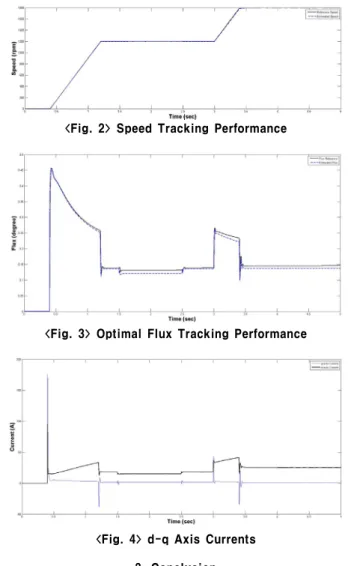
Fig. 2 shows the speed tracking performance It is clear the estimated speed follow the reference speed closely Fig. 3 shows the flux amplitude tracking performance, while the d-q axis currents are shown in Fig. 4.
<Fig. 2> Speed Tracking Performance
<Fig. 3> Optimal Flux Tracking Performance
<Fig. 4> d-q Axis Currents 3. Conclusion
The proposed controller can archive both the flux and speed tracking of IM with uncertainties. Rotor resistance is estimated using NDO. The model uncertainty and system non linearity are treated as disturbances. Simulation results show that controller with nonlinear disturbance observer has more superior tracking performance and this method is effective so the proposed method can be applied in real time vector control of IM motor drive.
[REFERENCES]
[1] Adel Merabet,Mohand Ouhrouche and Rung Tien Bui, "Nonlinear Predictive Control with Disturbance Observer for Induction Motor Drive", IEEE ISIE 2006, July, 2006.
[2] William Phipps, Ibrahim Al-Bahadly, "Sensorless Speed Control in Induction Motor Drives",preceeding of IEEE International workshop on Electronic Design, (DELTA'02) 0-7695-1453-7/02. 2002.
[3] Young Ho Hwang,Ki kwang park, Hai Won Yang, Robust Adaptive Backstepping Control for "Efficiency Optimization of INDUCTION Motors with Uncertainties" ,ISIE, IEEE International Symposium, pp.878-883, 2008.
[4] Hossain Madadi Kojabadi ,"Active Power and MRAS based rotor resistance identification of an IM drive" Simulation Modeling Practice and Theory 17, pp. 376-389, 2009.