Korean J. Mater. Res.
Vol. 25, No. 4 (2015)
191
Hydrogen Production Through Catalytic Dehydrogenation of Decalin over Pt/C Catalyst Using Activated Carbon Aerogel
Gihoon Lee, Ji Yeon Kang, Yeojin Jeong and Ji Chul Jung
†Department of Chemical Engineering, Myongji University, Yongin 449-728, Korea (Received March 17, 2015 : Received in revised form April 2, 2015 : Accepted April 3, 2015)
Abstract
To improve its textural properties as a support for platinum catalyst, carbon aerogel was chemically activated with KOH as a chemical agent. Carbon-supported platinum catalyst was subsequently prepared using the prepared carbon supports(carbon aerogel(CA), activated carbon aerogel(ACA), and commercial activated carbon(AC)) by an incipient wetness impregnation. The prepared carbon-supported platinum catalysts were applied to decalin dehydrogenation for hydrogen production. Both initial hydrogen evolution rate and total hydrogen evolution amount were increased in the order of Pt/CA < Pt/AC < Pt/ACA. This means that the chemical activation process served to improve the catalytic activity of carbon-supported platinum catalyst in this reaction. The high surface area and the well-developed mesoporous structure of activated carbon aerogel obtained from the activation process facilitated the high dispersion of platinum in the Pt/ACA catalyst. Therefore, it is concluded that the enhanced catalytic activity of Pt/ACA catalyst in decalin dehydrogenation was due to the high platinum surface area that originated from the high dispersion of platinum.
Key words
hydrogen production, activated carbon aerogel, decalin, dehydrogenation, platinum catalyst.1. Introduction
Hydrogen storage and delivery have been considered as an important technology for hydrogen energy utilization.
1-3)A number of organic and inorganic materials, including metal hydride, carbon nanostructures, hydrogen-absorbing alloys, and liquid organic hydride, have been widely investigated for hydrogen storage materials.
4)In particular, dehydrogenation-hydrogenation of liquid organic hydride is one of the promising methods to storage and supply hydrogen.
5-6)Because liquid organic hydride provides several advantages due to the high hydrogen contents, the high boiling point, the dehydrogenation-hydrogenation reversible process, and the utilization of the present in- frastructures. Among the various liquid organic hydrides, decalin is a good candidate for hydrogen storage materials because of its high hydrogen content(7.3 wt.%, 64.8 kg- H
2/m
3).
7-8)Thus, development of an efficient catalyst sys- tem for decalin dehydrogenation/naphthalene hydrogenation would be worthwhile.
It is well known that platinum catalysts supported on carbon materials are effective for dehydrogenation of
decalin.
9-10)Activated carbon is generally recommended for the carbon support of platinum catalyst. However, considering the fact that the physical properties of carbon support strongly affect the catalytic activity of platinum, the identity of carbon supports is thought to be a key factor to determine catalytic activity of carbon-supported platinum catalyst for this reaction. In this work, therefore, carbon aerogel was chosen as a model support for platinum catalyst, and its catalytic activity was examined and discussed.
Carbon aerogel has various interesting properties such as very low density, high conductivity and others due to its three-dimensional network structure of carbon parti- cles.
11-12)However, the specific surface area of carbon aerogel is much lower than commercial activated carbon, which is a serious drawback of carbon aerogel for use as a support in the carbon-supported metal catalyst. In order to overcome this problem, chemical activation method was attempted to carbon aerogel in this work. Activated carbon aerogel was prepared by a chemical activation method using KOH as a chemical agent, and subsequently, platinum was impregnated by an incipient wetness im-
†Corresponding author
E-Mail : [email protected] (J. C. Jung, Myongji Univ.)
©Materials Research Society of Korea, All rights reserved.
This is an Open-Access article distributed under the terms of the Creative Commons Attribution Non-Commercial License (http://creative- commons.org/licenses/by-nc/3.0) which permits unrestricted non-commercial use, distribution, and reproduction in any medium, provided the original work is properly cited.
pregnation.
13-14)The prepared activated carbon aerogel- supported platinum catalyst was applied to the catalytic dehydrogenation of decalin. The effect of carbon support on the catalytic activity of carbon-supported platinum catalyst was investigated.
2. Experimental Procedure
Carbon aerogel was prepared by a polycondensation of resorcinol(C
6H
6O
2, Sigma-Aldrich) and formaldehyde (H
2CO, Sigma-Aldrich), according to the method in the literature.
14)Sodium carbonate(Na
2CO
3, Sigma-Aldrich) was used as a base catalyst for polymerization. Molar ratio of resorcinol, formaldehyde, and sodium carbonate was fixed at 1:2:500. The solvent exchange of RF gel was performed using fresh acetone. The wetted RF gel was dried at room temperature, and then, it was carbonized at 800
oC for 2 h with a nitrogen stream in a tube furnace to yield carbon aerogel(CA).
Activated carbon aerogel was prepared by the pyrolysis of carbon aerogel with KOH at 800
oC for 2 h under a nitrogen stream. Mass ratio of carbon aerogel:KOH was fixed at 4:1. The activated sample was sufficiently washed with distilled water, and it was finally dried at 50
oC overnight. The activated carbon aerogel was denoted as ACA.
Platinum catalysts supported on carbon aerogel and activated carbon aerogel were prepared by an incipient wetness impregnation using an aqueous solution of K
2PtCl
4(Wako). For a comparison, commercial activated carbon (Sigma-Aldrich) was also employed as a carbon support.
The amount of platinum was fixed at 5 wt.% in all catalysts. The impregnated catalyst was dried at 120
oC overnight, and then, it was finally reduced with a mixed stream of nitrogen and hydrogen to yield carbon-supported platinum catalyst. The prepared catalysts were denoted as Pt/CA, Pt/ACA, and Pt/AC, where CA, ACA, and AC represents carbon aerogel, activated carbon aerogel, and commercial activated carbon, respectively.
In order to investigate the texture properties of the pre-
pared carbon supports, their corresponding N
2adsorption/
desorption isotherms were obtained with ASAP 2020 (Micromeritics) instrument. The specific surface areas of carbon supports were calculated from the Brunauer- Emmett-Teller(BET) equation, and the pore size distribu- tions of the samples were determined using the Barrett- Joyner-Halenda(BJH) method with the desorption branch.
SEM analysis(Jeol, JSM-6700F) was carried out with an aim of investigating the surface morphology of carbon supports. Dispersion of platinum and crystal structure of the catalysts were investigated by XRD measurements (Shimadzu, XRD-7000). Platinum particle size in the catalysts was also examined by TEM(Jeol, JEM-2100F) analysis.
Catalytic dehydrogenation of decalin over carbon-sup- ported platinum catalysts was conducted in a fixed-bed batch reactor under a nitrogen atmosphere with the similar reaction system as previously reported.
15)Decalin (cis- and trans-mixture) was purchased from Sigma- Aldrich. The reaction was performed at 210
oC using an oil bath. The amount of evolved hydrogen was peri- odically measured by a gas burette for 2 h. The evolved gas composition was analyzed by a gas chromatography (Young Lin instrument, YL6500) equipped with a thermal conductivity detector(TCD).
3. Results and Discussion
Textural properties of carbon aerogel(CA), activated carbon aerogel(ACA), and activated carbon(AC) were examined by N
2adsorption/desorption measurements, the corresponding results are shown in Fig. 1 and Table 1. A typical type IV isotherm with H2 type hysteresis loop was obtained in the carbon aerogel, which is consistent with the result reported in the previous works.
14)In addition, activated carbon aerogel exhibited the similar isotherm to the carbon aerogel. This means that carbon aerogel and activated carbon aerogel retained their charac- teristic well-developed mesopore structure. As expected, specific surface area of activated carbon aerogel(1,493
Fig. 1. (a) N2 adsorption/desorption isotherms and (b) pore size distribution of carbon aerogel.
m
2/g) was much higher than that of carbon aerogel(623 m
2/g), as listed in Table 1.
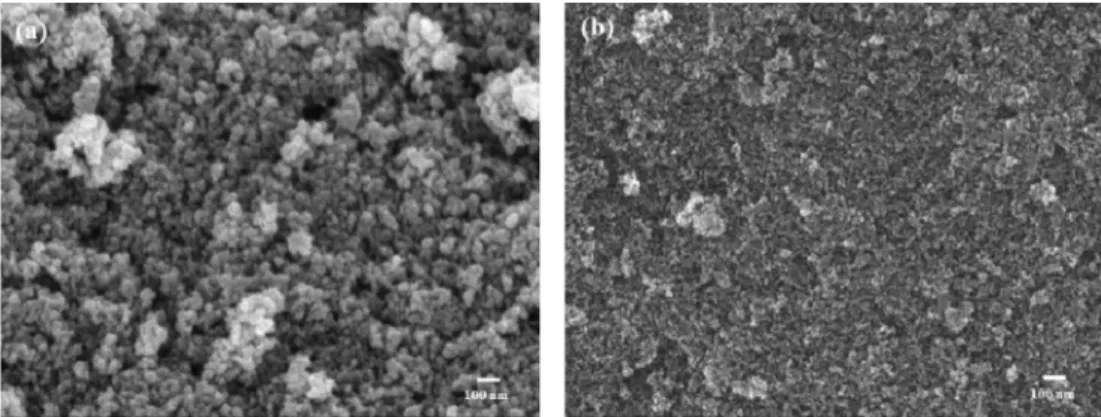
Interestingly, hysteresis loop of activated carbon aerogel was found at the lower relative pressure than carbon aerogel, indicating that pore size of activated carbon aerogel was smaller than that of carbon aerogel. The average pore diameter of carbon aerogel and activated carbon aerogel was found to be 9.1 and 4.8 nm, respect- ively (Table 1). It can be inferred from the above results that chemical activation of carbon aerogel was successfully performed in this work. Activated carbon showed a typical isotherm of microporous carbon material. Effect of acti- vation on the morphology of carbon aerogel was investigated by SEM analysis. It is clear that the size of carbon particle was decreased through chemical activation process (Fig. 2). Moreover, activated carbon aerogel rather than carbon aerogel retained a well-developed intercon- necting network of carbon particle with a smaller particle size. Form the N
2adsorption-desorption and SEM analysis, it was confirmed that a small particle size and a small pore size of activated carbon aerogel resulted in its high specific surface area.
It is well known that the optimal amount ratio of re- actant and catalyst is very important to perform the liquid-film state reaction in this reaction system. In order to find the reaction conditions for liquid-film state reaction, decalin dehydrogenations were performed over Pt/CA
catalyst with various decalin amounts(decalin: 0.8-2 ml, catalyst: 0.3 g, reaction temperature: 210
oC). The highest hydrogen evolution was found when 1 ml of decalin was used for the reaction (Table 2). Sand-bath state reaction was carried out in the condition of decalin insufficien- cy(< 1 ml), while excessive decalin amounts(> 1 ml) led to a suspended state reaction. The sand-bath state reaction and the suspended state reaction were unfavorable for
Table 1. Physical properties of carbon aerogel (CA), activatedcarbon aerogel (ACA), and activated carbon (CA).
Carbon materials
SBET
(m2/g)a
davg
(nm)b
Vmicro
(cm3/g)
Vtotal
(cm3/g)
CA 623 9.1 0.1 1.4
ACA 1,493 4.8 0.4 1.8
AC 1,012 2.8 0.3 0.7
aSurface area was calculated by the Brunauer-Emmett-Teller (BET) equation.
bAverage pore diameter was calculated by the Barrett-Joyner- Halenda (BJH) method with the desorption branch.
Fig. 2. SEM images of (a) carbon aerogel (CA) and (b) activated carbon aerogel (ACA).
Table 2. Total hydrogen evolution over Pt/CA catalyst with various decalin amounts (decalin: 0.8-2 ml, catalyst: 0.3 g).
Amount of decalin (ml) Total hydrogen evolution (mmol H2/gpt)
0.8 264
0.9 316
1 328
1.2 322
1.4 324
2 170
Fig. 3. Hydrogen evolution over Pt/CA catalyst with time on stream for 2 h in the decalin dehydrogenation at 210oC (decalin: 1 ml, catalyst: 0.3 g).
hydrogen production through decalin dehydrogenation, which is a good agreement with the results reported in the previous work.
15)Considering the fact that liquid-film state is a key factor to determine the catalytic activity in this reaction, catalytic activities of Pt/CA, Pt/ACA, and Pt/
AC catalysts were tested and discussed under the liquid- film state reaction condition using the appropriate ratio of decalin and catalyst.
Fig. 3 showed the hydrogen evolution over Pt/CA catalyst with time on stream for 2 h in the decalin de- hydrogenation at 210
oC. Gas composition analysis by GC-TCD revealed that no by-products were found in the detectable range. This indicates that gas evolved in this reaction was almost pure hydrogen. It is noteworthy that considerable amounts of hydrogen were evolved at an initial state(~5 min). Initial hydrogen evolution rate as well as total hydrogen evolution amount are very important in this reaction system, because this reaction system will be finally applied to the hydrogen production for the fuel cell vehicle. Therefore, investigation on the catalytic activity of carbon-supported platinum catalysts in this work was focused on both initial hydrogen evolution rate and total hydrogen evolution amount.
Catalytic activity of Pt/CA, Pt/ACA, and Pt/AC catalysts
in the decalin dehydrogenation at 210
oC was examined at a liquid-film state condition (Fig. 4). Initial hydrogen evolution rate was calculated using the amount of hyd- rogen evolved for 5 min in this reaction. Both initial hydrogen evolution rate and total hydrogen evolution amount were increased in the order of Pt/CA < Pt/AC <
Pt/ACA catalysts. In particular, it is interesting to note that catalytic activity of activated carbon aerogel-supported platinum catalyst(Pt/ACA) was higher than that of com- mercial activated carbon-supported platinum catalyst(Pt/
AC). This means that activated carbon aerogel served an efficient support for platinum catalyst in the decalin dehydrogenation. Therefore, we confirmed that chemical activation process played a key role to enhance the catalytic activity of carbon aerogel-supported platinum catalyst. The enhanced catalytic activity of Pt/ACA may be attributed to the high surface area and well-developed mesoporous structure of activated carbon aerogel.
It is generally accepted that high platinum surface area in the catalyst is favorable to produce hydrogen through catalytic dehydrogenation reaction.
8)Therefore, in order to elucidate the different catalytic activity of Pt/CA, Pt/
ACA, and Pt/AC catalysts, XRD measurements were carried out with an aim of examining the platinum dis-
Fig. 4. Catalytic activities of Pt/CA, Pt/AC, and Pt/ACA catalystsunder the liquid-film state in the decalin dehydrogenation at
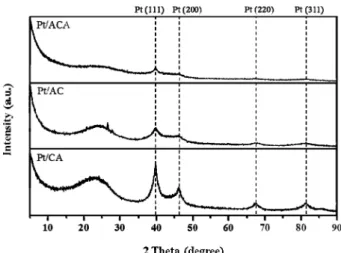
210oC. Fig. 5. XRD patterns of Pt/CA, Pt/AC, and Pt/ACA catalysts.
Fig. 6. TEM images of (a) Pt/CA, (b) Pt/AC, and (c) Pt/ACA catalysts.
persion of the catalysts. As shown in Fig. 5, all catalysts exhibited two broad XRD reflection peaks at 2 θ = 23.5
oand 43.8
o, which were due to (002) and (101) reflections of graphite carbon, respectively. What is interesting is that the XRD peak breadth for platinum was much different depending on the identity of carbon support.
The broader XRD peaks of platinum corresponds to the higher dispersion of platinum, that is, the smaller particle size of platinum in the catalyst. The small particle size of platinum in the catalyst can result in the high platinum surface area, and thus, the high catalytic activity in the dehydrogenation reaction. Among the catalysts tested in this work, Pt/ACA showed the broadest XRD peaks of platinum, indicating that platinum was finely dispersed in the Pt/ACA catalyst.
TEM analysis was carried out to double-check the platinum dispersion and particle size in the catalyst, the obtained figures were shown in Fig. 6. The platinum dispersion was clearly increased in the order of Pt/CA, Pt/AC, and Pt/ACA, and accordingly, the size of platinum particle in the catalyst was decreased in the order of Pt/
CA, Pt/AC, and Pt/ACA. Consequently, the platinum dispersion characterized by TEM analysis exhibited the same trend as the XRD results. Once again, we confirmed that activated carbon aerogel was efficient support for obtaining the finely dispersed platinum catalyst for this reaction. From the XRD and TEM results, it is finally concluded that the enhanced catalytic activity of Pt/ACA was attributed to the high platinum surface area originated from the high dispersion of platinum.
4. Conclusion
Activated carbon aerogel was prepared by a chemical activation method with carbon aerogel and KOH, and it was applied to the support of carbon-supported platinum catalyst. The prepared activated carbon aerogel-supported platinum catalyst was tested in the catalytic dehydroge- nation of decalin. Activated carbon aerogel-supported platinum catalyst(Pt/ACA) showed a better catalytic activity than carbon aerogel-supported platinum catalyst(Pt/CA) and commercial activated carbon-supported platinum cata- lyst(Pt/AC), in terms of both initial hydrogen evolution rate and total hydrogen evolution amount in this reaction.
This indicates that activated carbon aerogel was efficient support of platinum catalyst for hydrogen production through decalin dehydrogenation. Characterizations clearly
showed that activated carbon aerogel retained a high surface area and a well-developed mesoporous structure, leading to the high dispersion of platinum in the Pt/ACA catalyst. Among the catalysts tested, Pt/ACA with the highest platinum dispersion showed the best catalytic activity in decalin dehydrogenation. Therefore, it is be- lieved that activation process played a key role to prepare an efficient carbon support of platinum catalyst for hydrogen production through decalin dehydrogenation.
Acknowledgements
This research was supported by Basic Science Research Program through the National Research Foundation of Korea(NRF) funded by the Ministry of Science, ICT &
Future Planning(No. NRF-2013R1A1A1008792).
References
1. S. M. Ibrhim, Korean J. Chem. Eng., 31, 1792 (2014).
2. A. Shukla, S. Karmarkar and R. B. Biniwale, Int. J.
Hydrogen Energy, 37, 3719 (2012).
3. M. P. Lázaro, E. García-Bordejé, D. Sebastián, M. J.
Lázaro and R. Moliner, Catal. Today, 138, 203 (2008).
4. R. B. Biniwale, S. Rayalu, S. Devotta and M. Ichikawa, Int. J. Hydrogen Energy, 33, 360 (2008).
5. D. sbastían, C. Alegre, L. Calvillo, M. Pérez, R. Moliner and M. Láazaro, Int. J. Hydrogen Energy, 39, 4109 (2014).
6. G. W. H. Scherer, E. Newson and A. Wokaun, Int. J.
Hydrogen Energy, 24, 1157 (1999).
7. S. Hodoshima, H. Arai, S. Takaiwa, Y. Saito, Int. J.
Hydrogen Energy, 28, 1255 (2003).
8. S. Hodoshima, S. Takaiwa, A. Shono, K. Satoh and Y.
Saito, Appl. Catal. A: Gen., 283, 235 (2005).
9. N. Jiang, K. S. R. Rao, M. Jin and S. Park, Appl. Catal.
A: Gen., 425-426, 62 (2012).
10. P. Li, Y. Huang, J. Zhu, T. Zhao and X. Zhou, Catal.
Commun., 10, 815 (2009).
11. B. Fang and L. Binder, ElectoChim. Acta, 52, 6916 (2007).
12. H. W. Park, U. G. Hong, Y. J. Lee and I. K. Song, Appl.
Catal. A: Gen., 409-410, 167 (2011).
13. J. Wang and S. Kaskel, J. Mater. Chem., 45, 23710 (2012).
14. S. H. Kwon, E. Lee, B.-S. Kim, S.-G. Kim, B.-J. Lee, M.- S. Kim and J. C. Jung, Curr. Appl. Phys., 14, 603 (2014).
15. S. Hodoshima, H. Arai and Y. Saito, Int. J. Hydrogen Energy, 28, 197 (2003).