Manuscript received July 26, 2019, Accepted November 12, 2019
1 KEPCO Research Institute, Korea Electric Power Corporation, 105 Munji-ro Yuseong-gu, Daejeon 34056, Republic of Korea
2 Department of Chemical and Biomolecular Engineering, Seoul National University of Science and Technology, Seoul 01811, Republic of Korea
Improvement in Catalytic Activity of Ag Catalyst via Simple Mixing with Carbon
Myounghoon Choun
1†, Ji Yun Baek
2, Taehyoung Eom
1††Abstract
In this study we investigate catalytic activity and selectivity of mixture of Ag and ketjenblack according to their ratios by product analysis and electrochemical experiments, such as cyclic voltammetry, linear sweep voltammetry and chronoamperometry. We reveal that catalytic activity toward CO
2reduction to CO is improved by simple mixing Ag nanoparticle and ketjenblack because addition of ketjenblack suppresses aggregation of Ag nanoparticles and brings increase in electrochemical active surface area. However, excess amount of ketjenblack rather inhibit the CO
2reduction to CO. These observations provide clues to develop highly active Ag catalyst or electrode toward electrochemical reduction of CO
2.
Keywords: CO2 Reduction, Ag, Ketjenblack, Electrochemical Active Surface Area
I. INTRODUCTION
As environmental and global energy concerns grow, reducing NO
x, SO
xand CO
2, which are considered as the biggest contributor to environmental pollution and global warming, and developing alternative energy sources such as wind energy, solar, wave, geothermal and electrochemical energy are becoming the central interest and research focus.
In South Korea, there are many efforts to solve the global warming problem. South Korea has signed Paris Agreement, which deal with greenhouse gas emissions mitigation, adaptation and finance, to mitigate global warming and has planned to reduce 30 % of business-as usual (BAU) emissions of CO
2estimates by 2030 through improvement of energy efficiency, development of alternative energy and carbon capture utilization and storage (CCUS). In addition, the South Korea government announced 3020 renewable energy implementation plan, which create 30 percent of power supply through renewable energy by 2030, and a roadmap for activating the hydrogen economy to develop and promote carbon-free energy to reduce CO
2emissions.
Electrochemical reduction of CO
2, which is classified into
CCUS, is technology to convert to high value or useful product
such as HCOOH, CO and CH
4etc. using electricity. The
electricity applied to CO
2electrochemical reduction could be
supplied by using surplus electricity of renewable energy. In
other words, the electrochemical reduction of CO
2technology
could be both CCUS and power to gas, simultaneously. Among
the product of CO
2electrochemical reduction, CO is the
highest value product and enormously used product in
chemical industry. Therefore, many researches in
electrochemical reduction of CO
2have focused on CO
production. In production of CO by CO
2electroreduction, it is
known that Ag is highly active and selective electrocatalyst, so
many researchers have tried to develop Ag-based
electrocatalyst [1]-[8]. However, most of studies about Ag-
based electrocatalyst have been concentrated in alloying
silver [4] with other metal or organic materials or
mechanistic study on Ag through density functional theory
(DFT) computation or spectroscopy [5]-[8]. In
electrochemical catalytic reaction, electrochemical active
surface area of catalyst is one of key factor to decide the
catalytic activity of catalyst. Nevertheless, study in
improvement of electrochemical active surface area of
catalyst is rarely studied.
In this study, we prepared various ratios of Ag nanoparticle and ketjenblack through simple mixing both of them to obtain well-dispersed Ag nanoparticle, which directly related to surface area influencing catalytic activity, and investigated their catalytic activity and selectivity toward electrochemical reduction of CO
2to CO according to their ratios through product analysis and electrochemical evaluations.
II. EXPERIMENTS
All chemicals were obtained from commercial sources and utilized without further purification. All solutions were prepared with deionized water (18.2 MΩ). KHCO
3(Sigma- Aldrich, 99.7 %) and were used for evaluating the electrochemical behavior of catalysts and their electrocatalytic activity toward CO
2reduction.
Electrochemical experiments conducted in this study were performed using a three-electrode system connected to a potentiostat/galvanostat (Biologic, VSP). A platinum wire and double junction Ag/AgCl were utilized as counter electrode and reference electrode, respectively. For the working electrode, catalyst ink was prepared by various ratios of Ag nanoparticle (Alfa Aesar, APS 20 nm, 99.9 %) and ketjenblack in a mixture of 10 µL of nafion solution (Sigma- Aldrich, 10 wt%), 1 mL of distilled water (18.2 MΩ) and 4 mL of 2-propanol (Sigma-Aldrich). The catalyst ink was sufficiently sonicated until it was well dispersed. 20 µL of the well-dispersed catalyst ink was dropped onto a rotating glassy carbon disk electrode (0.2475 cm
2) using a micro- pipet. Through the method above, we prepared various ratios of Ag and ketjenblack (100, 90, 80, 70, 60, 0 wt%) as working
electrode.
To investigate electrochemical behaviors and catalytic activity toward CO
2reduction of various ratios of Ag and ketjenblack, cyclic voltammograms and linear sweep voltammograms were conducted in Ar or CO
2saturated 0.1 M KHCO
3.All cyclic voltammograms and linear sweep voltammograms were performed at 25 °C, which is controlled by the circulation of ethylene glycol flowing into a water jacket of the electrochemical cell. In case of linear sweep voltammograms, rotating speed of working electrode was set to 900 rpm to remove the bubble generated during reaction from surface of the electrode.
In order to minimize effect of impurities on the electrode surface, a cleaning process, which is was performed by voltammetric cycling from -0.79 to 0.26 V (vs Ag/AgCl) at 100 mV·s
-1for 50 cycles, was conducted before every electrochemical experiments
To analyze product of CO
2electrochemical reduction of various ratios of Ag and ketjenblack, chronoamperograms at various voltages of -0.6, -0.7 and -0.8 V (vs RHE) were conducted in CO
2saturated 0.1 M KHCO
3for 1 hour. All chronoamperograms were conducted in sealed H-type cell which has 20 ml of headspace. After 1 hour of chronoamperograms, 0.5 mL of gas in headspace was extract from the H-type cell by using syringe and was analyzed by using gas chromatography (DS science, iGC 7200A)
III. RESULTS AND DISCUSSIONS
In catalytic reaction, most of reactions occur on the surface of catalyst, so high surface area and well-dispersed catalyst are directly connected to high catalytic activity.
However, it is known that nanoparticle is difficult to be well- dispersed. In order to obtain well-dispersed Ag nanoparticle, we simply mixed Ag nanoparticle and ketjenblack and prepared various ratios of both of them.
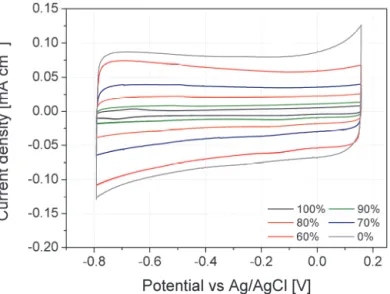
In order to investigate the electrochemical behavior of 100, 90, 80, 70, 60 and 0 % Ag, we conducted cyclic voltammetry in Ar saturated 0.1 M KHCO
3. Fig. 1 shows cyclic voltammograms of various ratios of Ag nanoparticle and ketjenblack. As shown in Fig. 1, the largest electrochemical active surface area is observed at 0 % Ag and 100 % Ag indicates the lowest electrochemical active surface area. The electrochemical active surface area is getting larger when the amount of ketjenblack is increased. Because ketjenblack has larger surface area than that of Ag nanoparticle, mixing Ag nanoparticle and ketjenblack showed large electrochemical surface area compared to that of Ag nanoparticle. We mixed Ag nanoparticle and ketjenblack to improve electrochemical active surface area by suppressing agglomeration of Ag nanoparticle. Thus, we expected that enhancement of current related to Ag redox is shown with increase of the amount of ketjenblack, but it is rarely detected due to relatively large surface area of ketjenblack.
To evaluate catalytic activities of 100, 90, 80, 70, 6 and 0
% Ag toward CO
2electrochemical reduction, linear sweep
Fig. 1. Cyclic voltammograms for 100, 90, 80, 70, 60 and 0 % Ag in Ar saturated 0.1 M KHCO3. All of cyclic voltammograms are recorded at a scan rate of 10 mV·s-1.
voltammograms for various ratios of Ag and ketjenblack were obtained at cathodic scan rate of 10 mV·s
-1in both Ar- saturated and CO
2-saturated 0.1 M KHCO
3as shown in Fig. 2.
In Ar-saturated solution, 90, 80, 70 and 60 % Ag exhibit similar onsetpotentials for the hydrogen evolution reaction compared to those of 100% Ag, but show higher current density for hydrogen evolution reaction than that of 100 % Ag. On the 0 % Ag, the slowest onsetpotentials and the highest current density for hydrogen evolution reaction are shown.
Under the sufficient CO
2condition, the suppression of hydrogen evolution reaction is observed on all samples,
because the surface of electrode is covered by CO molecules generated by CO
2reduction reaction. On the 90, 80, 70 and 60 % Ag, faster onsetpotentials and higher current densites for the activation of CO
2reduction than those of 100 % Ag and 0 % Ag are observed, and their osetpotentials and current densities are getting slower with increase of amount of ketjenblack. These results imply that mixing Ag and ketjenblack bring improvement in CO
2reduction activity.
In Fig. 2, it is difficult to separate CO
2reduction current from hydrogen evolution reaction current, the potential- dependent product distributions were carried out at -0.6, -0.7
Fig. 2. Linear sweep voltammograms for 100, 90, 80, 70, 60 and 0 % Ag in Ar or CO2 saturated 0.1 M KHCO3. The linear sweep voltammograms are recorded at a scan rate of 10 mV·s-1. (a) 100 wt% Ag. (b) 90 wt% Ag. (c) 80 wt% Ag. (d) 70 wt% Ag. (e) 60 wt% Ag. (e) 0 wt% Ag.
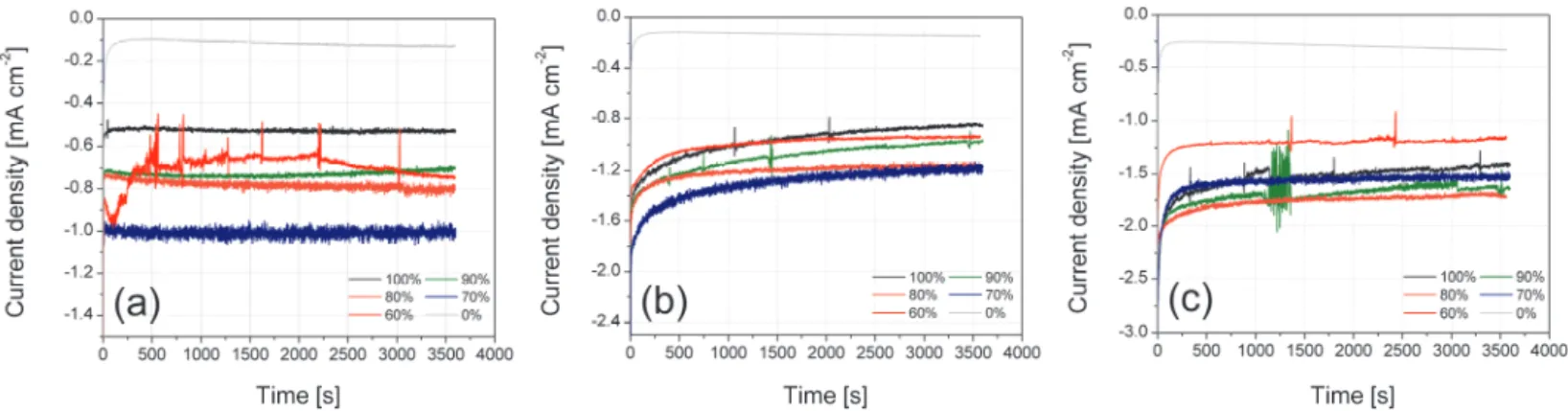
Fig. 3. Chronoamperograms of various ratios of Ag and ketjenblack in CO2 saturated 0.1 M KHCO3 at various voltages (vs RHE) of (a) -0.6 V, (b) -0.7 V and (c) -0.8 V for 1 hour.
and -0.8 V (vs RHE). All chronoamperograms of 100, 90, 80, 70, 60 and 0 % Ag at various voltages of -0.6, -0.7 and -0.8 V (vs RHE) were conducted in CO
2saturated 0.1 M KHCO
3for 1 hour (Fig. 3) and 0.5 mL of gas in headspace was extract from the H-type cell by using syringe and was analyzed (Fig. 4 and 5). As shown in Fig. 3, cathodic current density at all voltages is getting improved as Ag nanoparticles is mixed with ketjenblack (90, 80, 70 and 60 % Ag). However, 0 % Ag showed much lower cathodic current density than those of the others. At voltages of -0.6 and -0.7 V, the current density increase was higher than current density of 0 % Ag, implying that the electrochemical active surface area of Ag nanoparticles is improved. While, at voltage of -0.8 V, relatively small increase in current density was observed, which might be considered that mass transfer limitation of reactant and product. From these results, we could expect increase in amount of product.
In order to evaluate the increase in amount of product, product amounts of 100, 90, 80, 70, 60 and 0 % Ag at potential of -0.6, -0.7 and -0.8 V are calculated through product analysis as shown in Fig. 4. At the voltage of - 0.6 V, both H
2and CO is observed on 90, 80 and 70 % Ag samples, while only H
2is observed on 100, 60 and 0 % Ag in Fig. 4(a). At the voltage of – 0.7 and - 0.8 V, both H
2and CO is observed on 100, 90, 80, 70 and 60 % Ag, but only H
2is observed on 0 % Ag, meaning that ketjenblack has no activity toward CO
2reduction to CO in
whole voltage range between -0.6 and -0.8 V [Fig. 4(b) and 4(c)]. On 90, 80 and 70 % Ag at voltages of -0.6 and -0.7 V, more gas phase products (H
2and CO) than that of 100 % Ag were generated due to higher cathodic current density than that of 100 % Ag shown in Fig. 3. However, in case of 70 % at -0.8 V and 60 % Ag at -0.6, -0.7 and -0.8 V, less gas phase products were generated compared to 100 % Ag, in spite of higher cathodic current density shown in Fig. 3. This could be explained by that a portion of current comes from resistance, non-faradaic current and reduction to liquid product. To investigate the selectivity according to ratios of Ag nanoparticle and ketjenblack, we calculated Faradaic efficiencies of 100, 90, 80, 70, 60 and 0 % Ag as shown in Fig.
5. In Fig. 5(a), similar or low Faradaic efficiencies for H
2were shown on 90, 80 and 60 % Ag and high Faradaic efficiencies for CO were exhibited on 90, 80, 70 % Ag, compared to that of 100 % Ag at voltage of -0.6 V. However, interestingly, lower Faradaic efficiencies for CO than that of 100 % Ag were shown on 70 and 60 % Ag at higher voltages [Fig. 5(b) and 5(c)].
These results could be explained by that mixing Ag nanoparticles and ketjenblack suppress the aggregation of Ag nanoparticles, which shows increase in amount of gas phase product. In addition, addition of excess amount of ketjenblack rather suppress CO
2reduction and hydrogen evolution reactions on Ag by blocking from excess ketjenblack and mass transfer limitation of reactant and product.
Fig. 4. Product amount of various ratios of Ag and ketjenblack at various voltages (vs RHE) of (a) -0.6 V, (b) -0.7 V and (c) -0.8 V.
Fig. 5. Faradaic efficiencies of various ratios of Ag and ketjenblack at various voltages (vs RHE) of (a) -0.6 V, (b) -0.7 V and (c) -0.8 V.
IV. CONCLUSION
In this work, we prepared various ratios of Ag nanoparticle and ketjenblack through simple mixing both of them and investigated their electrochemical activities for CO
2reduction according to their ratios. We demonstrate that catalytic activity to CO
2to CO is enhanced, in terms of overpotential and current density, through simple mixing Ag nanoparticles with ketjenblack, because of suppression of aggregation of Ag nanoparticles by addition of the ketjenblack. However, on excess addition of ketjenblack (70 and 60 % Ag) samples, Ag nanoparticles are rather covered by excess amount of ketjenblack, so low catalytic activity were shown compared to that of 100 % Ag. These results provide direction to develop highly active Ag catalyst or electrode for CO
2reduction reaction.
ACKNOWLEDGMENT
This work was supported by the Korea Electric Power Corporation under Grant
REFERENCES
[1] Qi Lu, Jonathan Rosen, Yang Zhou, Gregory S. Hutchings, Yannick C.
Kimmel, Jingguang G. Chen, Feng Jiao, “A selective and efficient electrocatalyst for carbon dioxide reduction,” Nature Communications, vol. 5, pp. 3242, Jan. 2014.
[2] Toru Hatsukade, Kendra P. Kuhl, Etosha R. Cave, David N. Abram, Thomas F. Jaramillo, “Insights into the electrocatalytic reduction of CO2
on metallic silver surfaces,” Physical Chemistry Chemical Physics, vol.
16, pp. 13814-13819, Jun. 2014.
[3] Brian A. Rosen, Amin salehi-khojin, Michael R. Thorson, Wei Zhu, Devin T. Whipple, Paul J. A. Kenis, Richard I. Masel “Ionic liquid-mediated selective conversion of CO2 to CO at low overpotentials,” Science, vol.
334, pp. 643-644, Nov. 2011.
[4] Meenesh R. Singh, Youngkook. Kwon, Yanwei Lum, Joel W. Ager, III, Alexid T. Bell, “Hydrolysis of electrolyte cations enhances the electrochemical reduction of CO2 over Ag and Cu,” Journal of the American Chemical Society, vol. 138, pp. 13006-13012, Sep. 2016.
[5] Jonathan Rosen, Gregory S. Hutchings, Qi Lu, Sean Rivera, Yang Zhou, Dionisios G. Vlachos, Feng Jiao, “Mechanistic insight into the electrochemical reduction of CO2 to CO on nanostructured Ag surfaces,”
ACS Catalysis, vol. 5, pp. 4293-4299, Jun. 2015.
[6] Seoin Back, Min Sun Yeom, Yousung Jung, “Active sites of Au and Ag nanoparticle catalysts for CO2 electroreduction to CO”, ACS Catalysis, vol. 5, pp. 5089-5096, Jul. 2015.
[7] Nienke J. Firet, Wilson A. Smith, “Probing the reaction mechanism of CO2 electroreduction over Ag films via operando infrared spectroscopy,” ACS Catalysis, vol. 7, pp. 606-612, Dec. 2017.
[8] Ali Seifitokaldani, Christine M. Gabardo, Thomas Burdyny, Cao-Thang Dinh, Jonathan P. Edwards, Md Golam Kibria, Oleksandr S. Bushuyev, Shana O. Kelley, David Sinton, Edward H. Sargent, “Hydronium-induced switching between CO2 electroreduction pathways,” Journal of the American Chemical Society, vol. 140, pp. 3833-3837, Mar. 2018.