332
사료 내 해조류(톳, 감태) 첨가가 돌돔( Oplegnathus fasciatus) 치어의 비특이적 면역반응에 미치는 영향
송진우·장지웅·김성삼·오대한·차지훈·이경준1✽
제주대학교 해양의생명과학부,
1제주대학교 해양과환경연구소
Effect of Dietary Supplementation with Alga ( Hizikia fusiformis and Ecklonia cava )
on the Non-specific Immune Responses of Parrot Fish Oplegnathus fasciatus
Jin-Woo Song, Ji-Woong Jang, Sung-Sam Kim, Dae-Han Oh, Ji-Hoon Cha and Kyeong-Jun Lee
1✽Department of Marine Life Sciences, Jeju National University, Jeju 690-756, Korea
1
Marine and Environmental Research Institute, Jeju National University, Jeju 695-814, Korea
Two feeding trials were conducted to determine the effects of dietary supplementation with Hizikia fusiformis or
Ecklonia cava on the non-specific immune responses of parrot fish Oplegnathus fasciatus. Fish were fed experimental
diets to which H. fusiformis or E. cava powder were added to final concentrations of 0, 2, 4 and 6%, respectively. After feeding for two weeks, phagocytic activity was significantly higher in fish fed diets containing H. fusiformis, but not E.cava, than in fish fed the basal diet. Lysozyme activity was significantly increased in the fish fed diets containing 6%
H. fusiformis and E. cava. Myeloperoxidase activity was also significantly higher in fish fed diets containing 2 and 4%
H. fusiformis, as compared to the basal diet, but not in those fish fed E. cava. These two studies indicate that dietary
supplementation with H. fusiformis or E. cava could enhance the innate immune responses of parrot fish during their growth stage.Key words: Parrot fish, Oplegnathus fasciatus, Hizikia fusiformis, Ecklonia cava, Non-specific immune responses
서 론
어류의 질병 치료는 항생제나 화학요법제에 의존하고 있 지만 항생제의 과도한 사용은 약제 내성균의 확산을 초래하 여 치료를 어렵게 하고 어류의 면역 기능을 저하 시킬 수 있다 (Rodriguez et al., 2007). 이와 같은 문제의 해결 방안으로 어 류의 자체방어능력을 향상시키는 면역증강제의 개발과 친환경 적인 항균물질이나 해양생물자원에서 유래한 기능성 천연 생 리활성물질에 관한 연구도 이루어지고 있다(Yeh et al., 2006;
Divyagnaneswari et al., 2007; Fu et al., 2007).
해조류에 함유된 다양한 생리활성물질이 밝혀지면서 새로 운 개발자원으로 인식되고 있다(Lincoln et al., 1991; Cannell, 1993). 해조류는 식품원료로 이용되어져 왔으며 최근 항산화, 항암, 항염증, 항균 및 면역력을 향상시키는 것으로 보고되어 질 병예방 및 치료제로 이용되고 있다(Liu et al., 1997; Asai et al., 2004; Mayor and Hamann, 2002, 2004). 또한 해조류는 폴리페 놀 및 후코이단(fucoidan)을 함유하여 OH, O2-, H2O2 등의 활성 산소를 억제한다고 보고되었다. 해조류가 함유하고 있는 항산화
물질로는 톳의 fucoxanthin과 모자반의 phlorotannin이 보고되 었고 폴리페놀 함량이 높을수록 항산화 효과도 증가된다고 보 고되었다(Yan et al., 1998; Lim et al., 2002; Huang and Wang, 2004). 톳(
Hizikia fusiformis
)과 감태(Ecklonia cava
)는 갈조식 물문(Phaeophyta)에 속하는 갈조류로 식품, 의약품, 화장품 및 양식산업 등 관련분야에서 많은 연구가 이루어지고 있는 생리활 성이 높은 물질이다. 톳의 항산화 활성, 면역반응 및 질병 저항 성에 관한 연구(Shan et al., 1999; Karawita et al., 2005; Pham et al., 2006)가 보고되었고, 감태 또한 높은 항산화 활성, 항고혈 압제로써의 가능성 및 발암성 니트로사민 생성인자인 아질산염 을 효과적으로 분해한다고 보고되었다(Park, 2005; Athukorala et al., 2006; Hong et al., 2006). 넙치(Paralichthys olivaceus
)를 대상으로 한 연구에서(Pham et al., 2006; Kim and Lee, 2008;Kim et al., 2009) 사료 내 톳과 감태의 첨가는 면역증진 및 질병 저항성에 효능이 있다고 보고되었다.
돌돔(
Oplegnathus fasciatus
)은 농어목(Perciformes), 돌돔 과에 속하는 어종으로 우리나라 남부지역을 중심으로 분포하 는 아열대성 어류이다. 최근 양식 대상어종으로 각광받고 있지 만, 병원성 미생물에 의한 감염으로 폐사나 성장감소와 같은 문 제점이 발생되고 있다(Jung and Oh, 2000). 이러한 문제를 해결*Corresponding author: [email protected]
하기 위해 양식장에서는 항생제를 과다하게 사용하고 있는 실 정이다. 어류의 비특이적 면역반응을 증강시키는 천연물질로는 마늘(Kim et al., 2010), 스피룰리나(Kim et al., 2006; Tayag et al., 2010) 및 β-glucan (Selvaraj et al., 2005)이 보고되었다. 면 역증진 효과를 조사하기 위해 수행되었던 대부분의 연구는 6주 이상의 장기간 사양실험이 선행되었으나, Huang et al. (2006) 은 갈조류인
Sargassum fusiforme
에서 추출한 다당류를 사료 에 첨가하여 짧은 기간만(14일) 공급해도 새우(Fenneropenaeus chinensis
)에서 lysozyme 활성이 향상되었고 세균성 질병에 대 한 저항력도 증가되었다고 보고하였다. 따라서 본 연구는 톳과 감태 분말을 첨가한 사료의 단기간(2주) 공급이 돌돔의 비특이 적 면역반응에 미치는 영향을 알아보고자 수행되었다.재료 및 방법
실험사료
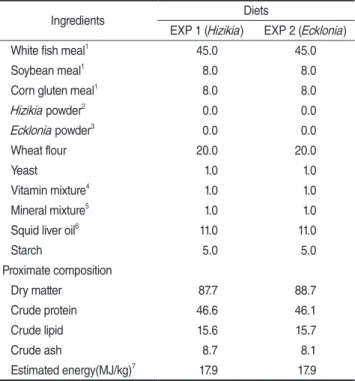
실험 1(톳)과 2(감태)에 사용된 각각의 실험사료는 조단백질 44%, 조지방 15%로 하였으며, 에너지는 17.2 MJ/kg이다(Table 1). 실험사료원의 성분분석 결과는 Table 2에 나타내었다. 실험 1에 사용된 톳 분말은 제주시에 위치한 동문시장에서 제주산 톳 을 구입하여 줄기와 뿌리를 제거한 후, 동결 건조하여 분말형태 로 제조되었다. 실험 2에 사용된 감태 분말은 제주대학교 해양 과학대학 해양생물자원이용공학연구실로부터 지원받았으며 제 조방법은 톳 분말과 동일하다. 해조류(톳, 감태)의 첨가효과를 알아보기 위하여 해조류를 첨가하지 않은 대조사료에 소맥분 대 신 톳과 감태분말을 각각 0%, 2%, 4%, 6%씩 첨가하였다(Exp 1: Hiz 0, Hiz 2, Hiz 4 and Hiz 6; and Exp 2: Eck 0, Eck 2, Eck 4 and Eck 6). 실험사료의 제조를 위하여 파쇄기를 이용하여 모 든 사료원을 분말형태로 일정하게 만든 후, 각 사료원을 사료조 성표에 따라 정확히 무게를 재고 혼합하였다. 혼합 후 사료원 총 량의 30%에 해당하는 증류수를 첨가하여 사료혼합기(NVM- 14-2P, Gyeonggido, Korea)로 혼합 및 반죽하였다. 혼합반죽물 은 소형초파기(SMC-12, Busan, Korea)를 이용하여 직경 3 mm 크기로 압출 성형되었다. 제작된 실험사료는 동결냉동건조기 에서 건조시켜 적당한 크기로 가공되었으며, 사료 공급 전까지 -20℃ 냉동고에 보관한 후 실험에 사용되었다.
실험어 및 사육관리
실험어는 제주도내에 위치한 종묘배양장(창해수산)에서 종 묘 생산된 돌돔 치어로 제주대학교 소속 해양과환경연구소로 운 송되었다. 2주 동안 시판 배합사료를 공급하면서 실험환경에 적 응할 수 있도록 순치시킨 후 실험에 사용하였다. 예비사육 후 실 험 1의 돌돔(초기 평균 무게: 53.4±1.0 g)은 총 12개의 150 L 원 형 플라스틱 수조에 각 수조 당 15마리씩 무작위로 선택하여 배 치되었다. 실험 2에서의 돌돔(초기평균무게: 46.6±1.1 g)은 총 12개의 150 L 원형 플라스틱 수조에 각 수조 당 20마리씩 무작 위로 배치되었다. 사료공급 실험은 실험구당 3반복구를 두었으
Ingredients Diets
EXP 1 ( Hizikia ) EXP 2 ( Ecklonia )
White fish meal
145.0 45.0
Soybean meal
18.0 8.0
Corn gluten meal
18.0 8.0
Hizikia powder
20.0 0.0
Ecklonia powder
30.0 0.0
Wheat flour 20.0 20.0
Yeast 1.0 1.0
Vitamin mixture
41.0 1.0
Mineral mixture
51.0 1.0
Squid liver oil
611.0 11.0
Starch 5.0 5.0
Proximate composition
Dry matter 87.7 88.7
Crude protein 46.6 46.1
Crude lipid 15.6 15.7
Crude ash 8.7 8.1
Estimated energy(MJ/kg)
717.9 17.9
Table 1. Formulation and proximate composition of the basal diet(%, DM basis)
1Provided by Suhyup Feed Co. Ltd., Uiryeong, Korea
2
Hizikia fusiformis
powder:H. fusiformis
was purchased in the market(Dongmun public market, Jeju, Korea).3
Ecklonia cava
powder:E. cava
powder was kindly provided by Professor Jeon, Y.-J., Faculty of Marine Biomedical Science, Jeju National University.4Vitamin mixture(g/kg of mixture): L-ascorbic acid monophosphate, 100.0; DL-tocopheryl acetate, 20.0; thiamin hydrochloride, 4.0; riboflavin, 4.4; pyridoxine hydrochloride, 4.0; niacin, 30.0; D-pantothenic acid hemicalcium salt, 14.5;
myo-inositol, 40.0; D-biotin, 0.2; folic acid, 0.48; menadion, 0.2; retinyl acetate, 1.0; cholecalficerol, 0.05; cyanocobalamin, 0.01.
5Mineral mixture(g/kg of mixture): MgSO4.7H20, 80.0;
NaH2PO4.2H2O, 370.0; KCl, 130.0; Ferric citrate, 40.0;
ZnSO4.7H20, 20.0; Ca-lactate, 356.5; CuC2, 0.2; AlCl3.6H2O, 0.15; Na2SeO3, 0.01; MnSO4.H2O, 2.0; CoCl2.6H2O, 1.0.
6Squid liver oil was purchased from Ewha oil Co. Ltd., Busan, Korea.
7Estimated energy was determined by using values of 16.7 KJ/kg protein or carbohydrate and 37.6 KJ/kg fat for dietary ingredients(Garling and Wilson, 1976).
Table 2. Chemical composition of the dried seaweeds and wheat flour(%, DM basis)
Hizikia powder Ecklonia powder Wheat flour
Crude protein 9.9 10.0 12.0
Crude lipid 1.2 0.7 0.7
Crude ash 40.0 17.4 3.0
Moisture 9.5 8.8 11.0
며, 사육수는 모래 여과해수를 사용하여 3 L/min의 유수량이 공 급되도록 조절하였고 모든 실험수조에 용존산소 유지를 위하여 에어스톤을 설치하였다. 수온은 실험기간 동안 18℃에서 19℃
범위로 유지되었다. 실험 1과 2의 사료공급은 1일 2회(08:00와 17:00)에 나누어서 2주 동안 매일 만복공급을 하였다.
분석항목
일반성분분석
실험사료의 일반성분 분석은 AOAC (1995) 방법에 따라 수분은 상압가열건조법(125℃, 3시간), 조회분은 직접회화 법(550℃, 6시간), 단백질은 자동 조단백질 분석기(Kejltec System 2300, Sweden)로 분석되었으며, 지방은 Folch et al.
(1957)의 방법에 따라 Soxhlet 추출장치(Soxhlet Heater System C-SH6, Korea)를 이용하여 분석되었다.
혈액샘플
실험어의 면역반응을 알아보기 위해 사료공급 6시간 후 에(Kim et al., 2009) 각 수조 당 3마리를 무작위로 선별하여 2-phenoxyethanol(100 ppm) 용액으로 마취 시킨 후 꼬리 미병 부에서 혈액을 채취하였다. 채혈된 혈액(전혈)은 대식세포 활성 (Nitro-blue tetrazolium activity) 분석에 사용되었으며, 혈청을 분 리하여 lysozyme 활성 및 myeloperoxidase 활성을 분석하였다.
대식세포 활성 분석
혈액 내의 대식세포 활성은 Kumari and Sahoo (2005)의 분 석방법을 이용하여 Nitro-blue tetrazolium(NBT) 분석방법을 통해 호중구의 oxidative radical 생성량을 측정하였다. 혈액(전 혈)과 NBT solution(0.2%)을 각각 50 µL씩 혼합한 후, 25℃에 서 30분 동안 반응시킨 반응물을 50 µL씩 유리튜브에 옮긴 후, formazon 생성을 감소시키기 위해 1 mL의 dimethyl formamide 를 첨가하여, 2000×
g
에서 5분 동안 원심분리 하였다. 이때 형 성된 상층액을 수집하여 spectrophotometer(Genesys 10UV, USA)로 540 nm에서 NBT의 감소 범위를 측정하였다. Blank는 dimethyl formamide를 사용하였다.Lysozyme 분석
혈청 내 lysozyme 분석은 Yeh et al. (2008)의 분석방법으로 분석하였다. Sodium phosphate acid buffer(0.05 M, pH 6.2)에 동결 건조된
Micrococcus lysodeikticus
(Sigma, USA)를 첨가 하여 0.2 mg/mL 농도의 현탁액을 제조한 후, 현탁액 200 µL을 96-well plates에 분주하고, 실험어에서 분리한 혈청 10 µL을 혼 합시킨 후, microplate reader(Thermo, USA)를 이용하여 530 nm에서 1분과 6분에 흡광도 값을 측정하였다. Lysozyme 활성 단 위는 분당 0.001의 흡광도 감소를 나타내는 양으로 정의하였다.Myeloperoxidase 분석
혈청 내 myeloperoxidase 활성은 Kumari and Sahoo (2005) 의 방법을 기초로 분석하였다. 먼저 HBSS(Hanks balanced salt solution) 용액을 96-well plates에 80 µL씩 분주한 다음 혈청 20 µL을 넣었다. 그 후 20 mM TMB(3,3'5,5'-tetramethylbenzidine hydrochloride) 용액과 5 mM H2O2용액을 넣고, 2분간 반 응시킨 후 4 M H2SO4용액을 35 µL 첨가하여 microplate reader(Thermo, USA)를 이용하여 450 nm에서 흡광도를 측정 하였다.
통계학적 분석
실험사료군의 배치는 완전확률계획법(Completely randomized design)에 따라 실시하였고, 분석결과는 SPSS(Statistical package for the social sciences, Version 12.0) 프로그램을 이 용하여 One-way ANOVA를 실시한 이후 실험구간의 유의성은 Duncan's multiple test(
P
<0.05)로 비교하였다.결과 및 고찰
해조류로부터 추출한 sodium alginate를 사료에 첨가하여 grouper(
Epinephelus fuscoguttatus
)에 12일간 공급한 후 면역 분석을 실시한 결과, sodium alginate를 첨가한 실험구에서 보 체 활성, lysozyme 활성 및 대식세포 활성이 증가되었다(Chiu et al., 2008). 사료에 톳과 감태 혼합물을 0%, 2%, 4%, 6%, 8%로 첨가하여 넙치를 대상으로 2주간 공급한 후
Edwardsiella
tarda
(100 CFU/mL)균으로 공격실험을 실시한 결과, 4% 이상 첨가된 실험구(65%, 65%, 60%)는 대조구(30%)와 2% 실험구 (20%)에 비해 유의적으로 높은 누적생존율을 보였다(Kim et al., 2009). 따라서 단기간의 사료공급으로도 어류의 면역력을 증가시킬 수 있을 것으로 추측된다. 본 실험에서는 톳과 감태가 첨가된 사료를 2주간 공급한 후 돌돔의 비특이적 면역반응을 조 사하였다(Fig. 1). 대식세포는 체내에 침입한 세균, 바이러스 등 을 포식하여 식균작용에 의해 병원균을 사멸시키는 것으로 알려 졌다(Hose et al., 2005; Tosi, 2005; Hume, 2006). 활성화된 대 식세포는 포획된 병원균을 가수분해함으로서 활성산소(reactive oxygen species, ROS)를 증가시키게 되는데 이때 과산화음이 온의 생성을 알아내는 표식방법으로 NBT test가 이용된다. 톳 을 첨가한 실험 1에서의 대식세포 활성은 톳을 첨가한 모든 그 룹이 톳을 첨가하지 않은 대조구에 비해 유의적으로 높은 활성 을 보였다. 넙치를 대상으로 한 연구에서도 사료에 톳을 2%와 4% 첨가하면 넙치의 대식세포 활성이 증가한다고 보고되었고 (Pham et al., 2006), 남조류인Spirulina platensis
를 사료에 첨 가하여 챠넬메기(Ictalurus punctatus
)와 잉어(Cyprinus carpio
) 에 공급하였을 경우에도 대식세포 활성이 증가한다고 보고되 었다(Duncan and Klesius, 1996; Watanuki et al., 2006). 사료 내 해조분말 첨가에 따른 대식세포 활성의 증가는 해조류의 첨가로 폴리페놀 함량이 유의적으로 증가되었다고 이전의 연구에 서 고찰하였다(Pham et al., 2006; Kim and Lee, 2008). 본 연구 에서도 해조류 첨가에 의한 폴리페놀 함량의 증가로 항산화 효 과와 같은 다양한 생리활성에 영향을 주어 대식세포 활성이 증 가된 것으로 사료된다. 감태를 첨가한 실험 2의 대식세포 활성 은 모든 실험구에서 유의적인 차이를 보이지 않았다. 하지만 넙 치를 대상으로 한 이전의 연구에서(Kim and Lee, 2008) 감태분 말 6%를 첨가하였을 경우에는 대식세포 활성이 증가됨으로 감 태가 어류의 면역반응에 미치는 영향은 어종별로 차이가 있음을 보여준다.
Lysozyme은 보체 및 식세포 등과 결합하여 세균 세포벽 의 peptidoglycan 성분을 분해하고 삼투압작용에 손상을 준다
(Jolles and Jolles, 1984; Grinde, 1989). Lysozyme은 그람양성 균에 대한 항균효과가 뛰어나서(Kim et al., 1992) 어류를 포함 한 육상동물에 있어서 비특이적 면역반응을 측정하는 분석항목 으로 이용되고 있다. 톳과 감태를 첨가한 실험 1과 2에서는 6%
첨가구가 대조구에 비해 유의적으로 높은 lysozyme 활성을 나 타내었다. 갈조류인 미역을 사료 내 5% 첨가하여 넙치에 공급하 였을 경우 넙치의 혈청 lysozyme 활성이 증가되었고(Park et al., 2003), 갈조류인
S. fusiformis
로부터 추출한 다당류를 새우에 공급하였을 때에도 lysozyme 활성이 증가되었다고 보고하였다 (Huang et al., 2006). 어류의 lysozyme 활성을 증가시키는 성분 은 구체적으로 밝혀지지 않았지만 해조류(톳, 감태)의 그람양성 균에 대한 특이적 살균효과(Kim et al., 1992)에 의해 lysozymeNBT activity (540 nm)
1.2
A
1.0 0.8 0.6 0.4 0.2 0.0
a b b b
Lysozyme activity (U/mL)
16.0
B
14.0 12.0 10.0 8.0 6.0 4.0 2.0 0.0
4.0 3.5 3.0 2.5 2.0 1.5 1.0 0.5
0.0 Hiz 0 Hiz 2 Hiz 4 Hiz 6
a ab ab
b
MPO activity (450 nm)
Experimental diets Experimental diets
C a
b b
ab
NBT activity (540 nm)
1.2
A
1.0 0.8 0.6 0.4 0.2 0.0
Lysozyme activity (U/mL)
28.0
B
24.0 20.0 16.0 12.0 8.0 4.0 0.0
3.5 3.0 2.5 2.0 1.5 1.0 0.5 0.0
Eck 0 Eck 2 Eck 4 Eck 6
a
ab ab
b
MPO activity (450 nm)
C
Fig. 1. Non-specific immune response of parrot fish
Oplegnathus fasciatus
fed the experimental diets containing different levels ofHizikia fusiformis
(0%, 2%, 4% and 6%) orEcklonia cava
(0%, 2%, 4% and 6%) for 2 weeks;(A) nitro-blue-tetrazolium(NBT) assay,(B) lysozyme activity and(C) myeloperoxidase(MPO) activity. Values(mean±SD) are means of three replicates per treatment(n = 9 fish). Bars with different letters are significantly different(P
<0.05).활성이 향상된 것으로 판단된다. 따라서 사료 내 톳과 감태의 6% 첨가는 돌돔에서 혈청 내 lysozyme을 분비하는 식세포의 수 를 증가시켜 세균사멸 능력을 증가시킬 수 있을 것으로 추측된다.
Myeloperoxidase(MPO)는 감염과 염증반응에 작용하는 효 소로, 과산화수소를 hypochlorus acid(HClO)로 전환시켜 감염 된 숙주에 독성을 주어 병원성 미생물을 사멸 시킨다고 보고되 었다(Palic et al., 2005). 사료 내 톳 분말을 첨가한 실험 1에서는 2%와 4% 첨가구가 대조구보다 유의적으로 높은 값을 보였으 나 6% 첨가구는 대조구에 비해 유의적인 차이를 보이지 않았다.
즉, 사료 내 해조류의 첨가로 어류의 항산화력이 증가하여 병원 성 미생물을 제거하는 능력이 향상 되었지만 우수성이 보고된 물질이라도 적정량 이상으로 사용하였을 때에는 높은 효과를 기 대할 수 없을 것으로 판단된다. 감태를 첨가한 실험 2에서는 대 조구와 유의적인 차이를 보이지 않았다. 하지만 넙치를 대상으 로 감태를 4%와 8% 첨가하여 공급한 경우 MPO 활성이 대조구 나 2% 첨가구에 비해 유의적으로 높은 활성을 나타내었다(Kim and Lee, 2008). 즉, 첨가물질의 효능은 모든 어종에 동일하게 적용되는 것이 아니라 양식생물의 종류, 연령 및 시기에 따라 달 라질 수 있을 것으로 사료된다.
톳과 감태가 돌돔의 성장에 미치는 효과는 사료공급기간이 짧아 조사하지 않았다. Yone et al. (1986)은
Undaria pinnatifida
와Ascophyllum nodosum
을 사료에 10% 첨가하여 참돔을 대 상으로 공급한 결과 성장이 감소되었고, Kim and Lee (2008)는 감태분말의 첨가로 넙치의 성장이 감소되었다고 보고하였다. 이 러한 결과는 해조분말에 포함된 과다한 섬유질 때문인 것으로 추측된다. 대부분의 어류는 8% 정도의 섬유질을 효율적으로 이 용할 수 있지만, 그 이상 포함된 경우에는 성장이 감소된다고 보 고되었다(Hilton et al., 1983; Poston, 1986). 따라서 사료 내 해 조류의 적정첨가는 면역활성에 긍정적인 영향을 끼칠 수 있지 만, 과다한 첨가는 어류의 성장에 부정적 영향을 미칠 수 있으므 로 향후 어종에 따른 적절한 첨가함량이 연구되어야 할 것으로 사료된다.최근 양식어종이 다양해지고 있으며 이에 따른 병원균 역시 광범위해지고 있다. 합성항생제는 병원균을 치료하는데 중요한 역할을 하지만 과도한 사용으로 어류 체내의 잔존 및 독성을 나 타내어(Chelossi et al., 2003) 사용에 한계가 있다. 따라서 돌돔 사료 내 톳과 감태의 첨가는 질병이 발병하기 전 초기 비특이적 면역체계를 강화시켜 질병예방에 도움을 줄 것으로 사료된다.
사 사
이 논문은 2009년도 제주대학교 학술연구지원사업에 의하여 연구되었으며, 이에 감사드립니다.
참고문헌
AOAC. 1995. Official methods of analysis. 16th ed.
Association of Official Analytical Chemists, Arlington, Virginia, U.S.A., 1298.
Asai A, Sugawara T, Ono H and Nagao A. 2004. Biotransformation of fucoxanthinol into amarouchiaxanthin a in mice and Hep G2 cells: formation and cytotoxicity of fucoxanthin metabolites. Drug Metab Dispos 32, 205-211.
Athukorala Y, Kim KN and Jeon YJ. 2006. Antiproliferative and antioxidant properties of an enzymatic hydrolysate from brown alga,
Ecklonia cava
. Food Chem Toxicol 44, 1065-1074.Cannell RJP. 1993. Algae as a source of biologically active products. Pestic Sci 39, 147-153.
Chelossi E, Vezzulli L, Milano A, Branzoni M, Fabiano M, Riccardi G and Banat IM. 2003. Antibiotic resistance of benthic bacteria in fish-farm and control sediments of the Western Mediterranean. Aquaculture 219, 83-97.
Chiu ST, Tsai RT, Hsu JP, Liu CH and Cheng W. 2008. Dietary sodium alginate administration to enhance the non- specific immune responses, and disease resistance of the juvenile grouper
Epinephelus fuscoguttatus
. Aquaculture 277, 66-72.Divyagnaneswari M, Christybapita D and Michael RD. 2007.
Enhancement of nonspecific immunity and disease resistance in
Oreochromis mossambicus
bySolanum- trilobatum
leaf fractions. Fish Shellfish Immunol 23, 249- 259.Duncan PL and Klesius PH. 1996. Effects of feeding
Spirulina
on specific and nonspecific immune responses of channel catfish. J Aquat Anim Health 8, 308-313.Folch J, Lee M and Sloane-Stanley GH. 1957. A simple method for the isolation and purification of total lipids from animal tissues. J Biol Chem 226, 497-509.
Fu YW, Hou WY, Yeh ST, Li CH and Chen JC. 2007. The immunostimulatory effects of hot-water extract of
Gelidium amansii
via immersion, injection and dietary administrations on white shrimpLitopenaeus vannamei
and its resistance againstVibrio alginolyticus
. Fish Shellfish Immunol 22, 673-685.Garling DLJ and Wilson RP. 1976. Optimum dietary protein to energy ratio for channel catfish fingerlings,
Ictalurus punctatus
. J Nutr 106, 1368-1375.Grinde B. 1989. Lysozyme from rainbow trout,
Salmo- gairdneri
Richardson, as an antibacterial agent against fish pathogens. J Fish Dis 12, 95-104.Hilton JW, Atkinson JL and Slinger SJ. 1983. Effect of increased dietary fiber on the growth of rainbow trout (
Salmo gairdneri
). Can J Fish Aquat Sci 40, 81-85.Hong JH, Son BS, Kim BK, Chee HY, Song KS, Lee BH,
Shin HC and Lee KB. 2006. Antihypertensive effect of
Ecklonia cava
extract. Kor J Pharmacogn 37, 200-205.Hose S, Zigler JS and Sinha D. 2005. A novel rat model to study the functions of macrophages during normal development and pathophysiology of the eye. Immunol Lett 96, 299-302.
Huang HL and Wang BG. 2004. Antioxidant capacity and lipophilic content of seaweeds collected from the Qingdao coastline. J Agric Food Chem 52, 4993-4997.
Huang X, Zhou H and Zhang H. 2006. The effect of
Sargassum fusiforme
polysaccharide extracts on vibriosis resistance and immune activity of the shrimp,Fenneropenaeus chinensis
. Fish Shellfish Immunol 20, 750-757.Hume DA. 2006. The mononuclear phagocyte system. Curr Opin Immunol 18, 49-53.
Jolles P and Jolles J. 1984. What's new in lysozyme research?
Always a model system, today as yesterday. Mol Cell Biochem 63, 165-189.
Jung SJ and Oh MJ. 2000. Iridovirus-like infection associated with high mortalities of striped beakperch,
Oplegnathus fasciatus
(Temminck et Schlegel), in southern coastal areasof the Korean peninsula. J Fish Dis 23, 223-226.
Karawita R, Siriwardhana N, Lee KW, Heo MS, Yeo IK and Lee YD. 2005. Reactive oxygen species scavenging, metal chelation, reducing power and lipid peroxidation inhibition properties of different solvent fractions from
Hizikia fusiformis
. Eur Food Res Technol 220, 363-371.Kim JW, Park SI and Chun SK. 1992. Purification and antibacterial effect of lysozyme from flounder,
Paralichthys olivaceus
. J Fish Pathol 5, 87-92.Kim SS and Lee KJ. 2008. Effects of dietary kelp(
Ecklonia cava
) on growth and innate immunity in juvenile olive flounderParalichthys olivaceus
(Temminck et Schlegel).Aquac Res 39, 1687-1690.
Kim SS, Galaz GB, Lee KJ and Lee YD. 2006. Effects of dietary supplementation of
Spirulina
and astaxanthin for juvenile olive flounder,Paralichthys olivaceus
in low temperature season. J Aquaculture 19, 57-63.Kim SS, Jang JW, Song JW, Lim SJ, Jeong JB, Lee SM, Kim KW, Son MH and Lee KJ. 2009. Effects of dietary supplementation of alga mixtures(
Hizikia fusiformis and Ecklonia cava
) on innate immunity and disease resistance againstEdwardsiella tarda
in olive flounder(Paralichthys olivaceus
). Kor J Fish Aquat Sci 42, 614-620.Kim SS, Song JW, Lim SJ, Jeong JB, Jeon YJ, Yeo IK and Lee KJ. 2010. Effects of dietary supplementation of fermented garlic powder on immune responses, blood components, and disease resistance against principal fish disease of juvenile olive flounder,
Paralichthys olivaceus
in low temperature season. J Anim Sci & Technol(Kor) 52, 337-346.
Kumari J and Sahoo PK. 2005. Effects of cyclophosphamide on the immune system and disease resistance of Asian catfish
Clarias batrachus
. Fish Shellfish Immunol 19, 307- 316.Lim SN, Cheung PCK, Ooi VEC and Ang PO. 2002.
Evaluation of antioxidative activity of extracts from a brown seaweed,
Sargassum siliquastrum
. J Agric Food Chem 50, 3862-3866.Lincoln RA, Strupinski K and Walker JM. 1991. Bioactive compounds from algae. Life Chem Rep 8, 97-183.
Liu JN, Yoshida Y, Wang MQ, Okai Y and Yamashita U.
1997. B cell stimulating activity of seaweed extracts. Int J Immunopharmacol 19, 135-142.
Mayer AMS and Hamann MT. 2002. Marine pharmacology in 1999: compounds with antibacterial, anticoagulant, antifungal, anthelmintic, anti-inflammatory, antiplatelet, antiprotozoal and antiviral activities affecting the cardiovascular, endocrine, immune and nervous systems, and other miscellaneous mechanisms of action. Comp Biochem Physiol C Toxicol Pharmacol 132, 315-339.
Mayer AMS and Hamann MT. 2004. Marine pharmacology in 2000: marine compounds with antibacteral, anticoagulant, antifungal, anti-inflammatory, antimalarial, antiplatelet, antituberculosis, and antiviral activities; affecting the cardiovascular, immune, and nervous systems and other miscellaneous mechanisms of action. Mar Biotechnol 6, 37-52.
Palic D, Andreasen CB, Menzel BW and Roth JA. 2005.
A rapid, direct assay to measure degranulation of primary granules in neutrophils from kidney of fathead minnow(
Pimephales promelas
Rafinesque, 1820). Fish Shell Immunol 19, 217-227.Park SU, Kwon MG, Lee YH, Kim KD, Shin IS and Lee SM.
2003. Effects of supplemental Undaria, obosan and wasabi in the experimental diets on growth, body composition, blood chemistry and non-specific immune response of juvenile flounder,
Paralichthys olivaceus
. J Aquaculture 16, 210-215.Park YB. 2005. Determination of nitrite-scavenging activity of seaweed. J Kor Soc Food Sci Nutr 34, 1293-1296.
Pham MA, Lee KJ, Lee BJ, Lim SJ, Kim SS, Lee YD, Heo MS and Lee KW. 2006. Effects of dietary
Hizikia fusiformis
on growth and immune responses in juvenile olive flounder(Paralichthys olivaceus
). Asian-Aust J Anim Sci 19, 1769-1775.Poston HA. 1986. Response of lake trout and rainbow trout to dietary cellulose. Fish and Wildlife Technical Report No.5. Washington, D.C.: U.S.A Fish and Wildlife Service.
Rodriguez JC, Pastor E, Ruiz M, Flores E and Royo G. 2007.
Antibiotic resistance during therapy: mechanisms and means of control. Infect Dis Drug Targets 7, 43-45.
Selvaraj V, Sampath K and Sekar V. 2005. Administration of yeast glucan enhances survival and some non-specific and specific immune parameters in carp(
Cyprinus carpio
) infected withAeromonas hydrophila
. Fish Shellfish Immunol 19, 293-306.Shan BE, Yoshida Y, Kuroda E and Yamashita U. 1999.
Immunomodulating activity of seaweed extract on human lymphocytes in vitro. Int J Immunopharmacol 21, 59-70.
Tayag CM, Lin YC, Li CC, Liou CH and Chen JC. 2010.
Administration of the hot-water extract of
Spirulina platensis
enhanced the immune response of white shrimpLitopenaeus vannamei
and its resistance againstVibrio alginolyticus
. Fish Shellfish Immunol 28, 764-773.Tosi MF. 2005. Innate immune responses to infection. J Allergy Clin Immunol 116, 241-249.
Watanuki H, Ota K, Tassakka ACMAR, Kato T and Sakai M. 2006. Immunostimulant effects of dietary
Spirulina platensis on carp, Cyprinus carpio
. Aquaculture 258, 157- 163.Yan X, Nagata T and Fan X. 1998. Antioxidative activities in
some common seaweeds. Plant Foods Hum Nutr 52, 253- 262.
Yeh SP, Chang CA, Chang CY, Liu CH and Cheng W. 2008.
Dietary sodium alginate administration affects fingerling growth and resistance to
Streptococcus
sp. and iridovirus, and juvenile non-specific immune responses of the orange- spotted grouper,Epinephelus coioides
. Fish Shellfish Immunol 25, 19-27.Yeh ST, Lee CS and Chen JC. 2006. Administration of hot- water extract of brown seaweed
Sargassum duplicatum
via immersion and injection enhances the immune resistance of white shrimpLitopenaeus vannamei
. Fish Shellfish Immunol 20, 332-345.Yone Y, Furuichi M and Urano K. 1986. Effects of wakame
Undaria pinnatifida
andAscophyllum nodosum
supplements on growth, feed efficiency and proximate compositions of liver and muscle of red seabream. Bull Jap Soc Sci Fish 52, 1465-1468.