183 Corresponding author: [email protected]✽
멍게껍질 추출색소 및
CLA (Conjugated Linoleic Acid)
가 함유된 사료를 섭취한 고등어( Scomber japonicus )
의 항산화 활성박은정・박시향・강석중1・하영래2・최영준・최병대✽
경상대학교 해양식품공학과 / 해양산업연구소, 1해양생명과학과, 2응용생명과학부
Antioxidative Properties of Mackerel Scomber japonicus Fed a Diet Fortified with
Conjugated Linoleic Acid and Ascidian Halocynthia roretzi Tunic Extract
Eun Jung Park, Si-Hyang Park, Seok-Joong Kang
1, Yeong-Lae Ha
2, Yeung Joon Choi and Byeong-Dae Choi*
Deptartment of Seafood Science and Technology / Institute of Marine Industry, Gyeongsang National University, Tongyeong 650-160, Korea
1Department of Marine Life Science, Gyeongsang National University, Tongyeong 650-160, Korea
2Division of Applied Life Science, Graduate School, Gyeongsang National University, Jinju 660-701, Korea
This study was performed to assess the antioxidative properties of lipid from aquacultured mackerel Scomber
japonicus fed with a diet fortified with conjugated linoleic acid (CLA) and ascidian Halocynthia roretzi
tunic extracts by radical scavenging assay. The fish were separated into squid oil (Control) and 2.5% CLA (CA25) groups during the 8-week feeding period. The reducing power of each sample showed high levels of activity compared with α-tocopherol and butylated-hydroxyanisol (BHA) at 0.2-1.0 mg/mL of lipid.Inhibition of linoleic acid oxidation in samples from Control and CA25 groups showed similar activity after 2 days of incubation at 40℃. The 2,2-diphenyl-1-picrylhydrazyl (DPPH), superoxide, and hydroxyl radical scavenging activities of CLA and carotenoid-deposited sample (CA25) were higher than those of the Control group. The results indicated that the lipid extracted from the viscera of mackerel showed slightly higher antioxidant activities than that from the muscle.
Key words: Mackerel, Conjugated linoleic acid (CLA), Ascidian tunic extract, Radical scavenging activity
서 론
고등어 (Scomber japonicus)는 운동성이 강한 난류성 회유성 어종으로 (Yamada et al., 1996), 동중국해에서는 3-5월, 제주도 와 대마도 연안에서 5-6월경 산란을 한 후 여름을 지내고 찬바 람이 불면 다시 남하하는데 타 어종에 비해 성장속도가 월등 히 빠르며 (Yamada et al., 1986), EPA (eicosapentaenoic acid) 및 DHA (docosahexaenoic acid) 등이 풍부한 대표적인 등푸른 생선이다. 고등어에 많이 함유된 EPA와 DHA와 같은 오메가 -3 지방산은 인체 내에서 특정 암의 감소, 임신기간 동안 아기 의 신경조직발달에 도움을 주며, 관절 건강 및 혈관기능 개선 등의 효과 (Dyerberg et al., 2010) 외에 치명적인 실명을 일으키 는 망막증 예방 (Sapieha et al., 2011) 등 다양한 생리적 기능을 나타내지만 체내 합성이 불가능하여 반드시 음식을 통하여 섭취해야만 하는 지방산이기도 하다. 고등어는 다양한 형태의 요리가 가능하고 생리적인 면에서 우수한 점 때문에 국민들에
게 사랑을 받지만, 이중결합을 가진 지방산의 함량이 많아 산화속도가 신속한 약점이 있다 (Yoon et al., 2008). 고등어 지질의 산화를 예방하는 것은 저장 및 유통 중에 제품의 품질 과 특성을 유지하는데 있어 매우 중요하다 (Park, 2006). 고등 어는 지속적인 소비가 가능하도록 통조림, 간고등어 등의 가 공기술이 날로 발전하고 있지만, 무엇보다도 살아있는 고등어 의 신선한 유용 지방산을 안전하게 충분히 섭취할 수 있다면 가장 좋은 영양섭취가 될 수 있을 것이다.
CLA는 이미 전 세계적으로 잘 알려진 linoleic acid의 이중결 합위치 및 기하학적 이성체를 총칭하는 기능성 물질로써 많은 연구결과에 의하여 항암효과, 체지방감소, 항산화효과, 항동 맥경화 등에 관한 보고가 많다 (Ip et al., 2002). 이 후 CLA는 외국에서 건강을 위한 기능성 건강보조제로 인증되었고, 우리 나라 역시 2006년부터 한국식품의약품안전청에서 기능성 식 품 원료 사용을 개별 승인받았고, 2009년에는 고시형 식품으 로 인정받았다 (KFDA, 2009). 카로테노이드 역시 인간의 건강 향상에 큰 역할을 한다는 것이 밝혀지면서 많은 관심을 받게
되었고, 섭취된 카로테노이드는 관상동맥 질환, 황반변성 및 암 발생위험을 감소시키고 (Cooper et al., 1999), 천연 항산화제 로써 활성 산소종의 제거, 과산화 과정에서 발생하는 일중항 산소 및 과산화 라디칼을 제거하는 활성이 높은 물질이다 (Edge et al., 1997).
양어사료에 CLA만 첨가할 경우 어류의 성장률이 감소되거 나 체지방 감소에 대한 우려가 있다 (Yasmin and Takeuchi, 2002). 그러나 감성돔을 대상으로 한 CLA와 성장에 관한 연구 (Guo, 2010)에 의하면 멍게껍질 색소를 사료에 첨가하여 급이 하였을 경우 육의 색소침착효과 이외에 성장이 우수함을 보여 주고 있으며, 또한 Torrissen (1986)이 대서양 연어 치어를 대상 으로 한 실험에서는 천연색소를 첨가했을 때 인공색소첨가 보다 성장이 빠르다고 보고하고 있다. 이에 근거하여 CLA와 멍게 껍질로부터 추출한 천연색소를 동시에 급여함으로써 기능성 어류의 생산이 가능하리라 본다. 본 연구에서는 CLA 와 멍게 껍질 추출물이 고등어 육 및 내장 지질에 축적되었을 때 양식 고등어의 항산화성에 어떠한 영향을 미치는가에 대하 여 검토하였다.
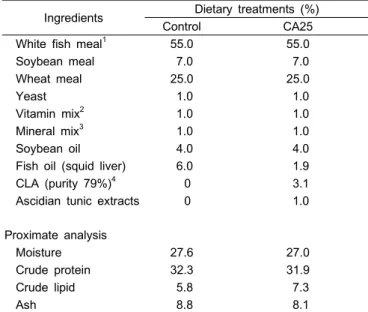
Table 1. Compositions and proximate analysis of the basal diets
Ingredients Dietary treatments (%)
Control CA25
White fish meal1 55.0 55.0
Soybean meal 7.0 7.0
Wheat meal 25.0 25.0
Yeast 1.0 1.0
Vitamin mix2 1.0 1.0
Mineral mix3 1.0 1.0
Soybean oil 4.0 4.0
Fish oil (squid liver) 6.0 1.9
CLA (purity 79%)4 0 3.1
Ascidian tunic extracts 0 1.0
Proximate analysis
Moisture 27.6 27.0
Crude protein 32.3 31.9
Crude lipid 5.8 7.3
Ash 8.8 8.1
1White fish meal supplied by Chunhajeil Feed Co., Dajeon, Korea.
2Vitamin mixture (mg kg-1 diet or IU): thiamin, 50 mg;
riboflavin, 60 mg; calcium pantothenate, 200 mg; biotin 1 mg; folic acid 20 mg; pyridoxine, 40 mg; cyanocobalamimin, 0.05 mg; niacin, 250 mg; ascorbic acid, 1000 mg; inositol, 400 mg; retinyl acetate, 8000 IU; DL-cholecalciferol, 2400 IU; DL-alpha tocopherol acetate 300 IU; sodium menadione bisulphate, 5 mg.
3Mineral mixture (mg kg-1): calcium carbonate, 850 mg;
magnessium oxide, 750 mg; copper sulphate, 25 mg;
manganese sulphate, 100 mg; ferric citrate, 150 mg; zinc sulphate, 120 mg.
4CLA (conjugated linoleic acid) supplied by HK Biotech Co.
Ltd., Jinju, Korea.
재료 및 방법 실험어
본 실험에 사용된 고등어 (Scomber japonicus)는 전보 (Park et al., 2010a)와 같이 남해안에 위치한 통영시 산양면 연안가두 리 양식장 (크기 5×5×7 m)에서 2009년 10월 15일부터 12월 15일까지 총 8주 동안 사육실험을 실시하였다. 양식방법은 한 그룹은 일반사료를 먹였고 (Control), 다른 그룹은 일반사료 에 멍게껍질 추출물과 CLA가 첨가된 사료를 먹인 (CA25) 그룹으로 각각 나누어 하루 2회 급이하였다.
사육용 사료
양식 고등어의 사료는 경남 고성군에 소재한 (주)경남특수 사료에서 생산된 어류용 EP (extruded pellet) 사료에 CLA와 멍게껍질 색소 추출물을 첨가하여 조제한 다음 급이하였고, 실험사료의 배합표와 일반성분은 Table 1과 같다. 조단백질 32%, 지질 6%로 설계하였고, 단백질원으로는 fish meal, soybean meal을 사용하였으며, 지질원으로는 오징어 간유와 대두유, 탄수화물원으로는 wheat flour를 사용하였다. 그 외 혼합 비타민제 및 혼합 미네랄제를 혼합하였다. CLA 및 멍게 껍질 추출물 첨가사료는 다른 영양성분의 양은 동일하게 하였 으며, CA25에는 control구의 어유 량을 줄인 만큼 CLA 2.5%
그리고 멍게껍질 추출물 1.0%가 되도록 첨가하였다. 실험사 료에 첨가한 멍게껍질 추출물은 멍게껍질 일정량에 3배량의 아세톤을 첨가하여 실온에 방치한 다음 색소성분을 충분히 추출, 여과하는 과정을 두 차례 반복하고 여과된 아세톤 추출 물은 회전진공증발농축기 (Rotavapor R-114, Buchi Labortechnik AG, Flawil, Switzerland)로 40℃이하에서 농축하 여 제조하였다 (Choi et al., 1994). CLA는 (주)HK바이오텍에서 화학적으로 합성된 자체규격검사를 통과한 CLA를 구매하여 전체 사료양의 2.5%가 되도록 첨가하였다. 본 실험에 사용된 CLA는 linoleic acid로부터 합성하여 c9,t11-CLA 이성체와 t10, c12-CLA 이성체가 각각 48%씩 함유되어 있었고, 그 외 이성체 는 미량으로 함유되어 있었다. CLA농도를 2.5%로 결정한 것은 Kang and Choi (1998)가 CLA사료를 급이하여 잉어의 성장을 측정한 연구 결과를 참고 하였다. 본 실험에 사용된 기본사료의 성분조성은 건물 기준 조단백 45%, 조지방 8%
및 조회분 11%로 펠렛기를 이용하여 제조한 후 -20℃ 냉동고 에 보관하면서 공급하였다.
총지질의 추출 및 정량
총지질의 추출은 Bligh and Dyer (1959)에 따라 chloroform:
methanol (2:1, v/v) 혼합용매로 반복 실험하였고, 이의 정량은 추출지질을 포화 식염수로 지질과 수분을 분리한 후, 지질층 을 농축하여 chloroform 100 mL로 정용한 다음 무게를 측정하 여 실시하였다.
환원력의 측정
환원력은 Elmastas et al. (2007)이 사용한 방법을 변형하여 사용하였으며, 항산화 물질에 대한 철 이온의 환원력을 측정 한 것이다. 에탄올에 녹인 일정량의 시료는 일정한 간격으로
각각 양을 달리하여 준비하고 여기에 0.2 M phosphate buffer (pH 6.6) 2.5 mL에 1.0% (w/v) potassium ferricyanide [K3Fe (CN)6]용액 1 mL을 가하고, 이 혼합물을 50℃에서 20분간 반응을 시킨 후, 10% (w/v) trichloroacetic acid 용액 2.5 mL을 넣었다. 반응이 끝난 혼합물을 5,000 rpm에서 원심분리 (10 분)하여 얻은 상징액 2.5 mL와 증류수 2.5 mL을 넣고 0.1%
FeCl3 용액 0.5 mL을 가하여, 750 nm에서 흡광도를 측정하였 다. 양성 대조군으로 α-tocopherol (Sigma-Aldrich Co., St.
Louis, MO, USA)및 BHA (butylated hydroxy anisole, Sigma-Aldrich Co.)를 사용하였다.
Linoleic acid를 이용한 항산화활성 측정
Linoleic acid를 이용한 고등어 지질 추출물의 항산화활성 측정은 Osawa and Namiki (1985) 방법을 변형하여 측정하였 다. 시료 액 (0.12%/ethanol, w/v) 4 mL, linoleic acid (2.5%, v/v) 4 mL/ethanol (99.5%), phosphate buffer (0.05 M, pH 7.0) 8 mL, 탈이온수 3.9 mL를 잘 섞은 다음, 마개달린 시료 병에 넣어 40℃ 암소에서 보관하면서 48시간 간격으로 실험하였다.
암소에 저장된 일정양의 시료에 75% 에탄올과 30% NH4SCN, 3.5% 염산에 녹인 0.02 M FeCl2를 더하고 마지막에 ferric thiocyanate시약을 넣은 후, 정확히 3분 후에 흡광도 500 nm에 서 측정하였다. 양성대조군으로 linoleic aicd, α-tocopherol (Sigma-Aldrich Co.) 및 BHA (Sigma-Aldrich Co.)를 사용하여 시료와 동일한 조건에서 반응시켜 48시간 간격으로 반응정도 를 측정하였다.
Linoleic acid inhibition (%) = [1 - (Sample Abs/Control Abs)]
× 100
DPPH 라디칼 소거활성 측정
DPPH를 이용한 라디칼 소거활성은 Chu et al. (2000)의 방법 을 변형하여 측정하였다. 일정량의 시료가 녹은 에탄올 0.2 mL에 0.004 M DPPH (2,2-diphenyl-1-picrylhydrazyl, Aldrich Co.) 0.8 mL를 넣고 10초 동안 vortex mixer (Vortex-Genie 2, Scienctific Industries, Inc., NY, USA)로 혼합한 후, 상온에서 30분 동안 방치한 다음 525 nm에서 흡광도를 측정하였다.
대조군은 추출물 대신 에탄올을 넣고 측정하였으며, 양성 대 조군으로는 에탄올에 녹인 α-tocopherol (Sigma-Aldrich Co.) 과 BHA (Sigma-Aldrich Co.)를 첨가하여 같은 방법으로 분석 하였다. 라디칼 소거 활성은 대조구 흡광도에 대한 시료 흡광 도의 상대비율 (%)로 나타내었다.
DPPH radical scavenging activity (%) = [1 - (Sample Abs/Control Abs)] × 100
Superoxide radical 소거활성 측정
Superoxide radical 소거활성은 Marklund and Marklund (1975)의 방법에 따라 에탄올에 녹인 일정량의 시료에 0.05 M Tris-HCl buffer (pH 8.5) 0.1 mL와 10 mM EDTA (pH 8.5) 3 mL, 7.2 mM pyrogallol (Sigma-Aldrich Co.) 0.2 mL를 첨가하
여 25℃에서 10분간 반응시키고, 1.0 N HCl 1 mL를 더하여 반응을 정지시킨 후, 420 nm에서 흡광도를 측정하고 백분율로 나타내었다. 또한 대조군은 시료 대신 에탄올을 사용하여 동 일한 과정으로 제조하여 420 nm에서 흡광도를 측정하여 superoxide radical 소거효과를 조사하였고, 양성 대조군으로 α-tocopherol (Sigma-Aldrich Co.) 및 BHA (Sigma-Aldrich Co.) 를 사용하였다.
Superoxide radical scavenging activity (%) = [1 - (Sample Abs/Control Abs)] × 100
Hydroxyl radical 소거활성 측정
Hydroxyl radical 소거활성은 Chung and Osawa (1998)의 방법을 변형하여 사용하였다. 일정량의 시료용액에 10 mM의 FeSO4/7H2O 용액 0.2 mL, 10 mM 2-deoxyribose 0.2 mL, 0.1 M phosphate buffer (pH 7.4)를 첨가하여 전체를 1.8 mL로 만든 후 10 mM H2O2 0.2 mL를 가하고, 37℃ 항온수조에서 4시간 반응시킨 후, 2.8% TCA (trichloroacetic acid) 용액과 TBA (thiobarbituric acid)용액을 각 1 mL씩을 더하여 100℃에 서 10분 가열한 후, 급속히 냉각시켜 515 nm에서 흡광도를 측정하였다. 양성 대조군으로 α-tocopherol (Sigma-Aldrich Co.) 및 BHA (Sigma-Aldrich Co.)를 사용하였다.
Hydroxyl radical scavenging activity (%) = [1 - (Sample Abs/Control Abs)] × 100
통계 처리
각 실험은 모두 3회 이상 반복실험을 통해 결과를 얻었으며, 결과의 통계처리는 SPSS (Statistical package for the social science, Chicago Illinois, USA) program version 12.0을 이용하 였으며, 각각의 시료에 대해서는 평균±표준편차로 나타냈다.
각 시료에 대한 유의차 검정은 One-way ANOVA test와 T-test 를 실시하여 분산분석한 후, Duncan's multiple range test에 의해 정직유의차검정을 실시하여 유의차 검정 (p<0.05)을 실 시하였다.
결과 및 고찰
환원력 측정
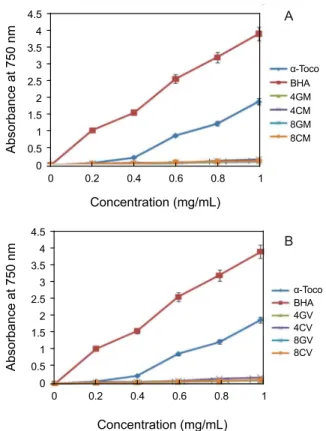
환원력은 환원인자의 존재여부와 연관이 있으며 항산화력 과도 밀접한 관계를 갖는다. Potassium ferricyanide법을 사용 하여 철이온 (Fe3+가 Fe2+로 변화)의 환원력에 대한 시료의 항산화력을 측정한 결과는 Fig. 1과 같다. 양성 대조군인 α -tocopherol과 BHA의 환원력이 최대 농도인 1 mg/mL에서 1.891, 3.912로 상대적으로 월등히 높게 나타났지만, 육과 내 장, Control과 CA25의 구분 없이 모든 시료의 환원력은 낮았 다. 육 지질 (A) 시료는 최대 농도인 1 mg/mL의 농도에서 4GM, 4CM, 8GM, 8CM이 각각 0.169, 0.171, 0.106, 0.126으로 대조군에 비해 낮은 값을 나타내었고, 내장 지질 (B) 시료인 4GV, 4CV, 8GV, 8CV 역시 최대 농도인 1 mg/mL에서 0.102,
Fig. 1. Reducing power of lipid extracted from muscle (A) and viscera (B) of mackerel after fed with experimental diets for 8 weeks. Final concentration of samples and standards (0.2~1.0 mg/mL). α-Toco; α-Tocopherol, BHA; butylated hydroxy anisole, 4GM; lipid extracted from mackerel muscle fed without CLA for 4 weeks, 4CM; lipid extracted from mackerel muscle fed with CLA 2.5% for 4 weeks, 8GM;
lipid extracted from mackerel muscle fed without CLA for 8 weeks, 8CM; lipid extracted from mackerel muscle fed with CLA 2.5% for 8 weeks, 4GV; lipid extracted from mackerel viscera fed without CLA 2.5% for 4 weeks, 4CV;
lipid extracted from mackerel viscera fed with CLA 2.5%
for 4 weeks, 8GV; lipid extracted from mackerel viscera fed without CLA 2.5% for 8 weeks, 8CV; lipid extracted from mackerel viscera fed with CLA 2.5% for 8 weeks.
0.193, 0.104, 0.115로 낮은 값을 나타내었으며 시료 간에 유의 성 (P<0.05)은 없었다. 합성 항산화제인 BHT (Kim et al., 2004) 및 BHA 등은 천연항산화제인 α-tocopherol의 환원력에 비하 여 농도증가에 따라 3배 이상 높은 값을 나타내었다. 생 아귀 부위별 추출물 중 간 부위가 껍질이나 육 등의 추출물보다 높은 환원력을 보여주어 간에 존재하는 항산화성 물질이 영향 을 미친다고 하였으며 (Lee et al., 2007), 고등어 육 및 내장 지질에 함유된 카로테노이드 및 CLA에 의한 환원력은 기대할 수 없었다.
Ferric thiocyanate 법을 이용한 항산화 활성
Linoleic acid (LA)는 동물 체내에서 인지질을 구성하거나 식물성 기름에 존재하는 불포화 지방의 하나로 free radical에 의해 자동산화 되면서 생성되는 과산화지질의 함량을 ferric
Fig. 2. Linoleic acid autoxidation of lipid extracted from muscle (A) and viscera (B) of mackerel after fed with experimental diets for 8 weeks. Final concentration of samples and standards (100 μg/mL). L-A; Linoleic Acid, α-Toco;
α-Tocopherol, BHA; butylated hydroxy anisole, 4GM; lipid extracted from mackerel muscle fed without CLA for 4 weeks, 4CM; lipid extracted from mackerel muscle fed with CLA 2.5% for 4 weeks, 8GM; lipid extracted from mackerel muscle fed without CLA for 8 weeks, 8CM; lipid extracted from mackerel muscle fed with CLA 2.5% for 8 weeks, 4GV;
lipid extracted from mackerel viscera fed without CLA 2.5%
for 4 weeks, 4CV; lipid extracted from mackerel viscera fed with CLA 2.5% for 4 weeks, 8GV; lipid extracted from mackerel viscera fed without CLA 2.5% for 8 weeks, 8CV;
lipid extracted from mackerel viscera fed with CLA 2.5%
for 8 weeks.
thiocyanate (FTC)에 의해 측정한다. CLA와 멍게껍질 추출물 이 첨가된 사료를 8주간 고등어에 급이한 다음, 고등어로부터 지질을 추출하여 저장하면서 지질산화를 측정한 결과를 Fig.
2에 나타내었다. LA구 및 모든 시료구를 40℃에서 8일간 저장 하였을 때, 산화 초기에는 고등어 육 지질 (A)의 경우 LA와 함께 α-tocopherol, BHA, 4GM, 4CM, 8GM, 8CM의 산화가 진행되었고, 저장 4일 이후 BHA의 항산화활성이 가장 높아 LA의 55.9%, α-tocopherol은 40.1%를 나타내었다. 시료 지질 인 4GM, 4CM, 8GM, 8CM도 저장 6일째 42.8-38.6%의 항산화 활성을 나타내었으며, 각 시료 간에 유의성 (P<0.05)은 보이지 않았다. 내장 지질 (B)의 경우 저장 6일째 4GM, 4CM, 8GM, 8CM에서 육 지질과 비슷한 42.8-40.3%의 항산화활성을 나타 내었고, 각 시료 간에 유의성 (P<0.05)은 보이지 않았다. 이는
LA를 이용할 수 있는 Fe2+의 산화가 멈춤으로써 과산화물의 생성을 억제한 것으로 보이며, 지질에 함유된 CLA 및 껍질에 함유된 카로테노이드 화합물의 영향인 것으로 추정된다. 해마 에 함유된 항산화성분을 추출하기 위하여 물과 용매를 사용한 경우 물 추출물 (70.4%) 보다는 MeOH (84.0%) 및 EtOH (80.3%)로 추출하는 경우 phenolic 화합물의 함량이 높아 저장 7일 후 FTC에 의한 항산화효과가 높았다고 하였다 (Qian et al., 2008). Park et al. (2010b) 등에 의하면 LA계에 미더덕 껍질 추출물의 함량을 증가시키면 (100~500 μg/mL) 항산화 효과도 높아진다고 한 결과와도 일치하는 것으로 나타났다.
DPPH free radical 소거활성
DPPH는 그 자체가 질소 중심의 라디칼로서 라디칼 전자의 비편재화에 의해 안정화된 상태로 존재한다. 다른 free radical 들과 결합하여 안정한 복합체를 만들고, 항산화 활성이 있는
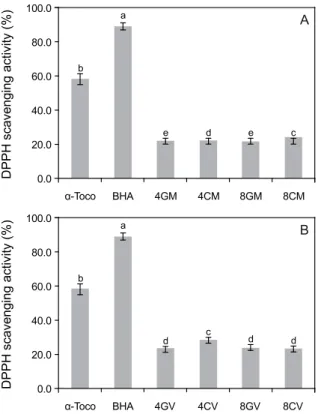
Fig. 3. DPPH radical scavenging effect of lipid extracted from muscle (A) and viscera (B) of mackerel after fed with experimental diets for 8 weeks. Final concentration of samples and standards (200 mg/mL). α-Toco; α-Tocopherol, BHA;
butylated hydroxy anisole, 4GM; lipid extracted from mackerel muscle fed without CLA for 4 weeks, 4CM; lipid extracted from mackerel muscle fed with CLA 2.5% for 4 weeks, 8GM; lipid extracted from mackerel muscle fed without CLA for 8 weeks, 8CM; lipid extracted from mackerel muscle fed with CLA 2.5% for 8 weeks, 4GV; lipid extracted from mackerel viscera fed without CLA 2.5% for 4 weeks, 4CV; lipid extracted from mackerel viscera fed with CLA 2.5% for 4 weeks, 8GV; lipid extracted from mackerel viscera fed without CLA 2.5% for 8 weeks, 8CV; lipid extracted from mackerel viscera fed with CLA 2.5% for 8 weeks.
물질과 만나면 radical이 소거되어 특유의 청남색이 옅어지는 특성이 있다. 이런 특성을 이용하여, 지질과 산화 연쇄 반응에 관여하는 산화성 free radical에 전자를 공여하게 하여 free radical의 생성 억제 정도를 간접적으로 측정할 수 있다 (Hyun et al., 2007). 사육된 고등어 육 (A)과 내장 (B)에서 추출한 지질의 DPPH 라디칼 소거활성을 측정하기 위해 양성대조군 으로 α-tocopherol과 BHA를 동일한 조건에서 측정하여 Fig.
3에 각각 나타내었다. 분석결과 α-tocopherol과 BHA의 소거 활성은 각각 58.9%, 89.1%로 높은 활성을 보였고, 고등어 육 지질의 소거활성은 4GM, 4CM, 8GM, 8CM이 각각 21.9%, 22.4%, 21.9% 24.0%로 양성 대조구인 α-tocopherol과 BHA와 비교하였을 때 비교적 낮은 소거활성을 나타내었지만, 4CM과 8CM은 4GM 및 8GM과 비교하였을 때 유의성이 (P<0.05) 있는 것으로 나타났다. 또한 내장 지질의 경우는 4GV, 4CV, 8GV, 8CV 역시 23.6%, 28.5%, 23.5%, 23.7%로 육 지질구보다 는 약간 높게 나타났지만, 4주 후 내장 지질 (4CV)구의 항산화 활성이 높은 것 (P<0.05)은 8주 후 내장 지질의 함량이 감소하 고 카로테노이드 축적이 낮은 결과와 관련이 있는 것으로 판단된다 (Park et al., 2010a). DPPH free radical 소거활성법을 통하여 활성산소의 인체 내 독성작용을 저지하는 활성물질의 분리는 항산화제가 될 가능성이 있다고 한다면 (Shin, 2010), CLA가 함유된 고등어는 유통기간의 연장과 함께 기능성 어류 로서의 가치가 인정된다고 할 수 있다. Noruma et al. (1997)에 의하면 DPPH 측정시 시료 추출물에 함유된 카로테노이드 성분이 항산화성 향상에 영향을 준다고 하였으며, 4CM, 8CM 및 4CV에 축적된 껍질 추출물에도 카로테노이드가 검출되었 으므로 (Park et al., 2010a) DPPH 소거활성에 영향을 미친 것으로 여겨진다.
Superoxide radical 소거효과
우리가 섭취하는 식품 중에는 생체 내에서 지속적으로 생성 되는 superoxide anion (O2-
), hydrogen peroxide (H2O2) 및 hydroxyl radical (OH) 등과 같은 O2 대사물로 일컬어지는 reactive oxygen species (ROS)를 적절하게 제어하여 세포 수준 의 단백질, 지질, 핵산 등의 손상을 보호하는 역할을 한다 (Ames et al., 1993). 사육된 고등어 육 및 내장 지질의 산화를 어느 정도 억제할 수 있는지를 파악하기 위하여 pyrogallol의 자동산화를 저해하는 정도로서 superoxide anion 소거효과를 측정하여 Fig. 4에 각각 나타내었다. 양성 대조군으로 사용한 α-tocopherol과 BHA는 각각 41.7%와 62.4%의 소거활성을 보였고, 고등어 육 지질 (A) 시료인 4GM, 4CM, 8GM, 8CM은 각각 32.0%, 34.1%, 32.2%, 35.4%로 나타나 CLA 및 카로테노 이드가 함유된 4CM과 8CM간에는 유의성 (P<0.05) 있는 결과 를 보였으며, 내장 지질 (B) 시료 4GV, 4CV, 8GV, 8CV 경우 34.7%, 40.2% 36.4%, 39.0%로 양성 대조군인 α-tocopherol보 다는 약간 낮지만 모두 유의성 (P<0.05) 있는 결과를 나타내었 다. Kuwahara et al. (2009)에 의하면 카로테노이드 색소가 superoxide anion 소거효과에 중요한 역할을 하는 것으로 보고 하고 있는데 본 실험의 시료 중 4CV와 8CV의 카로테노이드
Fig. 4. Superoxide radical scavenging activity of lipid extracted from muscle (A) and viscera (B) of mackerel after fed with experimental diets for 8 weeks. Final concentration of samples and standards (200 mg/mL). α-Toco; α -Tocopherol, BHA; butylated hydroxy anisole, 4GM; lipid extracted from mackerel muscle fed without CLA for 4 weeks, 4CM; lipid extracted from mackerel muscle fed with CLA 2.5% for 4 weeks, 8GM; lipid extracted from mackerel muscle fed without CLA for 8 weeks, 8CM; lipid extracted from mackerel muscle fed with CLA 2.5% for 8 weeks, 4GV;
lipid extracted from mackerel viscera fed without CLA 2.5%
for 4 weeks, 4CV; lipid extracted from mackerel viscera fed with CLA 2.5% for 4 weeks, 8GV; lipid extracted from mackerel viscera fed without CLA 2.5% for 8 weeks, 8CV;
lipid extracted from mackerel viscera fed with CLA 2.5%
for 8 weeks.
함량이 상대적으로 많은 것에 기인된다고 추정되었다 (Park et al., 2010a). 많은 연구에서 해양생물은 다양한 종류의 카로 테노이드를 함유하고 있으며, 특히 해양생물의 껍질은 카로테 노이드의 좋은 공급원이 된다고 하였다 (Ookubo and Matsuno, 1985). Choi et al. (1994)에 의하면 멍게 껍질에 함유된 카로테 노이드 함량은 47.9 mg/100 g이고, 주 성분은 alloxanthin (31.3%), halocynthiaxanthin (15.5%), diatoxanthin (11.9%) 및 astaxanthin (7.8%)으로 이들에 함유된 극성분자단인 carbonyl 및 hydroxyl기와 공역이중결합의 수에 의하여 radical 소거활 성에 영향을 미친다고 하였다 (Zulueta et al., 2007).
Hydroxyl radical 소거활성
Hydroxyl radical 소거활성은 2-deoxy-D-ribose를 시료에 첨 가하여 fenton reaction에 의해 malonaldehyde를 생성하게 한
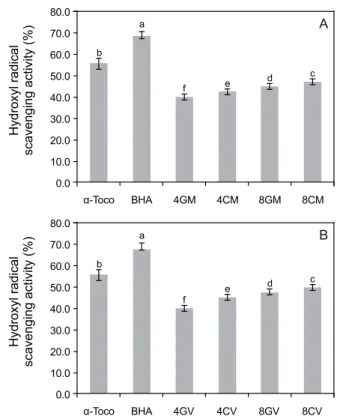
Fig. 5. Hydroxyl radical scavenging activity of lipid extracted from muscle (A) and viscera (B) of mackerel after fed with experimental diets for 8 weeks. Final concentration of samples and standards (200 mg/mL). α-Toco; α-Tocopherol, BHA;
butylated hydroxy anisole, 4GM; lipid extracted from mackerel muscle fed without CLA for 4 weeks, 4CM; lipid extracted from mackerel muscle fed with CLA 2.5% for 4 weeks, 8GM; lipid extracted from mackerel muscle fed without CLA for 8 weeks, 8CM; lipid extracted from mackerel muscle fed with CLA 2.5% for 8 weeks, 4GV; lipid extracted from mackerel viscera fed without CLA 2.5% for 4 weeks, 4CV; lipid extracted from mackerel viscera fed with CLA 2.5% for 4 weeks, 8GV; lipid extracted from mackerel viscera fed without CLA 2.5% for 8 weeks, 8CV; lipid extracted from mackerel viscera fed with CLA 2.5% for 8 weeks.
후 (Kwon et al., 2007), 여기에 TCA (trichloroacetic acid) 용액과 TBA (thiobarbituric acid) 용액을 첨가하여 100℃에서 가열한 후 생성되는 화합물의 흡광도를 측정하여 나타내는 것으로 결과는 Fig. 5와 같다. Hydroxyl radical 소거활성은 α -tocopherol과 BHA의 경우 각각 55.6%와 68.1%로 나타났고, 고등어 육 지질 (A) 시료인 4GM, 4CM, 8GM, 8CM의 경우 각각 39.8%, 42.3%, 44.6%, 46.7%로 나타났다. Hydroxyl radical 소거활성은 내장 지질 (B) 시료인 4GV, 4CV, 8GV, 8CV 경우에도 각각 40.3%, 45.5% 47.5%, 49.8%로 나타나 지질 함량이 높은 시료에서 높은 소거활성을 보였으며, 시료 간 유의성이 (P<0.05) 인정되었다. 이는 시료에 함유된 CLA와 카로테노이드의 함량의 차이에 따른 것으로 사육기간이 길어 짐에 따라 소거활성도 함께 증대되는 것으로 나타났다.
Bergamo et al. (2007)에 따르면 임신 중인 mice에 CLA와 올리 브 유를 급여한 다음 간과 비장의 산화적 스트레스를 조사한 결과 CLA를 섭취한 mice에서 라디칼 소거활성이 높아져 산화 적 스트레스를 잘 극복한다고 하였다. Yun and Park (2001) 역시 어유와 같은 불포화도가 높은 지방을 섭취하여 조직 내 TBARS 생성이 높았을 때는 CLA에 의하여 조직 내 TBARS 의 함량이 감소하는 항산화 작용을 보고하고 있다. 뿐만 아니 라 hydroxy radical이 인간의 백혈구를 자극하여 DNA의 손상 을 가져오는 것을 억제하기 위하여 미더덕 껍질 에탄올 추출 물을 농도별로 처리한 결과 농도가 증가될수록 DNA 손상을 억제하였으며 (Park et al., 2010b), 이는 미더덕 껍질에 포함된 카로테노이드인 halocynthiaxanthin이 2-amino-3-methylimidazole [4,5-f] quinoline과 같은 돌연변이원성 물질의 생성을 49.7-77.5% 감소시켰다는 보고 (Ha et al., 2000)를 뒷받침하고 있어 기능성 고등어로서의 개발이 가능할 것으로 여겨진다.
사 사
본 연구과제는 2009년도 경남테크노파크에서 시행한 지역 기반육성기술개발사업 연구비 지원에 의해 수행된 결과의 일부이며 이에 감사드립니다 (과제번호 : 20094001).
참고문헌
Ames BN, Shigenoga MK and Hagen TM. 1993.
Oxidants, antioxidants, and the degenerative diseases of aging. Proc Natl Acad Sci 90, 7915-7922.
Bergamo P, Maurano F and Rossi M. 2007. Phase 2 enzyme induction by conjugated linoleic acid improves lupus-associated oxidative stress. Free Radic Biol Med 43, 71-79.
Bligh EG and Dyer WT. 1959. A rapid method of total lipid extraction and purification. Can J Biochem Physiol 37, 911-917.
Choi BD, Kang SJ, Choi YJ, Youm MG and Lee KH.
1994. Utilization of ascidian (Halocynthia roretzi) tunic 3. Carotenoid compositions of ascidian tunic.
Bull Korean Fish Soc 27, 344-350.
Chu YH, Chang CL and Hsu HF. 2000. Flavonoid content of several vegetables and their antioxidant activity.
J Sci Food Agr 80, 561-566.
Chung SK and Osawa T. 1998. Hydroxyl radical scavenging from white mustard (Sinapis alba). Food Sci Biotech 7, 209-213.
Cooper DA, Eldridge AL and Peters JC. 1999. Dietary carotenoids and certain cancers, heart disease, and age related macular degeneration: A review of recent research. Nutr Rev 57, 201-214.
Dyerberg J, Madsen P, Møller JM, Aardestrup I and Schmidt EB. 2010. Bioavailability of marine n-3 fatty
acid formulations. Prost Leuko Essential Fatty Acids 83, 137-141.
Edge R, McGarvy DJ and Truscott TG. 1997. The carotenoids as antioxidants-a review. J Photochem Photobiol B 41, 189-200.
Elmastas M, Isildak O, Turkekul I and Temur N. 2007.
Determination of antioxidant activity and antioxidant compounds in wild edible mushroom. J Food Comp Anal 20, 337-345.
Guo R. 2010. Conjugated linoleic acid (CLA) deposition and antioxidant activity of lipid extracted from black seabream (Acanthopagrus schlegeli) and rockfish (Sebastes schlegeli) fed with CLA and carotenoids.
MS Thesis, Gyeongsang National University.
Ha BS, Baek SH and Kim SY. 2000. Carotenoids components of tunicate, shellfishes, and its inhibitory effects on mutagenecity and growth of tumor cell.
J Korean Soc Food Sci Nutr 29, 922-934.
Hyun SH, Lee JS, Lee KB and Lee JS. 2007. Antioxidative activity of Gynostemma pentaphyllum makino extracts. Korean J Food Sci Technol 39, 447-451.
Ip C, Dong Y, Ip MM, Banni S, Carta G, Angioni E, Murru E, Spada S, Melis MP and Saebo A. 2002.
Conjugated linoleic acid isomers and mammary cancer prevention. Nutr Cancer 43, 52-58.
Kang SJ and Choi BD. 1998. Encouragement of cooperative research after openness of import fishes / Production of fish containing newly recognized anticarcinogen CLA (Conjugated Linoleic Acid). J Ins Marin Industry 8, 3-17.
KFDA. 2009. Korea Food & Drug Adminastration.
http://hfoodi.kfda.go.kr/material/
Kim YJ, Lee KW and Lee HJ. 2004. Total antioxidant capacity of arginine-conjugated linoleic acid (CLA) complex. J Agric Food Chem 52, 439–444.
Kuwahara R, Hatate H, Yukia T, Murata H. Tanaka R and Hamada Y. 2009. Antioxidant property of polyhydroxylated naphthoquinone pigments from shells of purple sea urchin Anthocidaris crassispina.
Food Sci Techn 42, 1296-1300.
Kwon GJ, Choi DS and Wang MH. 2007. Biological activities of hot water extracts from Euonymus alatus leaf. Korean J Food Sci Technol 39, 569-574.
Lee JM, Chang PS and Lee JH. 2007. Comparison of oxidative stability for the thermally-oxidized vegetable oils using a DPPH method. Korean J Food Sci Nutr 39, 133-137.
Marklund S and Marklund G. 1975. Involvement of superoxide anion radical in the oxidation of
pyrogallol and a convenient assay for superoxide dismutase. Eur J Biochem 47, 468-474.
Nomura T, Kikuchi M, Kubodera A and Kawakami Y.
1997. Proton-donative antioxidant activity of fucoxanthin with 1,1-diphenyl-2-picrylhydrazyl (DPPH). Biochem Mol Biol Int 42, 361-370.
Ookubo M and Matsuno T. 1985. Carotenoids of sea squirts—II. Comparative biochemical studies of carotenoids in sea squirts. Comp Biochem Physiol Part B, 81, 137-141.
Osawa T and Namiki M. 1985. Natural antioxidant isolated from Eucalyptus leaf waxes. J Agric Food Chem 33, 777-780.
Park EJ, Kim JT, Kang SJ and Choi BD. 2010a. Fatty acid composition of mackerel (Scomber japonicus) fed a diet fortified with CLA and ascidian (Halocynthia roretzi) tunic extracts. Kor J Fish Aquat Sci 43, 581-588.
Park JH, Seo BY, Lee SC and Park EJ. 2010b. Effects of ethanol extracts from stalked sea squirt (Styela clava) on antioxidant potential, oxidative DNA damage and DNA repair. Food Sci Biotechnol 19, 1035-1040.
Park JN. 2006. Lipid oxidation and sensory characteristics of mackerel (Scomber japonicus) treated with vitamin C and salted with NaCl or KCl. MS Thesis, Chonbuk National University.
Qian ZJ, Ryu BM, Kim MM and Kim SK. 2008. Free radical and reactive oxygen species scavenging activities of the extracts from seahorse, Hippocampus kuda bleeler. Biotech Biopro Engine 13, 705-715.
Sapieha P, Stahl A, Chen J, Seaward MR, Willett KL, Krah NM, Dennison RJ, Connor KM, Aderman CM, Liclican E, Carughi A, Perelman D, Kanaoka Y, SanGiovanni JP, Gronert K and Smith LEH. 2011.
5-Lipoxygenase metabolite 4-HDHA is a mediator
of the antiangiogenic effect of n-3 polyunsaturated fatty acids. Sci Transl Med 69, 69ra12.
Shin MO. 2010. The antioxidative and antimicrobial effects of internal organs of Aplysia kurodai fractions.
J Korean Soc Food Sci Nutr 39, 1433-1438.
Torrissen OJ. 1986. Pigmentation of salmonids—A comparison of astaxanthin and canthaxanthin as pigment sources for rainbow trout. Aquaculture 53, 271-278.
Yamada T, Aoki I, Shiraishi M and Mitani I. 1996.
Maturation and spawning of the Japanese chub mackerel, Scomber japonicus, in the sea area of Izu Islands. Bull Jpn Soc Fish Oceanogr 60, 331-338.
Yamada U, Tagawa M, Kishda S and Honjo K. 1986.
Fishes of the east China and Yellow sea. Bull Seikai Reg Fish Res Lab, 501.
Yasmin A and Takeuchi T. 2002. Influence of dietary levels of conjugated linoleic acid (CLA) on juvenile tilapia Oreochromisniloticus. Fish. Sci. 68, 991-992.
Yoon SJ, Kim DH, Baeck GW and Kim JW. 2008.
Feeding habit of chub mackerel (Scomber japonicus) in the South Sea of Korea. J Kor Fish Soc 41, 26-31.
Yun KM and Park HS. 2001. Conjugated linoleic acid supplemented to dietary fat has an antioxidant activities, but it depends on the type of fat in diet.
Korean J Nutr 34, 858-864.
Zulueta A, Esteve MJ, Frasquet I and Ana Frígola A.
2007. Vitamin C, vitamin A, phenolic compounds and total antioxidant capacity of new fruit juice and skim milk mixture beverages marketed in Spain.
Food Chem 103, 1365-1374.
2011년 4월 1일 접수 2011년 5월 31일 수정 2011년 6월 8일 수리