한국컴퓨터정보학회 하계학술대회 논문집 제25권 제2호 (2017. 7)
135
차량의 후미등을 이용한 야간 고속도로상의 실시간 차량검출 및 카운팅
칼릴로브 발리존
ㅇ, 오염덕
*, 김봉근
*ㅇ*
한국교통대학교 소프트웨어전공
e-mail: [email protected]
O, [email protected]
*, [email protected]
*Real Time Vehicle Detection and Counting Using Tail Lights on Highway at Night Time
Khalilov Valijon
O, Ryumduck Oh
*, Bongkeun Kim
*ㅇ*
Dept. of Software, Korea National University of Transportation
●
요 약
●When driving at night time environment, the whole body of transports does not visible to us. Due to lack of light conditions, there are only two options, which is clearly visible their taillights and break lights. To improve the recognition correctness of vehicle detection, we present an approach to vehicle detection and tracking using finding contour of the object on binary image at night time. Bilateral filtering is used to make more clearly on threshold part.
To remove unexpected small noises used morphological opening. In verification stage, paired tail lights are tracked during their existence in the ROI. The accuracy of the test results for vehicle detection is about 93%.
키워드: vehicle detection, bilateral filtering, morphological opening, vehicle tracking and counting
I. Introduction
Nowadays, the number of vehicle usage is increasing significantly and as a result, some huge problems have appeared in Traffic Monitoring System. For instance, traffic congestions, traffic accidents and other problems. Among these problems there is one of the most common challenging problem is traffic congestions. We propose an approach to vehicle detection and tracking using contour finding, bilateral filtering and morphological operators. The proposed system is able to control the status of taillights.
II. Related Works
Pillai[1] has reviews different techniques used for the detection and identification of taillights of vehicle during nighttime.
However, by using this method, there is occurred some problems during the image processing. The methods implemented for
detection are not used for heavy vehicles as their taillight orientation is different from that of cars and motorbikes.
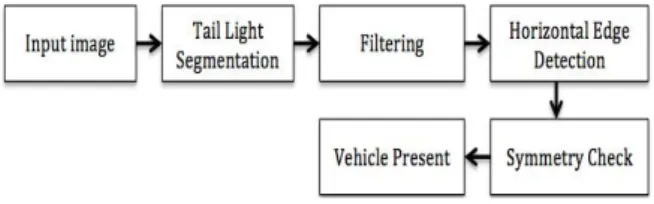
Fig. 1. Vehicle Detection Step
III. The Proposed Methodology
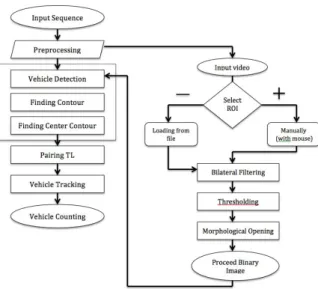
The flow chart of the proposed algorithm is presented in Figure 2. In the first stage, selecting ROI (Region of Interest) by manually. In the next stage is used Bilateral Filtering in binary images, and in the third stage morphological opening by using binary image.
한국컴퓨터정보학회 하계학술대회 논문집 제25권 제2호 (2017. 7)
136
Fig. 2. Vehicle detect and counting algorithm
Vehicle Detection
Detection part use contour functions. We divided in two groups.
First, finding contour of the object in binary image(Fig. 3a ).
Second, finding center point of each contour(Fig. 3b ).
a) finding contour b) finding center point Fig. 3. Taillight Detection Process
Pairing TL
Pairing TL(tail light) part find a distance of objects under (+10) (-10) degrees. The pairing of rear-lights was successfully achieved. In the Fig. 4 shows Pairing TL.
Fig. 4. Pairing Taillight Process
IV. Implementation
Performance Analysis
Performance are tested by using proposed algorithm on image sequences on highways. All the videos chosen for vehicle tracking
have same light intensity and have been taken during night time[2]. And then, we count the number of vehicles passing through the highway intersection in a given time duration. The experimental results are shown in the table 1.
Table 1. Accuracy of Counting
V. Conclusions
In this paper, we proposed the vehicle detection and counting method using tails lights on highway at night time. The proposed method successfully achieved images for heavy vehicles and general vehicles as their tail lights. The implemented results illustrate that the accuracy of counting vehicles 93%.
In terms of future work, we are planning to make under adverse weather condition.
Acknowledgments
This research was financially supported by the Ministry of Education (MOE) and National Research Foundation of Korea(NRF) through the Human Resource Training Project for Regional Innovation (No. 2014H1C1A1066414) and this research was supported by the MSIP(Ministry of Science, ICT and Future Planning), Korea, under the ITRC(Information Technology Research Center) support program (IITP-2017-2013-0-00680) supervised by the IITP(Institute for Information &
communications Technology Promotion)
REFERENCES
[1] Swathy S Pillai, Radhakrishnan B, "Night Time Vehicle Detection Using Tail Lights: A Survey," International Journal of Engineering Research and General Science Volume 4, Issue 2, March-April, 2016. ISSN 2091-2730.
[2] L. Vibha, “Moving Vehicle Identification using Background Registration Technique for Traffic Surveillance,” International Multi Conference of Engineers & Computer Scientist 2008, 20080101.