한국컴퓨터정보학회 동계학술대회 논문집 제27권 제1호 (2019. 1)
123
● 요 약 ●
This paper proposes an improved deep learning method based on small data sets for animal image classification.
Firstly, we use a CNN to build a training model for small data sets, and use data augmentation to expand the data samples of the training set. Secondly, using the pre-trained network on large-scale datasets, such as VGG16,the bottleneck features in the small dataset are extracted and to be stored in two NumPy files as new training datasets and test datasets. Finally, training a fully connected network with the new datasets. In this paper, we use Kaggle famous Dogs vs Cats dataset as the experimental dataset, which is a two-category classification dataset.
키워드: Improved deep learning, cNN, animal images
동물 이미지를 위한 향상된 딥러닝 학습
왕광싱*, 신성윤O, 신광성**, 이현창**
O*군산대학교 컴퓨터정보통신공학부
**원광대학교 디지털콘텐츠공학과
e-mail: [email protected]O, {waver, hclglory}@wku.ac.kr**
An Improved Deep Learning Method for Animal Images
Guangxing Wang*, Seong-Yoon ShinO, Kwang-Weong-Shin**, Hyun-Chang Lee**
OSchool of Com. Inf. & Comm. Eng., Kunsan National University
**Dept. of Digital Contents Eng., Wonkwang University
I. Introduction
In recent years, convolutional neural networks (CNNs) technology based on deep learning method [1] has made remarkable achievements in the field of computer vision, mainly applied to face recognition, image classification, natural language processing and so on [2-5]. However, CNNs require sufficient data samples for training to improve prediction accuracy.
II. Related Work
In order to achieve better generalization capabilities, the deep learning model relies in particular on the availability of a large amount of training data. Therefore, since deep learning has become popular in computer vision, a large number of well-marked image datasets have been introduced. However, for small datasets, the sample data used to train the network is limited, and the prediction results are not accurate and over-fitting due to too small data volume. Therefore, data
augmentation, regularization, and the Dropout methods are often used to suppress over-fitting of prediction results.1. CART model
Ⅲ. Proposed Method
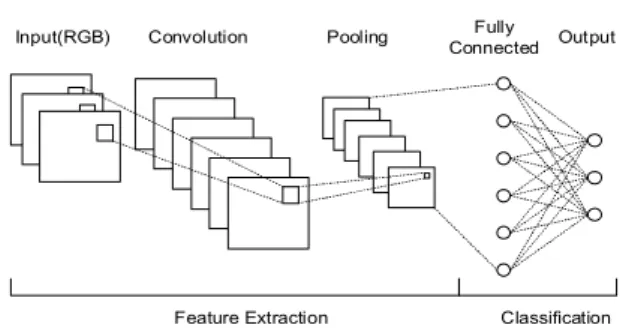
Convolution
Input(RGB) Pooling Fully
Connected Output
Feature Extraction Classification
Fig. 1. Convolutional block structure of a CNN (CNN consists of five parts, feature extraction and
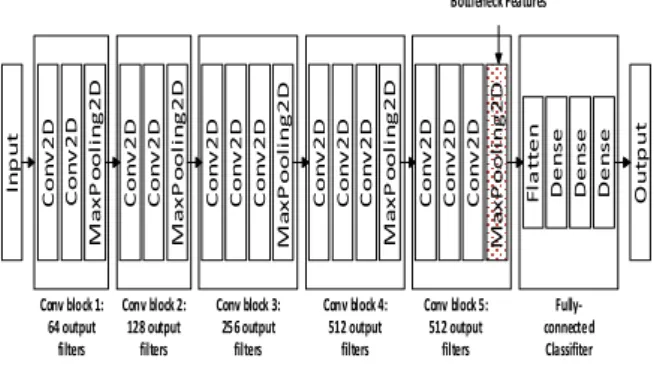
classification are performed during model training) The VGG16 model is a CNN model with five convolutional blocks and a fully connected layer, as shown in Fig. 2.
한국컴퓨터정보학회 동계학술대회 논문집 제27권 제1호 (2019. 1)
124
Input Output
Conv2D MaxPooling2D MaxPooling2D MaxPooling2D MaxPooling2D MaxPooling2D
Conv2D Conv2D Conv2D Conv2D Conv2D Conv2D Conv2D Conv2D Conv2D Conv2D Conv2D Conv2D Flatten Dense Dense Dense
Conv block 1:
64 output filters
Conv block 2:
128 output filters
Conv block 3:
256 output filters
Conv block 4:
512 output filters
Conv block 5:
512 output filters
Fully- connected Classifiter Bottleneck Features
Fig. 2. VGG16 CNN structure diagram
Data augmentation is a method that can effectively suppress overfitting. The method can generate new samples with original image data features by performing operations such as rotation, scaling, shifting, mirroring, etc. within a certain range of values of the original image. Thereby achieving the purpose of increasing the number of data samples in the training set.
IV. Experiments
Fig. 3. Improved CNN experiment results:
(a) accuracy statistics for training and prediction, (b) loss rate statistics for training and testing.
V. Conclusions
This paper presented an improved deep learning method based on small datasets for animal image classification. A two-category experiment was performed in the Kaggle Dogs vs Cats dataset.
The Kaggle Dogs vs Cats dataset consists of 25,000 training sets for pictures of dogs and cats with labels, and a 12500 test set for pictures of dogs and cats without labels.
REFERENCES
[1] J. Lemley, S. Bazrafkan, and P. Corcoran, “Deep learning for consumer devices and services: Pushing the limits for
machine learning, artificial intelligence, and computer vision,” IEEE Consumer Electronics Magazine, vol. 6, no.
2, pp. 48-56, 2017.
[2] Alex Krizhevsky,Ilya Sutskever,Geoffrey E. Hinton,
“ImageNet Classification with Deep Convolutional Neural Networks,” Advances in Neural Information Processing Systems 25, (NIPS 2012), pp.1-9, 2012.
[3] Karen Simonyan, Andrew Zisserman. “Very Deep Convolutional Networks for Large-Scale Image Recognition,” Computer Science, pp. 1-14, 2014.
[4] Christian Szegedy, Wei Liu, Yangqing Jia, Pierre Sermanet, Scott Reed, Dragomir Anguelov, Dumitru Erhan, Vincent Vanhoucke, Andrew Rabinovich, “Going Deeper With Convolutions,” The IEEE Conference on Computer Vision and Pattern Recognition, pp. 1-9, 2015.
[5] Kaiming He, Xiangyu Zhang, Shaoqing Ren, Jian Sun,
“Deep Residual Learning for Image Recognition,” The IEEE Conference on Computer Vision and Pattern Recognition (CVPR), pp. 770-778, 2016.