흡착제를 이용한 참기름의 벤조피렌 저감화
최승관․최수빈․강성태† 서울과학기술대학교 식품공학과
Reduction of Benzo(a)pyrene Content in Sesame Oil by Using Adsorbents
Seung Kwan Choi, Su Bin Choe, and Sung Tae Kang†
Dept. of Food Science and Technology, Seoul National University of Science and Technology, Seoul 139-743, Korea
ABSTRACT This study was conducted to reduce benzo(a)pyrene in sesame oil by addition of several kinds of absorb- ents (active carbon, diatomaceous earth, kaolin, acid clay, perlite, and silicate). Sesame oil containing 4.1 ppb ben- zo(a)pyrene was stirred with 0.2% (w/w) several kinds of adsorbents at 40°C for 30 min. Active carbon resulted in the highest reduction of benzo(a)pyrene in sesame oil among the investigated adsorbents, and decolorization was observed only by using silicate. Reduction of benzo(a)pyrene was optimized by controlling amount the of active carbon, stirring time, and stirring temperature. Futher, 4.1 ppb benzo(a)pyrene in sesame oil was reduced by up to 0.91 ppb by adding 0.5% (w/w) active carbon and stirring for 30 min at 70°C. Optimized conditions were applied to sesame oil (2.14~4.11 ppb) purchased from a Gyeonggi traditional market, and benzo(a)pyrene in sesame oil was reduced by up 0.43~0.86 ppb.
Key words: sesame oil, benzo(a)pyrene, reduction, absorbents, active carbon
Received 29 November 2013; Accepted 25 January 2014
†Corresponding author.
E-mail: [email protected], Phone: +82-2-970-6736
서 론
일반적으로 식물에서 기름을 추출하는 방법으로는 참깨, 들깨, 올리브 등을 압착하여 기름을 얻는 압착법, 유기용매 (n-hexane)를 이용하여 추출하는 추출법, 일반적인 액체나 기체와는 다른 고유의 특성을 갖는 임계 압력 및 임계 온도 이상의 조건을 갖는 상태에 있는 초임계유체(supercritical fluid, SCF)를 이용한 초임계유체추출법 등의 여러 가지 방 법이 알려져 있다(1).
참기름은 한국에서는 전통적으로 고소한 맛과 향을 부여 하기 위하여 애용하고 있는 식품이다. 한국의 경우 참깨로 참기름을 만들 때 고소한 맛과 향을 향상시키기 위해 고온의 볶음처리가 사용된다. 압착 참기름은 다른 식용유지와 달리 일반적인 정제과정 없이 단순한 침전분리, 여과 등의 물리적 인 정제에만 의존하고 있다. 따라서 원료 자체가 오염되었을 경우 이는 그대로 최종제품에 잔류하게 된다.
참기름의 제조과정 중에 발생될 수 있는 다환방향족탄화 수소(polycyclic aromatic hydrocarbons; PAHs)는 2개 이 상의 방향족 고리가 융합된 유기화합물로서, 참깨와 같은 탄수화합물의 연소과정에서 나타날 수 있다(2-6). Benzo (a)pyrene 등 일부 PAHs는 유전독성과 발암성을 나타내는 것으로 알려져 있다(7-9). 국제암연구소(International Agen-
cy for Research on Cancer, IARC)에서는 2006년 재평가 를 통하여 benzo(a)pyrene을 group 2A(인체발암가능물 질)에서 group 1(인체발암물질)로 상향조정하였으며, di- benzo(a,h)anthracene 등 3종을 group 2A로, benzo(a) anthracene 등 11종을 group 2B(인체발암우려물질)로, acenaphthene 등 45종을 group 3(인체발암성으로 분류할 수 없는 물질)으로 분류하였다. 미국 환경청(EPA)에서는 이 들 화합물 중 우선순위를 정하여 16개 PAHs에 대하여 관리 하고 있다(10).
식품에 주성분인 탄수화물, 단백질, 지질 등이 분해면서 PAHs가 생성되며 육류, 어류 및 유지류 등 지방함량이 높은 식품에 특히 많이 축적된다(4,5). 또한 생식품에서는 일반적 으로 PAHs 함량이 낮은 반면 굽기, 튀김, 볶음 등의 조리 및 가공과정에 의해 PAHs 함량이 증가된다고 보고되었다.
이 중 참기름은 개별 PAH 함량이 가장 높은 것으로 조사되 었다(2,6).
지금까지 참기름의 제조 중의 benzo(a)pyrene의 함량의 측정 및 변화에 대한 많은 연구(2,3)가 진행되어왔으나 참기 름 제조 중의 benzo(a)pyrene의 저감화를 위한 연구들은 많지 않다. Seo 등(11)은 참기름 제조공정 중 볶음온도가 점차 증가함에 따라 PAHs의 함량이 1.67~4.66 ppb로 증가 하는 결과를 보고한 바 있으며, Kim과 Song(12)은 참기름 볶음과정 중 발생되는 연기의 강제배출에 따른 benzo(a) pyrene의 저감화 연구를 수행하여, 밀폐된 공간의 볶음기에 서 220°C에서 20분 동안 참깨를 볶은 후 착유한 참기름의
Homogenized sample 10 g in DCM 50 mL Extract with ultrasonicator
for 10 min (3 times) Dehydrate with sodium sulfate anhydrous Concentrate to near dryness (2 mL)
on a rotary evaporator
Purify by Sep-Pak Florisil vac 6 cc (1 g) cartridge • Activation: DCM 10 mL → n-hexane 20 mL
• Elution: n-hexane 10 mL → n-hexane/DCM (3:1) 8 mL Concentrate to near dryness
on a turbo-vap evaporator Dissolve in 1 mL of ACN
(0.2 μm membrane filter) HPLC-FLD or analysis
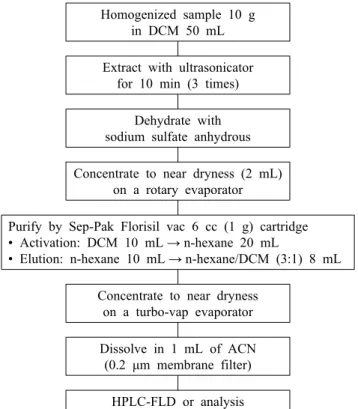
Fig. 1. Diagram of benzo(a)pyrene analysis in sesame oils.
benzo(a)pyrene 함량은 3.68 ppb이었으나 발생되는 연기 의 강제순환으로 동일조건에서 0.63 ppb까지 저감화 한 결 과를 보고하였다. 또한 Sung(13)은 흡착제(adsorbent)로서 0.23%의 활성탄을 사용하여 114.8°C에서 67.5분 동안 처 리하여 옥배유의 benzo(a)pyrene 함량을 저감화 한 결과를 보고하였다.
본 연구는 흡착제의 benzo(a)pyrene의 저감화 가능성에 주목하고 활성탄(active carbon) 이외의 식품에 첨가물로 사용가능한 흡착제로서 규조토(diatomaceous earth), 백도토 (kaolin), 산성백토(acid clay), 퍼라이트(perlite), 규산마그 네슘(silicate) 등을 선정하고 시판되고 있는 참기름과 혼합 하여 첨가량, 교반시간, 교반온도를 최적화함으로써 참기름 내의 benzo(a)pyrene 저감화를 최적화 하고자 시도하였다.
재료 및 방법
실험재료
Benzo(a)pyrene 함량이 낮은 시료로서 (주)사조해표 (Incheon, Korea)의 참기름을 구입하였다. 흡착제의 저감 화 효능을 평가하고 benzo(a)pyrene 함량이 높은 참기름 시료를 선정하기 위하여 경기지역 재래시장에서 정제하지 않고 착유한 특유의 향미를 가진 재래식 압착 참기름 시료 30가지(No.1~No.30)를 구입하였다. 흡착제로서 활성탄 (activated carbon granule, 200 mesh, Duksan, Gyeonggi, Korea), 규조토(celite 545, Duksan), 백도토(kaolin, Sigma-Aldrich Co., St. Louis, MO, USA), 산성백토(acid clay, Duksan), 퍼라이트(perlite, Kyungdong Ceratech Co., Ltd., Asan, Chungnam, Korea), 규산마그네슘(Mag- nesium silicate, Eco-system, Gyeonggi, Korea)을 사용 하였다.
표준품 및 시약
Benzo(a)pyrene 분석에 필요한 표준물질인 benzo(a) pyrene과 내부표준물질인 3-methylcholanthrene은 Sig- ma-Aldrich Co.에서 구입하여 일정농도로 희석하여 사용 하였다. PAHs 추출에 쓰이는 dichloromethane, n-hex- ane, N,N-dimethylformamide(DMF), 아세토니트릴 등은 HPLC급 또는 잔류농약용으로 Merck Inc.(Readington Township, NJ, USA)에서 구매하였고, sodium sulfide non- hydrate는 Sigma-Aldrich Co.로부터, Sep-Pak Florisil Vac cartridge는 Waters Co.(Birmingham, UK)로부터 구 입하여 사용하였다.
Benzo(a)pyrene 정량을 위한 표준검량곡선 작성 Benzo(a)pyrene 표준원액 100 μg/mL를 acetonitrile로 희석하여 표준용액 100 ng/mL로 조제하고 내부표준원액 100 μg/mL를 acetonitrile로 희석하여 내부표준용액 10 ng/mL로 조제하였다. 검량곡선표준용액은 benzo(a)pyr-
ene 표준용액과 내부표준용액에 acetonitrile을 가해 내부 표준물질 농도는 10 ng/mL, 표준물질은 5개 농도(0.5, 1.0, 5.0, 10.0 및 30.0 ng/mL)로 되도록 조제하여 농도별로 분 석하여 검량식을 Y=aX+b의 형태로 작성하였다. 검량선에 서 상관계수 값이 0.999 이상인 경우 성분의 함량을 평가하 는 검량선으로 사용하였다.
참기름 내에 함유되어 있는 benzo(a)pyrene의 추출 및 정제
참기름 시료 약 10 g을 정밀히 달아 내부표준용액 1 mL 를 첨가하고 n-hexane 100 mL에 녹여 분액깔대기(Ⅰ)에 옮기고 DMF-물(9:1) 50 mL를 넣고 흔들어 섞은 후 정치하 여 DMF-물(9:1)층을 분리하여 다른 분액깔때기(Ⅱ)에 옮 겼다(Fig. 1). n-Hexane층에 DMF-물(9:1) 25 mL씩을 넣 고 위와 같이 2회 되풀이하여 DMF-물(9:1)층을 분액깔때 기(Ⅱ)에 합쳤다. 여기에 1% sodium sulfide 용액 100 mL 를 넣어 섞고 n-hexane 50 mL를 넣어 흔들어 섞은 후 정치 하여 n-hexane층은 분액깔때기(Ⅲ)에 옮겼다. DMF-물 (9:1)층에 n-hexane 35 mL씩을 넣고 2회 되풀이하여 n-hexane층을 위의 분액깔때기(Ⅲ)에 합쳤다. 물 40 mL씩 을 넣고 흔들어 섞은 후 정치하여 물층은 버리는 조작을 2회 반복하였다. n-Hexane층을 sodium sulfide nonhydrate 약 15 g을 넣은 여과지를 사용하여 탈수여과한 후 40°C의 수욕조에서 감압하여 약 2 mL로 농축하였다.
Florisil cartridge는 미리 dichloromethane 10 mL 및 n-hexane 20 mL를 초당 2~3방울의 속도로 유출시킨 후
Table 1. HPLC conditions for analysis of benzo(a)pyrene Instrument
Column Solvent system Flow rate Detecter Injection volume
High Performance Liquid Chromatography (Shimazu)
LC-PAH column (250 mm×4.6 mm, particle size 5 μm)
ACN : DW (8:2, v/v) 1 mL/min
Fluorescence (Ex: 294 nm, Em: 404 nm) 20 μL
사용하였다. 이 florisil cartridge에 위의 농축액을 1 mL/
min의 속도로 가하였다. 이어서 n-hexane 10 mL와 n- hexane/dichloromethane(3:1) 8 mL로 각각 용출시킨 후 이 용출액을 40°C 이하의 수욕 상에서 질소가스 하에 날린 뒤 잔류물은 아세토니트릴에 녹여 전량을 1 mL로 하고 이를 0.5 μm 필터로 여과하여 시험용액으로 사용하였다(14).
Benzo(a)pyrene의 HPLC 분석 및 조건
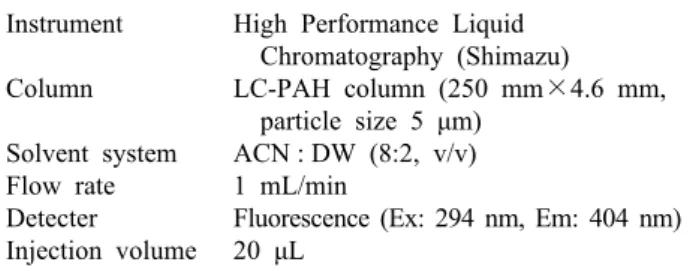
참기름에서 추출한 benzo(a)pyrene를 분석하기 위해 형 광검출기(HPLC fluorescence detector, Shimazu, Kyoto, Japan)가 장착된 고속액체크로마토그래피(High perform- ance liquid chromatography; HPLC, Shimazu)를 사용하 였으며 칼럼은 LC-PAH column(250 mm×4.6 mm, par- ticle size 5 μm)을 사용하였다(Table 1). 여기파장은 294 nm이고 형광파장은 404 nm이었다. 이동상으로는 아세토 니트릴과 물의 혼합액(8:2)을 사용하였으며 isocratic 조건 으로 1.0 mL/min의 유속으로 사용하였다. 시료는 20 μL를 주입하였다. 분석 결과 머무름 시간에 의해 정성 확인을 하 였으며 내부표준법에 따른 피크 면적법으로 정량하였다. 검 량곡선에서 얻어진 표준물질과 내부표준물질의 피크에 대 한 면적비(AS/AIS)를 Y축으로 하고 표준물질의 농도를 X축 으로 하여 검량곡선을 작성하고 시험용액의 면적비(ASAM/
ASAMIS)를 Y축에 대입하여 benzo(a)pyrene의 농도를 계산
하였다(14).
Benzo(a)pyrene=The concentration of the standard
solution (ppb) × ASAM
× AIS
× 1 ASAMS AS S ASAM: 시험용액의 benzo(a)pyrene 피크면적
ASAMIS: 시험용액의 내부표준물질 피크면적
AIS: 검량곡선표준용액의 내부표준물질 피크면적 AS: 검량곡선표준용액의 표준물질 피크면적
흡착제 사용에 따른 benzo(a)pyrene 함량 변화
식품에 사용되는 흡착제의 사용에 따른 benzo(a)pyrene 함량 변화를 조사하기 위해 benzo(a)pyrene의 농도가 낮은 (주)사조해표에서 구입한 참기름을 4.1 ppb까지 높인 뒤, 흡 착제 활성탄(active carbon), 규조토(diatomaceous earth), 백도토(kaolin), 산성백토(acid clay), 퍼라이트(perlite), 규 산마그네슘(silicate)을 각각 0.2%씩 넣고 40°C, 15분에서
교반하여 얻은 참기름의 benzo(a)pyrene 함량을 분석하였 다. 가장 저감화 효과가 있는 흡착제를 선정하여 benzo(a) pyrene 저감화 조건 설정을 위해 흡착제 투입량, 교반시간, 교반온도를 달리하여 참기름 중에 함유된 benzo(a)pyrene 의 저감화 방법을 최적화하였다.
흡착제 사용에 따른 참기름의 색 변화 측정
Benzo(a)pyrene 농도가 낮은 (주)사조해표에서 구입한 참기름을 4.1 ppb의 농도로 높여 제조한 참기름에 활성탄, 백도토, 산성백토, 규산마그네슘 등의 흡착제를 각각 0.2%
(w/w) 투입하고 40°C에서 30분 동안 교반한 후 spec- trophotometer(Shimazu)를 이용하여 420 nm에서 갈색도 를 측정하였다(15).
경기지역 참기름의 benzo(a)pyrene 저감화 확인 흡착제를 이용한 참기름 내의 benzo(a)pyrene 저감화 조 건을 확인하기 위하여 경기지역에서 유통되는 참기름 중 benzo(a)pyrene의 함량이 식품공전규격 2.0 ppb 이하보다 높은 것으로 확인된 시료들에 활성탄을 0.5%(w/w) 투입하 고, 70°C에서 30분 동안 교반한 후 참기름 내에 포함되어 있는 benzo(a)pyrene을 추출하여 정량분석 하였다.
통계분석
본 실험은 3회 반복 실험하였고 실험결과는 SPSS 20.0 (Statistical Package for Social Science, Chicago, IL, USA)을 이용하여 평균값과 표준편차를 계산하고, one-way ANOVA를 이용하여 P<0.05 수준에서 Duncan's multiple range test를 실시하여 유의적인 차이를 검증하였다.
결과 및 고찰
Benzo(a)pyrene 함량 분석
Benzo(a)pyrene에 대한 표준물질 및 내부표준물질인 3- methylcholanthrene 혼합표준용액의 크로마토그램, 공시 료에 혼합 표준액을 첨가하여 전처리 후 HPLC로 분석하여 얻은 크로마토그램 및 benzo(a)pyrene이 검출된 시료의 크 로마토그램은 Fig. 2와 같다. 검량선 작성을 위해 0.5~30.0 ppb 범위의 5개 농도에서 측정 분석한 결과 Y=1.13064X +0.007257의 검량선을 나타냈으며 0.9999 이상의 상관계 수를 나타냈다. LOD는 0.018 ppb로 나타났고, LOQ는 0.048 ppb로 나타났다. 공시료에 혼합표준물질을 첨가하여 회수율을 측정한 결과 참기름 평균회수율은 84%로 측정되 었다.
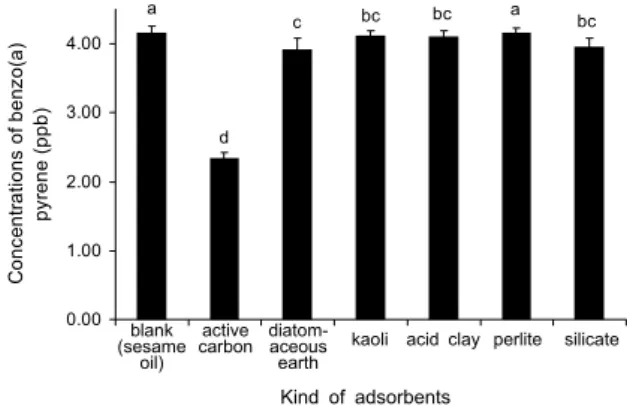
흡착제의 종류에 따른 benzo(a)pyrene 함량 변화 흡착제의 종류에 따른 benzo(a)pyrene 함량 변화를 측정 한 결과 흡착제 중 활성탄을 제외한 규조토, 백도토, 산성백 토, 퍼라이트, 규산마그네슘은 3.92~4.16 ppb로서 ben-
(a) Blank
(b) Benzo(a)pyrene (5 ppb) and 3-methylcholanthren (10 ppb)
Fig. 2. Typical chromatogram of benzo(a) pyrene and 3-methylcholanthren.
0.00 1.00 2.00 3.00 4.00
Kind of absorption Concentrations of benzo(a) . pyrene (ppb) .
a c bc bc a bc
d
blank (sesame
oil) active carbon diatom-
aceous earth
kaoli acid clay perlite silicate King of adsorbents
Kind of adsorbents
Fig. 3. Effects of adsorbents on the reduction of benzo(a)pyrene in sesame oil. Sesame oil was spiked with 4.1 ppb benzo(a)pyr- ene and stirred with 0.2% (w/w) adsorbents at 40°C for 15 min.
Values are means±SD. Those different superscript letters indicate significantly different at P<0.05 by Duncan's multiple range tests.
Table 2. Effects of various kinds of adsorbents on the decolori- zation of sesame oil
Kinds of adsorbents Absorbance (420 nm)2),3) Blank (sesame oil)1)
Active carbon Diatomaceous earth Kaolin
Acid clay Perlite Silicate
3.91±0.07a 3.90±0.10a 3.91±0.08a 3.91±0.10a 3.91±0.10a 3.91±0.08a 3.61±0.19b
1)Sesame oil, which was spiked with 4.1 ppb benzo(a)pyrene, was stirred with 0.5% (w/w) adsorbents at 40°C for 30 min.
2)All values are expressed as mean±SD of triplicate determinations.
3)Different superscripts are significantly different (P<0.05) by Duncan's multiple range tests.
zo(a)pyrene 함량변화에 큰 영향을 주지 못하는 것으로 분 석되었다(Fig. 3). 한편 활성탄은 2.21±14 ppb로서 benzo (a)pyrene 함량의 저감화에 효과가 매우 크게 나타났다. 활 성탄은 흑색 분상 또는 입상형태로 화학적으로 안정하며 냄 새와 맛이 없으며 표면은 심한 다공성(10~105 Å)으로 20~
50 Å에서는 혼탁물질을 형성하는 색소나 고분자의 유기 불 순물이 흡착되기 때문에 benzo(a)pyrene의 함량 변화에 영 향을 미치는 것으로 판단된다.
흡착제의 종류에 따른 참기름의 갈색도 변화
흡착제의 종류에 따른 참기름의 갈색도 변화를 측정한 결 과 활성탄, 백도토, 산성백토, 규조토, 퍼라이트의 갈색도는 각각 3.90, 3.91, 3.91, 3.91, 3.91로 원료 참기름인 대조군
시료의 값(3.91)과 유의적으로 차이가 없게 나타났다(Table 2). 그러나 규산마그네슘(silicate)을 사용한 경우의 갈색도 는 3.61로 가장 많이 탈색된 것을 확인할 수 있었다.
활성탄 첨가량에 따른 benzo(a)pyrene 함량 변화 활성탄 첨가량에 따른 benzo(a)pyrene 함량 변화를 측정 한 결과 Fig. 4와 같이 활성탄의 첨가량이 증가할수록 참기 름 내의 benzo(a)pyrene 함량이 줄어드는 결과를 확인하였 다. 참기름에 활성탄을 0.05%에서 0.5%까지 투입량을 증가 시킴에 따라 benzo(a)pyren 함량이 4.16 ppb에서 1.35 ppb로 급격히 줄어들었으나 0.5%(w/w) 이상을 투입한 경 우는 benzo(a)pyrene의 함량이 완만하게 감소하였고 1.5%
이상을 투입한 경우 0.91~0.97 ppb로 일정한 수준을 유지 하였다.
0 0.5 1 1.5 2 2.5 3 3.5 4 4.5
blank 0.05 0.1 0.2 0.3 0.5 0.8 1 1.2 1.5 1.8 2 The content of activated carbon added to sesame oil (%) concentrations of benzo(a) . pyrene (ppb) .
a
j j hi ij fg gh e f d c b
Fig. 4. Reduction of benzo(a)pyrene in sesame oil by addition of active carbon on sesame oil. Those different superscript let- ters indicate significantly different at P<0.05 by Duncan's multi- ple range tests.
Table 3. Effects of stirring time on the benzo(a)pyrene amount in sesame oil after addition of active carbon
Stirring time (min)
Benzo(a)prene contents (ppb) in sesame oil2) Blank1)
5 10 20 30 40 50 60
4.16±0.10a3) 3.61±0.14b 2.85±0.08c 1.61±0.20d 1.29±0.16e 1.25±0.26e 1.27±0.19e 1.22±0.09e
1)Sesame oil spiked with 4.1 ppb benzo(a)pyrene, was stirred with 0.5% (w/w) active carbon at 40°C for 30 min.
2)All values are expressed as mean±SD of triplicate determi- nations.
3)Different superscripts are significantly different (P<0.05) by Duncan's multiple range tests.
Table 4. Effects of stirring temperature on the concentration of benzo(a)pyrene in sesame oil after addition of active carbon
Stirring temperature (°C)
Amounts of benzo(a)pyrene (ppb) in sesame oil2) Blank
30 40 50 60 70 80 90
4.16±0.10a3) 1.27±0.09b 1.16±0.15bc 1.01±0.03cd 0.95±0.11cd 0.91±0.11d 0.89±0.13d 0.92±0.18d
1)Sesame oil spiked with 4.1 ppb benzo(a)pyrene.
2)All values are expressed as mean±SD of triplicate determi- nations.
3)Different superscripts are significantly different (P<0.05) by Duncan's multiple range tests.
0 1 2 3 4
1 2 3 4 5 6 7 8 9 10 1112 1314 1516 1718 1920 2122 232425 2627 2829 30 Sesame oil samples
Concentrations of benzo(a)pyrene (ppb)..
Fig. 5. Amounts of benzo(a)pyrene in 30 kinds of pressed ses- ame oils obtained from traditional market in Gyeonggi area.
활성탄 투입 후 교반시간에 따른 benzo(a)pyrene 함량 변화
Benzo(a)pyrene 함량을 4.1 ppb로 조절한 참기름 시료 에 활성탄을 0.5%(w/w)를 투입하고 40°C에서 5~60분간 교반하여 교반시간에 따른 benzo(a)pyrene의 변화를 알아 보았다(Table 3). Benzo(a)pyrene 함량은 활성탄 첨가 후 30분까지 초기 4.1 ppb에서 1.29 ppb로 급격히 감소하였으 며 30분 이후에는 benzo(a)pyrene의 함량이 완만히 감소하 여 1.25~1.22 ppb로 유지되었다.
활성탄 투입 후 교반온도에 따른 benzo(a)pyrene 함량 변화
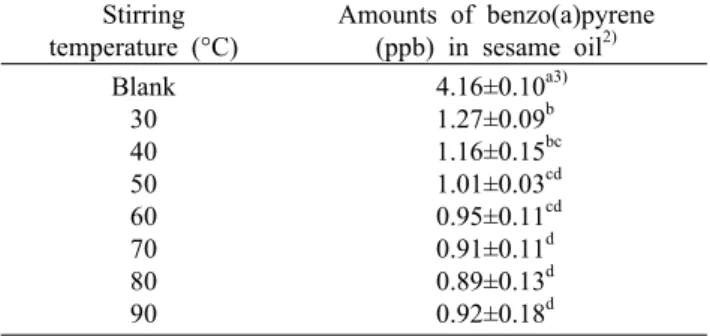
Benzo(a)pyrene 함량을 4.1 ppb로 조절한 참기름 시료 에 활성탄을 0.5%(w/w)를 투입하고 30~90°C에서 30분 동 안 교반하여 교반온도에 따른 benzo(a)pyrene의 변화를 조 사하였다(Table 4). 벤조피렌의 함량이 30°C에서 70°C로 증가함에 따라 1.27±0.09 ppb에서 0.91±0.11 ppb로 감소 하여, 교반온도가 높아짐에 따라 benzo(a)pyrene 함량이
유의적으로 감소되었다. 한편 70~90°C에서는 0.89~0.92 ppb로 유지되어 70°C 이상에서 교반하였을 때 benzo(a) pyrene 함량의 유의적 감소하지 않았으므로 70°C를 최적 의 교반온도로 선정하였다.
Benzo(a)pyrene 함량이 높은 시중 참기름의 선발 및 활 성탄을 사용한 저감화
경기지역 재래시장에서 제조 및 소분하여 판매하는 재래 식 압착 참기름 30건의 분석 결과 경기권 재래시장에서 판 매되고 있는 재래식 압착 참기름의 benzo(a)pyrene 함량은 0.19 ppb부터 4.11 ppb로 다양하게 나타났다. 경기지역 유 통되는 참기름 중 benzo(a)pyrene의 함량이 식품공전규격 2.0 ppb 이하보다 높은 것으로 확인된 시료는 No.11, No.17, No.18의 세 가지 시료로 확인되었다(Fig. 5). 평균 benzo(a)pyrene 함량은 1.06 ppb로 식품공전의 규격인 2.0 ppb 이하로 안전하나 일부 sample의 경우 4.11 ppb로 규격의 2배가 넘는 경우도 확인되었다. 이는 참깨를 가공하 는 참기름 경우 제조환경과 볶음공정 중 온도 조절의 어려움 으로 benzo(a)pyrene의 함량이 높았다고 판단된다. No.11,
0 1 2 3 4
11 17 18
Sesame oil samples Concentrations of benzo(a) . pyrene (ppb) .
Fig. 6. Benzo(a)pyrene reduction of sesame oil in market by ac- tive carbon. Sesame oil was stirred with 0.5% (w/w) active car- bon at 70°C for 30 min. ▉: without active carbon, □: with active carbon.
No.17, No.18의 세 가지 시료는 흡착제를 이용한 참기름 중 benzo(a)pyrene 함량의 저감화를 위한 시료로 선정하였다.
Benzo(a)pyrene의 함량이 식품공전규격 2.0 ppb를 초과 한 No.11(3.05 ppb), No.17(2.14 ppb), No.18(4.11 ppb) 의 시료에 대해 최적화된 조건에서 benzo(a)pyrene의 함량 을 저감화 하기 위해 0.5%(w/w)의 활성탄을 첨가하여 70°C 에서 30분 동안 교반하였다. 활성탄 처리 결과 식품공전규 격 2.0 ppb를 초과한 No.11, No.17, No.18 시료의 ben- zo(a)pyrene 함량은 각각 0.67 ppb, 0.43 ppb, 0.86 ppb로 확인되어 확립된 조건에서 식품공전규격에 맞게 benzo(a) pyrene의 함량을 효과적으로 저감화 시킬 수 있었다(Fig.
6). 식품첨가물공전(16)에서는 흡착제를 사용 시 최종 식품 완성 전에 제거해야 하며, 식품중의 잔존량은 0.5%(규조토, 백도토, 산성백토, 탈크 및 퍼라이트 등 다른 불용성광물성 물질과 병용할 때에는 잔존량의 합계가 0.5%) 이하이여야 한다고 규정하고 있으므로 본 규정을 준수한다면 참기름의 benzo(a)pyrene의 저감화를 위한 효과적인 방안이 될 수 있으리라 기대된다.
요 약
Benzo(a)pyrene 함량이 4.1 ppb가 되도록 첨가한 참기름 에 흡착제인 활성탄을 첨가하였을 때 첨가량, 교반시간, 교 반온도가 증가함에 따라 benzo(a)pyrene 함량이 줄어들었 다. 참기름에 활성탄을 0.5%(w/w) 투입하고, 30분간 70°C 에서 교반하였을 때 볶은 참기름에 존재하고 있는 ben- zo(a)pyrene의 함량은 0.91 ppb까지 낮아져 식품공전규격 인 2.0 ppb 이하의 적합 수준의 참기름을 얻을 수 있었다.
경기권 재래시장에서 판매되고 있는 재래식 압착 참기름 30 건의 benzo(a)pyrene의 함량은 0.19 ppb부터 4.11 ppb로 나타났다. 경기권 재래시장에서 구입한 참기름 중 ben- zo(a)pyrene 함량이 가장 높은 3가지 시료(2.14~4.11 ppb) 를 위와 같은 최적의 흡착조건으로 처리하였을 때 benzo (a)pyrene의 함량은 0.43~0.86 ppb로 매우 효과적으로 감
소하였다. 본 연구는 활성탄 첨가 후 교반처리만으로 볶음공 정을 반드시 거치는 참기름에서 규격 이상의 벤조피렌이 검 출되는 것을 저감화 하는 방법을 제시함으로써 참기름이 안 전하게 생산, 유통될 수 있는 데에 응용할 수 있을 것으로 생각된다.
감사의 글
본 연구는 2013년도 서울과학기술대학교 교내 학술연구비 지원에 의해 수행되었으며, 이에 감사드립니다.
REFERENCES
1. Kim JH, Park SH, Kang WS, Park YJ, Lee JH. 2009.
Preparation method of pressed oil reduced benzopyrene us- ing active carbon. Korean Patent 10-0909285-0000.
2. Kim IS, Ahn MS, Jang DK. 1993. A study on the occurrence of benzo(a)pyrene in fats and oils by heat treatment (I).
Korean J Soc Food Sci 9: 323-328.
3. Pupin AM, Toledo MCF. 1996. Benzo(a)pyrene in olive oils on the Brazilian market. Food Chem 55: 185-188.
4. Hu S, Woo GJ, Choi D. 2007. Determination of benzo(a)pyr- ene in olive oil. Anal Sci Technol 20: 170-175.
5. Asenni ED, Fischbach H. 1972. Trace polycyclic armomatic hydrocarbons analysis, the contribution of chemistry to food supplies. International Union of Pure and Applied Chemistry, Butterworth, London, UK. p 209-215.
6. Nam H, Seo I, Shin HS. 2009. Influence of roasting con- ditions on polycyclic aromatic hydrocarbon contents in ground coffee bean. Korean J Food Sci Technol 41: 362-368.
7. WHO. 2000. Air Quality Guidelines. 2nd ed. WHO Regional Office for Europe, Copenhagen, Denmark. Chap 5.9, p 1-24.
8. Pelkonene O, Nebert DW. 1982. Metabolism of polycyclic aromatic hydrocarbons: etiologic role in carcinogenesis.
Pharmacol Rev 34: 189-222.
9. Staal YC, van Herwijnen MH, Pushparajah DS, Umachandran M, Ioannides C, van Schooten FJ, van Delft JH. 2007.
Modulation of gene expression and DNA-adduct formation in precision-cut liver slices exposed to polycyclic aromatic hydrocarbons of different carcinogenic potency. Mutagenesis 22: 55-62.
10. Tomas A. 2006. IARC monographs on the evaluation of carcinogenic risk to humans. WHO, Lyon, France. Vol 92, p 92.
11. Seo I, Nam H, Shin HS. 2009. Influence of polycyclic ar- omatic hydrocarbons formation in sesame oils with different roasting conditions. Korean J Food Sci Technol 41: 355- 361.
12. Kim H, Song DS. 2008. Minimizing benzo(a)pyrene content in the manufacturing of sesame oil and perilla oil. Korean J Food Preserv 15: 556-561.
13. Sung TK. 2010. Optimization of refining process for edible oils for the reducation of benzo(a)pyrene. PhD Dissertation.
University of Hanyang, Seoul, Korea.
14. KFDA. 2011. Food code. Korea Food & Drug Administra- tion, Cheongwon, Korea. Vol 2, p 10-7-48.
15. Chung MY, Hwang LS, Chiang BH. 1986. Concentration of perilla anthocyanins by ultrafiltration. Korean J Food Sci 51: 1494-1497.
16 KFDA. 2011. Korea food additives code. Korea. p 1428.