IPv6 이동성 지원 프로토콜들의 핸드오버 지연시간에 대한 비교 분석
공기식 *
요 약
MIPv6, HMIPv6, FMIPv6와 같은 호스트 기반의 IPv6 이동성 지원 프로토콜들과 달리, Proxy Mobile IPv6 (PMIPv6)은 이동 노드의 개입없이 네트워크 엔티티들간의 협업 절차만을 사용하여 이동성 관리를 수행하기 때문에, IPv6 이동성 지원 프로토콜의 실질적인 도입을 촉진시킬 것으로 기대되고 있다. 본 논 문에서는, MIPv6, HMIPv6, FMIPv6와 같은 대표적인 호스트 기반의 IPv6 이동성 지원 프로토콜들과 네 트워크 기반의 IPv6 이동성 지원 프로토콜인 PMIPv6간의 핸드오버 지연시간을 분석 및 비교하고자 한 다. 본 연구의 분석 결과, PMIPv6의 핸드오버 지연시간은 MIPv6 및 HMIPv6에 비하여 월등히 짧으며, 또한 무선링크상에서의 지연시간이 MAG와 LMA간의 지연시간보다 클 경우에는 PMIPv6에서의 핸드오 버 지연시간이 FMIPv6에서의 핸드오버 지연시간보다 짧다는 것을 보여준다.
A Comparative Analysis on the Handover Latencies of IPv6 Mobility Support Protocols
Ki-Sik Kong*
Abstract
Unlike host-based IPv6 mobility support protocols such as Mobile IPv6 (MIPv6), Hierarchical Mobile IPv6 (HMIPv6), and Fast handover for Mobile IPv6 (FMIPv6), Proxy Mobile IPv6 (PMIPv6) is expected to accelerate the real deployment of IPv6 mobility support protocol by using only collaborative operations between the network entities without mobile node (MN) being involved. In this paper, we analyze and compare the handover latency of network-based IPv6 mobility support protocol (i.e., PMIPv6) with the representative host-based IPv6 mobility support protocols such as MIPv6, HMIPv6, and FMIPv6. Analytical results show that the handover latency of PMIPv6 is considerably lower than those of MIPv6 and HMIPv6, and the handover latency of PMIPv6 becomes lower than that of FMIPv6 in case the wireless link delay is greater than the delay between mobile access gateway (MAG) and local mobility anchor (LMA).
Keywords : IPv6, Handover Latency, Mobile IPv6, Proxy Mobile IPv6
1. Introduction
Although Mobile IPv6 (MIPv6) [1] is a well-known standard IPv6 mobility support
※ 제일저자(First Author): 공기식
접수일:2010년 07월 27일, 수정일:2010년 09월 26일, 완료일:2010년 09월 30일
* 남서울대학교 멀티미디어학과 [email protected]
▣ 이 논문은 2009학년도 남서울대학교 학술연구비 지원에 의하여 연구되었음.
protocol, it has resulted in some problems in
terms of handover latency, packet loss and
signaling overhead. Thus, the various
enhancement protocols such as Hierarchical
Mobile IPv6 (HMIPv6) [2] and Fast handover
for Mobile IPv6 (FMIPv6) [3] have been
developed over the past years. However,
host-based mobility support protocolssuch as
MIPv6, HMIPv6 and FMIPv6 inherently
require the protocol stack modification on the
mobile node (MN). This inherent drawback
Criteria MIPv6 HMIPv6 FMIPv6 PMIPv6 Operating
layer Network
layer Network
layer Network
layer Network layer Mobility
scope Global Local Global/
Local Local Required
infrastructure Home agent
(HA) HA, MAP HA, enhanced
access router(AR)
MAG LMA,
MN
modification Yes Yes Yes No
Mobility
management Host-based Host-based Host-based Network- based
<Table 1> Comparison between MIPv6, HMIPv6, FMIPv6, and PMIPv6 [4]
(Figure 1) A network architecture thus has obstructed wide deployment of
MIPv6 and its enhancement protocols in practice [4]. In addition, the requirement for modification on the MNs may cause the increased complexity on them. Unlike the host-based mobility support protocols, on the other hand, a
network-based mobility support protocolsuch as Proxy Mobile IPv6 (PMIPv6) [5] does not require any modification on the MN since a proxy mobility agent in network performs mobility-related signaling on behalf of the MN. Therefore, it is expected that PMIPv6 would accelerate the real deployment of IPv6 mobility protocol widely. Although various analyses on the host-based mobility support protocols have been conducted in the literature, few of the handover latency comparison between PMIPv6 and the host-based mobility support protocols has been investigated. Therefore, in this paper, to validate the superiority of PMIPv6, we analyze and compare the handover latency of PMIPv6 with those of various host-based mobility support protocols according to the change of various performance parameters. Table 1 shows the brief summary of each protocol.
2. Analysis of Handover Latency
In this section, we analyze the handover latencies of various IPv6 mobility support protocols. To simplify the analysis, we focus on analyzing the handover latency in case of intra-domain movement.
2.1. Notations and Assumptions
Similar to [6], we consider a simple network architecture shown in Fig.1. In order to represent various notations, and are defined: means the delay caused by the operation Y under the protocol X (Refer to Table 2 for X and Y), and means the total handover latency under the protocol X.
The notations used are as follows:
l The packet transmission delay between the MN and the access point (AP) is
. l The packet transmission delay between
the AP and the AR/MAG is
.
l The packet transmission delay between the AR/MAG and the mobility anchor point (MAP)/LMA (i.e., the delay between AR and MAP in HMIPv6 or between MAG and LMA in PMIPv6) is
.
l The packet transmission delay between the AR/MAG and the HA is
.
l The packet transmission delay between
the AR/MAG and the correspondent node
Parameter Description Values {Meaning}
X Mobility
management protocol
MIP{MIPv6}, HMIP{HMIPv6}, FMIP-pre{Predictive FMIPv6}, FMIP-rea{Reactive FMIPv6},
PMIP{PMIPv6}
Y
Operation for handover
process
MD{movement detection}, AC{address configuration},
BU{binding update}, RR{return routability}
<Table 2> Notations for analysis (CN), not via the HA, is
.
l The packet transmission delay between the HA and the CN is
.
For simplicity, the followings are assumed.
l For the analysis under the same network structure,
“administrative domain”can be applied as follows: from the perspective of MIPv6 and FMIPv6, it is assumed to be just a foreign network. From the perspective of HMIPv6, it is assumed to be a foreign MAP domain. Similarly, for PMIPv6, it is assumed to be a PMIPv6 domain.
l If PMIPv6 is considered, the location of LMA is assumed to be the same as that of MAP in HMIPv6 because they have same functionalities as the HA of MIPv6 within a localized administrative domain.
l We assume that for all the protocols, the MNs are allowed to access a service provider’s network after the AAA procedure is completed. Thus, we do not consider the AAA access delay.
l Address configuration is only performed using stateless address autoconfiguration [7].
l The processing delays are negligible.
l The delay between the MN and the CN is shorter than the sum of the delays between the MN and the HA and between the HA and the CN.
l For simplicity, router solicitation (RS) message is not considered here. Thus, only RA message can affect the movement detection of the MN.
2.2. Derivation of handover latency
Generally, the IP-level handover latency can be expressed as the sum of the movement detection delay, address configuration delay, and the binding update delay. In this paper, more specifically, the
handover latencyis defined as the time that elapses between the moment when the L2 handover completes at AP and the moment the MN can receive the first packet after moving to the new point-of-attachment. On the other hand, in order to estimate the movement detection delay, based on the above assumptions, we only consider the delay caused by the receipt of an unsolicited RA message without considering an RS message. Thus, in this case, the movement detection delay depends on the period of the RA message. In [1], it is specified that the routers for supporting mobility should be able to be configured with a smaller
MinRtrAdvIntervalvalue (=
MinInt) and
MaxRtrAdvIntervalvalue (=
MaxInt) to allow sending the unsolicited RA messages more often. In the case where the minimum intervals are used, the mean time between unsolicited RA messages can be expressed as
. Thus, we assume that the mean value of the movement detection delay in MIPv6 and HMIPv6 is the half of the mean time between unsolicited RA messages, and thus
.
After an MN detects an IP-level movement,
a new prefix information becomes available to
the MN. From the prefix information, the MN
should generate a new care-of-address (CoA)
via address autoconfiguration. To verify the
uniqueness of this CoA, it performs duplicate
address detection (DAD) process before
combining the network prefix to its interface
address. During this process, the MN cannot
use the CoA. Therefore, according to [8], the
address configuration delay in MIPv6 and
HMIPv6 can be simply expressed as
(Figure 2) Handover procedures of IPv6 mobility support protocols
×
, where
Rand
Dmean
RetransTimerand
DupAddrDetectTransmitsspecified in [7], respectively.
(1) MIPv6: As shown in Fig.2(a), the binding update delay in MIPv6 ( ) includes the time of the binding update delay to HA (i.e.,
) plus the binding update delay to CN (i.e.,
). On the other hand, in order to perform binding update procedure with the CN, the delay for return routability (i.e.,
) [1] is additionally required prior to the binding
update to CN. Therefore, the total handover latency in MIPv6 ( ) can be expressed as
(1)
where
.
(2) FMIPv6: Based on the MN’s movement
prediction, FMIPv6 reduces the handover
latency by informing the MN of the new AR
(NAR)’s network prefix via the previous AR
(PAR), and validating the uniqueness of the
prospective CoA on the NAR prior to the
MN’s movement. Thus, the movement
detection and address configuration delays in
FMIPv6 do not occur during the handover process. Instead, to quickly announce the MN’s attachment to the NAR, an unsolicited neighbor advertisement (UNA) message should be sent. In addition, since FMIPv6 basically operates based on movement prediction, perfect prediction may be difficult in real environment, and thus it may operate in reactive mode [3].
Therefore, the total handover latencies of FMIPv6-pre (
) and FMIPv6-rea (
) can be expressed as follows:
(2)
(3)
where
means the delay between PAR and NAR.
(3) HMIPv6: The binding update delay in HMIPv6 ( ) only includes the binding update delay to MAP (i.e.,
) without requiring the binding update to CN in case of intra-domain movement. This is because the MN’s movement within a MAP domain is transparent to the outside of the MAP domain. Thus, the total handover latency in HMIPv6 ( ) within a MAP domain can be expressed as follows:
(4) where
.
(4) PMIPv6: As shown in Fig.2(e), the IP-level movement detection and address configuration do not occur (or are needless) within a PMIPv6 domain because a unique home network prefix is assigned for each MN [5], [9]. Therefore, the total handover latency in PMIPv6 can be composed of the sum of the proxy binding update delay between the MAG and the LMA (i.e.,
) and the packet transmission delay from the MAG to the MN (i.e.,
). Thus, the total
handover latency in PMIPv6 ( ) within a PMIPv6 domain can be simply expressed as
(5)
3. Performance Analysis
We show analytical results based on the analysis derived in the previous section. For our analysis,
is assumed to be 10ms, considering relatively low bandwidth in a wireless link, and other parameters used are as follows:
ms,
ms,
ms, and
ms, respectively.
All of these values are the same or similar to the parameter setting values shown in [6]. For
MinIntand
MaxInt, we set
MinInt= 30ms and
MaxInt= 70ms [1], and for
Rand
D, we set
R= 1,000ms and
D= 1 [8], [10].
3.1. Effect of
t mr
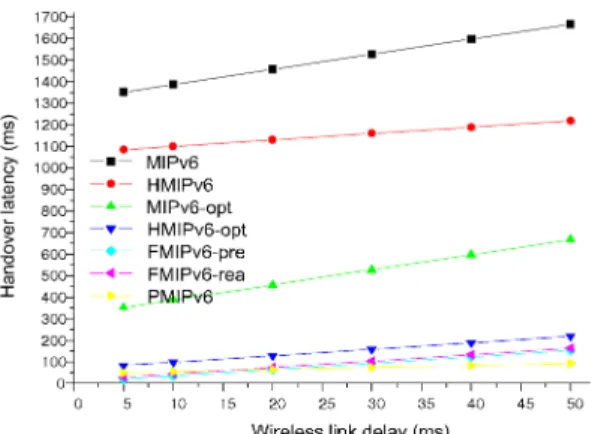
Figure 3 investigates the effect of wireless link delay over the handover latency. As shown in Fig.3, the handover latencies of all IPv6 mobility support protocols get larger as
increases although most of the slopes of each graph are different each other. MIPv6 is most affected by the change of
because it requires the largest number of the messages exchanged over the wireless link. In contrast, PMIPv6 is least affected because the MN is not involved in mobility-related signaling.
Note that the handover latencies of basic MIPv6 and HMIPv6 based on RFC 2462 [7]
are much larger than that of PMIPv6. This is because the time required for the DAD *
* IETF RFC 2462 [7] specifies that IPv6 DAD process takes at least 1,000ms, and some enhancement such as optimistic duplicate address detection (oDAD, RFC 4429 [11]) has been reported recently. In this paper, thus we investigate the handover latencies of MIPv6 and HMIPv6 based on both RFC 2462 and RFC 4429, respectively.
process in basic MIPv6 and HMIPv6 is considerably larger than the time caused by other factors that could affect the handover latency. As shown in Fig.3, for small
, the handover latency of FMIPv6-pre is the lowest, but as
increases, the handover latency of PMIPv6 gets the lowest. This is because the MN, in PMIPv6, is not involved in mobility-related signaling, PMIPv6 is least affected by the change of
.
(Figure 3) Effect of wireless link delay on handover latency
(Figure 4) Effect of movement detection delay on handover latency
3.2. Effect of
T MD
Figure 4 investigates the effect of movement detection delay over the handover latency. In PMIPv6, the IP-level movement
detection does not occur within a PMIPv6 domain. This is because PMIPv6 only supports Per-MN-Prefix model [5], and thus a unique home network prefix is assigned for each MN.
That is, from the perspective of the MN, the entire PMIPv6 domain appears as its home network. Thus, does not occur within a PMIPv6 domain. On the contrary, the graphs for MIPv6 and HMIPv6 increase with the same slope as does. In MIPv6 and HMIPv6, whenever the MN moves across the subnets, it configures the different CoAs.
Therefore, in MIPv6 and HMIPv6, the movement detection is required. On the other hand, in FMIPv6, does not occur during the handover process because NAR's network prefix is configured before its movement.
3.3. Effect of (
t mr
+t ra
+t ac
)Figure 5 investigates the effect of delay between MN and CN over the handover latency. Since we already investigated the effect of
in Fig.3-4, we only focus on investigating the change of
for
and
. For intra-domain movement, HMIPv6 and PMIPv6 do not require the binding update to the CN because the MN's movement within a domain is transparent to the outside of the domain. That is,
does not affect the handover latencies of both protocols in case of intra-domain movement. However, for MIPv6, the handover latency gets larger as
increases. This is due to the fact that MIPv6 requires the binding update to the CN as well as the HA whenever the MN moves across the subnets.
3.4. Effect of (
t mr
+t ra
+t am
)Figure 6 investigates the effect of delay between MN and MAP/LMA over the handover latency. For the analysis, we investigate the change of
for
and
. In addition,
is set because we assume that the CN is located outside the administrative domain.
Thus, the handover latencies of MIPv6 and HMIPv6 get larger as
increases. Note that in Fig.6, in terms of handover latency, for small
, PMIPv6 is the lowest protocol, but as
increases, FMIPv6-pre is the lowest one. The round trip time between the MAG and the LMA is included in the handover latency of PMIPv6. Therefore, although the handover latencies of FMIPv6-pre and FMIPv6-rea are all constant, handover latency of PMIPv6 is sensitive to the change of
.
(Figure 5) Effect of delay between MN and CN on handover latency
(Figure 6) Effect of delay between MN and MAP/LMA on handover latency
3.5. FMIPv6 vs. PMIPv6As shown in Fig.3-6, the handover latency
comparison between PMIPv6 and FMIPv6 may be much dependent on the values of several parameters. Therefore, in the following, we derive the condition where the handover latency of PMIPv6 is relatively lower than that of FMIPv6-pre. For the relatively comparative analysis, we define the normalized cost (δ) as the ratio of the handover latency of FMIPv6-pre to that of PMIPv6. That is, the normalized cost of 1 means that the handover latencies of both protocols are exactly the same. Therefore, the condition where the handover latency of PMIPv6 is lower than that of FMIPv6-pre is expressed as
≡
(6)
From Eq.(6), we can see that when we only consider FMIPv6-pre and PMIPv6, the parameters that can cause the difference of handover latencies are only
and
, and if
is only greater than
, the handover latency of PMIPv6 becomes lower than that of FMIPv6-pre.
Figure 7 shows how the relative handover latency between FMIPv6-pre and PMIPv6 varies according to the change of
and
. As shown in Fig.7, we can see that for large
and small
, the handover latency of PMIPv6 is relatively lower, and vice versa for FMIPv6-pre. From the perspective of the relative comparison between FMIPv6 and PMIPv6, FMIPv6 exchanges various signaling messages such as RtSolPr, PrRtAdv, FBU, FBack over the wireless link. These significant signaling message exchanges thus may cause an increase in the wireless channel access and transmission delays (i.e.,
).
Therefore, it is expected that unless the size
of PMIPv6 domain is configured too large,
PMIPv6 could be scalable and better solution
compared with FMIPv6.
(Figure 7) Relative handover latency between FMIPv6-pre and PMIPv6
4. CONCLUSION
In this paper, we have investigated the effects of the various performance parameters related to the handover latency. From our numerical results, we revealed that the handover latency of PMIPv6 is much lower than those of MIPv6 and HMIPv6. In addition, from the perspective of relative comparison between FMIPv6 and PMIPv6, it is derived that the handover latency is considerably dependent on both the wireless link delay and the delay between the MAG and the LMA;
compared with FMIPv6, the larger the wireless link delay is and the smaller the delay between the MAG and the LMA is, the lower the handover latency of PMIPv6 gets.
Our future research is to validate our research results through simulation.
REFERENCES
[1] D. Johnson, C. Perkins, and J. Arkko, "Mobility Supp ort in IPv6," IETF RFC 3775, June 2004.
[2] H. Soliman, C. Castelluccia, K. E. Malki, and L. Bellie r, "Hierarchical Mobile IPv6 Mobility Management (HMIPv6)," IETF RFC 4140, Aug. 2005.
[3] R. Koodli, "Fast Handover for Mobile IPv6," IETF
Internet draft, draft-ietf-mipshop-fmipv6-rfc4068bi s-02.txt, July. 2007.
[4] K. -S. Kong, Y. Han, M. Shin, H. Yoo, and W. Lee,
"Mobility Management for All-IP Mobile Networks:
Mobile IPv6 vs. Proxy Mobile IPv6," IEEE Wireless Commun., Vol.15, No.2, pp.36-45, April 2008.
[5] S. Gundavelli et al, "Proxy Mobile IPv6," IETF Intern et draft, draft-ietf-netlmm-proxymip6-01.txt, June 2007.
[6] H. Faithi and R. Prasad, "Mobility Management for VoIP in 3G Systems: Evaluation of Low-Latency Ha ndoff Schemes," IEEE Wireless Commun., Vol.12, N o.2, pp.96-104, April 2005.
[7] S. Thomson and T. Narten, "IPv6 Stateless Address Autoconfiguration," IETF RFC 2462, Dec. 1998.
[8] Y. Han, J. Choi, and S. Hwang, "Reactive Handover Optimization in IPv6-Based Mobile Networks," IEE E J. Sel. Areas in Commun. Vol.24, No.9, pp.1758-177 2, 2006.
[9] J. Laganier and S. Narayanan, "Network-Based Loca lized Mobility Management Interface Between Mobil e Node and Mobility Access Gateway," IETF Interne t draft, draft-ietf-netlmm-mn-ar-if-02, May 2007.
[10] T. Narten, E. Nordmark, and W. Simpson, "Neighbo r Discovery for IP version 6," IETF RFC 2461, Dec.
1998.
[11] N. Moore, "Optimistic Duplicate Address Detection (DAD) for IPv6," IETF RFC 4429, April 2006.
공 기 식
1999년 : 고려대학교 컴퓨터학과 (이학사)
2001년 : 고려대학교 컴퓨터학과 (이학석사)
2005년 : 고려대학교 컴퓨터학과 (이학박사)
2005년~2007년: 고려대학교 컴퓨터정보통신연구소 연구교수
2007년: 이화여자대학교 정보통신공학부 연구교수 2008년~2009년: 고려대학교 BK21소프트웨어사업단
연구교수
2009년~현 재: 남서울대학교 멀티미디어학과 전임강사
관심분야: 무선 이동 네트워크, IPv6 이동성 관리, 멀티미디어통신 등