• 검색 결과가 없습니다.

Retrograde balloon dilation as a therapeutic option for post-gynecologic surgery ureteral stricture followed by ureteroureterostomy: a comparative study regarding stricture length

N/A
N/A
Protected

Academic year: 2021

Share "Retrograde balloon dilation as a therapeutic option for post-gynecologic surgery ureteral stricture followed by ureteroureterostomy: a comparative study regarding stricture length"

Copied!
8
0
0

로드 중.... (전체 텍스트 보기)

전체 글

(1)

Yeungnam Univ J Med 2018;35(2):179-186

Retrograde balloon dilation as a therapeutic option for post-gynecologic surgery ureteral stricture followed by ureteroureterostomy: a comparative

study regarding stricture length

Geon Woo Lim, Young Dong Yu, Kyung Hwa Choi, Seung Ryeol Rhee, Dong Soo Park, Young Kwon Hong

Department of Urology, CHA Bundang Medical Center, CHA University School of Medicine, Seongnam, Korea Background: To evaluate the success rate of balloon dilation and the factors possibly influencing the out- comes of balloon dilation for the ureteric strictured portion of ureteroureterostomy (UUS) site in patients with post-gynecologic surgeries.

Methods: A single institution data base was screened for the patients who received balloon dilation for a treatment of ureteral stricture diagnosed after gynecologic surgery. Overall 114 patients underwent primary intra-operative UUS due to ureteral injury during gynecologic surgery. Among them, 102 patients received balloon dilation, and their medical records were retrospectively reviewed. Success of balloon dilation was de- fined as the condition that requires no further clinical interventions after 6 months from balloon dilation.

Results: The ureter injury rate of women treated with open radical abdominal hysterectomy was highest (32 cases, 31.4%). 60 patients (60.8%) showed successful outcomes regarding dilation. All patients underwent technically successful dilation with a full expansion of balloon during the procedure, but 40 patients (39.2%) were clinically unsuccessful as they showed a recurrence of ureteral stricture on the previous balloon dilation site after the first dilation procedure. Univariate logistic regression analyses showed that stricture length >2 cm was a significant predictor of successful dilation (odds ratio, 0.751; 95% confidence interval, 0.634-0.901;

p-value, 0.030), but it failed to achieve independent predictor status in multivariate analysis.

Conclusion: Balloon dilation can an effective alternative treatment option for strictured portion of the primary UUS in post-gynecologic surgery patients when its length is <2 cm.

Keywords: Gynecologic surgery; Postoperative complications; Surgical management; Ureter

Copyright ©2018 Yeungnam University College of Medicine

This is an Open Access article distributed under the terms of the Creative Commons Attribution Non-Commercial License (http://creative- commons.org/licenses/by-nc/4.0/) which permits unrestricted non-commercial use, distribution, and reproduction in any medium, provided the original work is properly cited.

Received: September 13, 2018, Revised: October 13, 2018 Accepted: October 16, 2018

Corresponding Author: Young Kwon Hong, Department of Urology, CHA Bundang Medical Center, CHA University School of Medicine, 59, Yatap-ro, Bundang-gu, Seongnam 13496, Korea

Tel: +82-31-780-5350, Fax: +82-31-780-5350 E-mail: [email protected]

INTRODUCTION

The clinical definition of ureteral stricture is a narrowing of the ureter, which results in a functional hindrance or ob-

struction of urinary flow [1]. Depending on its site, ureteral stricture causes stretching of the collecting system, which con- sequently manifests as renal colic and potentially permanent renal damages [1,2].

The rate of pelvic surgeries due to either benign or malignant

diseases has soared in worldwide, increasing the risk of intra-

operative ureteral injury subsequently, gynecologic surgery of

which accounted for 52-82% of the iatrogenic ureteral injury

types in the previous studies [3,4]. According to a study publi-

shed more recently, the ureteral injury incidence during gyne-

cologic laparoscopy ranged from <1% to 25% [5]. Further-

more, only 30-50% of intra-operative ureteral injuries were dia-

(2)

gnosed in the acute settings [6], and primary ureteroureteros- tomy (UUS) is a feasible therapeutic option for small size (<3 cm) injuries of the mid to upper ureter [1]. Although UUS shows a high success rate and relatively low adverse events compared to other urological interventions, a small portion of patients experiences late ureteric stricture, which requires additional treatments to regain adequate urinary flow [7,8].

There are several treatment methods for ureteral stricture in- cluding chronic ureteral stent exchanges, balloon dilation, and surgical intervention of UUS or ureteroneocystostomy (UNC).

Among these modalities, the success rate of balloon dilation for ureteral stricture recurred after UUS has been rarely re- ported, presumably because performing balloon dilation at the surgical sites may increase the risk of ureteral rupture. Never- theless, Helfand et al. [9] have shown promise in undergoing balloon dilation for the patients with the stricture length <3 cm, although it was only applied to the post-kidney transplant patients. With this regard, our study primarily aimed to present and evaluate a series of balloon dilation cases for ureteral stric- ture patients who previously received primary UUS due to gy- necologic surgery. Also, the secondary objective of the current study was to analyze the factors possibly influencing the thera- peutic outcomes of balloon dilation.

MATERIALS AND METHODS

1. Patient selection and study design

An approval of study was obtained from the Institutional Review Board (2018-08-019-001), and written informed con- sent regarding use of the clinical records was received from all study cohorts before inclusion to the study. A single insti- tution data base was screened for the patients who underwent balloon dilation from May, 2005 to January, 2017 for a treat- ment of ureteral stricture diagnosed after gynecologic surgery.

Overall 113,295 patients underwent gynecologic surgery dur- ing the corresponding period. Among them, total 155 cases of ureteral injuries were observed intraoperatively and all of the corresponding patients underwent primary repairs where- as 41 patients received UNC and the other 114 patients under- went UUS. Types of ureteral injuries such as transection, avul- sion, puncture, and so on were not analyzed in this study due to limited data. In addition, the patients who presented with

urinary tract injuries after gynecologic surgeries were not in- cluded in the current study cohort. Among the 105 UUS re- ceived patients, 102 patients (89.5%) showed post-repair ure- teral strictures and these 102 patients were retrospectively re- viewed. The evaluated pre- and post-operative factors include the site of ureteral injury, etiologic cause of ureteral injury (types of gynecologic surgery), success and failure rate of UUS, duration between UUS and therapeutic balloon dilation, stric- ture characteristics, and follow-up after balloon dilation. Te- chnique of balloon dilation was considered successful if the urologist was able to pass a guide wire and inflate the balloon through the structured portion of ureter. Clinical success of balloon dilation was defined as the condition that requires no further clinical interventions such as prolonged double J ureteral stent indwelling and revision of UUS or UNC after 12 months from balloon dilation. To diagnose clinical success of balloon dilation, all balloon dilation received patients under- went regular examinations of serum creatinine, intravenous pyelography and kidney ultrasonography during follow-up.

2. Diagnosis of ureteral stricture after primary UUS and balloon dilation

The cohorts underwent clinical evaluations of serum crea- tinine and kidney ultrasonography for every visit to urology clinic. In cases of elevated serum creatinine or hydroneprhosis on kidney ultrasonography, retrograde pyelography was per- formed for confirmative diagnosis of ureteral stricture. To neglect the possibility of malignant stricture of ureter, regular examination for gynecologic malignancy including positron emission tomography/computed tomography was performed during the follow up period.

For balloon dilation, 7.5 Fr (Wolf, France) ureteroscope was

introduced into the ureter with stricture and a 5 Fr catheter

with a hydrophilic 0.035-inch guide-wire (Terumo, Belgium)

was inserted through the working channel of ureteroscope

until it reached to the stricture segment. Then, the guide-wire

was passed through the stricture portion of the ureter and a

5 mm diameter balloon catheter was moved along the guide-

wire and inflated at 12 atmosphere (atm) over 5 minutes. Only

regular type balloon was used for dilation and no cutting type

balloon was used in any cases. After deflation of the balloon,

a 6 Fr. double J ureteral stent was placed and it was main-

tained for 12 weeks.

(3)

Table 1. Gynecologic surgeries and injuries of urinary tract

Subject Number of patients (%)

Total number of gynecologic surgery patients 113,295

Urinary tract injuries 593/113,295 (0.5)

Bladder injury 438 (0.4)

Ureter injury 155 (0.1)

Stricture location

Proximal 29 (18.7)

Mid 104 (67.1)

Distal 22 (14.2)

Intraoperative primary repair

UUS 114 (73.5)

Ureteral stricture occurred after UUS 105/114 (92.1)

Treated with ureteral stent (no balloon dilation performed) 3/105 (2.9)

Treated with balloon dilation 102/105 (97.1)

UNC 41 (26.5)

Values are presented as number (%).

UUS, ureteroureterostomy; UNC, ureteroneocystostomy.

3. Statistical analyses

All statistical analyses of the cohorts’ clinical data were un- dertaken using IBM SPSS version 24.0 (IBM Co., Armonk, NY, USA) and p -values were considered significant when it was less than 0.05. Means and standard deviations were pre- sented for continuous variables and proportions were used for categorical variables. The chi-square test, Mann-Whitney U test or an independent t-test were used to analyze the clinical differences between balloon dilation successful group and un- successful groups. Multivariate logistic regression analysis was performed to evaluate the factors influencing the success of balloon dilation. For statistical analysis, we considered all tech- nically and clinically unsuccessful balloon dilations were cate- gorized as unsuccessful entity.

RESULTS

1. Gynecologic disease and ureteral injury

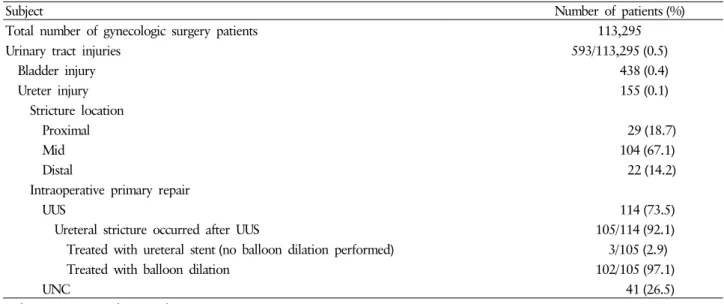
The overall urinary tract injury rates during gynecologic sur- gery were 0.5% and among them, bladder injury patients were 438 cases (73.9%), which was significantly higher than the ure- teral injury cases (155 cases, 26.1%). The frequency of ureteral injury following gynecologic surgery was approximately 0.1%, with a higher percentage of injuries occurring during abdomi-

nal hysterectomies and myomectomies. The median follow-up was 13 months. The most common site of ureteral injury was mid-ureter level (67.1%) that was profoundly higher than 18.7% and 14.2% of proximal and distal ureter, respectively.

The ureter injury rate of women treated with open radical ab- dominal hysterectomy was highest (32 cases, 31.4%), and 26 cases (25.5%) of ureteral injury was attributed to open myo- mectomy, which made the open surgeries account for more than 50% of the whole ureteral injury cases (Table 1). For laparoscopic myomectomy, 22 patients were noted with in- jured ureters, which revealed the greatest ureteral injury rate among laparoscopic surgeries. Moreover, laparoscopic salphin- go-oophorectomy and laparoscopic radical vaginal hysterec- tomy had 15 and 7 patients with ureteral injuries, respectively (Table 2). All of the corresponding ureteral injury patients underwent primary intra-operative UUS during pelvic surgery.

In addition, among 155 cases of ureteral injuries occurred

during gynecologic surgery, 78 patients (50.3%) had a history

of previous abdominopelvic surgeries and 128 patients (82.6%)

presented with severe adhesions between ureter and other

pelvic anatomical structures. For the treatment of ureteral st-

ricture occurred after primary UUS, three patients out of 105

ureteral stricture patients underwent only conservative the-

rapy by performing 6 Fr size ureteral stent placement with

duration of 12 weeks and it resolved stricture (Table 1, 3).

(4)

Table 2. Gynecologic surgeries that caused ureteral injury and subsequent UUS

Types of gynecologic surgery Number of patients (%)

Robotic surgery

Robot assisted radical vaginal hysterectomy 0 (0.0)

Robot assisted myomectomy 0 (0.0)

Laparoscopic surgery

Laparoscopic radical vaginal hysterectomy 7 (6.9)

Laparoscopic myomectomy 22 (21.5)

Laparoscopic salphingo-oophorectomy 15 (14.7)

Open surgery

Radical abdominal hysterectomy 32 (31.4)

Myomectomy 26 (25.5)

Cesarean section 0 (0.0)

Values are presented as number (%).

UUS, ureteroureterostomy.

Table 3. Logistic regression analysis for the predictors of ureteral stricture after primary UUS

Predictor OR (95% CI) p -value

Univariate analysis

History of previous abdominal surgery 1.020 (1.003-1.816) 0.040

Severe adhesions between ureter and adjacent tissues 1.331 (1.065-2.001) Surgery types

Open UUS Reference 0.021

Laparoscopic UUS 4.170 (0.932-8.014) 0.325

Multivariate analysis

History of previous abdominal surgery 1.405 (0.870-1.527) 0.186

Severe adhesions between ureter and adjacent tissues 1.052 (1.002-1.210) 0.047 UUS, ureteroureterostomy; OR, odds ratio; CI, confidence interval.

Table 4. Comparisons between clinical factors of initial balloon dilation successful and unsuccessful groups (n=102)

Clinical factor DSG DUG p -value

No. of patients 62 (60.8) 40 (39.2)

Age (yr) 44.8±6.0 (35-55) 44.7±5.3 (34-53) 0.921

Length of stricture (cm), median (range) 1.45 (0.8-4.0) 2.7 (1.5-4.5) 0.002

Stricture length >2 cm 4 (6.5) 32 (80.0) 0.001

Previous ureteral stent insertion 36 (58.1) 24 (60.0) 0.553

Duration between UUS and BD (mon) 49.3±7.5 47.1±8.2 0.117

Stricture location 0.980

Proximal 11 (17.7) 8 (20.0)

Mid 43 (69.4) 26 (65.0)

Distal 8 (12.9) 6 (15.0)

Multiple 0 (0.0) 0 (0.0)

BMI (kg/m

2

) 21.3±2.4 22.4±3.6 0.877

DM 7 (11.3) 5 (12.5) 0.062

Recurrence of gynecologic malignancy 0 (0.0) 0 (0.0)

Values are presented mean±standard deviation or number (%).

UUS, ureteroureterostomy; BD, balloon dilation; DSG, balloon dilation successful group; DUG, balloon dilation unsuccessful group;

BMI, body mass index; DM, diabetes mellitus.

(5)

Table 5. Logistic regression analysis for the predictors of successful balloon dilation

Clinical factor Univariate Multivariate

OR 95% CI p -value OR 95% CI p -value

Age 1.029 0.887-1.029 0.705

Stricture length >2 cm 0.751 0.634-0.901 0.030 0.951 0.805-1.002 0.078

Stricture location 2.166 0.551-8.514 0.269

Previous ureteral stent insertion 1.332 0.709-2.330 0.473

Obesity (BMI >30 kg/m

2

) 2.015 0.609-1.769 0.057

DM 1.037 0.887-1.154 0.998

OR, odds ratio; CI, confidence interval; BMI, body mass index; DM, diabetes mellitus.

2. Balloon dilation

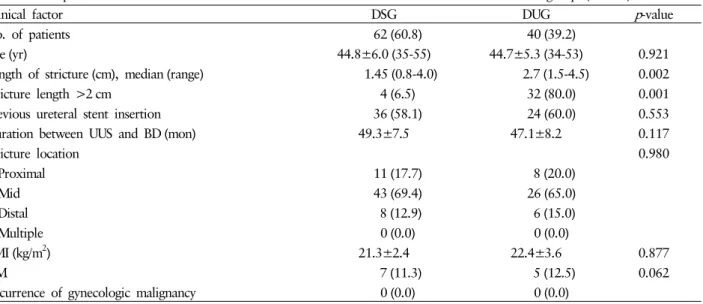
Table 4 shows the results of balloon dilation. Total 102 patients, who underwent primary intra-operative UUS due to pelvic injury-caused ureteral injury, received balloon dila- tion, and 60 patients (60.8%) showed successful outcomes re- garding dilation. No patient was assigned as technically unsuc- cessful dilation category as passage of guide-wires and balloon dilatation through the stricture portion were properly made as intended. Although all patients were gone through techni- cally successful dilation with a full expansion of balloon during the procedure, 40 patients (39.2%) were clinically unsuccess- ful as they showed a recurrence of ureteral stricture on pre- vious balloon dilation site after a certain period from the first dilation procedure. There were no significant differences bet- ween the balloon dilation successful and unsuccessful groups in terms of patients’ age, duration between UUS and balloon dilation, location of stricture, body mass index and diabetes mellitus prevalence (Table 4). The successful balloon dilation group had 58.1% of the patients underwent ureteral stent in- dwelling before balloon dilation, and the unsuccessful group had 60.0% of previous stent insertion rate ( p =0.553). In addi- tion, the duration of ureteral stent insertion, performed pri- or to the balloon dilation, was 12 weeks in every stented pati- ent. During the follow-up, no patient showed a recurrence of gynecology malignancy. Furthermore, the balloon dilation successful group showed 1.45 cm of median stricture length, which was significantly shorter compared to 2.7 cm of the un- successful group ( p =0.002). Regarding stricture location, the balloon dilation unsuccessful group showed a slightly higher portion of patients with distal ureter stricture (15.0%) com- pared to 12.9% of the successful group, though it was statisti- cally insignificant ( p =0.980). Since there was no patient who had multiple ureteral injuries during previous gynecologic sur-

gery, ureteral strictures at multiple locations were not observed in any patients. Among the balloon dilation unsuccessful group, 6 patients with distal ureter stricture underwent a surgery to undo the previous UUS and make a new UNC. Another 24 patients who had a stricture portion at proximal or mid ureter received the second balloon dilation, which eventually resol- ved the ureteral stricture within 22 patients. The second bal- loon dilation procedure was methodologically the same as the previous procedures, and no patient required more than two balloon dilations to achieve sufficient urinary flow. In addi- tion, no significant complications related to balloon dilation procedure such as ureteral perforation, urinary leakage or peri-ureteral hematoma were observed after each dilation pro- cedures in every patient. The other 12 patients of the unsucce- ssful group, including the two patients who were unsuccessful with the second balloon dilation, underwent conservative the- rapy by chronic ureteral stent placement, where the stents were exchanged every 3 months. Moreover, no patient under- went either permanent metallic stent placement or endoure- terotomy in this study.

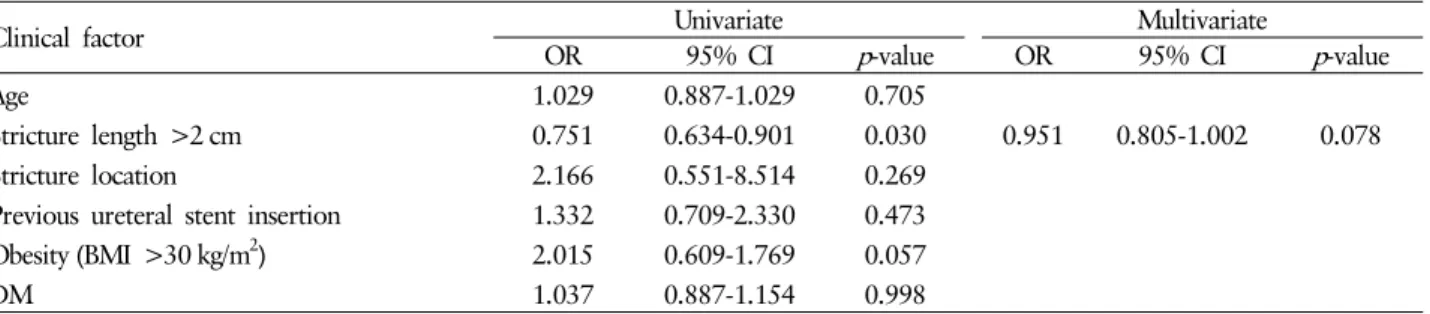
According to logistic regression analyses performed for eva- luation of the factors influencing successful balloon dilation (Table 5), stricture length >2 cm was a significant predictor of successful dilation in univariate analysis (odds ratio, 0.751;

95% confidence interval, 0.634-0.901; p -value, 0.030), yet failed to achieve an independent predictor status in multivari- ate analysis.

DISCUSSION

1. Ureteral injury during gynecologic surgery and UUS

According to the previous studies concerning the complica-

(6)

tions of gynecologic surgery, the incidence rate of urinary tract injury ranges from 0.5 to 1.5% in which bladder is more vul- nerable injury site compared to ureter [10,11]. For ureteral injury, the detection rate is 1.6 in 1,000 cases without perfor- ming intraoperative cystoscopy, but the rate increases up to 6.2 in 1,000 cases with the use of intraoperative cystoscopy so that the actual incidence rate of urinary tract injury might be higher if further investigated with long-term follow-ups [12]. In the present study, the incidence rate of ureteral injury due to gynecologic surgery was 0.1%, which was similar or slightly lower than that of previous studies. The relatively lower ureteral injury rate was probably attributable to the technical maturity of gynecologic surgeons at our institution. Ureteric injury, which is not found during the gynecologic surgery, may cause urinary obstructive signs including an increase in creatinine level and hydronephrosis depending on the site of ureteral injury. Moreover, infectious signs such as fever and flank pain can be also presented. According to Wu et al., some patients with gynecologic surgery experienced delayed urete- ral necrosis and subsequent stricture owing to undiagnosed intraoperative thermal injury [13]. In this study, no patient pre- sented delayed ureteral or bladder injury signs.

The location of ureteral injury is one of the major factors profoundly influencing the choice of surgical methods to re- pair the injury [14]. For the injuries of proximal ureter, UUS is a generally preferred method of surgical correction. UUS or UUS with a Boari flap can be a treatment option for mid ure- ter injury. UNC is a feasible treatment option for distal ureter injury if the remaining ureter maintains an adequate length [15,16]. However, if the length of remaining ureter after a re- section of injured portion is insufficient, an ileal ureter substi- tution can be required [15-17]. In the present study, all 102 patients included in the final evaluation were diagnosed as ure- teral injury immediately after the ureteral damage occurred, and this indicated the patients to undergo intraoperative UUS when the ureter was subjected to relatively less tissue infla- mmation compared to postoperative state. Thus, we believe that this immediate intraoperative UUS significantly reduced certain types of immediate to early postoperative complica- tions such as urinary leakage or infection to the level of zero.

The overall ureteral stricture rate after intraoperative pri- mary UUS was 92.1%, which was higher than the previous study results [17,18]. We believe this high ureteral stricture rate was derived from the patients’ distinctive underlying pel-

vic anatomy. More than a half of the ureteral injury patients (50.3%) had a history of previous abdominopelvic surgery and more than two thirds of the ureteral injury patients (82.6%) accompanied severe adhesions of ureter with adjacent pelvic tissues. Moreover, 89 patients out of 155 ureteral injury pati- ents were initially referred from other medical institutions for their gynecologic surgeries, because too highly technical gyne- cologic surgeries were required to the corresponding patients even at the operative planning stage. Thus, although the exact number of cases was not evaluated, a significant number of patients already had poor circulation and edema within the ureteral wall that were caused by extensive dissection of pelvic tissues undertaken before UUS procedure. These underlying conditions subsequently acted as potential technical difficulties to the urological surgeons involved in the study, which prob- ably resulted in relatively poor outcomes after primary UUS.

2. Balloon dilation

The evaluation of outcomes in balloon dilation to the stric- tured ureter has been researched in many previous studies, yet, few of which analyzed the clinical outcomes of balloon dilation as a treatment of ureteral stricture occurring after UUS. To the best of our knowledge, this approach of particular note is the first study evaluating the therapeutic effect of bal- loon dilation to ureteral stricture after UUS, which was per- formed due to ureteric injury following gynecologic surgery.

Bhayani et al. performed balloon dilation to four patients with

strictured UUS and three of them (75%) showed successful

outcomes [18]. Moreover, some of previous studies also poin-

ted out profoundly successful outcomes of balloon dilation

to strictured UUS in kidney transplantation (KT) patients with

certain clinical factors [19-21]. Ooms et al. [21] demonstra-

ted that the success rate of balloon dilation for a treatment

of strictured UUS in KT patients was 47%, although they used

both regular and cutting balloons for dilation procedure. In

the present study, the success rate of initial balloon dilation

was 60.8%, which was similar to the results of the previously

published KT-patient based studies. In addition, most of the

previous studies recommended performing balloon dilation

for stricture length <3 cm, but the univariate analysis results

of our study showed that stricture length >2 cm significantly

decreased the success rate of balloon dilation. Our study re-

sults also demonstrated that inflating the balloon at the pres-

(7)

sure of 12 atm over 5 minutes is strongly recommendable as no post-dilation complication such as ureteral rupture was ob- served. According to Ambani et al. [22], they placed a ureteral stent in strictured ureter and perform a staged balloon dilation that resulted in 95% success rate. However, ureteral stent insertion prior to balloon dilation was not associated with successful outcomes of balloon dilation in this study. In addi- tion, our study results showed the second balloon dilation, which was performed to the patients with initial balloon dila- tion failure, resolved ureteral stricture by 91.7% (22 successes out of 24 patients). Therefore, we believe the effect of staged balloon dilation should be analyzed in the further study with a larger study cohort.

This study has several limitations, and relatively small cohort size is one of them. Therefore, the clinical factors that could influence the success of balloon dilation might not have been included in the evaluation or no factor might actually influ- ence the procedure success rate. Moreover, in this study, cut- ting balloons for dilation were not used, thus employing other types of balloons would possibly cause better outcomes. Al- though this study focused on the patients having ureteral stric- ture after UUS, UNC is performed as frequent as UUS for the treatment of ureteral injury caused by gynecologic sur- gery. Thus further studies including both UUS and UNC cases need to be undertaken to establish the treatment protocols for ureteral injuries after gynecologic surgeries. In general, the ureteral double J stent was indwelled for 12 weeks after bal- loon dilation in all study cohorts, but varying maintenance period might have resulted in different clinical outcome. Con- sequently, these factors should be taken into analysis in further study. Despite these limitations, we believe the present study still has the highest number of balloon dilations performed for strictured UUS in post-gynecologic surgery patients.

Balloon dilation is an effective treatment option for the st- rictured UUS in post-gynecologic surgery patients. The suc- cess rate of balloon dilation is 60.8%, and given the follow-up periods, no significant dilation related complications are ob- served. Stricture length <2 cm might be regarded as the key factor for a successful procedure. No other remarkable factors influencing the success rate of balloon dilation are noted, but it should be further investigated in future studies.

CONFLICT OF INTEREST

The authors have no conflict of interest with any institu-

tions or products. No financial support was received by any author. The corresponding author is responsible for submit- ting a competing financial interest stamen on behalf of all authors of the paper.

ORCID

Geon Woo Lim, https://orcid.org/0000-0001-7426-2167 Young Dong Yu, https://orcid.org/0000-0002-2696-7004 Kyung Hwa Choi, https://orcid.org/0000-0003-2170-4368 Seung Ryeol Rhee, https://orcid.org/0000-0002-9959-3488 Dong Soo Park, https://orcid.org/0000-0002-3386-5719 Young Kwon Hong, https://orcid.org/0000-0002-4344-6788

REFERENCES

1. Nakada SY, Sara BL. Management of upper urinary tract obstruction. In: Wein AJ, Kavoussi LR, Partin AW, Peters CA, editors. Campbell-Walsh urology. 11th ed. Philadelphia:

Elsevier; 2016. p. 1104-47.

2. Janoff D, Conlin M. Uretroscopic management of ureteral structure disease. In: Smith AD, Badlani GH, Bagley DH, Clayman RV, Docimo SG, Jordan GH, et al. editors. Smith’s textbook of endourology. 2nd ed. Hamilton; London: BC Decker; 2007. p. 285-90.

3. Dowling RA, Corriere JN Jr, Sandler CM. Iatrogenic ureteral injury. J Urol 1986;135:912-5.

4. Fry DE, Milholen L, Harbrecht PJ. Iatrogenic ureteral injury.

Options in management. Arch Surg 1983;118:454-7.

5. Ostrzenski A, Radolinski B, Ostrzenska KM. A review of lapa- roscopic ureteral injury in pelvic surgery. Obstet Gynecol Surv 2003;58:794-9.

6. Manoucheri E, Cohen SL, Sandberg EM, Kibel AS, Einarsson J. Ureteral injury in laparoscopic gynecologic surgery. Rev Obstet Gynecol 2012;5:106-11.

7. Paick JS, Hong SK, Park MS, Kim SW. Management of post- operatively detected iatrogenic lower ureteral injury: should ureteroureterostomy really be abandoned? Urology 2006;67:

237-41.

8. Nie Z, Zhang K, Huo W, Li Q, Zhu F, Jin F. Comparison of urological complications with primary ureteroureterostomy versus conventional ureteroneocystostomy. Clin Transplant 2010;24:615-9.

9. Helfand BT, Newman JP, Mongiu AK, Modi P, Meeks JJ, Gonzalez CM. Reconstruction of late-onset transplant ureter- al stricture disease. BJU Int 2011;107:982-7.

10. Frankman EA, Wang L, Bunker CH, Lowder JL. Lower uri- nary tract injury in women in the United States, 1979-2006.

Am J Obstet Gynecol 2010;202:495.

11. Ozdemir E, Ozturk U, Celen S, Sucak A, Gunel M, Guney

G, et al. Urinary complications of gynecologic surgery: iatro-

genic urinary tract system injuries in obstetrics and gynecol-

(8)

ogy operations. Clin Exp Obstet Gynecol 2011;38:217-20.

12. Gilmour DT, Dwyer PL, Carey MP. Lower urinary tract injury during gynecologic surgery and its detection by intraoperative cystoscopy. Obstet Gynecol 1999;94:883-9.

13. Wu HH, Yang PY, Yeh GP, Chou PH, Hsu JC, Lin KC. The detection of ureteral injuries after hysterectomy. J Minim Invasive Gynecol 2006;13:403-8.

14. Han CM, Tan HH, Kay N, Wang CJ, Su H, Yen CF, et al.

Outcome of laparoscopic repair of ureteral injury: follow-up of twelve cases. J Minim Invasive Gynecol 2012;19:68-75.

15. Gomel V, James C. Intraoperative management of ureteral injury during operative laparoscopy. Fertil Steril 1991;55:

416-9.

16. Nezhat C, Nezhat F. Laparoscopic repair of ureter resected during operative laparoscopy. Obstet Gynecol 1992;80:543-4.

17. Cholkeri-Singh A, Narepalem N, Miller CE. Laparoscopic ure- teral injury and repair: case reviews and clinical update. J

Minim Invasive Gynecol 2007;14:356-61.

18. Bhayani SB, Landman J, Slotoroff C, Figenshau RS. Trans- plant ureter stricture: acucise endoureterotomy and balloon dilation are effective. J Endourol 2003;17:19-22.

19. Haberal M, Boyvat F, Akdur A, Kırnap M, Özçelik Ü, Yarbuğ Karakayalı F. Surgical complications after kidney transplan- tation. Exp Clin Transplant 2016;14:587-95.

20. He B, Bremner A, Han Y. Classification of ureteral stenosis and associated strategy for treatment after kidney transplant.

Exp Clin Transplant 2013;11:122-7.

21. Ooms LSS, Moelker A, Roodnat JI, Ijzermans JNM, Idu MM, Terkivatan T. et al. Antegrade balloon dilatation as a treatment option for posttransplant ureteral strictures: case series of 50 patients. Exp Clin Transplant 2018;16:150-5.

22. Ambani SN, Faerber GJ, Roberts WW, Hollingsworth JM,

Wolf JS Jr. Ureteral stents for impassable ureteroscopy. J

Endourol 2013;27:549-53.

수치

Table 1. Gynecologic surgeries and injuries of urinary tract
Table 4. Comparisons between clinical factors of initial balloon dilation successful and unsuccessful groups (n=102)
Table 5. Logistic regression analysis for the predictors of successful balloon dilation

참조

관련 문서

Seven patients underwent H. pyroli eradication therapy. Three patients showed complete response, but four patients failed... Conclusion

Thermal balloon ablation versus endometrial resection for the treatment of abnormal uterine bleeding. Thermal balloon ablation in myoma-induced menorrhagia

As the option pricing models to provide a theoretical option values, Black-Scholes and a binomial lattice option pricing models, most widely used, will

Therefore, this study aims to maintain the even saponin content by standardizing balloon flower extract (60ml) to use as tea to maximize the

Thus, as visual expansion interprets expressive characteristics applied for walls as physical structures by a visual and perceptual recognition system, non-materialization

Endoscopic papillary large balloon dilation(EPLBD) involves endoscopic biliary sphincterotomy followed by balloon dilation using 12-20mm balloon to remove large

출처 : IAEA 발표 자료(Comprehensive inspection exercise at bulk handling facilities, “U-235 Enrichment measurements by gamma-ray spectroscopy”) 13.  Uranium

Superior tensile properties were obtained, and heat treatment time could be shortened by the austenitizing treatment at A C1 +30∼40℃ followed by