경주용 자동차 브레이크 디스크 형상에서의 열 응력 및 구조 해석에 관한 융합 연구
오범석, 조재웅
*
공주대학교 기계자동차공학부 교수
A Convergent Investigation on Structural Analysis with Thermal Stress at the Shape of Brake Disk for Racing Car
Bum-Suk Oh, Jae-Ung Cho
*
Professor, Division of Mechanical & Automotive Engineering, Kongju National University
요 약 본 연구에서는 경주용 자동차에서 기존에 사용 중인 형상을 가진 모델 A와 경량화를 한 모델 B를 설계하고 열 변형과 열응력을 동반한 구조해석을 하였다. Model A가 Model B에 비하여 최고온도가 낮음을 보인다. 다른 냉각 조건이 주어지지 않고 디스크의 형상에 따른 냉각성능은 Model A가 더 뛰어남을 알 수 있다. Model A가 Model B에 비하여 거의 2배 이상으로 그 열응력이 낮아져 내구성면에서도 우수함을 알 수 있었다. 응력이 가장 크게 나타나는 부분 은 형상에 관계없이 허브와 접합되는 구멍으로 나타났다. 본 연구에서의 해석결과는 실제 자동차 브레이크 디스크의 형상을 설계하는데 있어서 유용하다고 보인다. 본 연구에서 얻은 해석 결과는 실제적으로 경주용 자동차 브레이크 디스 크의 강도를 파악하는 데에 적용될 수 있다. 경주용 자동차 브레이크 디스크의 해석 결과를 이용함으로서, 본 연구가 미적인 설계 및 해석이 적용된 융합 연구라고 보여진다.
주제어 : 경주용 자동차, 브레이크 디스크, 열 응력, 구조 해석, 내구성, 융합
Abstract In this study, the model A with the existing shape used at racing car and the model B with light weight were designed. The structural analysis with thermal deformation and stress were carried out. Model A shows that the maximum temperature is lower than model B. The cooling performance due to the shape of the disk without any other cooling conditions can be shown to be better for model A. Model A was seen to be superior in durability as the thermal stress reduced by almost twice as much as model B. The part where the greatest stress occurred appeared to be the hole jointed with the hub regardless of its shape. The analysis results at this study are seen to be useful at designing the shape of the actual vehicle brake disc. The analysis results obtained in this study can be applied at grasping the strength of the brake disk for racing car practically. By utilizing the analysis result of the brake disk for racing car, this study is seen as the convergence study that the aesthetic design and analysis are applied.
Key Words : Racing car, Brake disk, Thermal stress, Structural analysis, Durability, Convergence
*Corresponding Author : Jae-Ung Cho([email protected]) Received April 3, 2020
Accepted June 20, 2020 Revised May 8, 2020
Published June 28, 2020
1. 서론
본 연구는 경주용 자동차에서 사용되는 브레이크 디스 크의 열 변형 해석을 진행하였다. 브레이크는 차량의 동 력성능과 더불어 가장 기본적인 안전장치로 운전자를 포 함한 탑승자의 안전을 책임지는 중요한 역할을 한다. 브 레이크는 크게 드럼식과 디스크식으로 나뉘어지는데 근 래의 일반 승용차에는 주차브레이크를 제외하고는 대부 분 디스크식 브레이크를 사용한다. 드럼식은 강력한 제동 능력이 장점이나 정비성이 떨어지고 냉각이 불리한 단점 이 있다. 디스크식은 제동력은 드럼식에 비해 떨어지나 정비가 용이하며 외부로 노출되어있어 냉각성능이 뛰어 난 장점이 있다. 현재 자작자동차 팀들은 오토바이용 브 레이크 디스크를 사용하는 팀도 있으나 사용상의 제약이 있어 직접 설계, 제작하여 사용하는 팀이 늘어나고 있다 [1-8]. 본 연구에서는 경주용 자동차에서 기존에 사용 중 인 형상인 모델A와 경량화를 한 모델 B를 모델링하고 ANSYS를 이용하여 열 변형과 열응력을 동반한 구조해 석[9-12]을 하였다. 본 연구에서의 해석결과를 이용하면 자동차의 브레이크 디스크의 형상을 설계하는 데 있어서 도움이 될 것으로 예상된다[13-16]. 본 연구에서 얻은 해 석 결과는 경주용 자동차 브레이크 디스크에 대한 시험 을 하지 않고도 그 강도를 파악하는 데에 적용될 수 있 다. 경주용 자동차 브레이크 디스크의 해석 결과를 이용 함으로서, 본 연구가 미적인 설계 및 해석이 적용된 융합 연구라고 보여진다.
2. 본론 2.1 연구모델
본 연구를 위하여 Fig. 1과 같이 CATIA를 통하여 두 가지 종류의 모델링을 하였으며 지름은 200mm로 동일 하다.
(a) Model A (b) Model B
Fig. 1. Meshes of modelsYoung's Modulus 193 GPa
Poisson's Ratio 0.31
Density 7750 kg/m
3Tensile Yield Strength 207 MPa
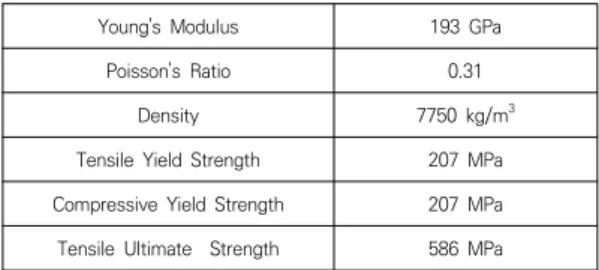
Compressive Yield Strength 207 MPa Tensile Ultimate Strength 586 MPa
Table 1. Stainless steel propertyNode numbers Element numbers
Model 1 163396 39904
Model 2 212958 39270
Table 2. Meshes of models 1 and 2
본 해석연구를 위하여 모델링한 브레이크 디스크들의 Model A와 B에 대한 메시의 형상들은 Fig. 1과 같다.
Table 1은 본 연구 모델의 물성치를 나타낸다. 또한 Model A와 Model B의 절점수와 요소수는 Table 2와 같다.
2.2 열 해석 및 구조 해석 결과
Fig. 2와 같이 가혹한 조건을 주기 위해 디스크 양면 의 C구간에는 0.23 W/mm²의 열 유량 조건을 주었다.
본 해석에서는 자연대류로서 외부의 공기가 브레이크 디 스크와 접촉하는 부분에서의 22℃의 상온 조건을 적용하 였으며 대류 열전달 계수는 2.3×10⁻⁴W/mm2℃로 설정 하였다. 이러한 열해석 조건으로서 Fig. 3에서와 같이, Model A와 B에 대하여 온도 분포들을 구하였다.
(a) Model A
(b) Model B
Fig. 2. Constraint conditions of models(a) Model A
(b) Model B
Fig. 3. Contours of temperature on models A and B Model A와 B는 브레이크 디스크의 가운데 볼트로 지 지되어 있으며 이때는 정상상태의 온도 분포로서 Mode A와 B의 경우는 각각 479.47℃와 540.85℃로 가장 높 은 은도를 보였다. 두 모델 모두, 중앙부에서 온도가 낮아 짐을 볼 수 있었다. Model A가 Model B에 비하여 최고
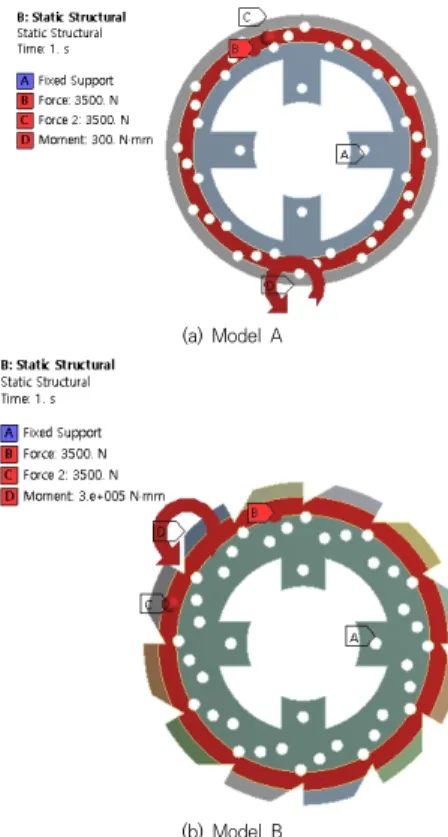
온도가 낮음을 볼 수 있다. 다른 냉각 조건이 주어지지 않고 순수하게 디스크의 형상에 따른 냉각성능은 Model A가 더 뛰어남을 알 수 있다. Fig. 3의 온도 해석 결과를 토대로 하여 열 변형과 열응력을 동반한 구조해석을 하 기 위하여 Fig. 4에서와 같이, 볼트가 체결되는 구멍을 고정하고 브레이크 패드와 마찰이 일어나는 부분을 양면 에서 3500N·m로 주었다. 또한 회전하는 디스크이므로 회전모멘트로서 300N·m를 가하였다.
(a) Model A
(b) Model B
Fig. 4. Constraint conditions of models A and B
(a) Model A
(b) Model B
Fig. 5. Contours of total deformations of models A and B Fig. 5는 Model A와 Model B에 대한 전변형량들을 나타낸다. 두 모델 다 열변형량은 Model에 관계없이 열 을 받는 부분이 아닌 구조적으로 가장 약한 부분에서 가 장 큰 값을 가지는 것을 알 수 있다. 즉, 가장자리 중 허 브와 체결되는 중심부의 십자 모양이 없는 대각선 방향 이다. Model A와 B는 각각 0.4912mm, 0.41741mm로 가장 큰 변형량을 나타내었다. 또한 최대 변형량은 Model A가 약간 더 큰 것을 확인할 수 있었다.
(a) Model A
(b) Model B
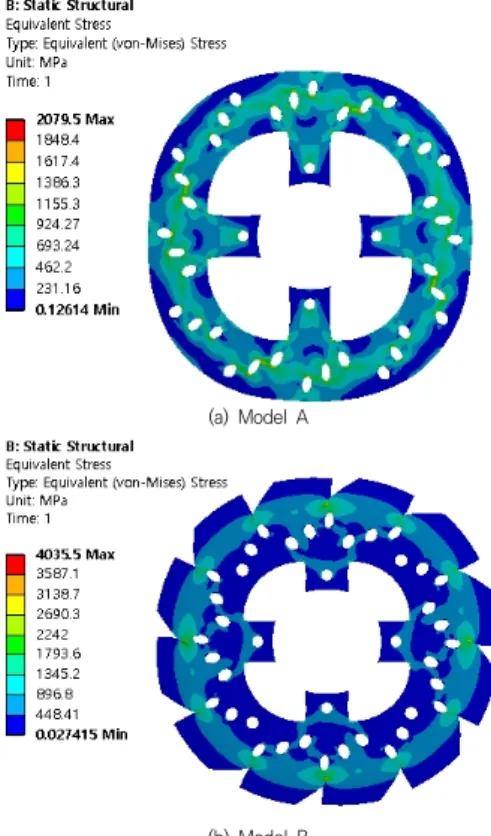
Fig. 6. Thermal stresses of modelsFig. 6은 Model A와 Model B에 대한 열응력들을 나 타낸다. Model B가 더 큰 열응력을 받음을 알 수 있다.
Model A에서의 최대 열응력은 2079.5MPa이며 Model B의 최대 열응력은 4035.5MPa이 되어 대략 두 배나 작 아짐을 알 수 있다. Model A가 Model B에 비하여 최고 온도는 낮고 거의 2배 이상으로 그 열응력이 낮아져 내 구성면에서도 우수함을 알 수 있었다. 그 응력이 가장 크 게 나타나는 부분은 형상에 관계없이 허브와 체결되는 구멍으로 나타났다. 실제 열을 받는 부분과는 거리가 있 지만 큰 부하가 가해지는 회전체를 작은 구멍으로 체결 하면서 발생하는 현상으로 보인다.
3. 결론
본 연구에서는 경주용 자동차에서 기존에 사용 중인 형상인 모델 A와 경량화를 한 모델 B를 모델링하고 ANSYS를 이용하여 열 변형과 열응력을 동반한 구조해 석을 한 연구 결과는 다음과 같다.
1. Model A가 Model B에 비하여 최고온도가 낮음을 볼 수 있다. 다른 냉각 조건이 주어지지 않고 순수 하게 디스크의 형상에 따른 냉각성능은 Model A 가 더 뛰어남을 알 수 있다.
2. Model A가 Model B에 비하여 최고 온도는 낮고 거의 2배 이상으로 그 열응력이 낮아져 내구성면에 서도 우수함을 알 수 있었다. 응력이 가장 크게 나 타나는 부분은 형상에 관계없이 허브와 체결되는 구멍으로 나타났다.
3. 본 연구에서의 해석결과를 이용하면 실제 자동차 브레이크 디스크의 형상을 설계하는데 있어서 도 움이 될 것으로 예상된다. 경주용 자동차 브레이크 디스크의 해석 결과를 이용함으로서, 본 연구가 미 적인 설계 및 해석이 적용된 융합 연구라고 보여진 다.
REFERENCES
[1] J. S. Lee. (2018). Structural Analysis of a 24 Person Elevator Emergency Brake. Journal of the Korea Convergence Society, 9(12), 189-194.
DOI : 10.15207/JKCS.2018.9.12.189
[2] J. H. Lee & J. U. Cho. (2015). Study on Convergence
Technique through Structural Analysis due to the Height of the Walker. Journal of the Korea Convergence Society, 6(2), 19-24.
DOI : 10.15207/jkcs.2015.6.2.019
[3] D. H. Lee & J. U. Cho. (2018). Convergence Study on Damage of the Bonded Part at TDCB Structure with the Laminate Angle Manufactured with CFRP. Journal of the Korea Convergence Society, 9(12), 175-180.
DOI : 10.15207/JKCS.2018.9.12.175
[4] J. H. Lee & J. U. Cho. (2015). Study on the Convergent Life Evaluation due to the Bumper Configuration of Multipurpose Vehicle. Journal of the Korea Convergence Society, 6(5), 85-90.
DOI : 10.15207/JKCS.2015.6.5.085
[5] J. U. Cho. (2014). Analytical Study on Durability due to the Load of Artificial Knee Joint. Journal of the Korea Convergence Society, 5(2), 7-11.
DOI : 10.15207/JKCS.2014.5.2.007
[6] J. W. Park, J. U. Cho. (2017). Convergence Study on Composite Material of Unidirectional CFRP and SM 45C Sandwich Type that Differs in Stacking Angle.
Journal of the Korea Convergence Society, 8(7), 231-236.
DOI : 10.15207/JKCS.2017.8.7.231
[7] J. U. Cho. (2015). Study on Convergence Technique through Strength Analysis of Stabilizer Link by Type.
Journal of the Korea Convergence Society, 6(1), 57-63.
DOI : 10.15207/JKCS.2015.6.1.057
[8] Y. K. Park & B. G. Lee. (2018). A Study on the Structural Analysis of the Spindle of Swiss Turn Type Lathe for Ultra Precision Convergence Machining.
Journal of the Korea Convergence Society, 9(5), 145-150.
DOI : 10.15207/JKCS.2018.9.5.145
[9] J. W. Park. (2017). Structural Analysis of a Tractor Cabin Considering Structure Production Error. Journal of the Korea Convergence Society, 8(5), 155-160.
DOI : 10.15207/JKCS.2017.8.5.155
[10] J. H. Lee & J. U. Cho. (2015). Study on Convergence Technique through Structural Analysis due to the Height of the Walker. Journal of the Korea Convergence Society, 6(2), 19-24.
DOI : 10.15207/jkcs.2015.6.2.019
[11] J. H. Lee & J. U. Cho. (2015). Study on Convergence Technique due to the Shape of Cruiser Board through Structural Analysis. Journal of the Korea Convergence Society, 6(4), 99-105.
DOI : 10.15207/jkcs.2015.6.4.099
[12] G. G. Choi. (2018). A Convergence Study through Durability Analysis due to the Configuration of Automotive Frame Butted. Journal of the Korea Convergence Society, 9(11), 271-276.
DOI : 10.15207/JKCS.2018.9.11.271
[13] Y. T. Oh. (2017). Study on the Structural Analysis of
SCARA Industrial Robot. Journal of the Korean Society of Mechanical Technology, 19(6), 866-871.
DOI : 10.17958/ksmt.19.6.201712.866
[14] Y. S. Lee & Y. J. Yang. (2017). Study on Structural Analysis of Variable Roll Unit for Drawing Process of SUS Hexagonal Bar. Journal of the Korean Society of Mechanical Technology, 19(6), 827-833.
DOI : 10.17958/ksmt.19.6.201712.827
[15] C. S. Yi, B. H. Lee & D. H. Chin. (2019). A Study on the Flow and Structural Analysis in an Air Conditioning Duct for Marine Offshore. Journal of the Korean Society of Manufacturing Process Engineers, 18(3), 88-93.
DOI : 10.14775/ksmpe.2019.18.3.088
[16] I. S. Son, C. H. Kim, S. H. Bae & J. Y. Lee. (2015).
Rescue Lift Development Using Structural Analysis.
Journal of the Korean Society of Manufacturing Process Engineers, 14(1), 111-116.
DOI : 10.14775/ksmpe.2015.14.1.111
오 범 석(Bum-Suk Oh) [정회원]
․ 1980년 2월 : 인하대학교 기계공학과 (공학사)
․ 1982년 2월 : 인하대학교 기계공학과 (공학석사)
․ 1987년 2월 : 인하대학교 기계공학과 (공학박사)
․ 1989년 3월 ~ 현재 : 공주대학교 기 계ㆍ자동차공학부 교수
․ 관심분야 : 기계 및 자동차 부품 의 강도평가 및 파손해석
․ E-Mail : [email protected]
조 재 웅(Jae-Ung Cho) [종신회원]