방사선과 대학생이 지각하는 방사선사의 이미지에 관한 Q방법론적 융합 연구
김영란1, 서선열2, 전민철3*
1원광보건대학교 방사선과 교수, 2을지대학교병원 영상의학과 방사선사, 3대전보건대학교 방사선과 교수
A Q-Methodological Convergence Study on Images of Radiologists as Perceived by Radiology College Students
Young-Ran Kim1, Sun-Youl Seo2, Min-Cheol Jeon3*
1Professor, Department of Radiology, Wonkwang Health Science University
2Radiologist, partment of Radiology, Daejeon Eulji University Hospital
3Professor, Department of Radiology, Daejeon Health Institute of Technology
요 약 방사선사의 이미지는 방사선과 대학생의 전문직관 확립과 방사선사직의 수행에 영향을 준다. 따라서 본 연구는 방사선과 대학생을 대상으로 방사선사의 이미지에 대한 유형을 파악하기 위해 Q방법론을 이용하였다.. Q 모집단은 W 대학교, D대학교 방사선과 학생 110명으로 이들로부터 총 110개의 Q 표본인 방사선사의 이미지에 대한 진술문을 수집 하였다. 선택된 진술문은 전문가의 검토와 수정절차를 거쳐 최종적으로 33개의 Q표본을 선정하였다. 33개의 Q 표본을 바탕으로 방사선과 대학생 30명이 9점 척도로 등급을 매겼다. 자료분석은 PQ method Program을 이용하였다. 연구 결과 방사선사의 이미지에 대한 인식 유형으로 ‘전문기술형’, ‘환자안전형’의 두 가지 유형으로 도출되었다. 본 연구는 방사선과 대학생이 인식하고 있는 방사선사의 이미지 유형을 이해하고, 앞으로 방사선사의 교육과정과 방사선사의 정책 방안에 기초자료로 활용될 수 있다.
주제어 : 방사선사, 이미지, 방사선과 대학생, Q방법론
Abstract Radiologist image perceived by radiology students plays important role for them in establishing a positive Radiology professionalism as well as having a satisfaction on their job. Thus, this study was conducted to examine the image of Radiologist perceived by both radiology students.
Q-methodology was used for this study. 110 Q statements were extracted from qualitative survey from 110 radiology students. The selected statements were reviewed and revised by experts and 33 Q samples were finally selected. Then, 30 radiology students were recruited for this study and were asked to arrange the statement cards on a 9 point scale, which shaped a normal distribution. The data were then analyzed by using PQ method program. As a result, two types of Radiologist’s images were explored: ‘professional technology type’, ‘safety of patient type’ The results of this study will be helpful to provide the direction that we have to pursue regarding educational and political perspectives.
Key Words : Radiologist, Image, Radiology Students, Q-Methodological
*Corresponding Author : Min-Cheol Jeon([email protected]) Received September 23, 2019
Accepted December 20, 2019 Revised December 3, 2019 Published December 28, 2019
1. 서론
현대 의학기술은 해를 거듭할수록 급진적으로 변화하 고 있다. 이를 기반으로 하는 방사선사의 업무 및 영역은 더욱 전문화,되고 있다. 방사선 기술 분야는 비약적으로 확대되고 있고, 중앙화, 집약화, 표준화, 전문화되고 있 다. 의학영상진단기술 부분도 gamma-ray imaging, MRI, digital radiography, ultrasound imaging, CT imaging 등으로 분류하는데[1] 이것은 종래의 X선 촬영 법과 비교조차 할 수 없는 광범한 영역이 되었다. 다양한 방사선과 영역에서 인식되는 방사선사에 대한 이미지는 방사선사의 전문직 발전에 매우 중요한 부분이다[2].
일반적으로 이미지란 특정 대상이나 사물에 대한 주관 적 인상이나 느낌을 의미하며, 타인의 태도를 형성하는 중요한 요인이다[3]. 이러한 이미지는 개개인의 체험 또 는 경험을 통해 인식되고 특정한 이미지로 각인된다.
방사선사의 이미지는 방사선사에 대한 신념 및 방사선 직에 대한 자아상으로 제시된다. 방사선과 대학생이 인지 하는 긍정적인 방사선사의 이미지는 임상실습만족도를 높이고 예비방사선사로써 방사선사의 정체성 및 전문직 관을 형성하는데도 중요하다. 예비 방사선사로써 방사선 과 대학생이 느끼는 방사선사 이미지를 통해 방사선사라 는 직업에 지침서의 역할뿐 아니라 양질의 보건인력으로 써의 성장의 기회가 된다.
기존의 방사선과 대학생을 대상으로 방사선사의 이미 지를 연구한 선행연구를 살펴보면, 일부방사선과 재학생 의 방사선사 이미지 결정에 대한 조사[4], 방사선과 대학 생이 지각한 방사선사 이미지와 자아존중감에 관한 연구 [5], 보건계열 대학생들의 방사선사 이미지에 영향을 미 치는 요인[6]등으로 이루어졌다. 그러나 본 연구에서는 인간의 주관적 구조에 따른 각 유형별 특성에 대한 이해 가 가능한 Q방법론적 접근[7]을 시도하였다. Q방법론적 접근은 주로 간호사의 이미지연구[8-11]에 시도됐으며, 방사선사의 이미지 연구에는 시도된 적이 없다.
따라서 본 연구는 Q방법론을 이용하여 방사선과 학생 들이 생각하는 방사선사의 이미지에 관해 유형별 이해를 돕고, 유형별 특성을 근거로 방사선과 대학생의 바람직한 방사선사 이미지 형성을 위한 기초자료를 제공하고자 한다.
2. 연구방법 2.1 연구설계
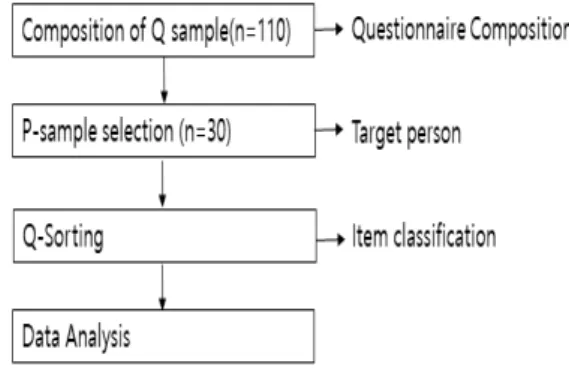
본 연구는 방사선과 대학생이 지각하는 방사선사 이미 지에 대한 인식 유형과 특성을 발견하고 어떠한 차이가 있는가를 규명하기 위해 Q 방법론을 적용한 탐색적 연구 이다. Fig. 1[12].
Fig. 1. Research Composition
2.2. 연구대상자 2.2.1 Q 모집단의 구성
Q 모집단은 Q 방법론 연구를 위해 수집된 항목의 집 합체를 말하는 것으로 한 문화 안에서 공유되는 의견의 총체이다. 본 연구의 Q 모집단은 D대학교, W대학교 방 사선학과 3학년 110명을 대상으로 2019년 7월 1일부터 2019년 7월 30일까지 자료를 수집하였다. 방사선사 이 미지에 대한 인식 유형을 파악하기 위한 질문은 “방사선 사란?”이었다.
2.2.2 Q표본의 구성
Q 표본은 Q 모집단으로부터 추출된 항목으로 보통 수십개로 구성된 카드 위에 쓰인 진술문을 의미한다. 수 집된 자료는 본 연구의 연구자들과 Q방법 연구에 경험이 많은 방사선학 교수와 여러 번 반복해서 읽으면서 검토 하였다. 타당도를 높이기 위해 방사선과 교수 2인에게 각 진술문에 대한 이해도와 명확성 여부를 점검받아 수정·
보완하였으며, 추가로 관련된 문헌을 고찰하여 문항별로 진술문이 중복되지 않도록 Table 1과 같이 총 33개의 Q 표본이 선정되었다.
2.2.3 P표본의 선정
본 연구에서는 P 표본을 본 연구에 동의하고, 방사선 사의 이미지를 잘 표현할 수 있을 것으로 판단되는 D대 학교, W대학교 방사선학과 대학생 30명을 편의 표집하 였다.
1 A radiographer is a person who helps doctors get good images for diagnosis.
2 A radiographer is a person who can build trust among patients during work.
3 A radiographer must put the first priority on patients during work.
4 Professionally, a radiographer can make the most of their major.
5 Professionally, a radiographer must steadily develop themselves.
6 A radiographer must be aware of expertise and be able to explain it easily.
7 A radiographer must consider the patient's condition of being not well physically and be able to get the optimal outcomes with the least movement.
8 A radiographer is a person who gets the best images possible with the least exposure to patients.
9 A radiographer is a person who plays a starting role in diagnosis.
10 A radiographer is a person who endures exposure for diagnosis and treatment of patients.
11 A radiographer is a person who handles cutting-edge technology.
12 A radiographer is always needed professionally for exact diagnosis of diseases.
13 Professionally, a radiographer must minimize the inconveniences of patients and respond to them with the best medical service.
14 The job of radiographer is dangerous.
15 Professionally, a radiographer must think highly of safety and shielding of patients.
16 Professionally, a radiographer should make no mistake during scanning of patients.
17 Professionally, a radiographer must consider a patient like their family.
18 Professionally, a radiographer must be kind to patients.
19 Professionally, a radiographer must cherish service mentality coming from their own heart.
20 Professionally, a radiographer must be responsible for the safety of patients.
21 Professionally, a radiographer needs more professional expertise than any other professions in diagnosis and treatment while dealing with radiation that is very dangerous to humans and most people avoids.
22 Professionally, a radiographer needs stress management.
23 Professionally, a radiographer must put the first priority on patients.
24 Professionally, a radiographer must have good communication with patients.
25 Professionally, a radiographer must sympathize with pains of patients.
26 Professionally, a radiographer has to shoot photos quickly and exactly.
27 Professionally, a radiographer is like a painter who draws a picture.
28 Professionally, a radiographer must consider the patient's pain in the first place and act accordingly.
29 Professionally, a radiographer must always think from the position of a patient.
30 Professionally, a radiographer must perform their job lest patients feel anxious and inconvenient while scanning,.
31 Professionally, a radiographer must make continuous efforts.
32 Professionally, a radiographer needs to render kind service.
33 Professionally, a radiographer must reduce exposure while dealing with patients.
Table 1. Q-Samples 2.2.4 Q분류
Q 분류는 추출된 Q 표본(진술문)을 P 표본으로 하여 금 읽게 한 뒤 주관적인 의견의 동의성 정도에 따라 동 의, 중립, 부정으로 크게 분류 하였고, 그 다음은 Q표본 의 분포도에 동의, 중립, 부정을 세부적으로 나누게 하였 다. 마지막으로 선택의 이유나 느낌에 대해 적도록 하였 다. 연구의 목적을 이해하고 자료 제출의 의사를 밝힌 학 생들의 자료 중 랜덤으로 30개의 자료를 골라 분석 자료 로 사용하였다.
3. 자료처리 및 통계분석
본 연구는 PQ Program을 이용하여 P 표본으로부터 수집된 자료에서 총 30명에 대한 자료를 코딩하였다. Q 표본에서 가장 비동의 하는 문항 –4점부터 가장 동의하 는 문항 +4점까지 점수화하였다. Fig. 2 Q 요인분석은 주요인분석(principal component analysis)방법을 이
용하였다. 이상적인 요인수를 결정하기 위해 Eigen value 1.0이상을 기준으로 하여 요인의 수를 다양하게 입력시켜 가장 이상적인 유형으로 판단되는 것을 선택하 였다.
Number 2 3 4 5 5 5 4 3 2
score -4 -3 -2 -1 0 1 2 3 4
Fig. 2. Q sample distribution
4. 결과 4.1. Q유형의 형성
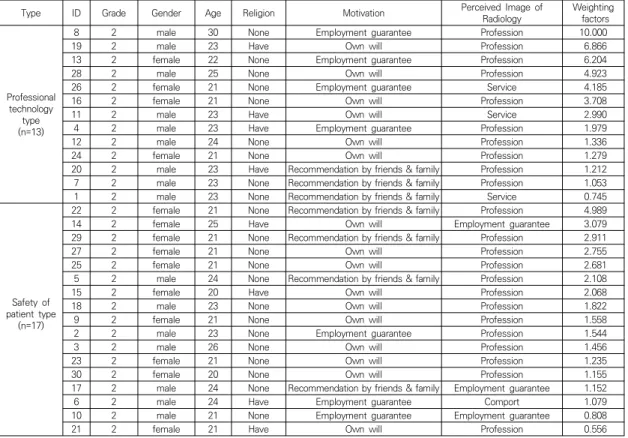
방사선과 대학생이 지각하는 방사선사의 이미지 유형 은 Q 요인분석 결과 2가지 유형으로 분류되었다. 2가지 유형으로 분류된 연구대상 P표본 30명 중 13명이 제 1 유형, 17명이 제 2유형에 포함되었다. Table 2 각 유형
Type ID Grade Gender Age Religion Motivation Perceived Image of
Radiology Weighting
factors
Professional technology
(n=13)type
8 2 male 30 None Employment guarantee Profession 10.000
19 2 male 23 Have Own will Profession 6.866
13 2 female 22 None Employment guarantee Profession 6.204
28 2 male 25 None Own will Profession 4.923
26 2 female 21 None Employment guarantee Service 4.185
16 2 female 21 None Own will Profession 3.708
11 2 male 23 Have Own will Service 2.990
4 2 male 23 Have Employment guarantee Profession 1.979
12 2 male 24 None Own will Profession 1.336
24 2 female 21 None Own will Profession 1.279
20 2 male 23 Have Recommendation by friends & family Profession 1.212
7 2 male 23 None Recommendation by friends & family Profession 1.053
1 2 male 23 None Recommendation by friends & family Service 0.745
Safety of patient type
(n=17)
22 2 female 21 None Recommendation by friends & family Profession 4.989
14 2 female 25 Have Own will Employment guarantee 3.079
29 2 female 21 None Recommendation by friends & family Profession 2.911
27 2 female 21 None Own will Profession 2.755
25 2 female 21 None Own will Profession 2.681
5 2 male 24 None Recommendation by friends & family Profession 2.108
15 2 female 20 Have Own will Profession 2.068
18 2 male 23 None Own will Profession 1.822
9 2 female 21 None Own will Profession 1.558
2 2 male 23 None Employment guarantee Profession 1.544
3 2 male 26 None Own will Profession 1.456
23 2 female 21 None Own will Profession 1.235
30 2 female 20 None Own will Profession 1.155
17 2 male 24 None Recommendation by friends & family Employment guarantee 1.152
6 2 male 24 Have Employment guarantee Comport 1.079
10 2 male 21 None Employment guarantee Employment guarantee 0.808
21 2 female 21 Have Own will Profession 0.556
Table 2. Demographics of the Samples according to the Types of perceived Image of Radiology College Students
Categories Type I. Type II.
Eigenvalue 9.81 3.59
Variance 0.33 0.12
Cumulative variance 0.33 0.49
Correlations Type I. 1.00
Type II. .44 1.00
Table 3. Eigen value, Variance and Correlations among Types 별 설명력은 제 1유형이 33%, 제 2유형이 12%로 나타났 고, 전체 유형의 설명력은 45%로 나타났다. Table 3 방 사선사 이미지 유형 간 상관관계는 Table 3과 같다. 제 1유형과 제 2유형은 .44의 상관관계를 보였다.
4.2 유형별 특성
각 유형이 자신에게 가장 긍정적(동의함) 또는 가장 부정적(동의하지 않음)이라고 선택한 진술문 중 유형별 표준점수가 ±1.00이상인 항목을 중심으로 유형별 특성 을 기술하였고, 유형별 대상자의 특성을 보다 구체적으로 파악하기 위해 개별 심층면담을 실시하였으며 그 결과는 다음과 같다. Table 4.
4.2.1 제 1 유형: 전문기술형
제1유형의 대상자들이 가장 긍정적 동의를 보인 진술 문은 ‘방사선사는 전공을 잘 살릴 수 있는 전문직이다 (Z=1.25)’, ‘방사선사는 전문적 지식을 충분히 알고 쉽게 설명해 줄 수 있어야 한다.(Z=1.17)’, 방사선사는 몸이 불 편한 환자의 입장을 생각하며 최소한의 움직임으로 최적 의 결과물을 얻어낼 수 있어야 한다‘(Z=1.15)’ 등이었다.
Table 4.
대상자들이 이와 같이 반응하는 이유는 전공을 잘 살 려 최적의 결과물을 얻어야 하기 때문(P4, ), 전공을 잘 살리는 전문직이므로(P4), 좋은 영상을 찍어야 진단이 정 확해지므로(P7)라고 하였다.
Types No Q sample Z
professional technology
type
4 Professionally, a radiographer can make the most of their major. 1.25
6 A radiographer must be aware of expertise and be able to explain it easily. 1.17 7 A radiographer must consider the patient's condition of being not well physically and be able to get the optimal outcomes with the least movement. 1.15 30 Professionally, a radiographer must perform their job lest patients feel anxious and inconvenient while scanning -1.16
14 The job of radiographer is dangerous. -1.33
31 Professionally, a radiographer must make continuous efforts. -1.34
33 Professionally, a radiographer must reduce exposure while dealing with patients. -1.35
32 Professionally, a radiographer needs to render kind service. -1.67
Safety of patient type
33 Professionally, a radiographer must reduce exposure while dealing with patients. 1.65
32 Professionally, a radiographer needs to render kind service. 1.29
2 A radiographer is a person who can build trust among patients during work. 1.29 10 A radiographer is a person who endures exposure for diagnosis and treatment of patients. -1.05 19 Professionally, a radiographer must cherish service mentality coming from their own heart. -1.2 17 Professionally, a radiographer must consider a patient like their family. -1.31
14 The job of radiographer is dangerous. -1.87
Table 4. Representative Q-samples and Z-scores in Types(Items with a standard score of ± 1.00 or more)
반면 제1유형이 가장 비동의를 보인 항목은 ‘방사선사 는 친절한 서비스가 요구되는 전문직이다(Z=-1.67)’, ‘방 사선사는 촬영 시 환자에게 피폭을 절감할 수 있어야 하 는 직업이다.(Z=-1.35)’, ‘방사선사는 항상 노력해야 하는 직업이다(Z=-1.34)’, ‘방사선사는 위험한 직업이다.(Z=-1.33)’,
‘방사선사는 환자가 촬영 시 불안과 불편을 최대한 느끼지 않게 본인의 업무를 수행해야 하는 직업이다.(Z=-1.30)’
등이었다. Table 4. 이러한 반응하는 이유는 환자도 중 요하지만 개인의 건강도 중요하므로(P14)라고 하였다.
4.2.2 제 2 유형: 환자안전형
제 2유형에 속한 대상자들은 ‘방사선사는 촬영 시 환 자에게 피폭을 절감할 수 있어야 하는 직업이다(Z=1.65)'.
‘방사선사는 친절한 서비스가 요구되는 전문직이다.(Z=1.29)’,
‘방사선사는 일할 때에 환자에게 신뢰를 줄 수 있는 사람 이다.(Z=1.29)’로 나타났다. Table 4.
그 이유는 방사선사가 갖추어야 하는 것이기 때문 (P32), 방사선사에 적합한 이미지이기때문(P33), 방사선 사에게 환자와의 의사소통은 상당히 큰 부분이다. 아무리 봉사 정신이 뛰어나도 어긋난 의사소통은 환자와의 불화 만이 생겨 좋은 촬영에 지정을 줄 수 있을 것 같다(P32) 로 대답하였다.
제 2유형에 가장 비 동의를 보인 항목에는 ‘방사선사 는 환자 진단, 치료 등을 위해 피폭을 감수하며 일하는 사람이다.(Z=-1.05)’, ‘방사선사는 자신의 마음에서 우러 나온 봉사정신을 가져야 하는 직업이다.(Z=-1.2)’, ‘방사
선사는 환자를 내 가족처럼 생각해야 하는 직업이 다.(Z=-1.31)’, ‘방사선사는 위험한 직업이다.(Z=-1.87)’
등으로 나타났다. Table 4.
5. 고찰
본 연구는 방사선과 대학생이 지각하는 방사선사 이미 지에 대한 인식 유형을 파악할 목적으로 Q방법론을 적용 하여 ‘전문기술형’, ‘환자안전형’’의 두 가지 유형으로 도 출되었다. 이들의 유형별 논의는 다음과 같다.
본 연구대상자에 의해서 가장 많이 볼 수 있는 방사선 사 이미지 유형은 제1유형인 전문 기술형이었다. 전문 기 술형은 다른 유형에 비해 방사선사는 전공을 잘 살릴 수 있는 전문직 직업으로 인식하고 있었다. 간호사와 간호조 무사가 인식하는 방사선사의 이미지에 대한 연구[13]에 서는 방사선사는 전문직이다라는 직업적 이미지로 보고 되고 있고, 방사선과 대학생의 직업가치관 연구에서는 입 학동기가 취직이 잘되서, 전공의 독특성 때문이라고 연구 가 되어[14] 본 연구결과를 지지한다.
본 연구의 대상 30명이 방사선사의 이미지를 한단어 로 설명했을 때 전문직이라고 답한 결과와 일치하는 결 과이다. 이는 방사선과 대학생은 방사선사에 관한 이미지 를 전문직으로 꼭 필요한 직업으로 인식하고 있는 것을 알 수 있었다. 이는 방사선과대학 교과과정에서부터 전문 직으로 자부심과 사명감을 가질 수 있도록한 교육의 결
과로 여겨진다. 앞으로 계속적인 교육과 끊임없는 자기 계발을 통해 전문직으로 면모를 갖출 필요가 있다. 대학 의 교육과정으로 끝나는 것이 아니라 전문직 영역을 확 장하기 위해 보수교육을 비롯하여 다양하고 체계적인 교 육 프로그램을 접할 수 있도록 하는 것이 중요하다고 할 수 있다[15]. 또한 현재 방사선사의 이미지에 관한 연구 는 미미한 실정이므로, 방사선사협회 및 관련단체에서 방 사선사의 전문직 이미지를 홍보하고 연구하는 전략이 필 요할 것이다.
환자안전형은 방사선사는 촬영 시 환자에게 피폭을 절 감할 수 있어야 하는 직업으로 친절한 서비스가 요구되 는 환자에게 신뢰를 줄 수 있는 사람으로 인식하고 있어
‘환자안전형’으로 명명하였다. 이는 환자가 방사선은 위 험하다는 생각을 많이 갖고 있기 때문에 환자에게 피폭 을 최대한 적게 준다는 신뢰를 줘야 한다는 인식에서 반 영된 것으로 여겨진다. 이는 Kim (2014)[16]의 간호사 의 이미지에 관한 주관성연구와 유사한 결과이다. 병원근 로자들은 모두 희생정신과 봉사정신이 있어야 한다는 인 식을 가지고 있는 것으로 유추할 수 있다. 또한 Yoon[17]
의 연구에서는 병원에서 근무하는 방사선사들의 환자안 전문화에 대한 인식도는 중간정도인 것으로 연구가 되었 다. 이 결과는 방사선사 학생이 인식하는 것과 조금은 상 이한 것으로 나타났다. 방사선사의 특성에 따른 환자안 전문화 인식은 연령, 결혼여부, 현 병원 근무경력, 현 부 서 근무경력, 현 근무부서, 안전교육 경험에 따라 유의한 차이가 있는 것으로 이런 일반적인 요인들이 작용하여 방사선과 학생이 지각하는 이미지와 다르게 인식되었다 고 생각된다.
이러한 결과는 방사선사 이미지에 대한 학교 교육과정 과 현실에서의 괴리감을 최대한 줄이고 방사선사에 대한 긍정적인 이미지를 갖추기 위해서 학교교육과정도 중요 하지만 현실형 유형과 동일하게 표현되고 있는 방사선사 근무환경의 처우개선에 대한 국가적인 대책이 시급하다 고 할 수 있다.
이상의 연구결과를 토대로 다음과 같이 제언한다.
첫째, 방사선과 대학생이 바람직한 방사선사 이미지를 형성할 수 있도록 방사선교육과 임상교육의 체계적으로 변화, 발전시켜 나가야 할 필요가 있다.
둘째, 방사선사 이미지에 대한 세밀한 Q방법론의 질 문항목과 분석방법을 개발하여 분석의 다각화가 이루어 지는 후속연구가 필요하다. 학령인구가 급감하는 현재 시 점[18] 에서 좋은 인재를 발굴하기 위해서는 방사선사의 이미지 연구가 본격적으로 이루어져야 한다. 또한 주관적
인식에 대한 탐색적 연구와 기존 연구방법론을 연계하여 Q방법론이 가지는 한계를 극복하고, Q방법론을 통해서 발견된 결과에 대한 실증적 연구가 필요하다.
6. 결론
본 연구는 방사선과 대학생의 이미지에 관한 주관적인 구조와 특성을 규명한 탐색적 조사 연구로, 개방형 질문 지, 심층면담 등을 토대로 수집된 자료를 종합·분석하여 최종적으로 33개의 Q 문항을 추출하였고, 이를 대전·전 북지역에 소재한 2개 대학교 방사선과 대학생 30명에게 분류하도록 하였다. Q 요인분석은 PQ Program을 이용 하였다. 분석결과 본 연구에서는 두 개의 유형(전문기술 형, 환자안전형)이 추출되었다. 본 연구결과는 방사선과 대학생이 지각하는 방사선사 이미지 유형의 차이를 최초 로 분석한 것이 의의가 있으며, 긍정적인 방사선사 이미 지를 위해서 체계적인 방사선사 교육과정 개발과 국민의 건강을 위해 보건의료정책 방안을 위한 기초자료로 활용 할 수 있을 것이다.
REFERENCES
[1] R. R. Carlton & A. M. Adler. (2001). Principles of radiographic imaging, Deliviar, 519-520.
[2] J. H Choi, C. K Kim, W. C. Kim & S. C. Kim.. (2006).
Study on Development in Professional Work of Radiological Technologists, Korean Society of Radiological Science, 29(3), 197-210.
[3] P. R. Kohler & N. Clarke. (1987). Marketing for Health Care Organization
[4] Y. G. Lee et al. (2012). Investigation about Decisions of Radiological Technologist Image of Some Students Majoring inradiology, Journal of the Korean society for digital imaging in medicine, 14(2), 69-74. [5] J. D. Yeo & B. K. Jeon. (2013), A study on Images of
the Radiological Technologists Perceived by College Students of Radiology and their Self-Esteem, Journal of the Korean society for digital imaging in medicine, 16(1)、49-59.
[6] J. K. Eom & S. G. Shin. (2012). Influencing Factors of Radiological Technologist Image of Allied Health College Students, Journal of the Korean society for digital imaging in medicine, 35(1), 25-33.
[7] H. K. Kim. (2009). Q methodology: Philosophy, theories, analysis, and application. Seoul: Communication Books.
[8] M. H. Kwon & J. W. An. (2018). Subjectivity Perceptions on the Nurse’s Admirable Character in Nursing Students, Korean Society For The Scientific Study Of Subjectivity, 43, 121-140.
DOI: 10.18346/KSSSS.43.6
[9] M. H Kwon & Y. E. Kwon. (2014). A Q-methodology Study on the Nurse’s Image of Nursing Students Experienced Clinical Practice, Korean Society For The Scientific Study Of Subjectivity, 29, 29-48.
[10] E. J. Yeun, I. J. Lee & J. H. An. (2013). Attitude toward Turnover Intention among Hospital Nurses: An Application of Q-methodology, Korean Society For The Scientific Study Of Subjectivity, 26, 57-69.
[11] J. S. Seong & E. Y. Yeom. (2016). The Types and Characteristics of the Male Nurses Perceived by Female Nurses: An Application of Q- Methodology, Journal of the Korea Academia-Industrial cooperation Society, 17(1), 572-584.
[12] Y. M. Kwon, H. J. Kim, M. S. Jeon & J. H. An. (2018).
Subjectivity of Hospital Nurses toward Emotional Exhaustion using Q Methodology, Journal of KSSSS, 42, 5-21.
DOI: 10.18346/KSSSS. 42.1
[13] S. G. Shin. (2011). Perception Level of Nurses and Auxiliary Nurses for Radiological technologist, The Journal of the Korea Contents Association, 11(8), 211-220.
DOI: 10.5392/JKCA.2011.11.8.211
[14] H. S Kim. (2007). A Study on the Types of Work Values of Radiologic Technology students, Journal of radiological science and technology, 30(3), 271-280.
[15] Y. H. Lee. (2011). ob analysis for curriculum improvement of radiologic technologist, Kyung Hee University. Seoul.
[16] Y. J. Kim. (2014), Study on the Subjectivity about Nursing Student's Image of Professional Nurse before Clinical Practice, International Journal of Contents, 14(5), 224-234.
DOI: 10.5392/JKCA.2014.14.05.224
[17] D. G. Yoon. (2014). The Perception of Patient Safety Culture of Radiological Technologists Working at Hospital, Kyungpook National University, Dae-gu.
[18] S. J. Ban, Y. J. Cho, H. S. Shin, M. S. No, M. J. Park &
Y. S. Kim. (2013). University enrollment quota adjustment and restructuring according to decline in school age population, Korean Society for the Politics of Education, 20(4), 189-211.
김 영 란(Young-Ran Kim) [정회원]
․ 2009년 2월 : 충남대학교 보건대학원 보건학과(보건학 석사)
․ 2013년 2월 : 충남대학교 보건대학원 보건학과(보건학 박사)
․ 2007년 10월 ~ 2015년 2월 : 충남대 학교 의학전문대학원 예방의학과 조교
․ 2015년 3월 ~ 현재: 원광보건대학교 방사선과 조교수
․ 관심분야: 보건학, 방사선학
․ E-Mail : [email protected]
서 선 열(Sun-Youl Seo) [정회원]
․ 2009년 8월 : 을지대학교 보건대학원 보건학과(보건학 석사)
․ 2013년 8월 : 을지대학교 보건대학원 보건학과(보건학 박사)
․ 2014년 3월 ~ 2016년 8월: 을지대학 교 방사선과 교수
․ 1992년 10월 ~ 현재 : 을지대학교 병 원 영상의학과
․ 관심분야 : 방사선학
․ E-Mail : [email protected]
전 민 철(Min-Cheol Jeon) [정회원]
․ 2012년 8월 : 충남대학교 의공학과(공 학 석사)
․ 2017년 2월 : 충남대학교 의공학과(공 학 박사)
․ 2006년 1월 ~ 2017년 2월: 충남대학 교병원 영상의학과
․ 2017년 3월 ~ 현재 : 대전보건대학교 방사선과 조교수
․ 관심분야 : 의료영상정보, 방사선영상학, 전산화단층활영
․ E-Mail : [email protected]