• 검색 결과가 없습니다.

Development of Boron Doped Carbon Using CO<sub>2</sub> Reduction with NaBH<sub>4</sub> for Vanadium Redox Flow Battery

N/A
N/A
Protected

Academic year: 2021

Share "Development of Boron Doped Carbon Using CO<sub>2</sub> Reduction with NaBH<sub>4</sub> for Vanadium Redox Flow Battery"

Copied!
5
0
0

로드 중.... (전체 텍스트 보기)

전체 글

(1)

Vol. 21, No. 1, 2018, 1-5

https://doi.org/10.5229/JKES.2018.21.1.1

− 1 −

pISSN 1229-1935 eISSN 2288-9000

수소화 붕소 나트륨 (NaBH

4

) 과 이산화탄소의 환원을 이용한 바나듐 레독스 흐름전지용 탄소 촉매 개발

한만호·김한성*

연세대학교 화공생명공학과

(2017년 12월 20일 접수 : 2018년 1월 24일 수정 : 2018년 1월 31일 채택)

Development of Boron Doped Carbon Using CO

2

Reduction with NaBH

4

for Vanadium Redox Flow Battery

Manho Han and Hansung Kim*

Dept. of Chemical and Biomolecular Engineering, Yonsei University

(Received December 20, 2017 : Revised January 24, 2018 : Accepted January 31, 2018)

본 연구에서는 수소화 붕소 나트륨 (NaBH

4

) 를 이용하여 고온에서 이산화탄소 (CO

2

) 를 환원시켜 붕소가 도핑된 카본을 제조하였고, 이를 카본 펠트에 코팅하여 바나듐 레독스 흐름전지용 전극으 로 적용하였다. 전기화학적 성능 평가 결과, 순수 카본펠트 대비 붕소 도핑된 카본으로 코팅된 카본펠트의 가역성이 약 20% 향상되었고 전하 전달 저항이 60% 감소하였다. 충/방전 결과에서 는, 에너지 밀도와 에너지 효율이 각각 21%와 12.4% 향상되었다. 이러한 결과는 CO

2

를 환원 시켜 제조한 탄소가 레독스 흐름전지용 전극소재로 사용될 수 있는 가능성을 보여준다.

Abstract : In this study, boron - doped carbon was prepared by reducing carbon dioxide (CO

2

) at high temperature by using sodium borohydride (NaBH

4

). The boron - doped carbon was coated on carbon felt and applied as an electrode for a vanadium redox battery cell. As a result of electrochemical performance evaluation, reversibility of carbon felt coated with boron doped carbon compared to pure carbon felt was improved by about 20% and charge transfer resistance was reduced by 60%. In the charge / discharge results, energy density and energy efficiency were improved by 21% and 12.4%, respectively. These results show that carbon produced by reduction of CO

2

can be used as electrode material for redox flow battery.

Keywords : Vanadium redox flow battery, CO

2

reduction, Boron doped carbon, Boron functional group, Sodium borohydride

1. 서

바나듐 레독스 흐름전지 (vanadium redox flow battery, VRFB) 는 양극과 음극에 바나듐을 사용하고, 바나듐의 산화, 환원 반응을 이용해 화학에너지를 전 기에너지로 저장하는 이차전지다.

1)

전지의 충전과 방

전이 진행될 때, 바나듐의 레독스 반응은 전극의 표면 에서 일어나기 때문에 VRFB의 에너지 효율은 전극의 전기화학적 활성에 영향을 받는다.

2-3)

따라서 전극의 활성을 증가시키는 것은 전지의 성능을 증가시키기 위 한 중요한 요소가 된다.

VRFB 에는 일반적으로 카본펠트가 전극으로 사용된 다. 카본펠트는 다공성 구조를 가지고 있어 전해질이 원활하게 흐를 수 있다는 장점이 있다. 또한, 내산성

*E-mail: [email protected]

(2)

이 크기 때문에 산성의 전해질을 사용하는 VRFB 시 스템에 적합하다.

4)

그러나 카본펠트는 제조과정의 특 성상 발수성이 강하며 전기화학적 활성이 높지 않다 는 문제점이 있다.

5)

따라서 전극의 전기화학적 활성을 향상시키기 위한 활성화 방법의 개발이 진행되어 왔 다. 먼저 전극을 직접 활성화하는 방법으로 열처리,

6-7)

산처리,

8-9)

전기화학적 산화,

10)

와 같은 방법들이 보고 되었다. 최근에는 카본펠트에 질소와 같은 이종원소의 작용기를 도입하는 방법들이 제안되었다.

9,11-13)

질소 작 용기를 도입하는 방법으로 화학기상증착법 (chemical vapor deposition, CVD),

14)

암모니아의 열처리법,

11,15-16)

도파민 코팅법,

17)

그리고 폴리피롤 (polypyrrole, ppy) 코팅법

18)

등이 보고가 되었다. 그 외 질소와 붕소가 동시에 도입된 탄소 촉매

19-20)

가 보고 되었다.

본 연구에서는 CO

2

를 NaBH

4

로 고온에서 환원하여 붕소 도핑된 탄소를 제조하였고, 이를 카본펠트에 코 팅하여 VRFB 용 전극을 제조하였다. 이렇게 제조된 탄소 촉매의 물리적 및 전기화학적 특성을 분석하여 VRFB 적용 가능성을 살펴보았다.

2. 실험 방법

본 실험에서는 CO

2

기체를 NaBH

4

로 환원시켜 붕 소가 도입된 탄소 (boron doped carbon, BC)를 제조

하였다.

21,22)

2g 의 NaBH

4

를 고온 전기로에 넣고 CO

2

기체를 흘려주면서 5

o

C/ 분 의 속도로 500

o

C까지 승온 시키고 2시간동안 열처리를 진행하였다. 열처리된 분 말을 5M 염산에서 산처리를 하고 초순수를 이용한 3 회의 세척과 12시간 건조 후 최종적으로 138 mg의 BC를 제조하였다. BC의 구조 분석을 위해 전자 현미 경 (FE-SEM, Sigma-300-VP)을 이용하였으며 전극 표면의 원소별 함량과 붕소 작용기를 분석하기 위해 XPS (K-alpha) 를 사용했다. BC의 표면적은 Brunauer- Emmet-Teller (BET, Belsorp-mini II)로 측정 했다.

전극은 3 mm 두께의 카본펠트 (PAN-based graphite felt, Nippon Carbon) 에 BC를 코팅하여 제조했다. BC (20 mg)와 에탄올 (0.9 mL) 그리고 5wt%의 Nafion 용액 (0.1 mL)을 섞고, 9 cm

2

면적의 카본펠트에 균일 하게 도포한 뒤, 진공오븐에서 60

o

C, 9 시간 건조시킨 다. 이런 과정을 거쳐 최종 BC가 3 mg이 코팅되었다.

전기화학적 특성은 순환 전압 전류법 (Cyclic voltammetry, CV)과 전기화학적 임피던스 분광법 (Electrochemical impedance spectroscopy, EIS) 을 이 용하여 측정하였다. CV는 0.1M VOSO

4

+ 3.0M H

2

SO

4

의 전해질과 삼전극 시스템으로 구성하였다. 전 압범위는 0.0 V and 1.0 V (vs. Hg/HgSO

4

)이며 scan rate 는 5 mVs

-1

이다. EIS는 10

-2

~10

5

Hz 의

frequency 범위에서 측정되었다.

충전/방전 평가 시스템은 이전에 진행한 연구와 동 일하게 구성하였다.

19)

9 cm

2

의 면적과 3 mm의 두께를 갖는 카본펠트를 양·음극의 전극으로 사용하였고, 전 해질막은 Nafion 117을 사용하였다. 전해질이 흐르는 채널은 flow frame을 사용했고, graphite polar plate 와 구리판 그리고 알루미늄 판을 이용하여 셀을 조립 하였다. 음극 (1.5M V

3+

+ 3M H

2

SO

4

) 과 양극 전해 질 (1.5 M VO

2+

+ 3M H

2

SO

4

) 은 각각 20 mL이며, 모든 전해질은 대기와 접촉을 차단하였다. 인가한 전 류밀도는 50 mAcm

-2

이고, 충전 최대 전압은 1.6 V이 며 방전 최저 전압은 0.8 V이다.

3. 결과 및 고찰

NaBH

4

와 CO

2

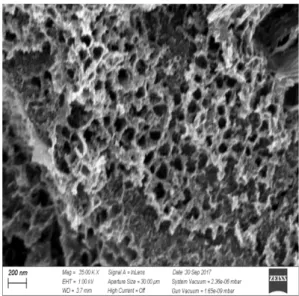
를 이용해 제조한 BC의 미세구조를 관찰하기 위해 전자현미경을 이용하였으며 그 결과를 Fig. 1 에 나타내었다. 다공성 구조는 전극의 표면적을 증가시켜 단위 무게당 반응면적을 크게 증가시키므로, Fig. 1 에 나타난 바와 같이 BC는 기공이 많은 다공성 구조형태로 활용하였다. BC의 비표면적과 기공크기를 Table 1에 나타내었다.

Fig. 1. FE-SEM image of BC.

Table 1. BET data of BC.

BC

BET (m

2

/g) 684.46

pore volume (cm

3

/g) 1.14

pore diameter (nm) 12.32

(3)

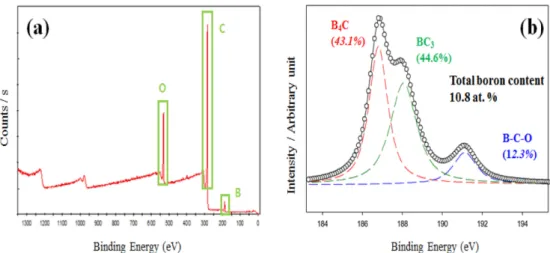
제조된 카본의 구성 성분을 분석하기 위해서 XPS 를 실시하였고, 그 결과를 Fig. 2에 나타내었다. Fig.

2(a)에 보듯이 BC에는 붕소가 검출되었다. 각 B, C 그리고 O의 원소 별 함량 (Table 2) 은 각각 10.8, 77.3, 11.9at. % 이다. Fig. 2-(b)의 B1s spectra를 보 면 3개의 붕소 작용기 peak들이 나타난다. 187eV 와 188.1eV 는 B-C group들을 나타나는데, 각각 B

4

C와 BC

3

를 의미한다. 191.4eV는 B-C-O group과 일치하 며 BCO

2

를 의미한다.

21,23-24)

BC를 VRFB에 적용하기 위해서 카본펠트에 BC를 코팅하여 전극을 제조하였고 (BCF), 바나듐이온의 산 화/환원 반응성을 측정하기 위해서 순환 전압 전류법 (CV) 과 전기화학적 임피던스 분광법 (EIS)을 실시하 였다. 비교를 위해 아무런 전처리를 하지 않은 카본펠 트 (GF)를 같은 조건에서 측정하였다. 일반적으로 산 화와 환원 peak potential차이 (

Δ

Ep) 와 환원 peak 대 비 산화 peak의 비율 (Ipa/Ipc)은 전기화학적 활성을 평가하는 주요 인자이다. Fig. 3에 나타난 것과 같이, BCF가 GF 보다 우수한 전기화학적 활성을 나타내었 다. 각 인자를 살펴보면, BCF의 산화 peak 값 (80.85 mA)이 GF (66.79 mA)보다 큰 값을 보였고, 환원 peak 값 (41.94 mA)도 GF (28.07 mA) 보다 더 크게 나타났다. Ipa/Ipc 값은 BCF (1.93)가 GF (2.38) 보다 1에 더 가깝게 나타났다.

Δ

Ep 도 BCF (0.33 V)가 GF (0.49 V) 보다 약 32.7% 더 작은 값 을 보인다.

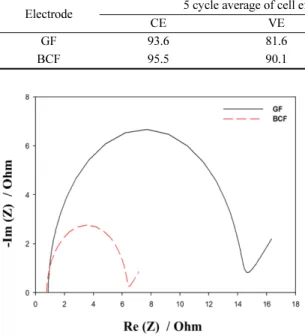
Fig. 4에 나타나는 EIS 결과에서도 BCF의 성능이

더 우수한 경향을 보인다. 특히 전하 전달 저항은 약 60% (13.28

5.52) 감소하였다. 이런 EIS 결과는 전해질과 전극의 계면에서 전하 전달 저항이 감소되 었음을 의미한다. 이는 CV 결과와 동일한 경향이다.

이 결과들은 모두 BCF가 GF보다 더 큰 전기화학적 활성과 가역성을 가지는 것을 의미하므로 BCF를 적 용한 VRFB의 에너지효율이 증가할 것으로 예상된다.

Fig. 5는 BCF와 GF를 전극으로 사용한 각각의 VRFB 의 충/방전 평가 결과를 보여준다. 초기 방전 시 potential loss 가 BCF에서 크게 감소하였다. 이는 반응 활성이 높은 BC를 사용함으로써 활성화 과전압이 줄 어든 것이 크게 기여한 것으로 보인다. 충방전 결과를 바탕으로 계산된 전류효율 (coulombic efficiency, Fig. 2 (a) XPS survey scan of BC and (b) XPS B1s spectra of BC.

Table 2. Composition ratio (at. %) of BC.

B C O

BC 10.8 77.3 11.9

Fig. 3 Cyclic voltammograms of GF and BCF in 0.1 M

VOSO

4

+ 3.0 M H

2

SO

4

electrolyte using a 5 mVs

-1

scan

rate with a 0.0 V to 1.0 V vs. Hg/HgSO

4

.

(4)

CE), 전압효율 (voltage efficiency, VE), 에너지효율 (energy efficiency, EE) 그리고 에너지밀도 (energy density, WhL

-1

) 는 Table 3에 정리되어 있다. Table 3 을 보면, BCF를 사용한 전지에서 모든 효율이 증가 하였다. BCF의 에너지효율 (86.1%)은 약12.4% 가 증 가하였고, 방전 에너지 밀도 (13.1WhL

-1

) 역시 약

21% 증가하였다. 이는 BC의 향상된 전기화학적 활성 이 영향을 미쳤기 때문이다. 이러한 결과들을 바탕으 로 CO

2

를 이용하여 제조한 카본이 VRFB용 전극에 적용할 수 있음을 알 수 있다.

4. 결

본 연구에서는 VRFB 전극에 적용할 수 있는 붕소 가 도입된 탄소 촉매 (BC) 를 수소화 붕소 나트륨을 이용하여 이산화탄소를 환원시켜 제조하였다. 물성 분 석을 통해 BC의 다공성 구조와 붕소 작용기들을 확 인하였다. 전기화학적 특성 평가와 충전/방전 평가를 통해 BC가 코팅된 카본펠트 (BCF) 는 코팅되지 않은 카본펠트 (GF) 보다 바나듐 레독스 반응에 더 우수한 성능을 나타냄을 확인하였다. 이러한 결과들은 CO

2

를 환원시켜 제조한 탄소촉매가 VRFB용 전극소재로 적 용 가능함을 의미하며 친환경적으로 CO

2

를 활용할 수 있는 방안으로 고려될 수 있다.

감사의 글

본 연구는 Korea Institute of Energy Technology Evaluation and Planning (KETEP) grant (No.

20152020106550) 의 지원으로 수행되었으며, 이에 감 사 드립니다.

References
1. Z. Mai, H. Zhang, X. Li, S. Xiao, H. Zhang, ‘Nafion/

polyvinylidene fluoride blend membranes with improved ion selectivity for vanadium redox flow battery application’ Journal of Power Sources, 196, 5737 (2011).

2. K. J. Kim, Y. -J. Kim, J. -H. Kim and M. -S. Park, ‘The effects of surface modification on carbon felt electrodes for use in vanadium redox flow batteries’ Materials Chemsitry and Physics, 131, 547, (2011).

3. Z. Gonzalez, C. Botas, P. Alvarez, S. Roldan, C. Blanco, R. Santamaria, M. Granda and R. Menendez, ‘Thermally reduced graphite oxide as positive electrode in Vanadium Redox Flow Batteries’ Carbon, 50, 828 (2012).

4. X. Wu, H. Wu, P. Xu, Y. Shen, L. Lu, J. Shi, J. Fu and H. Zhao, ‘Microwave-t reated graphite felt as the pos- Fig. 4 Nyquist plots for GF and BCF across the frequency

range from 10

-2

to 10

5

Hz in 0.1 M VOSO

4

+ 3.0 M H

2

SO

4

solution at an open-circuit potential.

Fig. 5 Charge-discharge profiles of VRFB single cell at a constant current density of 50 mAcm

-2

.

Table 3. Efficiency and energy density of the VRFB single cells with GF and BCF at a constant current density of 50mAcm

-2

.

Electrode 5 cycle average of cell efficiency (%) Energy

Density (WhL

-1

)

CE VE EE

GF 93.6 81.6 76.5 10.8

BCF 95.5 90.1 86.1 13.1

(5)

itive electrode for all-v anadium redox flow battery’

Journal of Power Sources, 263, 104 (2014).

5. W. Zhang, J. Xi, Z. Li, H. Zhou, L. Liu, Z. Wu and X.

Qiu, ‘E lectrochemical mass transport studied by probe beam deflection: potential step experiments’

Electrochim Acta, 37, 429 (2013).

6. B. Sun and M. Skyllas-Kazacos, ‘Modification of graphite electrode materials for vanadium redox flow battery application-I. Thermal treatment‘ Electrochimica Acta, 37, 1253 (1992).

7. D. Ha, S.-K. Kim, D. Jung, S. Lim, D. -H. Peck, B. Lee and K. L, ‘Effect of Carbon Felt Oxidation Methods on the Electrode Performance of Vanadium Redox Flow Battery’ Journal of the Korean Electrochemical Society, 12, 263 (2009).

8. B. Sun and M. Skyllas-Kazacos, ‘Chemical modification of graphite electrode materials for vanadium redox flow battery application-part II. Acid treatments’

Electrochimica Acta, 37, 2459 (1992).

9. J. Jin, X. Fu, Q. Liu, Y. Lin, Z. Wei, K. Niu and J.

Zhang, ‘Identifying the Active Site in Nitrogen-Doped Graphene for the VO

2+

/VO

2+

Redox Reaction‘ ACS nano, 7, 4764 (2013).

10. X. -G. Li, K. -L. Huang, S. -Q. Liu, N. Tan and L. -Q.

Chen, ‘Characteristics of graphite felt electrode elec- trochemically oxidized for vanadium redox battery application’ Transactions of Nonferrous Metals Society of China, 17, 195 (2007).

11. Y. Shao, X. Wang, M. Engelhard, C. Wang, S. Dai, J.

Liu, Z. Yang and Y. Lin, ‘Nitrogen-doped mesoporous carbon for energy storage in vanadium redox flow batteries‘ Journal of Power Sources, 195, 4375 (2010).

12. H. Lee and H. Kim, ‘Development of nitrogen-doped carbons using the hydrothermalmethod as electrode materials for vanadium redox flow batteries’ Journal of Applied Electrochemistry, 43, 553 (2013).

13. L. Shi, S. Liu, Z. He and J. Shen, ‘Nitrogen-Doped Graphene:Effects of nitrogen species on the properties of the vanadium redox flow battery’ Electrochim Acta, 138, 93 (2014).

14. S. Wang, X. Zhao, T. Cochell, and A. Manthiram,

‘Nitrogen-Doped Carbon Nanotube/Graphite Felts as Advanced Electrode Materials for Vanadium Redox Flow Batteries’ The Journal of Physical Chemistry

Letters, 3, 2164 (2012).

15. C. Flox, J. Rubio-Garcia, M. Skoumal, T. Andreu, and J.

R. Morante, ‘Thermo-chemical treatments based on NH

3

/ O

2

for improved graphite-based fiber electrodes in vanadium redox flow batteries’ Carbon, 60, 280 (2013).

16. T. Wu, K. Huang, S. Liu, S. Zhang, D. Fang, S. Li, D.

Lu and A. Su, ‘Hydrothermal ammoniated treatment of PAN-graphite felt for vanadium redox flow battery’

Journal of Solid State Electrochemistry, 16, 579 (2011).

17. H. Lee, H. Kim, ‘Graphite Felt Coated with Dopamine- Derived Nitrogen-Doped Carbon as a Positive Electrode for a Vanadium Redox Flow Battery’ Journal of The Electrochemical Society, 162 (8) A1675 (2015) 18. S. Park, H. Kim, ‘Fabrication of nitrogen-doped graphite

felts as positive electrodes using polypyrrole as a coating agent in vanadium redox flow batteries’ J. Mater. Chem.

A, 3, 12276 (2015).

19. M. Park, J. Ryu, Y. Kim and J. Cho, ‘Corn protein- derived nitrogen-doped carbon materials with oxygen- rich functional groups: a highly efficient electrocatalyst for all-vanadium redox flow batteries’ Energy &

Environmental Science, 7, 3727 (2014).

20. J. Ryu, M. Park, J. Cho, ‘Catalytic Effects of B/N-co- Doped Porous Carbon Incorporated with Ketjenblack Nanoparticles for All-Vanadium Redox FlowBatteries’

Journal of The Electrochemical Society, 163, A5144 (2016).

21. J. Zhang, A. Byeon, J. Lee, ‘Boron-doped electrocatalysts derived from carbon dioxide’ JMCA, 1, 8665 (2013).

22. J. Zhang, J. Lee, ‘Production of boron-doped porous carbon by the reaction of carbon dioxide with sodium borohydride at atmospheric pressure’ CARBON, 53, 216 (2013).

23. Z. Lei, H. Chen, M. Yang, D. Yang, H. Li, ‘Boron and oxygen-codoped porous carbon as efficient oxygen reduction catalysts’ Applied surface science, 426, 294 (2017).

24. B. Ottaviani, A. Derre, E. Grivei, O. A. M. Mahmoud,

M. -F. Guimon, S. Flandrois, P. Delhaes, ‘Boronated

carbons: structural characterization and low temperature

physical properties of disordered solids’ J. Mater. Chem.,

8, 197 (1998).

수치

Fig. 1. FE-SEM image of BC.
Fig. 3 Cyclic voltammograms of GF and BCF in 0.1 M VOSO 4  + 3.0 M H 2 SO 4  electrolyte using a 5 mVs -1  scan rate with a 0.0 V to 1.0 V vs
Table 3. Efficiency and energy density of the VRFB single cells with GF and BCF at a constant current density of 50mAcm -2 .

참조

관련 문서

Second, as a result of the IPA analysis of the sub-factors of audience perception, the factors of entry route were located in the first quadrant, the

A Study on Heat Dissipation Design and Performance Evaluation of Lithium-ion Battery Pack for Automated Logistics Robot Using Infrared Thermal Imaging

Among the sub-factors, confidence, The factors of setting, team harmony, image and will power were higher in the group with national representative

For the gender, while training and direction, democratic direction, positive regard, and autocratic direction of leadership type sub-factors were perceived as high in

Fourth, for the sub-factors of personality traits according to weight lifters’ education, while there was a high difference in neuroticism and agreeableness

For the sub-factors of selection attributes and customer value according to screen golf course handicap, convenience, professionality, facilities, price,

-another type of stereoisomer when Compound having carbon (chiral carbon) with 4 different groups attached carbon (chiral carbon) with 4 different groups

Yanga, “Mesoporous activated carbon fiber as electrode material for high-performance electrochemical double layer capacitors with ionic liquid electrolyte”, J...