39
KISEP Original Article Sleep Medicine and Psychophysiology
•••••••••••••••••••••••••••••••••••••••••••••••••••••••••••••••••••••••••
수면·정신생리 12(1): 39-44, 2005
나이에 따른 수면무호흡증 임상적 특성의 변화
Characteristics of Sleep Apnea Syndrome in the Elderly in a Clinical Setting
신윤경·윤인영·홍민철·윤영돈
Yoon-Kyung Shin, In-Young Yoon, Min-Chul Hong, Yong-Don Yun
■ABSTRACT
Objectives: Much attention has been paid to sleep apnea syndrome (SAS) in the elderly because of its high prevalence. It is expected that SAS in the elderly has both similarities and differences compared to SAS in the young or middle-aged populations. The aim of this study was to elucidate the characteristics and consequences of SAS in the elderly.
Methods: In this study we included 210 young or middle-aged adults between 23 and 59 years (20 women and 190 men) and 65 older adults between 60 and 83 years of age (16 women and 49 men). Respiratory disturbance indices (RDIs) of the study subjects were more than 5 in an overnight polysomnography. They completed the Epworth Sleepiness Scale (ESS) and Pittsburgh Sleep Quality Index (PSQI). Informations about body mass index (BMI), neck, waist, and hip measurements, and blood pressure were obtained.
Results: No difference was observed between older adults with SAS (older SAS) and adults aged under 60 with SAS (SAS aged under 60) in RDI, apnea index, % time of oxygen saturation less than 90%, and PSQI. Obstructive apnea index and oxygen desaturation index (ODI) were lower in older SAS. Compared to SAS aged under 60, lowest oxygen saturation and central apnea index were higher in older SAS, but they were statistically not significant. BMI and neck circumference were significantly lower in older SAS compared to SAS aged under 60. Diastolic blood pressure was lower in older SAS compared to SAS aged under 60 with no difference in systolic blood pressure. Older SAS showed lower scores in ESS than SAS aged under 60. Significant correlation was observed between RDI and BMI in SAS aged under 60, but not in the case of older SAS. The relationships between RDI and neck circumference, systolic and diastolic pressure, and ESS were similar.
Conclusions: The elderly with SAS were not over-weight and there was no relationship between body weight and the severity of SAS. Also, the behavioral and cardiovascular effects of SAS were not marked in the elderly, which might be partly explained by decreased ODI and relatively higher lowest oxygen saturation in older SAS. The normal aging process, aside from increased body weight, might contribute to the development of SAS in the elderly with modest complications. Sleep Medicine and Psychophysiology 2005;12(1):39-44
Key words: Sleep apnea syndrome·Elderly·Body mass index·Blood pressure·Epworth sleepiness scale.
서 론
수면 무호흡증은 코골음, 수면 시 빈번한 각성, 주간 졸
림증을 보이며, 고혈압, 동맥경화증, 부정맥 등의 심혈관계 질환과 인지기능의 장애 등의 합병증을 유발하는 질환이 다(1-4). 수면 무호흡증은 흔한 질환으로 우리나라의 경 우 성인 남, 여에서의 유병률이 각각 4.5%와 3.2%로 보고 되고 있고(5), 미국은 남, 여에서 각각 4%와 2%(6-8), 동양권인 홍콩은 남자에서 3.9%와 여자에서 1.2%의 유병 률을 보고하였다(9,10).
25세에서 60세 미만 사이의 성인과 60세 이상 노인 인 구에서 호흡장애지수(respiratory disturbance index, RDI) 가 15 이상인 환자의 비율을 조사한 Cleveland 가족 연구
••••••••••••••••••••••••••••••••••••••••••••••••••••••••••••••••••••••••••••••••••••••••••••••••••••••••••••••••••••
분당서울대학교병원 신경정신과
Department of Neuropsychiatry, Seoul National University Bundang Hospital, Seongnam, Korea
Corresponding author: In-Young Yoon, Department of Neuropsy- chiatry, Seoul National University Bundang Hospital, 300 Gumi-dong, Bundang-gu, Seongnam 463-707, Korea
Tel: 031) 787-7433, Fax: 031) 787-4058 E-mail: [email protected], [email protected]
40
에서는 남자 성인과 노인에서 각각 22%와 42%, 여자 성인 과 노인에서 각각 4%와 32%의 유병률을 보고하였다(11).
또한 40에서 60세 미만 사이의 성인과 60에서 99세 사이 의 노인 인구에서 호흡장애지수가 15 이상인 환자의 비율 을 조사한 Young 등(12)의 연구에서도 노인 인구에서 1.9배 높은 유병률을 보였다. 이상의 연구에서 수면무호흡 증은 성인보다 노인에서 훨씬 흔한 질환임을 알 수 있으나, 노인에서의 높은 유병률에 대한 임상적 의미는 아직 명확 하게 밝혀지지 않았다(9,10,13).
나이가 증가함에 따라 호흡장애지수와 무호흡기간(du- ration of apnea)이 증가하며, 특히 여성에서는 산소포화도 가 감소한다는 이전의 연구들이 있기는 하나 아직 이에 대 한 연구가 많지 않다(14-16). 또한 성인 수면 무호흡증에 서의 위험요인들이 노인 수면무호흡증에서도 유사한 영향을 미치는지의 여부와 노인 수면무호흡증에서의 고유한 위험 요인에 대한 조사 역시 드물다(17-19). 본 연구에서는 노 인 수면 무호흡증과 성인 수면무호흡증에서의 특성들을 비 교하고 이미 알려진 성인 수면무호흡증에서의 위험인자들 과 노인 수면무호흡증과의 상관관계를 살펴보고자 하였다.
연구대상 및 방법
1. 연구대상
2003년 2월부터 2005년 4월 사이의 기간에 분당서울 대학교병원 수면검사실에서 야간수면다원검사를 받은 20 세 이상의 성인 372명 중 호흡장애지수가 5이상으로 나타 난 275명의 환자들을 연구대상으로 하였다. 연구 대상자 중 여자가 36명(13.1%)이었고, 연령분포는 23세에서 83 세 사이로, 평균연령은 50.6±13.1세였다. 60세 미만 성인 집단(N=210)의 평균 연령은 45.0±8.8세였고, 여자가 20명(9.5%)이었으며, 60세 이상 노인 집단(N=65)의 평 균 연령은 68.8±6.4세였고, 여자가 16명(24.6%)이었다.
2. 방 법
1) 신체검사와 수면설문지
수면다원검사를 받은 모든 사람들은 수면다원검사 1시간 전에 키, 몸무게, 목둘레, 허리둘레, 엉덩이 둘레, 혈압 등을 포함한 간단한 신체검사를 받았고, 수면설문지를 작성하도 록 하였다. 혈압은 Welch Allyn®의 Tycos No. 5098- 02(classic style hand aneroid)를 사용하여 숙련된 기사가 측정하였다. 수면 설문지에는 Pittsburgh 수면질척도(Pitts- burgh sleep quality index), Epworth 졸림증 척도(Ep-
worth Sleepiness Scale) 등의 수면과 주간 졸리움에 대 한 주관적 평가도구와 현재 앓고 있거나 과거 앓은 적이 있 는 질환, 복용중인 약물과 복용기간, 그리고 수면 무호흡증 의 가족력에 대한 기술이 포함되었다.
2) 수면다원검사
수면다원검사는 분당서울대학교병원 수면다원검사실에서 하루 밤 동안 시행되었다. 수면다원검사 기록에는 Medcare® 의 Embla N 7000 recording system을 사용하였으며 분 석 프로그램은 Somnologica version 3.3.1을 이용하였다.
표준화된 판독지침서(20)에 근거하여 수면전문기사가 1차 판독을, 전문의가 2차 판독을 시행하였고, 이를 통해 수면 단계, 무호흡, 저호흡, 각성, 사지운동(limb movement) 등 의 사건(events)이 평가되었다. 각종 전극 및 감지기는 표 준화된 방법에 따라 대상자에게 부착하였다. 뇌파 전극은 국제 체계인 10~20체계에 따라 C3/A2, C4/A1에 부착하 였으며(21), 수면시작(sleep onset)과 각성(arousal)의 확 인에 유용한 알파 파(alpha wave)의 변화를 반영하기 위 하여 O1/A2, O2/A1에도 부착하였다. 안전도 전극은 좌우 외안각(outer canthus)의 외측 1 cm 상하방에, 하악 근전 도 감지기는 하악근(submentalis muscle) 위에 부착하였 으며 공기의 흐름(air flow)을 파악하기 위해 thermistor 와 nasal pressure cannula를 사용하였다. 호흡운동을 감 지하기 위해 respiratory inductive plethysmograph 방식 의 벨트를 흉부와 복부에 부착하였고, 산소포화도는 pulse oximeter sensor를 사용하여 좌측 두 번째 손가락에서 측 정하였다. 무호흡(apnea)은 코를 통한 공기의 흐름이 80%
이상 감소된 채 10초 이상 지속되는 경우로 하였고, 저호 흡(hypopnea)은 공기의 흐름이 50~80% 감소된 채 10초 이상 지속되면서, 산소포화도가 4% 이상 감소하거나 각성 (arousal)이 동반되는 경우로 하였다(22). 호흡장애지수는 시간 당 무호흡과 저호흡을 합한 호흡장애의 횟수로, 산소 포화도저하지수(oxygen desaturation index, ODI)는 시간 당 산소포화도가 4% 이상 감소한 횟수로 정의하였다(23).
3) 자료분석
본 연구의 자료들에 대한 통계분석은 윈도우용 SPSS 11.0.1을 사용하였으며, 통계적 유의수준은 p<0.05로 하 였다. 두 군에서의 성비는 Pearson’s chi-square test를 적용하였고, 체질량지수, 호흡장애지수 등의 연속 변수들에 대한 두 군간 비교에는 independent t-test를 사용하였다.
또한 Pearson 상관계수를 이용하여 변수들 간의 상관성을 조사하였다.
41
결 과
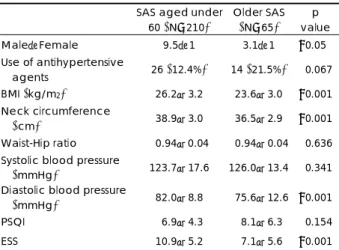
1. 인구통계학적 특성과 수면과 졸리움에 대한 주관적 평가 표 1에서와 같이 노인과 성인 수면무호흡증 집단 사이에 성 비(sex ratio), 체질량지수, 목둘레, 확장기 혈압, Epworth 졸림증 척도에 있어 통계적으로 유의한 차이가 있었다. 우선, 노인과 성인 수면무호흡증 환자에서 여자 환자의 비율은 9.5%와 24.6%로 노인 수면무호흡증에서 성인 수면무호흡 증에 비해 여자 환자의 비율이 유의하게 높았다(p<0.01).
즉, 노인 수면무호흡증 집단에서는 성인에 비해 남/여 성비 가 감소하였다. 노인 수면무호흡증 집단이 성인 수면 무호 흡증 집단에 비해 체질량지수(각각 23.6±3.0, 26.2±3.2, p<0.001)와 목둘레(각각 36.5±2.9, 38.9±3.0, p<0.001) 가 작고, 확장기 혈압(각각 75.6±12.6, 82.0±8.8, p<
0.001), Epworth 졸림증 척도 점수(각각 7.1±5.6, 10.9
±5.2, p<0.001)가 낮은 것으로 나타났다. 노인 수면무호 흡증 환자의 체질량 지수는 성인과 달리 정상 범위에 속했 다. 또한, 노인 수면무호흡증 환자는 성인에 비해 혈압이 낮 고, 주간 졸리움이 적었다. 그러나, 허리둘레-엉덩이둘레의 비, 수축기 혈압, Pittsburgh 수면질척도 점수는 두 집단 사 이에 유의한 차이가 없었다.
2. 수면무호흡 관련 지표들과 수면구조에 대한 비교 노인 수면무호흡증 집단은 성인 수면무호흡증 집단에 비 해 폐쇄성 무호흡지수(obstructive apnea index:각각 12.5±15.8, 18.1±20.0, p<0.05)와 산소포화도저하지수
(각각 18.5±17.8, 25.7±23.8, p<0.05)가 낮게 나타났다.
또한, 통계적 유의성은 없으나, 성인 수면무호흡증에 비해 노인 수면무호흡증에서 최저 산소포화도(Lowest O2 satu- ration)가 더 높고(각각 82.4±7.2, 80.4±8.0, p=0.074), 중추성 무호흡지수(central apnea index)가 더 컸다(각각 2.6±10.7, 0.5±1.5, p=0.136). 두 집단 사이에 호흡장애 지수, 혼합성 무호흡지수(mixed apnea index), 저호흡지수 (hypopnea index), 최장 무호흡기간(longest duration of apnea), 평균 산소포화도(average O2 saturation), 90% 미 만 산소포화도 시간의 백분율(% time of SaO2<90%)은 차이 가 없었다(표 2).
표 3에서와 같이 노인 수면무호흡증 집단은 성인 수면무 호흡증 집단에 비해 총수면 시간(total sleep time)이 짧고
Table 3. Comparison of polysomnographic parameters between SAS aged under 60 and older SAS (II)
SAS aged under 60 (N=210)
Older SAS (n=65)
p value Total sleep time (minutes) 373.4±64.3 338.9±77.4 <0.050 Sleep efficiency (%) 087.3±09.8 077.9±14.7 <0.001 Wake time during sleep
period (minutes) 051.4±41.6 094.7±67.0 <0.001 No. of wake 010.6±09.2 014.6±08.3 <0.010 Sleep latency (minutes) 010.1±17.1 013.4±23.3 <0.215 Stage 1 (%) 016.8±08.0 018.0±15.8 <0.541 Stage 2 (%) 048.0±10.7 043.4±14.1 <0.050 Stage 3 (%) 006.3±05.5 003.8±05.3 <0.050 Stage 4 (%) 000.9±02.3 000.1±00.4 <0.001 REM sleep (%) 015.9±06.4 014.3±07.4 0.097 Results represent mean±SD. SAS:Sleep apnea syndrome, SAS aged under 60:Adults with SAS aged under 60, Older SAS:
Adults with SAS aged 60 or older than 60 Table 1. Demographic characteristics and scores of subjective
tests of sleep quality and daytime sleepiness
SAS aged under
60 (N=210)
Older SAS (N=65)
p value
Male:Female 9.5:1 3.1:1 <0.050
Use of antihypertensive
agents 26 (12.4%) 14 (21.5%) <0.067 BMI (kg/m2) 026.2±3.20 023.6±3.00 <0.001 Neck circumference
(cm) 038.9±3.00 036.5±2.90 <0.001
Waist-Hip ratio 000.94±0.040 00.94±0.04 <0.636 Systolic blood pressure
(mmHg) 123.7±17.6 126.0±13.4 <0.341 Diastolic blood pressure
(mmHg) 082.0±8.80 075.6±12.6 <0.001
PSQI 006.9±4.30 008.1±6.30 <0.154
ESS 010.9±5.20 007.1±5.60 <0.001
Results represent mean±SD. SAS:Sleep apnea syndrome, SAS aged under 60:Adults with SAS aged under 60, Older SAS:
Adults with SAS aged 60 or older than 60, BMI:Body mass index, PSQI:Pittsburgh Sleep Quality Index, ESS:Epworth Sleepiness Scale
Table 2. Comparison of polysomnographic parameters between SAS aged under 60 and older SAS (I)
SAS aged under
60 (N=210) Older SAS
(n=65) p
value
RDI (/h) 30.8±23.6 27.0±20.0 <0.240
Obstructive apnea
index (/h) 18.1±20.0 12.5±15.8 <0.05 Central apnea index (/h) 00.5±01.5 02.6±10.7 <0.136 Mixed apnea index (/h) 01.6±05.0 01.6±04.3 <0.990 Hypopnea index (/h) 10.6±10.4 10.2±07.9 <0.741 Longest duration of
apnea (seconds) 45.9±23.5 50.2±40.3 <0.284 Lowest O2 saturation (%) 80.4±08.0 82.4±07.2 <0.074 Average O2 saturation (%) 94.0±02.5 94.0±02.9 <0.909
% time of SaO<90% (%) 11.6±18.8 10.0±20.4 <0.538 ODI (/h) 25.7±23.8 18.5±17.8 <0.05 Results represent mean±SD. SAS:Sleep apnea syndrome, SAS aged under 60:Adults with SAS aged under 60, Older SAS:
Adults with SAS aged 60 or older than 60, RDI:Respiratory dis- turbance index, ODI:Oxygen desaturation index, which was calculated by dividing the total number of oxygen desaturations (≥4% decrease in SaO2) by the total sleep time
42
(각각 338.9±77.4, 373.4±64.3, p<0.01), 자주 깨어나 며(각각 14.6±8.3, 10.6±9.2, p<0.01), 수면 중 깨어 있 는 시간이 길고(각각 94.7±67.0, 51.4±41.6, p<0.001), 수면효율이 낮았다(각각 77.9±14.7, 87.3±9.8, p<0.001).
또한, 노인 수면무호흡증에서는 성인 수면무호흡증에서 보 다 2단계(각각 43.4±14.1, 48.0±10.7, p<0.05), 3단계 (각각 3.8±5.3, 6.3±5.5, p<0.01), 4단계수면(각각 0.1±
0.4, 0.9±2.3, p<0.001)이 더 짧았고, 특히 서파수면인 3, 4단계 수면이 매우 짧았다.
3. 항고혈압 약물 복용이 혈압에 미치는 영향
노인과 성인 수면무호흡증 집단에서 항고혈압제를 복용 중인 사람의 비율은 두 집단 사이에 유의한차이가 없었다 (14명(21.5%), 26명(12.4%), respectively, p=0.067).
항고혈압 약물을 복용하지 않은 235명을 대상으로 노인과 성인 수면무호흡증 집단에서의 혈압을 비교한 결과, 노인 수면무호흡증에서 확장기 혈압이 유의하게 낮았고(각각 76.4±8.7, 81.7±8.8, p<0.001), 수축기 혈압은 두 집단 사이에 차이가 없어(각각 125.4±12.5, 125.0±11.5, p=
0.796) 전체 연구대상에서의 결과와 유사하였다.
4. 상관관계
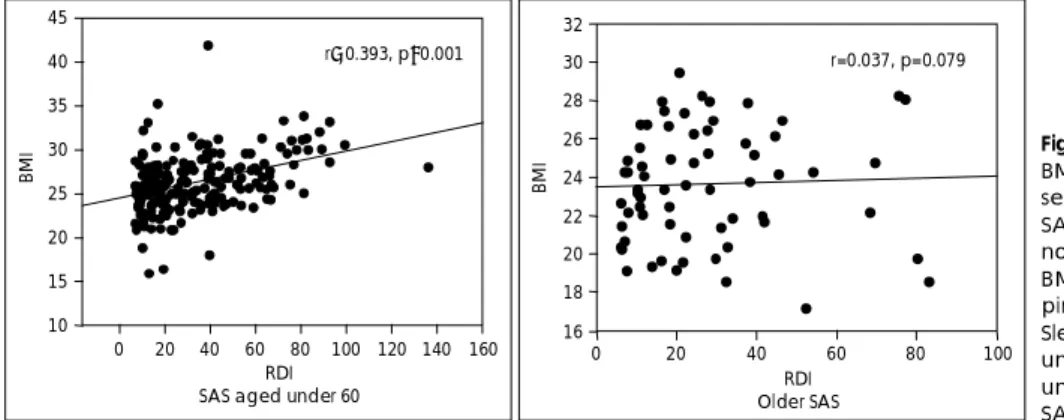
성인 수면무호흡증에서는 호흡장애지수와 체질량지수(r=
0.393, p<0.001), 목둘레(r=0.321, p<0.001) 사이에 유의 한 상관관계가 관찰되었지만. 노인 수면무호흡증에서는 호 흡장애지수와 체질량지수(r=0.037, p=0.769), 목둘레(r=
0.185, p=0.139)사이에 유의한 상관관계가 없었다(그림 1).
또한 허리둘레-엉덩이둘레의 비(노인:r=0.017, p=0.903;
성인:r=0.244, p=0.001), 수축기 혈압(노인:r=0.061, p=0.631;성인:r=0.216, p<0.01), 확장기 혈압(노인:
r=0.009, p=0.942;성인:r=0.183, p<0.01)에서도 유사 한 양상이 관찰되었다. 그러나 Pittsburgh 수면질척도(노 인:r=-0.189, p=0.134;성인:r=-0.024, p=0.732),
Epworth 졸림증 척도(노인:r=0.004, p=0.973;성인:
r=0.106, p=0.129)는 노인과 성인 수면무호흡증 모두에 서 호흡장애지수와 상관관계가 없었다.
고 찰
본 연구에서는 노인 수면무호흡증 집단에서 성인 수면무 호흡증 집단에 비해 여자 환자의 비율이 유의하게 높게 나 타났고, 이는 노인 수면무호흡증에서 성인에 비해 남-여 성 비가 감소함을 의미한다. 이러한 결과는 이전의 다른 연구 들에서의 결과와 유사하다(24,25). Tishler 등(14)은 나 이가 증가할수록 수면무호흡증의 남, 여 발생률 차이가 감 소하여 50세 무렵에는 거의 비슷해진다고 하였고, Block 등(26,27)도 여성에서 폐경 후 수면 무호흡증의 증가가 뚜 렷하여 수면무호흡증의 남-여 비가 감소한다고 하였다.
노인 수면 무호흡증 집단이 성인 수면 무호흡증 집단에 비해 체질량지수, 목둘레, 확장기 혈압, Epworth 졸림증 척 도 점수가 의미 있게 낮았고, 특히, 노인 수면무호흡증 환자 의 체질량지수는 정상 범위에 속하였다. 성인 수면무호흡증 에서와 달리 노인 수면무호흡증에서는 호흡장애지수와 체질 량지수, 목둘레, 수축기 혈압, 확장기혈압 사이에 상관관계 가 없었다. 이는 성인에서는 수면무호흡증이 체질량지수, 목 둘레 등으로 대표되는 비만과 연관이 있으나, 노인에서는 그렇지 않으며 비만 이외의 다른 요인에 의해 좀 더 영향을 받음을 시사한다. 노인에서는 상기도 허탈의 증가, 근긴장 도의 감소, 수면 분절과 서파수면의 감소 등이 수면 무호흡 증의 위험 요인으로 알려져 있다(19). 노인 수면무호흡증 에서는 성인 수면무호흡증에 비해 폐쇄성 무호흡은 적고 통계적 유의성은 없으나 중추성 무호흡은 많았다. 이는 노 인에서 비만에 의해 좀 더 직접적인 영향을 받는 폐쇄성 무 호흡은 감소하고, 노화에 따라 동맥혈중 이산화탄소분압에 대한 feedback 기전의 둔화와 같은 중추신경계의 호흡조절 기능은 쇠퇴하므로 중추성 무호흡은 증가하는 것으로 해석
RDI SAS aged under 60
0 20 40 60 80 100 120 140 160
BMI
10 15 20 25 30 35 40 45
r=0.393, p<0.001
RDI Older SAS
0 20 40 60 80 100
BMI
16 18 20 22 24 26 28 30 32
r=0.037, p=0.079
Fig. 1. Correlation between RDI and BMI. Significant correlation was ob- served between RDI and BMI in SAS aged under 60, but RDI was not correlated with BMI in older SAS.
BMI:Body mass index, RDI:Res- piratory disturbance index, SAS:
Sleep apnea syndrome, SAS aged under 60:Adults with SAS aged under 60, Older SAS:Adults with SAS aged 60 or older than 60.
43 될 수 있다(28-30). 또한 노인 수면무호흡증 집단에서 성
인 수면무호흡증 집단에 비해 산소포화도저하지수는 낮고, 통계적 유의성은 없지만, 최저 산소포화도는 높았다. 이는 노인 수면무호흡증에서 성인 환자 집단에 비해 저산소증 상 태가 적게 유발됨을 의미하는 것으로, 저산소증으로 인한 손상을 적게 받을 것임을 시사한다. 노인 수면무호흡증 집 단에서 상대적으로 저산소증에 의한 손상이 적다는 것은 노 인 수면무호흡증에서 고혈압과 같은 심혈관계 합병증이나 인지기능의 저하가 성인 수면무호흡증에 비해 심하지 않을 수 있음을 의미한다. 한편 두 집단 간에 호흡장애지수에 유 의한 차이가 없지만, 노인에서 Epworth 졸림증 척도 점수 가 유의하게 낮게 나타났다. 이러한 결과는 노인 수면무호 흡증 환자가 주간 졸리움과 같은 수면무호흡증으로 인한 행동적 합병증(behavioral complication)을 적게 경험함을 시사한다(19,31).
이번 연구에서 노인 수면무호흡증 집단은 성인 수면무호 흡증 집단에 비해 총수면시간이 짧고, 더 자주 깨었으며, 수 면 중 깨어난 시간도 더 길었다. 이러한 소견은 정상 젊은 성 인과 노인의 수면을 비교했을 때와 유사한 것이다(19,32).
이는 노인과 성인 수면무호흡증 집단 간에 호흡장애지수에 차이가 없음을 고려할 때 나이의 영향이 반영된 결과로 생 각된다.
본 연구에서는 항고혈압 약물이 혈압에 미치는 영향을 조 사하기 위해 항고혈압 약물을 복용 중인 환자와 그렇지 않 은 환자로 분류하였다. 노인과 성인 수면무호흡증 집단에서 항고혈압 약물을 복용하는 환자의 비율은 두 집단 간에 차 이가 없었다. 또한, 항고혈압 약물을 복용하지 않은 환자만 을 대상으로 노인과 성인 두 집단에서 혈압을 비교한 결과 와 항고혈압 약물을 복용하는 환자를 포함하는 전체 연구대 상에서 혈압을 비교한 결과는 유사하게 나타났다. 이러한 결과들은 항고혈압 약물 복용 여부가 본 연구 결과에 영향 을 미치지 않았음을 의미한다.
이번 연구에서는 연구대상 중 여자의 수가 적어(36명 (13.1%) 성별에 따른 차이나 성별이 수면 무호흡증에 미 치는 영향에 대해서는 분석을 하지 않았다. 향후 성별과 나 이가 독립적으로 수면 무호흡증에 미치는 영향을 분석하는 연구가 필요하다. 연구대상 측면에서 분당서울대학교병원이 라는 특정 지역의 특정 병원에서 검사받은 사람들을 대상 으로 하여 연구 대상자 선택에 따르는 오류가 있을 수 있다.
또한 이 연구는 1회의 수면다원검사, 신체검사, 설문조사에 기초하여 환자의 상태를 횡단면적으로 조사한 연구로 수면 무호흡증의 경과는 반영되지 않았다. 향후 수면 무호흡증 환자들에 대한 장기간의 추적 연구를 통해 이 질병의 경과
와 예후를 조사, 평가하는 것이 필요하다. 한편 연구 대상 자들로부터 설문지를 통해 공존 질병, 복용 중인 약물, 수 면무호흡증의 가족력 등에 대한 자료를 얻었으나, 항고혈 압 약물 복용 여부 이외의 다른 약물, 공존 질병, 가족력이 수면무호흡증에 미치는 영향에 대해서는 분석하지 않았다.
대부분 성인에 비해 노인에서 공존 질병이나 복용 중인 약 물이 더 많은 점을 생각해 볼 때, 향후에는 이러한 요인이 노인 수면무호흡증에 미치는 영향에 대한 분석이 뒤따라야 할 것이다.
요 약
목 적:본 연구에서는 노인 수면 무호흡증과 성인 수면 무호흡증에서의 특성들을 비교하고, 이미 알려진 성인 수 면무호흡증에서의 위험인자들과 노인 수면무호흡증에서의 호흡장애지수 사이의 상관관계를 살펴 노인 수면무호흡증 의 특징을 조사하고자 하였다.
방 법:호흡장애지수가 5 이상이면서 연령이 20세 이상 인 275명의 수면 무호흡증 환자들을 대상으로 하였고, 연구 대상에게 간단한 신체검사, Pittsburgh 수면질척도, Epworth 졸림증 척도 등을 포함한 설문지 평가, 수면다원검사를 시 행 하였다. 60세 미만의 성인 수면무호흡증 집단과 60세 이상의 노인 수면무호흡증 집단 간에 자료들이 비교, 분석 되었다.
결 과:노인과 성인 수면무호흡증에서 호흡장애지수, 무 호흡지수, 90% 미만 산소포화도 기간의 백분율, Pittsburgh 수면질척도 등은 두 집단 간에 차이가 없었다. 노인 수면무 호흡증은 성인 수면무호흡증에 비해 폐쇄성 무호흡지수와 산소포화도저하지수가 낮았다. 또한 통계적 유의성은 없으 나, 최저 산소포화도와 중추성 무호흡지수가 높았다. 노인 수 면무호흡증에서 체질량지수와 목둘레가 성인 수면무호흡증 에 비해 작았다. 확장기 혈압도 노인에서 성인 수면무호흡증 에 비해 낮았으나, 수축기 혈압은 두 집단 간에 차이가 없 었다. 노인 수면무호흡증에서 성인에 비해 Epworth 졸림 증 척도 점수가 낮았다. 성인 수면무호흡증에서는 호흡장애 지수와 체질량지수 사이에 유의한 상관관계가 있었으나, 노 인 수면무호흡증에서는 두 변수 사이에 상관관계가 관찰되 지 않았다. 이와 유사한 결과가 호흡장애지수와 목둘레, 수 축기 혈압, 그리고 확장기 혈압 사이에서도 나타났다.
결 론:노인 수면무호흡증 집단은 비만하지 않았고, 노 인에서의 수면무호흡증의 심각도는 체중과 관련이 없었다.
또한, 노인에서는 수면무호흡증이 행동과 심혈관계에 미치 는 영향이 현저하지 않았는데, 이는 노인 수면무호흡증에서
44
성인에 비해 산소포화도저하지수가 낮고, 최저 산소포화도 가 상대적으로 높은 것에 의해 일부 설명되어질 수 있을 것 이다. 체중 증가보다는 정상 노화과정이 합병증이 적은 노 인 수면무호흡증 발생에 좀 더 기여하는 것으로 생각된다.
중심 단어: 수면무호흡증·노인·체질량지수·혈압·Ep- worth 졸리움 척도.
R
EFERENCES1. Leung RS, Bradley TD. Sleep apnea and cardiovascular disease. Am J Respir Crit Care Med 2001;164:2147-2165
2. Marin JM, Carrizo SJ, Vicente E, Agusti AG. Long-term cardiova- scular outcomes in men with obstructive sleep apnoea-hypopnoea with or without treatment with continuous positive airway pressure:
an observational study. Lancet 2005;365:1046-1053
3. Sateia MJ. Neuropsychological impairment and quality of life in obstructive sleep apnea. Clin Chest Med 2003;24:249-259
4. Engleman H, Joffe D. Neuropsychological function in obstructive sleep apnoea. Sleep Med Rev 1999;3:59-78
5. Kim J, In K, Kim J, You S, Kang K, Shim J, Lee S, Lee J, Lee S, Park C, Shin C. Prevalence of sleep-disordered breathing in middle- aged Korean men and women. Am J Respir Crit Care Med 2004;
170:1108-1113
6. Young T, Palta M, Dempsey J, Skatrud J, Weber S, Badr S. The occurrence of sleep-disordered breathing among middle-aged adults.
N. Engl. J Med 1993;328:1230-1235
7. Bixler EO, Vgontzas AN, Ten Have T, Tyson K, Kales A. Effects of age on sleep apnea in men. I. Prevalence and severity. Am J Respir Crit Care Med 1998;157:144-148
8. Bixler EO, Vgontzas AN, Lin HM, Ten Have T. Rein J, Vela-Bueno A, Kales A. Prevalence of sleep-disordered breathing in women: ef- fects of gender. Am J Respir Crit Care Med 2001;163:608-613 9. Ip MS, Lam B. Lauder IJ, Tsang KW, Chung KF, Mok YW, Lam
WK. A community study of sleep-disordered breathing in middle- aged Chinese men in Hong Kong. Chest 2001;119:62-69
10. Ip MS, Lam B, Tang LC, Lauder IJ, Ip TY, Lam WK. A community study of sleep-disordered breathing in middle-aged chinese women in Hong Kong: prevalence and gender differences. Chest 2004;125:
127-134
11. Redline S. Epidemiology of sleep-disordered breathing. Semin Respir Crit Care Med 1998;19:113-122
12. Young T, Shahar E, Nieto FJ, Redline S, Newman AB, Gottlieb DJ, Walsleben JA, Finn L, Enright P, Samet JM, Sleep Heart Health Study Research Group. Predictors of sleep-disordered breathing in community dwelling adults: The Sleep Heart Health Study. Arch Intern Med 2002;162:893-900
13. Duran J, Esnaola S, Rubio R, Iztueta A. Obstructive sleep apnea- hypopnea and related clinical features in a population-based sample of subjects aged 30 to 70 yr. Am J Respir Crit Care Med 2001;
163:685-689
14. Peter V Tishler, Emma K Larkin, Mark D Schluchter, Susan Redline.
Incidence of sleep-disordered breathing in an urban adult population.
JAMA 2003;289:2230-2237
15. J Catesby Ware, Reuben H McBrayer, Jeffrey A Scott. Influence of sex and age on duration and frequency of sleep apnea events. Sleep 2000;23:165-170
16. Quinnell TG, Smith IE. Obstructive sleep apnoea in the elderly: rec- ognition and management considerations. Drugs Aging 2004;21:
307-322
17. Klawe JJ, Tafil-Klawe M. Age-related response of the genioglossus muscle EMG-activity to hypoxia in humans. J Physiol Pharmacol 2003;Suppl 1:14-19
18. Young T, Skatrud J, Peppard PE. Risk factors for obstructive sleep apnea in adults. JAMA 2004;291:2013-2016
19. In-Young Yoon, Daniel F. Kripke, Shawn D. Youngstedt, Jeffreey A.
Elliott. Actigraphy suggests age-related differences in napping and nocturnal sleep. J Sleep Res 2003;12:87-93
20. Rechtschaffen A, Kales A (eds). A manual of standardized termin- ology, techniques and scoring system for sleep stages of human sub- jects. U.S. Public Health Service, U.S. Government Printing Office, Washington D.C.;1968.
21. Jasper HH (Commitee chairman). The ten twenty electrode system of the international federation. Electroencephalogr Clin Neurophysiol 1958:10;137
22. Tsai WH, Flemons WW, Whitelaw WA, Remmers JE. A comparison of apnea-hypopnea indices derived from different definitions of hyp- opnea. Am J Respir Crit Care Med 1999;159:43-48
23. Tsai WH, Flemons WW, Whitelaw WA, Remmers JE. A comparison of apnea -hypopnea indices derived from different definitions of hypopnea. Am J Respir Crit Care Med 1999 Jan;159:43-48 24. Redline S, Kump K, Tishler PV, Browner I, Ferrette V. Gender di-
fferences in sleep disordered breathing in a community-based sample.
Am J Respir Crit Care Med 1994;149:722-726
25. 김석주·박두흠·김용식·우종인·하규섭·정도언. 수면다원
기록법으로 확진된 폐쇄성 수면무호흡증환자의 임상특성, 그 리고 호흡장애지수와 수면 구조간의 상관관계. 수면정신생 리 2001:8:113-120
26. Block AJ, Boysen PG, Wynne JW, Hunt. Sleep apnea, hypopnea, and oxygen desaturation in normal subjects. N Engl J Med 1979;
300:513-517
27. Block AJ, Wynne JW, Boysen PG. Sleep-disordered breathing and nocturnal oxygen saturation in postmenopausal women. Am J Med 1980;69:75-79
28. Javaheri S. A mechanism of central sleep apnea in patients with heart failure. N Engl J Med 1999;341:949-954
29. Poulin MJ, Cunningham DA, Patterson DH, Kowalchuk JM, Smith WD. Ventilatory sensitivity to CO2 in hyperoxia and hypoxia in older aged humans. J Appl Physiol 1993;75:2209-2216
30. Phillipson EA, Kozar LF. Effect of aging on metabolic respiratory control in sleeping dogs. J Am Rev Respi Dis 1993;147:1521-1525 31. Kaneita Y, Ohida T, Uchiyama M, Takemura S, Kawahara K, Yok-
oyama E, Miyake T, Harano S, Suzuki K, Yagi Y, Kaneko A, Tsutsui T, Akashiba T. Excessive daytime sleepiness among the Japanese general population. J Epidemiol 2005;15:1-8
32. Donald L. Bliwise Normal aging. In Principles and Practice of Sleep Medicine. 3rd ed, Ed by Kryger MH, Roth T, Dement WC, Phi- ladelphia, W.B. Saunders Company;2000. p.26-42