January February March April MayJune JulyAugust September October November December
cc This is an open access article distributed under the terms of the Creative Commons Attribution Non-Commercial License (http://creativecommons.org/
licenses/by-nc/4.0/), which permits unrestricted non-commercial use, distribution, and reproduction in any medium, provided the original work is properly cited.
Research Article Open Access
오이 유묘와 과실을 활용한 검은별무늬병에 대한 저항성 품종 검정 방법
Screening Methods for Resistant Cucumber Cultivars againstCucumber Scab Caused by Cladosporium cucumerinum Using Cucumber Fruits and Seedlings
*Corresponding author Tel: +82-63-238-2554 Fax: +82-63-238-3824 E-mail: [email protected]
박소향·홍성준·심창기·김민정·박종호·한은정·박종원·지형진·김석철·김용기*
농촌진흥청 국립농업과학원 농업환경부 유기농업과
So-Hyang Park, Sung-Jun Hong, Chang-Ki Shim, Min-Jeong Kim, Jong-Ho Park, Eun-Jung Han, Jong-Won Park, Hyeong-Jin Jee, Seok-Cheol Kim, and
Yong-Ki Kim*
Organic Agriculture Division, Department of Agricultural Environment, National Institute of Agricultural Science, Rural Development Administration, Wanju 55365, Korea
Received December 18, 2015 Revised March 7, 2016 Accepted March 8, 2016
This study was conducted to elucidate the cultural and pathogenic characteristics of Cladosporium cucumerinum PT1 and resistance of 81 commercial cucumbers (Cucumis sativus). Cucumber leaves and fruits appeared as scab were collected from a plastic film house located in Pyeongtaek, Gyeonggi- province, Korea in late March, 2015. A casual fungus was isolated from the diseased fruits on potato dextrose agar and it was identified as C. cucumerinum PT1 based on the morphological characteristics.
To find out the effect of wounding and fruit size on the development of cucumber scab, small (<10 cm long), medium (10 to 20 cm long), and large (>20 cm long, commercially mature fruit) size cucumber fruits were harvested, C. cucumerinum PT1 pathogens were inoculated with a single droplet of suspension (1×10⁵ spores/ml) on wounded or unwounded cucumber fruits. Small fruits were completely damaged with showing severe water-soaking symptoms and fast pathogen growth regardless of wounded or unwounded. Meanwhile slight water-soaking symptoms on medium and large size fruits occurred and disease development into plant tissues was observed only on wounded fruits. Disease resistance of 81 commercial cucumber cultivars was evaluated on third-stage seedlings and small fruits by inoculating suspension (1×10⁵ spores/ml) of C. cucumerinum PT1. As a result, mini and pickling cultivar groups were resistant, ‘Cheoeumcheoreom’ cultivar was symptomless and the other cultivars were resistant to medium resistant. On the other hand, most of cucumber cultivars belonging to the other groups were susceptible. Disease resistance of cucumber against cucumber scab was significantly different among cultivars and a few cucumber cultivars showed different disease resistant responses to two bioassay methods using seedlings and small fruits. Therefore, to screen scab resistance in cucumber, a test using both fruits and seedlings is advisable. We think that the selected resistant cultivars can be used to control cucumber scab effectively under the farmhouse condition.
Keywords: Cladosporium cucumerinum, Cucumber, Fruit, Scab, Seedling
Research in Plant Disease
©The Korean Society of Plant Pathology pISSN 1598-2262, eISSN 2233-9191
18
서 론
우리나라의 최근 5년간(2011–2015년) 오이 평균 재배면적 은 4,123 ha이고, 이 중 시설재배 평균 면적은 3qh,227 ha로, 전체 오이재배 면적의 78.2%이다(Statistics Korea, 2016). 오 이 시설재배가 보편화됨에 따라 재배기술, 재배형태 및 품 종이 다양화되어 촉성재배에서부터 억제재배에 이르기까 지 연중재배가 이루어지고 있다. 하지만 시설재배 시 환경 이 열악할 경우 여러 가지 병들이 발생하기 쉬운데, 특히 오 이 검은별무늬병은 1988년 전남 승주와 구례에서 발생이 보 고(Kim, 1999)된 이래, 1995년 충북 괴산(Lee 등, 1997), 2013년 충북 청주지역(Lee 등, 2015)에서 발생되었다는 보고가 있고, 최근 2015년도에는 경기도 평택 지역에서도 발생되어 큰 피 해를 주었다(Park 등, 2015). Cladosporium cucumerinum에 의 한 검은별무늬병은 박과 작물, 가지, 작두콩 등 넓은 기주 범 위를 가지고 있다(Cho 등, 1997; Kwon 등, 1999, 2000). 오이 검 은별무늬병에 걸리게 되면 신초 부위의 생장이 정지되고, 과실에 검정 병반이 생기며, 병반 쪽으로 구부러지기 때문 에 상품성이 떨어져 심각한 피해를 준다. 그러므로 검은별 무늬병의 피해를 극복하기 위해서 병의 정확한 진단, 병원 균의 생리 · 생태적 특성, 감염 경로, 발병 조건 등에 관한 연 구가 필요하고 이에 대한 대응책을 마련할 수 있는 연구가 수행되어야 한다. 특히 검은별무늬병 대한 피해를 줄이기 위해서는 저항성 품종 선발이 필요한데, 병 저항성 검정은 주로 유묘와 자엽을 이용해 수행하고 있다(Hijwegen, 1963;
Lebeda, 1985; Vakalounakis와 Williams, 1989). 하지만 오이 시 설 재배지에서 검은별무늬병은 잎, 신초, 과실, 줄기 등에 발 생하고, 오이에서는 유묘의 병 저항성 정도와 과실의 병 저 항성 정도 간 상관관계가 있는지에 대해서는 보고된 바가 없기 때문에 정확한 저항성 품종 선발을 위해서는 과실검 정을 병행하여 이용하는 것도 필요하다고 생각된다. 따라서 본 연구에서는 검은별무늬병을 일으키는 C. cucumerinum의 배양적 특징, 병원성, 과실에 상처 유무에 따른 감염 정도를 구명하고, 오이 유묘와 과실을 이용하여 검은별무늬병에 대 한 저항성 품종을 선발하기 위해 수행하였다.
재료 및 방법
병원균. 검은별무늬병균(C. cucumerinum PT1, KACC
48094)은 경기도 평택의 오이 하우스 재배지에서 2015년 3 월 말에 병든 오이 과실을 채집하여 분리하였다. 과실 조직 의 병반 부위 조직을 5×5 mm의 크기로 잘라 1% 차아염소산
나트륨(sodium hypochlorite) 용액에서 1분, 70% 에탄올에서 30초 담근 후 살균수로 씻은 다음, 수분을 제거하고 potato dextrose agar (PDA) 배지에 치상하였다. 20oC 항온기에서 암 조건으로 20일간 배양하였으며 조직으로부터 생성된 포자 를 떼어 광학현미경으로 형태적 특성을 조사하고 순수분리 하여 시험에 사용하였다.
In vitro에서 C. cucumerinum PT1의 배양적 특성 조사.
온도와 pH가 균사 생장에 미치는 영향을 조사하기 위해 20oC에서 20일간 배양한 균사의 끝부분을 5 mm cork borer로 잘라 사용하였다. 온도 조건은 5oC부터 35oC까지 5oC 간격으 로 나누어 PDA 중앙에 이식하였고, pH 조건은 PDA에 HCl과 NaOH를 첨가하여 4.5부터 9.0까지 0.5 간격으로 조절한 다음 멸균 후 배양한 검은별무늬병균 균총을 배지 중앙에 3반복 으로 이식하였다. 온도 및 pH별 균사 생장량은 각각 7일, 14 일에 조사하였다.
C. cucumerinum PT1 처리농도가 병 발생에 미치는 영향 조사. 병원균 농도에 따른 발병 정도를 조사하기 위해 2% potato dextrose broth (PDB)에 1×10⁴, 5×10⁴, 1×10⁵, 5×10⁵, 1×10⁶, 5×10⁶ 포자/ml 농도의 검은별무늬병 포자현탁 액을 제조하여 2–3엽기 전개된 ‘가야청장’ 품종 오이 유묘에 3반복으로 분무접종하였다. 접종된 식물체는 온실 내에서 18oC–20oC, 상대습도 70%-99%, 오전 9시부터 오후 6시까지 9 시간 동안은 광조건으로, 오후 6시부터 다음날 오전 9시까 지 15시간 동안은 암조건으로 하였으며, 11일 후 병 발생정 도를 조사하였다. 발병도는 발병 수준을 0–5로 나누어 0은 무발병, 1은 생장점 갈변, 2는 생장점 고사, 3은 생장점 고사 와 본엽에 갈색 병반, 4는 생장점 및 본엽 일부 고사, 5는 식 물체 완전 고사로 하였고, 발병도 값이 0.50 이하를 저항성, 0.51–1.00을 중도저항성, 1.10–2.00을 중도감수성, 2.10–3.00 을 감수성, 그리고 3.00 초과를 고도감수성이라 판단하였다.
유묘를 활용한 품종 저항성 검정. 품종별 저항성 및 감수성을 조사하기 위해 유통 중인 오이 81개 품종을 공시 하였고, 2% PDB에 C. cucumerinum PT1 포자현탁액(1×10⁵ 포 자/ml)을 제조하여 품종별 3–4엽기 전개된 유묘에 4반복으 로 분무접종하였다. 발병 환경과 발병도 값은 위의 C. cuc- umerinum PT1 처리 농도가 병 발생에 미치는 영향 조사와 동 일하였다.
유과를 활용한 품종저항성 검정. 오이 과실의 크기 및
상처 유무에 따른 발병 정도를 조사하기 위해 길이가 20 cm 초과의 대과, 10–20 cm의 중과, 10 cm 미만의 유과를 채집하 여 1% 차아염소산나트륨 용액에서 1분, 70% 에탄올에서 30 초 담근 후 살균수로 씻어 표면살균하였다. 각 크기별 반은 수술용 칼을 이용해 0.5 cm 깊이로 상처를 냈고 반은 상처를 내지 않았다. 2% PDB에 C. cucumerinum PT1 1×10⁵ 포자/ml 농 도의 포자현탁액을 제조하여 상처난 과실 표면과 상처가 없 는 과실 표면 위에 각 10 µl씩 표면접종한 뒤 20oC 생육상에 넣고 10일 후 조사하였다. 또한 오이 과실의 품종별 저항성 및 감수성을 조사하기 위해 10 cm 미만의 유과를 수집하여 표면 살균 후 앞과 같은 방법으로 접종하였으며, 9일 후 조사 하였다. 발병도는 과실에 나타난 발병 수준을 0–5로 나누어 0은 무발병, 1은 수침상 반점, 2는 넓게 진전된 수침상 병반, 3 은 병반 가장자리 황갈색, 4는 병반에 균사 및 포자 생성, 5는 오목하게 패인 병반에 균사 및 포자 다량 형성으로 하였다.
유묘 검정과 마찬가지로 발병도 값이 0.50 이하를 저항성, 0.51–1.00을 중도 저항성, 1.10–2.00을 중도 감수성, 2.10-3.00 을 감수성, 그리고 3.00 초과를 고도 감수성이라 판단하였다.
병원성 검정방법 상관분석. C. cucumerinum PT1에 대한 유묘 검정과 유과 검정 간에 상관이 있는지 알아보기 위해 SAS 프로그램 ver. 9.1 (SAS Institute, Cary, NC, USA)을 이용하여 Pearson 상관계수를 산출하였다.
결과 및 고찰
병원균 분리동정. 검은별무늬병에 감염된 오이 과실로 부터 순수 분리한 병원균을 PDA상에 14일간 배양하여 형태
적 특징을 조사하였다. 균총은 회녹색-회흑색이고 가장자 리로 갈수록 색이 옅어져 백색으로 보였다. 분생자경의 두 께는 2.8–4.0 µm이며, ramo-conidia는 주로 격막이 없거나 1 개였다. 크기는 11.0–17.8×3.8–4.9 µm로 나타났으며 양쪽이 잘린 독특한 모양을 하였다. 분생포자의 크기는 5.5–9.0×3.2–
4.1 µm로 레몬모양-타원형이었다. 이러한 형태적인 특징은 기존에 기술된 C. cucumerinum의 범주에 속하기 때문에 본 연구에 사용한 병원균은 C. cucumerinum PT1으로 동정하였 다(Table 1; Ellis와 Holliday, 1972).
온도 및 pH가 균사 생장과 포자 형성에 미치는 영향.
C. cucumerinum PT1은 35oC에서 균사 생장이 억제되었고, 5oC Table 1. Comparison of morphological characteristics of a fungal isolate Cladosporium cucumerinum PT1 from cucumber and C. cuc- umerinum described by Ellis and Holliday
Characteristic Isolate C. cucumerinum*
Colony color Greenish black, velvety Greenish black, velvety Conidiophore
Color Pale olivaceous brown Pale olivaceous brown
Width (µm) 2.8–4.0 3–5
Ramo-conidia
Color Pale olivaceous brown Pale olivaceous brown Size (µm) 11.0-17.8×3.8–4.9 <30×3–5
No. of septa 0–1 0–2
Conidia
Color Pale olivaceous brown Pale olivaceous brown Size (µm) 5.5–9.0×3.2–4.1 4–25×2–6
No. of septa 0–1 0–1
Shape Ellipsoidal, fusiform Ellipsoidal, fusiform
*CMI Descriptions of Pathogenic Fungi and Bacteria No. 348.
5 45 40 35 30 25 20 15 10 5
Diameterofcolony(mm)
Temperature ( C)o 0
7 Day 14 Day
A
10 15 20 25 30 35 4.5 5.0 5.5 6.0 6.5 7.0 7.5 8.0 8.5 9.0
45 40 35 30 25 20 15 10 5
Diameterofcolony(mm)
pH 0
7 Day 14 Day
B
Fig. 1. Effect of temperature (A) and pH (B) on the mycelia growth of Cladosporium cucumerinum PT1 on potato dextrose agar for 7 and 14 days. Bars represent standard deviations (n=5).
에서는 생장속도가 느렸으며, 20oC–25oC에서 생장이 가장 우수하였다. 배지의 pH가 병원균의 균사생장에 미치는 영 향은 pH 4.0에서 9.0까지 대체적으로 양호하였으나 pH 6.0일 때 가장 우수하였다(Fig. 1). Lee 등(1997)도 이와 비슷한 결과 를 보고하면서 검은별무늬병균이 30oC에서는 생장이 안 되 는 것으로 보고하였는데 본 실험에서는 30oC에서도 균사 생 장이 잘 되는 것으로 확인되었다. 따라서 일단 병이 발생하 면 이른 봄철 시설 내 온화한 조건에서도 발병이 가능할 것 으로 판단되었다. 한 예로 오이 검은별무늬병은 주로 반촉 성 재배에서 발생하였으나 6월 이후의 고온기에도 발생했 다는 보고가 있다(Choi, 2003).
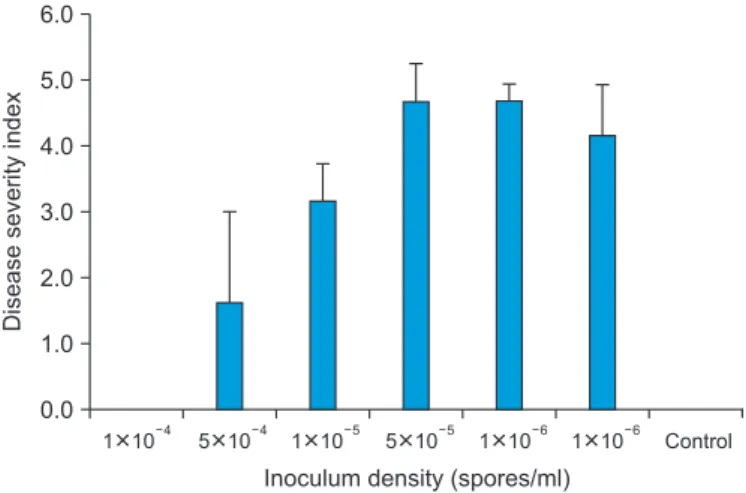
병원균의 농도에 따른 발병 정도. 생물검정에 알맞 은 병원균의 접종 농도를 결정하기 위해 다양한 농도의 포 자현탁액을 제조하여 유묘에 분무 접종한 결과, 낮은 농도 인 1×10⁴ 포자/ml에서는 병징이 나타나지 않았으나 5×10⁴ 포자/ml부터 균 농도가 높아질수록 발병 정도는 증가했고, 5×10⁵ 포자/ml와 1×10⁶ 포자/ml에서는 발병도가 4.7로서 식 물체 전체가 고사하였다(Fig. 2). 따라서 오이의 생물검정 시 C. cucumerinum PT1의 포자현탁액을 1×10⁵ 포자/ml 농도로 하여 접종하면 처리별 발병도의 차이가 명확해 저항성 품종 선발 등의 생물검정 시 효과적일 것이라 판단되었다.
오이 과실 크기와 상처 유무가 발병에 미치는 영향.
오이 과실의 성숙도와 상처 유무에 따른 발병 정도를 조사 한 결과, 병원균 접종 10일 후 모든 유과에서 발병도는 5로 과실이 황변하고 접종 부위가 움푹 패였으며 균사와 포자가 생성되었다. 상처를 낸 중과와 대과에서는 발병도가 각각
1 104 6.0
5.0
4.0
3.0
2.0
Diseaseseverityindex 1.0
Inoculum density (spores/ml) 0.0
5 104 1 105 5 105 1 106 1 106 Control
Fig. 2. Effect of inoculum density on the development of cucum- ber scab caused by Cladosporium cucumerinum PT1. Seedlings of the ‘Gayacheongjang’ were inoculated with C. cucumerinum PT1 by spraying spore suspension of six different concentrations. The inoculated plants were incubated in a greenhouse at 18oC–20oC and relative humidity 70%–99%. After 11days, disease severity of cucumber seedlings was measured. Bars represent standard devi- ations (n=3). 0, no symptoms; 1, growing point damaged; 2, grow- ing point died; 3, true leaves were infected; 4, true leaves became necrotic; 5, plant died.
Table 2. Effect of fruit size and wounding on the development of cucumber scab caused by Cladosporium cucumerinum PT1*
Fruit size Disease severity†
Wounded Unwounded
Small (<10 cm) 5.0 5.0
Medium (10–20 cm) 0.9 0.3
Large (>20 cm) 0.5 0.0
Values are presented as mean of four replicates.
*Each fruit was inoculated by dropping a drop of C. cucumerinum PT1 spore suspension containing 1×10⁵ spores/ml in 2% potato dextrose broth. The inoculated fruits were incubated in a growth chamber at 18oC–20oC and relative humidity 70%–99%. After 10 days, disease severity of cucumber fruits was investigated.
†0, no symptoms; 1, water-soaking; 2, broadly developed water- soaking; 3, fruit discoloration; 4, hyphal formation and sporula- tion; 5, completely destroyed fruit.
Wounding Non-wounding A Wounding Non-wounding B Wounding Non-wounding C
Fig. 3. Symptoms of cucumber scab on wounded and unwounded cucumber fruits of various sizes. They were inoculated by dropping a drop of Cladosporium cucumerinum PT1 spore suspension containing 1×10⁵ spores/ml in 2% potato dextrose broth. Water-soaking symptoms and disease development into the fruits were different among the sizes and wounding. Photos were taken at 10 days after inoculation. Left fruits were wounded and the others were not. (A) Small fruits less than 10 cm. (B) Medium (10–20 cm) to large (over 20 cm) fruits. (C) Cross section of medium to large fruits.
0.9, 0.5였다. 무상처 중과에서는 0.3으로 접종 부분 주위에 약 간의 수침상의 반점이 형성되었고, 무상처 대과에서는 아무 런 증상이 나타나지 않았다. 반면에, 유과일수록 상처 여부 에 상관 없이 발병확률과 발병 정도가 높게 나타났고, 과실 이 커질수록 발병도는 감소했지만 무상처 접종에 비해 상처 접종한 부위에서 수침상 반점이 더욱 넓게 발달하는 경향을 나타내었다. 중과 및 대과에 접종한 경우에는 접종 부분을 기준으로 횡단면을 봤을 때 과실 내부로 병원균이 발달하 여 황색 더뎅이처럼 생성된 것은 과실 표면에 상처 접종한 것뿐이었다(Table 2, Fig. 3). 이와 비슷한 양상으로 Gevens 등 (2006)은 오이 성숙단계별 과실 표면에 Phytophthora capsici 를 접종하였는데, 유과일수록 포자 형성 및 수침상의 피해 가 나타나 성숙과보다 상대적으로 감수성임이 관찰되었고, 이는 감수성에서 저항성으로의 변화는 급격한 과실 신장기 부터 과실 직경 증가시기로의 변화와 일치하는 것으로 나타 나 생육단계별 생리적인 변화가 일어났을 것임을 시사하였 다. 또한 오이의 과실 표면은 역병균에 대항하여 중요한 방 어 기작 역할을 하는데, 성숙과일수록 두터운 큐티클이 있 고 껍질세포의 메탄올 추출물이 역병균의 생장을 억제한다 는 보고가 있다(Ando 등, 2015). 이런 결과들을 토대로 오이 의 성숙단계별 검은별무늬병에 대한 억제 기작도 비슷하게 작용했을 것이라는 추측을 가능하게 한다. Ando 등(2012)은 오이의 형태적인 분석과 전사체 데이터 분석에서 오이 과실
의 생장기와 성숙기 사이에 병 저항성에 있어서 차이가 있 음을 보고하면서, 유과단계에서 발현이 증가하는 전사체들 은 세포 분열 및 발생과 관련된 유전자가 많은 부분을 차지 하고, 급격한 생장단계에서는 형태적으로 큐티클 두께가 크 게 증가하며 더불어 세포구조와 관련된 유전자가 관여한다 고 하였다. 그리고 성숙단계에서는 생물 · 무생물적인 자극 에 반응하는 스트레스와 관련된 전사요인 유전자 동족체가 관찰된 것으로 보아 오이의 성숙단계별로 물리 · 화학 · 유전 적인 변화가 C. cucumerinum 병원균의 침입에 대한 방어 기 작에 작용했을 것이라 판단된다.
C. cucumerinum PT1 병원균에 대한 오이 품종별 저 항성. 오이 품종별 저항성 및 감수성을 검정하기 위하여 시판 중인 81개 오이 품종을 과실의 형태에 따라 6개의 품 종군으로 나누어 검은별무늬병에 대한 반응을 조사하였 다(Table 3). 미니오이와 피클오이 품종군의 유묘 검정에서 는 발병도가 각각 0.23과 0.26으로 나타나 고도저항성을 나 타냈고 유과 검정에서는 각각 1.05와 1.55로 나타나 중도저 항성을 나타냈다. 이 중 ‘처음처럼’ 품종은 유묘와 유과 모두 병징이 나타나지 않았고, ‘마야’, ‘러스보이’ 품종도 발병도가 0.50 이하로 나타나 저항성을 보였다. 반면 가시오이 품종군 의 유묘와 유과 검정에서 발병도는 각각 3.59와 3.96으로 나 타나 감수성이었으나, 이 중 ‘미니사엽’ 품종은 유묘와 유과
Table 3. Resistance degree of 81 commercial cucumber cultivars to Cladosporium cucumerinum PT1*
Cultivar group†
No. of cultivar entries used
Inoculated plant part
Disease incidence
Representative resistant cultivar
≤0.50 (R)
0.51–1.00 (MR)
1.10–2.00 (MS)
2.10–3.00 (S)
>3.00 (HS)
Mini 6 Seedling 5 1 0 0 0 Cheoeum-cheoreom
Small fruit 2 1 2 1 0
Pickling 2 Seedling 2 0 0 0 0 Rusboy
Small fruit 1 0 0 0 1
Dadagi 44 Seedling 2 1 12 14 15 Obokja
Small fruit 0 1 3 7 33
Chuichung 11 Seedling 0 0 3 3 5 Oseongnakhap
Small fruit 0 0 3 3 5
Chungpung 1 Seedling 0 0 0 1 0 Nokyacheong-cheong
Small fruit 0 1 0 0 0
Gasi 17 Seedling 1 0 1 2 13 Minisayeop
Small fruit 0 0 0 2 15
R, resistant; MR, moderately resistant; MS, moderately susceptible; S, susceptible; HS, highly susceptible.
*Each fruit was inoculated by dropping and spraying of C. cucumerinum PT1 spore suspension containing 1×10⁵ spores/ml in 2% potato dextrose broth. The inoculated fruits were incubated in a growth chamber at 18oC–20oC and relative humidity 70%–99%. Disease severity of cucumber seedlings and fruits was investigated after 7 and 9 days, respectively.
†Cultivar group was classified based on morphological features of 81 cucumber fruits such as skin color, wrinkle, spine color.
검정 각각 0.25와 2.17로, 가시오이 품종군 중 상대적으로 발 병이 적었다. 국내 오이 구매패턴을 보면 취청오이와 다다 기오이의 구매 빈도는 93.6%로 상당히 많은 양을 차지하고 있는데(Lee 등, 2013), 이들 계통의 오이는 대부분 감수성인 것으로 나타났다(Fig. 4). 하지만 같은 품종군 내에서도 ‘오복 자’, ‘오성낙합’ 품종은 유묘와 유과가 중도감수성-감수성으 로 나타나 나머지 품종들에 비해 상대적으로 저항성이 높은 것으로 나타났다.
미니오이는 유럽의 서늘한 환경에서 개발된 품종들(Lim 등, 2010)이기 때문에 검은별무늬병이 발생하기 쉬운 저온 다습한 조건에서는 미니오이의 수세가 강건하여 저항성으 로 작용했다고 생각된다. 반면 가시오이는 국내 경남 지역 에서 한여름에 재배되는 오이로서 더위에 견디는 힘은 강하 나 저온에 견디는 힘은 약해(Son, 2007) 검은별무늬병에 감 수성으로 나타났다고 판단되었다. 또한 오이 세포벽의 hy- droxyproline 함량 증가는 저항성과 관련되고, lignin 침전은 조직화학적으로 저항성 품종에서만 발견되었다는 점을 토 대로(Hammerschmidt 등, 1984) 본 실험에서도 품종군과 품 종별로 hydroxyproline과 lignin 생성과 관련이 있을 수 있다.
따라서 검은별무늬병이 심하게 발생되는 지역에서는 재 배지의 기후, 재배방식, 재배목적 등을 고려하여 품종군 내 저항성 있는 품종을 선택해야 할 것이며, 식물체의 생장점 및 어린 과실에서 발병이 잘되기 때문에 생육 초기부터 세 심한 보호와 관리가 필요할 것이다.
병원성 검정방법 상관분석. C. cucumerinum PT1에 대한 오이 품종의 저항성에 있어서 유묘 검정과 유과 검정 간의 상관관계를 분석한 결과 정의 상관이 있는 것으로 나타났으
나 일부 품종에 있어서 유묘 검정과 유과 검정 간에 차이를 보였다(r=0.284, P=0.01). 따라서 오이 검은별무늬병은 잎, 줄 기, 과실에 모두 피해를 주는 병이기 때문에 정확하게 저항 성 품종을 선발하기 위해서는 유묘 검정과 유과 검정을 병 행해서 수행할 필요가 있다고 판단된다.
요 약
본 연구는 검은별무늬병균의 배양적 및 병원학 특성을 구 명하고, 81개 시판 오이 품종의 저항성 여부를 검정하기 위 해 수행되었다. 시험균은 2015년 3월 말 경기도 평택에 위치 한 시설 오이 재배농가에서 채취한 병든 과실로부터 분리하 였고 PDA상에서 배양하면서 형태적인 특성에 근거하여 검 은별무늬병균(C. cucumerinum PT1)으로 동정되었다. 상처 유 무와 과실 크기가 검은별무늬병의 발생에 미치는 영향을 규 명하기 위해 과일 크기를 유과(10 cm 미만), 중과(10–20 cm), 대과(20 cm 초과)로 구분하고 과실 크기별로 상처와 무상처 조건으로 오이 과실표면에 1×10⁵ 포자/ml 농도의 병원균을 접종하였다. 작은 과실에서는 표면 상처 여부에 관계없이 심한 수침상의 병반과 빠른 병원균 생장을 보이면서 피해 정도가 매우 컸던 반면, 중과와 대과에서는 상처 부위와 무 상처 표면 모두에서 경미한 수침상의 병반이 나타났지만 식 물체 안쪽 조직으로 병이 진전된 것은 상처 낸 과실에서 뿐 이었다. 오이 유묘와 유과에 검은별무늬병균의 포자 현탁액 을 접종하여 81개 시판 오이 품종의 병 저항성을 평가한 결 과, 미니오이와 피클오이 품종군은 대부분 저항성이었다.
특히 ‘처음처럼’ 품종은 아무런 병징이 나타나지 않았으며 나머지 품종들은 저항성-중도저항성으로 나타났다. 반면,
A B
Fig. 4. Disease responses of two cucumber cultivar seedlings upon inoculation with Cladosporium cucumerinum PT1. They were inocu- lated by spraying of C. cucumerinum PT1 spore suspension containing 1×10⁵ spores/ml in 2% potato dextrose broth. (A) Resistant cultivar
‘Cheoeumcheoreom’. (B) Susceptible cultivar.
다른 품종군의 오이 품종은 대부분 감수성 품종으로 판명되 었다. C. cucumerinum PT1에 대한 오이의 병 저항성은 품종 간 유의하게 차이를 보였으며 일부 품종에 있어서 유묘 검정과 유과 검정 간에 차이를 보였다. 따라서 검은별무늬병에 대 한 저항성 품종을 선발하기 위해서 오이 유묘 검정과 유과 검정을 병행하여 사용할 필요가 있다고 생각한다. 이상의 결과를 토대로 선발된 저항성 품종을 농가에 적용한다면 오 이 검은별무늬병 방제를 위한 실질적인 방법이 될 수 있을 것이라고 생각된다.
Acknowledgement
This study was carried out with the support of Research Program for Agricultural Science & Technology Development (Project No. PJ010879032016), National Academy of Agricultural Science, Rural Development Administration, Republic of Korea.
References
Ando, K., Carr, K. M., Colle, M., Mansfeld, B. N. and Grumet, R. 2015.
Exocarp properties and transcriptomic analysis of cucumber (Cucumis sativus) fruit expressing age-related resistance to Phytophthora capsici. PLoS One 10: e0142133.
Ando, K., Carr, K. M. and Grumet, R. 2012. Transcriptome analyses of early cucumber fruit growth identifies distinct gene mod- ules associated with phases of development. BMC Genomics 13: 518.
Cho, W. D., Kim, W. G., Jee, H. J., Choi, H. S., Lee, S.-U. and Choi, Y.
C. 1997. Compendium of vegetable diseases with color plates.
National Institute of Agricultural Science and Technology, Su- won, Korea. 447 pp. (In Korean)
Choi, K. J. 2003. Development of cucumber cultivars resistant to major diseases as a replacement of the imported seeds for the domestic and export market. Research Information of Jeolla- nam-do Agricultural Research and Extension Services, Naju, Korea. 204 pp. (In Korean)
Ellis, M. B. and Holliday, P. 1972. Cladosporium cucumerinum. CMI Descriptions of Pathogenic Fungi and Bacteria 348: 1-2.
Gevens, A. J., Ando, K., Lamour, K. H., Grumet, R. and Hausbeck, M. K. 2006. A detached cucumber fruit method to screen for
resistance to Phytophthora capsici and effect of fruit age on susceptibility to infection. Plant Dis. 90: 1276-1282.
Hammerschmidt, R., Lamport, D. T. A. and Muldoon, E. P. 1984. Cell wall hydroxyproline enhancement and lignin deposition as an early event in the resistance of cucumber to Cladosporium cuc- umerinum. Physiol. Plant Pathol. 24: 43-47.
Hijwegen, T. 1963. Lignification, a possible mechanism of active resistance against pathogens. Neth. J. Plant Pathol. 69: 314-317.
Kim, K. C. 1999. Diagnosis and control of cucurbit crop diseases.
Chonnam National University Press, Gwangju, Korea. 702 pp. (In Korean)
Kwon, J. H., Kang, S. W. and Park, C. S. 1999. Occurrence of egg- plant scab caused by Cladosporium cucumerinum in Korea.
Plant Pathol. J. 15: 345-347.
Kwon, J. H., Kang, S. W. and Park, C. S. 2000. Occurrence of sword bean scab caused by Cladosporium cucumerinum in Korea. My- cobiology 28: 54-56.
Lebeda, A. 1985. Resistance of Cucumis sativus cultivars to Clado- sporium cucumerinum. Sci. Hortic. 26: 9-15.
Lee, I. K., Chae, Y. W., Kim, W., Son, J. H. and Choi, D. W. 2013. Con- suming pattern of fruit vegetables in consumer households.
Rural Development Administration, Suwon, Korea. 197 pp. (In Korean)
Lee, K. H., Ban, Y. H., Yoon, B. H., Seo, B. M., Lee, M. W., Kim, S. K., Chang, W. B. and Kim, Y. G. 2015. Occurrence of diseases in cu- cumber in Chungbuk province. Res. Plant Dis. 21: 155. (Abstract) Lee, K. Y., Youn, K. H., Kang, H. J., Ahn, K. S., Min, K. B. and Cha, B. J.
1997. Cucumber scab caused by Cladosporium cucumerinum in Korea. Korean J. Plant Pathol. 13: 288-294. (In Korean)
Lim, Y. S., Lee, M. J., Seo, Y. J. and Nam, H. H. 2010. High tempera- ture adaptable improvement of cucumber in greenhouse. Ag- ricultural Research Report of Gyeongsangbuk-do Agricultural Research & Extension Services, Daegu, Korea. 117-120 pp. (In Korean)
Park, S. H., Hong, S. J., Shim, C. K., Kim, M. J., Park, J. H., Han, E. J., Gang, G. H., Park, J. W., Kim, S. C. and Kim, Y. K. 2015. Selection of resistant cucumber cultivars against Cladosporium cucumeri- num using cucumber seedling bio-assay. Res. Plant Dis. 21: 379.
(Abstract)
Son, J. H. 2007. Characteristics and cultural techniques of foster- ing domestic cultivars on cucumber. Korea Agric. Trade Inform.
Newslett. 6: 62-69. (In Korean)
Statistics Korea. 2016. Agricultural area survey. Statistics Korea, Daejeon, Korea. (In Korean)
Vakalounakis, D. J. and Williams, P. H. 1989. A cotyledon screen for resistance to scab (Cladosporium cucumerinum) in cucumber (Cucumis sativus) seedlings. Ann. Appl. Biol. 115: 443-450.