접수일 : 2015년 6월 19일, 수정일 : (1차) 2015년 7월 16일, (2차) 2015년 7월 20일, 채택일 : 2015년 7월 21일
†
Corresponding author : Hyunjung Lim, Department of Medical Nutrition, Graduate School of East-West Medical Science, Kyung Hee University, 1732 Deogyeong-daero, Giheung-gu, Yongin 17104, Korea
Tel : 82-31-201-2343, Fax : 82-2-969-7717. E-mail : [email protected]
경도비만 성인에서 행동변화단계에 따른
‘Change 10 Habits’ 개인별 영양교육의 효과
김보형1·임현정1,2†
1
경희대학교 동서의학대학원 의학영양학과·
2경희대학교 임상영양연구소
Effects of Customized Nutritional Education ‘Change 10 Habits’ Program According to Stage of Behavior Change in Mildly Obese Adults
Bo Hyung Kim1·Hyunjung Lim1,2†
1
Dept. of Medical Nutrition, Graduate School of East-West Medical Science, Kyung Hee University, Yongin 17104, Korea
2
Research Institute of Medical Nutrition, Kyung Hee University, Seoul 02447, Korea
ABSTRACT
The prevalence of obesity is increasing worldwide and has become a serious epidemic health problem. We developed the ‘Change 10 Habits’ educational program based on obesity treatment and dietary guidelines and examined its effects on customized nutrition education in mildly obese adults. The study was approved by the Institutional Review Board. Study subjects were excluded if they had several major diseases, if had consumed an anti-obesity drug, or if they practiced an obesity-related program within 30 days. The subjects (n=87, 25≤
BMI<30) were each exposed to the customized nutrition education program with four lessons according to the stage of the transtheoretical model (TTM). The stage-matched program was administered for 12 weeks and was run by a clinical dietitian. Overall, subjects who were in the precontemplation/contemplation stage at baseline made progress in the preparation and action/maintenance stage after 12 weeks (P<0.05). For
‘Alcohol is consumed, up to 2 drinks per day’, the proportion of subjects who belonged in the action/main- tenance stage increased from 34.5% to 49.4% at 12 weeks. In addition, scores of all items significantly in- creased after the program (P<0.05). ‘Chew more than 10 times and eat slowly’ score significantly increased from 3.9±2.4 to 5.8±2.3 (P<0.05). In conclusion, behavioral stage-matched nutrition education using the
‘Change 10 Habits’ program was effective in improving eating behaviors and enhancing healthy lifestyles in mildly obese adults.
Key words : obesity, transtheoretical model, stage of change, customized nutritional education
서 론
세계보건기구(World Health Organization, WHO)에 따르면 비만 인구는 지난 30년간 전 세계적으로 2배 이상 증가하였고, 2030년에는 전 세계 성인의 절반 이상이 과체중 또는 비만이 될 것이라고 예측하였 다(Rokholm 등 2010). 우리나라 또한 만 19세 이상 성인에서 비만 유병률(BMI≥25)이 1998년 26.0%, 2005년 30.8%, 2013년 32.5%로 지속적인 증가 추세 를 나타내고 있다(Ministry of Health & Welfare 2014).
비만 치료로는 식사, 운동, 행동요법이 기본이 되 며 단독요법으로 섭취열량을 제한하는 저열량 식이 요법, 초저열량 식이요법(Niskanen 등 1996; Hellström 등 1997), 주 2∼3회, 1회 45∼60분 복합 운동프로그 램(Lean 등 1996; Kwon 등 2012)을 실시하기도 하지 만 식사, 운동, 행동요법을 병행한 다각적인 방법으 로 구성된 지속적인 체중조절 프로그램이 체중감소 와 유지를 위해 효과적인 방법으로 알려져 있다 (Stunkard 1987; National Institutes of Health 1998). 국 내에서도 다각적인 방법으로 체중조절 프로그램이 적용되고 있으나(Lee 등 2008; Choi 2009) 대부분의 연구가 지식 전달과 연구기간 내 열량 제한, 운동프 로그램 진행으로 단기간의 일시적인 체중감소에 초 점이 맞추어져 있었다. 또한 이러한 프로그램들은 매주 각각의 주제로 다양한 교육이 진행되어 교육 의 반복성이 떨어졌고 프로그램 중 포함된 운동, 식 행동 및 생활습관 개선은 연구 종료 후 자발적인 유지가 어렵다는 제한점을 가지고 있다(Epstein &
Wing 1987; Choue 등 1995; Lee & Chang 2007). 따 라서 단기간의 체중감소 효과가 아닌 장기적인 체 중감소와 유지, 스스로 올바른 생활습관 확립을 위 한 교육이 요구되며(Fitzwater 등 1991) 생활습관 변 화를 통한 체중관리의 중요성이 강조되고 있다(Song 등 2013). 통상적인 영양교육이 아닌 행동습관의 변 화나 태도 향상을 목적으로 하는 캠페인과 같은 간 단한 메시지를 통한 중재는 식사 및 행동 권장사항 에 대한 인식을 높이고 행동변화를 위한 동기부여를
증가시킬 수 있는 방법이라고 알려져 있다(Snyder 2008; Pollard 등 2008). 또한 실천 중심의 메시지를 제공하여 중재를 하였을 때 자기점검(self-monitoring) 과 자아효능감(self-efficacy)을 증진시킨다고 하였다 (Franklin 등 2006; Joo & Kim 2007).
영양교육을 계획하거나 실시할 때에는 개인의 행 동변화단계에 맞는 교육내용과 교육전략을 세워 진 행하는 것이 더욱 효과적이다(Cardinal & Sachs 1996;
Clark 등 2004). 하지만 국내 연구에서는 범이론적 모 델(Transtheoretical model, TTM)의 행동변화단계에 따 라 단계별 전략을 시행한 체중조절 영양교육은 미 비한 상황이다.
따라서 본 연구에서는 경도비만(25kg/m2≤BMI
<30kg/m2) 성인의 체중감소를 위한 실천 중심의 10가 지 간단한 메시지를 개발하고 이를 이용하여 행동 변화단계에 따른 개인별 영양교육을 실시한 후 식 행동 및 생활습관 변화를 알아보고자 하였다.
연구방법 1. 연구대상자 및 기간
본 연구는 만 20세 이상에서 60세 미만의 한국 성인을 대상으로 2014년 5월부터 12월까지 대상자 모집 공고문을 의료기관, 다이어트 정보 홈페이지 등에 게시하여 공개적으로 모집하였다. 대상자는 신 장과 체중을 측정하여 경도비만에 해당하는 체질량 지수 25kg/m2 이상 30kg/m2 미만인 자를 선정하였다.
질환을 진단받은 자(고혈압, 당뇨, 심장, 신장, 간, 갑상선, 담낭, 통풍, 우울증, 정신질환자), 비만치료 제 또는 체중조절 관련 약물(흡수저해제, 항우울제, 식욕억제제, 피임약, 스테로이드 제제, 여성 호르몬 제)을 복용하고 있는 경우, 연구 시작 전 30일 이내 에 상업적인 비만프로그램에 참여 또는 다이어트 식품을 복용한 경우는 연구에서 제외되었다. 연구 목적과 내용, 절차, 주의사항을 설명하고 이에 동의
‘Change 10 Habits’ Recommendation Source
1. 1 hour of exercise a day Management of obesity 2012 recommendation, Korean Society for the Study of Obesity 2012
2. Alcohol is consumed, up to 2 drinks per day for men (1 drink per day for women)
National Institute on Alcohol Abuse and Alcoholism 2015
3. Eat 3 meals regularly, adequate amount Dietary guidelines for Korean adults, Ministry of Health & Welfare 2008 4. Avoid food with sugar-sweetened beverage, snack,
high sugar and salt contents
Guideline: sugars intake for adults and children, World Health Organization 2015 Dietary guidelines for Americans, United Satates Department Agriculture 2010 5. Eat 5 color foods Dietary guidelines for Korean adults, Ministry of Health & Welfare 2008 6. Balanced intake of 6 food groups Dietary guidelines for Korean adults, Ministry of Health & Welfare 2008 7. Get at least 7 hours of sleep National Sleep Foundation 2015
8. Drink 8 glasses of water a day Dietary reference intakes for Koreans, The Korean Nutrition Society 2010 Australian dietary guidelines, National Health and Medical Research Council 2013 9. Do not eat after 9 pm Eating habits guide for weight management, Ministry of Health & Welfare 2010 10. Chew more than 10 times and eat slowly Management of obesity 2012 recommendation, Korean Society for the Study of
Obesity 2012
Table 1. The development of the ‘Change 10 Habits’.한 사람에 한해 동의서를 받아 최종 105명을 대상 자로 선정하였다. 본 연구는 서울 소재의 K대학병원 의 임상시험심사위원회(IRB)의 승인을 받아(KMC IRB 1401-05) 수행되었다. 연구 시작 시 대상자의 일 반사항을 조사하였고 매 방문마다 개발된 ‘Change 10 Habits’의 문항별 단계 판정 후 행동변화단계에 따라 영양교육을 실시하였다. 연구기간 동안 지속적 인 참여가 어려운 18명은 중도 탈락되었고 연구에 빠짐없이 참여한 87명의 자료를 분석하였다.
2. 조사내용 및 방법
1) ‘Change 10 Habits’ 구성
실천 중심의 간단한 메시지를 이용하여 식사 및 생활습관을 변화, 향상시키는 것을 목표로 일상생활 에서 쉽게 떠올려 실천할 수 있도록 구성하였다. 대 한비만학회 비만치료지침, 한국인을 위한 식생활지 침, 국외 지침 등을 참고하여 숫자 1∼10번호와 연 관 지어 10개 항목을 선정한 후 이를 ‘Change 10 Habits’로 정하였다. ‘Change 10 Habits’ 각 개발 근거 는 다음과 같다(Table 1).
(1) 하루 1시간 운동하기
체중감량을 위해 유산소 운동은 중강도로 하루에 30∼60분 실시하며 주당 5회 이상 실시하도록 권고 하는 대한비만학회 비만치료지침(Korean Society for the Study of Obesity 2012)을 따라 구성되었다.
(2) 술 마실 때, 하루 2잔 이하 마시기 (여자는 1잔 이하)
알코올은 높은 열량(7kcal/g)을 지니고 음주는 식 사량, 지방섭취 증가, 지방 연소의 방해 등 다양한 기전으로 체내 지방 축적에 영향을 미치므로(Colditz 등 1991; Arif & Rohrer 2005) 대한비만학회 비만치 료지침(Korean Society for the Study of Obesity 2012) 에서는 음주 빈도와 음주량을 제한하였다. 미국의 National Institute on Alcohol Abuse and Alcoholism (NIAAA)에서는 적정 음주를 1일 남자 표준 2잔, 여 자 표준 1잔으로 정의하였다.
(3) 하루 3끼 식사 규칙적으로 적정량 섭취하기 식사를 거르게 되면 다음 끼니를 더 많이 먹기 쉬우며 식사를 거르는 일이 계속되면 신체의 대사 율이 떨어지고 영양소를 많이 저장하려는 반응이 나타나므로 식사시간은 규칙적으로 해야 한다. 한국 인을 위한 식생활지침에 근거하여 개인의 나이, 키,
체중, 활동량에 따라 에너지 섭취량을 조절할 것을 권고하였다.
(4) 4S(sugar-sweetened beverage, snack, sugar, salt) 섭취 제한하기
첨가당 및 가당음료의 섭취는 포만감이 낮고 섭 취 후 다음 식사에서 음식 섭취를 제한하는 열량보 상(caloric compensation)이 일어나지 않아 총 에너지 섭취가 증가하게 되고 조직 내 체지방으로 전환되 어 비만을 야기시킨다(Malik 등 2006). WHO에서는 첨가당이 함유된 식품과 음료의 섭취를 줄이고 총 에너지 섭취의 10% 이하로 줄일 것을 권고하였다.
나트륨 과잉 섭취는 만성질환의 발생 위험을 높이 므로 한국인 영양섭취기준(The Korean Nutrition Society 2010)의 목표섭취량인 2,000mg 이하로 제한 하였다. United States Department of Agriculture(USDA) 지침에 따라 스낵은 트랜스지방, 당, 나트륨의 함량 이 높은 식품이 많으므로 신선한 과일과 채소 섭취 로 대체할 것을 권고하였다.
(5) 5가지 컬러푸드 섭취하기
과일과 채소는 비타민과 무기질의 주요 공급원이 며 식이섬유가 풍부하게 들어있어 포만감을 증가 시킨다(Rolls 등 2004). 한국인을 위한 식생활지침에 따라 여러 가지 색의 과일과 채소를 매일 섭취할 것을 권고하였다.
(6) 6개 식품군 골고루 섭취하기
한국인을 위한 식생활지침에서는 각 식품군의 권 장되는 섭취 횟수에 맞추어 한 끼 식사에 6가지 식 품군이 모두 들어가도록 식단을 구성하여 여러 가 지 영양소를 골고루 섭취할 것을 권고하였다.
(7) 하루 7시간 숙면 취하기
수면시간의 감소는 비만, 체지방 증가 위험과 연 관이 있다(Gangwisch 등 2005). 수면 부족은 인슐린 민감성 감소, 교감신경계 활성화, 렙틴(leptin) 분비 감소로 비만, 당뇨병의 위험을 증가시킨다. 또한 식 욕 촉진 호르몬인 그렐린(ghrelin)을 증가시켜 배고픔 을 느끼게 하여 체중 증가를 일으키는 원인이 된다 (Patel 등 2004). National Sleep Foundation은 18∼64세
는 7∼9시간 수면을 취할 것을 권장하고 있다.
(8) 하루 8잔 물 마시기
물은 교감신경계를 활성화시키고 이로 인해 신진 대사 원활, 지방 분해를 촉진시킨다(Boschmann 등 2003; Dennis 등 2010). 한국인 영양섭취기준(The Korean Nutrition Society 2010) 개정에 의해 식품모형이 식품 구성탑에서 식품구성자전거로 변경되면서 수분 섭 취의 중요성을 나타내었다. 보건복지부에서 발행한 식생활 가이드에서는 수분을 충분히 섭취하도록 하 였고, 호주인을 위한 식사지침에서는 하루 물 8∼10 잔 섭취를 권장하였다.
(9) 저녁 9시 이후(취침 3시간 전) 음식 섭취 제 한하기
밤에는 신체적 활동량이 감소하여 섭취 열량의 상당 부분이 소비되지 않고 체지방으로 축적되어 체중을 증가시킨다. 야식을 할 경우 아침 결식률이 높고 바람직하지 못한 식습관을 야기시킨다(Gluck 등 2008). 보건복지부에서 발행한 식생활 가이드에 서 야식은 금지하도록 하였다.
(10) 음식 10번 이상 씹고 천천히 섭취하기 식사를 하고 포만감을 느끼기까지 약 15분 이상 이 소요되므로 식사 속도가 빠를 경우 더 많은 양 을 섭취해야 포만감을 느끼게 되므로 섭취량이 증 가되어 비만의 원인이 된다(Andrade 등 2008). 대한 비만학회 비만치료지침(Korean Society for the Study of Obesity 2012)에서는 음식을 천천히 충분히 섭취 하도록 식사행동 조절을 권고하였다.
2) 행동변화단계에 따른 영양교육
영양교육은 매 방문마다 40∼50분씩 총 4회(0, 4, 8, 12주) 실시하였다. ‘Change 10 Habits’ 실천점수는 각 문항을 10점 척도로 하여 대상자가 각 문항의 실천 정도를 점수로 매겼고, 점수가 높을수록 실천 도가 높음을 의미한다. 행동변화단계는 전문 임상영 양사의 1:1 면접을 통해 대상자의 변화 의도, 한 달간의 실천점수 변화점수를 바탕으로 실천할 계획 이 없는 경우는 고려 전/고려 단계, 실천하지 않지
Stage Nutrition Education Contents 1. 1 hour of exercise a day
PC
1)/C
2)Necessity and advantages of exercise, Activity check and evaluation P
3)How to increase physical activity in daily life
A
4)/M
5)Type and intensity of exercise, Recommendations for proper exercise
2. Alcohol is consumed, up to 2 drinks per day for men (1 drink per day for women) PC/C Crapulence impact on the body, Assessment of alcohol consumption, Calories in alcohol P Moderate alcohol consumption, Practical ways to reduce alcohol consumption A/M How to increase self-control
3. Eat 3 meals regularly, adequate amount
PC/C Reasons one should not skip meals, Assessment of eating habit, Necessity of 3 square meals a day, How to eat light P Proper energy intake, Keeping a food diary
A/M Alternative foods and portion sizes, How to choose food when eating out 4. Avoid food with sugar-sweetened beverage, snack, high sugar and salt contents PC/C Understanding sugar, sodium and the foods that contain them, Sugar’s influence on health P Assessment of sugar and salt content in food
A/M Practical ways to reduce sugar and sodium intake 5. Eat 5 color foods
PC/C Understanding phytochemicals, Different colors of foods P Efficacy and benefit of food colors
A/M Healthy eating recipes
6. Balanced intake of 6 food groups PC/C Necessity and importance of balanced meal
P Food groups chart (food construction bicycle), Characteristic of each food group and representative food there in A/M How to choose food when eating out
7. Get at least 7 hours of sleep
PC/C Assessment of lifestyle, Sleep deprivation symptoms, Relationship between sleep deprivation and weight gain P How to get a deep sleep, Food to help you sleep
A/M Healthy sleeping habits
8. Drink 8 glasses of water a day PC/C Importance and role of water in body P How to increase water intake
A/M Healthy water drinking habits, Water intake plan for lifestyle 9. Do not eat after 9 pm
PC/C Problems of eating at night, Relationship between late-night eating and weight gain P Practical ways to reduce late-night eating, Overcoming the urge to eat
A/M Recommended low-calorie foods
10. Chew more than 10 times and eat slowly
PC/C Assessment of eating habits and lifestyle, Assessment of eating time, Reasons for eating slowly and chew more
P How to eat slowly
A/M How to enjoy eating
1)
PC: Precontemplation
2)
C: Contemplation
3)
P: Preparation
4)
A: Action
5)
M: Maintenance
Table 2. Contents of the ‘Change 10 Habits’nutrition education program according to the stage of the transtheoretical model.
만 실천할 계획이 있는 경우는 준비단계, 실천을 하 고 있는 경우는 행동/유지단계로 구분하였다. 그에 따른 영양교육 프로토콜을 개발하여 각 단계에 맞
는 교육을 실시하였고(Table 2) 전문 임상영양사는 이전 방문의 ‘Change 10 Habits’ 실천점수와 비교하 여 영양교육을 진행하였다.
Variables Total (n=87) Men (n=37) Women (n=50) P-value Age (years)
Range
31.7±10.0
1)(20∼59)
28.8±8.4 (20∼50)
33.8±10.7 (20∼59)
0.022*
Sex (n, %) 87 (100.0)
2)37 (42.5) 50 (57.5) 0.163
Marital status (n, %)
Married 37 ( 42.5) 10 (27.0) 27(54.0) 0.012*
Single 50 ( 57.5) 27 (73.0) 23 (46.0)
Smoking Never
Before Current
66 ( 75.9) 5 ( 5.7) 16 ( 18.4)
24 (64.9) 3 ( 8.1) 10 (27.0)
42 (84.0) 2 ( 4.0) 6 (12.0)
0.119
Alcohol Yes/No
Frequency (times/week) Amount (glasses/time)
50 ( 57.5) 1.4±0.9 6.2±5.2
26 (70.3) 1.4±0.8 6.4±4.7
24 (48.0) 1.4±1.1 5.9±5.8
0.038*
0.989 0.770
Exercise Yes/No
Frequency (times/week) Time (min)
39 ( 44.8) 3.5±1.4 67.3±45.6
15 (40.5) 3.5±1.6 86.9±60.0
24 (48.0) 3.5±1.6 25.7±5.4
0.489 0.843 0.051
1)
Values are Mean±SD
2)
Values are n (%)
*Significantly different between the groups by Chi-square at P<0.05
Table 3. Socio-demographic and health-related behaviors of the mildly obese adults at baseline.
식품모델을 이용한 식품의 교환단위와 각 대상자 에 맞는 일일 에너지 필요량 산정, 운동요법을 기본 으로 하여 고려 전 단계/고려 단계는 문제를 인식하 도록 정보 제공, 동기부여를 하였고 준비단계는 생 활수칙을 시작할 수 있는 실현 가능한 목표를 설정 하고 행동변화를 격려하고 행동/유지단계의 경우 지 속으로 실천할 수 있도록 다양한 실천방법 등을 제 시하였다.
3) 일반사항 조사
연구 시작 시 일반사항으로 성별, 나이, 직업, 가 족력을 조사하였고 운동, 흡연, 음주 여부와 같은 건강 관련 행동을 조사하였다.
4) 통계방법
모든 자료는 통계분석 프로그램 Statistical Package for the Social Science(SPSS) version 22(IBM, Seoul, South Korea)를 이용하여 기술적인 통계치를 산출하 였으며, 연속변수는 평균(Mean)과 표준편차(Standard deviation, SD)로, 비연속 변수는 n(%)로 표시하였다.
비연속 빈도간의 유의성은 Chi-square test(χ2-test)로 분석하였고 ‘Change 10 Habits’ 실천점수 변화는 rep-
eated measures ANOVA 분석을 실시한 후 Bonfferoni 방법에 의해 사후검정을 실시하였다. 모든 통계분석 결과는 P<0.05 수준에서 유의성을 검증하였다.
결 과 1. 일반적 특성
대상자의 일반적인 사항은 Table 3과 같다. 대상 자의 평균 연령은 31.7±10.0세였다. 전체 대상자 중 남자는 37명으로 42.5%를 차지하였다. 대상자의 흡 연율은 18.4%였으며 음주율은 57.5%, 운동 실천율은 44.8%로 나타났다.
2. 행동변화단계
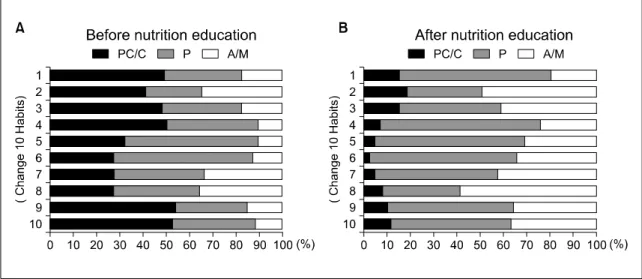
대상자들의 연구 전과 후 행동변화단계 결과는 Fig. 1과 같다. 연구 전 총 10개 중 6개 항목에서 고 려 전/고려 단계에 속한 대상자가 준비단계, 행동/유 지단계보다 높은 비율을 차지하였다. 연구 전 ‘5가 지 컬러푸드 섭취하기’, ‘6개 식품군 골고루 섭취하
Variables
1)Baseline 4 week 8 week 12 week P-value
1. 1 hour of exercise a day 3.6±3.1
2)a4.3±2.8
ab4.8±2.9
b5.0±2.5
b0.001**
2. Alcohol is consumed, up to 2 drinks per day for men (1 drink per day for women)
5.7±4.0
a6.9±3.6
b7.4±3.1
b7.2±3.4
b<0.001***
3. Eat 3 meals regularly, adequate amount 4.8±2.8
a5.6±2.7
b6.2±2.3
bc6.5±2.4
c<0.001***
4. Avoid food with sugar-sweetened beverage, snack, high sugar and salt contents
4.3±2.3
a5.2±2.3
b5.8±2.2
bc6.1±2.0
c<0.001***
5. Eat 5 color foods 5.0±2.0
a5.9±2.0
b6.4±2.0
b6.5±1.7
b<0.001***
6. Balanced intake of 6 food groups 5.4±1.9
a6.3±1.7
b6.4±1.7
b6.7±1.5
b<0.001***
7. Get at least 7 hours of sleep 6.0±2.7
a6.5±2.4
ab6.9±2.4
b7.0±2.2
b0.017*
8. Drink 8 glasses of water a day 6.2±2.9
a6.9±2.6
b7.3±2.3
b7.3±2.5
b<0.001***
9. Do not eat after 9 pm 4.9±2.7
a6.4±2.5
b6.1±2.4
b6.4±2.3
b<0.001***
10. Chew more than 10 times and eat slowly 3.9±2.4
a5.5±2.3
b5.6±2.3
b5.8±2.3
b<0.001***
1)
The average score of each items, 10-point Likert scale (10: Strongly practice degree, 1: Poor practice degree)
2)
Values are Mean±SD
Significantly different between the times by repeated measures ANOVA test at *P<0.05, **P<0.01 or ***P<0.001. Different letter subscripts indicate a significant difference among the groups by Bonferroni-adjusted post hoc test.
Table 4. Change of the scores of ‘Change 10 Habits’
Figure 1. Distribution of the stage of change in ‘Change 10 Habits’ before (A) and after (B) nutrition education. PC: Precontempla- tion, C: Contemplation, P: Preparation, A: Action, M: Maintenance.
기’, ‘하루 7시간 숙면 취하기’, ‘하루 8잔 물 마시 기’는 각각 57.5%, 59.8%, 39.1%, 36.8%로 준비단계 에 속한 대상자가 가장 많은 비율을 차지하였다.
‘술 마실 때, 하루 2잔 이하 마시기’는 연구 전 고려 전/고려 단계가 41.4%에서 연구 후 18.4%로 감소하 였고 행동/유지단계는 34.5%에서 49.4%로 증가하였 다. 연구 후 모든 항목에서 고려 전/고려 단계에 속 한 대상자의 비율이 가장 낮았고 준비단계, 행동/유
지단계로 변화하였다.
3. 행동실천점수 변화
대상자의 ‘Change 10 Habits’의 실천점수를 살펴 본 결과 Table 4와 같다. 연구 전과 후 ‘하루 1시간 운동하기’는 각각 3.6±3.1점, 5.0±2.5점으로 가장 낮 았고, ‘하루 8잔 물 마시기’가 6.2±2.9점, 7.3±2.5점으
로 가장 높았다. 모든 항목의 실천점수가 연구 전과 비교하여 연구가 진행됨에 따라 유의적으로 증가하 였다. 측정시점에 따른 변화는 ‘하루 3끼 식사 규칙 적으로 적정량 섭취하기’의 경우 0주, 12주가 각각 4.8±2.8점, 6.5±2.4점, 4주, 12주가 각각 5.6±2.7점, 6.5±2.4점으로 점수 변화가 유의적인 증가를 보였다.
‘4S 제한하기’ 항목에서는 0주, 12주가 각각 4.3±2.3점, 6.1±2.0점, 4주, 12주가 각각 5.2±2.3점, 6.1±2.0점으로 유의적인 점수 변화를 보였다. 나머지 항목은 0주와 12주의 점수 변화는 유의적인 변화를 보였으나, 4주, 8주, 12주간의 점수 변화는 유의적인 차이가 없었다.
고 찰
비만 관리를 위해서는 근본적으로 식습관과 생활 습관을 개선하고 신체활동을 증가시키는 행동수정 이 요구된다(Hollis 등 2008). 본 연구에서는 영양태 도 및 식행동을 확립하는데 실천적인 면이 중요하 다고 생각되어 비만과 관련성이 높게 나타난 빠른 식사속도, 짧은 식사시간, 간식과 야식 선호, 과잉 섭취, 식사의 불규칙성 등을 바탕으로 다각적인 요 법에 기반한 실천적인 내용으로 교육을 구성하였다.
또한 대상자의 행동을 변화시키기 위해 범이론적 모델의 행동변화단계를 적용하여 행동변화단계에 따른 단계별 영양교육을 실시하여 생활 속에서 건 강생활실천을 도모하고자 하였다.
‘Change 10 Habits’ 행동변화단계를 살펴보면 연구 전 6개 항목에서 고려 전/고려 단계에 속한 대상자 의 비율이 높았으나 연구 후 모든 항목에서 고려 전/고려 단계의 비율이 가장 낮아 ‘Change 10 Habits’
를 통해 유의적인 행동변화를 나타냈다. Kim 등 (2007)의 연구에서 비만 여성을 대상으로 12주간 영 양교육과 운동 중재를 실시하였고 영양교육의 효과 를 측정하기 위해 연구 전과 후 규칙적인 식생활, 식습관, 식행동 점수를 조사한 결과 유의한 차이가 없는 것으로 나타나 본 연구와는 다른 결과를 나타
냈다. Johnson 등(2006)의 연구에서는 개인의 행동단 계에 맞는 중재를 통해 식행동, 신체활동 증가, 지 방섭취 감소 항목의 행동변화가 행동/유지단계로 유 의적으로 증가하였다. Cox 등(2003)의 연구에서도 자신의 운동단계에 맞는 중재를 제공받은 집단에서 약 33%, 일반적인 중재를 받은 집단에서는 약 19%
가 규칙적인 신체활동을 하는 유지단계로 향상된 것으로 나타났다. 본 연구 또한 행동변화에 따라 단 계를 판정하고 그에 맞는 단계별 교육, 생활실천을 중심으로 교육한 것이 대상자들의 행동을 유의적으 로 변화시킨 것으로 사료된다.
대상자들의 ‘Change 10 Habits’ 실천점수를 보면 모든 항목에서 연구 시작 전과 비교하여 유의적으 로 증가하였다. Kim 등(2014)의 연구에서 체중관리 프로그램을 통한 식행동 변화를 살펴보면 하루 3끼 규칙적으로 식사, 천천히 섭취, 취침 전 음식 섭취 제한 등의 항목에서 유의적으로 식행동이 개선되어 본 연구 결과와 유사하게 나타났다. 본 연구에서 연 구 전 ‘하루 1시간 운동하기’ 실천점수가 가장 낮았 고 ‘8잔 물 마시기’ 실천점수가 가장 높았다. 실천점 수 변화의 측면에서 ‘하루 7시간 숙면 취하기’가 증 가율이 가장 적었지만 이는 이미 잘 실천되고 있었 기 때문인 것으로 생각된다. ‘음식 10번 이상 씹고 천천히 섭취하기’는 실천점수가 가장 크게 증가하였 으나 여전히 낮은 실천율을 보이므로 동기부여와 좀 더 적극적인 실천이 필요하겠다. ‘하루 1시간 운 동하기’는 10가지 항목 중 유일하게 5점 미만의 실천 점수를 나타내고 다른 항목들에 비해서 규칙적인 운 동을 실천하는 것이 어려운 것으로 사료된다. 미국 스포츠의학회(American College of Sports Medicine)에 서는 체중감량을 위해 생활패턴을 고려한 중등도 강 도의 신체활동을 주당 최소 150분(30분, 1주당 5일) 시행하도록 권고한다(Haskell 등 2007). 본 연구에서 는 대한비만학회(Korean Society for the Study of Obesity 2012) 권고에 근거한 최대시간 60분을 기준 으로 하였으나 30분으로 하면 실천도가 더 증가할 것으로 사료된다.
간단한 행동수칙을 중재도구로 사용한 선행연구 는 본 연구와는 달리 연구기간 동안 매번 다른 행 동수칙을 제시하였다. Chow 등(2012)은 식행동 및 신체활동 향상을 위해 매주 4번의 메시지 제공하여 긍정적인 변화를 이끌어내었다. Joo & Kim(2007)의 연구에서는 체중감소와 관련한 28가지 수칙 중 무 작위 선정을 하여 휴대폰 메시지로 제공하였을 때 체중감소에 효과가 있다고 보고하였다. 선행연구에 서는 행동변화를 평가하지 않아 근본적인 식행동 및 생활습관의 변화를 통한 효과인지를 명확하게 밝힐 수 없었다.
식행동 및 운동습관 등 생활습관의 행동변화를 통한 비만치료는 초기 체중감소율은 낮지만 장기간 체중감소 효과는 크다. 다른 치료방법과 비교하여 부작용이 거의 없고 중도 포기율이 낮으며 치료 과 정 및 치료 후 발생하는 요요현상을 방지하는데 효 과적으로 알려져 있다(Weyer 등 2001). Kausman 등 (2003)의 연구에서 과체중 성인을 대상으로 행동수 정요법을 시행한 결과, 연구 후 요요현상, 지속적인 체중증가를 보인 대상자는 4명, 체중유지, 지속적인 체중감소를 보인 대상자는 28명이었다. 하지만 본 연 구는 10가지 수칙 및 단계별 영양교육이 행동변화에 영향을 미치는지를 알아보았을 뿐 효과 평가를 하지 못하였다. 향후 선행연구와 동일한 효과를 나타내는 지에 대한 추가적인 연구가 필요할 것이다.
본 연구는 행동변화단계를 지난 6개월 기준의 변 화의도, 문제인식 여부가 아닌 대상자의 행동실천 점수와 전문 임상영양사와의 상담을 통해 판정하였 고 연구기간이 12주로 행동요법을 진행한 다른 연 구와 비교하였을 때 상대적으로 짧았다. 또한 대조 군을 설정하지 않아 영양교육의 효과 검증이 어렵 다는 제한점이 있다. 그러나 ‘Change 10 Habits’을 개 발 및 적용, 각 수칙마다 행동변화단계를 판정하여 단계별 영양교육 진행을 통해 선행연구들과 유사한 긍정적인 효과를 나타내었고 다른 연구에서 시도하 지 않은 중재방법을 사용한 점에서 의의가 있다.
요약 및 결론
본 연구는 ‘Change 10 Habits’을 개발하고 체질량 지수 25kg/m2 이상 30kg/m2 미만인 경도비만 성인 87명을 대상으로 행동변화단계에 맞는 영양교육을 12주간 실시하여 식행동 및 생활습관변화에 미치는 영향을 알아보고자 하였다.
1. 대상자의 평균 연령은 31.7세였고 성별 분포는 남 자 42.5%, 여자 57.5%였다. 흡연율은 18.4%로 금 연하는 대상자의 비율이 높았고 음주율 57.5%로 주 1회 정도 섭취하는 것으로 나타났다. 대상자 중 44.8%가 주 3회, 회당 30분 이상의 규칙적인 운동을 하고 있었다.
2. 비만과 상관성이 높은 빠른 식사속도, 간식과 야 식 선호, 과잉섭취, 짧은 수면시간 등을 바탕으로 식사요법 5문항, 운동요법 1문항, 행동요법 4문항 으로 구성된 ‘Change 10 Habits’을 개발하였다.
3. 본 연구 대상자의 연구 전후 행동변화단계를 비 교해 본 결과, 단계별 분포가 유의적으로 차이가 있었다. 연구 전 전체 10개 항목 중 고려 전/고려 단계의 비율이 가장 높았던 항목이 6개였으나 연 구 후에는 관찰되지 않았다. 연구 후 대상자의 변화단계가 준비단계, 행동/유지단계로 비율이 증 가한 것으로 나타나 행동이 긍정적으로 변화한 것을 알 수 있었다.
4. ‘Change 10 Habits’의 실천점수 결과를 살펴보면 모든 항목에서 연구가 진행되는 시간에 따라 유 의적으로 증가하였다. 이로써 행동변화가 ‘Change 10 Habits’을 실천하는데 긍정적인 영향을 미치는 것을 확인할 수 있었다.
본 연구에서는 경도비만 성인에서 실천 중심의 영양교육, 행동변화단계에 맞는 단계별 영양교육이 대상자의 식행동 및 생활습관 향상에 유의적인 효 과가 있음을 확인하였다. 본 연구를 통하여 비만 교 육 시 행동변화단계를 평가하고 각 개인의 단계에 따른 순응도를 고려한 영양교육의 중요성을 확인
할 수 있었다. 실천적인 측면을 강조한 ‘Change 10 Habits’ 이용하여 자발적인 건강생활실천 참여를 통 해 행동변화가 일어났고 장기적으로 진행하였을 경 우 긍정적인 생활습관을 확립시키고 나아가 체중감 소와 만성질환을 예방할 수 있을 것으로 기대된다.
REFERENCES
Andrade AM, Greene GW, Melanson KJ (2008): Eating slowly led to decreases in energy intake within meals in healthy women. J Am Diet Assoc 108(7):1186-1191
Arif AA, Rohrer JE (2005): Patterns of alcohol drinking and its association with obesity: data from the third national health and nutrition examination survey, 1988∼1994. BMC Public Health 2005;5:126
Boschmann M, Steiniger J, Hille U, Tank J, Adams F, Sharma AM, Klaus S, Luft FC, Jordan J (2003): Water-induced thermogenesis. J Clin Endocrinol Metab 88(12):6015-6019 Cardinal BJ, Sachs ML (1996): Effects of mail-mediated,
stage-matched exercise behavior change strategies on female adults' leisure-time exercise behavior. J Sports Med Phys Fitness 36(2):100-107
Choi MS (2009): Effects of nutrition education and exercise in- tervention on health and diet quality of middle-aged women.
Korean J Nutr 42(1):48-58
Choue RW, Hong YJ, Lee HW, Lee SL (1995): Effects of nu- trition education in weight management program. Korean J Obesity 4(1):23-32
Chow CK, Redfern J, Thiagalingam A, Jan S, Whittaker R, Hackett M, Graves N, Mooney J, Hillis GS (2012): Design and rationale of the tobacco, exercise and diet messages (TEXT ME) trial of a text message-based intervention for ongoing prevention of cardiovascular disease in people with coronary disease: a randomised controlled trial protocol.
BMJ Open 2(1):e000606
Clark M, Hampson S, Avery L, Simpson R (2004): Effects of a brief tailored intervention on the process and predictors of lifestyle behaviour change in patients with type 2 diabetes.
Psychol Health Med 9(4):440-449
Colditz GA, Giovannucci E, Rimm EB, Stampfer MJ, Rosner B, Speizer FE, Gordis E, Willett WC (1991): Alcohol intake
in relation to diet and obesity in women and men. Am J Clin Nutr 54(1):49-55
Cox KL, Burke V, Gorely TJ, Beilin LJ, Puddey IB (2003):
Controlled comparison of retention and adherence in home- vs center-initiated exercise interventions in women ages 40-65 years: The S.W.E.A.T. Study (sedentary women ex- ercise adherence trial). Prev Med 36(1):17-29
Dennis EA, Dengo AL, Comber DL, Flack KD, Savla J, Davy KP, Davy BM (2010): Water consumption increases weight loss during a hypocaloric diet intervention in middle-aged and older adults. Obesity (Silver Spring) 18(2):300-307 Epstein LH, Wing RR (1987): Behavioral treatment of child-
hood obesity. Psychol Bull 101(3):331-342
Fitzwater SL, Weinsier RL, Wooldridge NH, Birch R, Liu C, Bartolucci AA (1991): Evaluation of long-term weight changes after a multidisciplinary weight control program. J Am Diet Assoc 91(4):421-426, 429
Franklin VL, Waller A, Pagliari C, Greene SA (2006): A randomized controlled trial of Sweet Talk, a text-messaging system to support young people with diabetes. Diabet Med 23(12):1332-1338
Gangwisch JE, Malaspina D, Boden-Albala B, Heymsfield SB (2005): Inadequate sleep as a risk factor for obesity: analy- ses of the NHANES I. Sleep 28(10):1289-1296
Gluck ME, Venti CA, Salbe AD, Krakoff J (2008): Nighttime eating: commonly observed and related to weight gain in an inpatient food intake study. Am J Clin Nutr 88(4):900-905 Haskell WL, Lee IM, Pate RR, Powell KE, Blair SN, Franklin
BA, Macera CA, Heath GW, Thompson PD, Bauman A;
American college of sports medicine; American heart associ- ation (2007): Physical activity and public health: updated recommendation for adults from the American college of sports medicine and the American heart association.
Circulation 116(9):1081-1093
Hellström L, Rössner S, Hagström-Toft E, Reynisdottir S (1997): Lipolytic catecholamine resistance linked to alpha 2-adrenoceptor sensitivity--a metabolic predictor of weight loss in obese subjects. Int J Obes Relat Metab Disord 21(4):314-320
Hollis JF, Gullion CM, Stevens VJ, Brantley PJ, Appel LJ, Ard JD, Champagne CM, Dalcin A, Erlinger TP, Funk K, Laferriere D, Lin PH, Loria CM, Samuel-Hodge C, Vollmer WM, Svetkey LP; Weight loss maintenance trial research group (2008): Weight loss during the intensive intervention
phase of the weight-loss maintenance trial. Am J Prev Med 35(2):118-126
Johnson SS, Driskell MM, Johnson JL, Dyment SJ, Prochaska JO, Prochaska JM, Bourne L (2006): Transtheoretical model intervention for adherence to lipid-lowering drugs. Dis Manag 9(2):102-114
Joo NS, Kim BT (2007): Mobile phone short message service messaging for behaviour modification in a community-based weight control programme in Korea. J Telemed Telecare 13(8):416-420
Kausman R, Murphy M, O'Connor T, Schattner P (2003): Audit of a behaviour modification program for weight management.
Aust Fam Physician 32(1-2):89-91
Kim MS, Choi MS, Kim KN (2007): Effect of nutritional edu- cation and exercise intervention on reducing and maintaining weight in obese women. Korean J Community Nutr 12(1):
80-89
Kim SH, Yu OK, Byun MS, Cha YS, Park TS (2014): Effects of weight management program for middle aged women with metabolic syndrome risk factors. Korean J Obes 23(2):
106-115
Korean Society for the Study of Obesity (2012): Management of obesity 2012 recommendation. Korean Society for the Study of Obesity. Seoul. pp.43-86
Kwon HJ, Sun SO, Hur S (2012): The effects of combined ex- ercise program on health related fitness and risk factors re- lated to metabolic syndrome in severely obese women. J Korean Phys Educ Assoc Girls Women 26(2):1-13
Lean ME, Han TS, Deurenberg P (1996): Predicting body com- position by densitometry from simple anthropometric measurements. Am J Clin Nutr 63(1):4-14
Lee JS, Park JS, Lee GH, Ko YS, Kim EK (2008): Effect of body composition, serum lipid level and resting metabolic rate by nutritional education and exercise program in middle aged women. J Korean Diet Assoc 14(1):64-76
Lee SH, Chang N (2007): Effectiveness of nutrition education on dietary habits and diet quality in the weight loss and weight gain groups in college women. Korean J Nutr 40(5):
463-474
Malik VS, Schulze MB, Hu FB (2006): Intake of sug- ar-sweetened beverages and weight gain: a systematic review. Am J Clin Nutr 84(2):274-288
Ministry of Health & Welfare (2008): Dietary guidelines for Korean adults. Ministry of Health & Welfare. Seoul. pp.1
Ministry of Health & Welfare (2010): Eating habits guide for weight management. Ministry of Health & Welfare. Seoul.
pp.129-130
Ministry of Health & Welfare (2014): Korea health statistics 2013: Korea national health and nutrition examination sur- vey (KNHANES Ⅵ-1). Ministry of Health & Welfare.
Seoul. pp.50-51
National Health and Medical Research Council (2013):
Australian dietary guidelines. National Health and Medical Research Council. Australia. pp.61-63
National Institute on Alcohol Abuse and Alcoholism. Drinking levels defined. Available from: http://www.niaaa. nih.gov/al- cohol-health/overview-alcohol-consumption/moderate- binge-drinking. Accessed June 17, 2015
National Institutes of Health (1998): Clinical guidelines on the identification, evaluation, and treatment of overweight and obesity in adults. National Heart, Lung, and Blood Institute.
Bethesda. pp.11-14
National Sleep Foundation. How much sleep do we really need? Available from: http://sleepfoundation.org/how-sleep- works/how-much-sleep-do-we-really-need. Accessed June 17, 2015
Niskanen L, Uusitupa M, Sarlund H, Siitonen O, Paljärvi L, Laakso M (1996): The effects of weight loss on insulin sen- sitivity, skeletal muscle composition and capillary density in obese non-diabetic subjects. Int J Obes Relat Metab Disord 20(2):154-160
Patel SR, Ayas NT, Malhotra MR, White DP, Schernhammer ES, Speizer FE, Stampfer MJ, Hu FB (2004): A prospective study of sleep duration and mortality risk in women. Sleep 27(3):440-444
Pollard CM, Miller MR, Daly AM, Crouchley KE, O'Donoghue KJ, Lang AJ, Binns CW (2008): Increasing fruit and vegeta- ble consumption: success of the Western Australian Go for 2&5 campaign. Public Health Nutr 11(3):314-320
Rokholm B, Baker JL, Sørensen TI (2010): The levelling off of the obesity epidemic since the year 1999--a review of evi- dence and perspectives. Obes Rev 11(12):835-846 Rolls BJ, Ello-Martin JA, Tohill BC (2004): What can inter-
vention studies tell us about the relationship between fruit and vegetable consumption and weight management? Nutr Rev 62(1):1-17
Snyder LB (2007): Health communication campaigns and their impact on behavior. J Nutr Educ Behav 39(2 Suppl):S32-S40
Song SJ, Ahn HS, Khil JM (2013): Comparison of practice of dietary guidelines and health beliefs according to stage of weight loss behavior change among male workers. J Nutr Health 46(3):276-284
Stunkard AJ (1987): Conservative treatments for obesity. Am J Clin Nutr 45(5):1142-1154
The Korean Nutrition Society (2010): Dietary reference intakes for Koreans. The Korean Nutrition Society. Seoul. pp.1-9 United States Department of Agriculture (2010): Dietary guidelines
for Americans. USDA. Washington, DC. pp.1-54
Weyer C, Funahashi T, Tanaka S, Hotta K, Matsuzawa Y,
Pratley RE, Tataranni PA (2001): Hypoadiponectinemia in obesity and type 2 diabetes: close association with insulin resistance and hyperinsulinemia. J Clin Endocrinol Metab 86(5):1930-1935
World Health Organization (2011): Global status report on non- communicable diseases 2010. World Health Organization.
Geneva. pp.1-138
World Health Organization (2015): Guideline: sugars intake for adults and children. World Health Organization. Geneva.
pp.1-59